
Leaderboard


Popular Content
Showing content with the highest reputation on 04/04/2026 in all areas
-
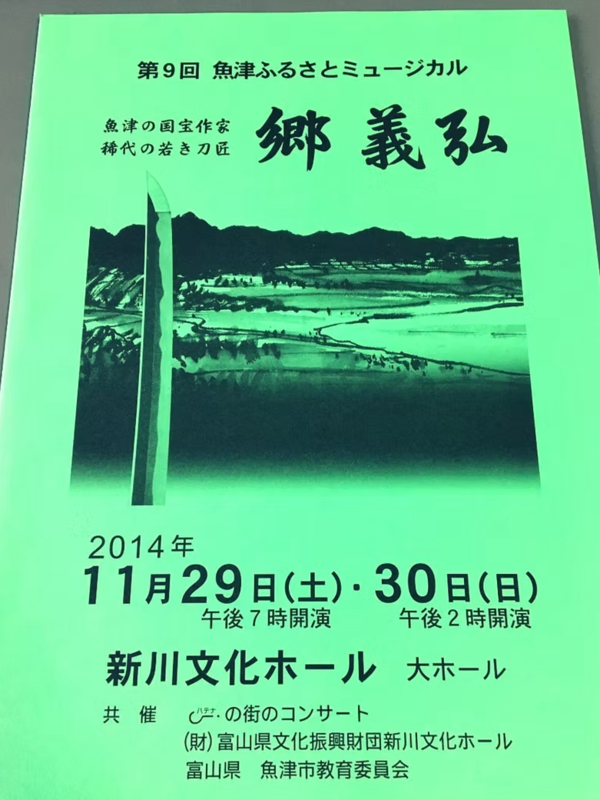
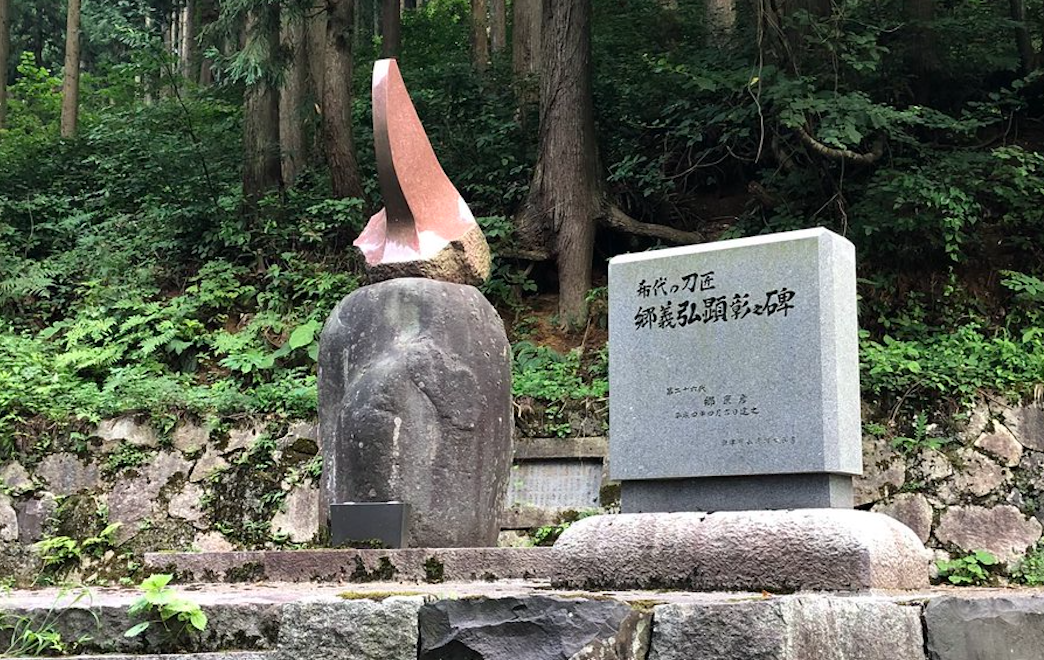
Have been digging a little deeper into Gō Yoshihiro blades recently - hoping to share more soon but in the mean time I found a really interesting article written in 2020 by Kurobe City that puts some flesh onto this mysterious, legendary sword smith. In the article they share some pretty incredible stories, myths and legends and even some stories and pictures from his descendants the Gō family. Yes, turns out the origin of the name Gō apparently comes from his surname Gō(郷) and it was not Gō(江) which is now used for his swords and that is only one of the amazing and super interesting tit-bits found in this article. I hope you enjoy reading this as much as I did. After reading it, it kind of reminded me a little of that line from Braveheart, where it is said William Wallace shot lightning bolts from his arse - that is, like all good stories there is a sense of blurring the lines between myth, legend and reality but with so little available on this enigmatic man and because we all love hearing a good story I am so grateful that these oral traditions have been collated and shared. As they say, there is always a little truth in the rumour. Enjoy. Gō Yoshihiro - The Master Swordsmith who created famous swords in Matsukura-Gō, Niigawa-gun, Etchū By Kurobe City (May 13, 2020) Gō Yoshihiro The Three Great Works Many mysteries surround the life of Gō Yoshihiro, one of the "Three Great Swordsmiths of Japan." He was a samurai who lived during the Kamakura period, estimated to have been born in 1298 (Einin 6) and died in 1325 (Shōchū 2). In his short life, he made a name for himself as a sword smith and left behind many excellent works. Although Yoshihiro's swords do not bear his signature, their high quality makes them unmistakable, and they were favoured by Sengoku warlords, including Toyotomi Hideyoshi. In the Edo period's "Kyoho Meibutsucho" a catalogue of famous swordsmiths), he is counted among the greatest three sword smiths of all time (the "The Nihon San Saku"), and his reputation remains unshaken to this day. The "Three Great Swordsmiths of Japan" refers to three sword smiths: Awataguchi Yoshimitsu (1229-1291), Gōrō Nyūdō Masamune (1264-1343), and Gō Yoshihiro. While Masamune and Yoshimitsu were professional swordsmiths, Yoshihiro was a samurai. For Yoshihiro, sword smithing was a hobby, and he died at the age of 27 (by traditional Japanese reckoning), so his time as a sword smith was extremely short. However, through his innate talent and extraordinary effort, he produced masterpieces of divine beauty. The Nihon San Saku Scroll with Gō Yoshihiro (top left), Masamune (middle right) and Yoshimitsu (bottom right). Loyalist and anti-shogunate patriot Gō Yoshihiro, was said to be a loyalist and anti-shogunate activist, who lived in Matsukura-go, Niikawa-gun, Etchū Province (present-day Uozu City). Some documents suggest he was the Lord of Matsukura Castle, but the details are unclear. At the end of the Kamakura period, when public order was in disarray and the shogunate was losing its ability to govern, Yoshihiro was a samurai under Inoue Toshikiyo, the deputy Gōvernor of Etchū Province, and there is a theory that he secretly harboured loyalist and anti-shogunate aspirations together with Toshikiyo and was acting in secret. Gō Yoshihiro, a samurai who became a nationally renowned swordsmith at a young age, went to Kamakura at the age of 21 and became an apprentice to Masamune. There, he honed his sword-making skills while also gathering intelligence on the shogunate's activities. However, the shogunate learned of Emperor Go-Daigo's plot to overthrow the shogunate, and the emperor's close associates were exiled or placed under house arrest (Shōchū Incident, 1324), and pursuers were sent throughout the country. It remains a mystery whether Gō Yoshihiro, who had returned to Matsukura in Etchū Province, committed suicide to avoid implicating his Lord Toshikiyo and Masamune, or whether he was captured and executed as a samurai close to the imperial court. What we do know is the remaining Gō family fled Matsukura with their family temple and moved to what is now Kurobe City, where they became ordinary blacksmiths. This is a hanging scroll depicting Fudo Myoo (Acala), has been passed down through the Gō family. Family tradition says it once hung in Gō Yoshihiro’s forge. The Legend of Inamuragasaki After the death of Gō Yoshihiro, Emperor Go-Daigo regained power in various regions, and in 1333 (Genko 3), Nitta Yoshisada finally attacked Kamakura. However, Kamakura was a natural stronghold, surrounded by mountains on three sides and protected by the sea in front. Unable to make progress, Yoshisada advanced to Inamuragasaki to try to attack from the sea, but his path was blocked by sheer cliffs, and furthermore, enemy ships were waiting offshore, firing arrows, so he could not break through. In the Taiheiki, it is said that at this time Yoshisada prayed to the dragon god and threw his golden-mounted sword into the sea, and the tide went out, moving the ships far away and removing the threat of arrows, so he was able to easily cross the coastline and attack, and brilliantly defeated the shogunate army. It is suggested the sword that was thrown into the sea in this episode of the attack on Kamakura may have been a sword presented by Gō Yoshihiro to Yoshisada. It is believed that Gō Yoshihiro was well-versed in astronomy and knowledgeable about the ebb and flow of tides. The story is told that he informed Nitta Yoshisada of the timing of low tide when he sent him the sword, and Yoshisada used that information 8 years later to launch his attack... if this is true, then Gō Yoshihiro was indeed a brilliant strategist! Inamuragasaki cliffs A rare sword The highly sought-after and nationally treasured sword "Inaba-Gō" is considered the finest masterpiece among Gō Yoshihiro's works. "Tomita-Gō" is considered its equal, and is also designated a national treasure. Gō "江" refers to Gō"郷", and five other swords by him—"Kuwana-Gō," "Matsui-Gō," "Murakumo-Gō," "Buzen-Gō," and "Samidare-Gō"—are designated as important cultural properties. His early works show influences from older schools such as the Yamato-den (Nara) and Yamashiro-den (Kyoto), but after studying under Masamune, he based his style on the Soshu-den (Kamakura), resulting in a refined, bright, and brilliantly beautiful style. Yoshihiro's aesthetic sense is also reflected in the blade patterns, some of which depict the landscape of the Tateyama mountain range. Because Yoshihiro's swords were favoured by warlords during the Sengoku period, most of them were treasured possessions and never seen by the public. As they were moved from place to place, many were destroyed by fire or lost. "Kurikara-Gō," said to be the beloved sword of Akechi Mitsuhide, is one of those that went missing during the turbulent times. The more we learn about the many legends surrounding him, the more we regret that Yoshihiro did not live longer. Gō Yoshihiro's swords bear no inscriptions. There are various theories as to why, including: "He was not a blacksmith who made swords for sale, but a samurai (or nobleman)"; "He often presented the swords he made as gifts, and he hesitated to assert his own identity by inscribing his name to the recipient (a person of high rank)"; and "He had absolute confidence in the swords he made, and believed that anyone who knew would be convinced that they were Gō Yoshihiro's works." We can only imagine Gō Yoshihiro's character from the works he left behind and fragmented anecdotes. Kokuho: Inaba Gō National Treasure author turned into musical In 2014, a musical featuring this great sword smith as the protagonist was performed in Uozu. Toshiro Kitahara (representative of Hatena no Machi Concert), who was in charge of production, faced a lack of materials and various difficulties, and at one point almost gave up on making the work. However, he persevered with his research, completed everything from the script to the direction from scratch, and successfully staged the performance. Flyer for the Gō Yoshihiro Musical in 2014 Memorial monument The monument to Gō Yoshihiro stands near the main keep of Matsukura Castle. It was erected to honour the 26th generation descendent of Yoshihiro who died in the line of duty in 1985 who wished such a monument erected - a wish that was fulfilled by his mother Gō Toki and the City of Uozu. It is the last known monument to be erected for one of Masamune's Ten Disciples (Masamune Jittetsu). A monument modelled after a Japanese sword anvil was also built next to it. Not many people know that Etchū Province was once a centre for sword production or that sword smith Gō Yoshihiro existed, but recently, games that personify swords have ignited a Japanese sword boom, and attention to Gō Yoshihiro has been increasing. Gō Yoshihiro only lived in his hometown Matsukura for a few years after returning from Kamakura. Although there is very little evidence of interaction with the local community and no detailed records or historical documents, it is certain that Matsukura-go in Niikawa-gun is the place where many famous swords, including his national treasures, were created. Even after 700 years, his extraordinary talent and story continues to fascinate people. Monument to Gō Yoshihiro erected by his descendants and Uozo City at Matsukura Castle in Niigawa-gun, Uozu We would like to thank Toshiro Kitahara, who is the concert representative of Hatena Town and produced the Uozu hometown musical "Gō Yoshihiro" for sharing so much information about Gō Yoshihiro. [References] Toyama Prefecture Shimoshinkawa District Office, “Shimoshinigawa County History, Vol. 2” (1908) Toyama Prefecture Youth Activities Practical Council, “People Shining in the Local Area, Vol. 1” (1962) Uozu City History Compilation Committee, “Uozu City History, Vol. 1” (1962) Nobuaki Tamagawa, “Toyama Photography Portraits” (1975) Junji Okuda and Hiroshi Yonehara, “Etchū People (Toyama Bunko 11)” (1976) Toyama Shimbun, “Etchu Hyakuke, Volume 2” (1981) Koji Nojima, “Shinkawa Monogatari” (1987) Monthly Uozu Doujinsha “Legend Uozu” (1988) Toyama Social Studies Education Research Group, “The People Who Built Toyama Prefecture” (1985) Matsukura Promotion Association, “Jusan no Sato (No. 13) Special Feature on Yoshihiro Gō” (1993) Junji Okuda, “Illustrated History of Uozu, Kurobe, and Shimoshinkawa” (2000) Hometown Development Research Institute, “Kaleidoscope No. 218 Swordsmith” Yoshihiro Gō” (2010) Toyama Prefectural Board of Education “Stories of People from Hometown and Yama” (2011) Hatena Town Concert “9th Uozu Hometown Musical Yoshihiro Gō” (2014) The original Japanese version of this article can be found on the Korobe City website here.


 8 points
 -
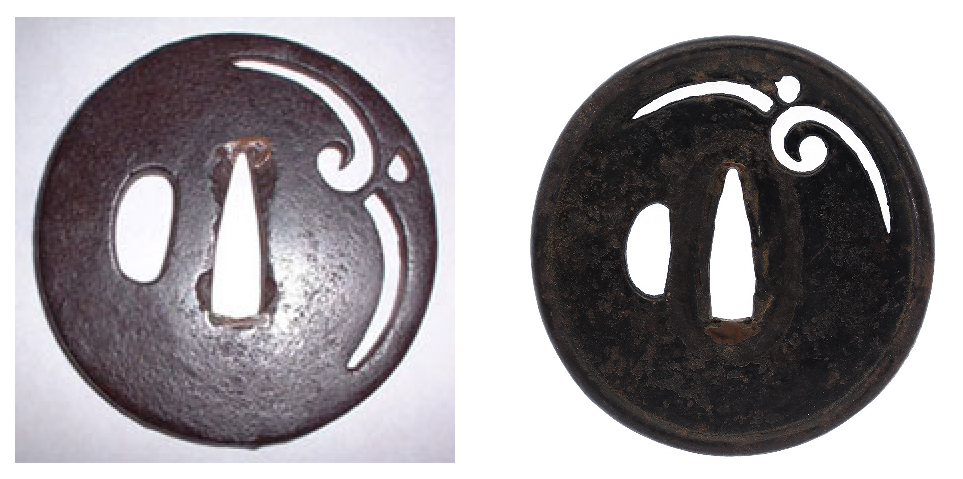
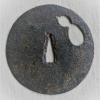
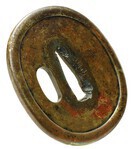
Perhaps it might be a generalization but I think tanto sized tsuba are underrated - they require as much [or even more] work to construct, but most collectors tend to concentrate on larger guards. Bigger is not necessarily better. Maybe we need a magnifying lens mounted over these little fellows to give them the credit they deserve?5 points
-
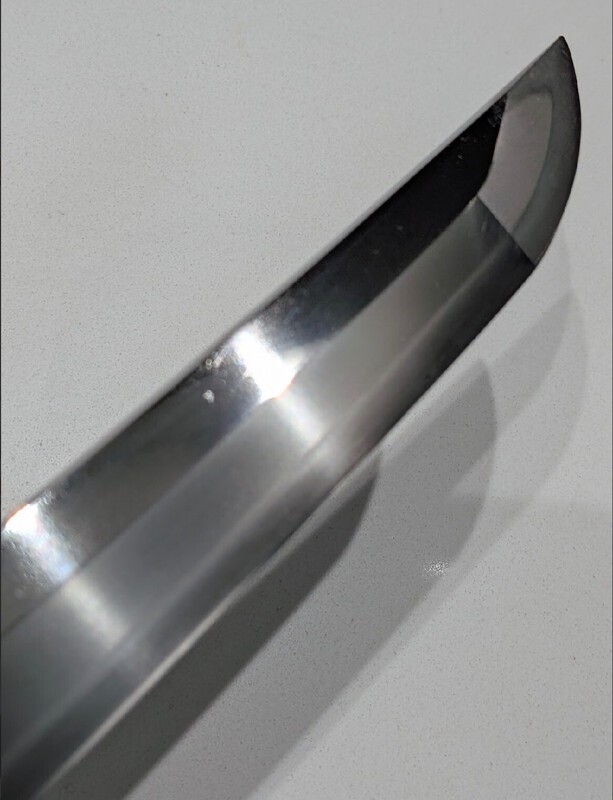
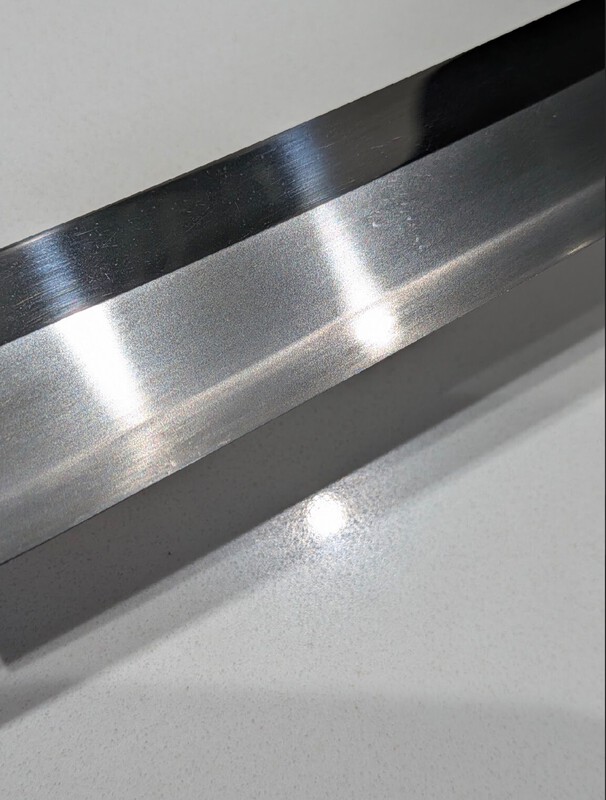
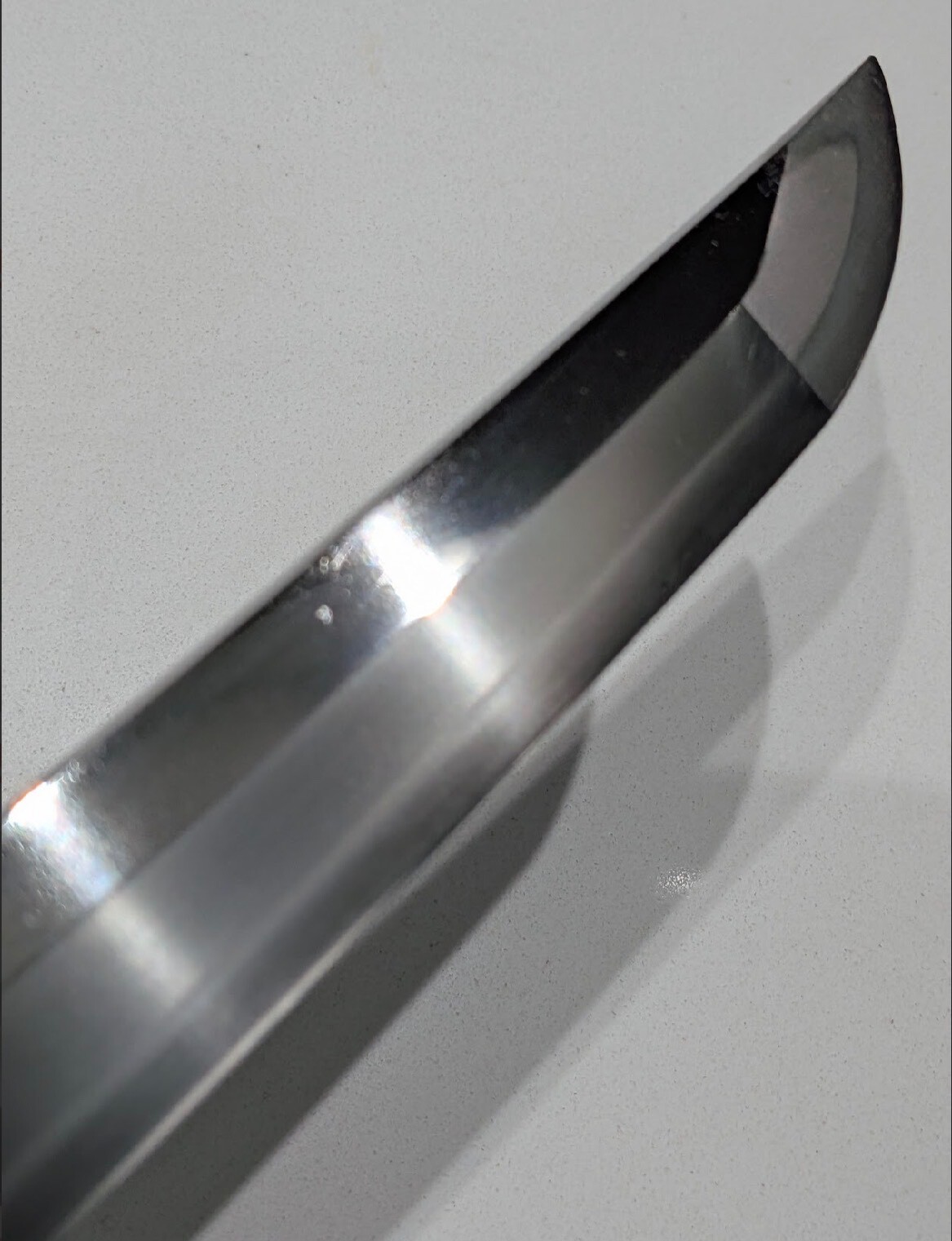
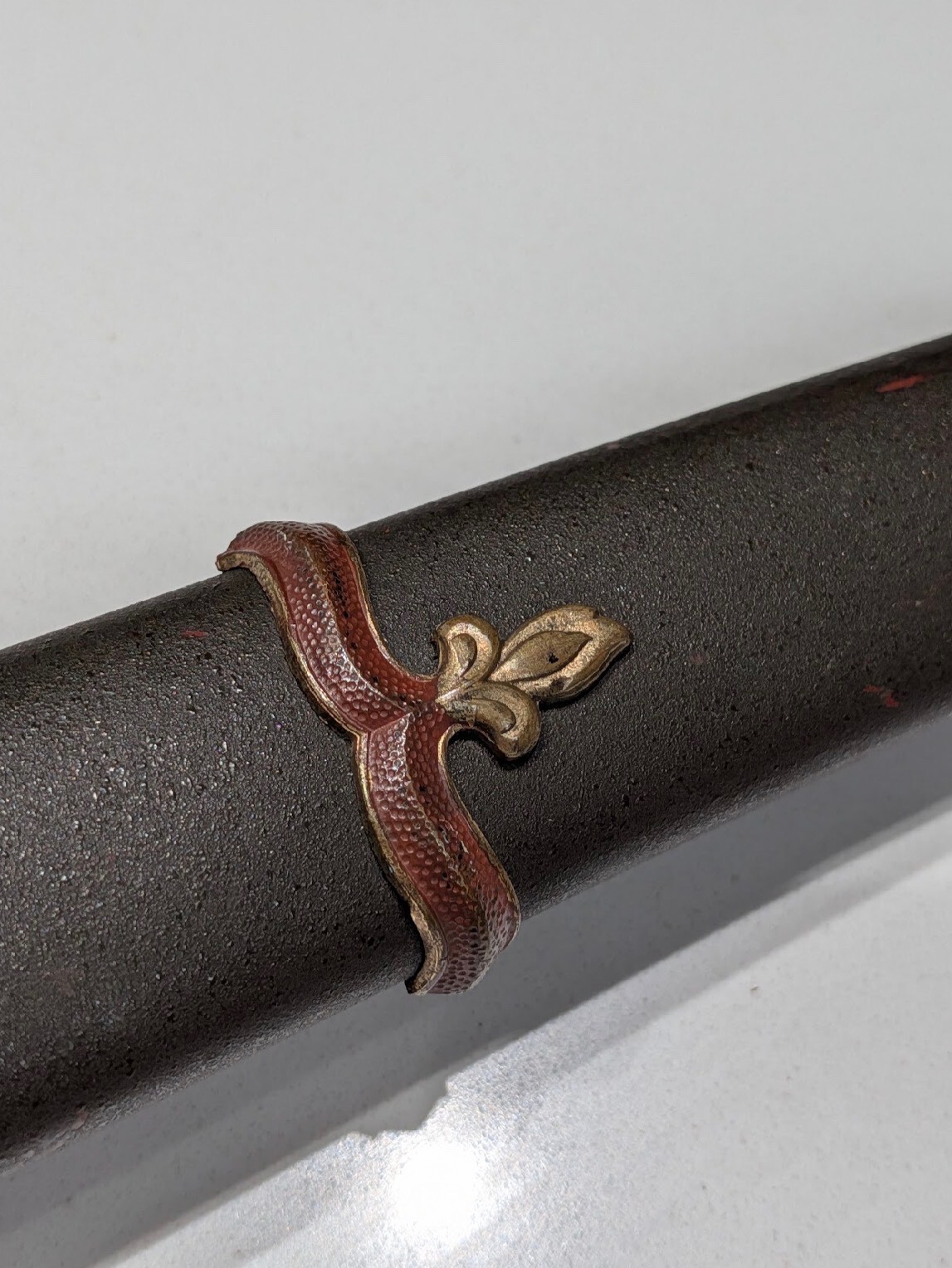
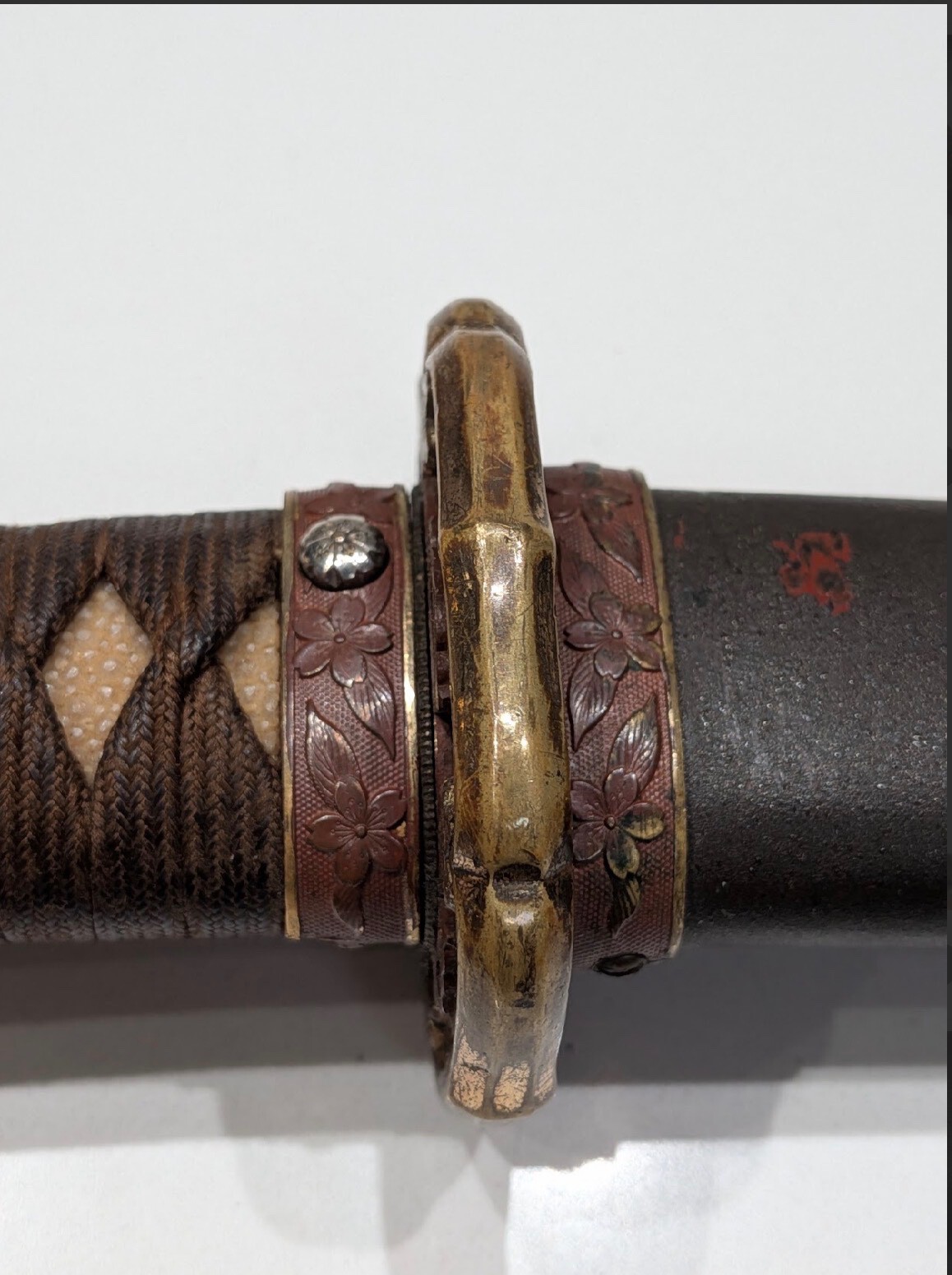
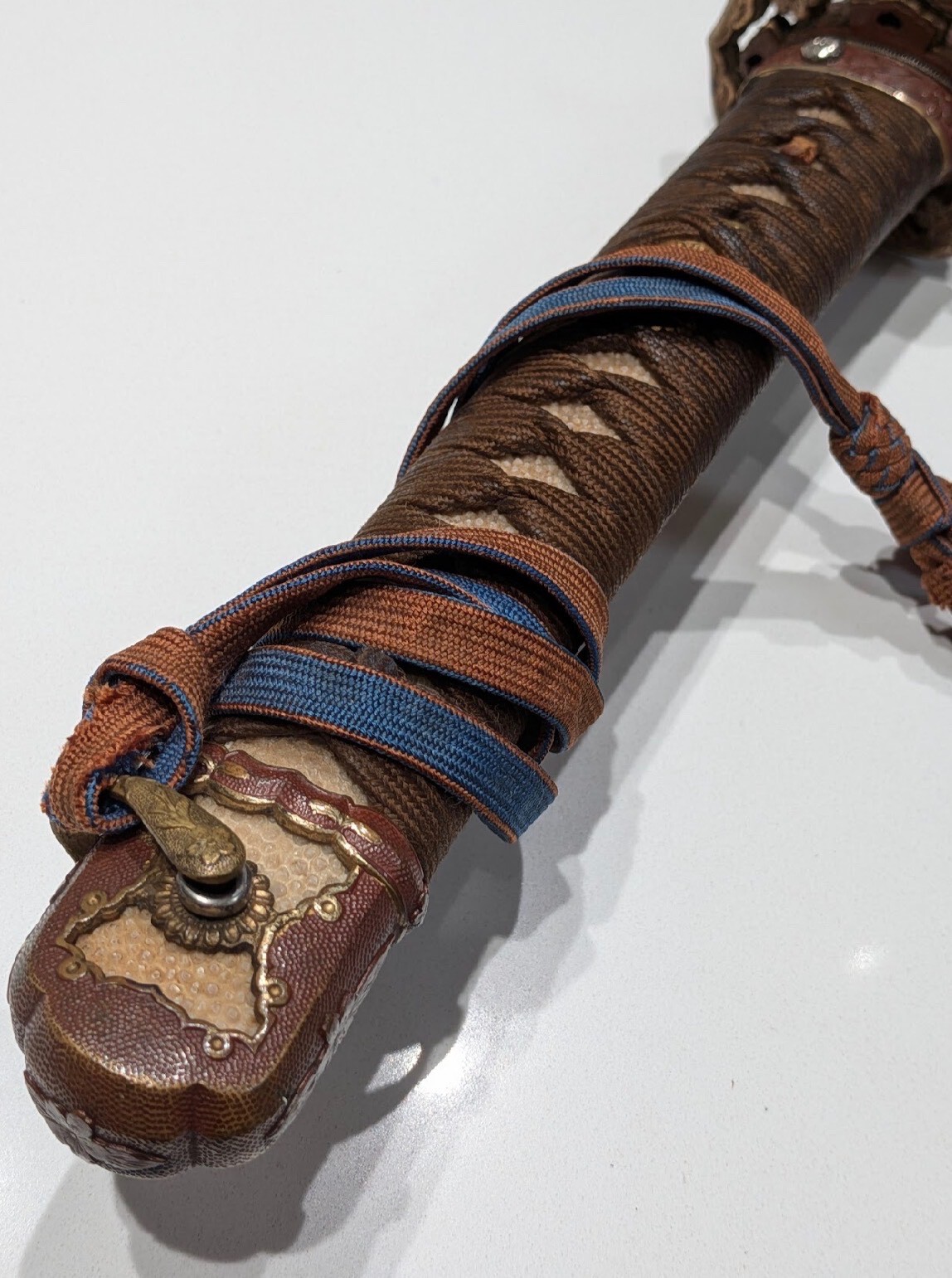
I just received my Mantetsu Spring 1940. Photos are from seller, Ray Singer.
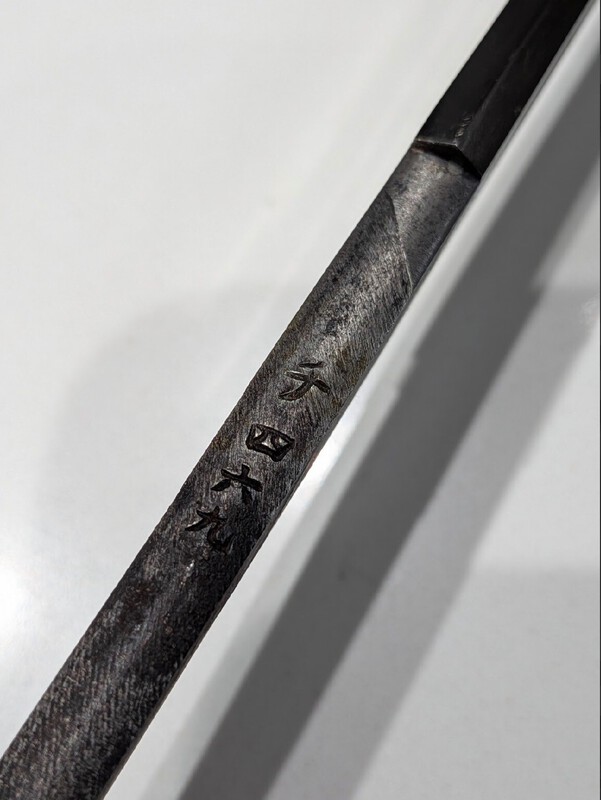
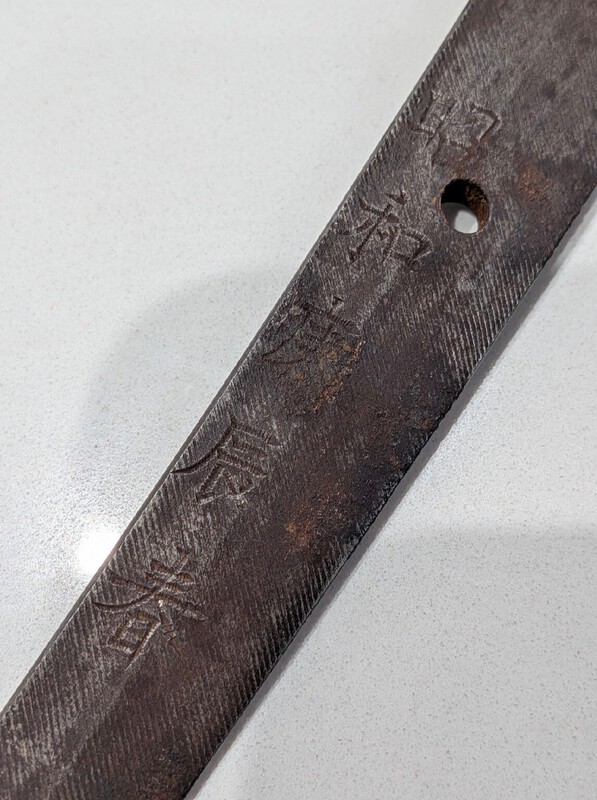

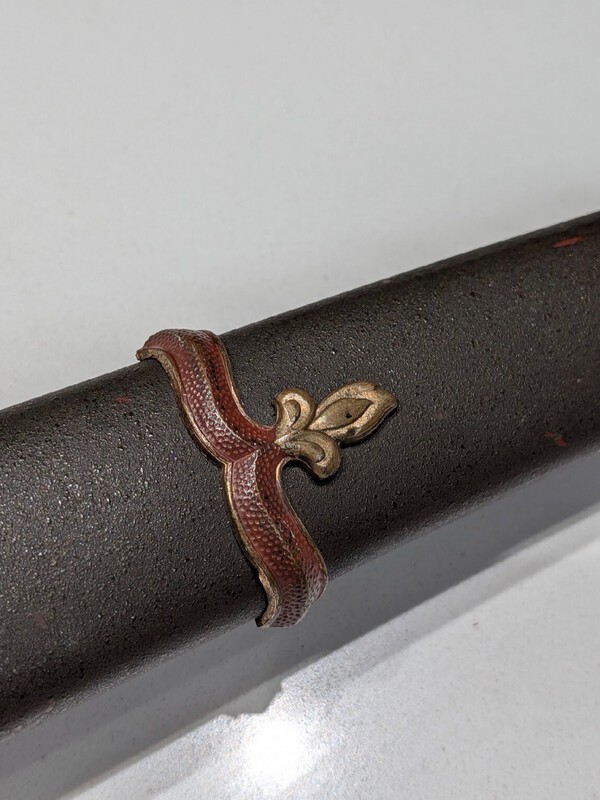
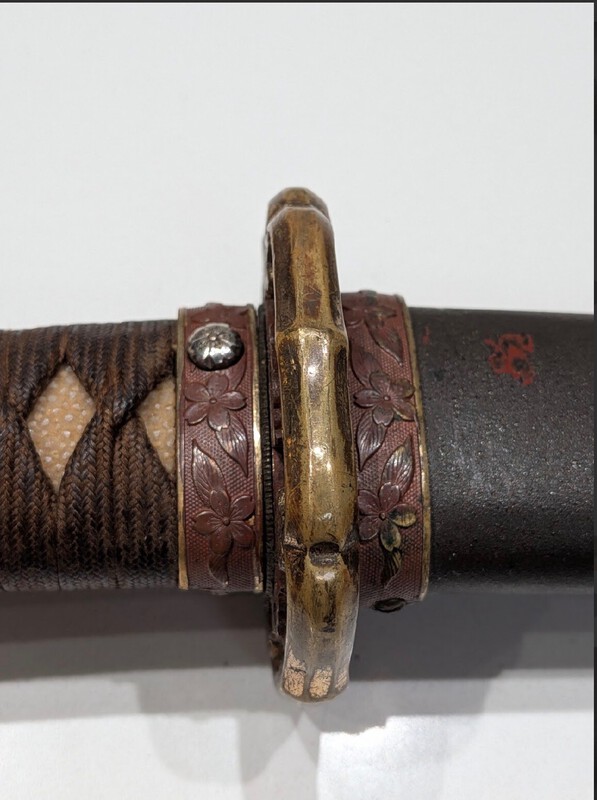
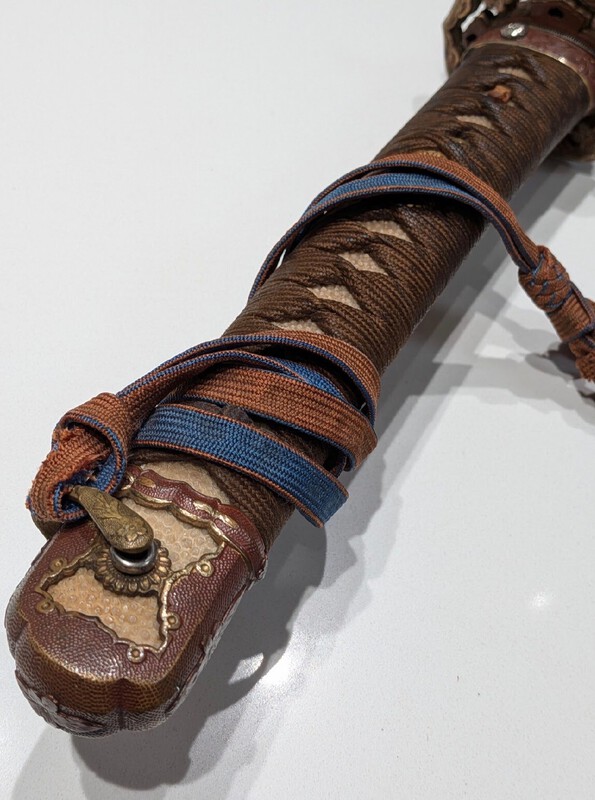
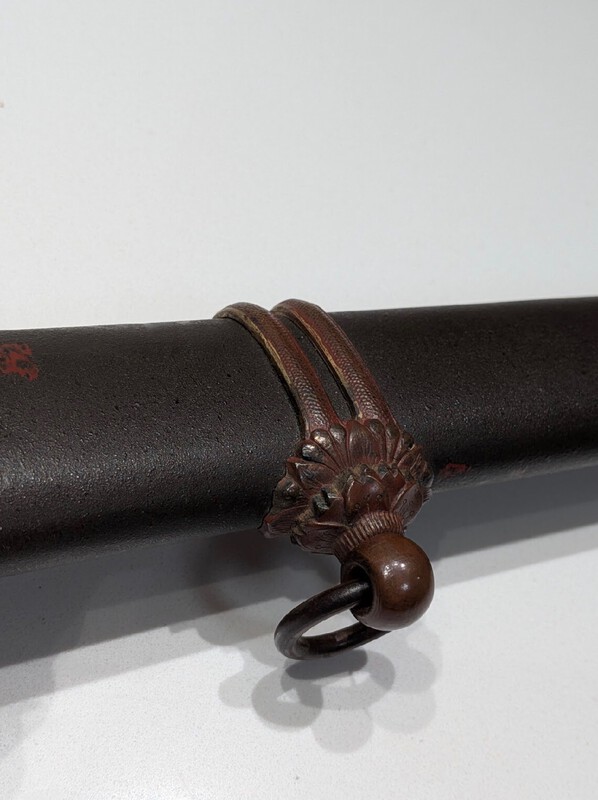 4 points
 -
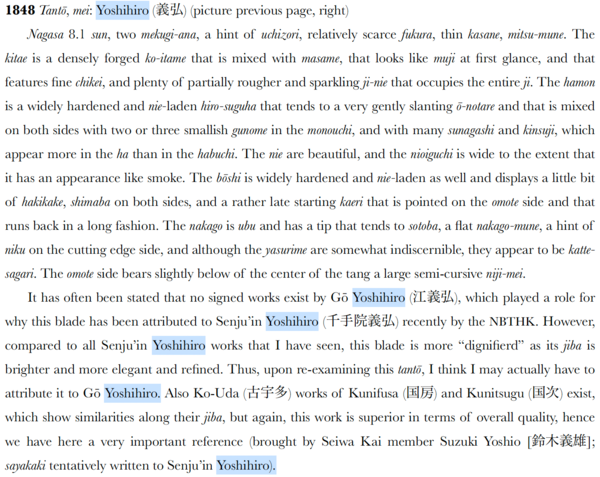
Kunzan believed this to be a signed Go tanto. Although attributed by the NBTHK in mid 70's to Senjuin Yoshihiro, the quality of the jiba exceeds that of the SY blades he had examined. An important reference work.
 4 points
 -
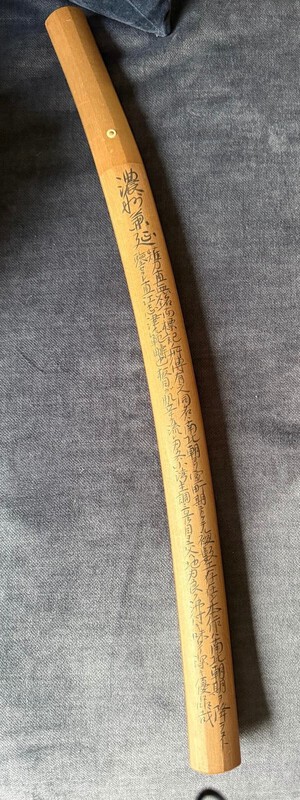
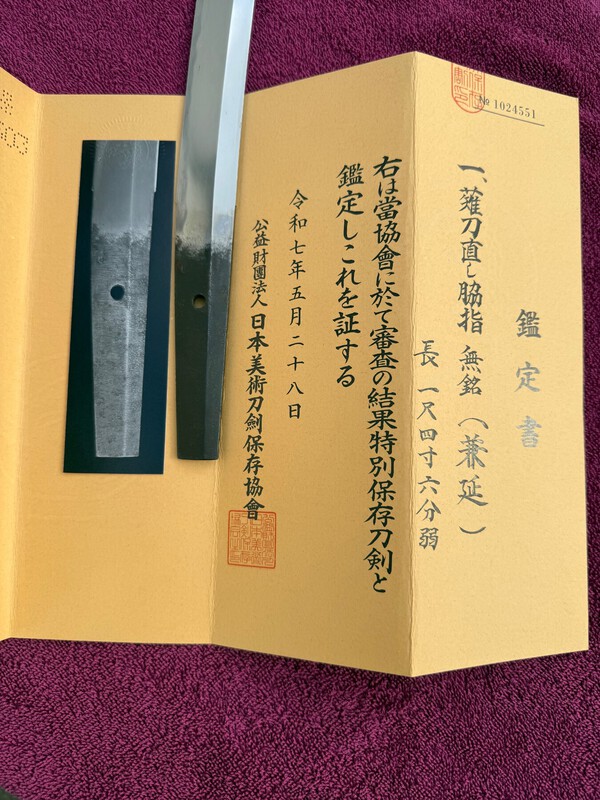
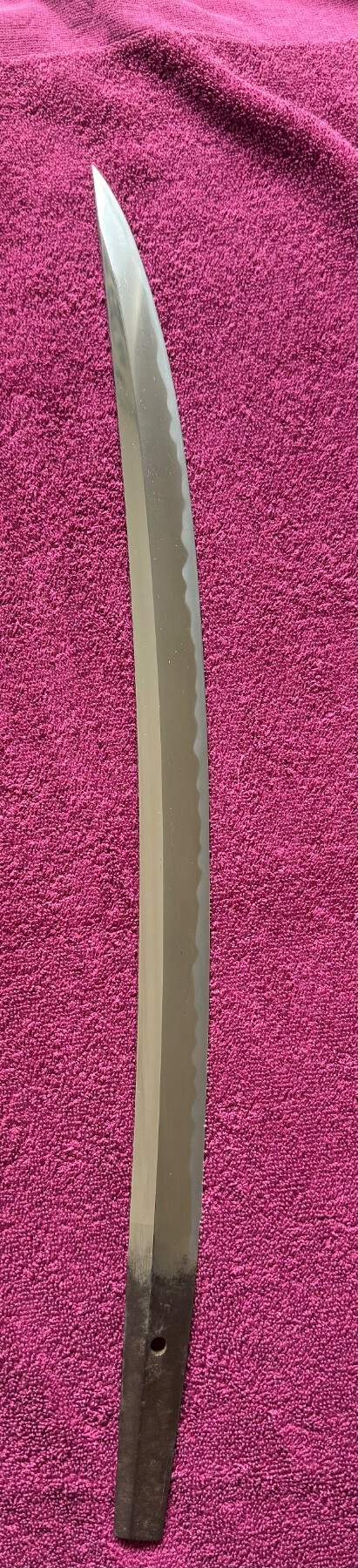
Since I will be selling a large part of my collection, here is the first piece. This Naginatanaoshi-zukuri/shaped wakizashi is mumei, but has been attributed to "Kanenobu belonged to the Naoe-Shiz I school. The hamon of this wakizashi shows gunome-midare consists of similar to Yahazu-ha and sunagashi which can be said to be "Den-Naoe Shizu," demonstrating the characteristics of Naoe Shizu. There are signs of repairs that appear to be umegane, but the work more than makes up for this. Tokubetsu Hozon sayagakı by Tanobe san. Length. 44.3cm Sori. 0.9cm Motohaba. 2.9cm Munekasane. 0.3 cm Shinogikasane. 0.7cm 3300€ +PP +shipping many pictures in the link https://drive.google.com/drive/folders/1quHMHSl_W1t5hfjPdAb50gYNybmHZGY7 Currently, DHL is not shipping from Germany to the USA (thanks, Trump). The shipping value must not exceed €100.


 3 points
 -
Described as geese (karigane). Regards Luca
 3 points
 -
3 points
-
Mauro: I agree with filing a case with the postal inspector and the local LAPD. The theft is both grand theft and a federal crime. LAPD investigators and postal inspectors should be able to interview employees, which at least will make the culprit nervous. Maybe the swords just "shows up." John C.3 points
-
Yes those are great, thank you! If you’d like to read some more on these. Here’s a great couple links: http://ohmura-study.net/794.html http://ohmura-study.net/957.html Additionally here on the NMB in the download section, I have written a document about the variations and evolution of the Type 95 military sword. Best of luck, and happy to help. -Sam3 points
-
Tassel is in best version.2 points
-
It's a beauty, Justin! What a great sword to own.2 points
-
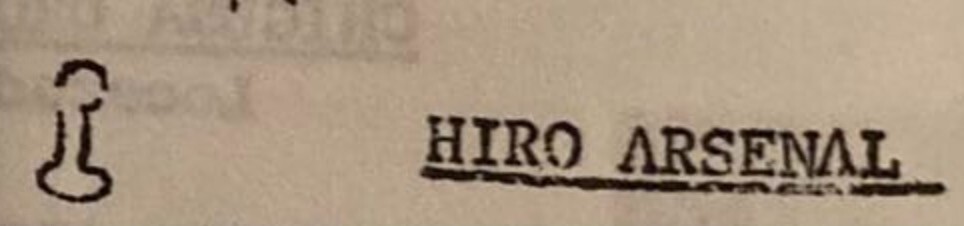
Hiro arsenal's mark is kind of like gourd.


 2 points
 -
Over the years I have seen both with paperwork here, suggesting that there was a strong demand. Often the Japanese version came with a shorter butt.2 points
-
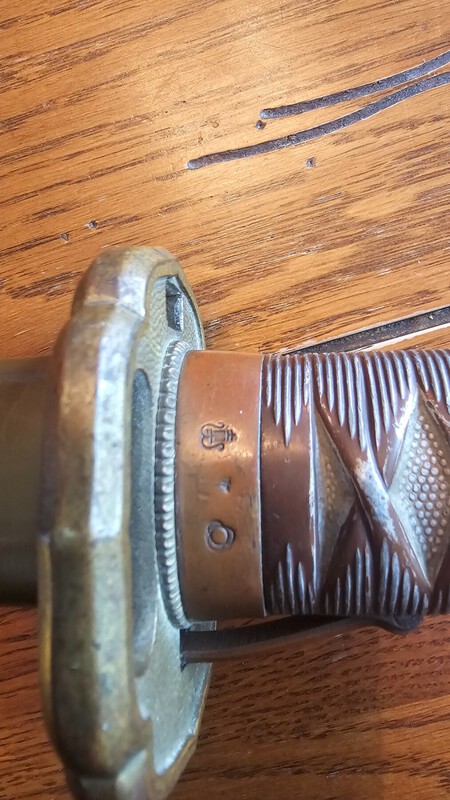
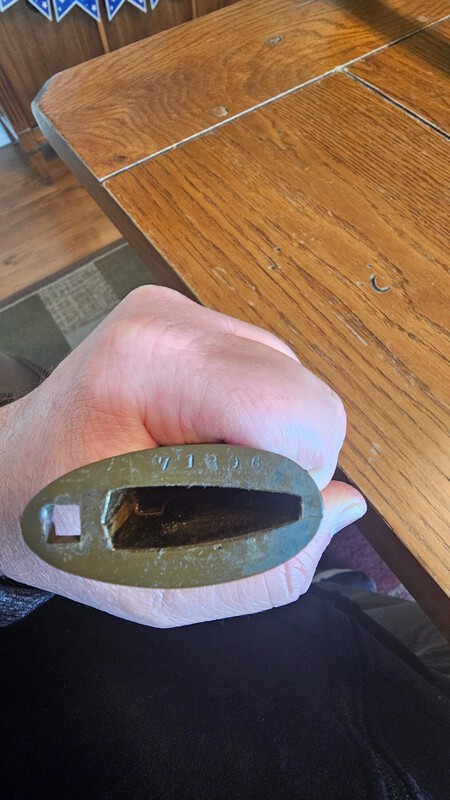
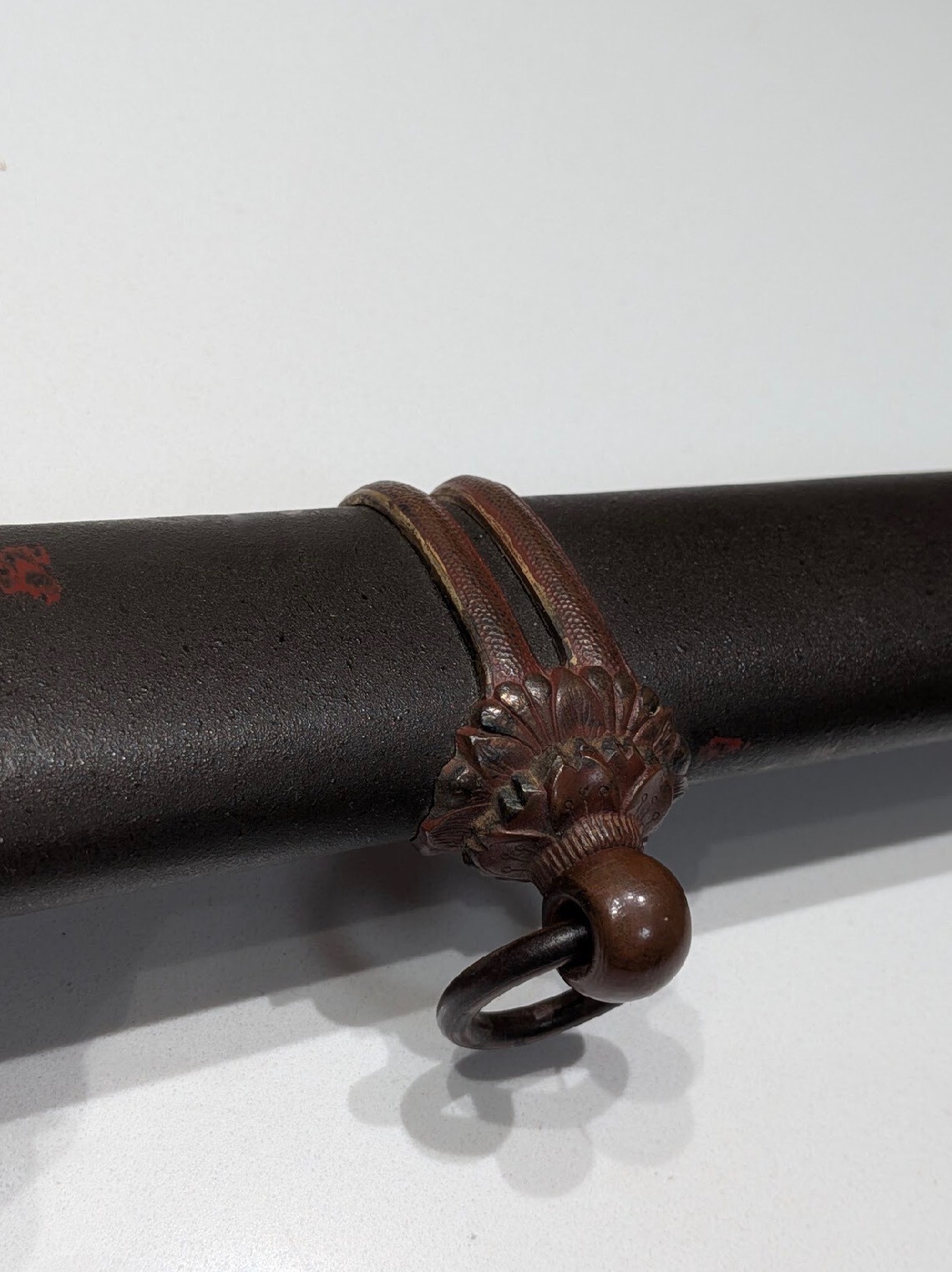
Hello Adam, welcome to the forum. What you have is an authentic Japanese Type 95 Military Sword. Sometimes called a Type 95 Guntō, or Type 95 NCO sword. Yours has the stamps on the ferrule indicating it was made by Suya Shoten, inspected by Tokyo first army arsenal, and administered by Kokura Arsenal. The "東" stamp on the blade (also middle stamp on the ferrule) is for 東京第一陸軍造兵廠監督課 = Tōkyō 1st Army Arsenal Supervisory Section. According to my study and interpretation, your sword was made between April 1941 and March 1942. It looks to be in good condition, although the hanger piece at the end of the hilt (the sarute) is not factory original. It's very common for the sarute to be replaced or missing entirely, so this is not a big issue. It also looks like the scabbard number does not match the blade, this is also common, but it does hurt the value a bit from a collector standpoint. Are you able to get a close up shot of the flowers in the handle? Also the side openings of the tsuba? I like to catalog these swords, and am noting some fine details. Nice looking sword, and thank you for sharing. All the best, -Sam2 points
-
Of possible interest to some. Japanese Copy of a British M1855 Enfield Rifle2 points
-
Very rare original scroll painting from Yasukunishrine in its original wooden box,complletely untouched, original condition aged very nice This rare painting is nestled inside the wooden box within a Japanese newspaper dated 1938 overall I never saw a second one. signature traslation is: Yasukunishrine respectfully paint's Made at the department of Yasukuni shrine support department Price 395,00 Euro 35,00 shipping worldwide Germany shipping free


 1 point
 -
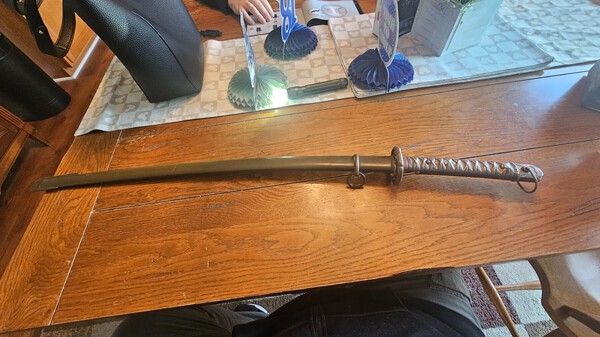
Hello. My son was given this sword today from his grandfather who is 78, it was his father's that was in the war. We don't know much about it. We are assuming it's a military version but im having a hard time finding some of the marks so we can figure out it's age, where it was made and any other info. Thank you for any help you can give us. Adam Franks


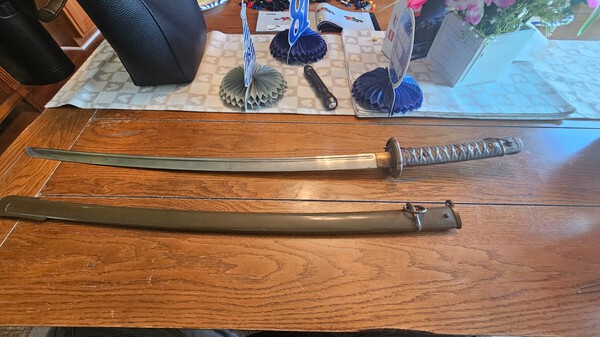
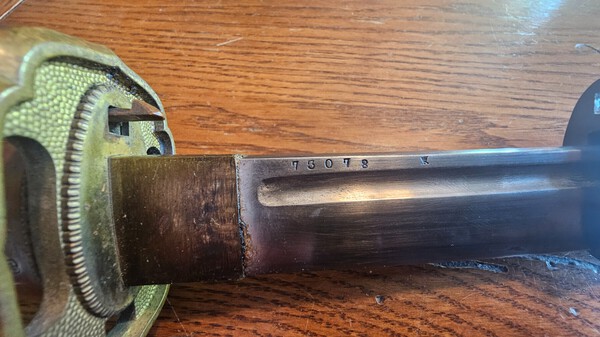

 1 point
 -
Ouch Charles but welcome anyway. Sri to be bringer of bad tidings but it's a nasty fake..very common and more recently made in China. You can consider it 'identified'. Copy of a Type 95 IJA NCO sword. Rob1 point
-
Kiril, I wouldn't say "arbitrary drawing," as it implies whimsy and serendipity. I think the attempt to recreate the hamon is more of artistic interpretation or impression, which can be arbitrary but I wouldn't say that Cezanne's still life's were arbitrary. That said no two artists will see and interpret the same subject in the same way, pretty much the same way no two people see all the activity in the same way.1 point
-
Awesome example in great looking fittings. I was drooling over that one, and other gunto on Mr. Singers Instagram recently Thank you for sharing, -Sam1 point
-
Colin, I found a TSUBA by him, and the MEI looks close:1 point
-
My curiosity is due to observing tsuba for sale and what appears to be a lower than expected price?, maybe that's a particular school or tsuba of a certain era or whatever. You see some tsuba with very good carving and a price that doesn't seem to match, anyone else notice?. May be many other reasons why someone thinks a certain type of tsuba is underrated. Interested to see what others think before i mention my ideas. Might give me more perspective as not really a serious tsuba collector. Over a period of time, one can build an opinion, though that opinion may be limited.1 point
-
A good example is a Bushu that Grey had on his site very briefly before it was snapped up. When I saw it, the first thing that came to mind was, that looks like like a lot of mind numbing finishing work to get the curves smoothed out so that iron can have the appearance of looking “soft”. Then the transition angles from the elements to the rim.
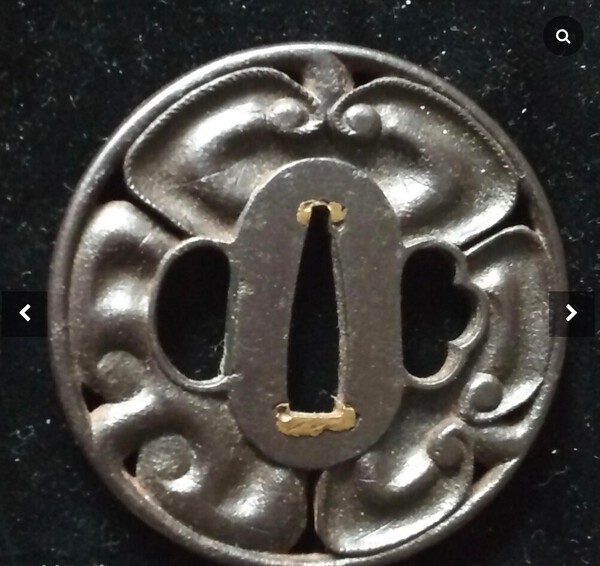 1 point
 -
Persistence pays off maybe……is it “Denryusai Yoshiyuki”? (from a aha mani school kozuka of Shoki)1 point
-
I understand your opinion, Calabrese. Many people cant appreciate tsuba such as Tosho or Katchushi and many other tsuba from the Muromachi thrown in for good measure. Over the years it feels like the same bunch of collectors own these type of tsuba at various times and they all travel in the same circles between them, me included. Right or wrongly, that's another opinion ive formed. They have to be appreciated in a different way and not everyone is on board with the notion.1 point
-
For me, it's the exact opposite. Plate tsuba like sukashi where there is only a piercing and little to no texture or dimensional geometry, have little visual appeal to me. As someone who has to engrave on a regular basis, but on a MUCH smaller scale, im amazed at the level of smooth curves and fine detail that was achieved with handmade tools.1 point
-
I’ve already been in touch with the presenter for the 1:00 PM session on Saturday, April 25, 2026. I’ll be bringing a fine set of large Ko-Kinkō menuki with NBTHK papers. While they feature an iconic dragon motif, the pair also showcases several contrasting stylistic elements and techniques when compared with contemporary Ko-Gotō examples.1 point
-
Agree Dale, it seems collectors tend to avoid or look past them. Shame really, as sometimes it gives people the opportunity to pick up good quality at a lower price. Snapped a few up over the years that seemed to have sat around in the sales section, didn't pay much and wont expect much when i eventually sell. One in particular, small copper Kiku tsuba that would look wonderful mounted on a tanto. Beautiful old dark patina, really like it. I guess beauty is often in the eye of the beholder. Also, i guess ones perspective changes as time moves on.1 point
-
So, this may sound stupid, but might it be possible to contact the embassy or another party, like the USPS itself to open up an investigation into the matter? The heist must've been rather recent. Wishing you the best of luck in any next courses of action. Best Regards, Zoglet1 point
-
Gorgeous work over there. Enjoy the piece! Especially interesting to see such a large kissaki on a Gassan piece. Don't come across that too often, at least in my experience. Have any photos of the ura side? Keep us posted! Zoglet1 point
-
it will most likely be licance issues, i had a wakizashi once take 6 months. they might send it back to the dealer and ask him to start the process over again or have the swords re-licanced. or your countries postal service might not accept edged weapons via air mail etc1 point
-
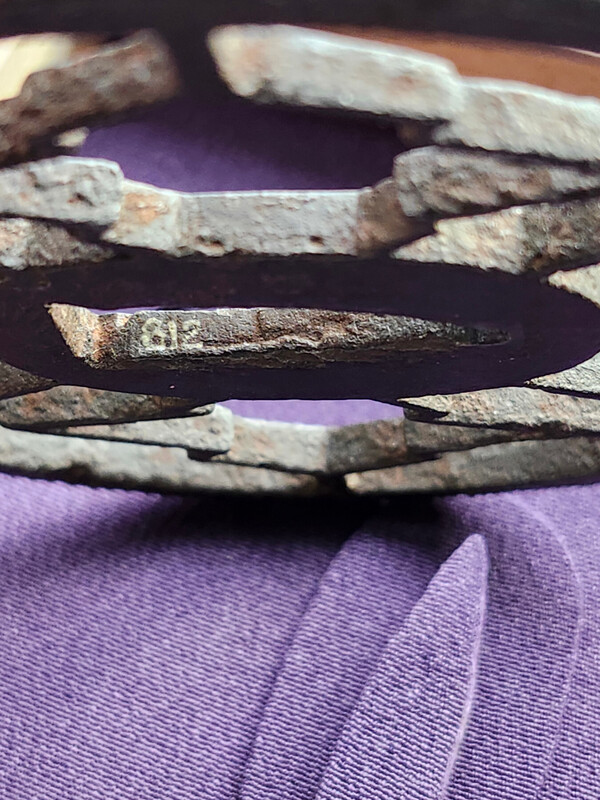
Posting a few more pics and will give it 8 to 24 hours more on NMB, before opening up to the masses on Facebook. The large ex-Denmark Museum Ko-Shoami . Circa 1450-1500. Acquisition number #812 inside the sukashi. Matsukawa design. We debated whether it was made for an O-dachi around the time of the Onin War. $1200 ask. Ask questions.

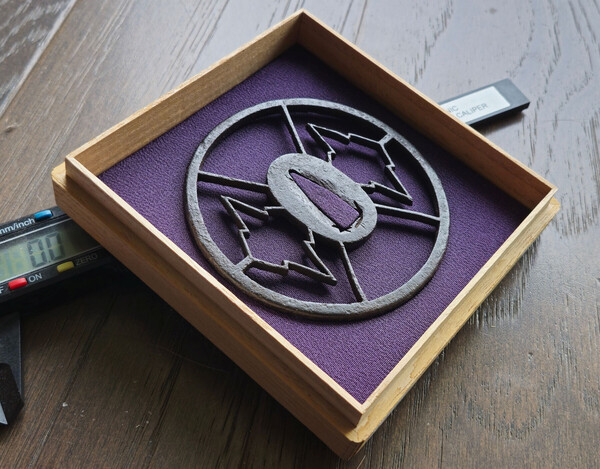


 1 point
 -
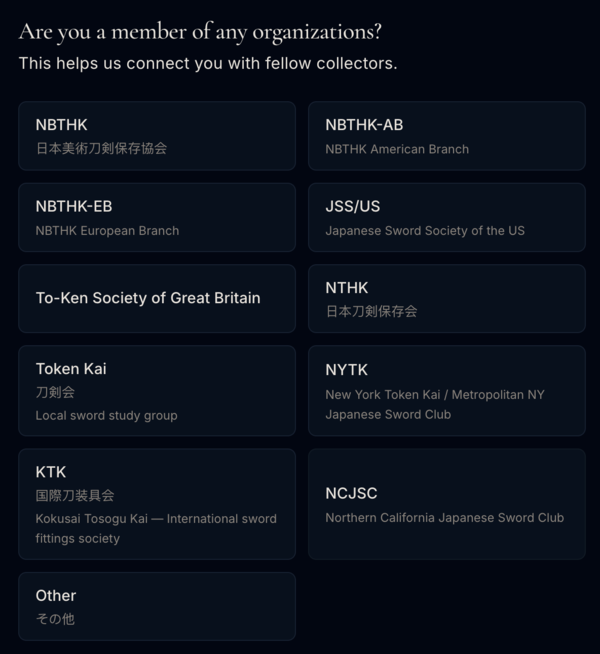
Sacramento Japanese Sword Club Nanka To-ken Kai (Southern California Japanese Sword Club)1 point
-
Hi @Toryu2020 I've added your society. As for the other ones I'm missing - please reply in thread and I will add your society.
 1 point
 -
Jared, I’m sorry the information provided about titles didn’t meet your expectations. We are all here because we care about Nihonto. What’s historically important to the broader study of Nihonto isn’t always the same as what’s culturally or artistically worth preserving and respecting. All of it matters to most of us, and we feel strongly about it. With any fine art, there’s a spectrum of importance. The Mona Lisa’s significance doesn’t negate the value of a family heirloom or an older painting with more personal meaning. -Sam1 point
-
Not sure if this helps, but my uncle was in the Australian Army Engineers during the occupation of Japan 1946-1949. He was based in a place called Hiro which was not far from Kure. I always thought he worked at Kure but lived at near-by Hiro. Looks like Hiro might have been the place where his unit was stationed and also where they worked at the former Japanese Army (oops, meant to say Navy) arms production facility mentioned in babgbangsan's link.1 point
-
Update: Yamanaka Newsletters Volume 4 Issue #10 available: Yamanaka V4 NL101 point
-
March 2026 Update now available for the Stamps of the Japanese Sword. Download here: Stamps of the Japanese Sword - NMB Download Section What's new: -- Navy Tsuba with "Gunto Houkoku" "Serve the Country with Military Swords". It was the slogan of the government program to procure civilian swords for the war effort. -- Stamped mei - Kanemune -- Kikumon - new variant added in this section lacking better way to classify it - Botan/Peony Flower on a 26th Generation Kanenori. Significance unknown -- Kokuin - Kiyonobu and Kanenori added -- Kakihan - 4 added: Enshin, 1905; Masatsugu; Sukenao, 1696; Yukihide, 1853 -- Blades with both Kakihan & Kokuin - Naotane, used personal kakihan + kokuin of city the blade was made in -- Appraisors - Ho' nami Kotoku added -- Koshirae stamps - Itabashi Supervisory Unit, Army Ordinance Admin HQ -- Unknowns - Circled Yama; Circled kana -- Type 19 shop logo - 2 added. Enjoy1 point
-
Thank you all for your comments!1 point
-
There must been an old Chinese story about binding slips of paper with messages into the feathers of birds. Thus musubi-karigane are bearer of good news and at least good luck as Jean mentioned. There was a thread on this motif some years ago:1 point
-
update at 1pm Saturday the NBTHK-AB are having a presentation for NBTHK-AB members here is a link https://nbthk-ab2.org/chicago-sword-show-presentation/ at approx 3pm there will be a presentation highlighting the Changing blade shape during the Nambokucho period the hotel is about full, there are a couple of rooms friday, saturday, and Sunday nights.1 point
-
Dear Joseph. It is perfectly understandable that you are looking for the type of boshi but there is a problem. When you read the texts they seem to suggest that there are discreet types of boshi and even that they can lead you to a specific smith. This is sometimes true, the example that Chris gave of a Mishina boshi being a case in point. Mishina being the name of the school. In some swords you would certainly expect a specific boshi as confirmation of the smith however in many others this classification by type does not work. To quote from Markus in Shinto and Shinshinto Kantei, "....on the omote side a shallow notare komi with a pointed and rather long kaeri, on the ura side a more sugu based notare with some ko gunome which turns into a jizo like and short ko maru kaeri. there is hakikake on both sides." It is useful to think of the types displayed in text books as just that, text book examples. What they are giving you is a vocabulary with which to describe the features of the hamon in the kissaki. (The same thing can be said for almost any other feature of a sword.) With some swords the description might be short and sweet, something like suguha with komaru and short kaeri, sometimes not. From what I can see in your photographs your sword does not have a nice tight nioi guchi running into the kissaki and so the description might be more convoluted. Feel free to wax lyrical in your description of the boshi on your sword. I hope that helps rather than hinders. All the best.1 point
-
Jean, some interesting research has been done... Note, if any of these break copyright, let me know and I'll delete them Kuji Iron Sands.pdf Characteristic_Feature_Found_in_Typical_TATARA-Product-Japanese-Sword.pdf Control_of_slag_and_inclusions_in_traditional_Japanese_iron_and-steelmaking.pdf1 point
-
1 point
-
Online research material. Inatome gun manual, Gakushuin University Library. http://glim-els.glim.gakushuin.ac.jp/ki ... INA07.html Inatomi gun manual, The New York Public Library. http://digitalgallery.nypl.org/nypldigi ... id=1918492 Inatomi gun manual, Bonhams. https://m.bonhams.com/auctions/21101/lot/458/ The process of teppo and cannon making, National Museum of Japanese History. http://www.rekihaku.ac.jp/english/publi ... tness.html Secret Books on the Art of Gunnery, National Museum of Japanese History. http://www.rekihaku.ac.jp/english/publi ... tness.html Marksmanship teachings, National Museum of Japanese History. http://www.rekihaku.ac.jp/english/publi ... tness.html The Introduction of Guns in Japanese History, National Museum of Japanese History. https://www.rekihaku.ac.jp/english/exhi ... 61003.html The Introduction of Guns in Japanese History, (downloadable pdf), National Museum of Japanese History. https://www.rekihaku.ac.jp/english/exhi ... 1003_e.pdf The Impact of Firearms on Japanese Warfare, 1543-98 Delmer M. Brown, The Far Eastern Quarterly Vol. 7, No. 3 (May, 1948), pp. 236-253 http://www.pinterest.com/worldantiques/ ... e-1543-98/ Shigeo Sugawa's web site (English version). http://www.japaneseweapons.net/ Shigeo Sugawa's web site (Japanese version). http://www.xn--u9j370humdba539qcybpym.jp/1 point
-
They made a better deal than this one https://www.bonhams.com/auction/18307/lot/6093/a-nagatsune-tsuba-by-minamoto-nagatsune-edo-period-19th-century/ Sold for US$976 https://www.invaluable.com/auction-lot/a-tsuba-depicting-oni-kneeling-before-abe-no-seim-220-c-19f4a14bbb This one had an estimated auction valuation of Est: €700 EUR - €1,400 EUR - it passed!0 points
-
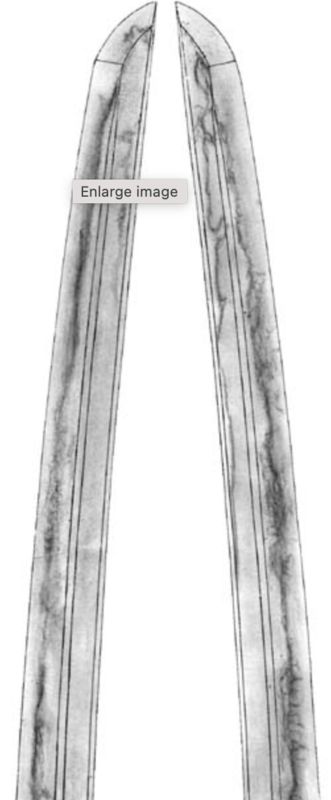
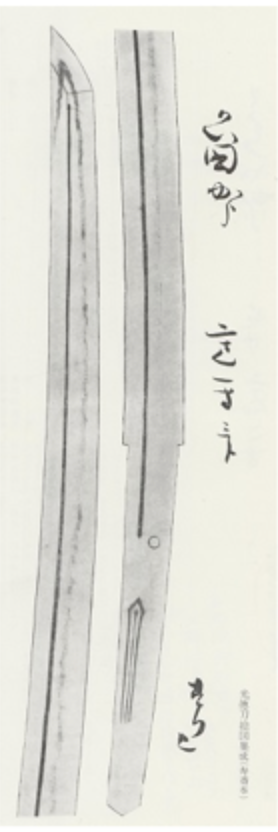
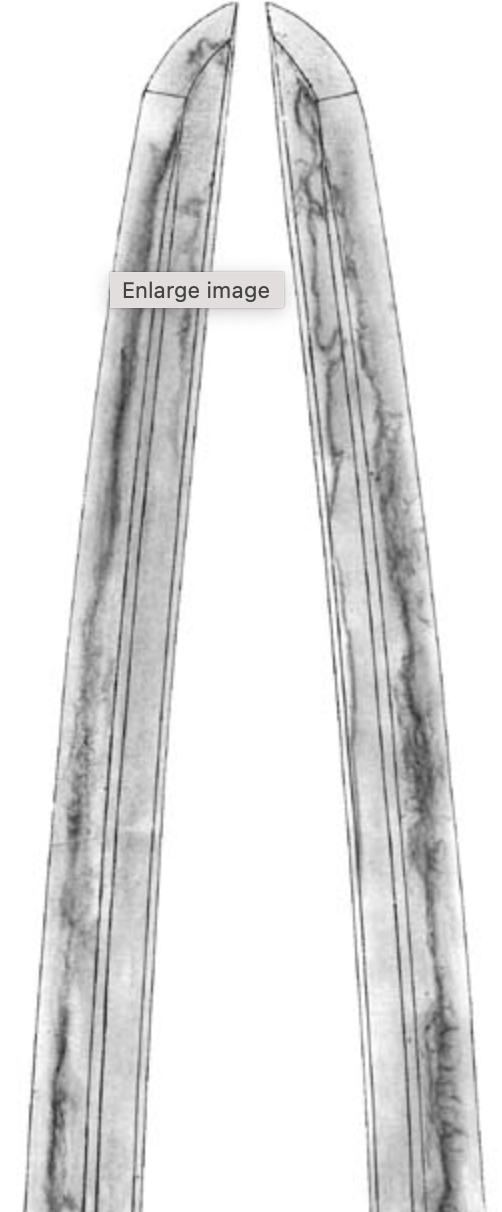
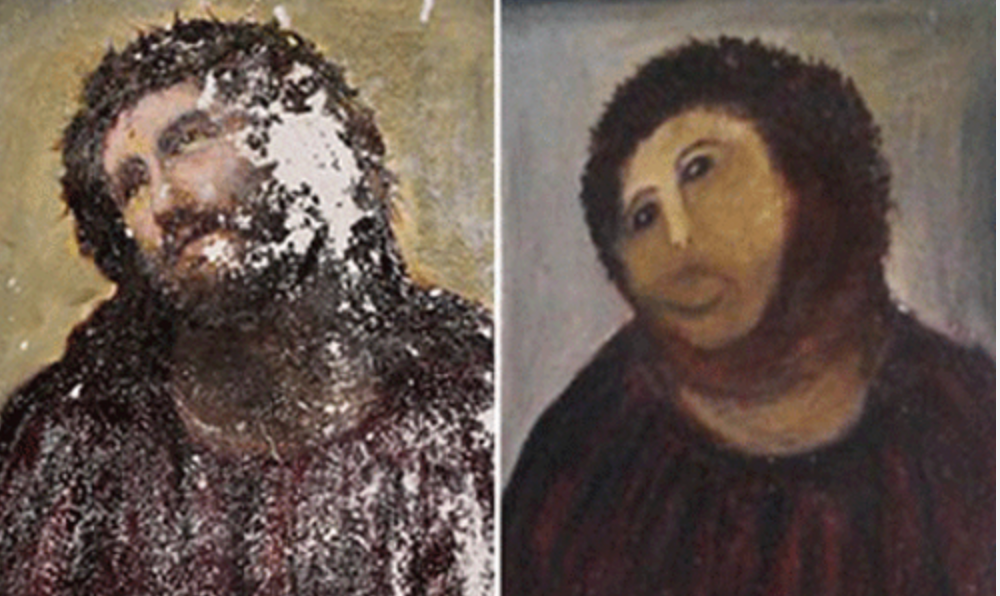
I'll play. This is a bit of the curve ball though. The Kaikuni Go has 2 quite different oshigata although the 1st one was probably drawn after it sustained fire damage and 2nd after an unsympathetic saiha. Echo's of this sorry workmanship

 0 points
 -
Why is it that every Forum has a person being a fkhead? Signed FOREST NINJA-1 points


































This leaderboard is set to Johannesburg/GMT+02:00