
Leaderboard




Popular Content
Showing content with the highest reputation on 03/29/2026 in all areas
-
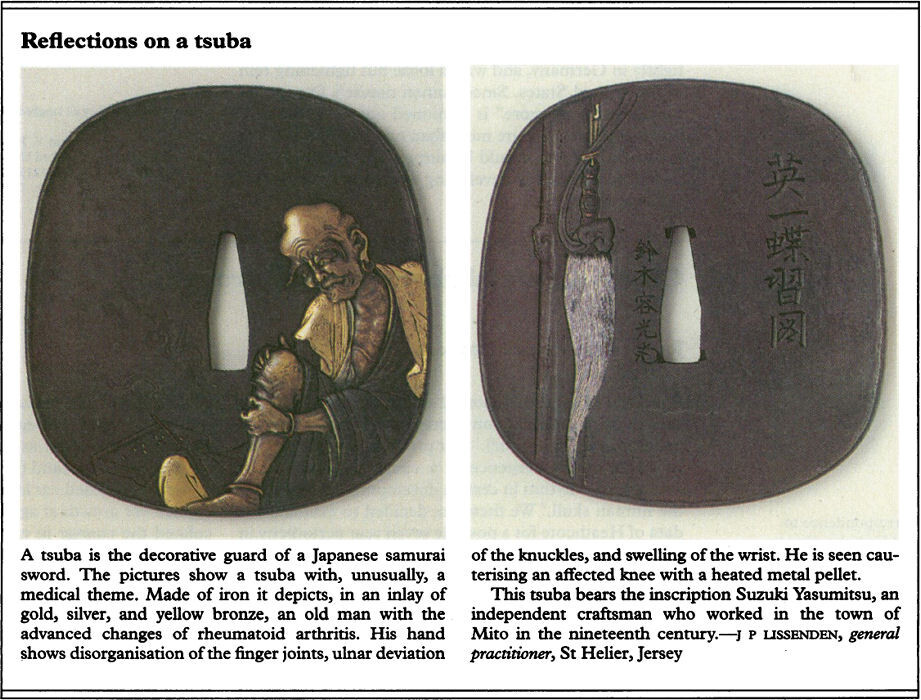
I came across a short article in the British Medical Journal by the late Dr. Lissenden. An opportunity to remember a respected member of the NMB ten years after his passing. from: https://pmc.ncbi.nlm.nih.gov/articles/PMC2359109/pdf/bmj00573-0034.pdf
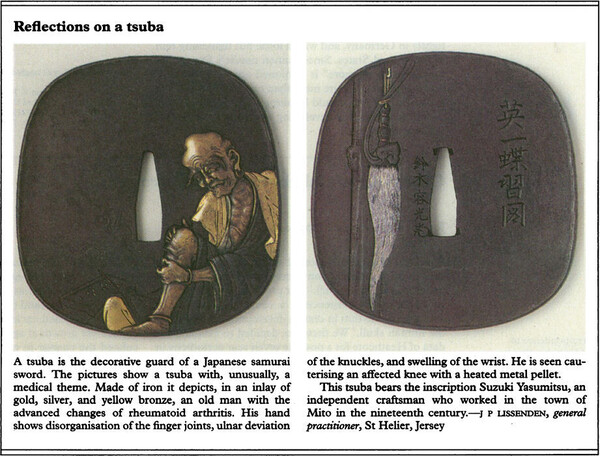 8 points
 -
In the forum, it has often been asked which books are truly suitable as introductory reading. One of the books that is surprisingly rarely mentioned is the masterpiece by Dmitry Pechalov: Japanese Swords: Sōshū‑den Masterpieces. Brett and others have already written very good reviews about it, and I have now worked through the book from cover to cover. It is so good that it inspired me to write about it myself. Many of us know the saying, “It is better to buy one great sword than a thousand junk swords.” I would like to add that the same maxim certainly applies to books. For that very reason, I want to praise Japanese Swords: Sōshū‑den Masterpieces — a book I now wish had been my introductory reading. When this work is mentioned, it is usually because of its extraordinary photography. These images are without doubt impressive – but the real substance of the book lies in its content. In terms of content, it differs significantly from classic reference works, which are indispensable when it comes to terminology and the classification of the various schools of Nihontō, but ultimately answer a different kind of question. D. Pechalov, by contrast, brings insight in a light, accessible way — showing not just what you need to know, but especially how that knowledge was generated and how to develop your own opinions and understanding. Individual observations that would otherwise be collected slowly and fragmentarily are brought together here generously and almost playfully into a comprehensive picture. This is precisely what is missing in many other works that remain confined to dry lists or rigid structures. The book makes no secret of the fact that even intensive source work does not guarantee absolute clarity. Attributions change, assessments evolve – and this is not presented as a weakness, but as an integral part of deeper understanding. You are guided to place expert opinions in context, rather than adopt them uncritically. You begin to understand why perspectives shift – for instance, when a blade’s attribution has changed over time. It conveys how swordsmithing traditions developed, how knowledge was passed down, which signatures carry meaning, and why contextual understanding remains crucial. New documents continue to surface, capable of unsettling supposed certainties. Earlier sources are not always reliable – they use different standards, hold to outdated attributions, or simply contain errors. Thus, we learn why there can be unusual attributions – for example, when a blade was originally given one name because kanji in old sources were difficult to interpret and were confused with one another. Not infrequently, oshigata of forgeries or blades with incorrect signatures have been published. This may initially seem sobering, but ultimately it proves liberating. What arises from this is not a dogmatic collection of answers, but a stance — a way of working. Against this backdrop, Pechalov’s approach gains additional weight. It gives the impression of watching over the shoulder of an archaeologist with extraordinary knowledge and keen intuition: knee‑deep in the exposed debris of past libraries, he lifts up fragments here and there and draws his audience’s attention to their significance and function. The only slight drawback remains the absence of photographs of genuine Masamune blades. But even this is understandable and explained by the author, so in the end one is not disappointed. A possible objection might be that the book deals exclusively with the Sōshū‑den school. Yet precisely therein lies a strength: it evokes those few years in which everything that could happen did happen — only more brilliantly than before and after. Conclusion This book does not replace practical experience, but it brings structure to a field that otherwise easily becomes fragmentary and dogmatic. Anyone who wants to learn to recognize connections and develop well‑founded assessments will find an unusually clear approach here. Controversial topics are not left out; instead, the author gives the reader space to form their own opinion and develop their own perspective. This is rare — and of invaluable worth, especially for beginners. Not the easiest introduction — but an honest one. And perhaps exactly the right one for those who are just beginning their search, and for the eternally curious among us. I hope that we all benefit from sharing this information. Thank you, Dmitry, and I hope that others in our community of enthusiasts will be just as kind and generous with their knowledge and follow your example, so that the rest of us can continue to learn and study.5 points
-
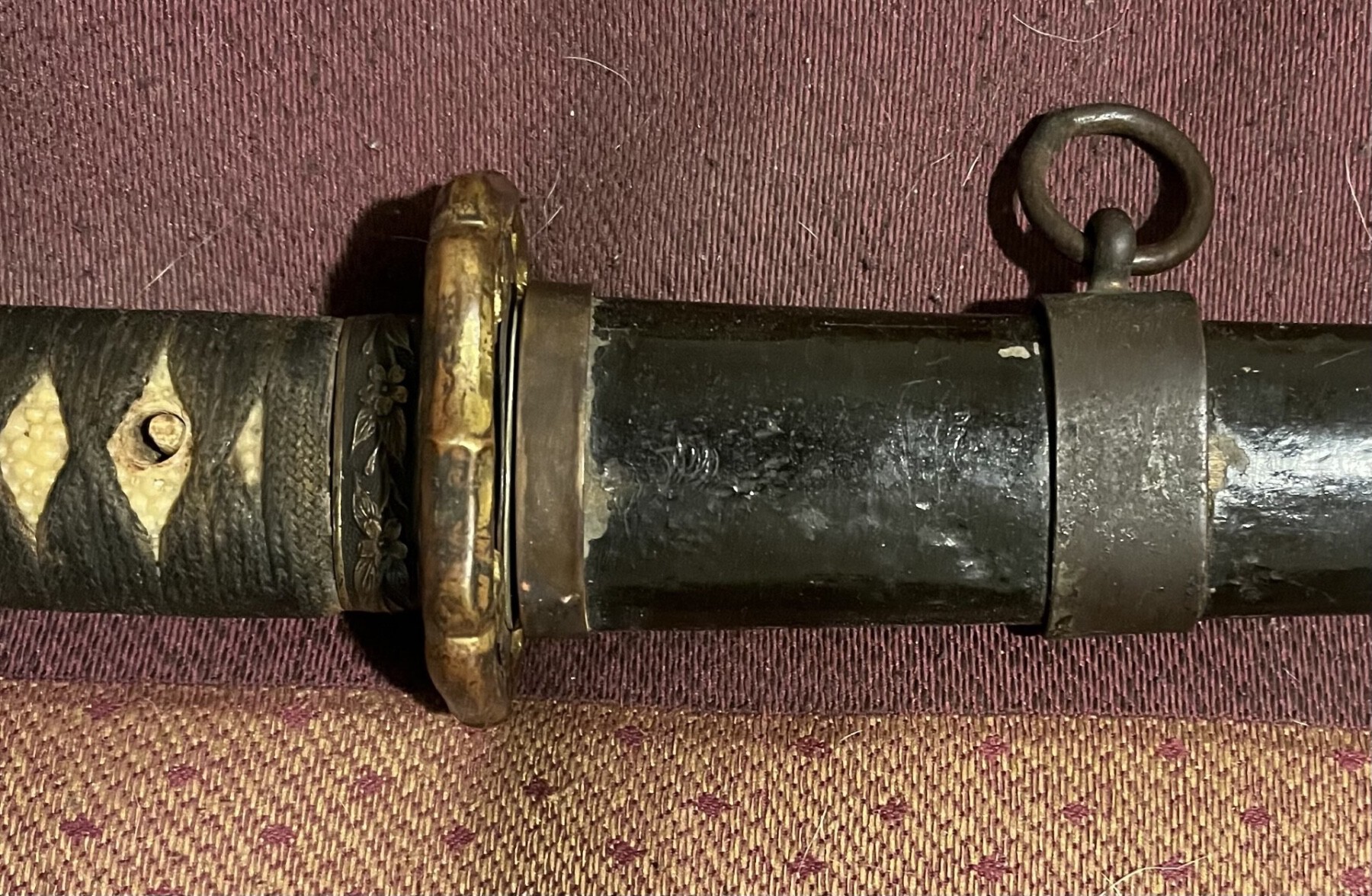
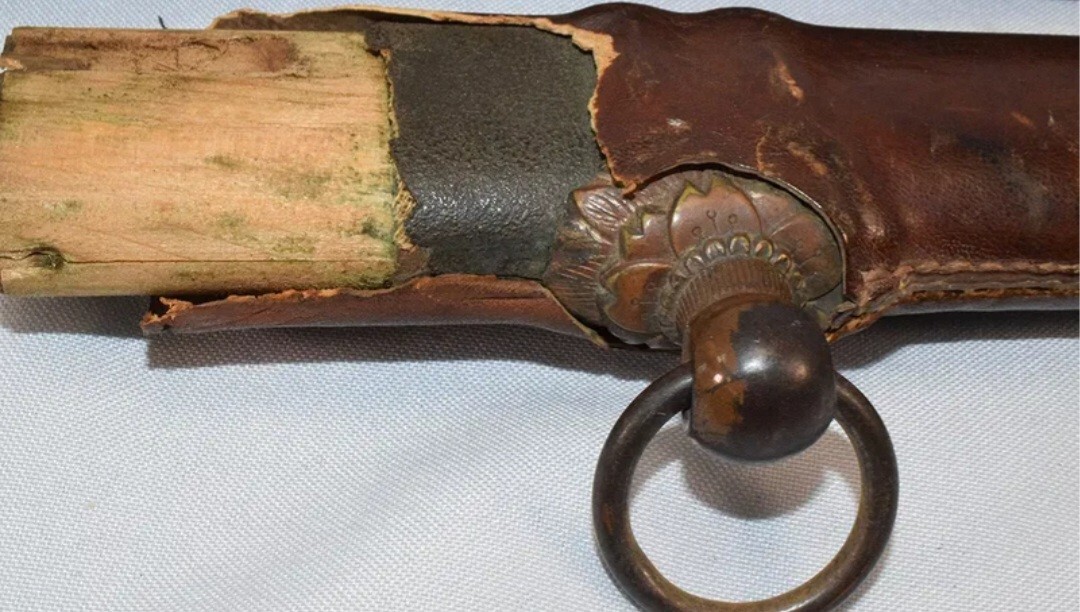
Well I made a simple brass band and put a simple patina on it. I did this to stabilize the scabbard. The scabbard no longer comes apart. See pics. I also realized that the blade is a nihonto mumei! Too bad it has sections of rust.

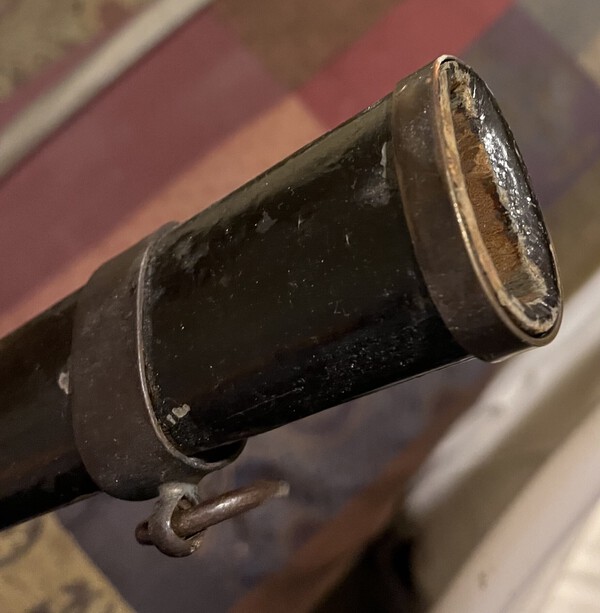 5 points
 -
The part is 皆焼刃 - Hitatsura ha/ba.5 points
-
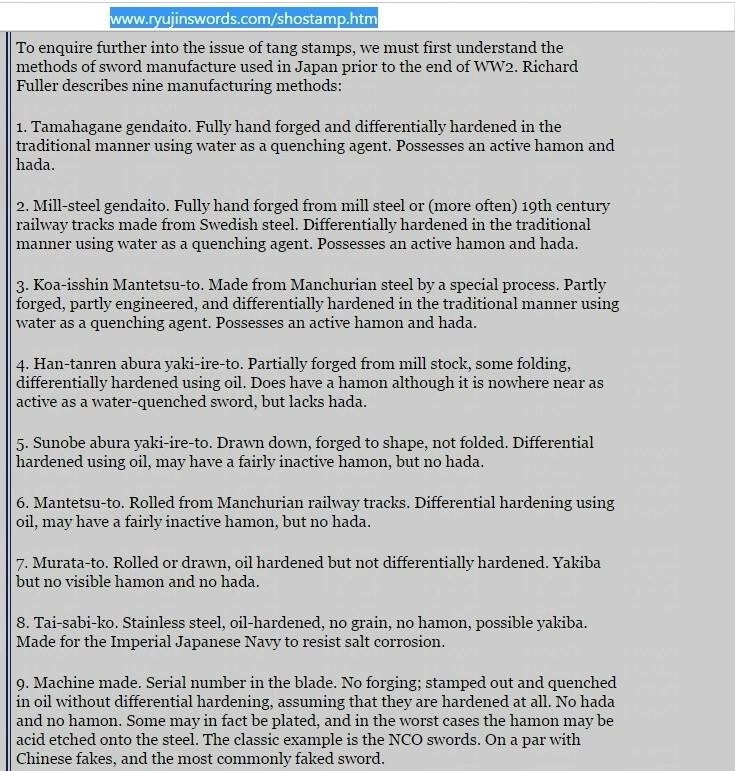
Mr. Ninja (given name?): I think the tamahagane coming from smelters is graded (5 I think) so it can be mixed in various amounts by the smith. Note in the pic below there are two grades coming from the Yasukuni smelter being sent to various arsenals. This adds to the variability. In addition, the smith has a lot of control over how the metal is heated, folded, pounded, etc. So I don't personally think blades are in danger of being too generic. I think about the example of two RJT smiths with vastly different values both using the same tamahagane from Yasukuni. Just my two cents (Oh wait, the US doesn't make pennies any more.) John C.
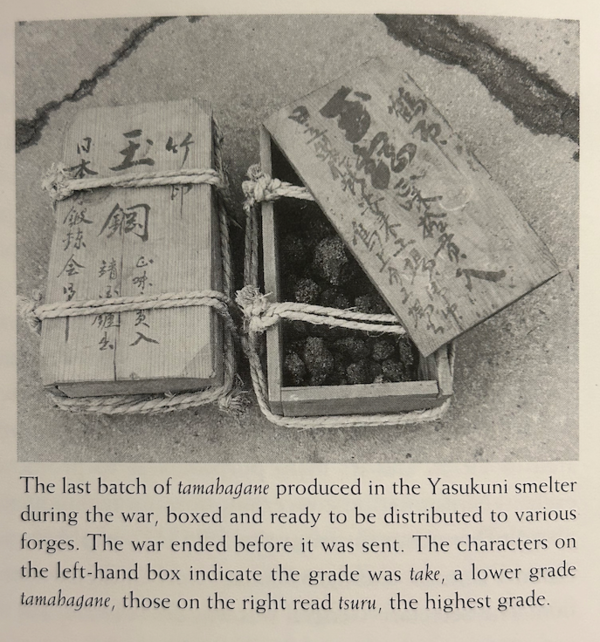 4 points
 -
I have watched a few videos of modern smiths adding broken pieces of older nihonto to their billet. I imagine this would help provide a level of diversity from one sword to the next in steel composition. Interesting stuff, -Sam3 points
-
Nothing stops smiths adding various elements and other materials while forging it, to get the desired characteristics. It's not like they are forbidden from altering the recipe while they forge. I don't think it's a huge problem.3 points
-
The only thing that stands in the way of this book being an instant recommendation for any newbie is its rarity and price - it was a limited print run and copies now are hard to find and expensive (especially if you don't live in the same country as the seller). Fortunately, Dmitry has generously made most of the content available online, and instead the web version can be recommended, with the advantage of being free and instantly viewable on any web-capable device: https://www.nihonto-museum.com/3 points
-
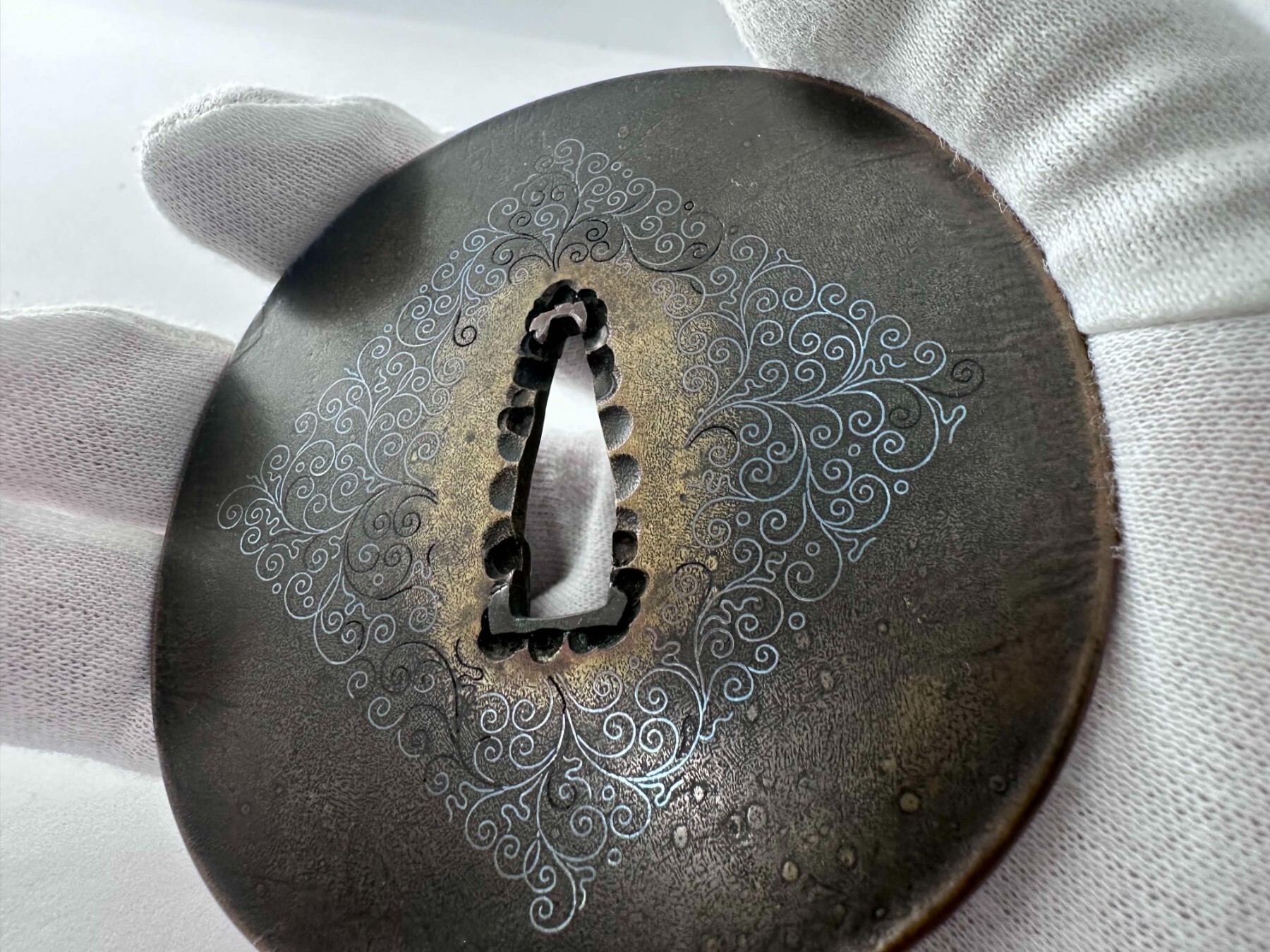
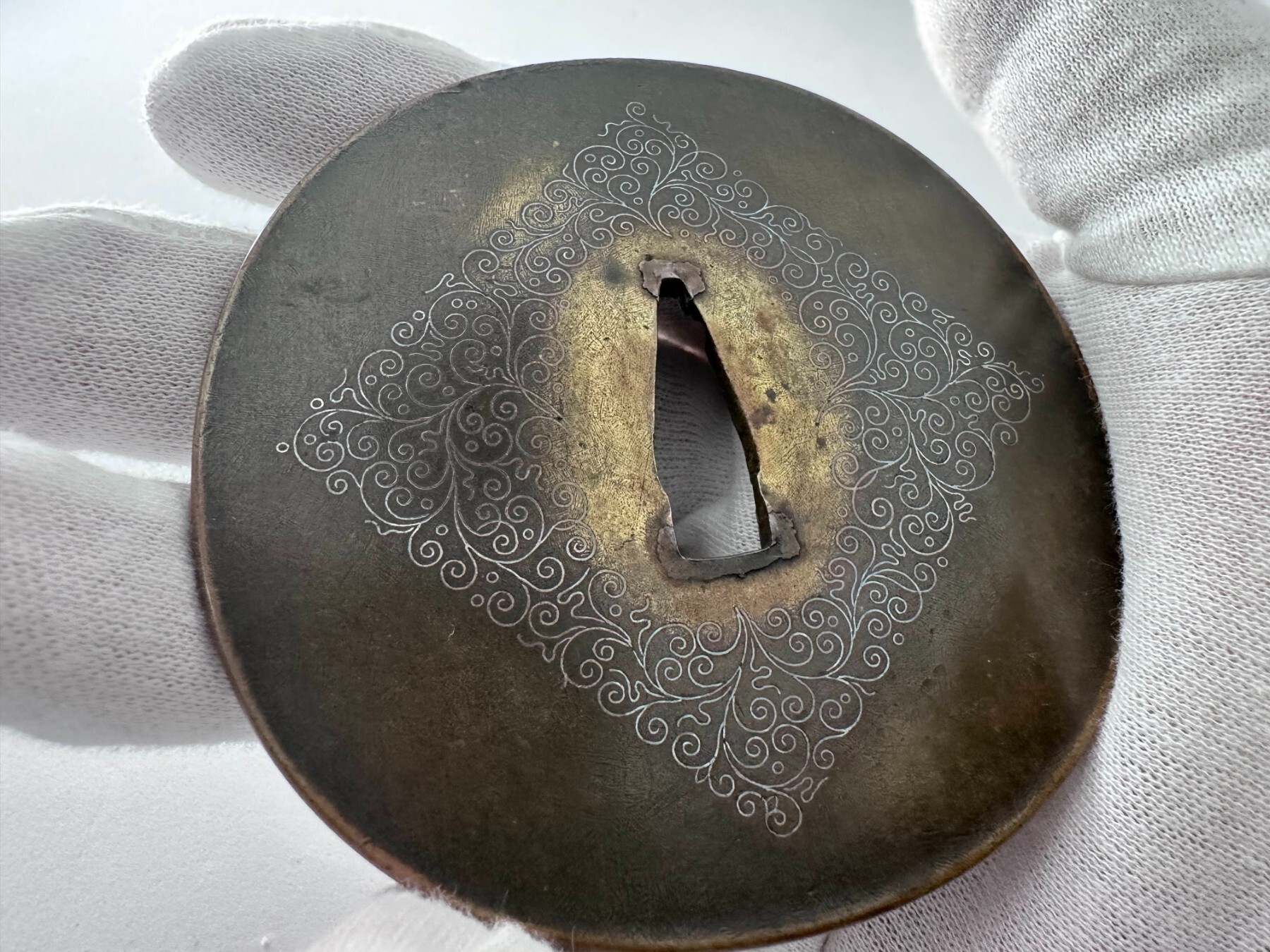
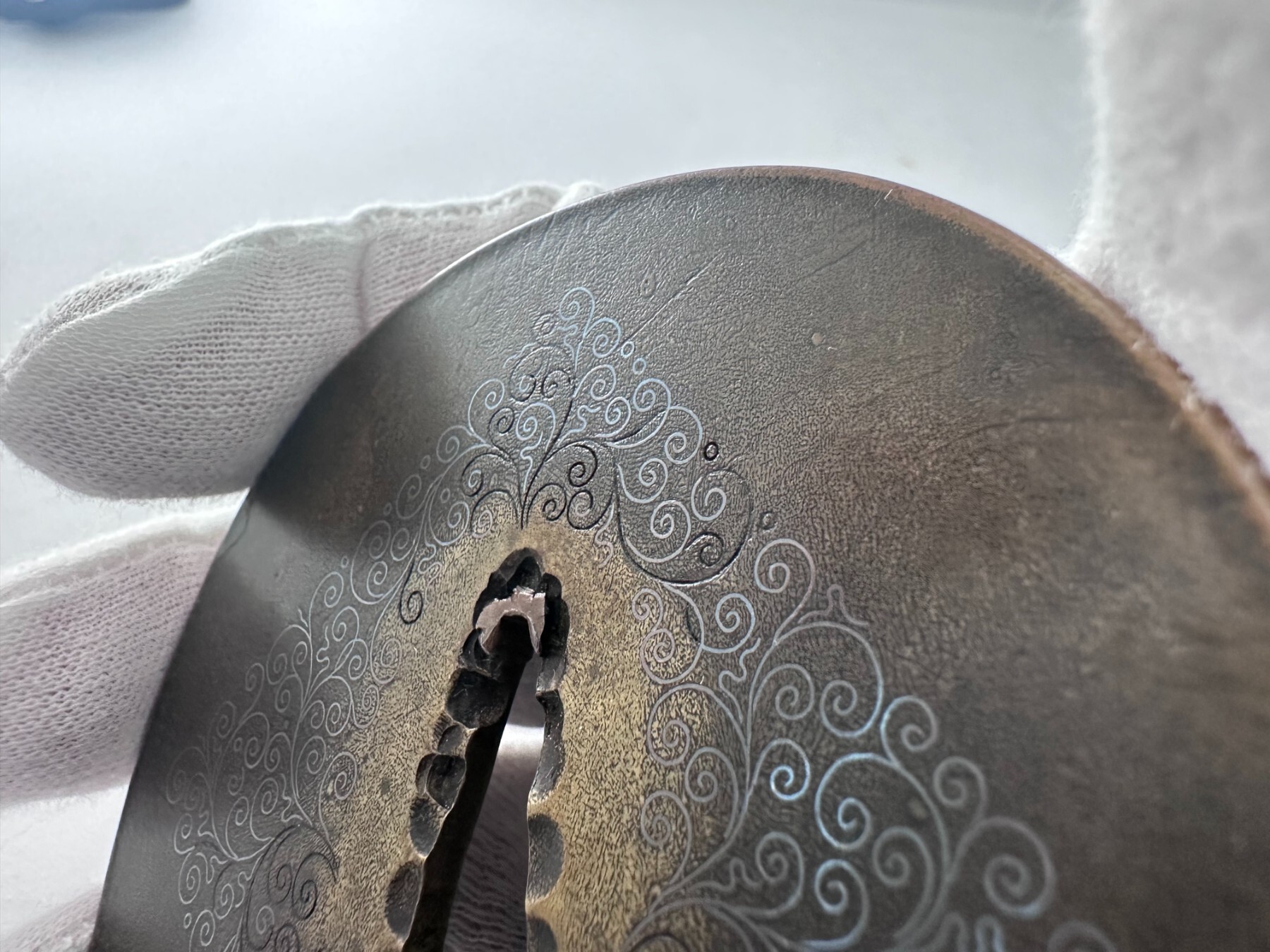
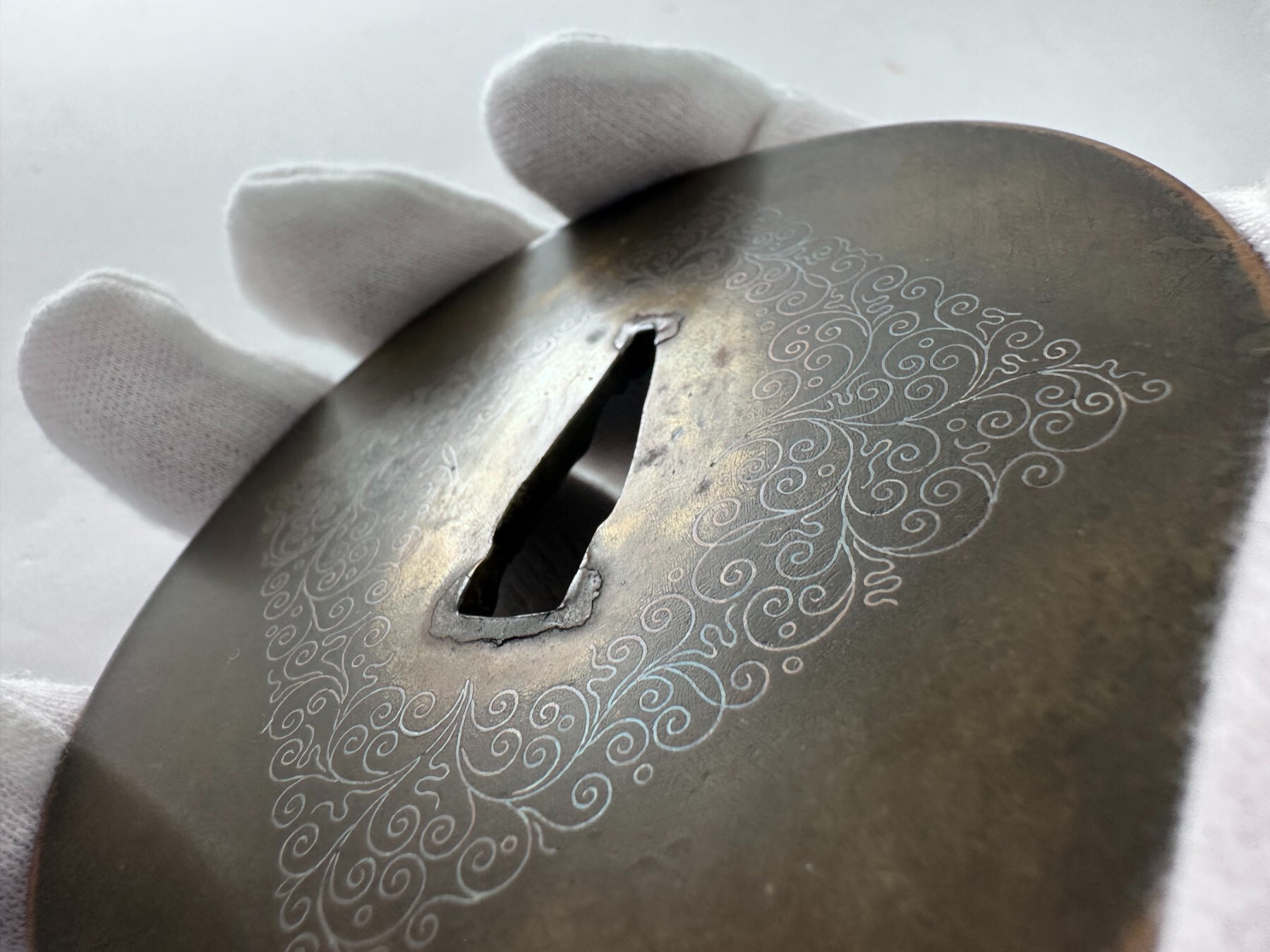
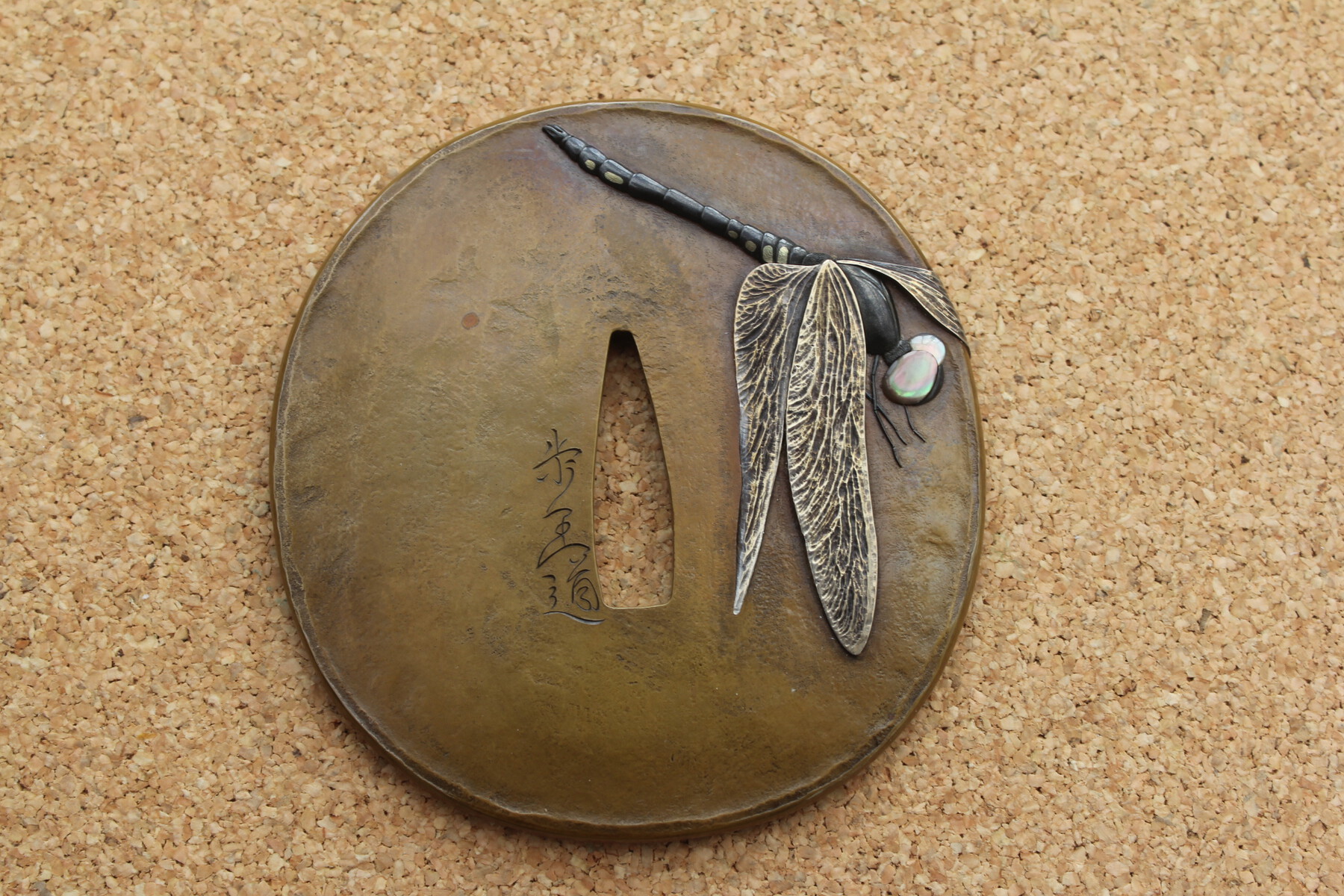
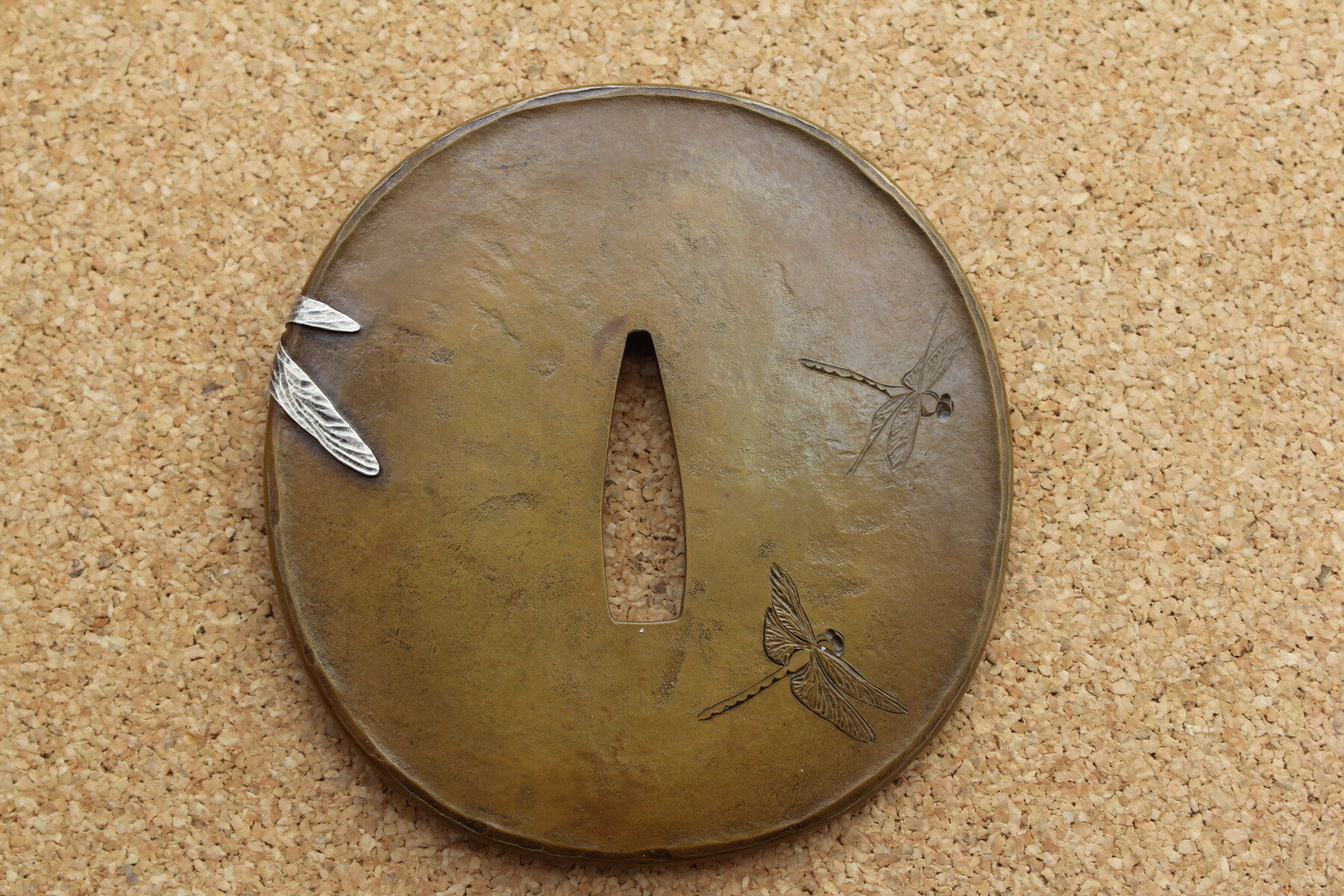
This is in my collection. Papered Umetada (埋忠) by NBTHK. Dimensions 77.3 mm x 72.5 mm, thickness 2.8 mm at the seppa-dai, 7.5 mm at the mimi. All the best. Luca
 3 points
 -
Hi… (I’m not very confident in this translation, so please don’t take it as definitive.) No.13432 (Wakizashi)(Unsigned) 綱廣(Name:Tsunahiro) (Living in Sagami Province)(Momoyama period) (Blade length) 壹尺参寸0分強[←maybe] (Re-tempering?)[←I'm not sure, but maybe...] 「I authenticated it as described in the text on the right.」 (1990.6.19) (Blade length) 壹尺参寸0分強=1Shaku 3Su n 0bu +a =1×Shaku(30.303 cm)+ 3×Su n(3.0303 cm)+ [0×Bu(0.303 cm)]+a =about 39.4 cm?3 points
-
Jean, some interesting research has been done... Note, if any of these break copyright, let me know and I'll delete them Kuji Iron Sands.pdf Characteristic_Feature_Found_in_Typical_TATARA-Product-Japanese-Sword.pdf Control_of_slag_and_inclusions_in_traditional_Japanese_iron_and-steelmaking.pdf2 points
-
This a great topic As Lewis stated above, Tamahagane production/distribution became more and more centralized as time went on. This was also a gradual process throughout the koto periods but really became mainstream in shinto ( edo ) periods. While it could be argued that steel quality became more consistant , it inevitably lost all the regional characteristics of steel that once appeared in the old works. There is ( and will always be ) much great debates trying to pin down the cause for the great artistic ( not functional ) decline in swords over time and the loss of regional characteristics of steel likely has a big part in it2 points
-
This one is also odd - found in the Ashmolean museum - 75 mm x 72 mm Notice the "niku" [raised trimmings] around the whole of the opening - the hole was made that way
 2 points
 -
Nothing new. Tamahagane production was centralised back in the Edo period (as a means of controlling sword production by the Bakafu), often said to the detriment of the blades produced since then.2 points
-
Basically, yes - there's only so much you can do with the same steel, which is why several smiths make or enrich their own tamahagane (the Akamatsu Taro family being one well-known example - they make theirs from scratch using iron sand they gather themselves). Many smiths and researchers believe there was some mineral or chemical component of the steel used to make the great old works (particularly Soshu) and that this steel running out is what led to the decline of those schools in quality and also drove some of the migration we see in those times. Naturally, it would follow that to truly reproduce those old masterworks, you would need to develop steel of a similar composition as what those old grandmasters used. The research and experimentation continues...2 points
-
Not sure of book but this is an utsushi from Mauro's post https://www.militaria.co.za/nmb/topic/42631-tsuba-identification-help/#comment-4370502 points
-
Moritoki Taiyu was an highly regarded calligrapher and Bizen potter. He is far more known for the former, as his pottery production was very limited in comparison. Showing immense skill at both disciplines, this piece beautifully combines them. A classic stacked mochi form reminiscent of ancient Bizen works with beautiful clay flavor. Graced with spotted natural ash deposits on one side, which get heavier and begin to flow on the reverse. Both sides are decorated with a bamboo design and that make wonderful use of the artists brushwork prowess. Comes with its original matching lid, which is always preferred vs a lacquered wood replacement, along with the box and cloth. Measures 21cm wide by 17cm tall and in excellent/unused vintage/antique condition. $220 shipped to the USA, payment via PayPal friends and family. Please let me know if you have any questions or need additional pics.
 2 points
 -
Ron Here are a few examples of police gunto for your review—this type is also documented in Dawson’s book.

2.thumb.jpg.af8883521be61d416b2a1583d002f4d9.jpg)
.thumb.jpg.3f440444352f027f612108af8d7554de.jpg)

 2 points
 -
Update teaser number 2. The metal reinforcement pieces after patination. Captures the look of the iron pieces well enough, I think. John C.
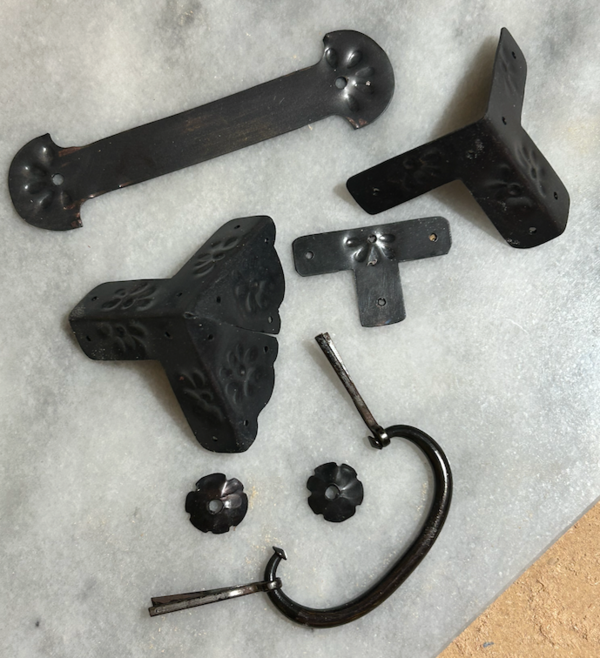 2 points
 -
That is a wise decision. Excluding old “family” swords, and Gendaito; many WW2 swords, and especially machine-made blades and showato; are simply relics of their time and the war. Their value and collectibility is associated with their history, and there’s a level of acceptable condition issues. People in the militaria collecting world will see more value and intrigue in an item that shows some wear and tear, and will look at a “clean” or “pristine” item with scrutiny and skepticism. Nobody likes to see evidence of modern alterations on vintage or antique items or art. Best to leave it as-is. Best of luck, -Sam2 points
-
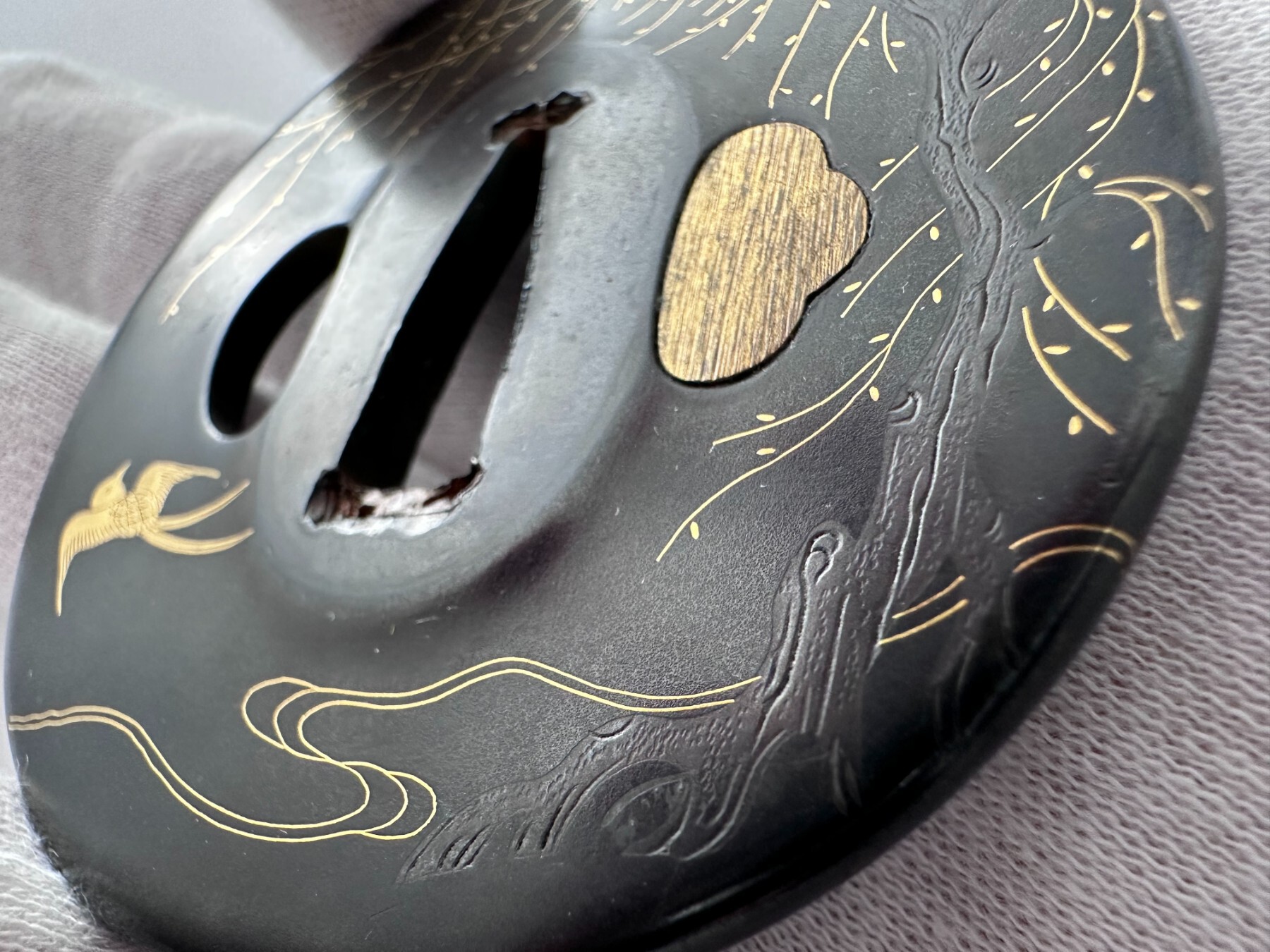
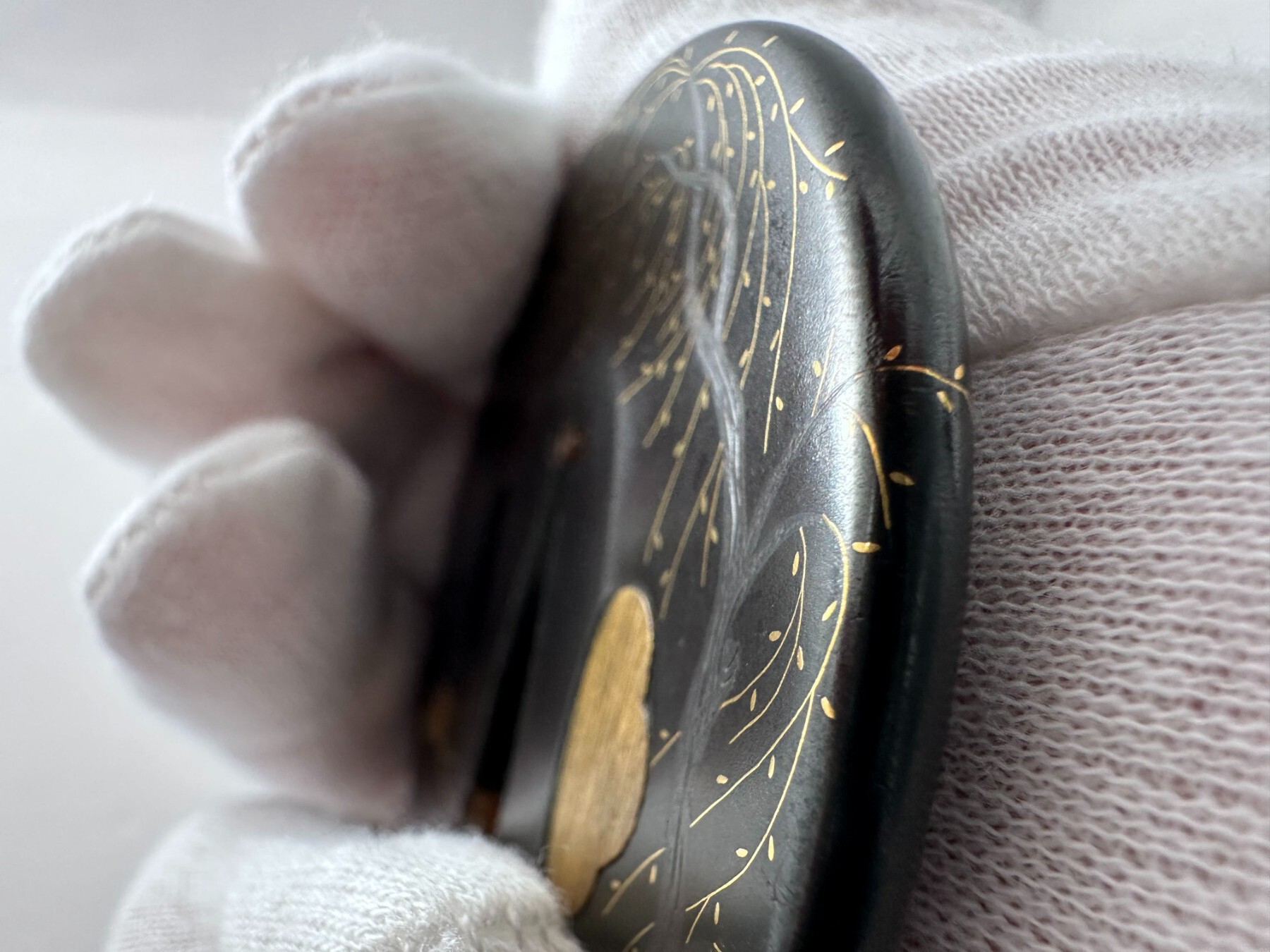
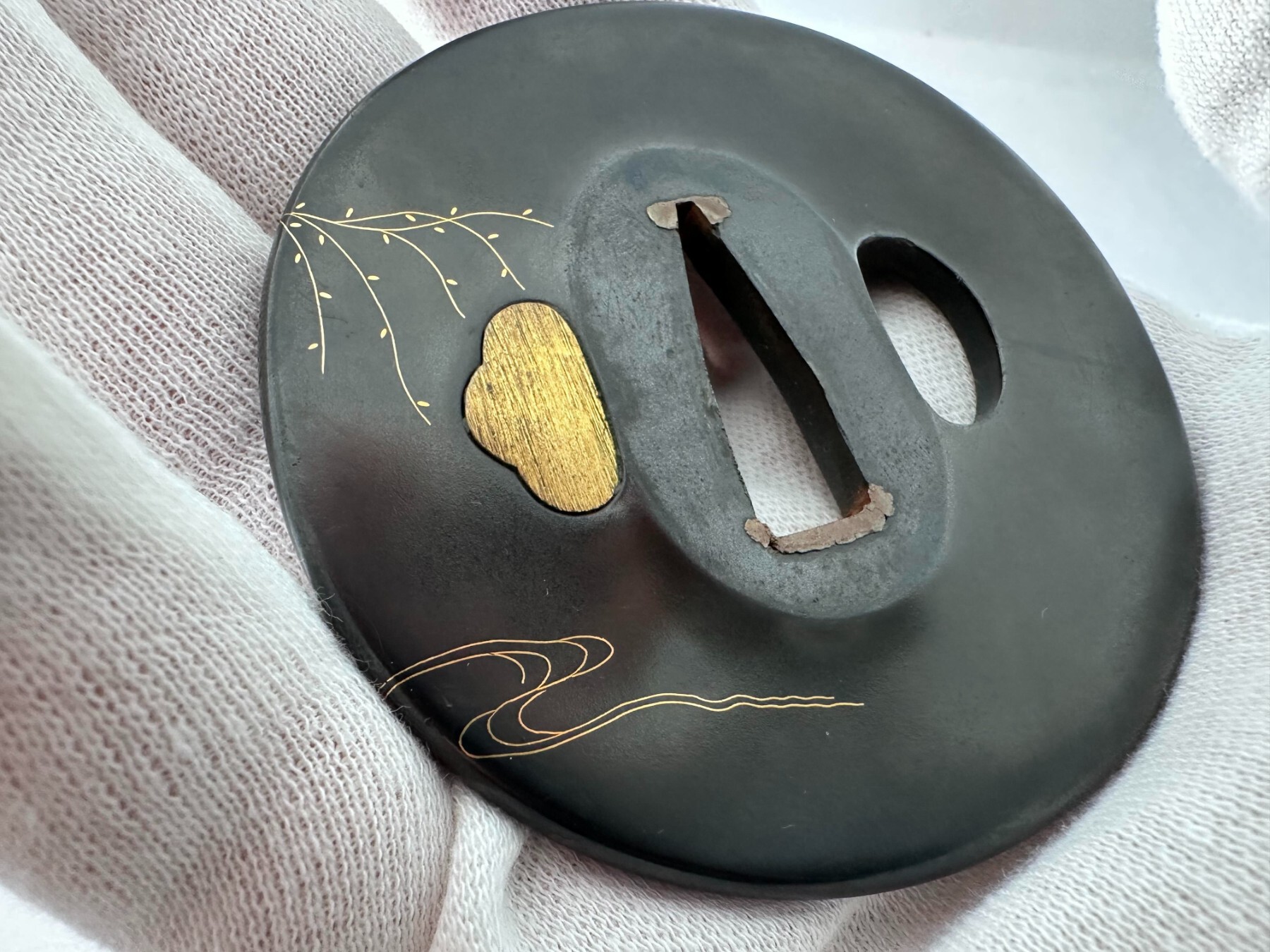
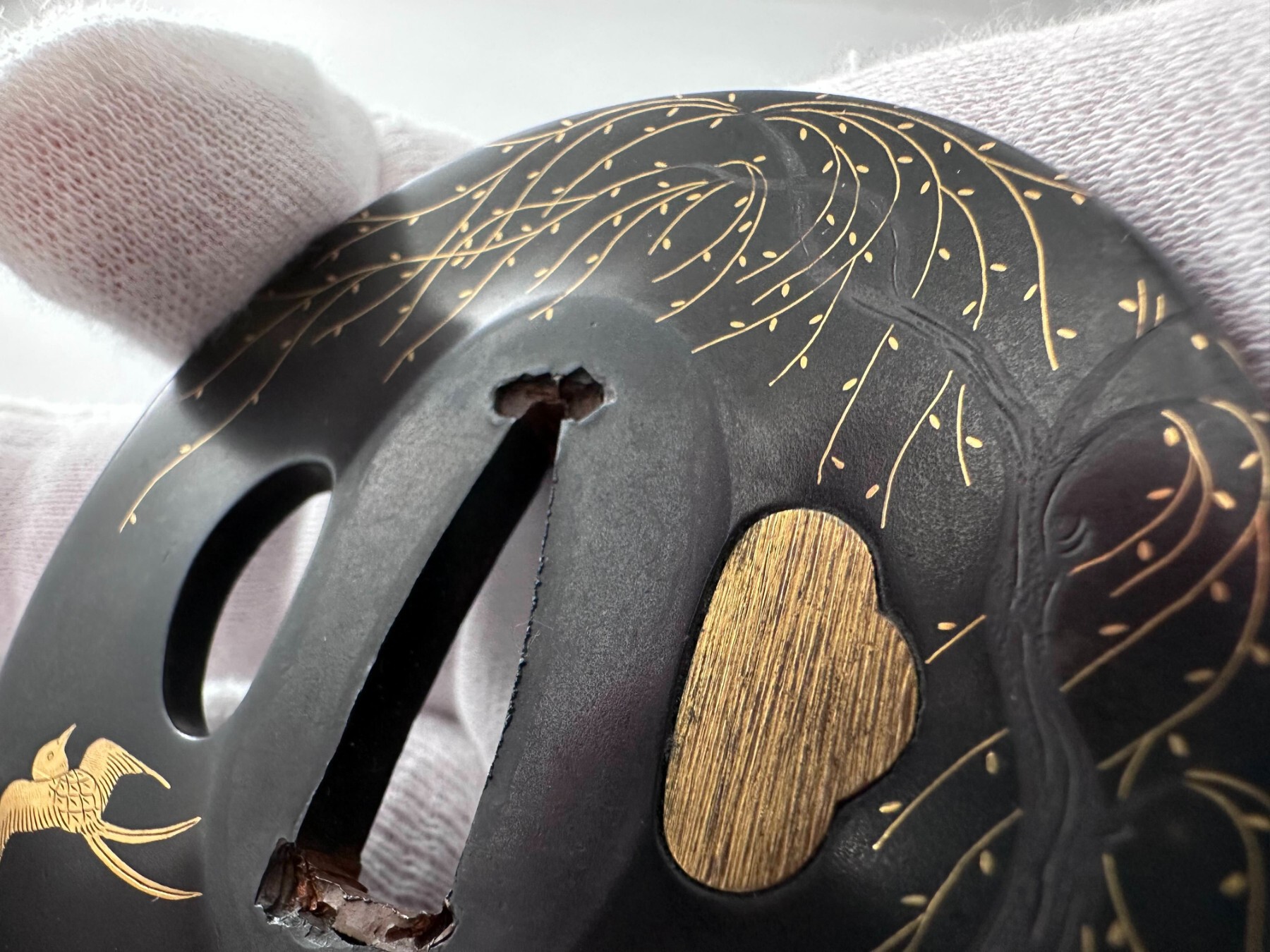
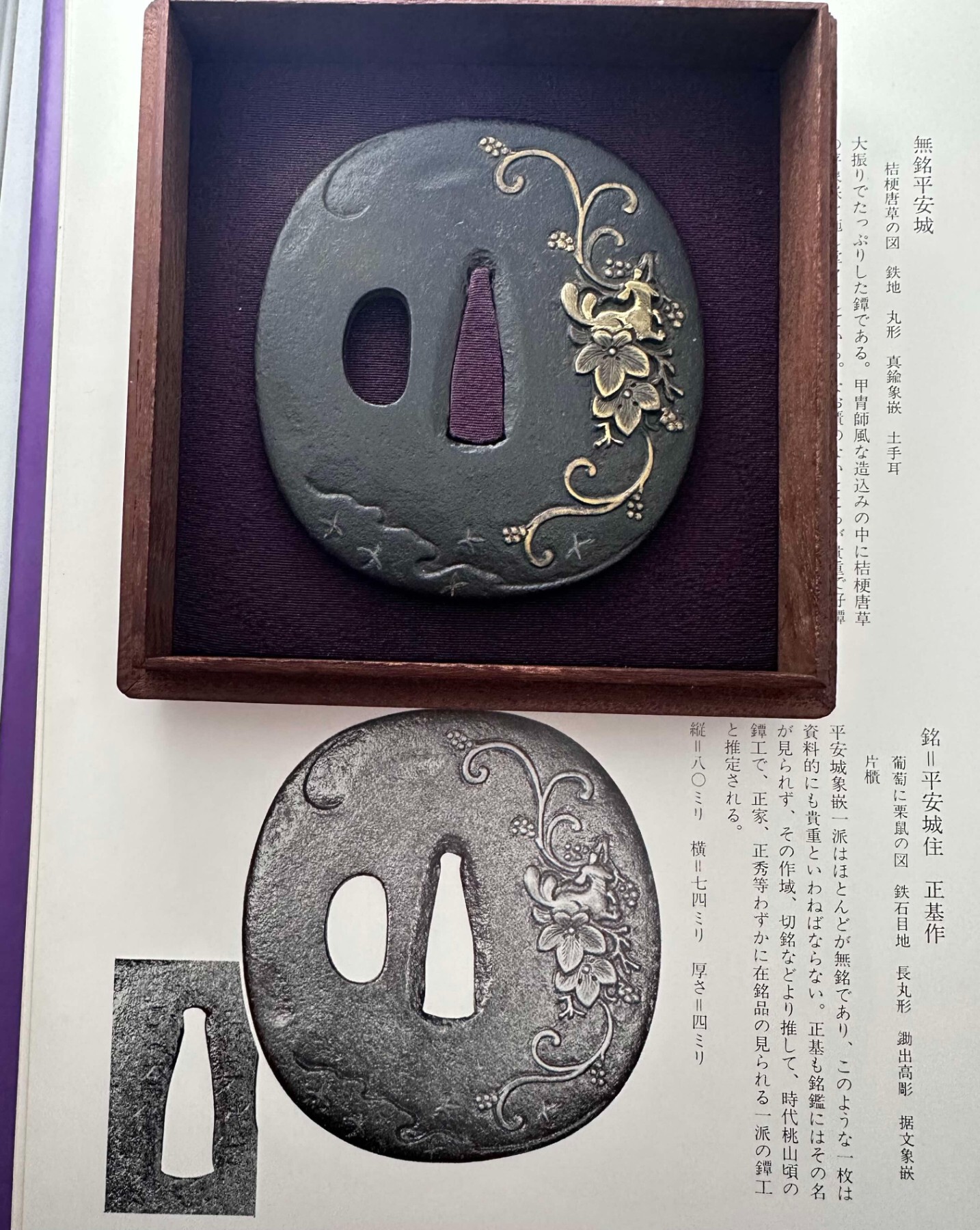
Hi all, I would like to share three tsuba that recently joined my collection: an Umetada tsuba with karakusa design (perhaps Momoyama?), a Kaga piece, and a Momoyama Heianjo. Each has a different taste and gives a slightly different feeling. Any thoughts or observations are very welcome.


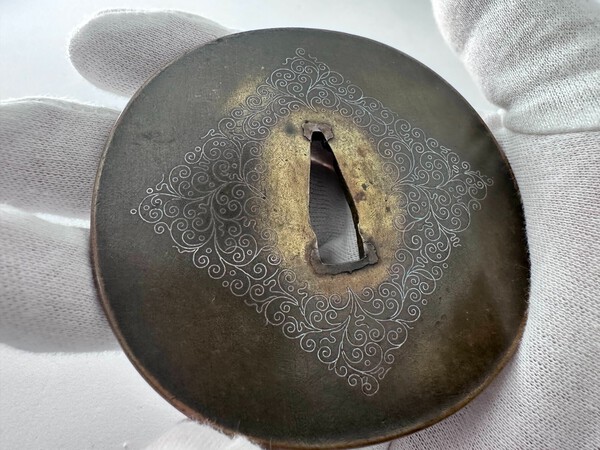
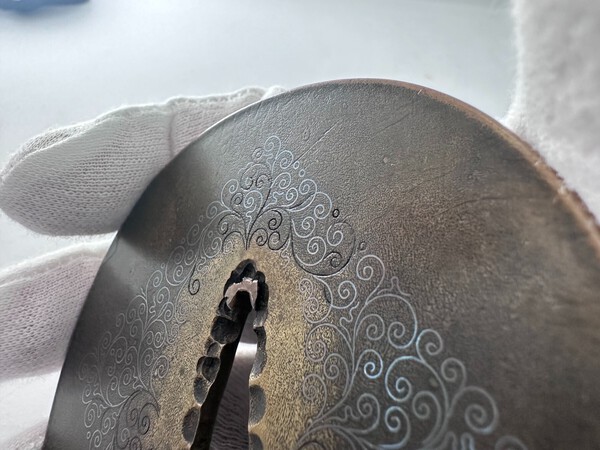
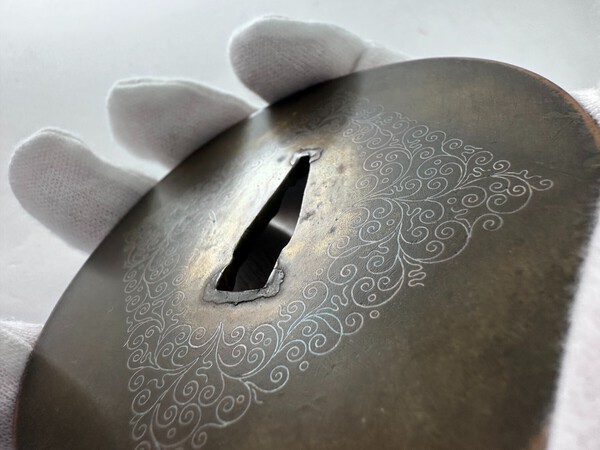


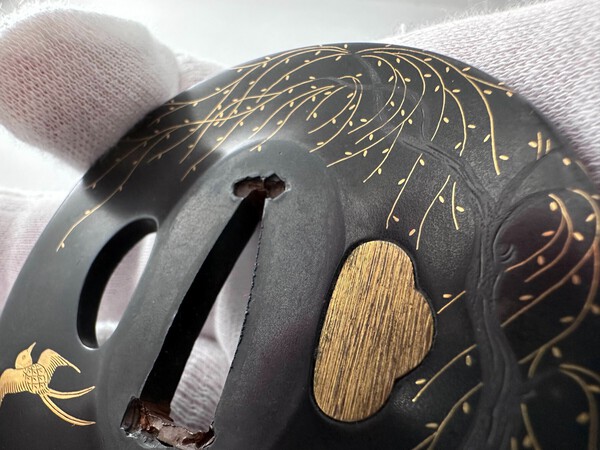
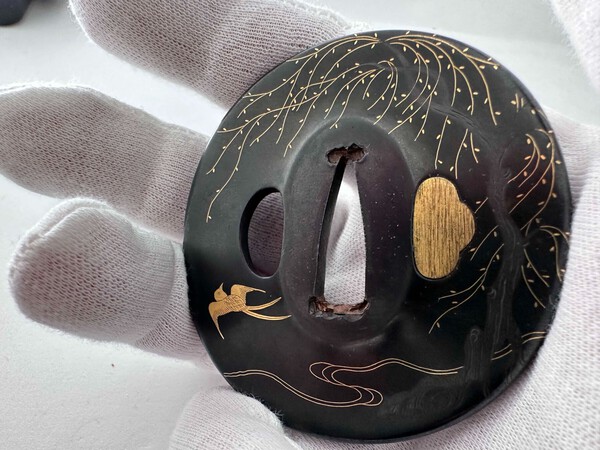

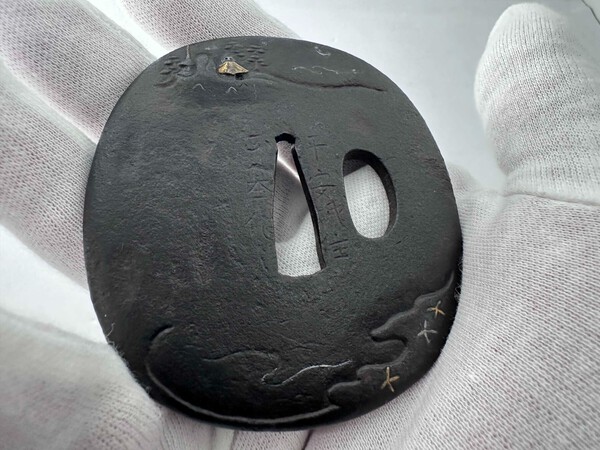
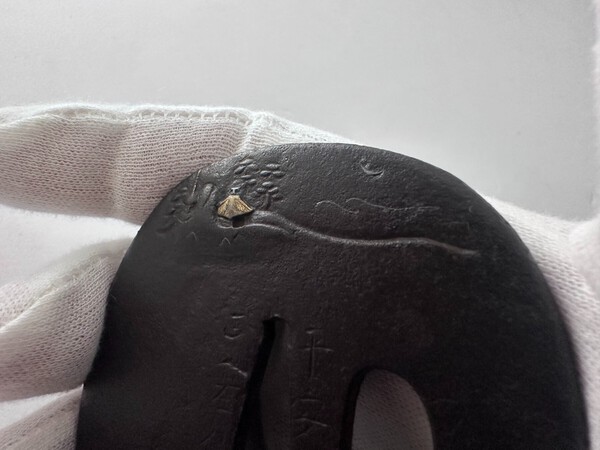
 2 points
 -
The question should be, “Can anyone read this eccentric (highly stylized) brush writing?” It’s not easy, Chansen. From a quick glance this is an appraisal carried out in Heisei 2, for a “wakizashi, mumei , Tsunahiro, Sagami no Kuni Jū”. There are a couple of notations (?) and the length of one Shaku and… 3(?) Sun.2 points
-
I have a few but just picked up this Echizen Kinai piece recently. I like the concave petals.2 points
-
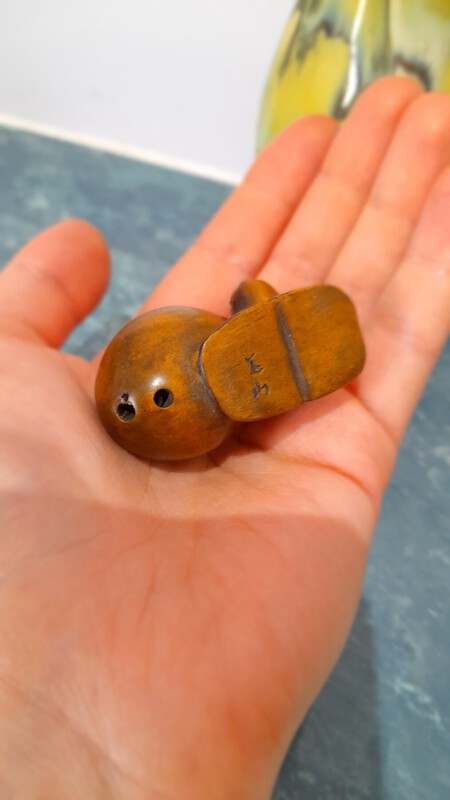
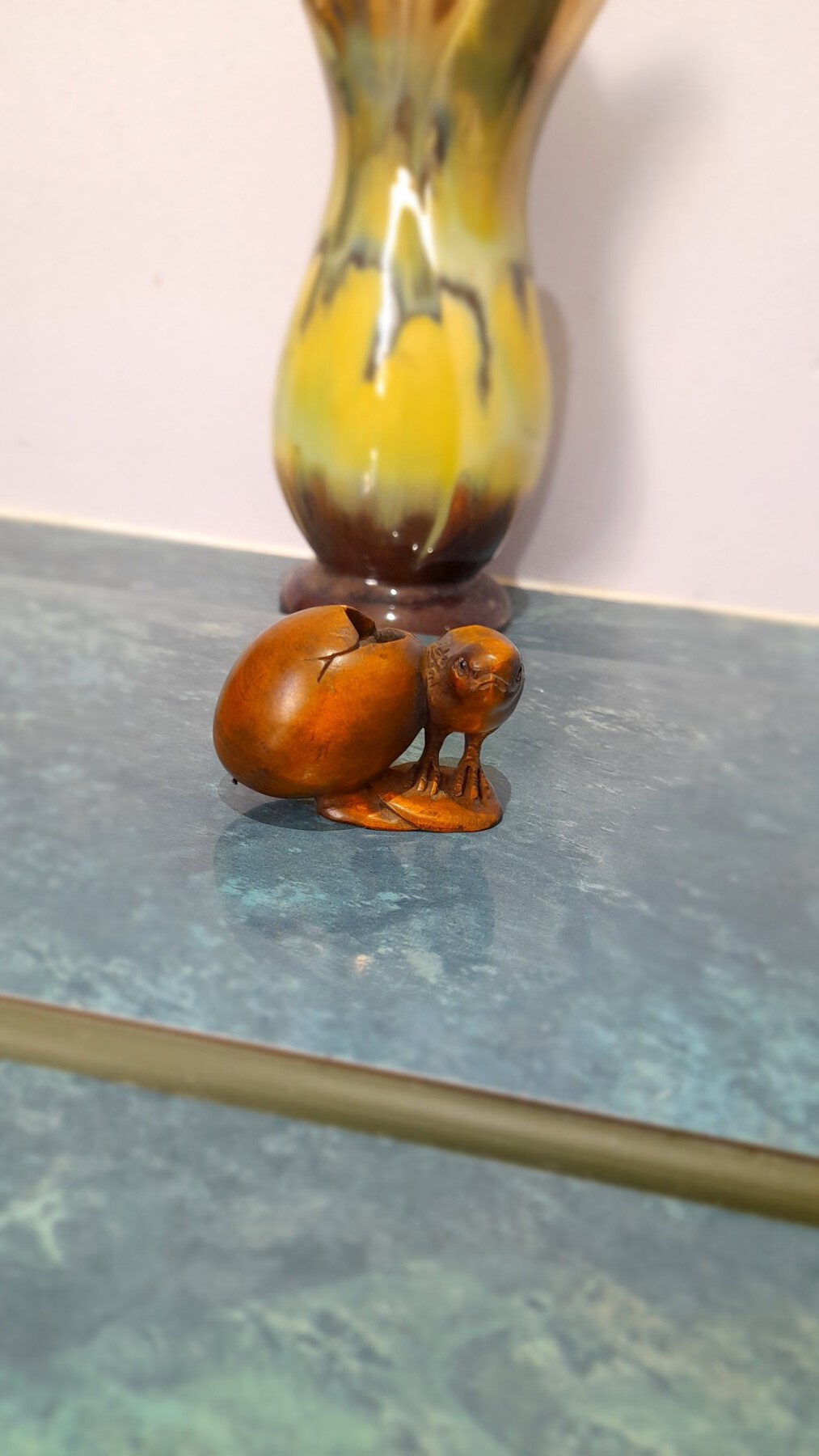
I've recently come into possession of the object below and would like help identifying any information (maker, age etc.) as I'm very much a novice to the world of netsuke collection. I've been informed that it is made from keyaki wood. It features a chick within the egg, carved loose in such a way that when the netsuke is suspended, the chick's head hangs out.

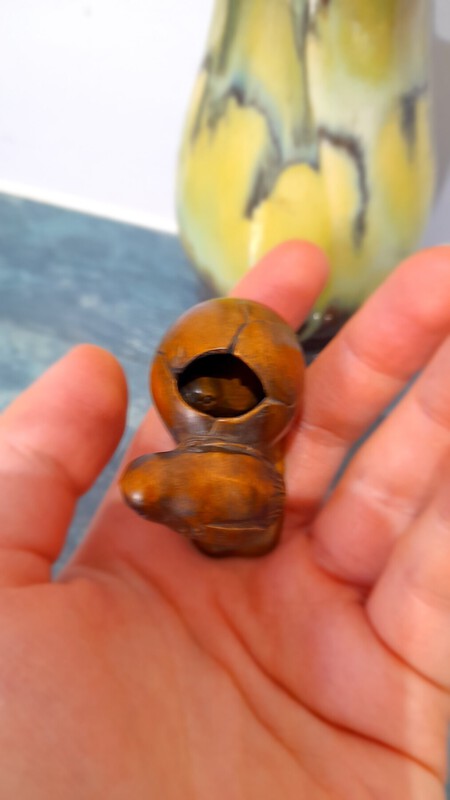

 1 point
 -
Hi Guys, Dmitry's book is wonderful and a bit expensive but it isn't rare. If you will excuse my self promotion, I can get you a copy new and unopened. https://japaneseswordbooksandtsuba.com/store/book/sword-books/c265-Japanese-swords-soshu-den-masterpieces-by-pechalov/ Thanks, Grey1 point
-
One of the title pages shows a date of 1938, for what it's worth. Not sure if that's early or not. My copies are 1960's reprints. John C.1 point
-
Hi… Top→「銘」Mei Under→「前大徳誡堂(叟)←maybe」 前:former 大徳:大徳寺Ditoku-ji 誡堂:(Name)Kaidō 藤井誡堂 Fujii Kaidō(1898-1984) The 515th Chief Abbot of Rinzai school of Zen Buddhism at Daitoku-ji Temple “-Sō(叟)” is a character used in an artistic pseudonym (雅号gagō) , meaning “old man,” with a humble tone that also suggests refined taste. (The mark at the very bottom is a kaō [stylized signature].)1 point
-
Is this the same guard as from the Michael Tomkinson collection? Now in the Metropolitan Museum of Art1 point
-
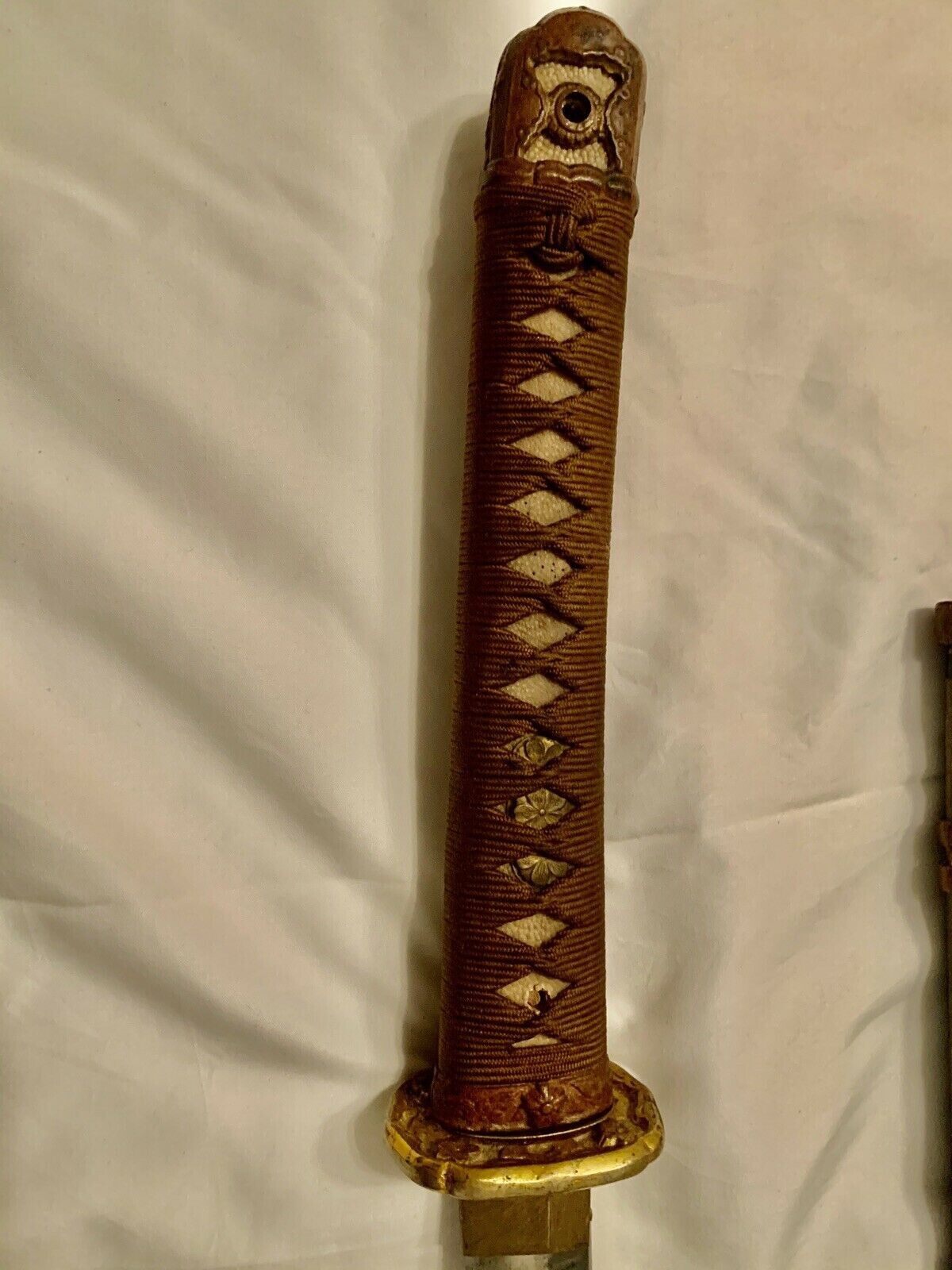
I have a couple of swords with the paracord wrapping that was done by US sailors and Coast Guard’s men when they were heading back to the states from Japan post war. It’s a part of the history of the sword and I decided to leave it in place. It’s not particularly valuable but because of the family history I would never sell it! Tom1 point
-
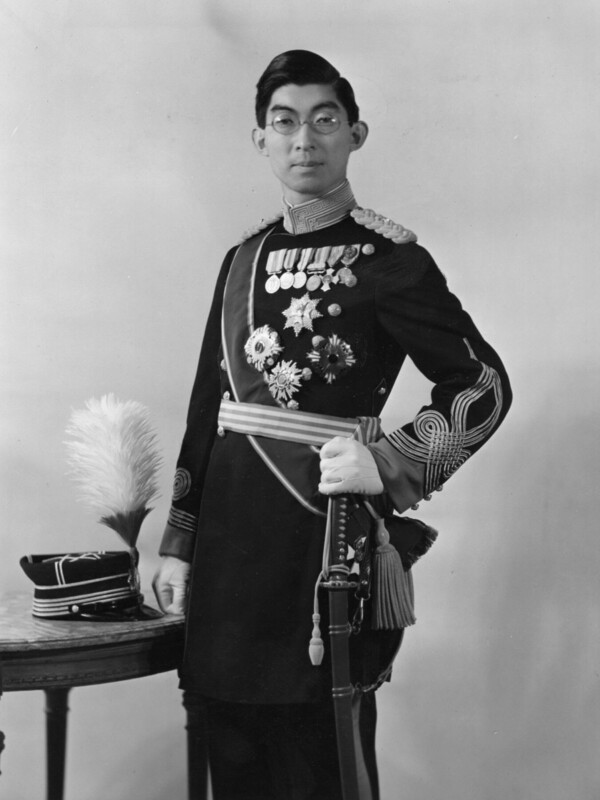
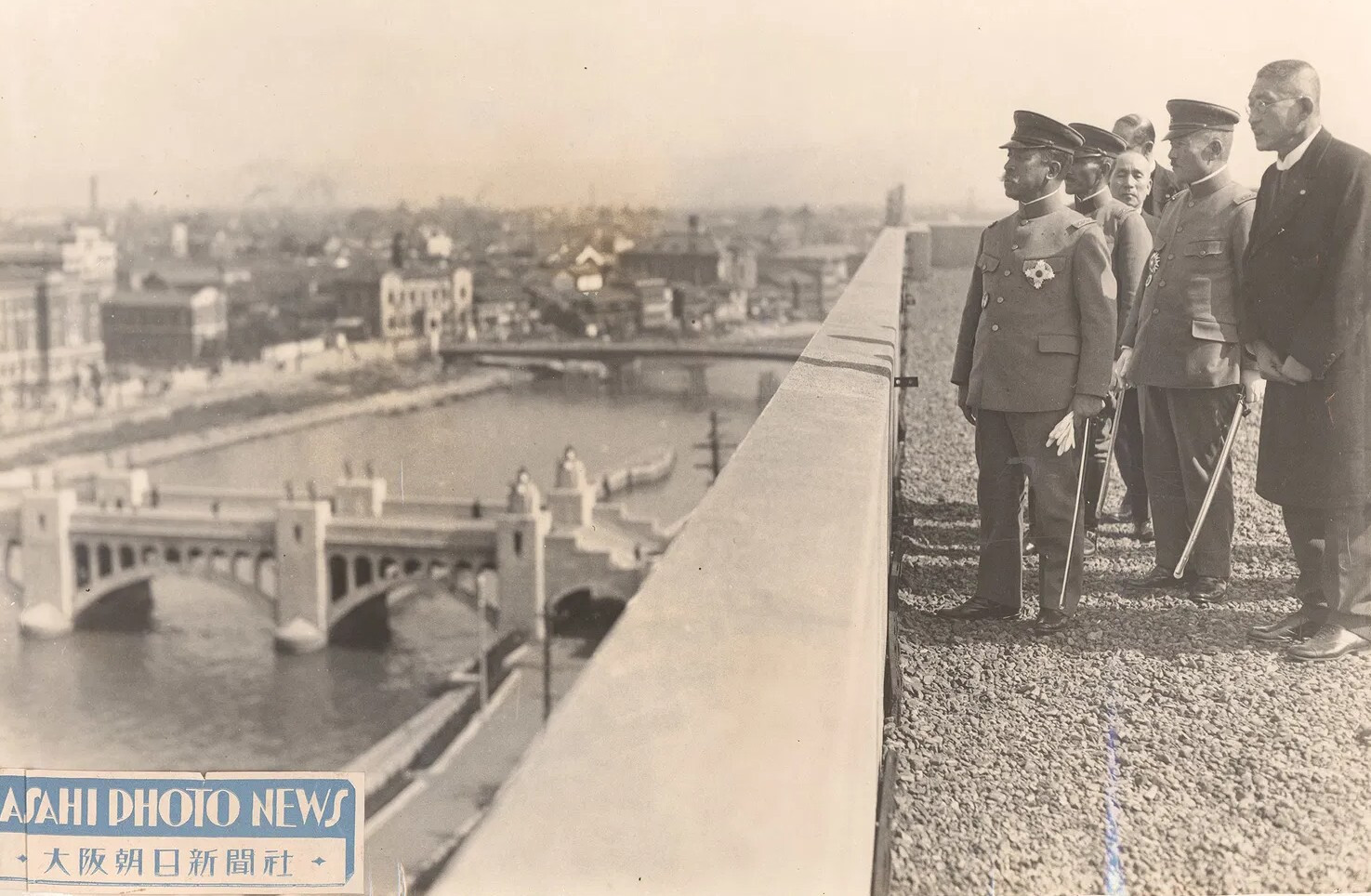
Prince Yasuhito, note the parade knot on his Type 94:
 1 point
 -
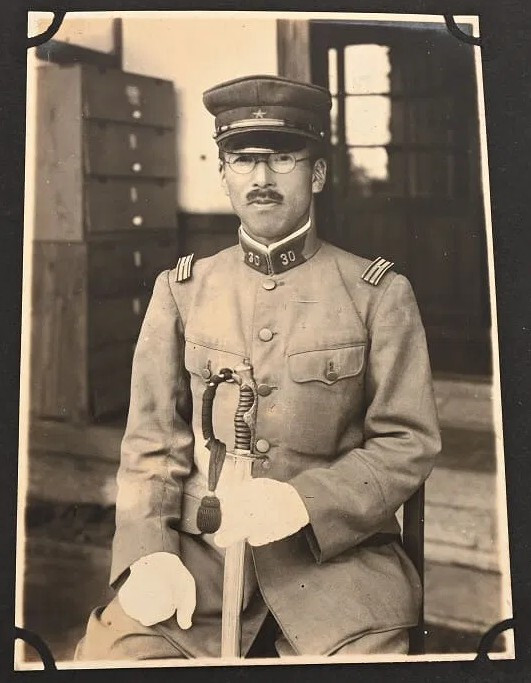
I thought this one was interesting , a naval officer with a Shinto gunto
 1 point
 -
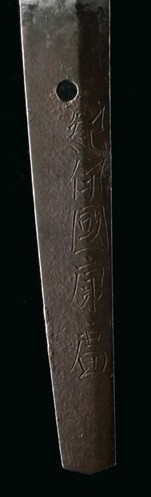
@cookiemonstah47 Khalid, about your top blade (below) I have not had much luck. Upper kanji is rusted but it looks to me like: 紀伊國綱廣 "Kii no Kuni Tsunahiro" but cant find him. However, there are similarities to others like " Kii no Kuni Yasuhiro" but its only guessing.

 1 point
 -
Correct. The "old-style" hiro kanji is 廣, the "new" kanji is 広. An honorary title given to a Sagami smith. For more information on how these worked, Markus Sesko has an excellent writeup: https://markussesko.com/2013/02/19/how-honorary-titles-were-conferred/1 point
-
I know we all want to display the things we love but these cases strike me as ringing a dinner bell for burglars and other opportunistic bottom dwellers. My wife's parents store the family swords in a safe that looks like something out of a bank heist movie!1 point
-
Welcome. Why don’t you give us your ideas first, Khalid? We do have several threads here showing off people’s personal displays, their stands, their cases, their accessories, their lighting, etc. Maybe take some time to look through those first and get some inspiration?1 point
-
The blade looks to be signed Tsuda Echizen no Kami Sukehiro. A Shinto smith who signed in this grass style script. He’s also a Sai-Jo Saku smith so the likelihood of gimei is very very high.1 point
-
Hi Khalid, You get a minimal description and lousy photos; what's not to love? Unless you can attend and see the swords in hand, I find it hard to believe you can't do better with a knowledgeable dealer you can trust. Grey1 point
-
It will be funny auction to watch. And yeah I know "you have to inspect every blade separately" but in this case it looks like bait. [Which many will sadly take] Remember about 27% premium, this blade will sell in Shigetsugu price range.1 point
-
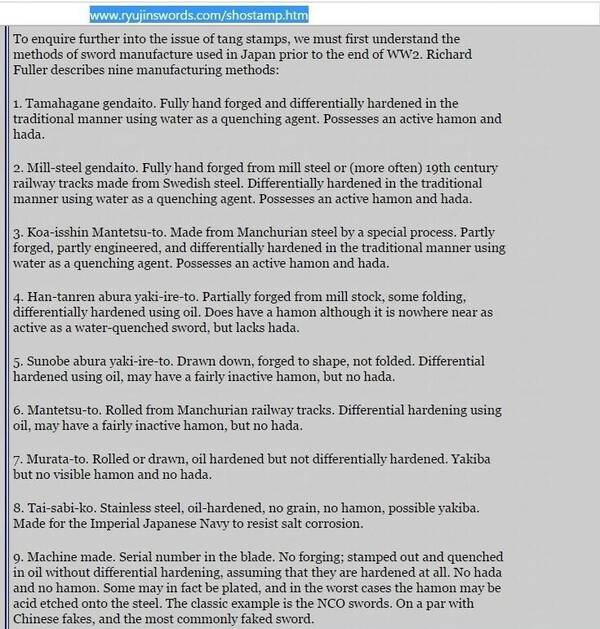
To complete this topic for future searchers I'm posting some info. And for lazy ones: [credits to @Navymate] From Markus Sesko's, "Index of Japanese Swordsmiths": “Toshihiro (寿広), Shōwa (昭和, 1926-1989), Tōkyō – “Miyaguchi Ikkansai Toshihiro” (宮口一貫斎寿), “Toshihiro saku” (寿広作), “Miyaguchi Toshihiro” (宮口寿広), civilian name “Miyaguchi Shigeru” (宮口繁), he was born in April 1897 as son of Yonezawa Kanjirō Masatoshi (米沢勘治郎正寿) in Tōkyō, he and his father were both adopted into the Miyaguchi family, after the death of his father he continued his studies under Kasama Shigetsugu (笠間繁継), he used the gō “Ikkansai” (一貫斎) from August 1916 onwards, in 1934 he entered the Yasukuni forge, special-order blades were signed by him with the name “Toshihiro”, the larger numbers of blades he made for the Yasukuni forge were signed with his Yasukuni-name “Yasuhiro” (靖広), blades made with western steel and some made by his students were signed by him with the pseudonym “Kunimori” (国護), in December 1936 he entered the Ōkura forge (大倉鍛錬所) and died on March 21st 1956 at the age of 59, his posthumous Buddhist name is “Kantoku´in Han´a Shinshō” (貫徳院繁阿真照), records say that he made about 500 blades for the Yasukuni forge.” From Fujishiro: “Yasuhiro Miyaguchi (Showa 1926 Tokyo) He is the chakushi of Miyaguchi Masahide, and is called TOSHIHIRO. He is in the Kasama Hankei Mon, he became the Kudan Nipponto Tanrenkai Toko for a number of years and signed YASUHIRO. However, later, without changing his name, he used both TOSHIHIRO and YASUHIRO. Also, in response to the demand for Yotetsu Gunto, he produced under the name of KUNIMORI (means “defend the country”). He also did horimono such as ryu, Fudo, Bonji nado. He died on Showa Sanjuichinen (1956) at the age of 60. Signatures: MIYAGUCHI IKKANSAI TOSHIHIRO MIYAGUCHI YASUHIRO YASUHIRO” From Chris Bowen: “It is well known (in Japan) that these Kunimori blades were made with western steel (Fujishiro points this out in his Shinto Hen) and they are not considered nihon-to thusly, in the mainstream. Most seem to be oil quenched as well. It is certainly possible to forge western steel and oil quench it to produce a defined nioi-guchi. What one does not generally produce in these blades is nie, which is what a shinsa team is looking for in WWII era blades where there is concern about the blade being made in a non-traditional way.” "…his swords were not made by Miyaguchi, only signed by him. According to his son, who helped hold the blades while his father cut the signatures, they were made in bulk by a smith in Shizuoka prefecture named Mitsukoshi Hiromasa, using western steel. Apparently they were forge welded, but the exact nature of their construction is not known." From Slough’s Reference on page 182: “His real name is Miyaguchi Shigeru, and he was born in 1897. He was trained by his father Masatoshi, and also studied under Kasama Ikkansai Shigetsugu. In July 1933, he received an appointment as a master swordsmith for the Nihonto Tanren Kai and was given the Tosho name of Yasuhiro. Then in January 1937, he became head instructor for the Okura Tanrenjo. The founder of this forge was Baron Okura Kishichiro, which was located on the grounds of his estate. Yasuhiro applied the mei Ikkansai Kunimori on swords made at the Okura Tanrenjo. He passed away on March 21, 1956.”
 1 point
 -
Oh its going to start drama again. But I saw this kabutogane and have to admit that it's best executed crest addon I saw on T98/94. Saya is badly damaged. Looking like someone didnt know how chuso works and ripped off koiguchi with lacquer from saya.

 1 point
 -
If you get it post please more photos of mounting.1 point
-
The tag is almost correct. It’s Hizen Kuni junin Tadayoshi Saku1 point
-
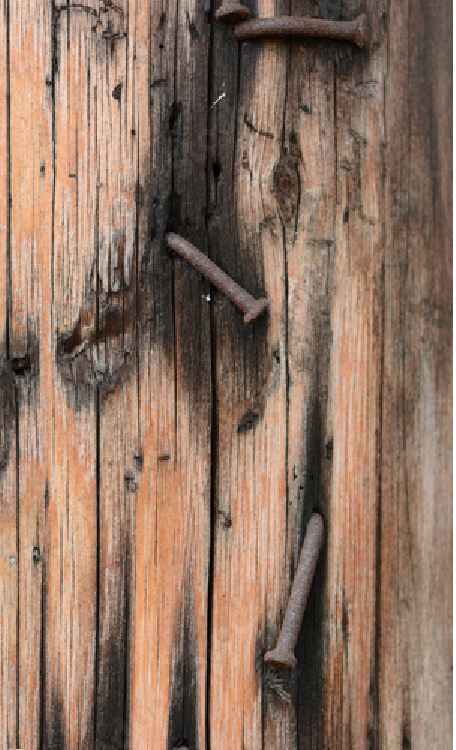
I think it might be related to something the smith might see every day on the walls of his forge - bent nails in the boards? [hand made nails of course] There are examples with what look like barbed wire or staples through them - I can't find images off hand.
 1 point
 -
Good afternoon Colin, In the hope that I can supplement your own memory - then the statement below is from the tsuba collection in the “Metropolitan Museum of Art”. Design is slightly different, but motive (without insect any 🕷️ 🦟), as well as the story could be related to your recent acquisition. Text: “The entire plate of the tsuba is carved to resemble a dead tree, with a spider web and threads inlaid in gold nunome-zōgan. A spiderweb on a dead tree combined with an openwork design (as here represented by the small ko-sukashi towards the bottom and the two hitsu-ana) alludes to a famous scene from the Genpei War (1180-1185). In 1181, Taira warrior Kajiwara Kagetoki (梶原景時, 1162-1200) was sent to pursue the fleeing Minamoto no Yoritomo (源頼朝, 1147-1199). Kagetoki discovered Yoritomo hiding in the hollow trunk of a fallen tree but as he was switching sides, he did not reveale Yoritomo’s hideout. A spider had spun its web over the opening in the trunk since Yoritomo had crawled inside and so Kagetoki pointed out to his men that no one could be hiding therein as that spider web was intact.” All the best. /Soren
 1 point
 -
Some of this conversation reminds me of the back and forth between Hannibal Lecter and Clarice in “Silence of the Lambs” (changed a bit to make relevant… and less creepy): HL: First principles… simplicity… read Marcus Aurelius, “Of each particular thing, ask what is it in itself… what is it’s nature?” What does he do? This man you seek? C: He collects nihonto HL: NO!!! That is incidental. What is the first and principal thing he does? What NEEDS does he serve by collecting? C: Anger?… ummm… social acceptance… HL: NO!!! He COVETS! THAT is his nature. And how do we begin to covet? Do we seek out things to covet? Make an effort to answer now. C: No… we just… HL: No… we begin by coveting what we see every day. Don’t your eyes seek out the things YOU want? C: All right, yes…1 point
-
"3) Imagine likening the various formulations of "collections" to identifiable psychological processes. Insecure attachment being linked to hoarding for example. " I knew it ! someone has caught on to the reasoning behind my lifelong obsession ! I am an insecure hoarder, explains a lot1 point
-
HI Khalid, I have a few thoughts on this below and a great article from Guido Schiller.1 point
-
No. 7 - a modern piece ...

 1 point











2.jpg.8de42af7965bf94f4e4e159e2a4faf93.jpg)
.jpg.4fb852af2a160df2fa08465fedf375fd.jpg)






















This leaderboard is set to Johannesburg/GMT+02:00