
Leaderboard


Popular Content
Showing content with the highest reputation on 02/21/2026 in all areas
-
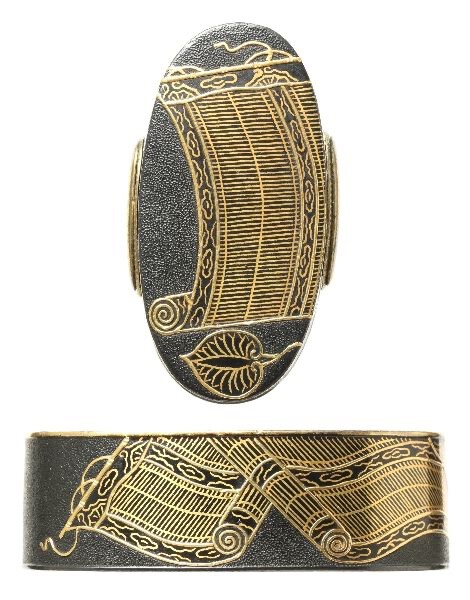
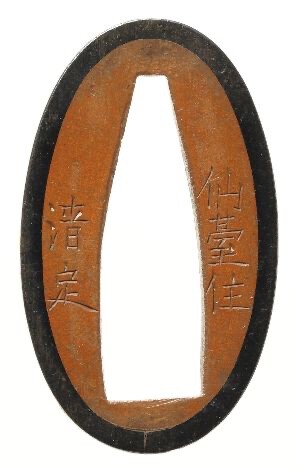
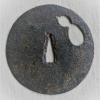
A amazing work by Kusakari Kiyosada, a metal artist from Sendai renowned for finishing shakudo surfaces in a uniform stone-texture ground (ishime-ji), outlining the design with gold wire, and executing delicate linear decoration in flat gold inlay (hira-zogan). Kiyosada trained with the Omori family in Edo and went on to create a new aesthetic distinct from earlier Sendai inlay traditions, characterized by a beautifully composed, planar pictorial space. After returning to his home province, he served the Date family and trained many disciples. The last example is probably daisho


 6 points
 -
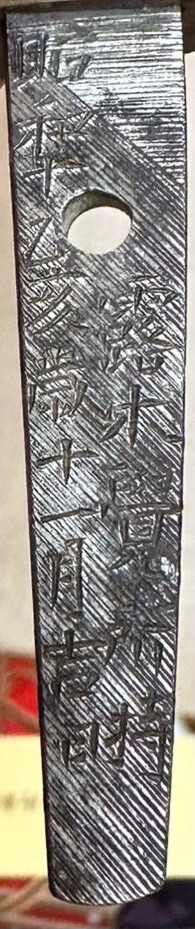
More precisely, 埋忠重義 – Umetada Shigeyoshi 慶長十二年八月日 – Keicho 12th year (1607), 8th month5 points
-
The US Supreme Court decision invalidated the tariffs issued under the International Emergency Economic Powers Act. These tariffs are separate from the 15% tariff the US and Japan negotiated in their trade agreement following the issuance of the IEEPA tariffs. For now, that trade agreement stands and should continue to dictate the tariff collected on nihonto imported from Japan. One open question is whether Japan will continue to honor this trade agreement since it was based in large part on avoiding the higher (and now invalidated) IEEPA tariff on Japanese imports. @eternal_newbie is right. The situation has been inconsistent ever since the IEEPA tariffs were first announced. Shipping companies have different processes to collect tariffs (or refused shipments altogether), some sellers under-declare the value of a shipment—leading to less tariff collected, and customs agents vary in enforcement—one reason why some have been importing swords via their airline luggage. I expect all of this to continue for the foreseeable future.4 points
-
I have picked up some times that things are delayed, and then suddenly everything loads fine. Usually mornings my time. I have asked the hosts to check what is causing it, and if there are times we are overloading resources. I am monitoring it and hope to have an answer and solution in the next few days. There is no identified cause at this point.4 points
-
And maybe just a little more on the cleaning issue. Part of making a tsuba for the artist is how they patinate it - it's a bit of an art in its own right - and the patina is part of the total piece. Yet at the same time tsuba can deteriorate over time from corrosion, crud, etc. If a tsuba has serious issues, it takes a real expert to remove (or at least reduce) the problems while preserving/matching the original patina as much as possible. Do you have any pictures of the tsuba before polishing? That might help to understand the era and school of the maker, as well as help guide what restoration might look like. As Geraint says, over time a patina will come back.4 points
-
Tom, you’re too generous - the guy didn’t even say “please”.4 points
-
I think they are both 文政, its just that the top picture uses a variation (𭐠) So 文政ニ卯年 and 文政元寅年4 points
-
Many apologies for my failures. New member of nihonto message board and woefully ignorant of proper procedures. Thank you for your helpful responses.3 points
-
I believe it is still a custom. I have had few friends who have these swords. I believe they are pretty much always ceremonial swords made by WKC Solingen in Germany: https://www.wkc-shop.de/en/ceremonial-swords-sorted-country/finnland/finnish-doctoral-sword-tohtorinmiekka-finnish-university-crest-options I've never been to university so I have no clue about the doctorates that grant you the sword. I know that universities have different emblems that are engraved on the design.3 points
-
I haven't purchased any blades from him, but I have bought some accessories like tsuba and fittings. He ships quickly and I've had no problems with him.3 points
-
Sam and Bruce, thank you! You both got it in one. I really did not understand what I was looking at when I was inspecting (there's an overstatement) the menuki. I'm glad I kept asking questions, and I'm very glad that you both were willing to point out my mistakes. As Sam said: That's an understatement, if ever I saw one! I'm beginning to think that I have just barely enough understanding to write a simple description that is not riddled with errors and inconsistencies. That, frankly, would be a small triumph! I plan to keep that with the sword, along with the details of my father's service in both the ETO and the Occupation of Japan. It seems important to have the sword's history documented, and to keep that with the sword. About ten years ago, I spent a good deal of time researching and documenting Dad's three years in the Army. In person, by telephone, through letters and email, I met quite a few veterans who were kind enough to share their thoughts and experiences, and they helped me to gain insight I would not have had otherwise. I'm very pleased that now I can also add what I've learned recently about this Type 95. I never thought it would be unusual to know where the sword came from, which goes to show you how little I know! After thinking about it for a bit, I expect most veteran "bring-back" trophies have little to no provenance unless the swords have remained in the family. Even then, I'm not sure that would be sufficient. I know my father rarely talked about his Army service; maybe that way of thinking was more common than I realized. In any case, I'm glad I will be able to provide this information to my son, and there will be a detailed provenance for this specific sword.. Thomas, I'm still tickled with that extra inspection stamp. It's great to know that it was something that was intentionally done, at least for a time, and it wasn't some random mistake. Thank you for taking the time to tell me! I have to say, again, that I'm in awe of the extensive knowledge all of you have cultivated through the years, and your willingness to support and assist one another. Thank you so much for your help. I appreciate it very much. I have also enjoyed reading Bruce's Japanese Sword Stamps, and I found Sam's Type 95 Military Sword Variations to be invaluable. I strongly suspect that any problems I had understanding the material are all on me. Marilyn P.S. I never met a note I couldn't turn into a letter. It's a failing, I know, but I've learned to live with it.3 points
-
This practice of having two 東 inspection stamps on opposite sides of the ferrule is well known by advanced Type 95 collectors. From memory, it was used for a short time only. Nice sword and thanks for sharing.3 points
-
You're amongst peers in your desire to dive right in! That's how myself, and many of us started this hobby. It's fascinating stuff. I think you're confusing asymmetrical wrap pattern with asymmetrical menuki placement. The wrap pattern is symmetrical, while your menuki are offset. The menuki depict Sakura Flowers (cherry blossoms). The wrap pattern is just the imitation silk wrap (cast in aluminum) that creates those diamond shapes across the hilt. The menuki on all Type 95s, and most Japanese swords are offset. This is because when you hold the hilt with two hands (you can try this at home), the menuki will fill the gaps in your hands/palms and create a more secure grip. Your confusion on the matter actually helps me though... I might want to reword that section in my document on the next edition, to make it a little more clear. Hope that answers some questions, All the best, -Sam3 points
-
Colin, thank you for your kind words! Your grandfather was in Japan as one of the earliest Europeans and just at an important threshold of Japanese history! He would have seen medieval Japan trying to become a modern nation in a very short period of time! How fascinating that must have been, and how difficult with no internet to ask question, no English speaking Japanese, and no Westerners knowing manners nor language! That would be a topic for a nice film!3 points
-
文政元年、文正二年 Bunsei 1 and Bunshō 2, but the second date mistakenly(???) uses a different character…3 points
-
Dear Mark. One of the things that cleaning it up will do is remove the patina from an alloy known as shakudo. This is a distinctive Japanese alloy of copper with a small percentage of gold which, when treated correctly, acquires a deep lustrous black colour which is still evident on the eyes and the inlayed sections at the back of the wing. Some of these retain their colour while some are now looking like copper where the patina has been removed. All being well, and further cleaning eschewed, these inlays will recover their patina over a considerable time. I appreciate that you are not interested in the monetary value but the best way of approaching this item is as a work of art and yourself as its temporary custodian. That art will communicate down the years if cared for. Enjoy this and keep up the research. In terms of age I note that no one has hazarded an assessment yet, it is an unusual tsuba. My guess would be late 18th to 19th century, just to get the ball rolling, but I look forward to others informed opinions. All the best.3 points
-
Hello everyone, TLDR: Interested in Japanese swords and fittings? I made this to help the field. Open nihontowatch.com on your phone browser, and add to home screen (Share → Add to Home Screen). Thank me later. --------------------------------------------------------------------------------------------- I have been thinking for quite some time about the future of our field. I have been blessed with incredible mentors and opportunities, most notably the late Darcy Brockbank, who was so generous in sharing his knowledge. Since his tragic passing, I have felt a responsibility to carry that work forward. What I am about to present, I built as an homage to his memory. Our field has problems. We operate in a field of extraordinary depth without being equipped with the knowledge and tools to understand what we're looking at when we browse the market. Refreshing dozens of dealer websites every week, most in Japanese, copy-pasting listings into translation apps, pinching to zoom on sites built twenty years ago — market awareness is just painful and you miss things constantly. You spend an hour and walk away unsure you have seen everything. And this is just the market experience. The deeper problem is access to knowledge. There are no catalogues raisonnés for artists. Yuhindo would have grown into it — it was planned. But alas, Yuhindo is no more. No way to know, with any confidence, whether a price is reasonable without decades of experience or tens of thousands of dollars invested in published references. No way to know why something costs what it does. Communication with Japanese dealers remains daunting for most. No easy way to know who is a reputable dealer. The barrier to entry is simply too high, and this friction keeps our field artificially small. Fine art has Artnet. Watches have Chrono24. Antiquarian books have AbeBooks — markets with comparable depth and comparable opacity, served by platforms that bring transparency and accessibility. These fields have benefited immensely: they have enabled new entrants in droves to collect in confidence. Our field needs more knowledge and transparency to build interest and trust.Japanese swords and fittings. Eight hundred years of collecting history at the highest levels. The category that contains the most national treasures in Japan. The indefatigable search for perfection of an entire civilization. And yet, we have nothing. This had to change. As I write this, there are 3,021 Nihonto and 1,607 Tosogu items for sale across 44 dealers, Japanese and international, in a single searchable interface. Every listing is structured with attribution, certification, measurements, and artist intelligence data. NihontoWatch is on track to follow 100% of the online market for genuine items with NBTHK papers. Refreshed 12 times a day. Everything is translated and structured, as it trickles in live. But what is this worth, if it's so hard to know what you're looking at? Especially for newcomers, it is so hard to tell what you're looking at. This is where the magic is. I am nostalgic of reading through Yuhindo's artist descriptions. It made me deeply appreciate the field. It got me in. NihontoWatch scales this experience and creates something approaching a living catalogue raisonné for every Tosogu and Nihonto artist. It matches every listing against a database combining the complete Juyo, Tokubetsu Juyo, Juyo bunkazai, Kokuho, and Gyobutsu designation data — over 23,000 items at the highest level, with rich text in classical Japanese. This data is then processed, synthesized, and presented into NihontoWatch's artist directory in a way that is respectful of the NBTHK's copyright. With this, you'll be able to discover a maker's historical reputation through quantitative analysis of exhaustive provenance records, in ways never seen before. Over time, all of these artist pages will come alive, forming an ever-expanding knowledge base. - How rare is it? - How many Tokuju? - How many designated works ranked Juyo and above? - Why is this important? - Where does it rank relative to other works? - What is for sale right now? - What was for sale recently? All the answers are in. These are questions that come up constantly in our community, and until now, answering them required years of collecting published references worth tens of thousands of dollars, and patiently indexing them with post-its or one-by-one in a spreadsheet. Only professional dealers or major collectors could afford to do this. This is a BETA, so there are errors. The more obscure the artist, the higher the error rate, and there are still basic errors I need to fix with some famous artists. A lot of algorithmic tinkering and curation ahead. It will keep getting better with your feedback. See the results for yourselves: - Soshu Masamune: https://nihontowatch.com/artists/masamune-MAS590 - Ichimonji school: https://nihontowatch.com/artists/NS-Ichimonji - Yasuchika (tosogu): https://nihontowatch.com/artists/yasuchika-TSU001 - Goto school: https://nihontowatch.com/artists/NS-Goto Click one and explore the designations, the provenance abalysis, the measurement distributions. This is just a first shot — over time this data will grow. Here is one where I have published an item I studied for my Substack article on Mitsutada: - Osafune Mitsutada: https://nihontowatch.com/artists/mitsutada-MIT281 Imagine Yuhindo, but with a page for every artist and every piece ever captured on camera. Saw a national treasure at an exhibition in Japan? Share your photos on NihontoWatch's artist catalogue. In the future, owners of particular works will be able to publish them to the artist's catalogue. Think of it as a growing, community-curated knowledge base for every artist in the field. And so much more Browse and filter: Designation, dealer, item type, school, province — all filterable, all instant. Prices display in JPY, USD, or EUR. Every filter combination is a shareable URL. The sold archive tracks thousands of items for pricing research. And it works for every budget, for collectors at every level. - All Tokubetsu Juyo Nihonto on the market - All Tsuba with Hozon or Tokubetsu Hozon, maximum price $2,000 Setsumei translations: On some items, you can press the floating book icon on any Juyo item to toggle between photos and the Juyo setsumei translated text. For most Juyo and above items, the NBTHK evaluation text from the dealer's page is identified by computer vision and translated into English. It will fail if the dealer has not posted the Juyo Zufu extract, but in the majority of cases they do, and the result is remarkably accurate. Do use responsibly — the quality is great, but not perfect. Always purchase professional translation from Markus Sesko when contemplating the purchase of a Juyo-designated piece. Search alerts: Never miss an item again. Define keywords and filters and save them. NihontoWatch will run your search every 15 minutes, and when something new appears, immediately send you an alert email. In practice, missing a listing that fits your interests becomes almost impossible. Tip: I recommend avoiding overly specific queries. "Juyo tsuba" or "Kamakura signed tachi" are safer than specific artists such as "Yozozaemon Sukesada," which would be more fickle. Broad queries give you the best market coverage. Inquiry emails: Press "Inquire" on any listing to draft a professional inquiry in Japanese. Handles etiquette and formality, and can help you request the 10% consumption tax exemption available to overseas buyers. Did you even know you could get 10% off? How many new entrants lost 10% on this, at least at the beginning? I for one did. I've seen countless high spenders neglect to request it while shopping across Japanese galleries. Glossary: The technical language of Nihonto and Tosogu is deep and specialized — needlessly so for non-Japanese speakers. Anytime a technical term comes up, you can click and see what it means. Over 1,200 terms, searchable, automatically linked from the setsumei translations. Who remembers always keeping an index open to keep track of terms when studying Juyo items? https://nihontowatch.com/glossary How best to use NihontoWatch While it works wonders on desktop, NihontoWatch works most beautifully on your phone. I use it every day — it feels like I have the market in my pocket. Open nihontowatch.com on your phone, hit Share → Add to Home Screen. And voila, you have an app. It becomes something you check with your morning coffee, the way one might check the news. A word of caution The data has errors — always verify independently. This is a tool to explore the market, not a substitute for critical thinking. If it looks too good to be true, it likely is, and this system can't easily correct online misrepresentations. Old listings where dealers have not marked items as "SOLD" will still appear as available. Listing errors will slip through, but data quality improves continuously as the system learns over time. Get involved - Missing a listing or dealer you like? PM me or post here. - Bug? PM me or post here with steps to reproduce. - Dream feature request? Reply in this thread. I will keep this thread active and share major updates when time permits. Everything is free right now, and will remain so until ready for official release. This is no trivial task, and it is expensive to operate — it will need to be covered in some way down the line. It will be tempting to keep it for yourself. But if we want our field to grow, we must share knowledge and expand market access and transparency. The single most impactful thing you can do right now is help others discover and use the tool. Share it with your study group. Share it with your collecting circle. Share it with a friend who has been curious about Nihonto and Tosogu but found the barrier to entry too high. That barrier just got a lot lower. Farewell, Darcy. This is for the teacher in you. Hoshi
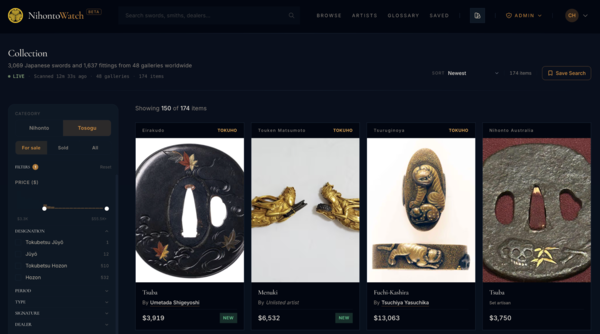

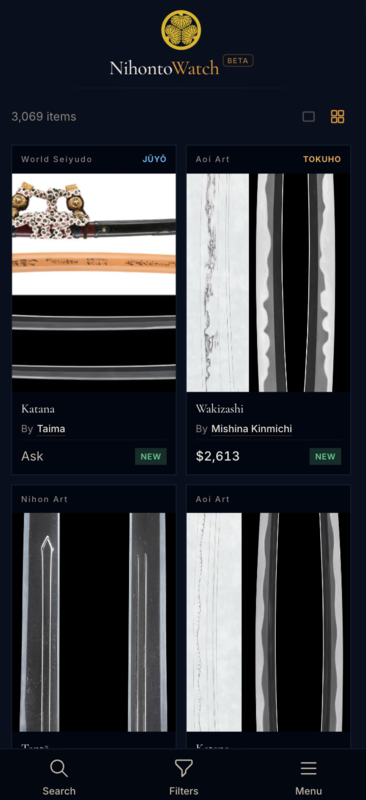
 2 points
 -
I received this when I was a kid and over 30 years after it was acquired. It was never kept by anyone in my family as a collector piece or a piece of history I’m sure that cleaning it was not the worst thing that could have happened to it. I’m sure that it was probably cleaned at some other point because I did not clean off heavy crud or patina. So I get it now it will never be cleaned again.2 points
-
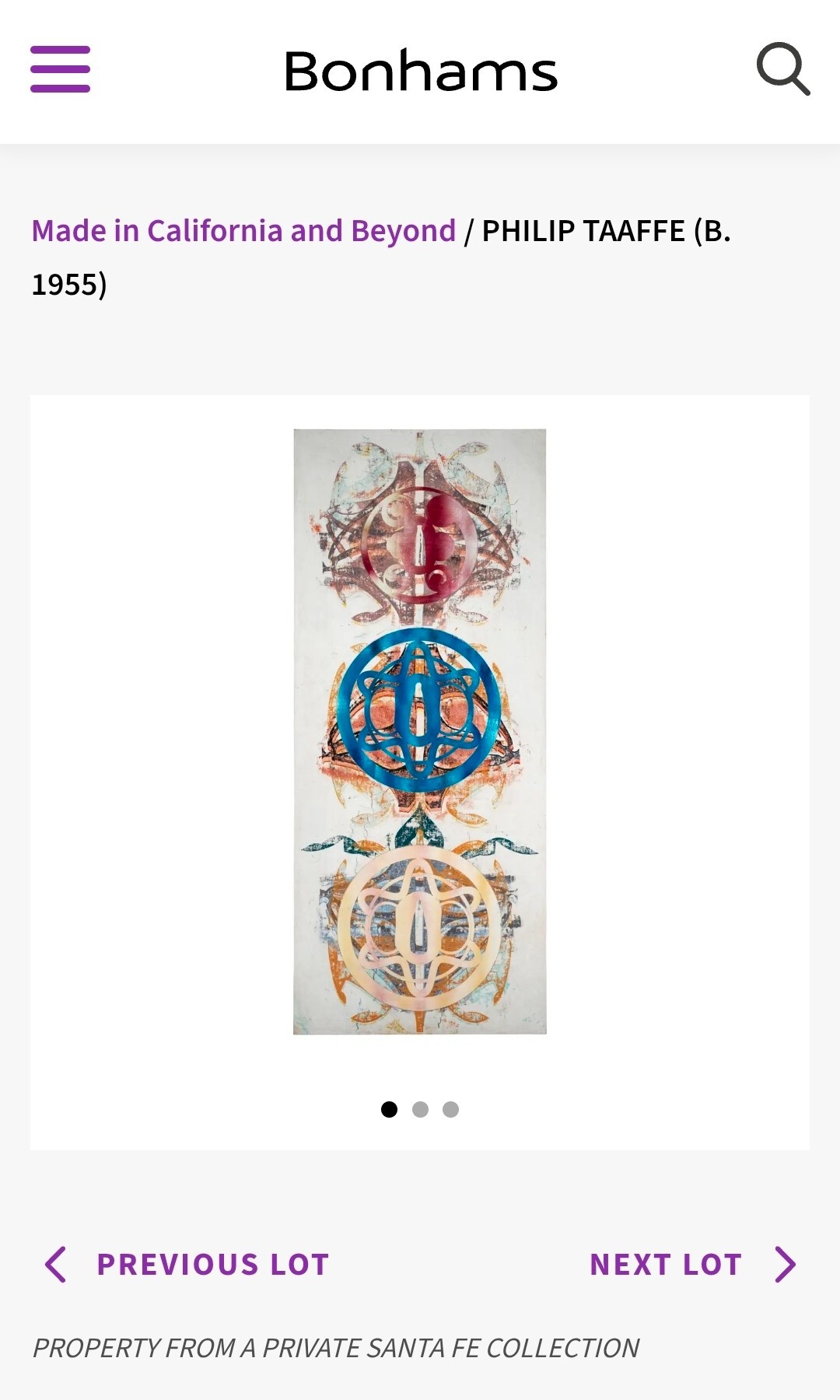
Anyone have an extra 12k-15k to drop on a tsuba art print? 😆 https://www.bonhams.com/auction/31839/lot/2/philip-taaffe-b-1955-tsuba-figure-1995-96/
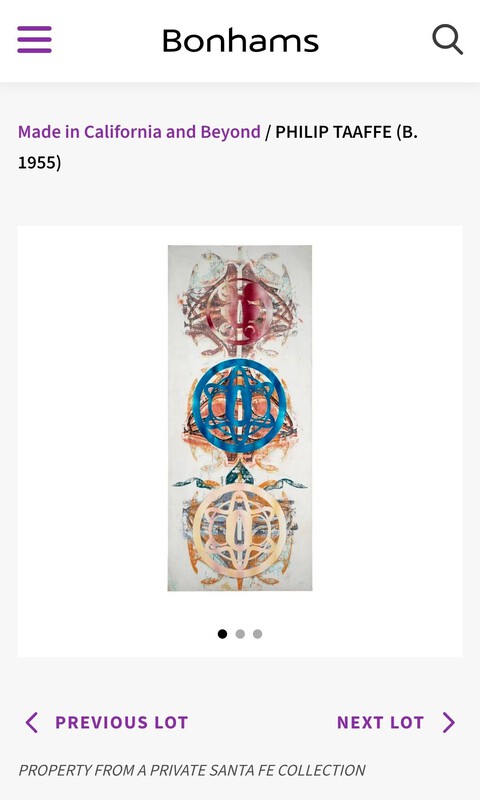 2 points
 -
Once again, I agree with Colin. This is a silver plating, the inlay looks like this: I think it's just an amateur work from the late Edo period. The inlay of birds, like themselves, is sloppy, and the edge near the tree after the chisel was raised and not processed, not a complicated technique.
 2 points
 -
Marilyn, Thank you for sharing a bit of your father‘s story and the story of the sword. Many of us don’t just collect swords, it matters to us the people they served and the stories behind them when those can be told. These things to me, represent real people in real lives. Thank you for sharing some of yours again. You’re welcome to hang around here as often as you like and read the various conversations that go on.2 points
-
Joshu Rai Kunizane2 points
-
Signed Umetada Shigeyoshi, and dated Kei-cho 122 points
-
Buy “asymmetrical“ are you talking about the fact that one is lower on the handle on one side and higher on the handle on the other? If you are, that is how they are all made. That is perfectly normal.2 points
-
Hope I'm not duplicating efforts, but this is the latest of his newsletters, JULY, 1971 Volume IV, No. 7. Something I found interesting: "Leon says " On page 9 below the section showing the family tree for the Awataguchi Tadatsuna school, there is a comment saying that a famous sword by Ikkanshi Tadatsuna was used to assassinate the corrupt official Tanuma. Abert says that Tanuma forced the Honami appraisers to write false appraisals or orikami for swords. I had read about the Tanuma corruption before, but had never heard about false or worthless orikami by the Honami."" Albert Yamanaka Swordsmith Article.pdf2 points
-
2 points
-
Like an iron tyre/tire on a wooden cart wheel... BaZZa.2 points
-
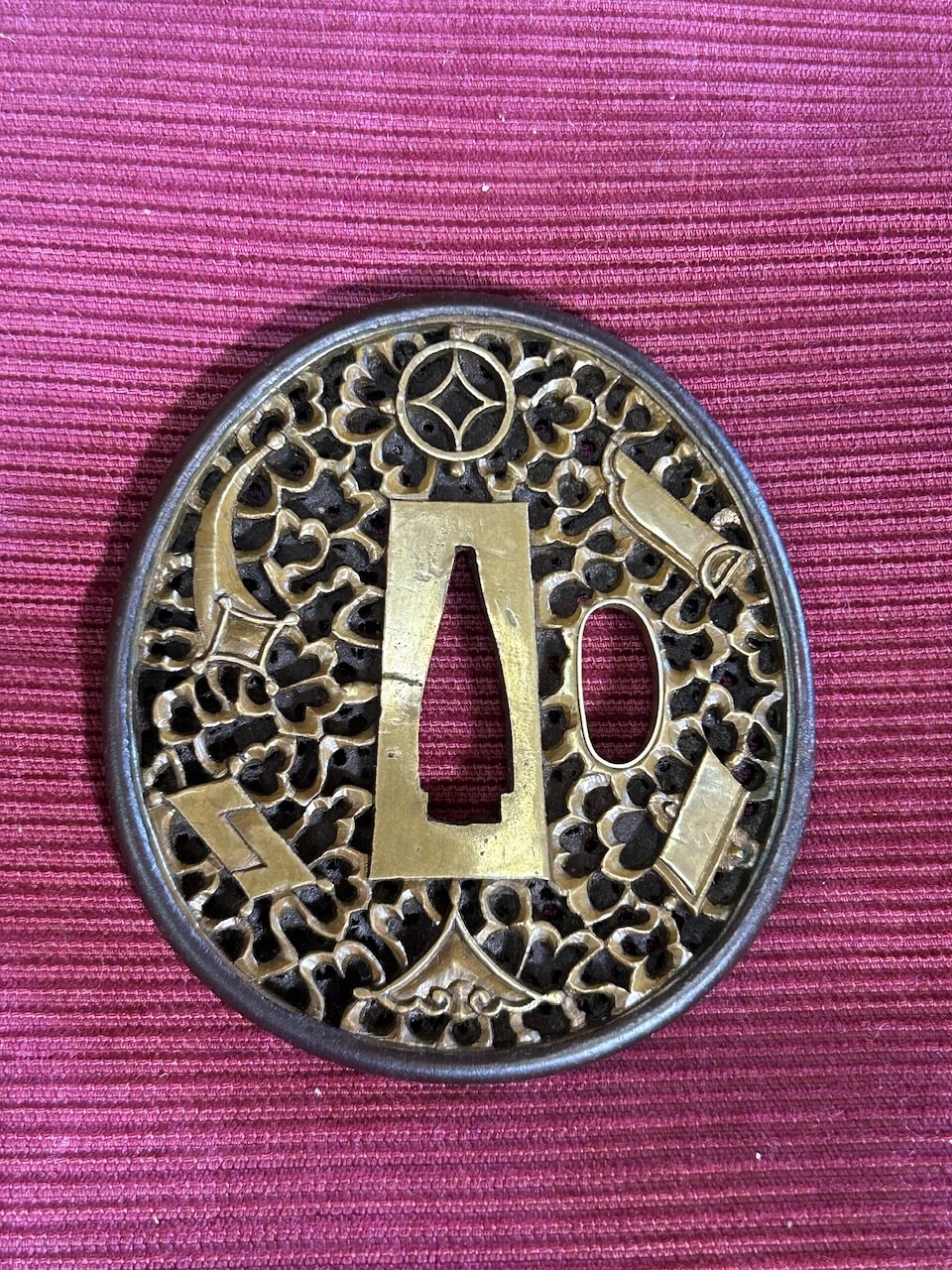
Showed this to a Kinkō artisan today. He thinks the shinchū insert is later Edo work as the carving style is quite different, and that the iron mimi fukurin rim was heated (熱処理, netsu shori)and slipped over to hold the two facet sections together.2 points
-
Just got a new armor. It's unsigned . There are plates with Bonji on the sleeves. Would appreciate your thoughts. Thanks to Nick Ricupero for selling this to me.

 1 point
 -
Alex: I give my two cents here since I have been doing some ordering from Japan. As Rohan noted, it can depend on the seller. There are options for them to ship the item having already paid the fees. On the stuff I have gotten, under shipping it usually says something like "includes all duties and fees" etc. Sure it costs more for shipping and I suspect they are charging a little more than necessary, though the transactions have been seemless so far and actually faster than USPS. I've had stuff shipped DHL, USPS Speedpak, and USPS priority mail international. John C.1 point
-
Type 95 Variation #4, Kokura-Kōbe 107164, with two 東 ferrule stamps. My First WWII Type 95 Japanese NCO Sword - Info Requested
 1 point
 -
My vote is genuine old sword badly neglected and subsequently badly mistreated with gimei added at some point. One of those gambles…..personally I’d roll the dice. I love a gamble.1 point
-
I'm undecided about this sword, as are most people I think. The horimono looks genuine and very well done, but looks to me to be later work, maybe with modern tools. I really don't know. The package doesn't look like it was that was for hundreds of years. No, it's not by THE Masamune. But it should be examined by someone qualified to see if there is hamon and hada, and the quality. Restoration of patina etc is possible if the sword warrants it. But i really don't know what we have here.1 point
-
Here is the Nakahara Nantenbo that was part of this set of 8 hanging scrolls. Nakahara Nantenbo (1839-1925), whose Buddhist name was Toju Zenchu (Complete Devotion), was in the last 17 years of his life the Exalted Master of the main temple of Moyoshin-ji of the Rinzai sect. A contemporary of the great lay Zen master, swordsman, calligrapher/artist, and statesman Yamaoka Tesshu, whom he met while teaching at the training hall at Sokei-ji in Tokyo and had daily private meetings with, he was a tireless reformer of Zen monastic training and activity, emphasizing strict practice and koan study. This brushwork was done when Nantenbo was 80 years old. A similar one offered by Gallery Friedrich Muller is listed for $1,700. The kanji inscription is the first verse from a famous Chinese couplet often used as a blessing for good fortune: 福如东海长流水, 寿比南山不老松 Fú rú dōnghǎi cháng liúshuǐ, shòu bǐ nánshān bù lǎosōng May good fortune be as boundless and enduring as the flowing waters of the East China Sea, and longevity stand firm like the ageless pines of South Mountain
 1 point
 -
. Eitarō Uchiyama (1887–1973) was a lieutenant general in the Imperial Japanese Army during World War II
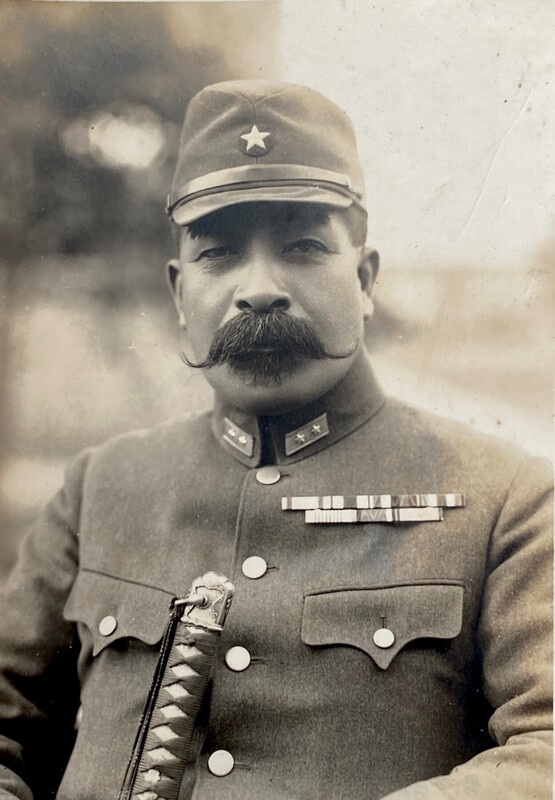 1 point
 -
Yes, I am only too aware, very frustrating. They have been working on the site issues, but can't seem to fix it. Works one day, not the next. Looks like it is time to get a new host, and start over or shut it down.1 point
-
Can I send you a "P" for your headline?1 point
-
By not obvious, I meant there is no link anywhere that says "register", so I never even tried to log in, because I didn't have one yet. Only after thinking to try it as a last ditch effort to get forwarded to a registration page, did I even try. The code then came immediately. I'll PM you another seller I search often. Thanks. Again, great work and super appreciate the effort!1 point
-
Hello, Are you referring to the email verification code? I'm aware email codes have been slow since the announcement, this is to the traffic on the email service. Otherwise, let me know what you mean by 'not obvious' - I'll make it better. Many members here and dealers have written over the last few days with requests, we're up to 52 dealers today. PM me what you'd like to see. Best, Hoshi1 point
-
Thank you Pier In the Bunsei 1, I can read the Tora zodiacal kanjIi (in 4th position) what do you think ?1 point
-
Yak hair, often used to trim a variety of armour components…..mostly Kabuto and Menpo. (Just the opinion of a total beginner!)1 point
-
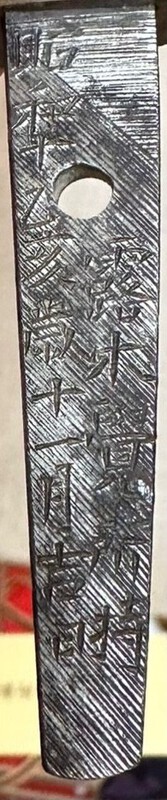
Could someone please help me translating this total inscription on the opposite side of a Hisakatsu tanto? Thanks in advance.
 1 point
 -
https://www.tsukamaki.net/PDF/gary_montgomery01.pdf An amusing story of early tsuba collecting - and why cleaning is not something to undertake without research.1 point
-
Probably you have seen this: https://wakeidou.com/pages/640/ Ichijo work. His student Ikkin could do this sort of design even better, though he kinda worked to the level he was getting paid. Thus, some stunningly detailed Ikkin works, and some kinda mailing it in. This is an example of "mailing it in" : Is yours Ichijo school? Hard to know. I would say No. I understand @Rivkin point that it might be Meiji work. The focus is more on decoration, less on detail. That does point more towards Meiji.1 point
-
Generally it's a big no-no to clean these unprofessionally as the patina will often contain vital clues as to age.1 point
-
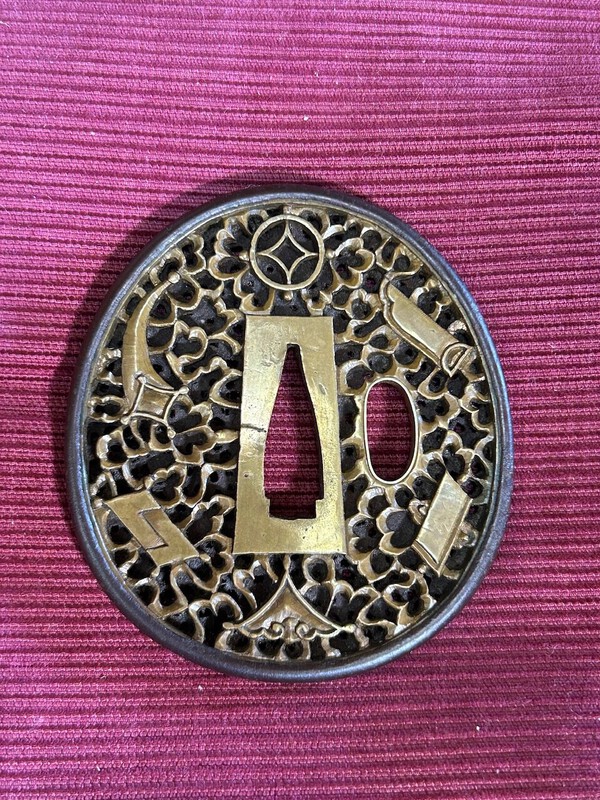
Too many incoming rounds! Duck!!! Fantastic stuff guys, the NMB Detective Agency. Here’s the answer… shinchū set somehow within the iron mimi. 7.75 x 7.0 x 0.55 cm
 1 point
 -
Hi Mark, a very nice guard! The overall design is not uncommon but so far as I know all other examples are in iron so yours is even more unusual. https://varshavskycollection.com/collection/bizen-shoami-sukashi-tsuba-with-a-butterfly-design-early-edo-period/ https://www.flyingtigerantiques.com/ca-1600-large-Japanese-katana-tsuba-of-the-ikeda-clan-mon-form.html https://www.liveauctioneers.com/price-result/bizen-shoami-sukashi-tsuba-with-butterfly-design-a-cut-off/?srsltid=AfmBOoqXf04EdDxx-K4vRdHHHFGXVgEhwJa_3yaSjEVbIdiUzrIZBmu4 Very likely these examples have had the rim removed. MFA Boston https://www.espace4.com/en/collections/marugata-iron-tsuba-butterfly/ https://world-seiyudo.com/product/tu-030522/ Welcome to NMB1 point
-
Yes, as Jean and Bruno say, an unusual but strangely attractive version of agehacho swallowtail. Alignment of eyes, dot numbers, number of legs… The wave treatment of the rim is striking too. It could be a ‘torn-fan’ butterfly. Will check some books. Among others, the Ikeda Daimyo family of Himeji and Tottori used the standing, wings-up butterfly.1 point
-
I don't know that I can help you find the Honjo Masamune (any more than I am able to help myself do so), however a couple of quick items. I actually just posted a video on the Honjo Masamune a few weeks back, with some informtion which may be helpful in general in learing about the sword: I see now that the koshirae for the Honjo Masamune appears to have remained in Japan, perhaps rediscovered but likely never left Japan, and was displayed at an exhibition: https://tsumugu.yomiuri.co.jp/feature/桃山展「本庄正宗」の刀装初公開/1 point
-
Knife collectors will tell you that few of us keep expensive knives in their leather sheaths. Often the steel handles it well, but the brass fittings can suffer. I'm with Ed, you won't know what your leather supplier used, best to be safe.1 point


















This leaderboard is set to Johannesburg/GMT+02:00