

Exclus1ve
-
Posts
183 -
Joined
-
Last visited
-
Days Won
2
1 Follower

Recent Profile Visitors
1,239 profile views


Exclus1ve's Achievements






-
Actually, I think the relief was simply carved out of the solid metal. It’s not an inlay, and perhaps that’s what gave some people a vague sense that something was off…
-
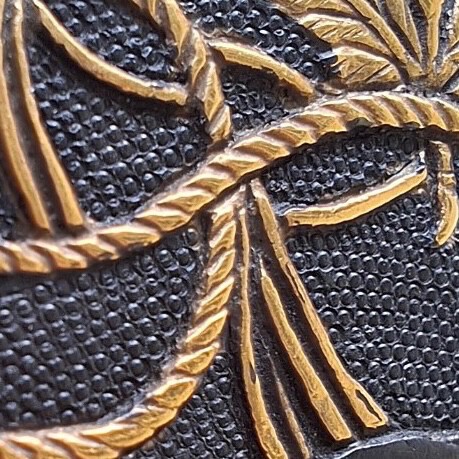
Perhaps it makes us a little more attentive and vigilant) But above all, look more closely at the work itself. I think it’s genuinely difficult to fool someone in tosogu. The important thing is knowing what to look for. P.S. In this particular piece, take a close look at the highlighted areas. Between the dots, there is an incredibly fine and sharp ridge. In some places, the metal bends in a “wave” which simply cannot be achieved through casting. In other areas, the tool was worked into the same spot several times, creating many complex forms on the tiniest scale. This was done by a human hand.

-
I would take the position that this is a genuine, legitimate tsuba. The quality may be comparable to Nagoya work, but I think it is nevertheless a rather mediocre piece from the late Edo period, and definitely not a modern reproduction. The file marks on the nakago and hitsu-ana also look natural to me. Even on more expensive pieces, these areas were not always polished completely. If you look closely at the actual workmanship, you can see that the nanako was made with a hand tool: there are many sharp sections between the individual “dots,” and the tool marks are clearly visible. With casting, all those fine, sharp details tend to become smoothed out. As for the gilding, for some reason everyone seems to think that it should be perfectly even and uniform, especially on simpler pieces. That is not necessarily the case. Applying gold amalgam with perfect precision and evenness is not easy to begin with, and during the heating/firing process it has a tendency to spread beyond the boundaries that were originally defined. This photo is revealing to me.
-
Shakudo with a high gold content almost always has a rich bluish-purple tone with an iridescent sheen in the light. My observations are based on those of Ford Hallam. He mentioned that, by the late Edo period, gold was no longer used to achieve this kind of black patina. These are only my own observations, but it certainly doesn't look like modern work to me.
-
Based on these photos, it does not appear to be shakudo, it is more likely a later alloy. However, the construction looks original and does not appear to be a modern reproduction. I think it is simply an ordinary late-period piece.
-
I agree. In this case, the cleaning appears to have been chemical. That's worse than simply losing the patina. The copper color will never be the same again because the top layer of the metal has been chemically etched.
-
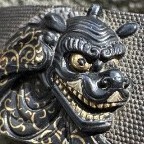
Questions on a Dragon Fuchi-Kashira: School, Period, and Technique
Exclus1ve replied to FruitSamurai's topic in Tosogu
Everything is fine with this F/K set. -
Questions on a Dragon Fuchi-Kashira: School, Period, and Technique
Exclus1ve replied to FruitSamurai's topic in Tosogu
Hello) I don't see any crime) It feels like the relief has been somewhat worn down through use. I'd guess it's kyo-kinko. -
More often than not, people are interested in the sword itself rather than the fittings. Dealers understand this. There's a fake security guard there.
-
According to the new photos, the quality seems to be more ordinary, which is typical of school work. The signature itself is well written, the first kanji is different in spelling, perhaps it makes sense to have another artist.…
-
I think we often focus too much on Mei instead of looking at the work itself) Thomas, is it possible to take large photos of the object itself?
-
Hi, Jake! I just can't stop thinking about it) Repatination is a complicated process and doesn't always end successfully. Also, the black color of the tenjo-ita matches the base material of the fuchi perfectly, and overall it looks like a single, seamless piece (it's been polished without any gaps), so it doesn't seem like a separate chemical treatment. I can't really judge the authenticity of the mei, and I wouldn't rely on shinsa 100% either, since the craftsman wasn't famous enough for forging his signature to be as worthwhile as forging the signatures of the great founders. Variations in his signature over the course of his career are entirely possible, and this signature is executed quite well. Based on these photos, the quality is clearly above average. The carving and especially the nanako both look very good. imho
-
A good example of the Soten school.
-
These are low-quality works of the mass segment. In the style of Soten, yes, but this is not even close to the work of the Soten school itself. The signature was made by a man who is just beginning to master a chisel.
-
I like. The plate is completely black because it is made of the same alloy as the rest. This is less common, but still a common occurrence (in the kinko meikan example as well). I would ask you to take such large photos of the work itself.


