Iaido dude
-
Posts
559 -
Joined
-
Last visited
-
Days Won
3
Recent Profile Visitors
4,742 profile views
.thumb.png.54593db2789c8a1dcb235543b184ce39.png)


Iaido dude's Achievements






-
 The mitsugake used for yabusami (left) is more like a regular glove and doesn't have the hardened thumb with groove that is used in kyudo (right). This really reflects the different focus of kyujutsu (combat archery) vs. kyudo (contimeplatve archery to develop the mind/body). Many riders don't use a glove at all for nocking, drawing, and releasing the arrow, which has to be done in rapid succession. The softer mitsugake allows for more tactile sensation and manipulation. I also wear a glove on my bow hand that covers the thumb and provides protection from the feathers hitting the inner arm and the top of the web between thumb and first finger where the arrow shaft rests during the draw. This is very important because the technique of shooting in yabusame is to not allow the string to turn (called yagaeri), which is an advanced technique in kyudo acquired through years of practicing the bow grip (tenouchi). The grip on the bow is tighter so that the released string essentially ends facing the rider after release, allowing the next arrow to be nocked in succession. If yagaeri occurs, the string will rotate counter clockwise to the back of the bow hand and difficult to bring back around clockwise.

-
I have a set of crafted elm burl tsurumaki for storing spare strings and giriko-ire crushed pine resin container for my mitsugake 3-fingered glove. I have replicated how these are attached to the waist with an ito (in this case the cord is an ojibime for kimono) based on a vintage set (right). .


-
Thanks very much, Jean. I'll add that woodblock print to my growing catalog of kyudo-related artworks. I just received the leather strips and pieces needed to complete the leather restoration and will post the completed restoration of the utsubo on my other thread dedicated to my efforts to set up a wooden horse for yabusame training at home. I had this amazing opportunity to train in Kamakura about 12 years ago that I will never forget. Only bringing focus back to kyudo/yabusame in the past 2 years after overcoming chronic pain from a sports-related nerve injury to my left upper arm and neck that happened about a decade ago. https://quantumfieldbasedmedicine.substack.com/p/the-clinic-as-dojo-part-i-entering?r=vfrlb
-
This source material is worthy of a dissertation thesis!
-
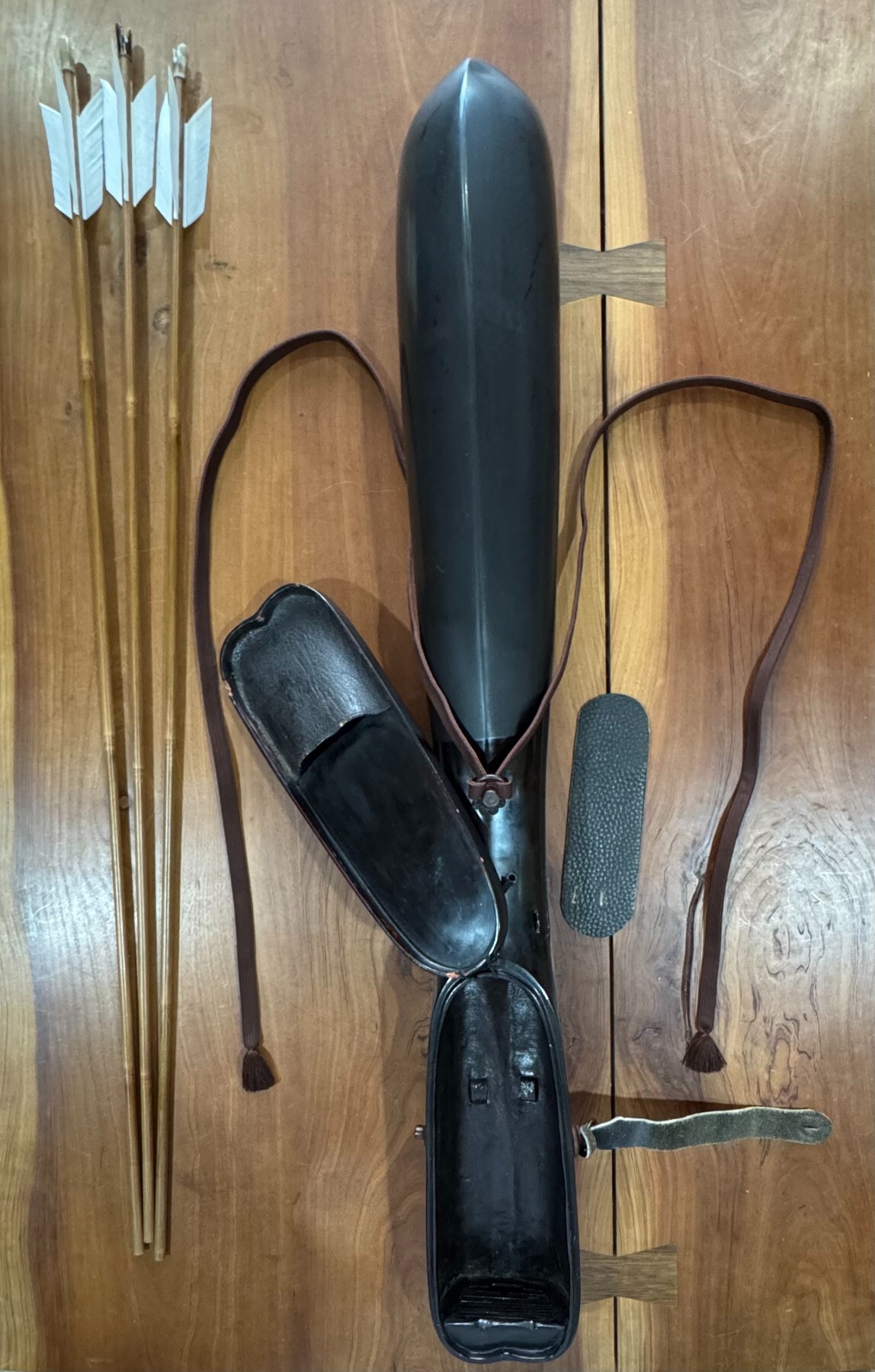
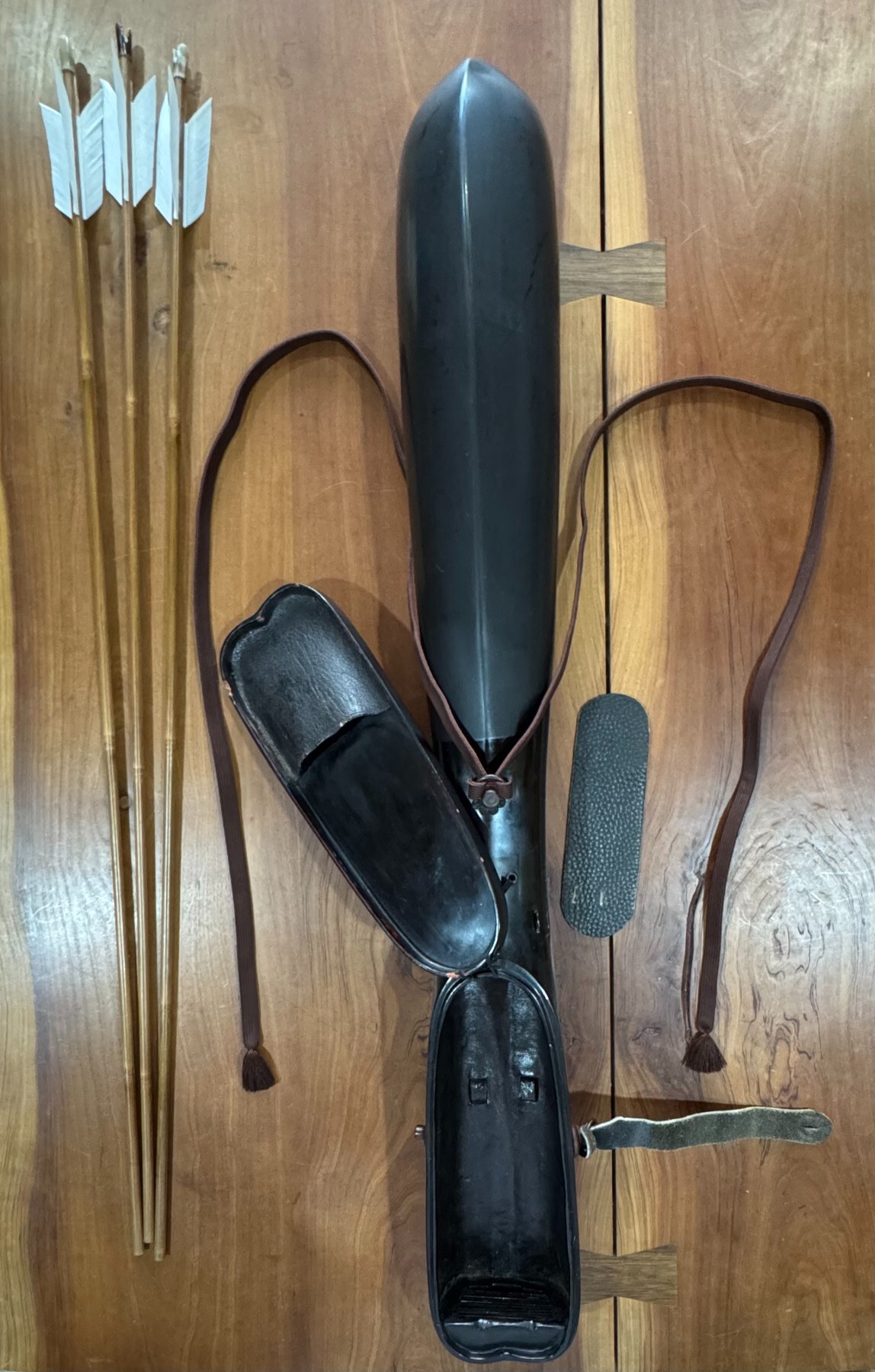
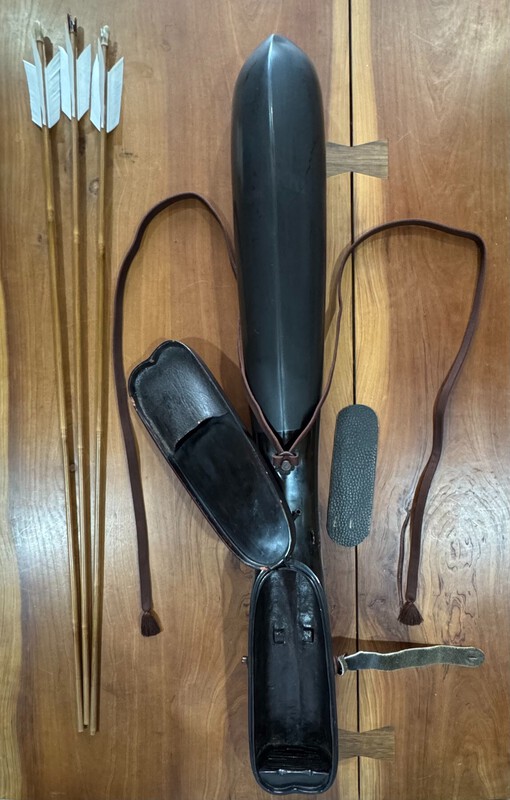
Fascinating, peteb. Thanks for sharing. I've encountered a fair number of scrolls that are almost like schematics with written instructions on the different types and grades of feathers that are traditionally fletched on arrows for kyudo. Or an amazing one (I don't own it) that details the parts of an utsubo quiver, which really helped me to restore the leather on one that I have. Of course the leather doesn't last for centuries. However, the shiny protected lacquer surface tells you exactly where leather covered it originally. Mine has a smooth black lacquer finish, not the woven basket type of surface for the upper compartment as per the schematic. Tips point down and the archer reaches to the right side to extract the arrow. The image of the two other utsubo previously on auction shows that the seller had the impression that the orientation was reverse, which is why the tassels of the obijime appear to be hanging in the air when I show them in the correct orientation. . . .



-
The English saddle is probably going to lend itself to yabusame, because the ite has to shoot with a long asymmetric yumi bow on the left side. The horn on the Western saddle seems like it could get in the way. The 9" hand-carved horse head will be scavenged from a decorative wall hanging. The tail is going to be a small hand broom. Gotta use imagination.


-
I am going to create a wooden horse for yabusame training by combining the following: 1) Freemax treeless "English saddle" with straps for mounting the Abumi ($210, eBay) 2) Wooden saddle rack with curved top surface, heavy duty and high weight tolerance ($70, Amazon) 3) Improvised head and tail attached to either end ($33, Amazon) 4) 3/4" board, 20" wide, 36" long ($18, Lowes) 5) Large 24" motorized electric turntable with 500 lb weight tolerance ($130, eBay) Total is <$475. .


-
The traditional Japanese saddle, called a Wa-gura, is made of a wood frame that goes over the back of the horse. The yabusame practicitioner, called an ite, has mastered a unique technique called tachisukashi--a form of riding without pressing the horse’s body with the legs and without resting the body on the saddle. The hips are kept away from the saddle by one sheet of paper distance. This is accomplished in part by the unusual flat bottom design of the Abumi, which allows for full contact with the bottom of the Monoigutsu, which allows for exquisite control of the body position in relation to the Wa-gura. In this manner, the ite maintains a stable posture without the up and down movements of the upper body, enabling him to aim accurately shoot at the targets in full gallop. I found a vintage Wa-gura on Etsy for $260 with minimal shipping cost from Japan. However, it is clearly too fragile from age and wear to be used. The one below is decorated in maki-e. It is highly collectible for $750. Instead, until I find a suitable example, I'm going to use a leather English saddle (possibly a spare donated by one of my patients who is an equestrian in Ocala, FL, which is big time horse country).


-
It looks like Oda Nobunaga is wearing an Utsubo, while the other archers are using Ebira. Just a really nice composition and historical reference for the hunting costume in use at around the time of the Azuchi-Momoyama period. They are wearing hitatare with the crossover front, not suikan tops with collar tie.
-
Interesting. Same artist as the one I posted. Different series, but both related to Chiyoda Castle.
-
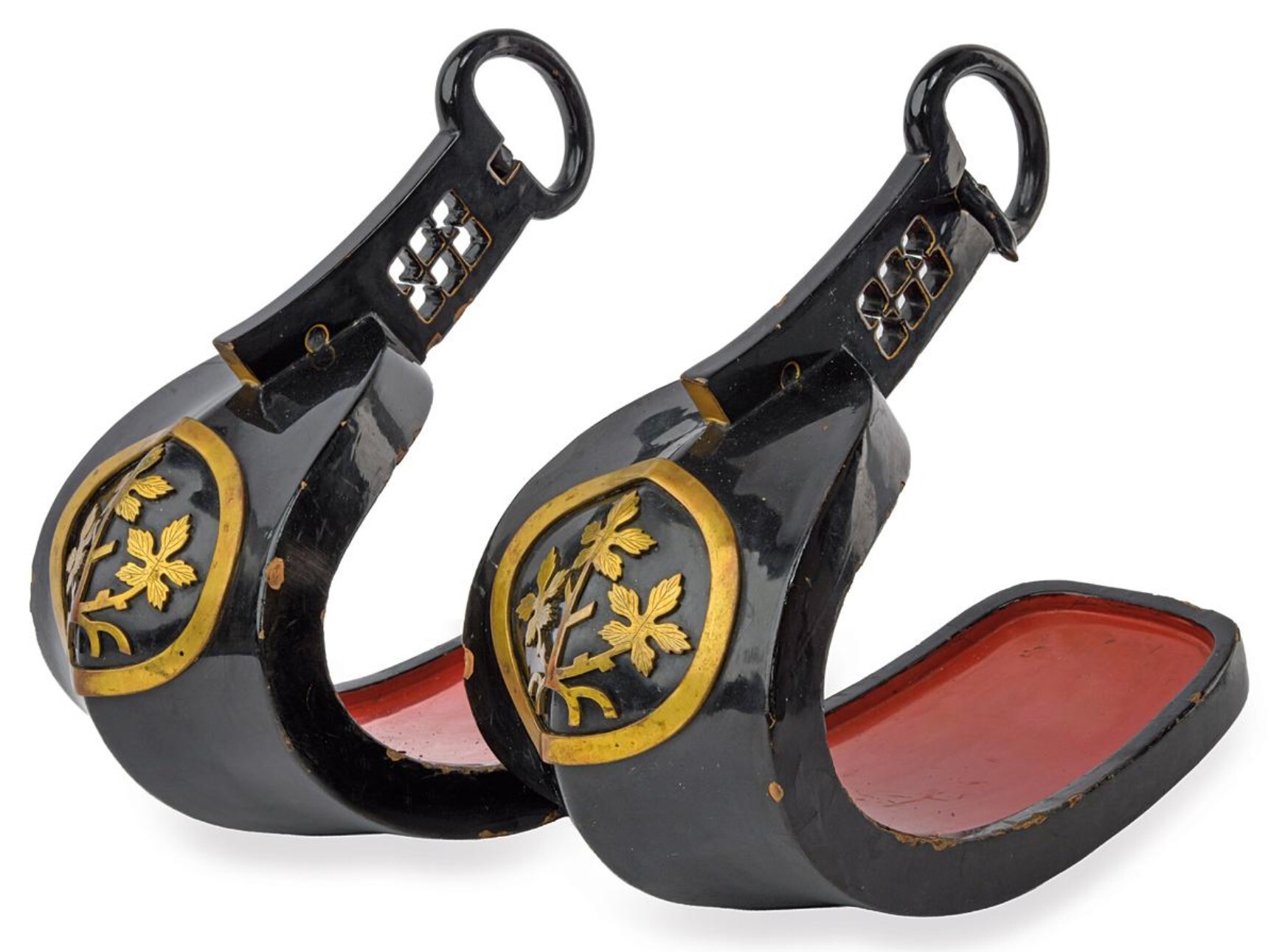
The specialized leather boots (Monoigutsu, #8) worn in yabusame are difficult to source out except through engagement with the two schools of yabusame in Japan--namely Ogasawara-ryu or Takeda-ryu. Authentic yabusame equipment relies entirely on a highly insular network of specialized Japanese craftsmen and lineage associations. Active practitioners are expected to obtain gear strictly through their school's vetted master craftsmen (shokunin). Because the skills to manufacture traditional Japanese saddlery and equestrian attire are rare or mostly extinct, the schools themselves regulate who can purchase from the remaining living artisans. In Omasawara-ryu, you must request equipment access directly through the school's administrative board. They work with specific lacquerers and leather artisans who understand the unique structural requirements for standing in Japanese stirrups (wabumi). In Takeda-ryu, yabusame attire features distinctly different colors and historic patterns. Inquiries must go through their internal network to avoid buying gear that violates Shinto ceremonial protocols. I can hope to acquire a vintage Edo period pair and do restoration work. Since I don't train on a horse (at least not yet), it's a non-issue. However, I will be purchasing a vintage pair of Abumi stirrups. I'll have to see what kind of conventional footwear works best with the iron flat bottom design. The pair below with an eminashi shape (no front groove) is up for auction on Czerny, but it is collector grade with a Nihon-Katchu-Bugu-Kenkyu-Hozon-Kai (NKBKHK) certificate. I think that a structurally sound pair for $200-300 is more what I am targeting for actual use, like the pair on the right available on Etsy.


-
The deerskin chap for protection while riding is called a Mukabaki (#10). Not exactly big on my list because we have highs of 90-95 degrees with extreme humidity every day here in North Central Florida. However, when I get my wooden horse and saddle set up, I may find that I do need some protection down there. Fortunately, Iron Mountain Armory sells a very high quality one for $70, which is not just for cosplay. They really do their history homework.

-
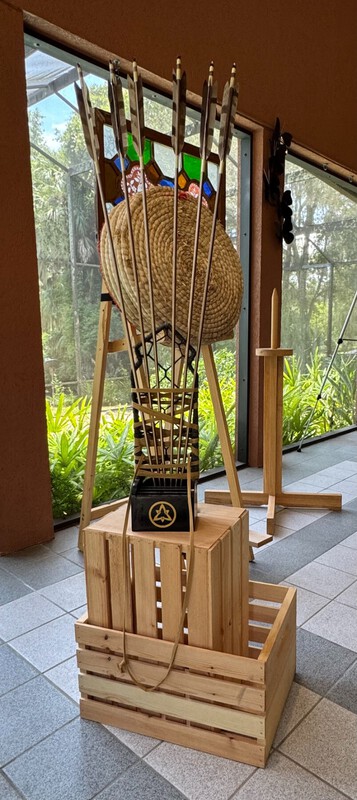
Whereas the Utsubo was used by archers on the battle ground, the Kari-Ebira was probably more practical for wearing while on horse back. The one below was custom-made for me by Iron Mountain Armory, featuring the mon used by the Rinzai Zen community (Chosei Zen), where I study with the abbot. It is shown with a set of Japanese hawk feather-fletched arrows. There is something about hawk feathers that makes them so wonderful on arrows. They are more resilient than swan or goose feathers, but still far softer than turkey feathers. Traditionally, arrows with blunt turnip-shaped (jindo-ya) or whistling (kaburi-ya) arrow heads are used to strike the target during competition. In reality, modern yabusame practitioners most often just stick their arrows through the straps of their hakama (tips pointed down) and reach back and down with the right hand to pull out an arrow from the bottom.

-
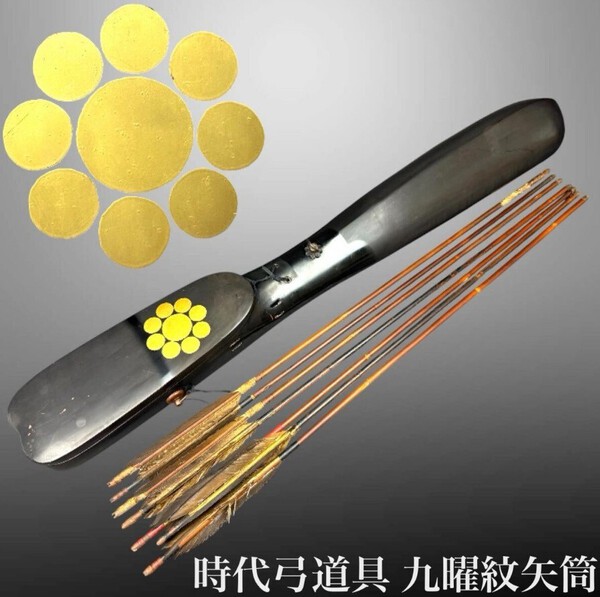
I recently acquired a vintage Edo period Utsubo (#5) with the Kuyōmon (九曜紋, nine luminaries crest) representing sun, moon, and seven stars. It was used by the Hosokawa and Soma clans. Arrows are stored with the tip pointed down. The bottom has a cover that is removable for easy access in order to withdraw an arrow for yabusame. I'm replacing all of the missing leather parts used for cushion where the Utsubo rests against the right waist (you can see where the shiny lacquered surface used to be covered). An Obijime waist cord is used in the figure on the right for two other utsubo. I'm using a silk sageo instead, which is the same color as the one in the depiction of an archer in full uniform with Utsubo strapped around the waist. I think that originally, the Utsubo was actually held in place with leather straps. There is also a thin strip of leather that goes over the cover to hold it in place with two clasps when not in use, which I have also replicated from an old unused guitar strap. We'll talk later about the specialized arrows with Manchurian style nocks that I have made. .


-
Beautiful, Piers. There is a more contemporary Ukiyoe offered on eBay depicting yabusame, which is not nearly as nice as the one you shared. Who is the artist?