
Leaderboard


Popular Content
Showing content with the highest reputation on 07/10/2023 in all areas
-
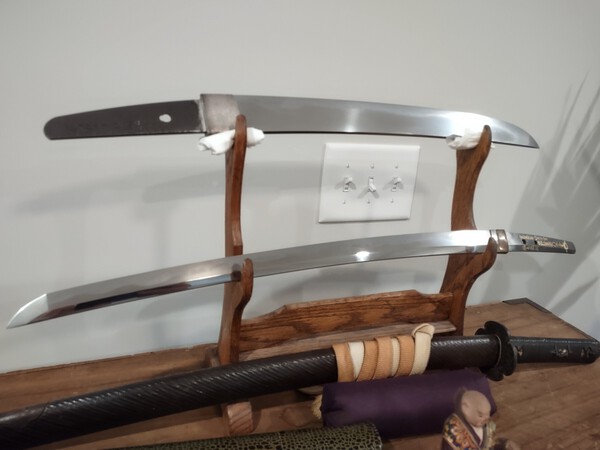
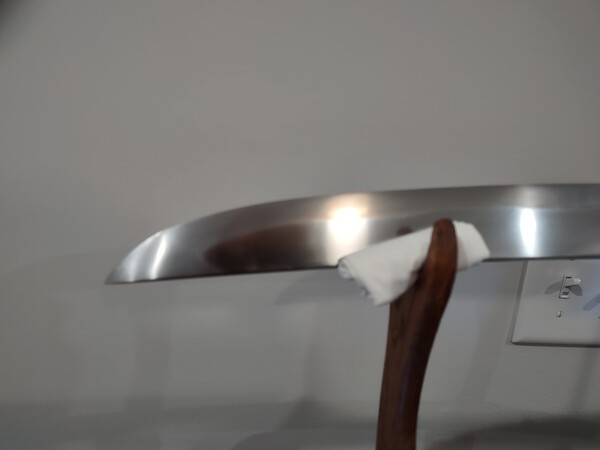
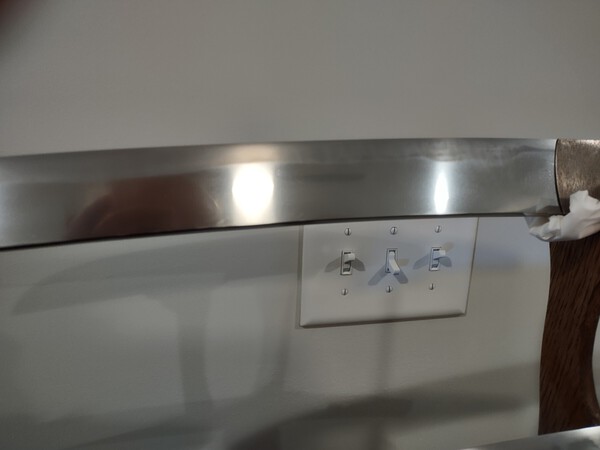
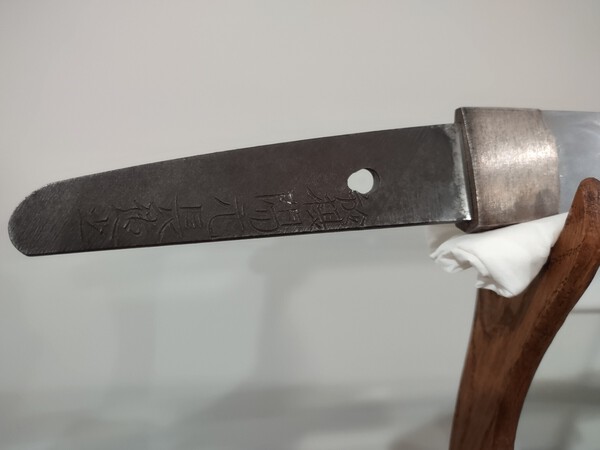
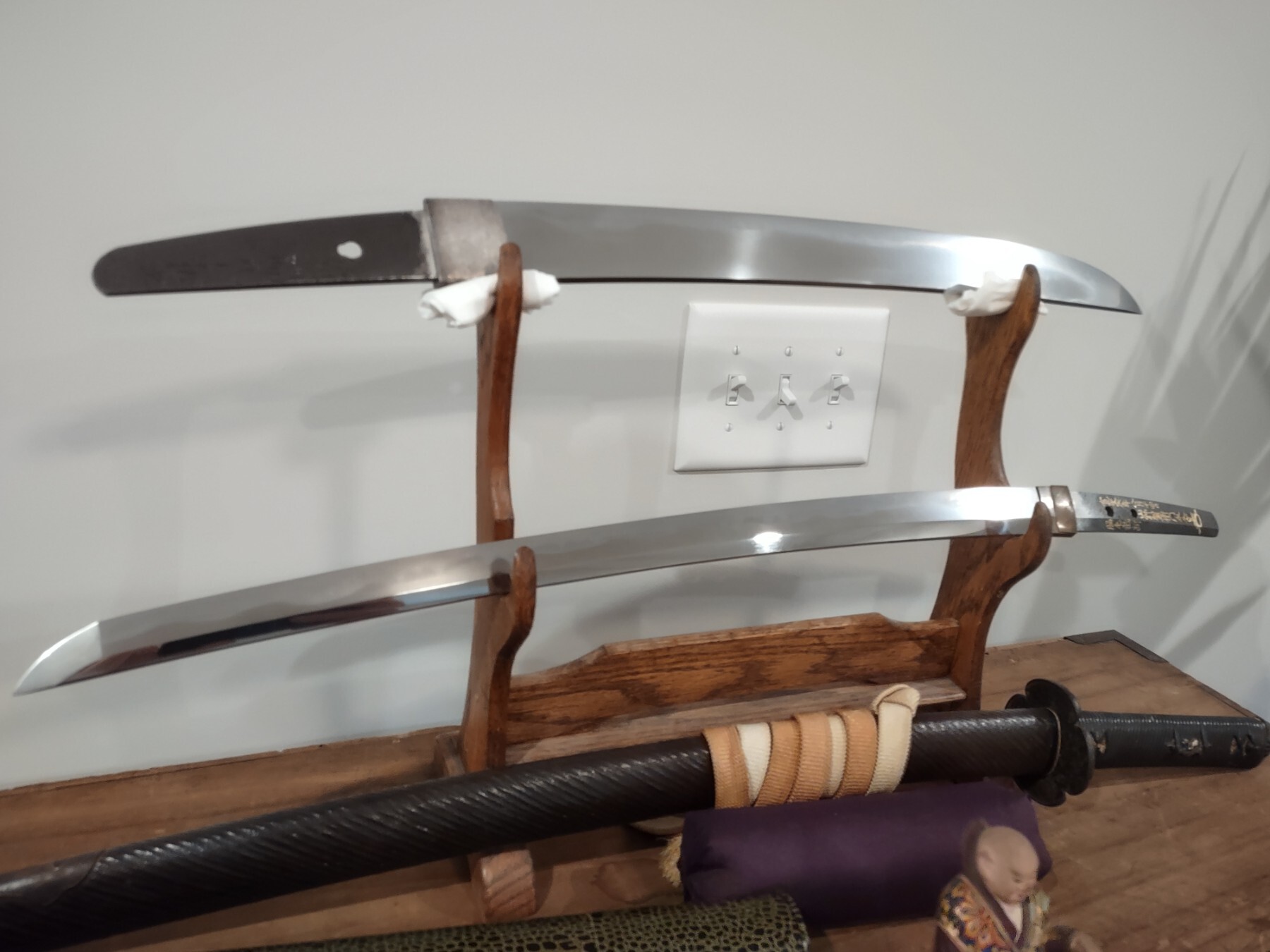
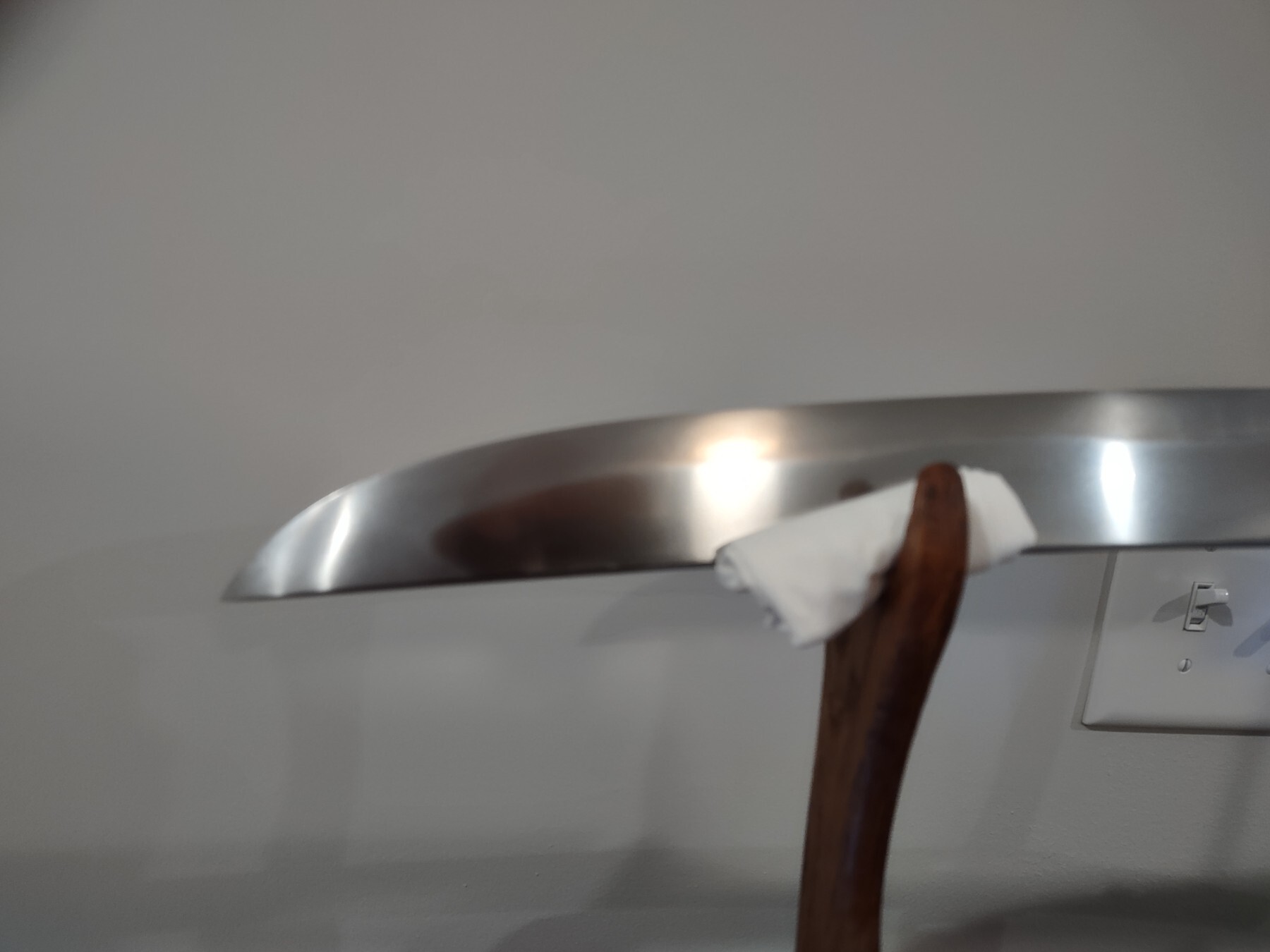
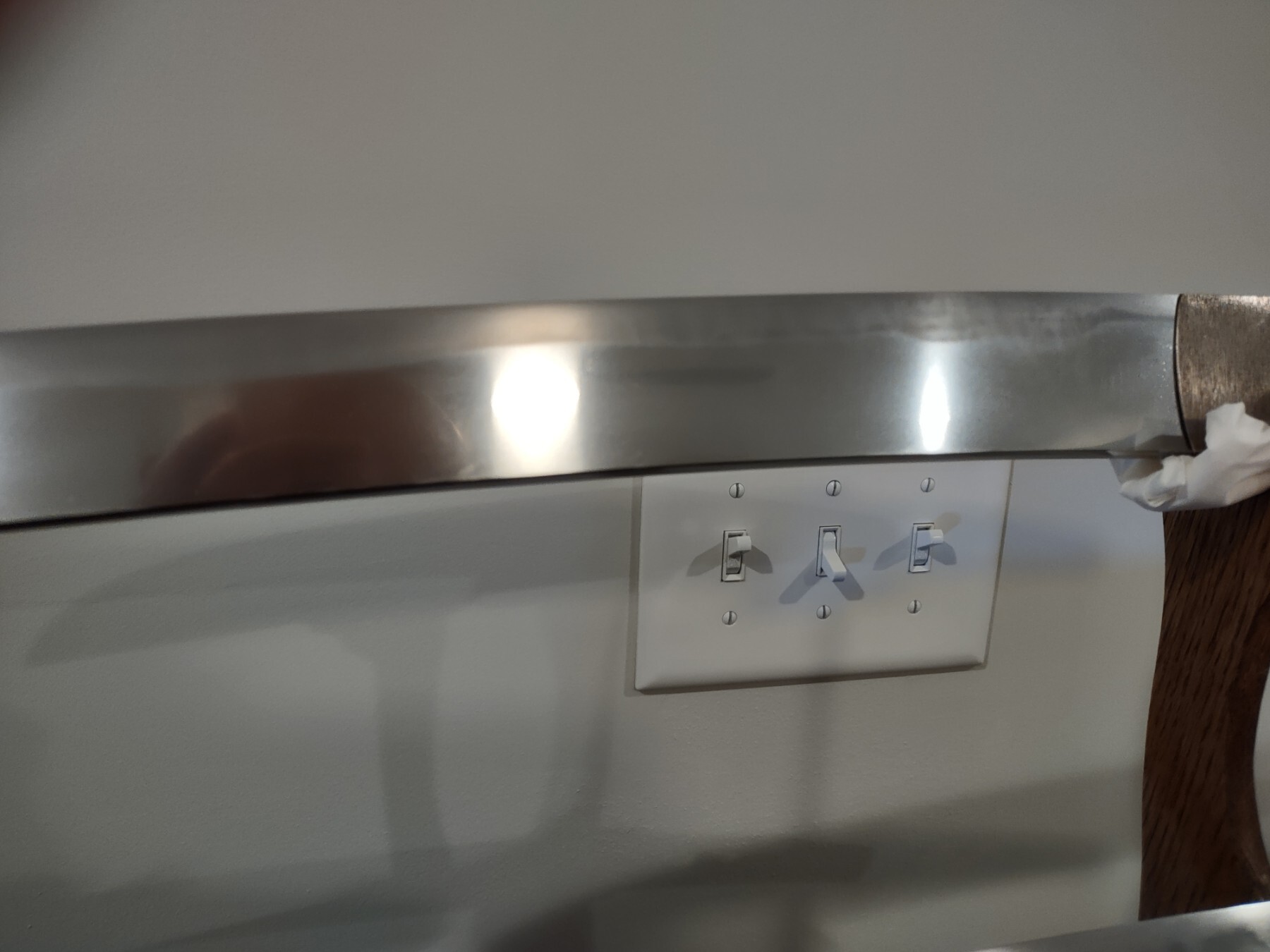
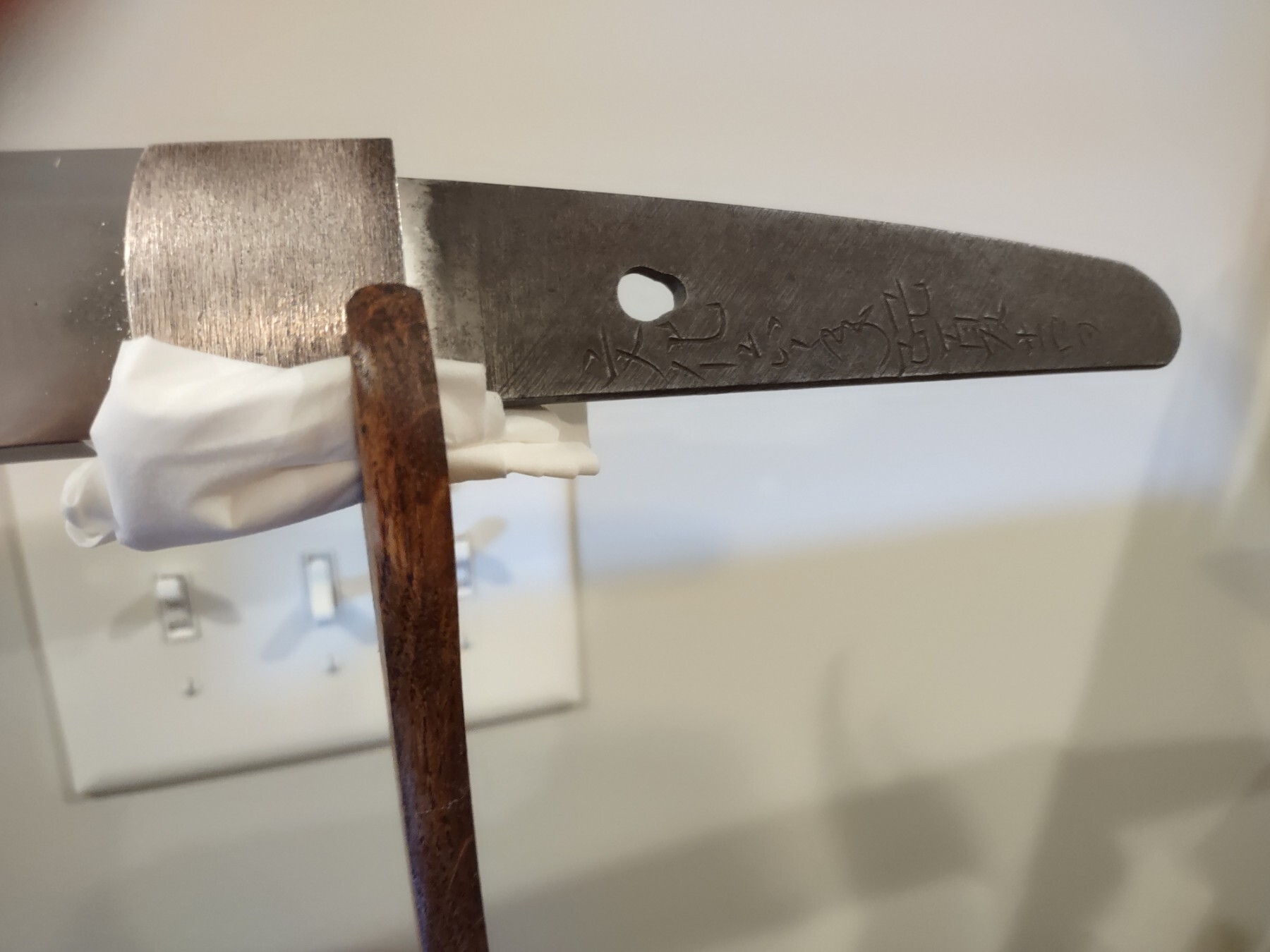
Shin Shinto Satsuma Wakizashi Signed Sesshu Motonaga Dated 1810 This is the widest and thickest Wakizashi I have ever held in hand 4 cm wide. 0.76 cm thick. 45 cm long It's also incredibly heavy , I have put up a normal sized Edo period Wakizashi for comparison. It has Koshirae I haven't received yet. I am looking forward to seeing what it looks like Many thanks to Mike Yamasaki for selling this to me.

 6 points
 -
Nomenclature and Etymology Part 5 - Conclusion There are many other texts and illustrations I have encountered here and there, but most seem derived from the Buyo Benryaku. Rather than hammer repeatedly with ideas taken from the same source to try and prove my point, I have instead tried to show a more diverse range of illustrations and definitions here from the time. Even then, we can see a clear pattern. Going forward, I will elaborate further on old and modern terminology as I present case examples and analyses of the stages of development of these kabuto. I will explain the original terminology, and why I think the modern terminology is deeply flawed in most cases. I am of the opinion that a return to older terminology in regards to Japanese armor is a direction the community needs to take going forward. The original conceptualization of Japanese armor is, in my opinion, crucial to understanding it. Without it, the study falls prey to the whims of those with influence and personal agendas, and moving forward with deeper research becomes nearly impossible so as not to step on toes. Doing this however requires people to let go of an image they might cling to. The study of samurai history in general is deeply tainted with pop-history, media consumption, and worse, orientalism. People first encounter these things as their entry point into the study, but many refuse to let go; in the end, it was that initial thing they consumed that they loved, not the history itself. In the following posts, I will present many controversial ideas that will go against the grain of the vast majority of people interested in this field. But, I will attempt to present things as objectively as possible, focusing on a technical analysis of the pieces alongside the linguistic aspects covered in this initial Nomenclature and Etymology section. Seeing as I'm currently working on reproducing this particular line of helmets and prototyping them from the ground up, I will also share some insights from this perspective. I will show patterns where relevant, comparison of geometry in parts, etc. Rather than seeing collections photographed for dramatic effect, I hope to instead show these as a sum of their parts. Understanding these from their inception will help to demystify them while also exposing connections between armorers and designs that may not be as apparent in the finished products that have been passed down to the modern era. The next post will be discussing the helmet preserved at Kongo-ji and my theories as to its origin and date. Until then, I hope this Nomenclature and Etymology section serves as a good primer for the rest of this thread, and that the texts themselves lead others to their own discoveries.
 5 points
 -
豊後國住紀新太夫行平作 – Bungo no kuni ju Ki (no) Shindayu Yukihira saku4 points
-
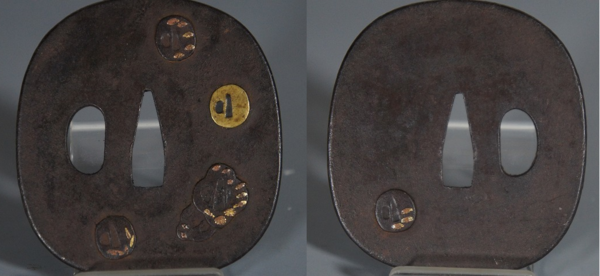
This one is clearly from the same workshop as Bruno's, Grev's and Soren's examples - other than overall shape and the inclusion of the gold plain tsuba. It was passed in at auction so it may reappear at sometime https://www.jauce.com/auction/d1097013007
 4 points
 -
Filling in the blanks 無銘(長州) then 萩 in pencil Mumei (Chōshū) Hagi Sukashi openwork of irises on left and right Iron, nikubori sukashi-ji Tokubetsu kichō paper.3 points
-
Yes, that is not a Japanese item. Don't buy it.3 points
-
Arthur, these are great, thanks from us all.3 points
-
Nomenclature and Etymology Part 4 So when do we see these particular hachi referred to exclusively as Zunari Kabuto? The earliest case I am aware of is in the Kousei-Roku (甲製録), authored by Myouchin Munesuke. I have had some trouble with this particular document. I have found a couple of copies in archives, but no full digitization. The dates on them are from the early 19th century, with the oldest one I have found so far being dated 1828. Myouchin Munesuke's life is also somewhat confusing as I am seeing multiple birth dates. The one thing that seems agreed upon is his year of death, 1735. If anyone is aware of an older, or the original copy, of the Kousei Roku, I would love to see it. So far, it's an elusive text for me. I do have a relevant page from one of the copies here however. This is the earliest, and currently only, example of the "Hineno Zunari" being exclusively referred to as a zunari. If this is the foundation of the modern nomenclature, then I think this should raise concerns with any scholars here. Not only is it an outlier, but there are many issues with the document itself it would seem. Of course I am open to any new evidence or information in regards to this particular document. It's also notable for the fact that it refers to the Saika-bachi now as something unrelated to this design entirely, instead focussing on things such as kirigane, zabyo, etc. as being features. Unfortunately, I do not have a digitized document in this case, but I will post a couple of archive catalogue lists for anyone interested in pursuing leads. 1. https://iss.ndl.go.j...000001-I065169104-00 2. https://jpsearch.go.jp/item/cobas-1388563 points
-
Interesting google results Bruce. Try mine: Kinnoto/kinnotoh https://studyingjapa...ds.com/tag/kinno-to/ Meiji Ishin-To Right before the Meiji Restoration, long swords (approx. 3 feet) with no curvature were made. Sa Yukihide (from Tosa) forged this type of sword. Saigo Takamori (西郷隆盛)、 Sakamoto Ryoma (坂本龍馬) owned this type of swords. Both are famous historical characters during the Meiji Restoration, called Meiji Ishin (明治維新). Both of them were a part of the Kin’no-to (勤皇党) group which supported the Emperor and renewed the political system. BaZZa.3 points
-
Wow, so first of all, my SINCEREST apologies to everyone who took the time to reply-I never received any notifications of this, so for the last several months I just thought no one had ever responded, and I decided to let it drop, and moved on to a different project. I only revisited this today, and was shocked to see all of your comments! Thank you so so much, all of you, for your help and support! The photos my uncle sent were pretty awful quality so I'm going to visit him soon and take some better ones myself haha. I will absolutely post them here after.3 points
-
see, https://www.militaria.co.za/nmb/search/?q= older "green papers"&quick=1 "Buy the sword not the papers." Do your homework.3 points
-
Nomenclature and Etymology Part 2 My next find was sent by a good friend that is a book I highly recommend everyone look through. It is the Zukai-Heiki (図解兵器), written in 1708, and includes many things that will interest everyone here. However, for this particular discussion, there is one illustration that stands out. Once again, we have a "Saika-bachi". There are no other helmets in this book with a similar construction to this or what would constitute the zunari in the modern sense. When looking at Sakakibara Kozan's work from the early 1800's, he defers to the Buyo Benryaku's definitions of helmet shapes, including the Akoda as "Zunari" and the San-mai-bari as "Saika-bachi". We see this also with the Natori-ryu scroll on armor from the 1680's, once again going with the definitions used in the Buyo Benryaku. In the next section, I will cover the next form of Kabuto, the "Go-mai-bari", as well as a caveat to the above definitions in the Kousei-Roku. For anyone who would like to read through the Zukai-Heiki, here is the archive link: 1. Zukai-Heiki - https://webarchives.....jp/dlib/detail/26723 points
-
Hi Mickie , congratulatons on having a go at translating this yourself . I was pretty impressed with what you achieved . Too many collectors here will not attempt a translation and will thus remain ignorant forever.Well done Ian Brooks3 points
-
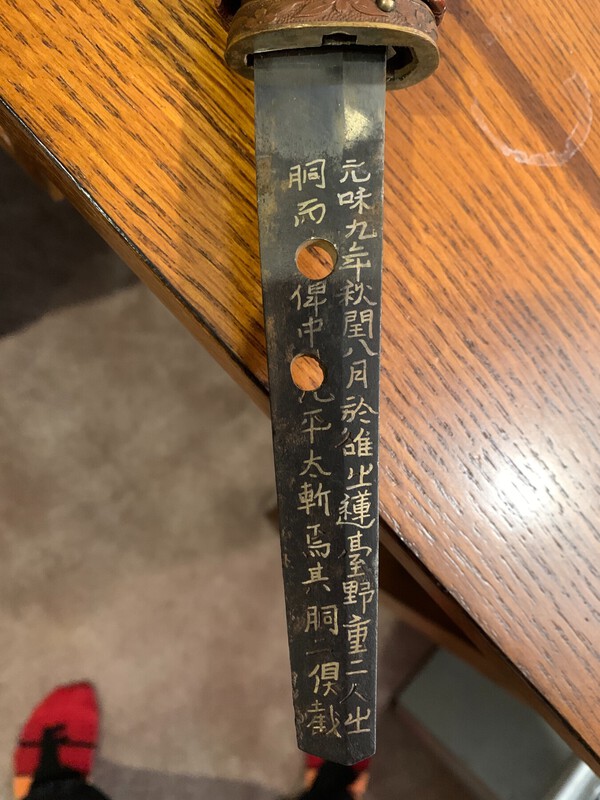
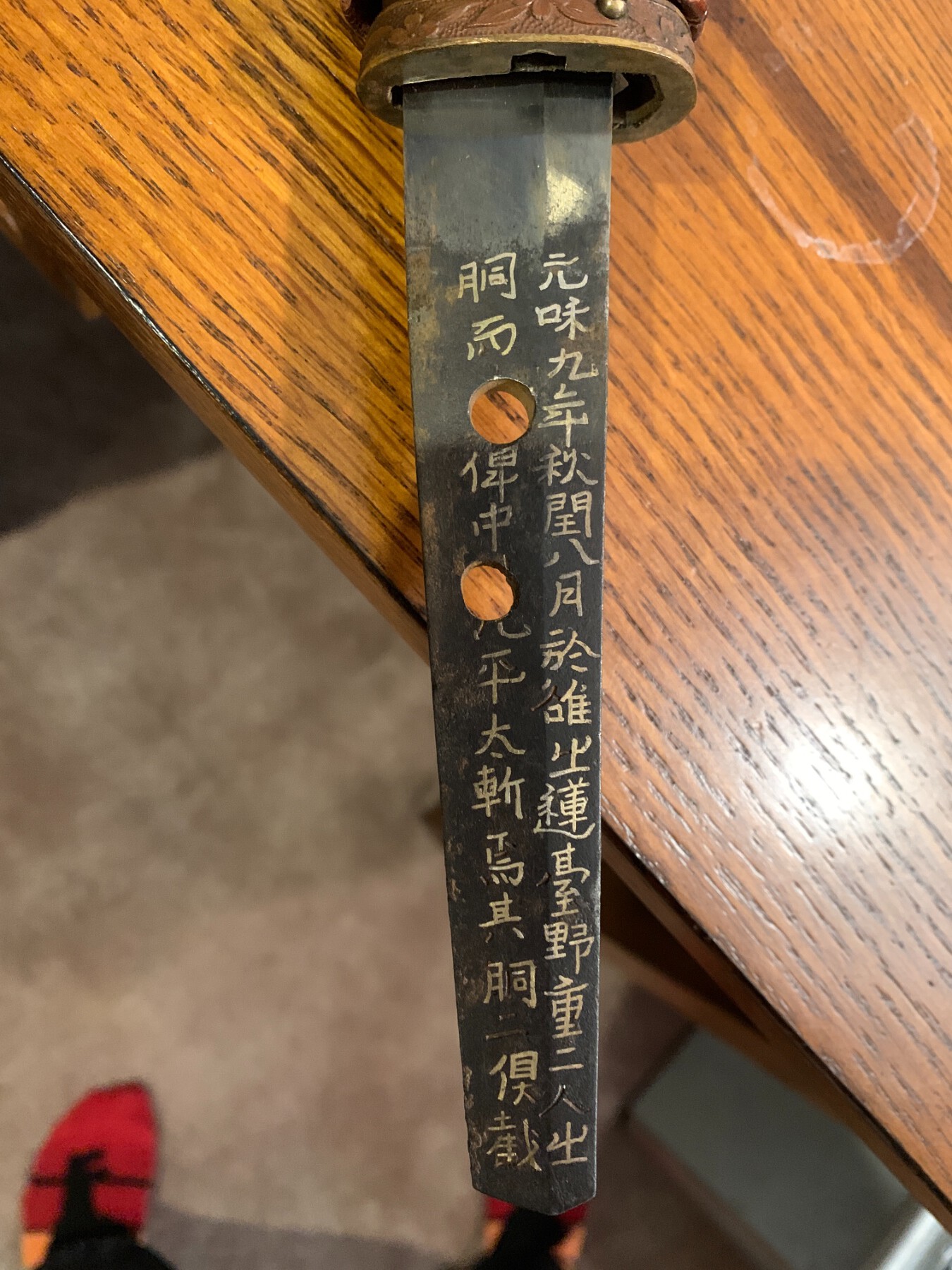
(1) 元咊九年秋閏八月於雒之蓮臺野 – Genna 9th year (1623) autumn, leap 8th month, at Rendaino in Kyoto, (咊 is an old style of 和.) (2) 重二人之胴而俾中川左平太斬焉其胴二倶截断 – two bodies were stacked up and made Nakagawa Saheita cut through the bodies. (3) 餘勢入▢▢尺乃號元日上品 – (my guesswork) With the excessive momentum, the blade cut into the mound several feet (≒尺). (I am unsure after that.) (4) 伊賀守作喜多見左門所持之 – Made by Iga no kami, Property of Kitami Samon (same as Steve M)3 points
-
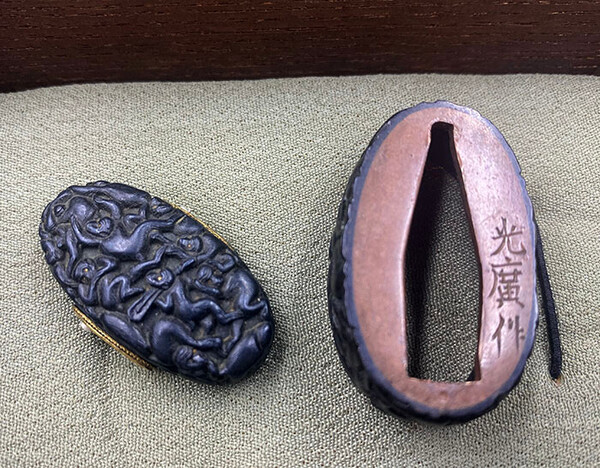
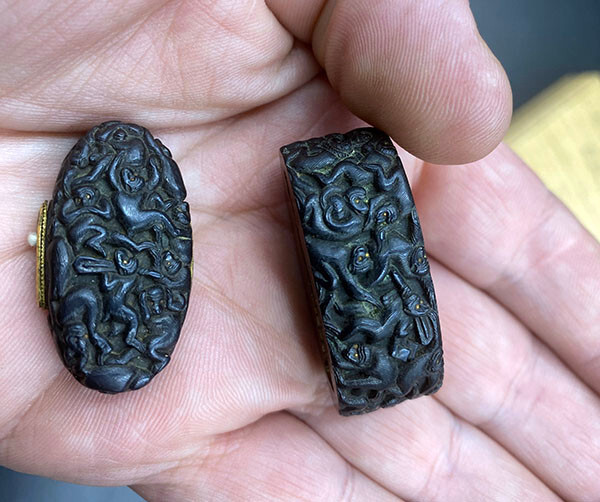
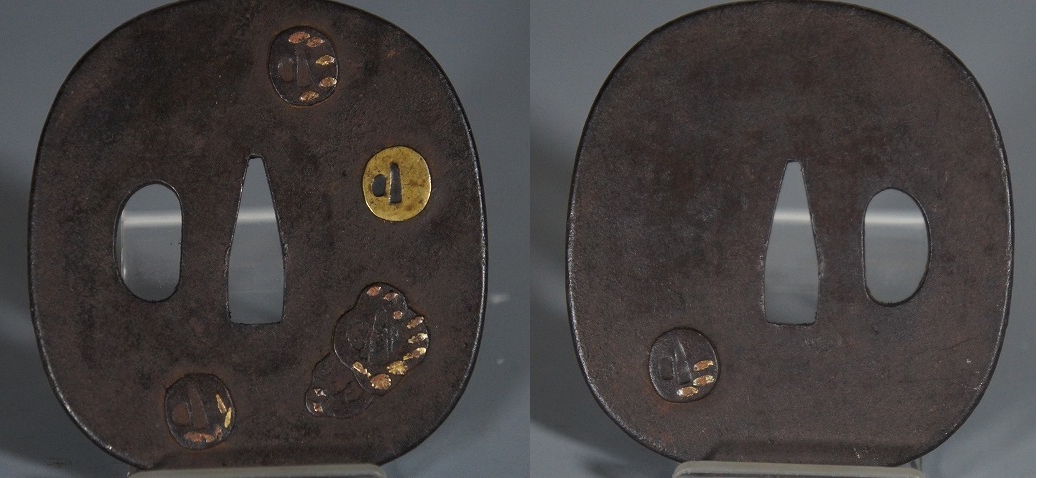
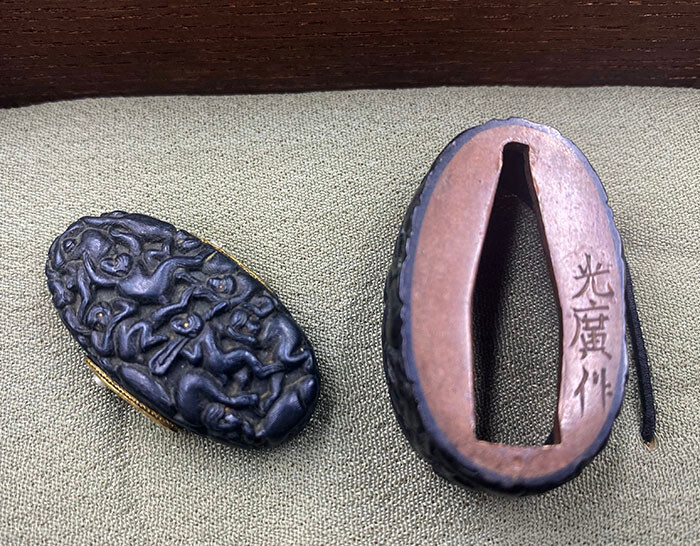
Starting with some of the stuff that will be going to SF, as I work through it slowly. I was going to post this in translation section, but I worked out it is by Mitsuhiro, the founder of the Yagami school. No reason to think they are gimei, they match the work this school produced. I see many of these 1000 monkey tsuba by him and the school, so maybe these will find a home with someone who has the matching tsuba. Anyways, posting just for interest now. Enjoy.
 2 points
 -
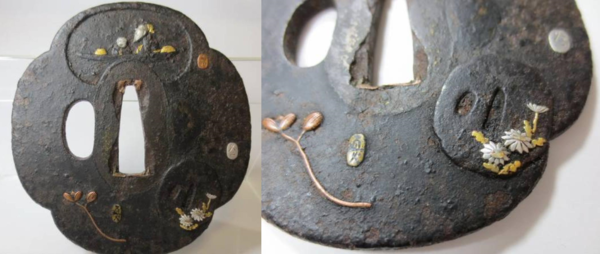
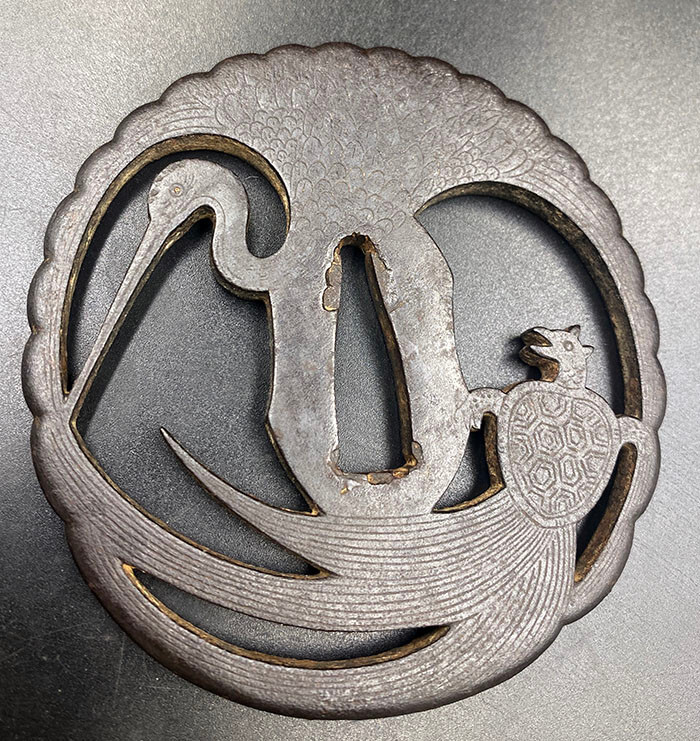
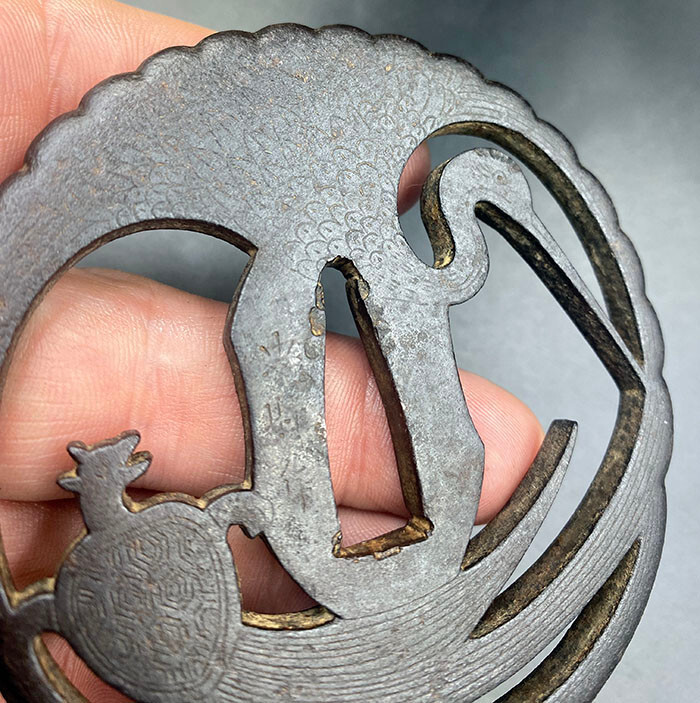
Sharing this one, and hoping for any info on the school etc. It is lightly signed, and I'll post that in the correct area to see if anyone can make it out. Nice patina, good tsuba. Don't know if this would be considered Bushu or Higo or...? Popular theme, I think represents longevity? Appreciate any info or comments.

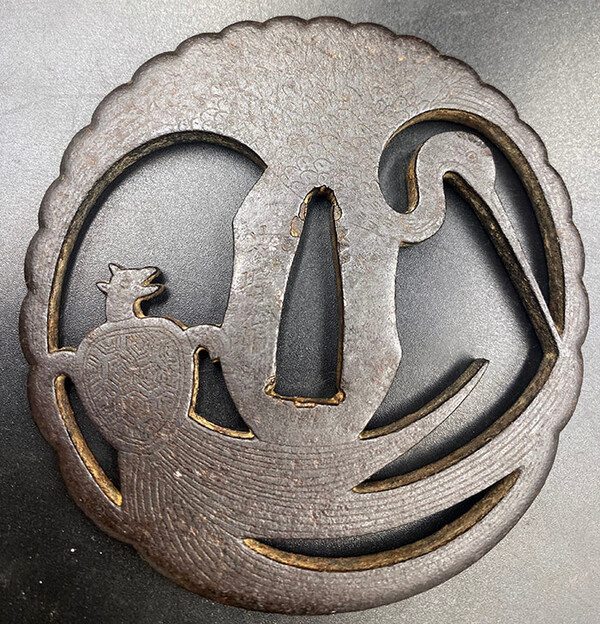

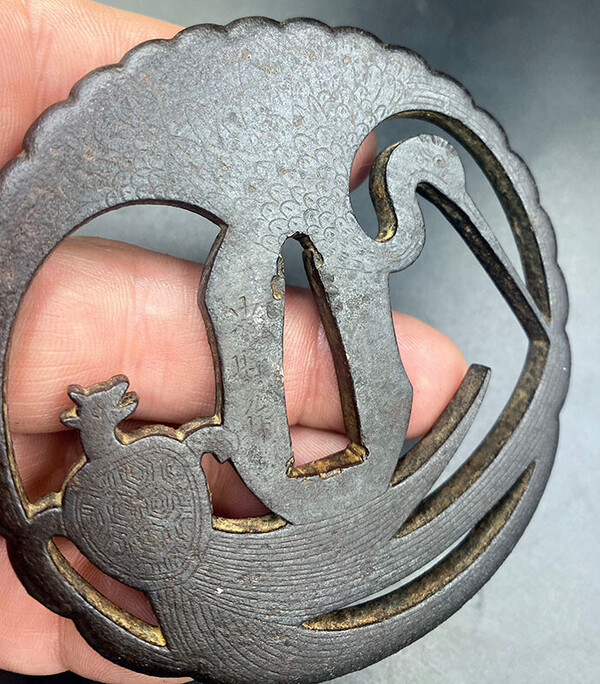


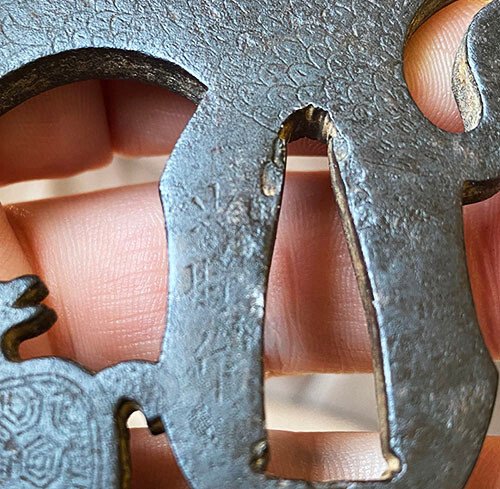
 2 points
 -
Hi there! My Aunt's dad apparently received this sword at the end of WWII from a Japanese officer while he was serving there, and I have been appointed the task of researching it. I know nothing about Japanese swords but I thought it would be a fun challenge. However I have already spent two weeks on this and I am desperate for some help. Firstly, I apologize for not knowing all of the Japanese terms for everything, I'm learning. *Some of the gold inlay had fallen out so I used a drawing app to fill in the missing parts on these photos. So far I believe it is saying "in the Autumn, leap 8th month of Genna", sooo like 1623-1624ish? However, I'm unsure of the era because the second kanji of what I think is Genna (元和) is written as 味, not 和. I am lost already. I could be sooo wrong about this, but I think the next kanji, 雒, is referring to Kyoto? It's an alternative form of 洛, which according to Wiktionary (I know, I know) is often used to refer to Kyoto. The next one, I have NO idea about. I've spent days hunting around. It looks like a trident. After that, I believe 䑓野重 is referring to Rendaino, an old cemetery established just north of Heian-kyō, famous partly for being the site of one of Miyamoto Musashi's battles. As for the rest of the line, I'm too burnt out to try, especially as I have no idea what that last character is. Please help?? And for the sword-smith, I recognize 伊賀守作 as Iga no Kami made, but isn't this only referring to the title of the sword-smith and not specifying who it actually is? Is this even real or am I wasting my time? Any help would be much appreciated! *Also I'm awaiting pics of the blade from my uncle. Thanks so much, Mickie
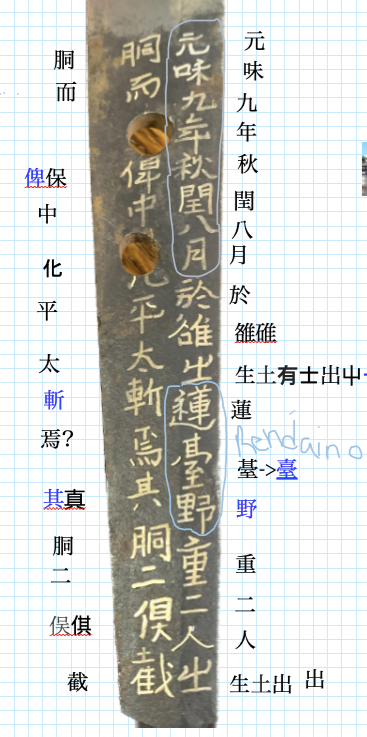


 2 points
 -
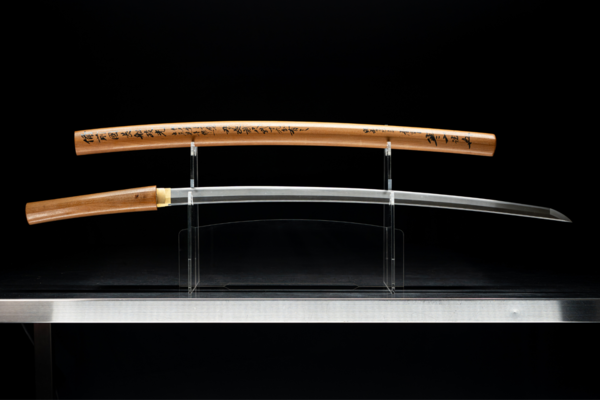
This distinctive katana hails from the Nanbokucho Era, characterized by the expert craftsmanship associated with this period. The sword is mumei, attributed to Den Bizen Masamitsu, a fact further validated by the NBTHK, dated October 13, 1979 . The nagasa (blade length) measures 69.4 cm, with a sori (curve) of 2 cm. Its sugata (shape) is a shinogi-zukuri and iori-mune, with a wide mi-haba that tapers slightly towards the kissaki (point). The kasane (thickness) is substantial, and the kissaki extends just slightly, aligning with the design traditions of this era. In terms of the blade's jihada (grain pattern), the katana exhibits an itame with hints of mokume mingled within the flowing hada. An appealing touch of ji-nie can be spotted, and the steel boasts plentiful chikei. Furthermore, utsuri can be discerned within the beautifully forged hada. The hamon (temper line) is a ko-notare with a ko-gunome pattern, with pointed elements also visible. As for activities, ashi and yo can be seen, complemented by fine kinsugi and sunagashi. The boshi (temper pattern in the tip area) showcases a jizo-boshi with a long kaeri. The nakago (tang) appears suri-age with three mekugi-ana, aligning with the modification traditions of its time. The sword's form displays the defining characteristics of the Nanbokucho era - a wide mi-haba, slightly extended kissaki, and ample sori. Its hamon and hada further hint at the school of the famed Bizen Osafune smith, Kanemitsu. The NBTHK attributes the blade to Masamitsu, who was among Kanemitsu's top students. The sword is mounted in a shirasaya with a sayagaki attributing the blade to Bizen Osafune Masamitsu, as confirmed by the renowned sword expert and former head of the NBTHK, Dr. Kanzan Sato. Kanemitsu, believed to be a student of the Soshu den master Masamune, brought the Soshu style of smithing to Bizen, resulting in the popular Soden-Bizen style. His techniques attracted several top students, including Masamitsu. Masamitsu's works span around 40 years, from the Enbun to Oei periods. Although a theory exists that two generations may have adopted the Masamitsu name due to a shift in working style, it remains unconfirmed. Masamitsu's swords have achieved the prestigious Juyo Token rank, indicating high quality and significance. Given this sword's features and quality, it stands as a promising candidate for the NBTHK Juyo Token shinsa, further increasing its value and importance. This katana thus presents a remarkable blend of artistry, history, and tradition in the sphere of Japanese sword-making. Price : $2500
 2 points
 -
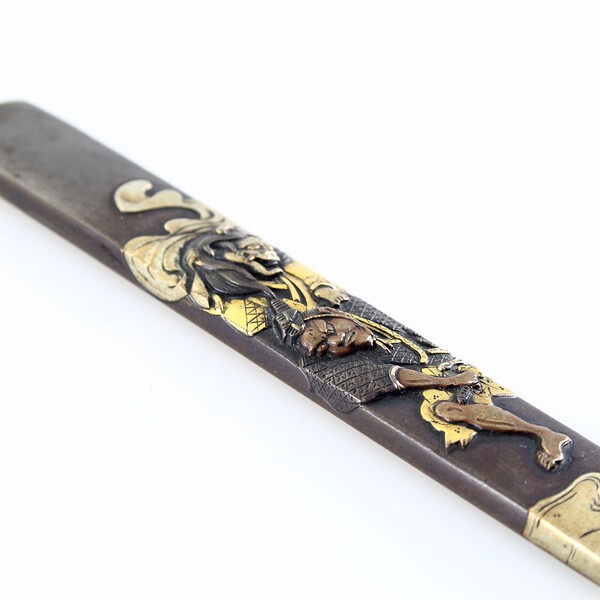
Thank you for your input. As wished, a couple more pictures.


 2 points
 -
Thanks guys. Yes Bruce, putting it on your list and keeping our eyes open for an actual signed/dated/star stamped example is probably the only thing we can do about this so far (unless someone finds some more actual reference to it somewhere - I will keep browsing and see if I can find any more references). In the meantime, I hope we get a bit of feedback from the RJT knowledgeable...might be a good conversation. I know that of my 4 star stamped blades 1 is dated 1943 and 3 are dated 1944 so well into the RJT period we know of, and of my 3 blades by smiths who are known RJT (but no star), 1 is undated, 1 is Sept 1941 and 1 is April 1942, so presumably they were not yet RJT at those dates. So this statement I posted regarding Hidehiro translates as " #3 Showa 14 nen 6 gatsu Rikugun no Jumei Tosho to naru." (1939 June, Army no Certified Swordsmith became) is so far the earliest RJT start date I have seen mentioned - and - it only refers to this one smith Hidehiro, it is not saying that this 1939 year start refers to the whole RJT scheme across Japan. I suppose only the seeing of an actual tang with a name, a 1939/1940/1941 date and star stamp will confirm an early start year (for some smiths only?), and so far we have not seen one. Regards,2 points
-
I believe there was a pilot program prior to 1942 and seem to recall Ohmura san mentioning it. So lets not tar and feather poor old George yet.2 points
-
Really great stuff, Arthur! I believe the shape of the helmet you posted from the Murakami collection is called an urinari (although there are variations of this that don't follow this construction, so for the purposes of your study it's probably irrelevant). I once had one in my collection signed by Myochin Mune-somebody and a similar one is in the Chappelear book that shows more clearly the construction. Anyway, intriguing topic and I love the meticulous approach.2 points
-
I believe that Kinnoto swords also have an exaggerated long nakago…..eg….
 2 points
 -
lol yep thanks that's what I thought but I'm only new at this so i wanted to check with you all... Thank you2 points
-
Gary, We tend to allocate all swords into the tachi / katana / wakizashi / tanto classifications, forgetting that during the past, some swords were classified differently. I have a blade, in an Edo period mount, that is dated to the second year of Onin (1468), signed: Bishu Osafune Saemonjo Norimitsu. The nagasa of this blade is 596mm and like yours is heavy despite a wide groove on each side that occupy most of the shinogi ji. It is clearly meant to be used single handed - a Katateuchito I believe. Ian Bottomley2 points
-
Hi Bruce, that image of Muto Hidehiro with the statement that he began as a RJT in Sho 14/6 (June 1939) is from Ono, 'Gendai Toko Meikan' 1971 p.100 (look at image page and read column #3 (this is the earliest RJT start date I have seen). I posted it as I thought it might be worth a chat with the RJT knowledgeable on the start date of scheme. Just my "feeling" on this is that maybe thoise smiths who were closely linked to Army swordmaking were the first to be offered a RJT position...or maybe Ono has made an error? I will have a look at my other books and if it says anything further I will let you know. Regards, I had a quick look through my books and while all mention Hidehiro was RJT only the page I posted gives a start date....sorry. This is maybe a question that needs looking at by RJT specialists...2 points
-
Hi Christina, why not add the other photos in reply to this post? This is a Sakai (Osaka) hosozutsu small bore long matchlock, with some extra decoration, a ‘merchant’s gun’ of probably early to mid-1800s. When I get a minute I’ll try and dig up some more info for you. Kotobuki 壽 is a general wish for good fortune.2 points
-
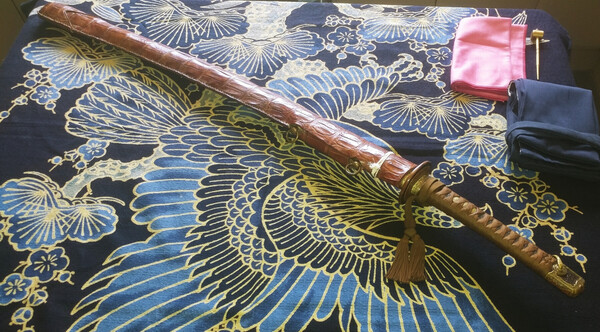
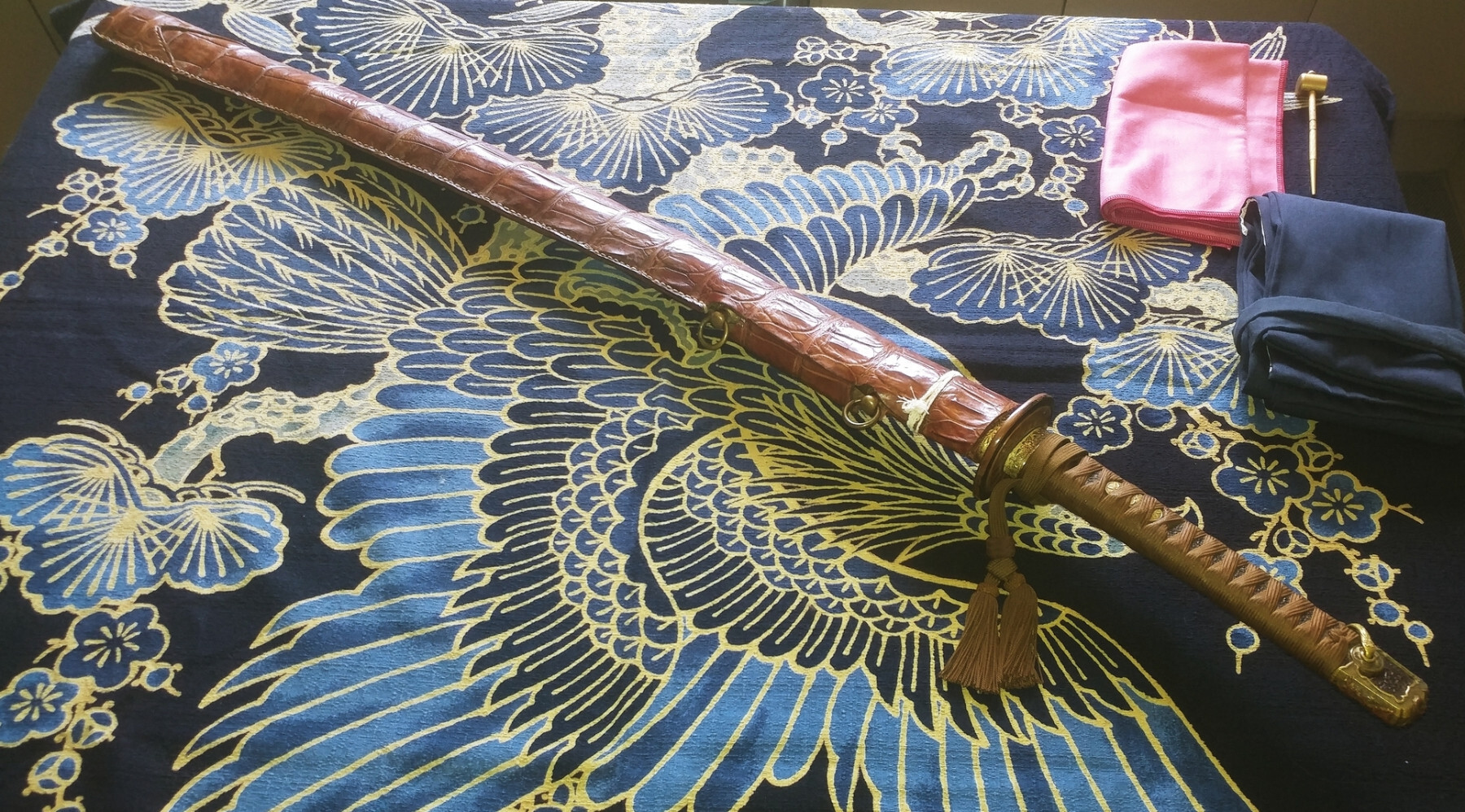
Hi Frank, interesting sword, thanks for sharing. The cover was likely made in the field from salt water crocodile skin, perhaps on one of the major islands of the former Dutch East Indies. Here is a Kai Gunto surrendered on Balikpapan with a similar field made cover from crocodile skin. Do you have any further information about how it was acquired? The blade itself may have have potential, there is significant machi-okuri (habaki moved up to create a longer handle) which looks to have been done fairly crudely. Keep it oiled with a light gun oil and whatever you do, don't attempt any restoration yourself.
 2 points
 -
Bruce Thomas is the one who knows more about RJT. According to Nick " 1942 July: The Army called upon each prefecture to solicit volunteers through these unions, who may be interested in getting into sword production. These messages from the military originated in the First Tokyo Army Arsenal and got passed onto the union through the Trade and Industry Dept. of the Prefectural government, and then from the union to its member smiths." https://www.warrelic...sword-1940-a-793016/ https://www.warrelic...umentation-789067-6/ From Ohmura san: これを受けた陸軍兵器本部は、昭和 15年8月16日、試案を纏めて陸軍大臣に実施を申請し、翌日認可された。 15年度中に指定刀匠を使って仕様に基づいた若干の試作刀が作られ、陸軍戸山学校で性能の実践検証が実施された。 統一性の無い日本刀を規格化する初めての試みだった。 同時に服制の「軍装用軍刀」を「兵仗化」する狙いがあった。刀身の制式化である。 上記の加工仕様書は制式仕様を刀匠に指示したものである。 http://ohmura-study.net/214.html2 points
-
More than 20 Tsuba have just been added for sale. Please find them on my website: https://tsubashi.com/ Always feel welcome to contact me if you have questions.
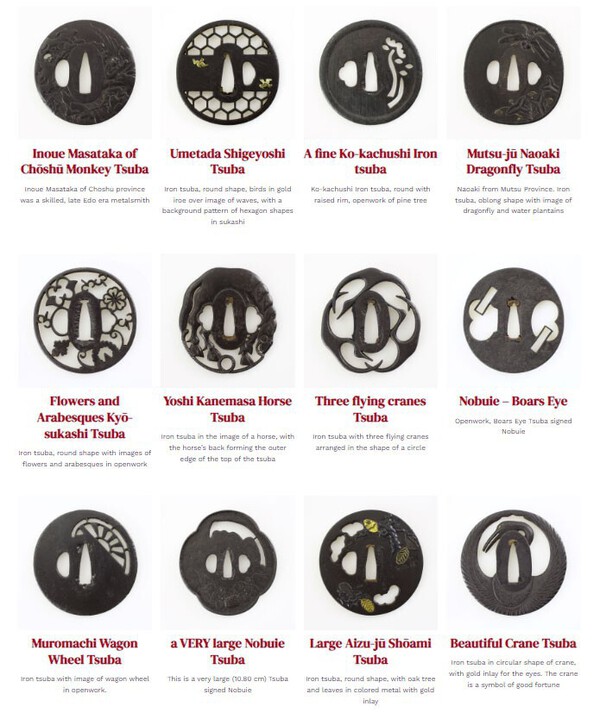
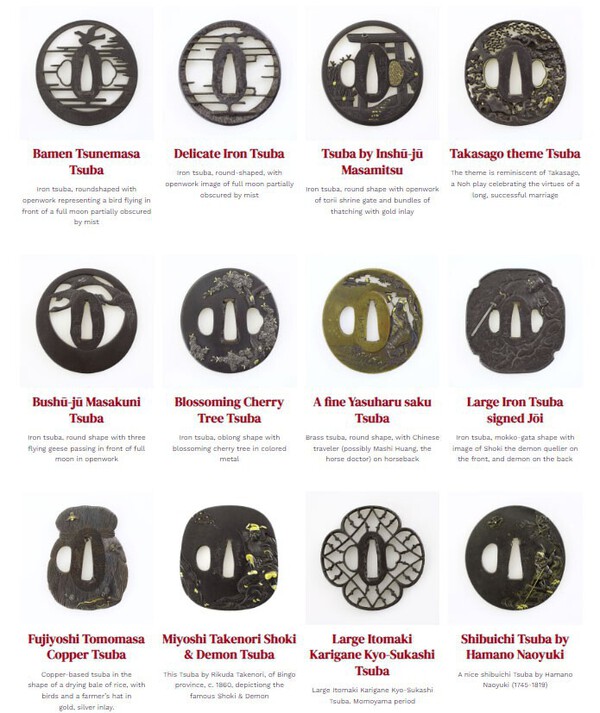 2 points
 -
I have a sword with a similar inscription. Sorry not trying to hijack your thread.
 2 points
 -
Hi Noah welcome to the forum, glad to see you’re getting good advice for this interesting sword If you’re doing this on your phone (like me!) - One simple way I’ve found to downsize images, is to take a screenshot on your phone of the image you’ve just taken. This will immediately copy the picture you’ve taken and make it a smaller size2 points
-
The blade looks old for me. Late muromachi/shinto time. The nakago looks cleaned but the 2 file marks are often made in that period. Can't say anything about the Koshirae. Could be wartime by someone who wanted to have his own sword in war. Some soldiers prefered a short sword for different reasons.2 points
-
Fyi this year's DTI will only be on Saturday and Sunday not on Friday as in prior years so only the 18th and 19th.2 points
-
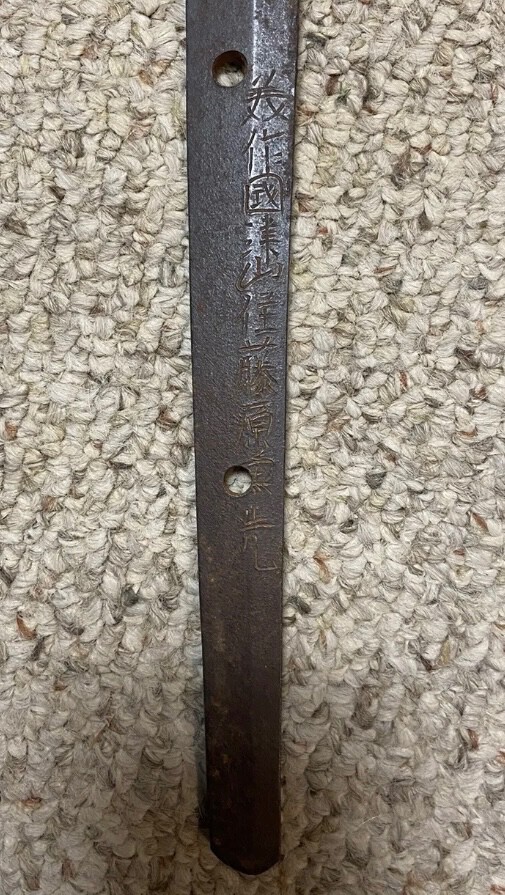
1st pic 松本一郎 Matsumoto Ichirō 2nd pic 長光道 Naga mitsu michi They are both sort of generic kanji names, put on the sword to give the impression of legitimacy.2 points
-
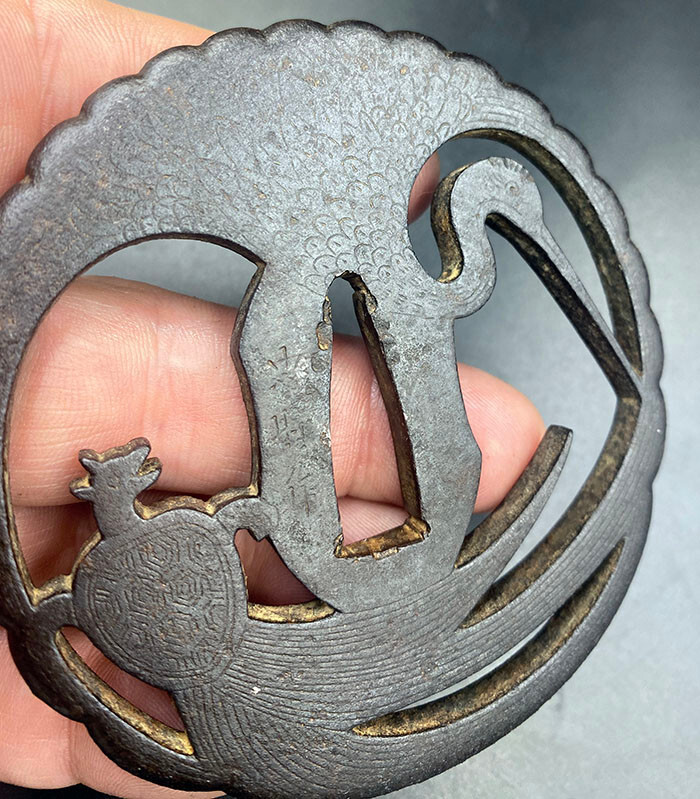
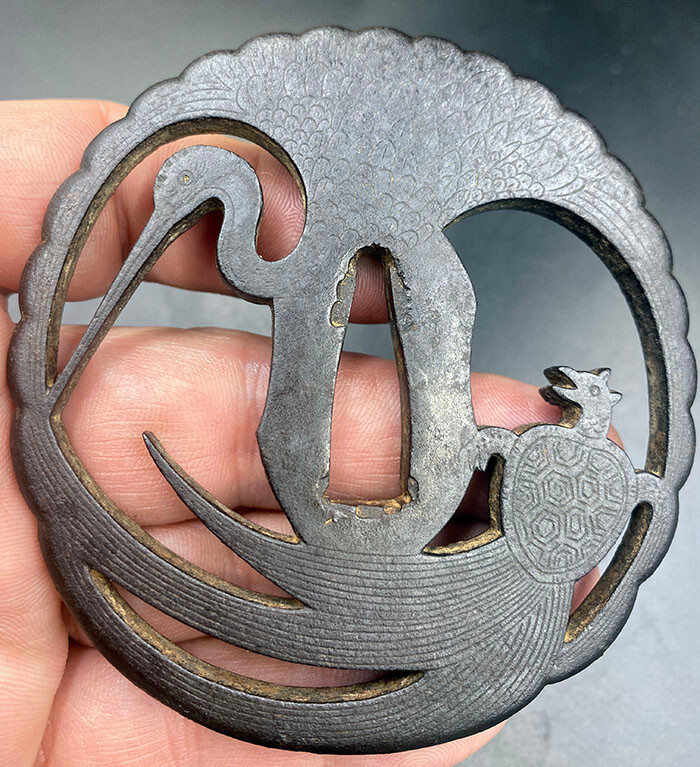
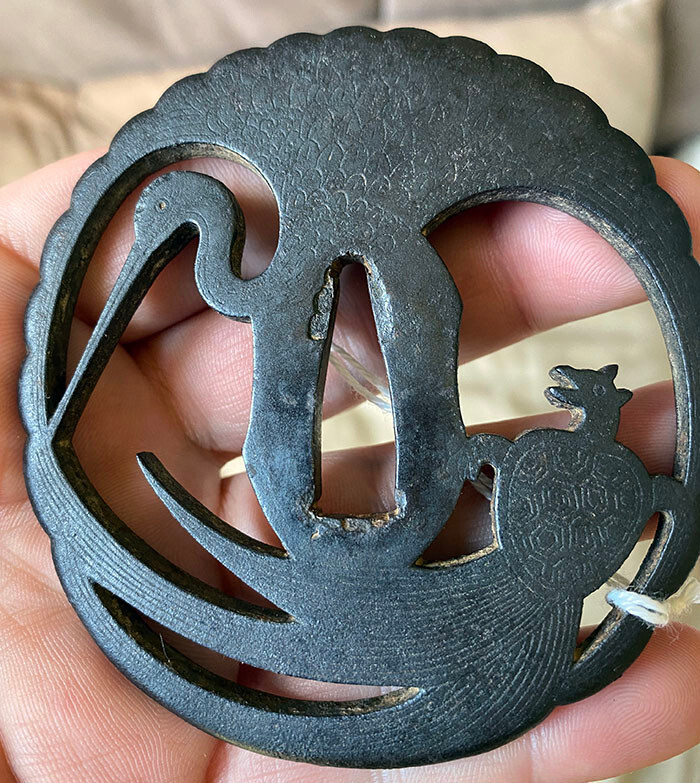
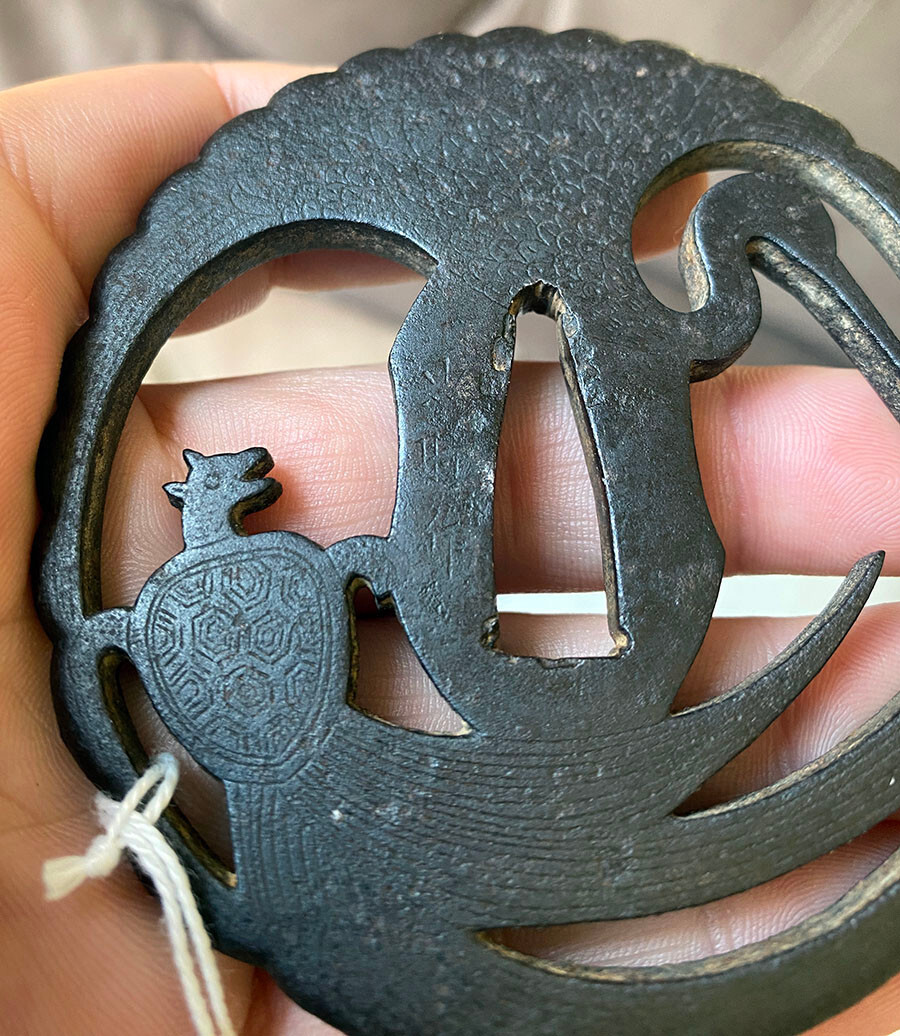
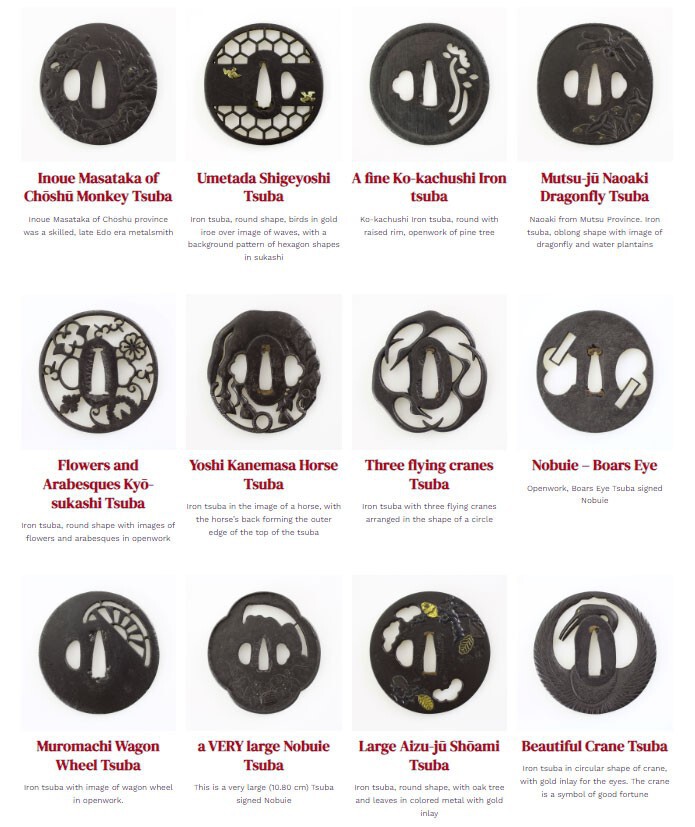
Hi Brian, sure is a popular design - it looks like nearly every school had a try at the design! Higo, Akasaka and Akao in this group. The one from the Ashmolean has been grouped in the Itō schools of Yedo and Odawara.
 2 points
 -
Strange how the world works these days - here is a modern copy [literally made last week], The design taken from a souvenir and not the other way around! https://www.jauce.com/auction/m1098404470 This seller has his own little "factory" producing copies [some very convincing] - he is somewhat stuck with his uniform patination, all his work comes out uniformly glossy black. https://www.jauce.com/user/dj2hmyuc2 points
-
Nomenclature and Etymology Part 1 I first came across the novel concept of a Zunari being also referred to as a Saika-bachi when first reading the "Saika Book" a while back. In Part 3 of the book, focussing on Okitenugui, it opens with what is likely the oldest of the surviving "San-Mai-Bari" Kozunari located at Kongo-ji. This is the helmet I'm currently prototyping as seen in the "Show Off Your Work" thread. On the following page it shows an illustration of the same type of helmet from the Buyo Benryaku (武用辨略), 1684. The caption clearly reads "Saika-Bachi, which is a form of Zunari". The writer of this book elaborates on it further, but is a little disingenuous with what he writes. He continues the current mainstream terminology, but conveniently leaves out what the Buyo Benryaku defines a Zunari-Bachi as..... This is a Zunari according to the Buyo Benryaku: And quite clearly, this is what we refer to in the modern era as the Akoda-nari. The fact that the author would leave this out raises an eyebrow with me. I realized there was an extreme hesitance to divert from the mainstream modern terminology upon looking more closely at this example: This is taken from the Buki Nihyaku-zu (武器皕図), 1854, which was in essence a trading card game that one could cut out from the pages. This illustration shows two helmets, but the black one in the background is the one we are looking at. Clearly this must be illustrating a "Hineno" Zunari as the author insists, even though the caption is very clear with its definition of this helmet. It plainly states, once again, Saika-Bachi. However this time it elaborates further with the description of the shikoro, detailing it as a Hineno-jikoro. The illustration and caption are very clear with no ambiguity, yet the author states the original source must be wrong. This sent me on a hunt to see what other writers from the past thought. What I found was already in line with my thoughts and theories on the origin of Ko-tousei kabuto, but was far beyond even my wildest speculations. For anyone that would like to comb through the original Buyo Benryaku, here is the link: 1. Buyo Benryaku - https://kokusho.nijl...io/100060596/1?ln=ja2 points
-
Gentlemen, Just to add to the collection. Have just received an identical iron tsuba with a truly beautiful color patina. Shown mounted on a sword made by 1st generation Hirotaka around 1655 and together with an equally nice quality Koshira. Pictures taken by seller. /Soren
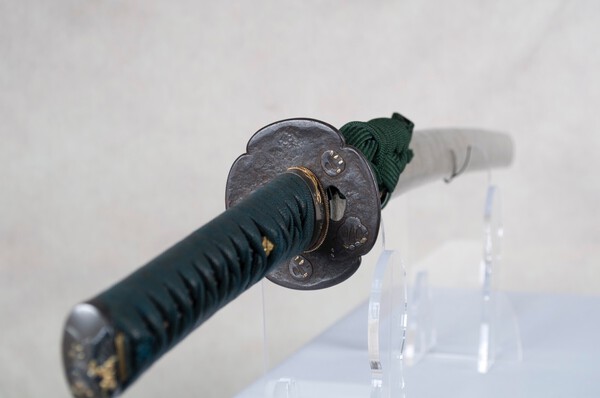
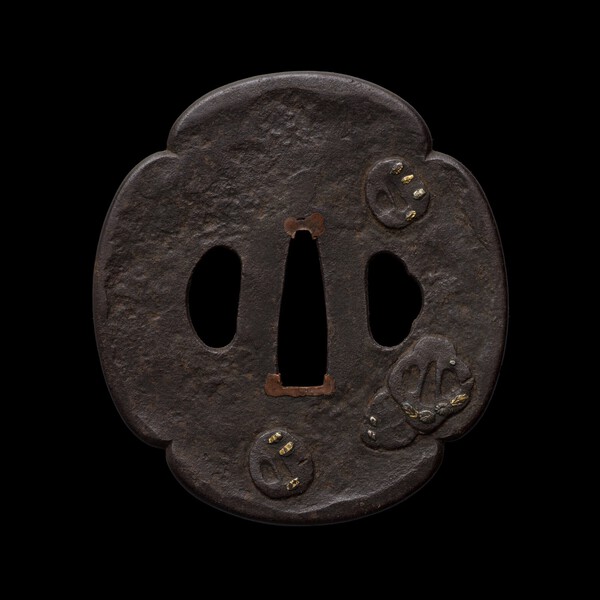 2 points
 -
John, I would like to propose a new test with more bodies. Right away I could name a few candidates (= living politicians) who deserve to become famous this way!2 points
-
It's a cutting test (the sword's sharpness was tested on two bodies stacked one on top of the other). I can't pick out the ones in red. I'm guessing at one or two of the others, but given the context it feels obvious (the tester's name). He is a known historical figure. 1. 元和九年秋閏八月於雒北蓮臺野重二人生胴而囗囗中川佐平太斬焉 2. 其胴二俱截断餘 3. 勢入囗囗尺乃號之日上品 4. 伊賀守作喜多見左門所持之 1. Genna 9 (1623) leap-August, North Kyōto Rendaino (village). Two bodies stacked up and cut through at the chest by test-cutter Nakagawa Saheita. 2. Cut through two bodies easily? (guessing a bit). 3. I can't get the meaning after the above (but you have most of the kanji right). Hopefully someone can fill in the blanks. 4. Made by Iga-no-kami. Property of Kitami Samon. Note: 咊 is a variant of 和.2 points
-
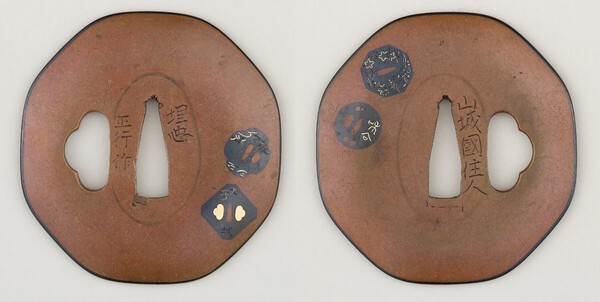
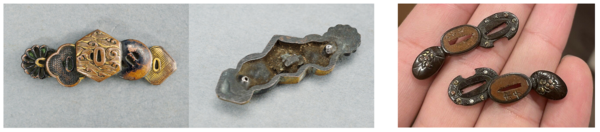
Sorry I don't have any information on the first guard - the second is from the Metropolitan Museum of Art acc. Number 14.60.40 https://www.metmuseum.org/art/collection/search/34941 It is signed but I don't have the translation. Tsuba menuki
 2 points
 -
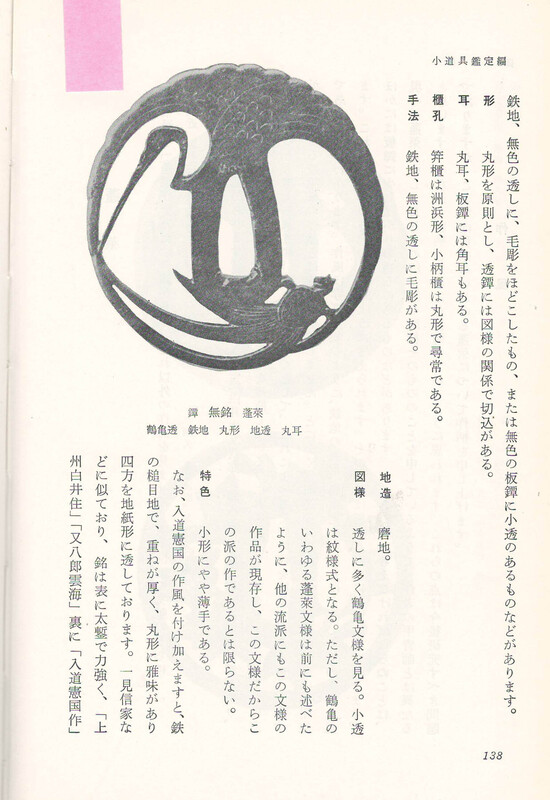
This design is so popular that it can be difficult to attribute a school if mumei. Quality of work can differ a lot. Luckily, yours is signed. If you have the Akasaka book, you can probably go to the back and take a good guess at which generation of Tadatoki. Remember there were many. Odds are fairly good it is shoshin. Stephen, did you sell this one? I think the correct name general name for them are Horai tsuba. See attachments. It has been years since I read this, so forget the particulars from Wakayama.

 1 point
 -
Thank you for all the helpful replies. This rusty one was cheaper than the shipping so don't worry I didn't spend much on it. I'm excited to be armed with some new search terms from the other examples to eventually get my hands on a better condition example. And perhaps some menuki 🤔.1 point
-
Dimitri, Thank you for asking and for the help everyone. I am also a newer collector, reading a lot but it is a journey. As a result, I never heard of the background on these 'green papers' prior to the post and thank you for asking more questions.1 point
-
Thank you very much for the links which adds uncertainties personally. I'm going to read them to find out more and have bad luck afterwards.1 point
-
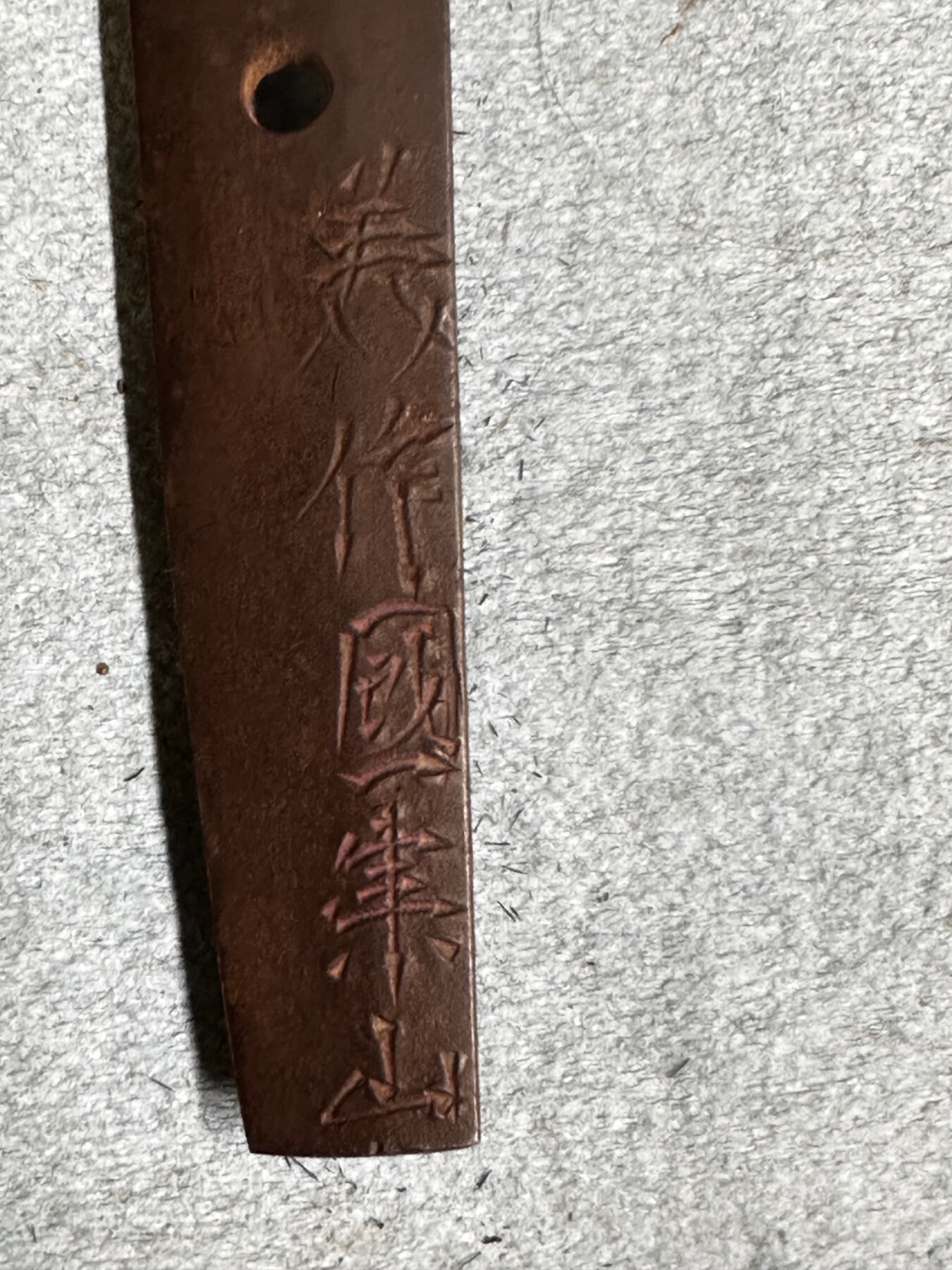
Thank you all for your expertise on this. I have horrible reception where I live so I’m sorry for the delayed response. I had my wife take a better picture with her phone if that helps with identification. It seems to me unique that a lot of the characters appear with arrow ends on them. I know this is a repurposed blade and it seems very well foraged.
 1 point
 -
We need the real translators for this. To me, all the kanji look real rather than the usual jibberish. The first kanji on the first photo is "Matsu". Regardless of the mei, though, I agree with the others about the blade. The offset machi and the poorly made nakago speak of Chinese work. It is odd, to me, that the blade looks to have been re-fitted - double ana and moved machi - like it was actually a sword-in-use somewhere. Either way, the Nagamitsu we all know and love did not make this blade! Ha!1 point
-
I guess 新春 - New Year.1 point
-
If it were me, I'd find a friendly dentist of doctor and ask them to do an xray, to see what the tang looks like, where the ana is and get an idea of what's in store. If you know where the hole is, you may be able to find a way to get to it without damaging the tsuka too much.1 point


























This leaderboard is set to Johannesburg/GMT+02:00