
Leaderboard



Popular Content
Showing content with the highest reputation on 06/20/2026 in all areas
-
佐藤兼住 - Sato Kanezumi He was one of WWII swordsmiths in Seki.5 points
-
Hello, The Count is the model collector archetype, and amongst the ones I most admire. He lovingly invested into every single of his blades to leave them in a better, more complete state than when he bought them. Polish, Koshirae, habaki, name tags, tsunagi - he had an entire system, and these artifacts are precious today and add value to the whole. Here is one of his swords that just came out today, with wonderfully and tastefully created koshirae. https://nihontowatch.com/s/493024?v=1781928271 Best, Hoshi4 points
-
Yes, we have a lot of languages in Europe. English understands the most people.4 points
-
The way that all images have been photographed at angles and cropped, partially cutting of sections of the inscription make readability difficult (like trying to read a sentence that has been fragmented into a number of separate images with words randomly cut off). It is best to provide a single vertical image that shows the entire inscription in one photo. The sword is a Seki made showato arsenal blade, not fully traditionally made. I believe the smith is Kanenobu ( there were several individuals using that name working during the war). Best regards, Ray4 points
-
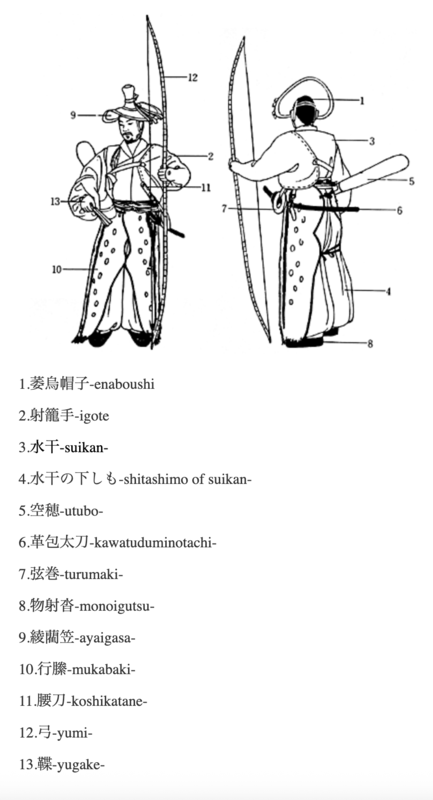
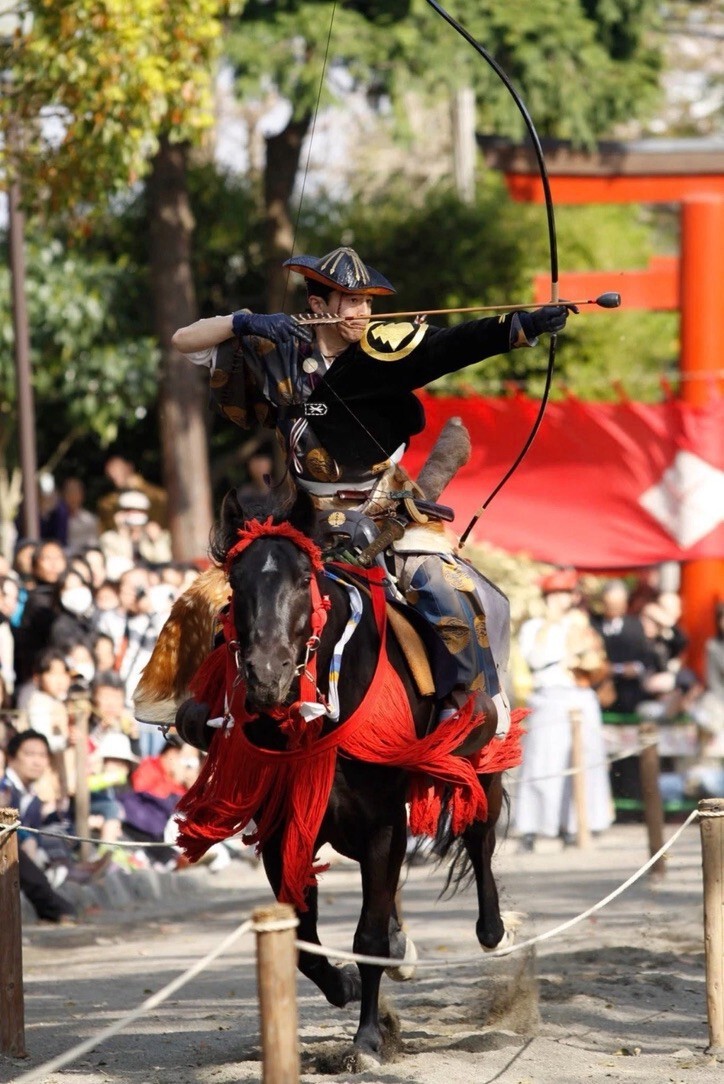
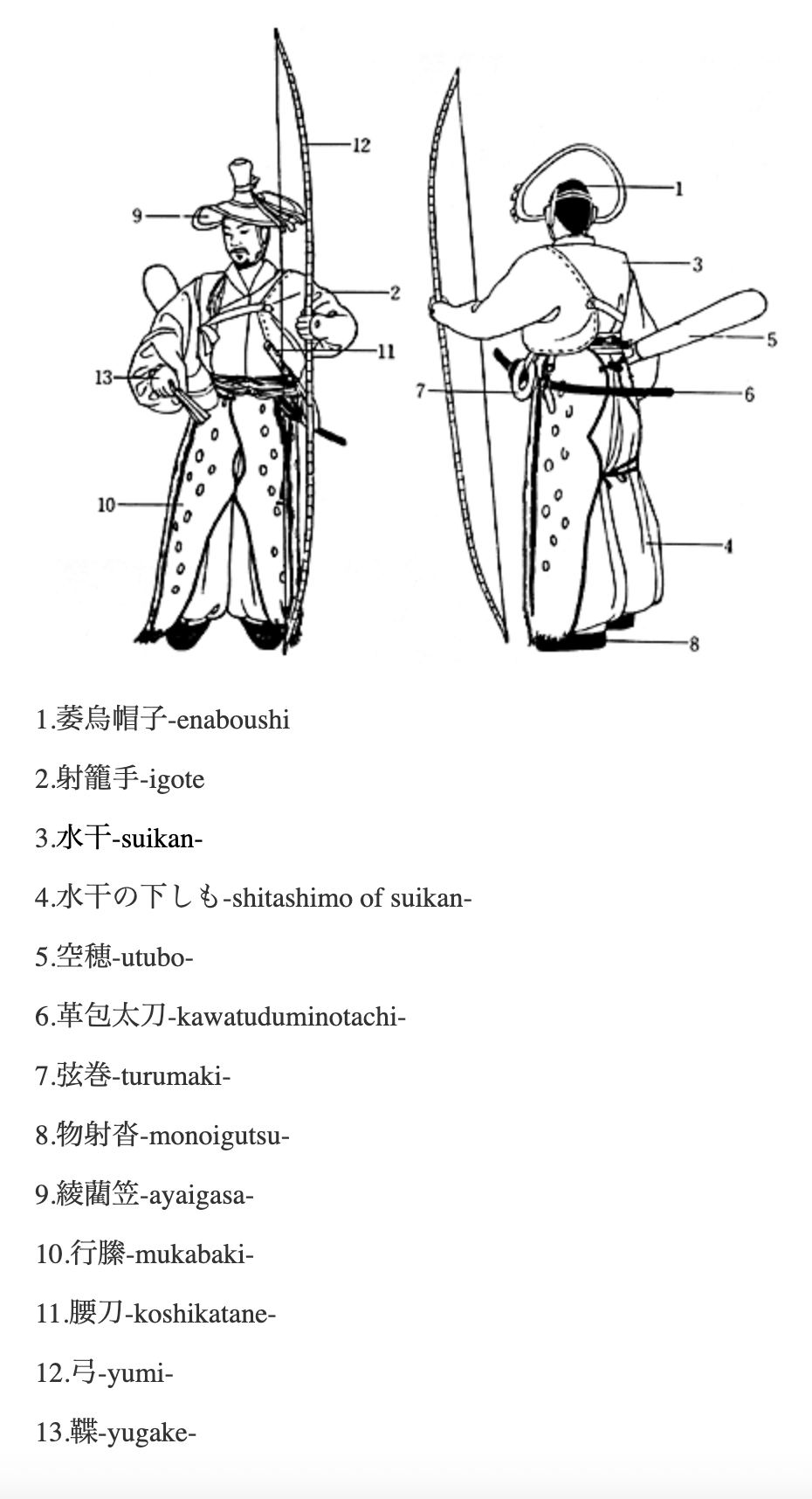
The suikan (3) is a top that had collar and wrist ties, worn as under armor-attire by samurai during the Heian Period (794–1185). The Shitashimo of Suikan is a hakama with ties at the ankles (4). During the Kamakura Period (1185–1333), it transitioned into standard formal wear for middle-ranking samurai and younger military nobility (buke). By the Muromachi Period (1336–1573) its popularity rapidly declined as samurai aesthetics shifted toward the simpler, more mobile hitatare. By the Edo period, it had largely fallen out of common use. The igote is worn over the left arm and upper body to protect the forearm of the bow arm from being hit by the string (tsuru). The wrist tie hitatare is fastened on the right sleeve to keep the material out of the way when manipulating and shooting the arrow (ya). The same American seller on eBay of the Ayaigasa will be selling me a new custom-made hitatare outfit that has a matching top and hakama along with a left-arm sleeve called an igote. This is the only seller that I have found who is supplying yabusame-related clothing. I also acquired a horse-whip (yumi-guchi) that is fashioned from broken bows (yumi).


 4 points
 -
カ = “Ka”, perhaps? I have never seen that one on a gunto tsuba. Very interesting. -Sam4 points
-
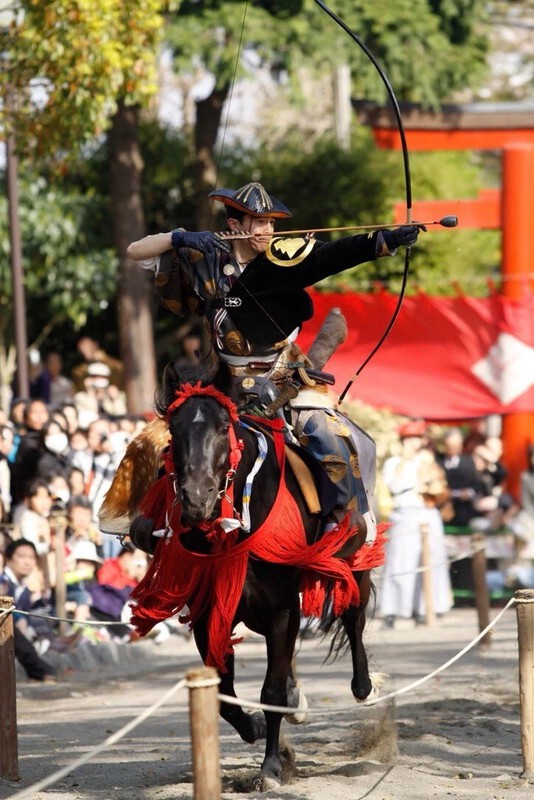
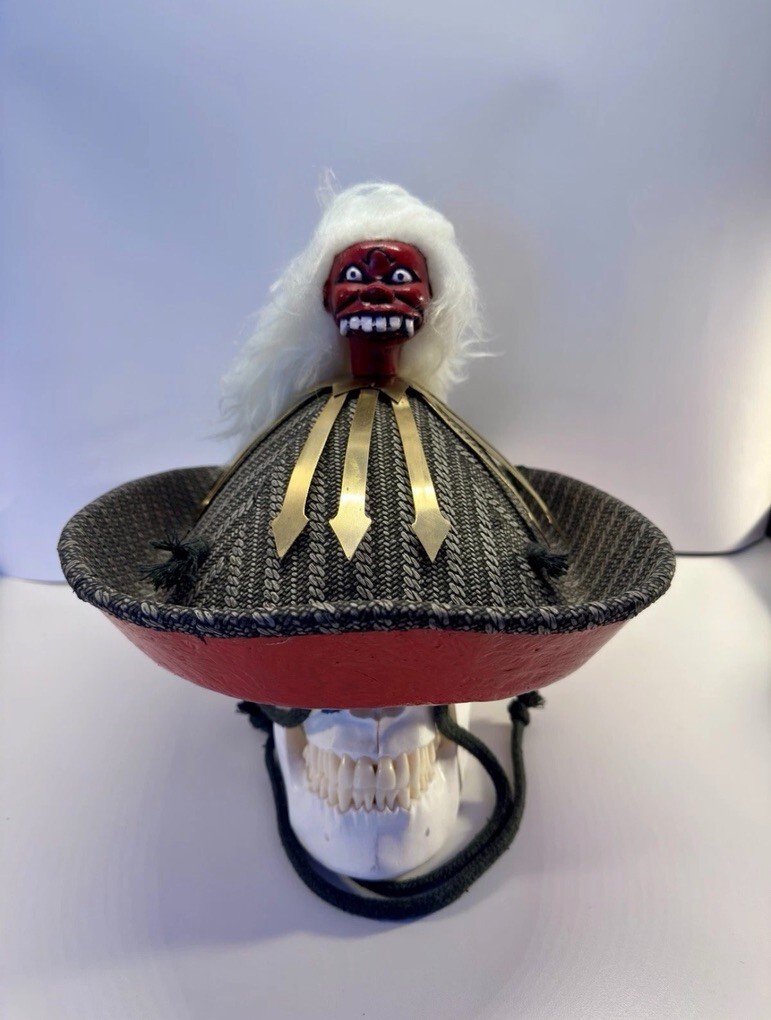
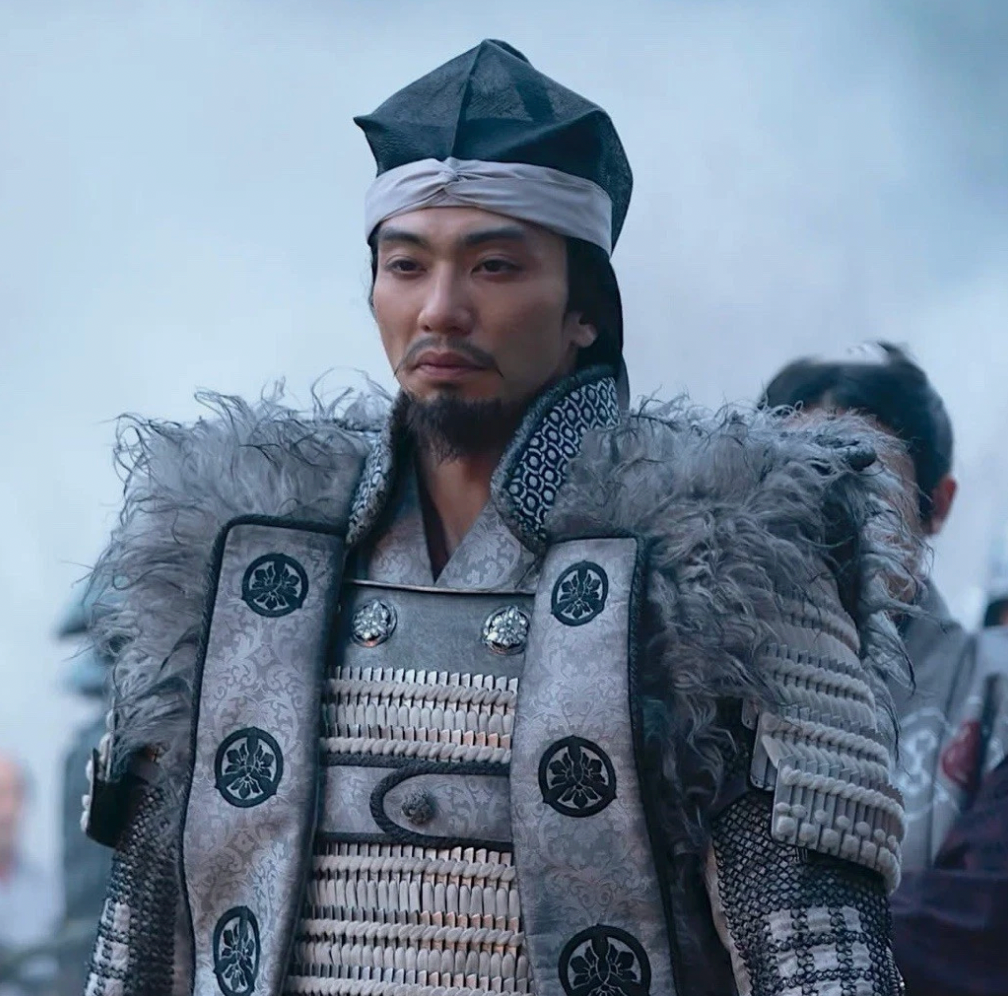
Recently, I have been researching the traditional equipment (specialized bow/arrows, saddle, horse whip) and outfit (clothing, swords) related to the practice of yabusame. Here, I would like to document what I have learned as well as what I have personally acquired over time in order to both be able to train at home in yabusame on a wooden horse, and to experience the feeling of wearing the traditional "hunting" outfit along with swords. Here is what yabusame looks like and the equipment and clothing that is traditionally worn: Let's start with the outfit. Enouboshi (1) is a traditional samurai fabric hat, which is not practical to wear except for under a kabuto helmet. For the style of Ayaigasa I will be using, the Enouboshi is too long and trailing in the back. I managed to find a modern reproduction fiberglass Kimen Ayaigasa (2) custom-made in Japan. This highly specialized hat is the traditional headwear of yabusame practitioners. It features the iconic, menacing red Kimen (Demon/Oni face) mounted on the top, which is detachable. The interior features a fully adjustable suspension pad system and secure chin strap to ensure it stays firmly in place during movement.

 3 points
 -
SOLD @Scogg please move to archive thank you!3 points
-
Tsuruta-san offers a suigetsu-Yagyu: https://www.aoijapan.com/tsuba-mumeiunsignedyagyunbthk-tokubetsu-hozon-tosogu/
 3 points
 -
@Takezo Swords continued to get longer throughout the 1500s and Tenbun era sue bizen generally ranged from 65cm to 68cm and reached 70cm + from Eiroku up to the Momoyama so I think it s just due to the general time period trend. That Yosozaemon was recently on AOI earlier this year. I made a post about it. It s interesting that a sword this level it would re appear so soon. It did go for well over $100,000 USD. The sayagaki from Tanobe sensei noted it as being Shodai Yosozaemon best work. Which is saying quite a lot
 3 points
 -
Attached is the catalogue entry for the Sa Hiroyuki / Kunihiro daisho . Also a couple of others being a ko Aoi Kanetsugu which was a National treasure at the time and also the Meibutsu Hocho Masamune which was Juyo bijutsuhin at the time and is now Kokuho.


 3 points
 -
Here are some Naval officers belts . The top one is a senior officers ( Lt Commander to Captain ) full dress belt for Medical officers . The central one is another full dress belt for senior line officers and the bottom one is the standard service belt .

 3 points
 -
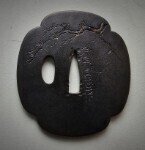
You can check the size of the circular punch marks making up the background, at the time the guard would have been made the punch would have been hand made [possibly by the same smith as the tsuba itself] if the punch marks are identical size it would not be surprising that both guards were made by the same tools and at least possible the same person - of course the tools could be handed down from one smith to another. Getting back to your first guard I just noticed it has a "Fukure" - a blister in the metal surface where the folding of the metal has failed to adhere and peeled up. Not uncommon. A "fukure" guarantees the guard is not cast.
 3 points
 -
Smiths_Soldiers_Diplomats_Block_Sesko-FINAL.pSmiths_Soldiers_Diplomats_Block_Sesko-FINAL.pdf Markus Sesko and I used to talk about how much we knew about Horikawa Kunihiro's life and travels compared to virtually every other smith before 1600. Then I came across Koyama Kanami's 1977 study of Akamatsu Masanori and his associates Katsumitsu and Munemitsu, I realized Kunihiro wasn't the only pre-Edo smith hiding in plain sight in the historical record. Markus and I began talking about a deep dive, and the result is the attached paper, which I hope stands out in a field where we know far more about the metallurgical features of great swordsmiths than about the men themselves. I am sharing it here with you guys first. It could not have been written without Markus's translations, discussions, and editorial judgment, which are evident on every page. I Hope you enjoy Smiths_Soldiers_Diplomats_Block_Sesko-FINAL.pdf2 points
-
Hi all; for reference here we have a Takayama sword made by the smith Ishihara Masanao. She regroups all the common features of these blades, such as compact nagasa (62 cm), short and thick kissaki (2,9 cm/8 mm) and long nakago (28,5 cm). The nakago has also a second mekugi ana, which is aligned with the sarute hole on the tsuka. The tsuka itself has a peculiar shape often related to the Takayama swords. The koshirae is, I think, an expensive upgrade, with 8 seppa and texturized saya's laquer. The dai seppa are finished with gold paint. About the steel... It should be some kind of anti-rust one, just the nakago differs from the shining, silver-like ones made in the IJN arsenals. Oddly, the mei doesn't bear the name Ishihara, just Masanao; the togishi should be Kizaemon (anyone could help on this?) Thanks for watching.


 2 points
 -
Chikuzen (no) kuni Katsutoshi.2 points
-
謹作高山刀 Kinsaku Takayama-tō. 刀匠 Tōshō 正直 Ishihara Masanao. 研師 Togishi 吉左衛門 Kichizaemon. @SteveM2 points
-
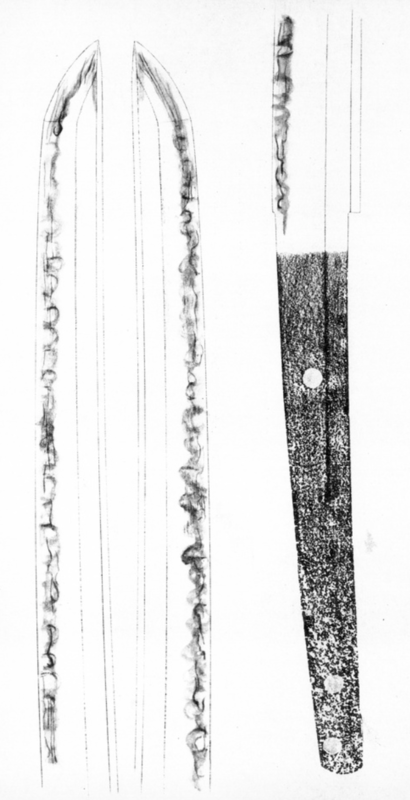
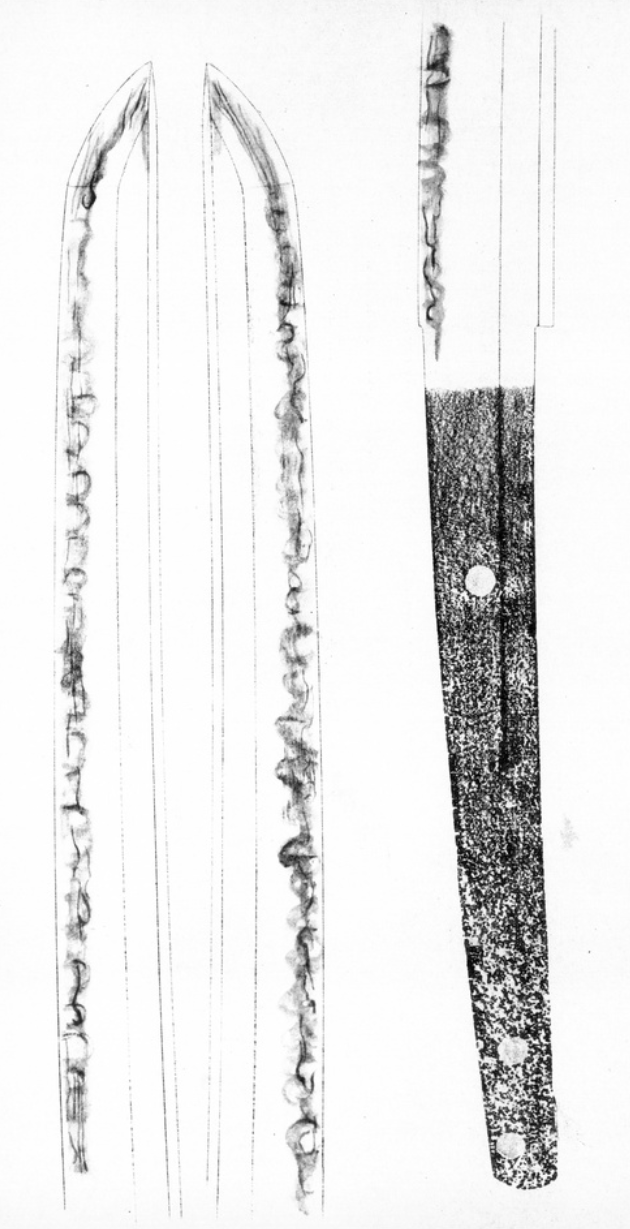
Feel sorry for the guy trying to draw the Oshigata. He did not stand a chance. Quite possible one of the worst Oshigata drawings I have ever seen. He even shades off the sword. This guy was struggling to keep up with Norshige's insane genius poured into this sword.
 2 points
 -
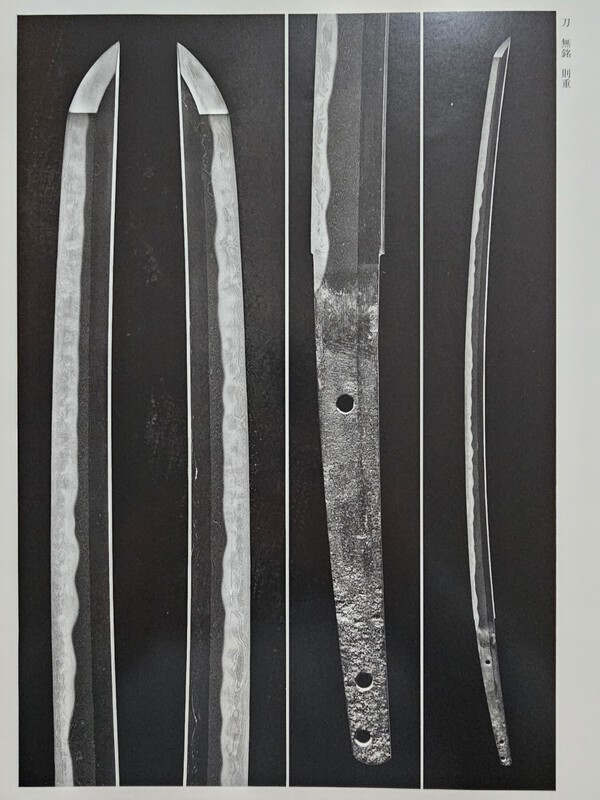
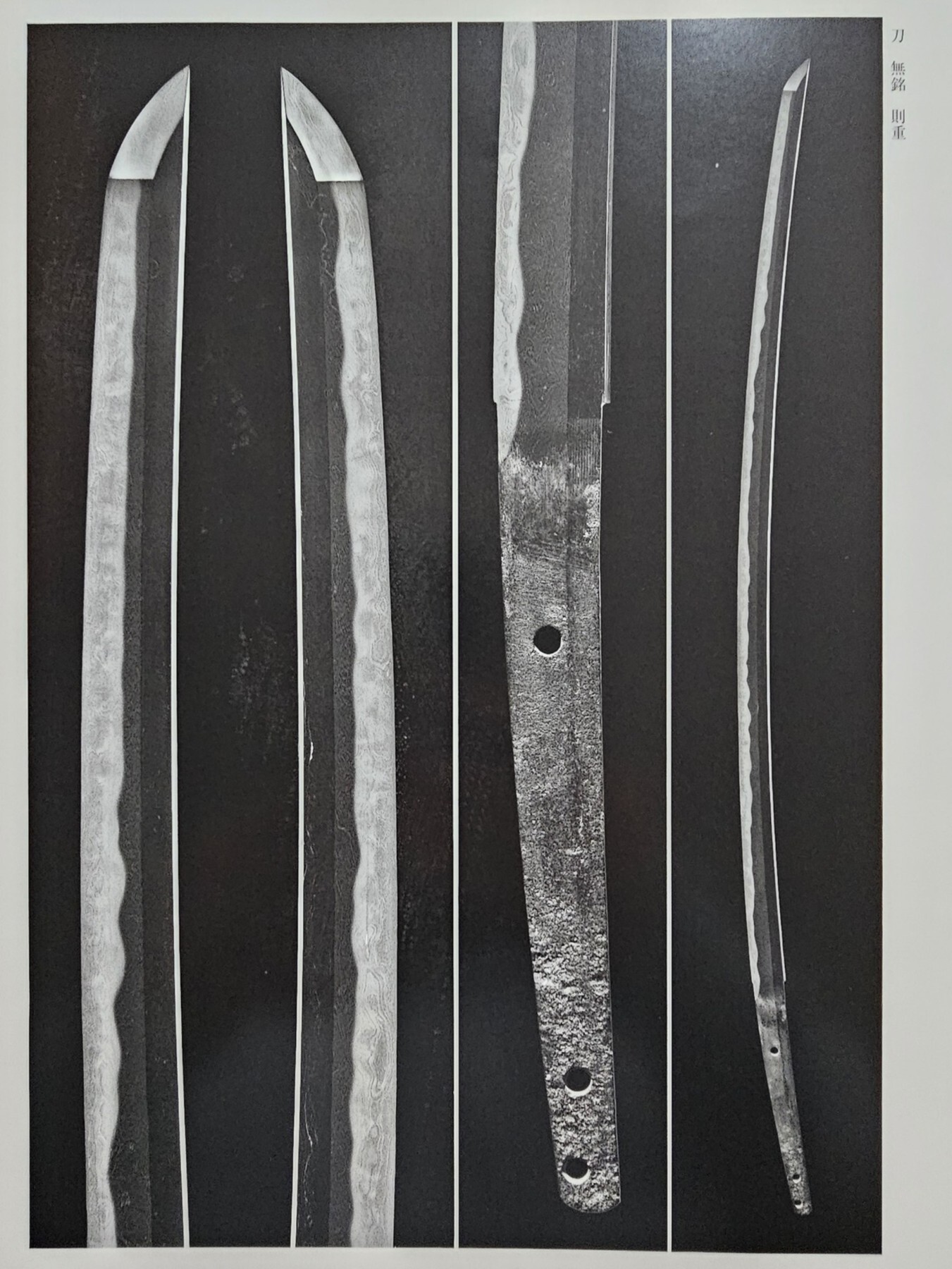
Juyo 10, TokuJu 10. This Hada gives me goosebumps. Absolute cracker of a sword! Designated Juyo March 10, 1964 Designated Tokubetsu Juyo November 11, 1987 Tachi, Mumei, Norishige Owner: Tateishi Katsuhiro Dimensions: Length 74.6 cm, Side curvature 2.3 cm, Base width 2.7 cm, Tip width 19 cm, Base thickness 0.6 cm, Ornament length 1.8 cm Tang length 19.3 cm, Tang curvature 2 types Shape: Shinogi-zukuri, Iori-mune, greatly shortened but with a slightly high sori, chu-kissaki Jitetsu: Itame grain mixed with mokume and nagaru-hada, with good ji-nie (small crystals in the ji), and frequent ji-kei (patterns in the ji). Hamon (temper line): Mix of choji and gunome (clove-shaped) midare, deeply nie-deki (crystals) overall, with a subdued nioiguchi (misty effect), yubashiri (snow-like patterns), ashi (legs) and ha (leaves) well-defined in the middle of the blade, sunagashi (sand-like patterns), and frequent kinsuji (golden streaks). Boshi: Midare Komi, sweeping, with kinsuji (golden streaks). Nakago: Greatly shortened, Kurijiri (wavy end), yasurime-katte sagari (downward-sloping) shape, three mekugi-ana (peg holes), unsigned. Artisan: Norishige, Etchu Province Period: Late Kamakura Period Provenance: Kishu Tokugawa Family Description: Norishige was from Gofuku-go, Etchu Province, and studied under Shintogo Kunimitsu of Soshu Province, making him a fellow disciple of Yukimitsu and Masamune. While there are relatively many short swords among Norishige's existing works, two long swords designated as Important Cultural Properties are known. His style resembles that of Yukimitsu and Masamune, but his forging is distinctive. The grain pattern, a mix of straight and wavy patterns, with a pronounced grain and thick ji-kei (patterns in the steel), is called Matsukawa Hada "pine bark grain." Ancient texts describe him as "skilled in iron preparation, with a non-uniform grain and masterful sunagashi (sand-like patterns)." Norishige's hamon (temper pattern), like Masamune's, shows influence from Anben of Hoki Province and old Bizen swords, giving it a unique antique feel. This sword also clearly displays Norishige's characteristics in its ji-ha (steel surface) and hamon, with strong nie (martensite crystals), ji-kei, and kinsuji (golden lines) demonstrating the extraordinary skill of a master craftsman of the Soshu tradition. This blade has been passed down through the Kishu Tokugawa family. This is Peak Norishige.
 2 points
 -
I would expect to see more masame/nagare in a Shizu blade, as well as a more active hamon. Also, Shizu is generally considered a higher attribution tier than Soshu Masahiro so putting a gimei of Masahiro on a sword that could pass as Shizu doesn't make sense from an economic perspective.2 points
-
Most academic presentations are in English here. I live in Germany and even in groups where the majority are native German speakers, they use English.2 points
-
Talking fantasy swords there is a certain TokuJu Norishige Tachi (only 3 Tachi remain and the other two are JuBu) - I am just enamoured with it. I personally think it is the best thing Norishige ever produced. Once owned by the Kishū Tokugawa. If the universe conspired to make things happen that sword is without a shadow of a doubt my pipedream fantasy buy.2 points
-
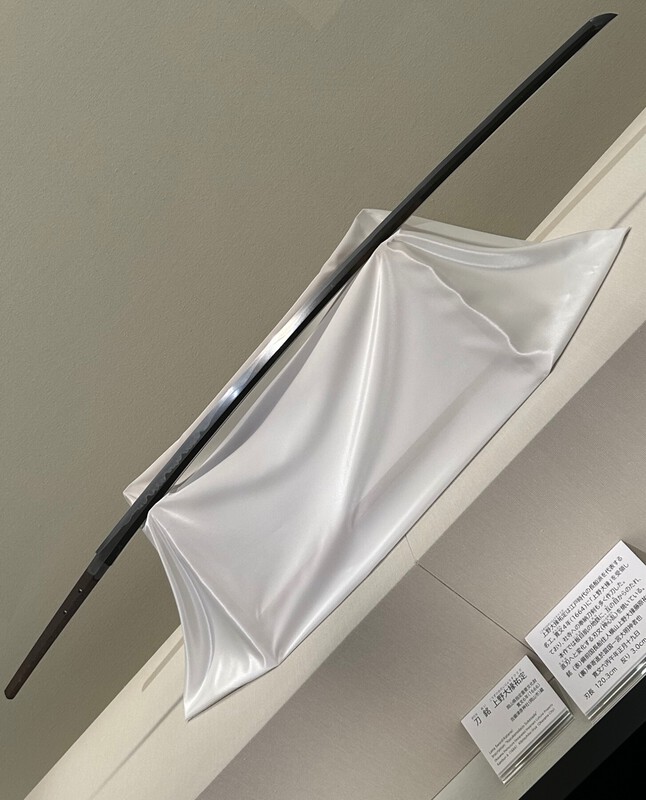
One of my all-time favourite dedication swords is by Kozuke Daijo Sukesada, another of those genius smiths of his time. I am sure this 1664 blade has been covered by me and others on this NMB site, but it is now on display with some other shrine swords at the Okayama Prefectural Museum. From the Kibitsu Hiko Jinja, restored and polished by the local branch of the NBTHK. The hamon expresses through three stages the ability of (the) God/god(s) to pacify the troubled hearts of the people. This Shinjin-midare 神心乱 starts out as midare, changing to notare and ends in suguha through the monouchi to the kissaki. NB The word Midare, (verb midareru) also means turbulence, trouble or confusion. Change of angle

 2 points
 -
Thanks Adrian! Yes, that "KA" is in the location where we see shop logo. So, I would say we are seeing an unidentified shop that made these fittings, or at least the tsuba. So, the "23" of your fittings doesn't match the "44" of your blade. A couple of options: 1. The "44" is from the original fittings shop, but the blade saw a fittings change either during the war or after. 2. The "44" was put there by the smith or the arsenal, and the fittings shop used their own numbering system, not caring what was on the blade. We see plenty like this and there is no way to know the significance. Thanks again for the photos!2 points
-
Hey Nazar, Looks good and the price is also good. My opinion!2 points
-
@Takezo I was just looking at them 😆 While I ll always prefer Gorozaemons signature suguha works, he was indeed skilled at hitatsura and this is a beautiful work. I do think however that hadori is a very poor choice for this blade ( or any hitatsura works ). Judging by the oshigata, this sword would look magnificent in sashikomi. And a beautiful sugata and signature by Magouemon. One of the pro s of Magouemon over Gorozaemon for me was that swords became longer during the Eiroku and his works are consistantly 70cm+ while Gorozaemons work are generally in the 65cm to 68cm range. I generally try to avoid bo hi ( except futasuji hi ) bc of the asthetics and I always dread seeing blades where the soe bi is polished off in places over time. Both beautiful works overall however and I certainly would have a hard time saying no if I had the $$$2 points
-
I did consider that as well, however Sudo-san does not ship outside of Japan so I did not want to put the broker of this deal through too much trouble. It would be awesome if NBTHK would fly a team to USA occasionally for a Shinsa session...
 2 points
 -
And another video https://www.facebook.com/reel/27437695526622582 points
-
SASANO-SENSEI used pointed tools made of antler, bone, ivory or bamboo to scrape off red rust on iron TSUBA (see below). He also exposed TSUBA to humid air by hanging them out on a string. After some time, he rubbed them with clean cotton and carried them for a long while in the pockets of his trousers. He said the moisture evaporating from the body and the very light rubbing of the fabric resulted in a good and natural patina. On the other hand, Mrs. SASANO was angry with him about that method as she had to mend his worn-through pockets ever and ever again! He also recommended to handle iron TSUBA with bare hands while soft metal TSUBA should be handled with cotton gloves.
 2 points
 -
Every once in blue moon, a piece appears that checks all my wishful nihonto fantasy boxes https://eirakudo.shop/9787491 point
-
Hi Steve Youasked "Beautiful, Piers. There is a more contemporary Ukiyoe offered on eBay depicting yabusame, which is not nearly as nice as the one you shared. Who is the artist?" Piers' is by TOYONOBU and called Oda Nobunaga and Shibata Katsuie, from Shinsen Taikoki (Newly selected history of Toyotomi Hideyoshi), diptych 1883 The Artist is Yōshū (Hashimoto) known as Chikanobu 1838 - 1912 The print is from the series known as Chiyoda Castle (Album of Men) Date of Print 18971 point
-
That is a beauty, Marzio! Thanks for sharing it. I really love my Takayama style blade. They are something special.1 point
-
From what I recall he used two distinct styles, so called kaku Tsuda or square and maru Tsuda or rounded. Clearly the sword in question is from the kaku Tsuda period if that helps at all. Some more information here, https://www.sho-shin.com/osaka-tsuda.html All the best.1 point
-
Don't know enough about the signature (Kosho would make it one of the earliest known?? more likely the previous generation), but the work is strong, despite a rather dated polish.


 1 point
 -
Yes, plenty of koto Bizen blades in that price range if you don't care about ubu nakago and signature. Especially if you're happy to get a shorter blade (65cm or less).1 point
-
I believe I know the blade you're talking about and I agree; it's one of those swords that really solidifies Norishige's reputation as the swordsmith's swordsmith.1 point
-
I'm realizing the belt topic, like swords, is going to be bigger and broader than I'd imagined. Here's a belt shared by @Marcin. It's advertised to be a "youth school, pre-military" belt. I asked Akira Komiya at Warrelics about it and he believes it to be a "...belt with the round buckle to be for a girl’s school uniform. I remember seeing some school girls wearing such belts with their summer white sailor jacket style school uniforms while commuting on trains. I believe they were students of the high school/junior high school attached to the Ochanomizu Women’s University as they would have taken the same line as I did. Here is an example photo of the uniform complete with belt. Although the belt is not identical, there are other schools which uniforms came with belts" So, essentially correct. Belt in question: Akira's example:

 1 point
 -
I believe the asking price is twice that...1 point
-
I noticed the lecture was in English. Is it common to have Japanese sword fairs in Europe where the common language is English?1 point
-
Took a little longer than expected at Customs but arrived safely, Higo School, Early Edo and 8.3 cm. The wine leaf decoration is almost completely intact and the the Iron is a beautiful chocolate color. Very happy with this one.
 1 point
 -
Just finished reading. What a wonderful treatise about 2 unique swordsmith siblings working in a turbulent age and navigating a life, while still being able to follow their passion. Its a remarkable document, the two of you @Mushin and @Markus have created. Your piece is a moving tribute to their lives and work. One question. When the blades were signed gassaku, did one brother sign both signatures or did each sign his own name? I assume its possible to determine who was the author of the inscription based on their individual carving styles.1 point
-
That’s a good idea, but it’s not easy. Aside from what Sam just mentioned, a lot of Type 95s were sold into China, including non-matching ones. Usually, sword dealers will have someone grind off the serial number on the scabbard, re-stamp it to match the blade, and sell it as a matching set. That being said, the original number on the scabbard is gone forever。1 point
-
@2devnul How long ago was this purchased? Usually when an item is purchased the sale post goes into the "SOLD" listings and yet I cannot seem to find this sale. IMO, It seems to me that a statement of "No Forging Flaws" Is a CLEAR misrepresentation of what you have posted pictures. Just to be certain though, could you please measure the length of flaw present on the mune. Anything greater than 2mm, and thats being generous, should have been easy to spot by anyone who was looking to give an honest description.1 point
-
It is one side, can't be removed by Uchiko but should be removed with proper polish (as per initial info from polisher). Yeah, I used electron microscope to do the pictures, not a build in camera from cheap Motorola smartphone ... again, I can't tell if you are joking or being serious, as these type of comments are so ridiculous. Yes it does. I don't need to use my spectacles or magnifying glass to see it. I recommend eye check for yourself if you missed these flaws. Well, you either missed the spot or the rust was there and just 'evolved'. Per info from polisher it is to deep for a 1,5month fresh rust. Still, that is not the biggest issue. Kissaki is the main problem. Also caracks on Mune are not what I expected from (your words here) "no forging flaws" blade. Same here.1 point
-
Just because the mei was signed differently doesnt mean its gimei anyway. This is the point i'm trying to say. The artist could have signed it in a bad mood , drunk , sick or who knows. Unless its worth over 100k at least sword then I would try my best to prove its is from the artist.1 point
-
Where does this constant assumption come from that gimei blades are "fake"? People really need to understand that fake signatures are common, done sometimes at the time of manufacture, and was an accepted and commonplace occurrence in the history of Japanese swords. The FAQ above has a write-up on it. There are thought to be more false signatures on swords than real ones. But the swords are still genuine. It's something you live with if you collect Nihonto. Also, Roger (Hizento) is one of the most qualified people when it comes to this school. He's literally written the book on the subject. If he says a mei is gimei, then there is a very likely chance that it is. I trust his opinion just slightly below a shinsa panel.1 point
-
Adam, maybe I didn't understand the point, if you're asking me if I would spend that amount of money on a blade without paper the answer is definitely no, and yes I would have expressed the same opinion if the blade in question hadn't had the paper while still immediately recognizing that the the work is undoubtedly of excellent quality. Compared to your blade (Leaving aside the issue of the lack of certificate coming from Japan) I can express my opinion (Which however counts zero): I think your blade has some qualities and the signature isn't that bad but if I compare it with the one on sale the perception I have of the activity seems totally different, especially regards Jinie the one on sale definitely seems on another level but I admit that (In addition to the author's lack of knowledge) my reading may be distorted by the difference in the state of polishing of the two blades and by the photos. For me everyone is free to believe what they want, someone believes that their Chinese fake is worth 80,000,000 millions... I personally tend to have a very objective approach and for me the market has its unwritten rules... also especially for economic evaluation having the certificate also means having traceability to establish a value consistent with the work, establishing a value is already a complex thing... without any reference that gives a minimum of certainty everything becomes very questionable. Just my 2 cent. All the best, Giordy1 point
-
For me its much harder to judge signatures compared to blades. On the one hand it does not look badly written and does look like a koto signature. On the other hand Sagami signatures tend to be bolder, with larger kanji, somewhat lower and at least with a bit more towards the center placement. They are also often faked. The work is not the most typical Masahiro but within roughly the same style. I think the possibility it papers is 50/50.1 point
-
Ok that clarifies things a bit. Very straight bo utsuri, very weak hamon but high contrast jigane, this is circa 1510-1550.1 point
-
Thanks so much fellows! I am wondering if what Ray mentioned is spot on as if someone was doing heavy combat one handed the extra mekugi might act to reinforce the far end of the tsuka against leverage where the left hand would normally hold the tsuka in two handed grip. A single mekugi acts like a fulcrum and rotational force could be delivered to the end of the tsuka. It's just an idea. Perhaps Guido can get involved as this is very much his subject?1 point



















This leaderboard is set to Johannesburg/GMT+02:00