


Nihonto student
-
Posts
175 -
Joined
-
Last visited


Nihonto student's Achievements






-
Sorry Mitchell, obviously my post was meant for Andrea I mixed up names
-
Dear Mitchell, first of all congratulations on your purchase. Are you sure about the nagasa measurement? Because in that case, it would be an ōdachi, not a katana; looking at the photos, it doesn't appear to me to be a 101 cm nagasa. Are you sure that measurement isn't the total length (including the nakago)? Regards, Giordy
-
Hello Anthony, always a pleasure to help, as I mentioned, mine is just an opinion based on a photo and a measurement, though I do think it’s a safe bet given the available information. I should clarify, however, that even if my intuition is correct, the fact that it is 400–500 years old doesn't make it rare or valuable in itself, that was the peak period of production in Japanese history, and the average quality of the work tends to be lower than in other eras but that doesn't mean great pieces can't be found. Regarding your blade: first, I recommend checking the forum's FAQ, especially the sections on care and maintenance, if you can't see the hamon doesn't mean it isn't there, blades become dull over time, especially if not properly cared for. Yours would likely need polishing by a professional togishi (don't try to do anything yourself this isn't a job for sandpaper, and you risk permanently ruining the blade). However, polishing is expensive, and I’m not sure if there is a qualified, recognized togishi in the UK (Geraint might be able to advise you on that), so you might have to consider sending it abroad. That’s why I suggest having someone look at it in person to see if it’s worth it, I'm sure at Token Society of GB you will receive the best advices. If you'd like, keep us informed of developments Kind Regards, Giordy
-
Dear Antony, based on the measurements, I confirm you that this is a katana. Given the condition of the blade, it is impossible to attribute it to a specific school or smith. Regarding the period, despite the worn yokote, the tip appears to me to be ō-kissaki (large point). Considering that is *ō-suriage* (significantly shortened), I would lean towards dating it to the late Muromachi era (1550–1600); however, this is merely an opinion based on limited information, and other users might offer further insights. In any case, I believe it is worth having it examined by an expert, there could be some potential. All the best Giordy
-
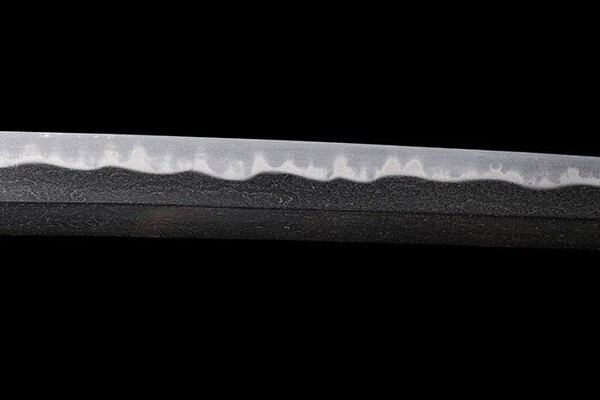
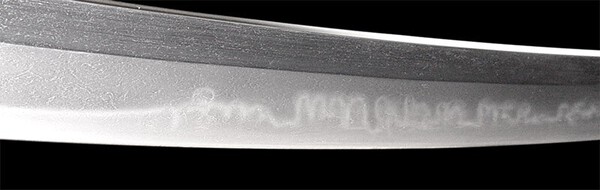
I certainly see shared traits, though that doesn't surprise me... from what I gather, Kunimasu (Shigetsugu's master) studied under Yoshikuni after his time in Osaka. In any case, Yoshikuni tends to retain Mishina-style characteristics, such as the boshi and yakidashi, though there are naturally exceptions. Furthermore, in works featuring choji-midare (including my own piece), one finds tobiyaki both in the ji and within the hamon, a feature also seen in the Yoshimichi lineage. I do wonder, however, if Kunisuke also served as an inspiration...regardless, Kunisuke’s kobushigata-choji tends to be more defined, whereas I would describe Yoshikuni’s style as more organic. Kunisuke Nidai Yoshikuni Yamato no kami Yoshimichi



-
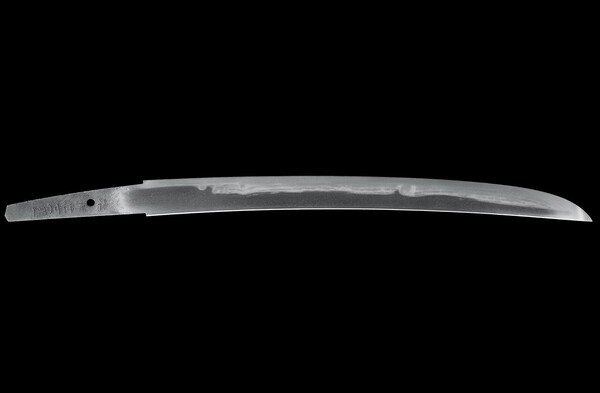
Some other pictures of his works:


-
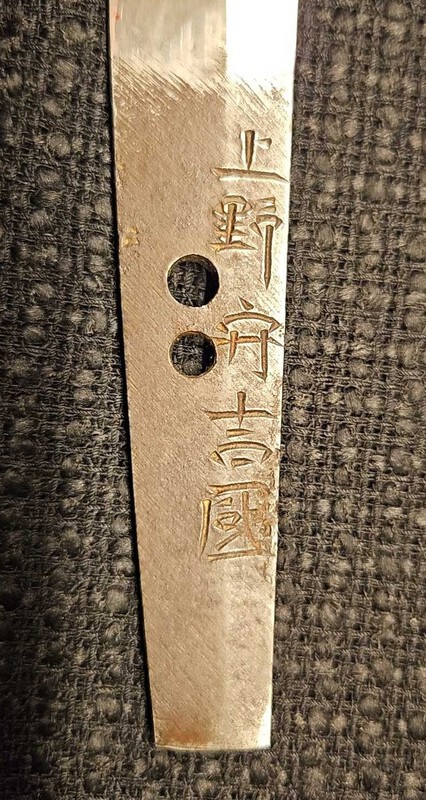
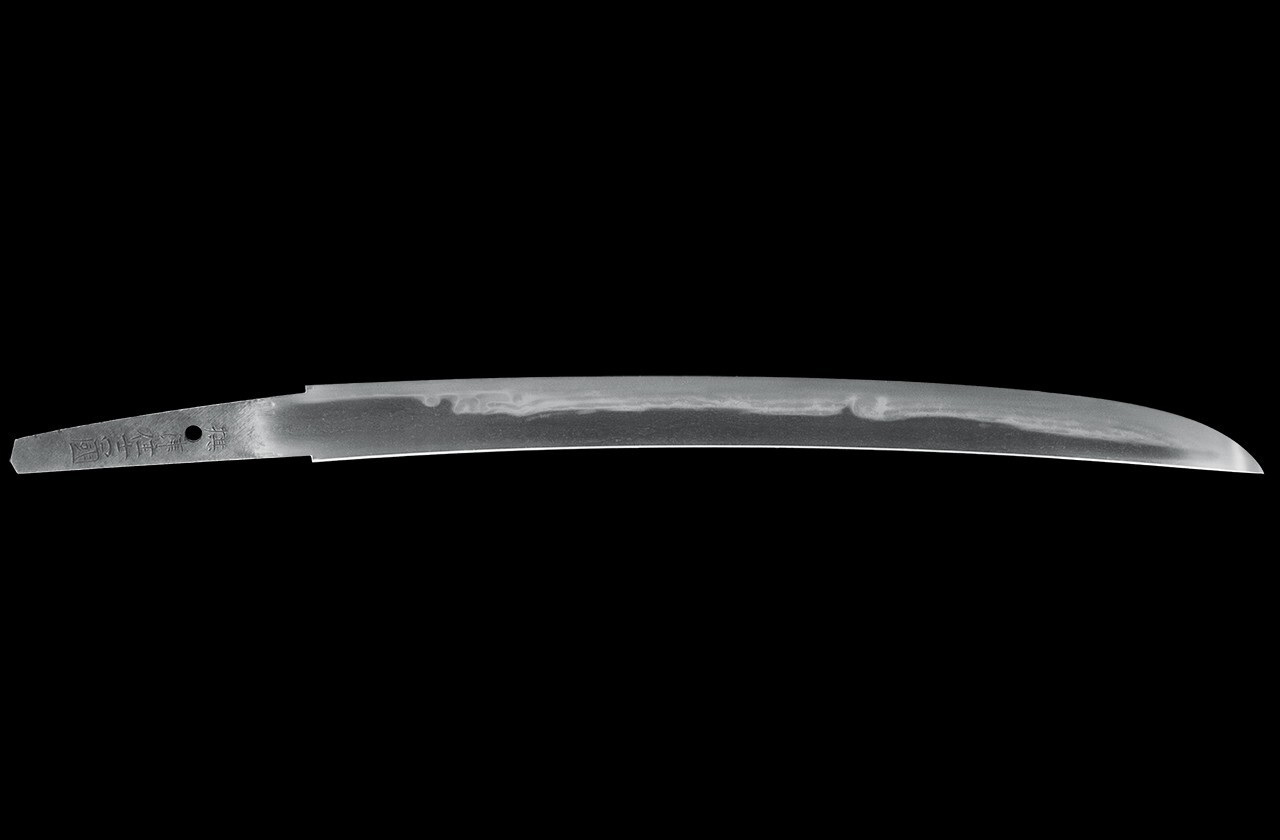
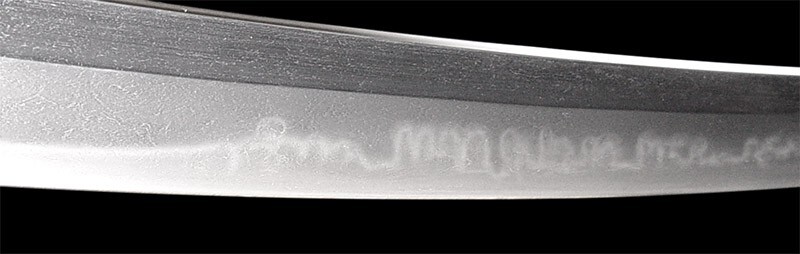
Hi Adam, I own a ko-wakizashi Ueno no Kami Yoshikuni (上野守吉国)— real name was Morishita Magobei, was a highly esteemed swordsmith of the early Edo period. His life was closely intertwined with the Osaka school and the history of the samurai of the Tosa domain. Yoshikuni was born in Mutsu Province (specifically in Nakamura, within the Soma domain). He was the eldest son of the swordsmith Harima no Kami Yoshinari and the older brother of Morishita Heisuke, who would later gain fame under the name Mutsu no Kami Yoshiyuki. The entire family moved from Mutsu to Osaka, settling in the Fushimi Ryogaemachi district. There, Yoshikuni and his brother joined the Mishina school, becoming pupils of Yamato no Kami Yoshimichi (the first of the Osaka generation). During this apprenticeship in Osaka, he initially used to sign "Yoshinari" (吉作). The brothers' talent attracted the attention of the powerful Yamauchi clan, the feudal lords of the Tosa domain; both were hired as official swordsmiths for the domain. Yoshikuni subsequently moved to Tosa, settling in the village of Kusaka, where he built his forge. On June 25, 1659, he received the honorary noble title of *Ueno no Daijo*, which was later elevated to *Ueno no Kami*. Although Yoshikuni is somewhat overshadowed today by his younger brother Yoshiyuki, famous in popular culture for forging the katana used to assassinate the revolutionary Sakamoto Ryoma in 1867, Yoshikuni is considered one of the most talented swordsmiths of the early Edo period on the island of Shikoku. His works show strong similarities to those of Yoshimichi; he is particularly renowned for being one of the few makers outside the Yoshimichi lineage to recreate the Sudare-ba pattern, although, especially in the latter part of his career, he settled on the Kobushigata-chōji style.


2.thumb.jpg.7db161520fa142517678b4309fe8f47d.jpg)
-
The thing about studying Kamakura/Nanboku-chō periods is that, beyond their works, the figures involved are essentially all ghosts... there are only assumptions, speculations, and romanticized tales regarding them and their lives, but nothing concrete. It seems absurd in itself not to have definite birth and death dates for the one considered the greatest of all time... This lack of certainty naturally leads to thoughts of "conspiracies" concocted to fill the gaps, though these too remain speculation... just frustrating.... As for the topic, it is impossible to choose for me, though I have long been searching (Unsuccessfully) for high-resolution photos of the Heshikiri Hasebe.
-
Dear Tony, It's a hybrid signature, with mei in kaku and nengo in sosho. The change from one style to the other wasn't immediate; there was a transition period in which the mei continued to be kaku with the addition of the kanji Tsuda (Family name) and the nengo in sosho. I can't read the nengo, but the reference period for the hybrid mei should be from 1668 to 1674, if I remember correctly. Compared to the blade, when the hamon is suguha, Sukehiro always tends to have variations in height, it's never completely uniform, as you can see in the oshigata posted by Uwe. All the best Giordy

-
Katana I inherited, looking to learn more
Nihonto student replied to Battosai's topic in General Nihonto Related Discussion
Dear Bryan, in addition to agreeing with what was previously expressed, perhaps it is an optical effect of the photos but in the nakago the shinogi seems to disappear, furthermore not a single trace of yasurime for a "relatively recent" nakago... if due to corrosion I would expect a more generally suffering appearance of the whole nakago and not such deep mei strokes. All the best Giordy -
Dear Tyler, some considerations: - From the photos, it's clear you purchased the blade from a well-known dealer in Japan. Did you actually go there to purchase it? The dealer has a high reputation, and I doubt they sold you an illegible or poorly polished blade without telling you, or even offering a repolishing service at an additional cost. If the blade was already in Japan, it would have been worth checking right away. - I don't know who's seen the blade, but it could very well have potential for Juyo. I'd just like to point out that there's a difference between having potential and obtaining certification. To obtain a Juyo certification, compared to previous ones, you need luck as well as excellent quality workmanship. It's not just a matter of requirements or quality. A high-level polish in Japan comes with significant costs, which, objectively speaking, will be difficult to justify if the blade doesn't pass Juyo. Of course, everyone is free to spend their money however they want... always free to spend on the absolute best polish, knowing that in the event of a resale of the blade, that expense will be considered very marginal. - Personally, from the photos, the blade looks more than legible. Could it be better? Possibly... but for now, if I were you, I'd try to show and hear from as many people as possible before embarking on a long and expensive adventure. All The Best Giordy
-
A widely discussed and controversial topic where scientific truth will likely be difficult to come by, just to make a reflection: Regarding the topic, much emphasis is always given to the changes in raw materials between the various periods and to the hamon based on the studies conducted by Masahide, but much less is said about the actual construction characteristics, perhaps also due to a real lack of reliable information. The simple question I think many of us ask is how, a blade forged in 1300 can be considered technically superior to a blade made today... a few weeks ago my father made a classic statement: "Today, cars aren't made like they were in the '70s, it's all plastic." Regardless of whether you agree with this statement or not, it got me thinking about the concept of evolution. What rewards evolution in the field of production in general? Basically, time and money. If I can produce the same object at a lower cost and in a shorter time with better/same or similar performance, this will be taken as the new reference model. Today it would be impossible to think of reproducing a car body like in the 70s, the costs would be insane... I wonder, then, how much time was required to produce a blade in the Kamakura period compared to the Shinto period? What about the combination of hard and soft steel as at the beginning the awareness of the percentage of carbon was zero? What techniques were in vogue compared to the kobuse of the Shinto period? Without reliable sources on these answers it is difficult to reach a conclusion...
-
Undoubtedly a beautiful blade Okan, thanks for sharing, I would like to ask what characteristics lead one to think that it is a Kunitoshi utsushi? Thank you Giordy
-
1798 Ozaki Gengomon Suketaka
Nihonto student replied to Frye1001's topic in General Nihonto Related Discussion
Kansei = from 1789 to 1801 --- Kansei 10 should be 1798 so for Mr. Yamasaki 19th October 1798 I can't confirm the signature in question, but even if it were the same year I don't think it would substantially change the cards on the table from an evaluation point of view, of course you would surely know that it is a blade made at the peak of his career so qualitatively would expect more compared to previous works. -
1798 Ozaki Gengomon Suketaka
Nihonto student replied to Frye1001's topic in General Nihonto Related Discussion
Dear John, I'll try to simplify Jean's post. The blade was previously covered in rust, but now it's not...who cleaned the rust from the blade? You or a professional togishi? This is because when it comes to Japanese blades, the problem isn't just removing the rust, but maintaining the geometry. If you don't maintain the geometry, it's a big problem. This is why becoming a togishi requires years of training...in the photos you posted, the shinogi seems barely visible, which suggests that whoever removed the rust had no idea how to maintain the geometry. @Lindley Suketaka received honorary title “nagato no Kami” in 1789 (Reference Sesko Compendium). All the best Giordy











2.jpg.b4ed97f77b49a9d13fe8d0c57a5ad083.jpg)