
Leaderboard



Popular Content
Showing content with the highest reputation on 12/24/2025 in all areas
-
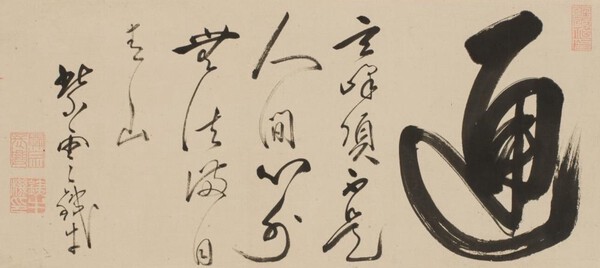
This is a wonderful "One Character Barrier" calligraphy scroll by the Obaku Zen Master Tetsugyu, which starts with a pictorial representation of the character 通 followed by an inscription that I am having a bit of trouble translating. 通 can mean "all" or "through" or "to pass through (penetrate)." in koan Case 89 of The Blue-Cliff Record, it appears as “通身是眼” (My body is through-and-through hands and eyes). I think I can make out the phrase 人同心 (people of the same mind) and also 無 (no, none, nothing, not one thing) and 山 (mountain).
 3 points
 -
On the road from Santa!
 3 points
 -
An excerpt from Hiroi Yuichi:3 points
-
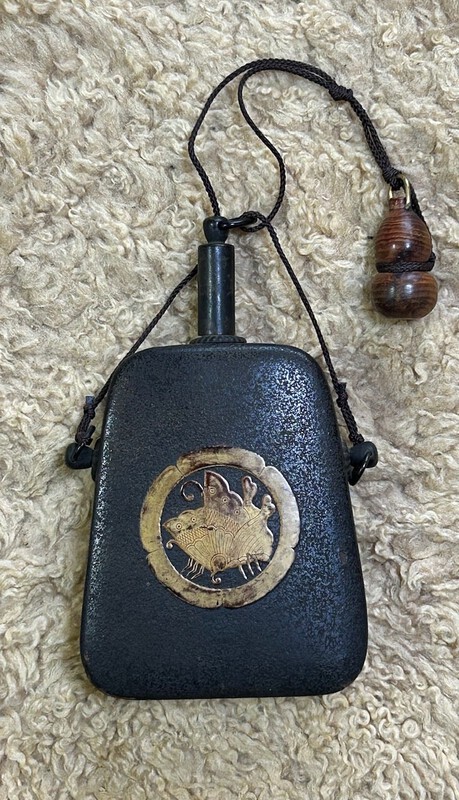
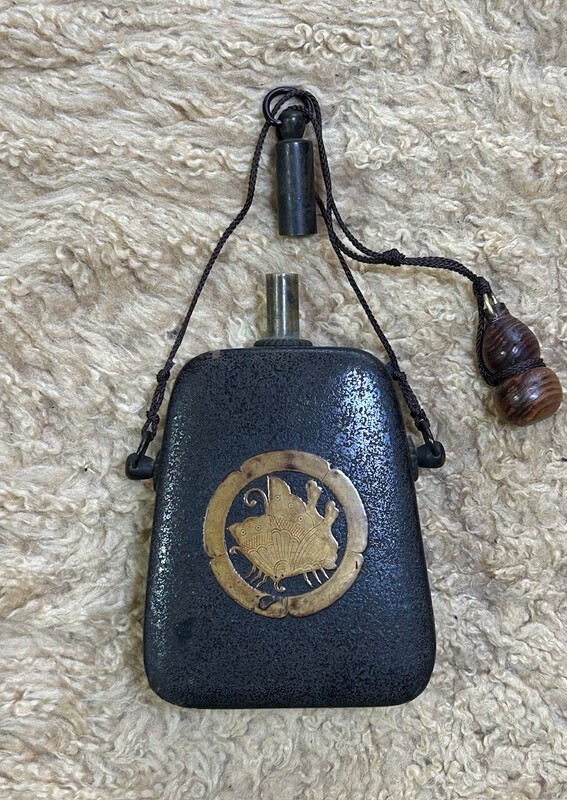
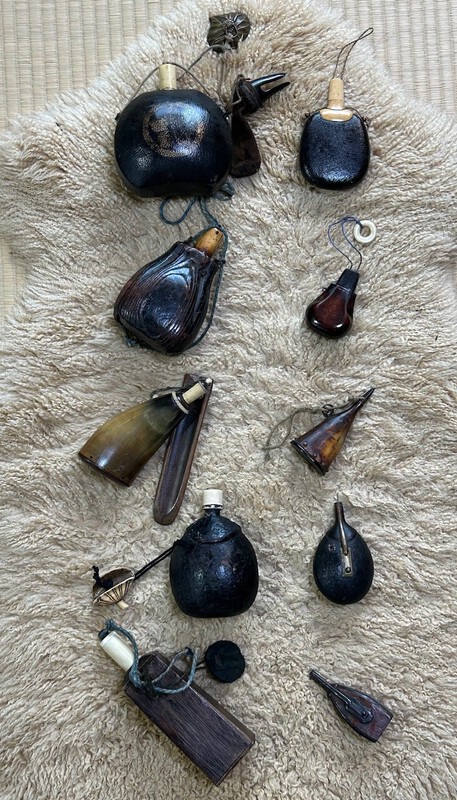
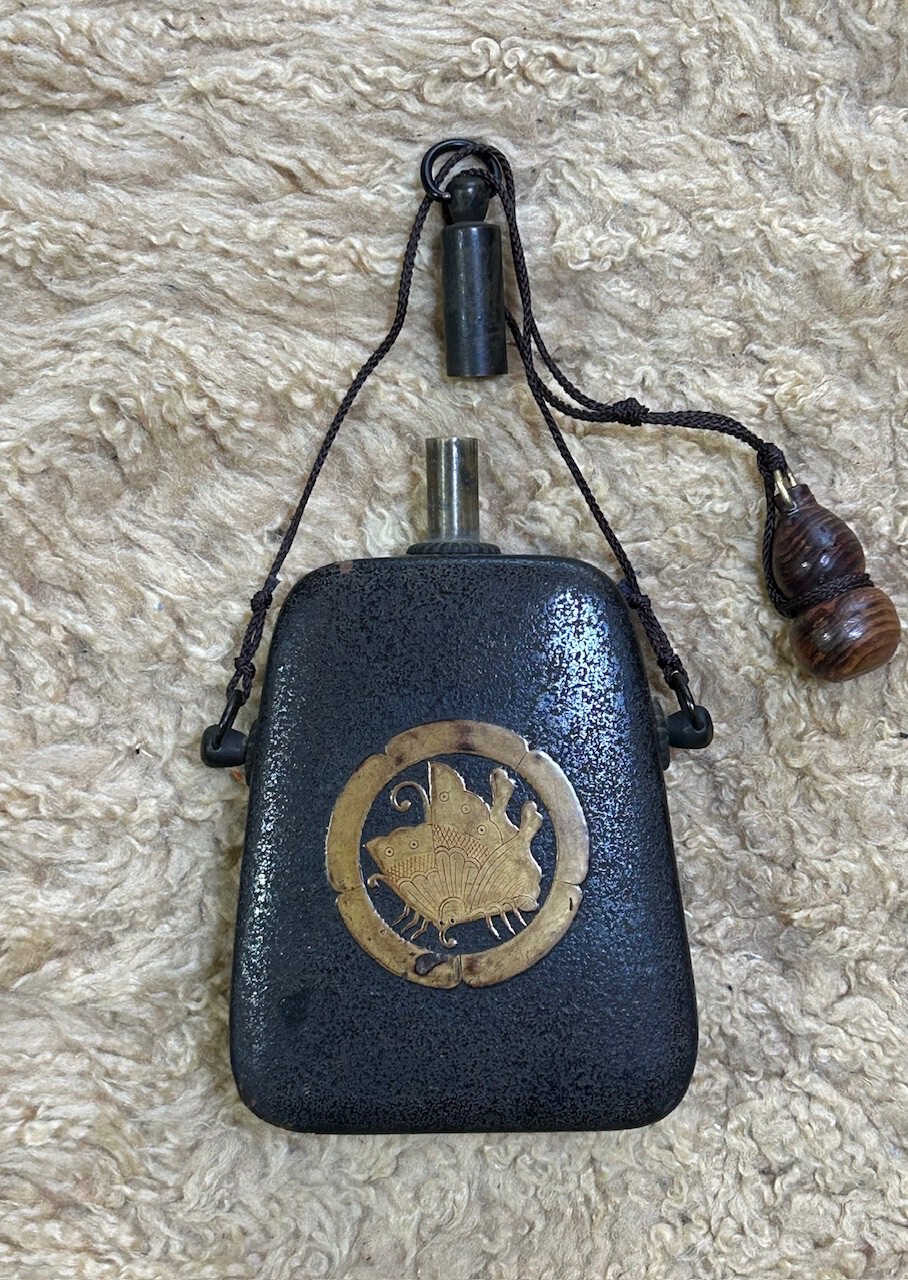
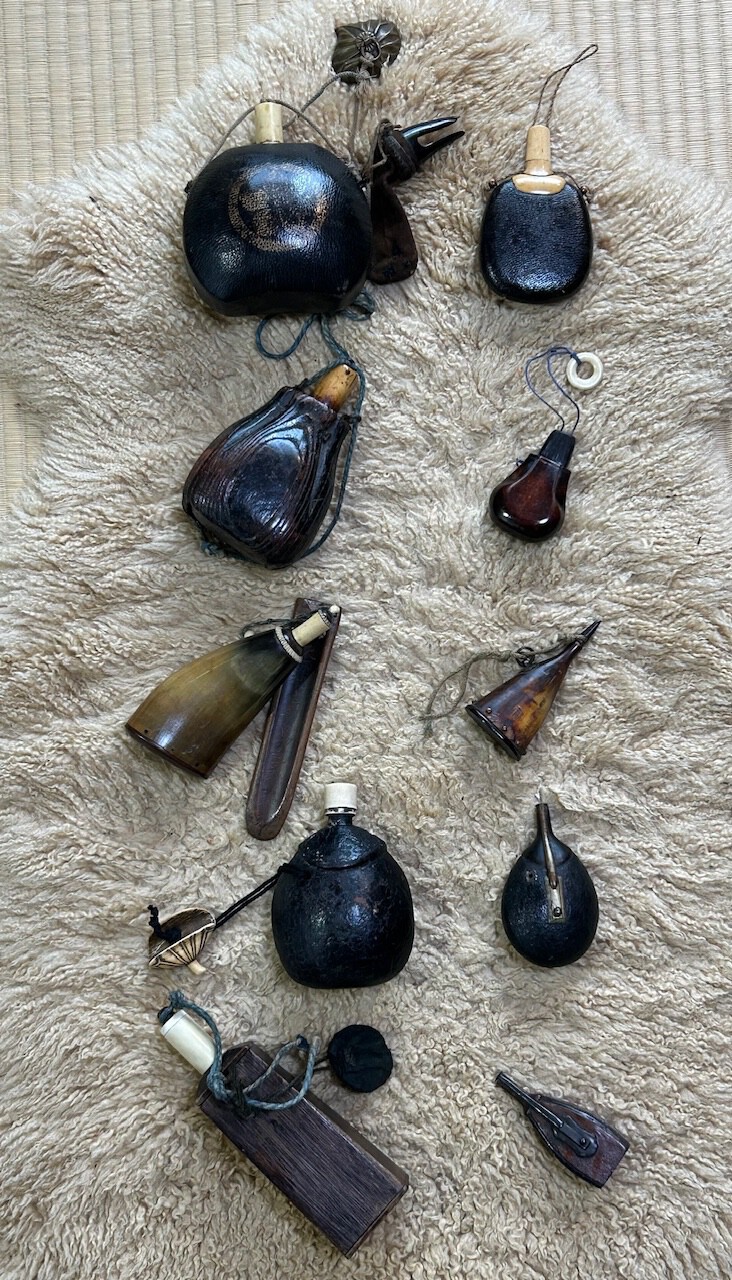
This example is a Kayaku-iré large coarse powder flask (A) from Tottori with Ikeda butterfly mon. Pouring spout enclosed, and opened. and PS Shinchū brass fittings do not strike sparks. The ‘netsuke’ was attached by the previous owner! Please disregard.
 3 points
 -
Hi all, we all know of the Rai school and their members. Rai Kunitoshi, Kunimitsu, Kuniyuki, and Ryokai. I consider myself to be somewhat of a new student in this hobby after maybe a year, or at least closing in on a year in the hobby. We hear a lot from the Rai school mostly focused around the following members. Yet I never have heard much about Rai Kunitsugu, despite him being one of Masamune's Jittetsu. Is there a reason for this? have I simply not read enough? looked around enough? is his work just not as superb as compared to the others in Rai? is he forgettable? any answer would be appreciated. Helping out what could maybe be a case of newbie nativity. Hoping this isn't too silly of a question to be asked, still working up my confidence to post as much in this forum Thank you all!2 points
-
Nice work, Thomas! Interesting read. You are the Master Researcher -2 points
-
I am seeing exactly the opposite. One side appears to be ichimai-boshi. If you have access to a better primer like the Connoisseur's Book of Japanese Swords, you will see an example of this.2 points
-
Hizen (no) kuni Tadayoshi.2 points
-
2 points
-
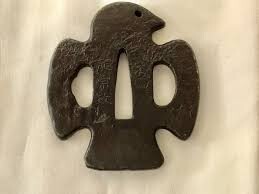
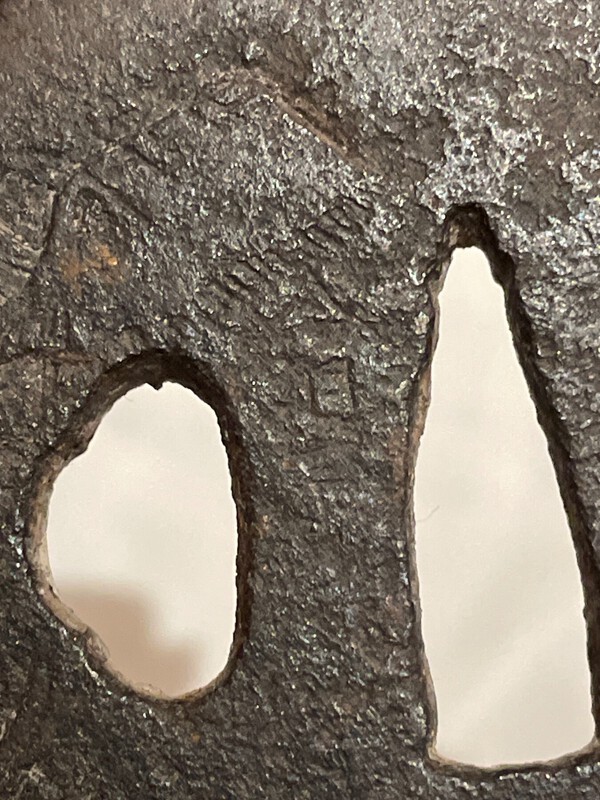
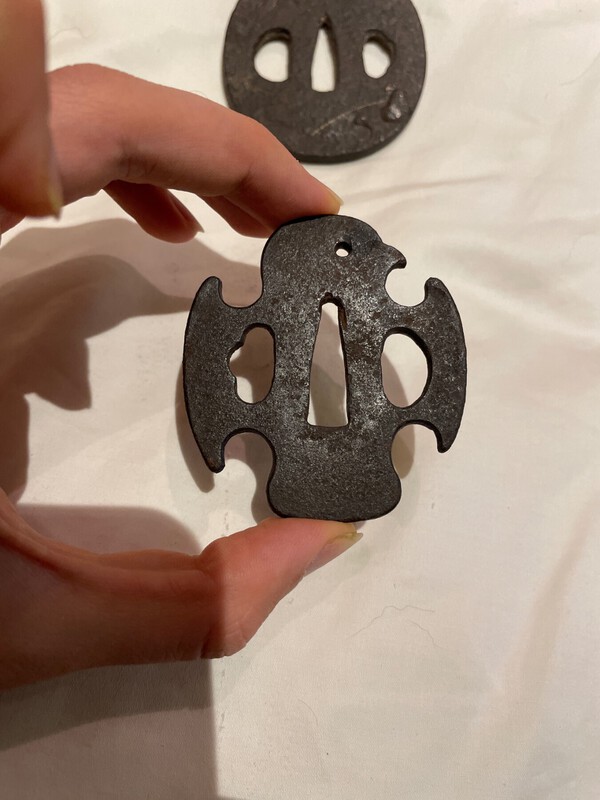
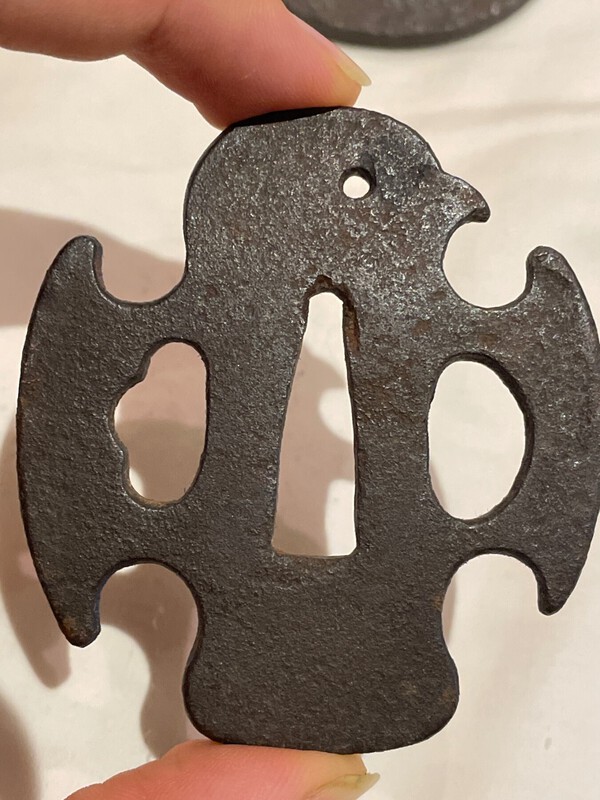
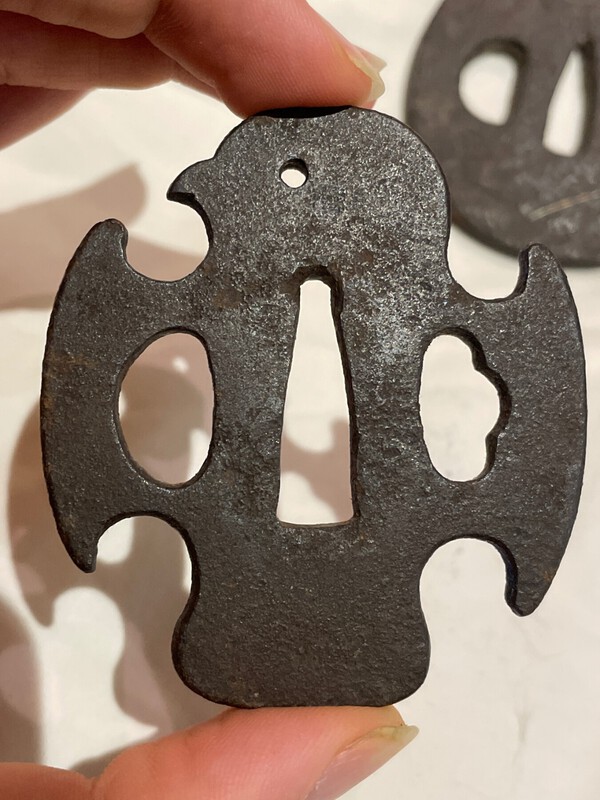
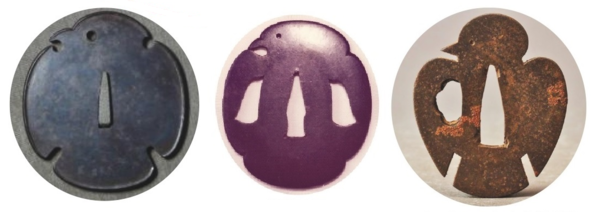
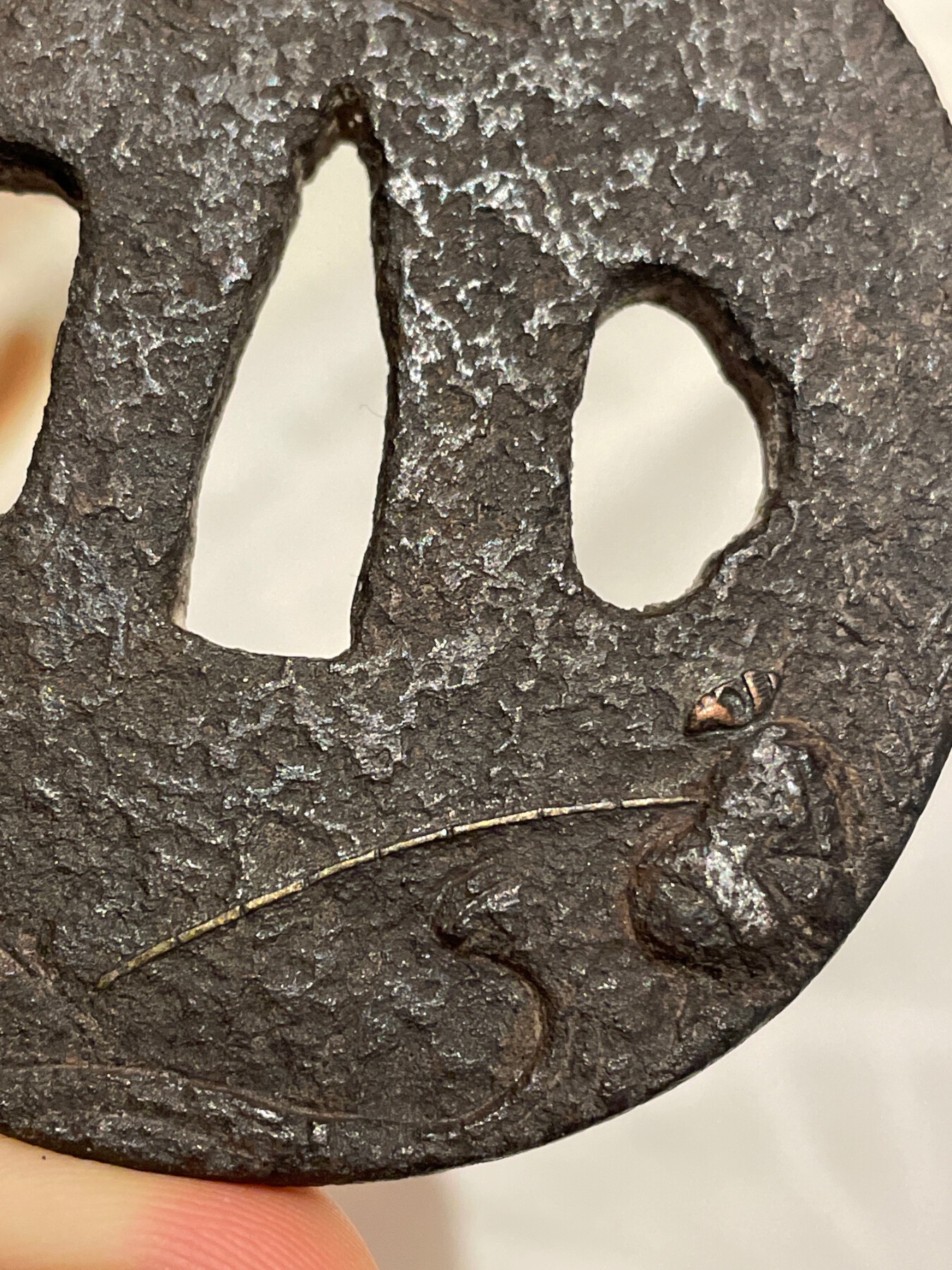
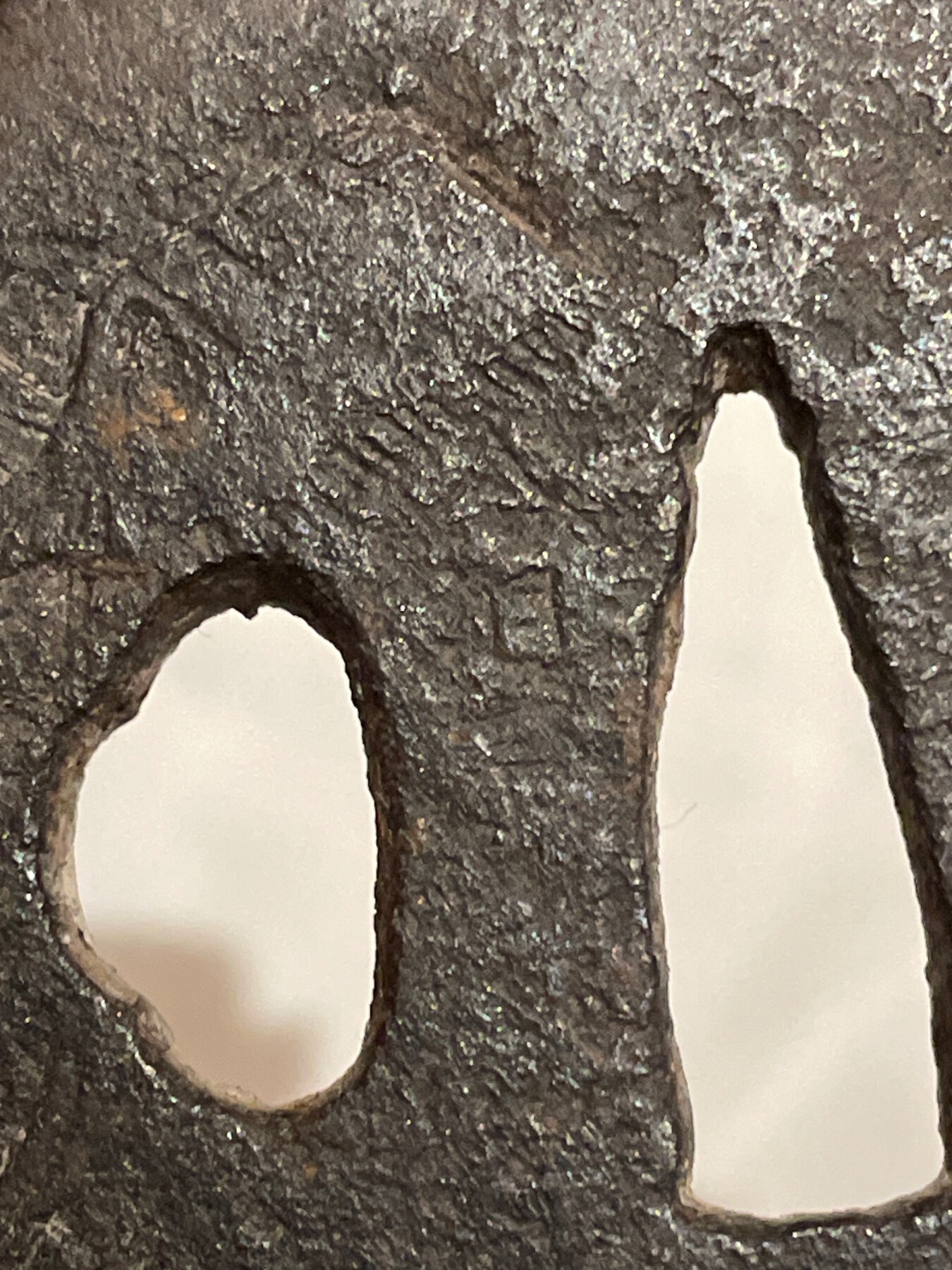
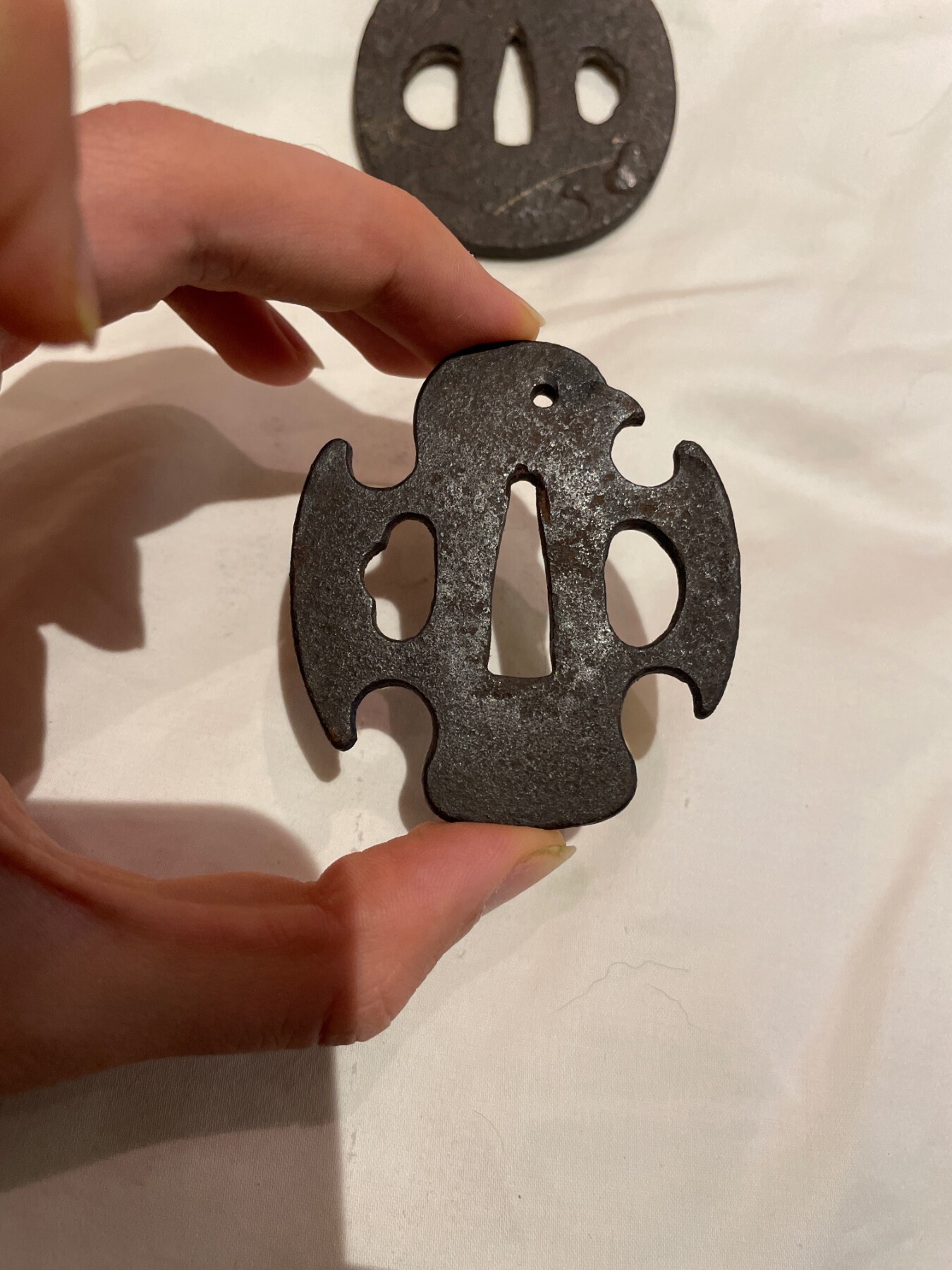
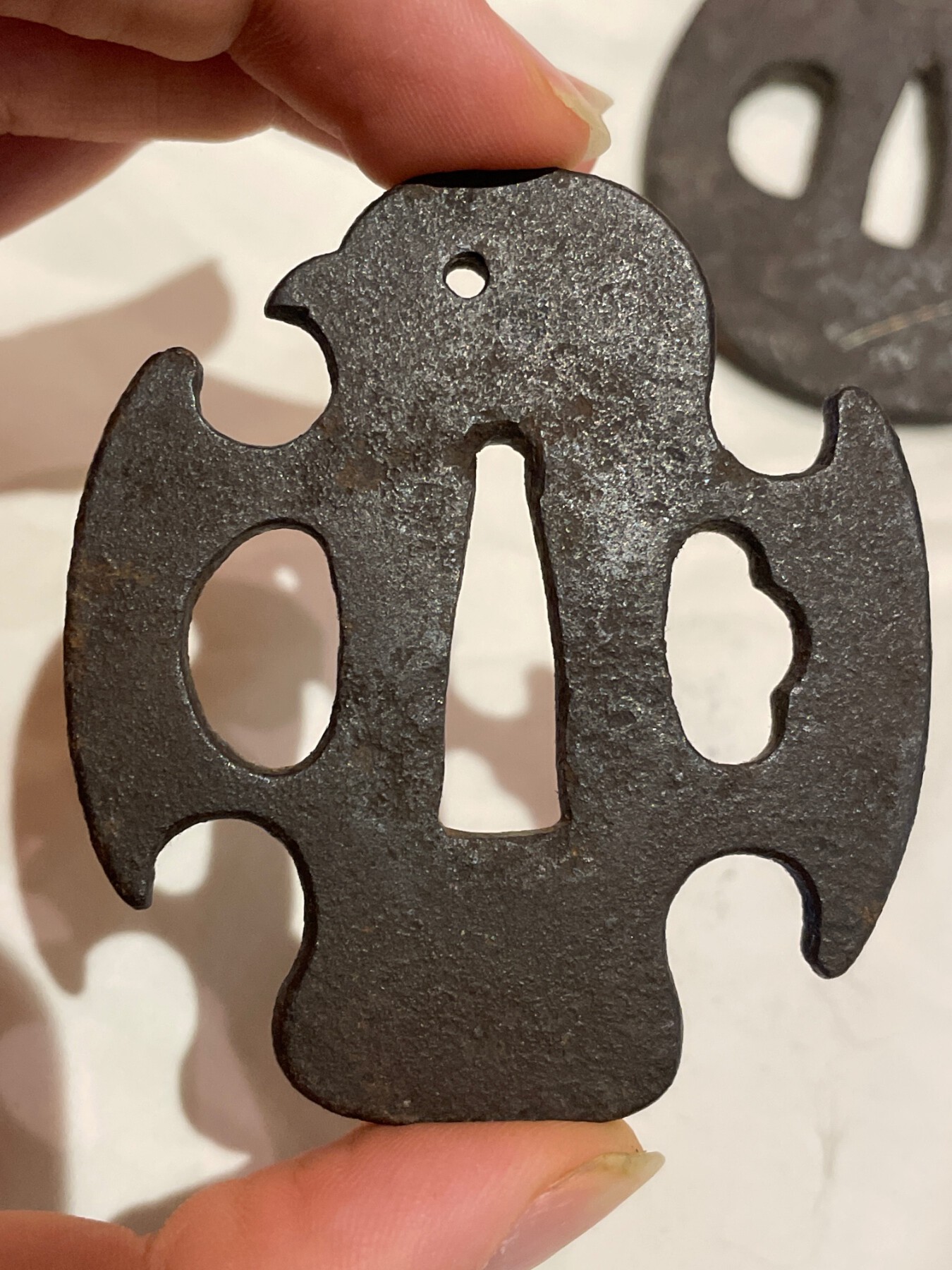
A common Miochin school design, often with an inscription/poem to Hachiman around the nakago-ana [Hachiman is the deity of war or warriors - his "messangers" were doves] Sometimes seen as a sparrow or even a hawk. The small dents at the top of the tang hole [nakago-ana] are called tagane-ato and are a sign that the guard has been fitted to a blade in the past [good sign] The design of the wings is a little unusual but there are others like it. I agree with Mauro that the first is very likely Shoami the mix of inlays with incised carving is typical. The guard looks like it may have been in a fire, the rough surface I am sure was not intended. I doubt the signature can be read it is too far gone. Welcome Tristan to NMB - and Merry Christmas
 2 points
 -
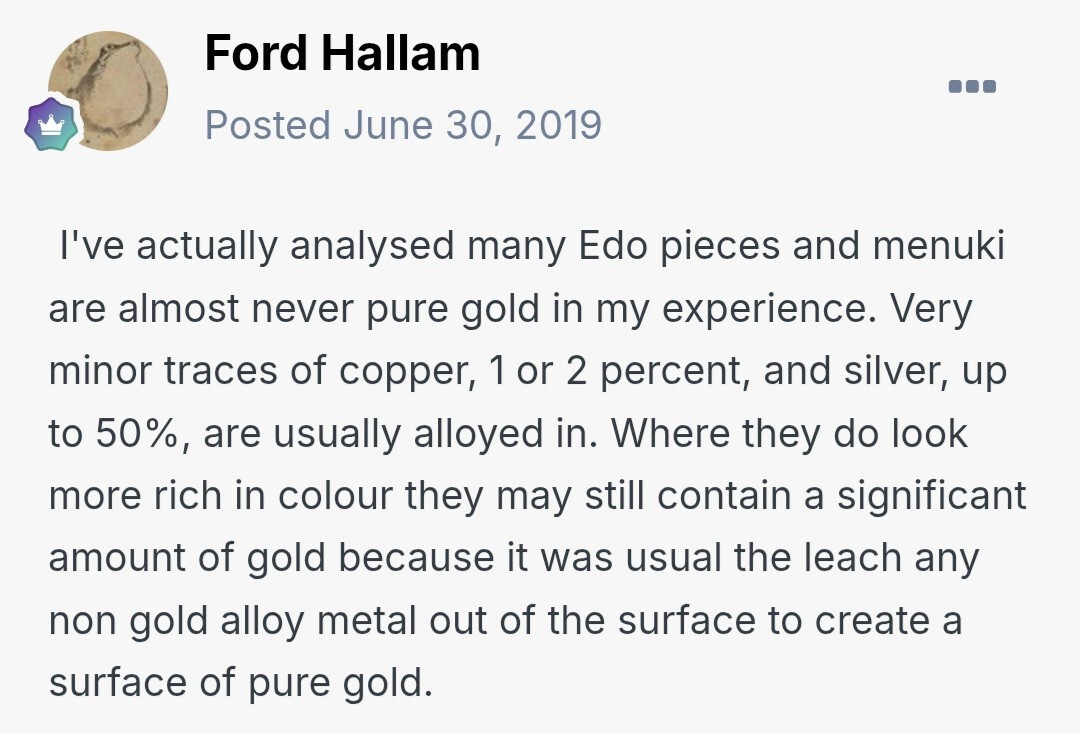
I agree, I am saying these aren't "solid gold" as the OP was told. From the late Ford Hallam himself:
 2 points
 -
The 700th Anniversary catalog can be downloaded via the link below. 高島屋 編『後鳥羽天皇七百年式年祭水無瀬神宮隠岐神社奉納刀匠昭和の御番鍛冶作刀展』,高島屋,昭和16. 国立国会図書館デジタルコレクション 後鳥羽天皇七百年式年祭水無瀬神宮隠岐神社奉納刀匠昭和の御番鍛冶作刀展2 points
-
With such boshi I would say Tametsugu appears as quite possible outcome.2 points
-
With such strong nie Naminohira excluded. This is most likely Uda. I would say Yamato Shizu or Shikkake are distant, but possible. Timewise I would lean towards early Muromachi. There is also possibility its early Kaga Fujishima, which is basically other way to interpret Uda features.2 points
-
A hotlink to a 37-page monograph by Paul Martin. See page 21 for the 700th Anniversary. Emperor Gotoba: A Swordsmith Emperor in Medieval Japan And finally, I found the answer in an old NMB thread. 700th Anniversary inscription2 points
-
Tanobe-sensei is somewhat of an outlier compared to historical appraisers in that his sayagaki, when he approves of the blade or finds it interesting in some way, have essentially a setsumei with some thoughts that almost count as a classification level on their own (see past arguments over what "chin chin, cho cho" means compared to swords that don't have it); Kunzan and Kanzan tended to be much more of an attribution/authentication than a commentary. So in a sense there's a value-add in getting a sayagaki done by him because in addition to being a second opinion, often you'll find insights in there that aren't in the Juyo setsumei, or even (if you're lucky) an implication that the NBTHK's attribution was a bit too conservative.2 points
-
I can add detail of my recent experience of posting a tsuba from the UK to a friend in the USA. In place of the old customs form sticker which I used to complete the UK post office now adds the details to the online postal system when you take for package for posting and the value of the item being sent is then used to calculate the tariff amount which is paid for by the sender on dispatch. Example tsuba declared £250 value attracts 10% tariff = £25.00 plus payment for postage = £20.00 meaning total cost payable on sending = £45.00 This then should go straight to the person it’s addressed to without any further charges. this is how it works UK to USA2 points
-
Hello Jon, Yes, the Southern California Japanese Sword Club (Nanka Token Kai) holds a meeting on the 2nd Friday of every month. We just had our December meeting a couple of weeks ago. You are welcome to bring any swords to the meeting and get an opinion on valuation. The next meeting should be on January 9th, but this is not fixed yet as I haven't confirmed availability of our club teacher/sensei. We meet at the Gardena Valley Japanese Cultural Institute (link below). Feel free to come by if you are so inclined. https://share.google/5cSJ3YytU03Cqh8D9 In general I would say the market price for WW2 blades is between $1k and $2k, depending on the condition. Items that are in particularly good condition will reach the top end of that range or higher. Swords that are unique or have signatures of well-regarded smiths may fetch higher prices. In the event your sword is an antique blade that predates WW2 - as in, it was a family heirloom that got mounted in WW2 era scabbard/fittings, the value could be higher. Condition is everything. If you want a quick sanity check you can post pictures of the blade here on the forum and we can take a look. If you don't want the whole world to see, feel free to DM me pictures of the blade and I'll give you my best guess.2 points
-
Recent posts regarding powder flasks have led me back to look again at A. and B. in the list at the top of this thread. 1. A gunner would have a large flask (A) for coarse gunpowder to replenish the quick-loading tubes, or to pour in measured amounts directly down the barrel for the main charge. 2. Hanging from the front of his armour would be a smaller flask (B) for the pan-priming powder, which is the same powder, but more finely ground. The pouring spout is narrower, to pour a pinch of fine powder into the pan. (B) flasks are smaller than their companion (A) flasks, though for a large gun you could have a relatively large flask (B) and a much larger flask (A). Photos below, showing example 'pairs' of (A) left, and (B) right, and their relative sizes.
 2 points
 -
神前 後鳥羽天皇七百年祭奉賛新作刀奉納会 Shinzen/ Gotoba-Tenno Nanahyaku-Nen-Sai Hosan Shinsakuto Hono Kai. 奉賛 Hosan means "support given to a shrine". Support given to a shrine for The 700th anniversary of a death of Emperor Godaigo,by Shinsakuto Dedication Association. These swords were dedicated to two shrines by Shinsakuto Dedication Association. 15 swords for Minase shrine: Kajiyama Yasunori(靖徳) Watanabe Kanenaga(兼永) Takahashi Sadatsugu(貞次) Akimoto Akitomo(昭友) Kotani Yasunori(靖憲) Murakami Yasunobu(靖延) Koyama Nobumitsu(信光) Fujita Tadamitsu(忠光) Shibata Ka(果) Miyaguchi Toshihiro(寿廣) Inoue Sadakane(貞包) Ishii Akifusa(昭房) Endo Mitsuoki(光起) Ki no Masatsugu(政次) Katsumura Masakatsu(正勝) 10 swords for Oki shrine. Horii Toshihide(俊秀) Ikeda Yasumitsu(靖光) Kajiyama Yasutoshi(靖利) Nakao Tadatsugu(忠次) Moritsugu Norisada(則定) Imai Sadashige(貞重) Takahashi Yoshimune(義宗) Gassan Sadamitsu(貞光) Yoshihara Kuniie(国家) Sato Akinori(昭則) -------------------------- Oshgata of these dedicated swords was published on [showa no Gobankaji sakuto] pub 1941. 昭和の御番鍛冶作刀 Beautiful tang Oshigata also appears in this book. Oshigata of the same sword tang of Nobumitsu also appears.
 2 points
 -
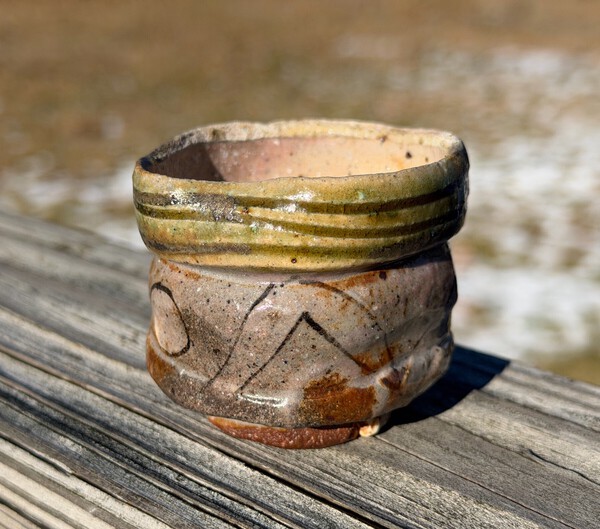
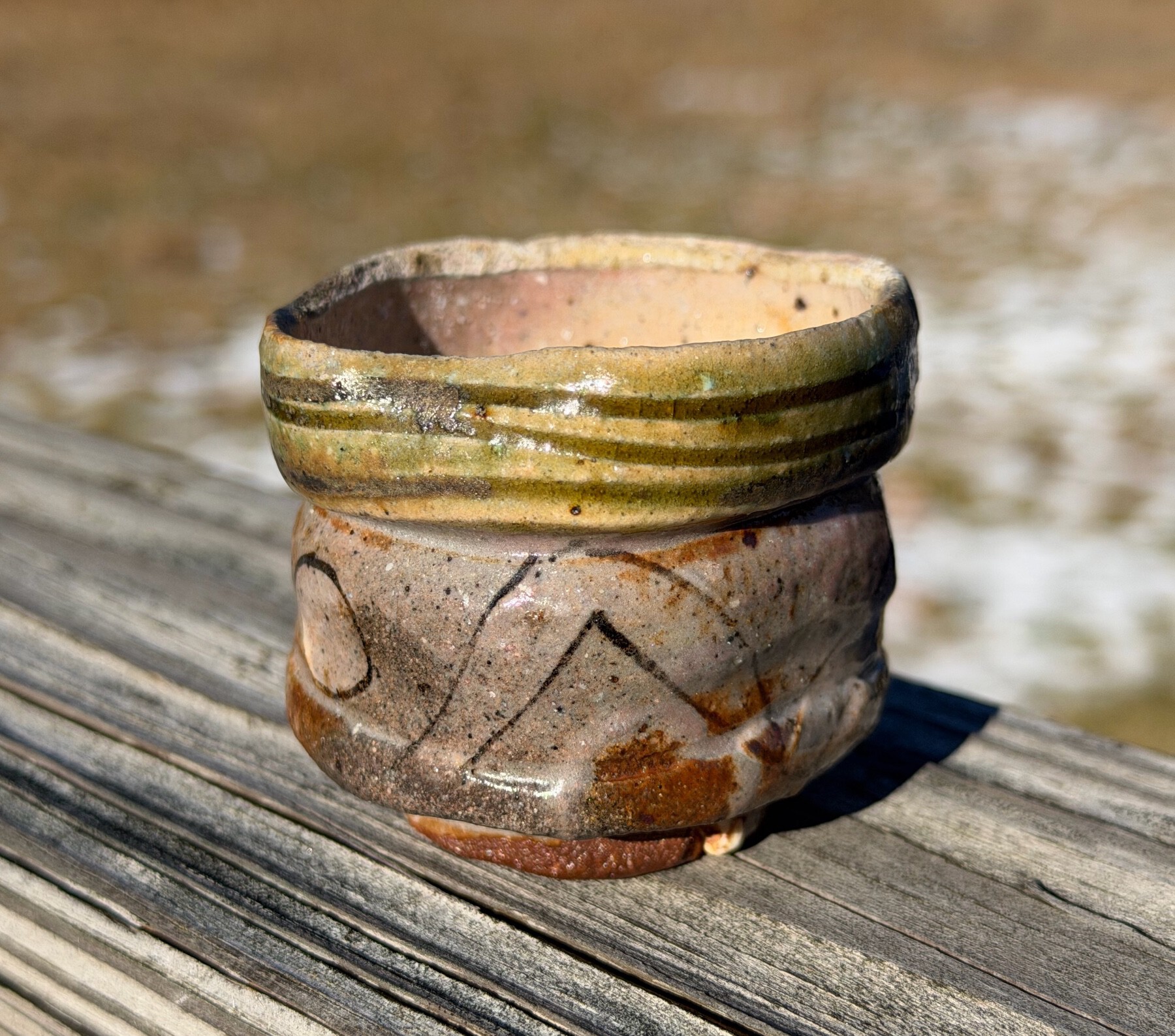
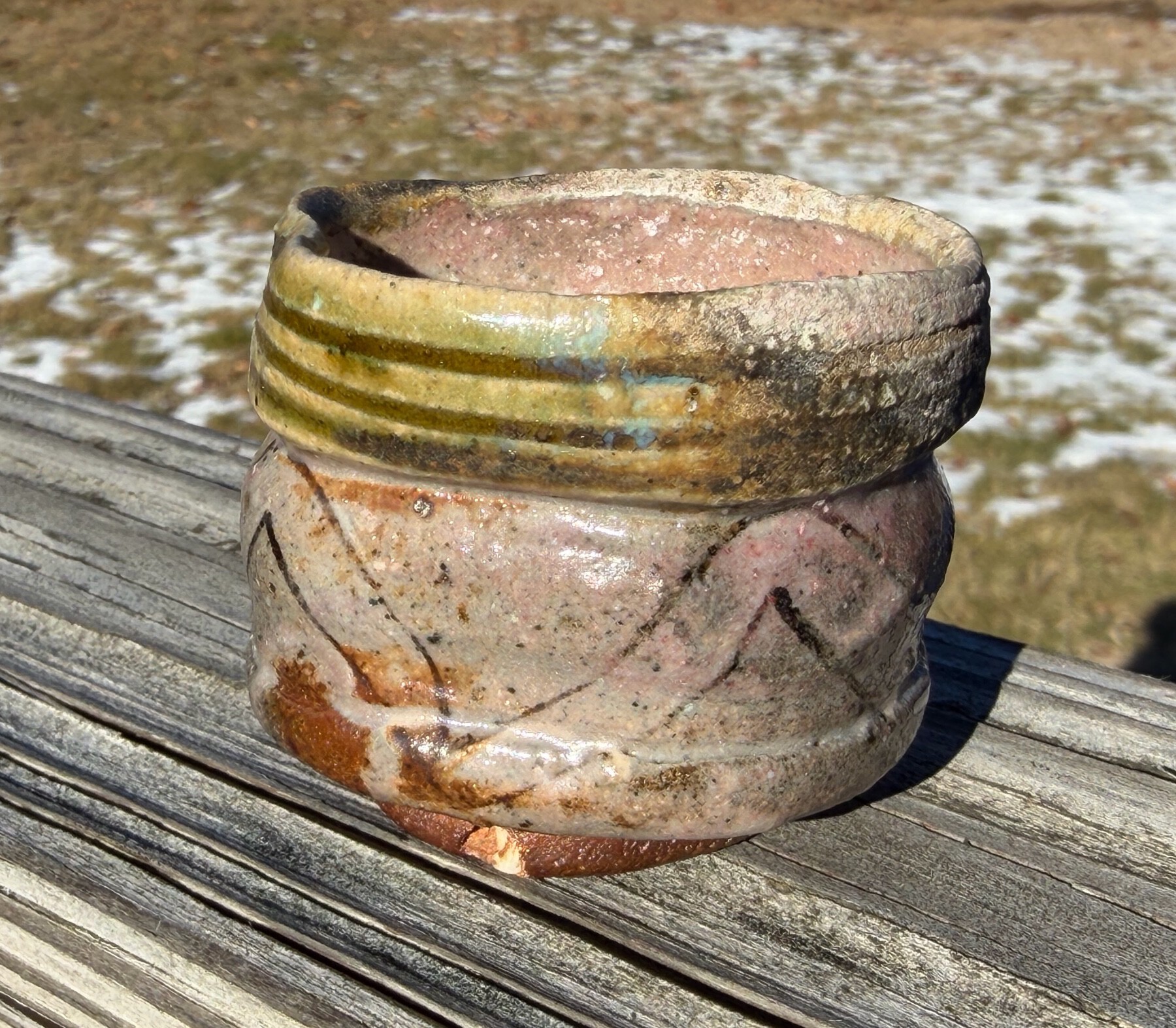
Good afternoon and happy holidays NMB, On offer today is a stunning Oribe ware sake cup by the best (IMO) contemporary potter working in the style. While many modern artists have turned to gas firing because it yields consistent results, Tomonori Koyama has stayed true to the old ways of doing things by wood firing his works. The loss rate is higher and the results unpredictable, but when things go well you get pieces like this. Oribe is a core style of my study, and I haven’t seen another example that has such incredible variation of color, all while maintaining a cohesive vision. The traditional green and cream tones of Oribe are beautifully accented by flashes of bronze, gray and even pink, along with natural ash deposits along the rim to give this cup a depth rarely seen. The incised lines along the rim are confidently done, and the geometric pattern brushwork is carefree without being sloppy. The three circles possibly represent dango, a common motif, but could just as well be patterns typically found on kimono, an even more popular Oribe design. This piece is in perfect condition and measures 6cm wide by 5cm tall. Complete with its original box, cloth and paperwork as shown. $160 shipped to the USA, international buyers please contact me for a quote. Please let me know if you have any questions or need additional pics. Thanks for looking!
 1 point
 -
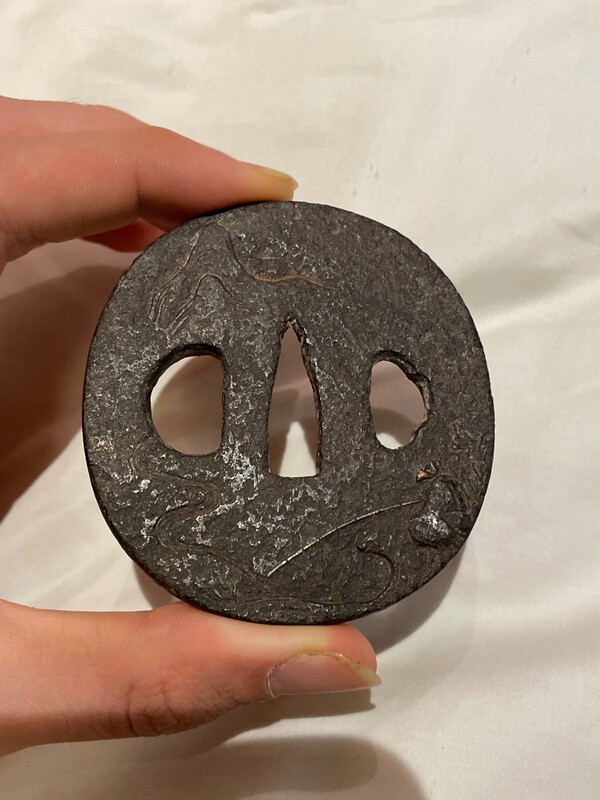
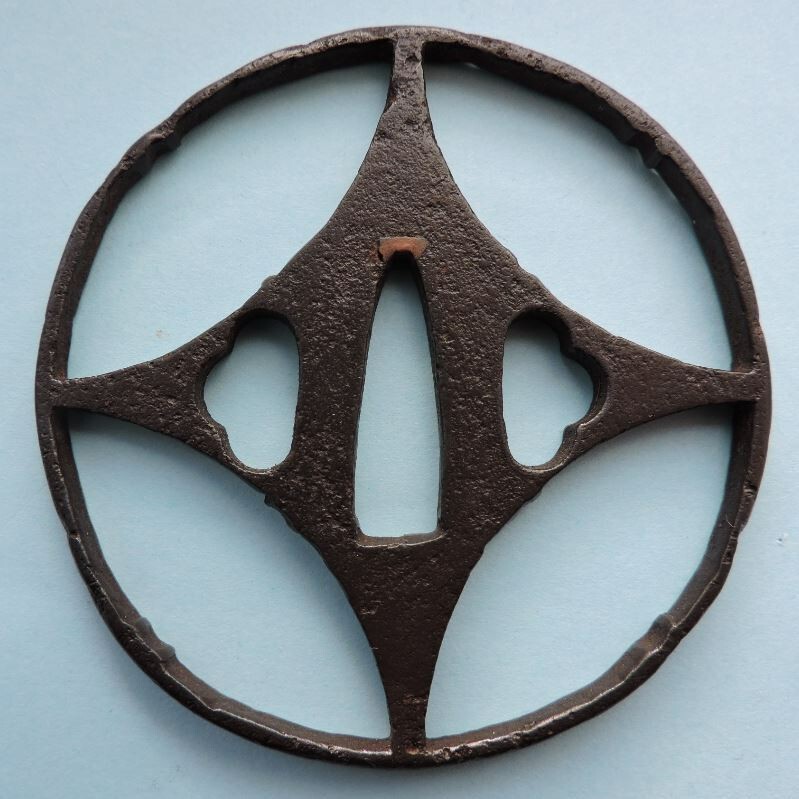
Hello all, I discovered Tsuba on my trip to Japan this year and bought 2 Tsuba at a market. I would love to know if they are genuine from Edo or Meiji period. The circular one might have a signature that is faded, but I am unsure. I tried to photograph it. The other in the shape of a bird looks to be the newer of the two. I’d also love some book recommendations on getting started. Thank you in advance!



 1 point
 -
Thank you very much Ray. I hope you have a great holiday! Tom1 point
-
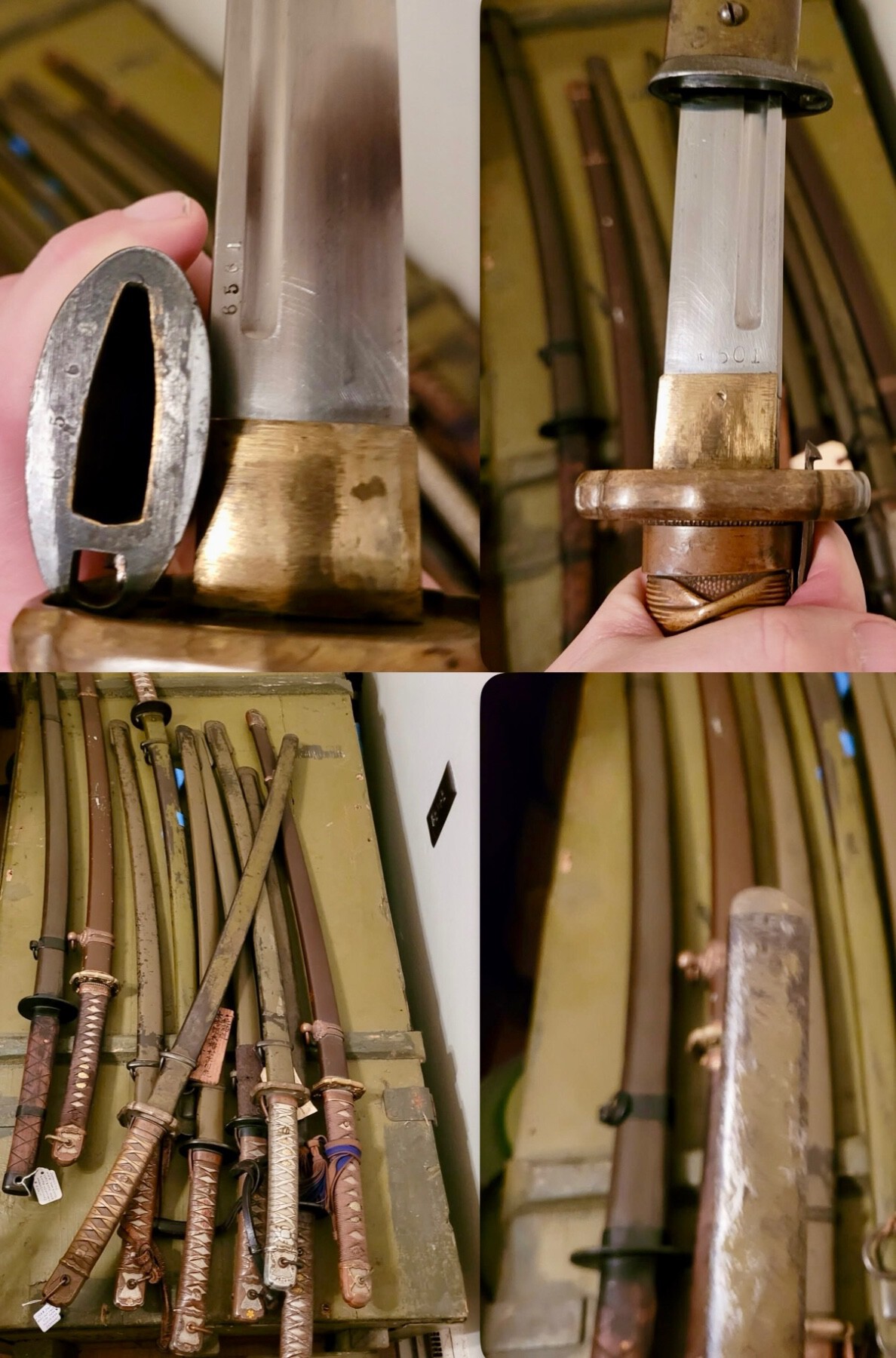
Spotted on Facebook this week. This pattern1 copper hilt Type 95 once appeared on an Australian list from Donald Barnes over 20 years ago; and is also listed in Jim Dawsons Cyclopedia. In all sources, the 501 number forward the habaki is noted. What makes this one extra interesting, is that it’s the highest serial number pattern1 that I have on file. Obviously, there are probably higher serial numbers out there, but this is the latest that I've ever personally seen and cataloged. Pretty cool to see it surface again. Sharing is caring! Seasons greetings, -Sam Copper tsuka pattern 1 Type 95. Serial number matching saya 6561 , with 501 forward the habaki: (Not my photos)
 1 point
 -
Yes, we are all born as newbies! Or did you mean "naivety"?1 point
-
Yes sometimes described as a Chidori, or any number of other birds. I wonder if there is any significance to which way the head of the bird points? The "Chidori" and the last bird here would face to the right when mounted, whereas the doves/pigeon etc point to the left in the examples previously shown.

 1 point
 -
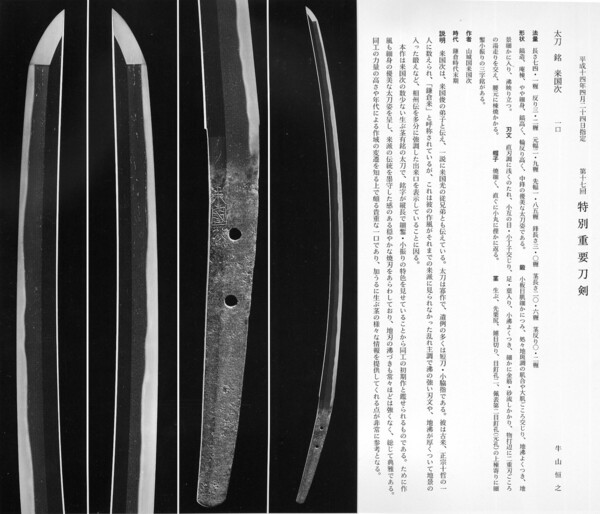
Here are 2 Tokubetsu Juyo examples of signed Kunitsugu work, a tanto and a tachi
 1 point
 -
It's not so much that he's obscure or lesser, more that a) his work is much rarer than Kunimitsu and Kunitoshi, and b) as a hybrid style (Yamashiro Rai with heavy Soshu flavor) he doesn't really fit the template of the "archetype" or "exemplar" of the Rai school, so when talking about good examples of Rai work people tend to refer to Kunimitsu or Kunitoshi (who hew more to the classical Rai tradition). Incidentally, Dmitri Pechalov has a good writeup on Kunitsugu (as well as the other Jittetsu) at his website: https://nihonto-museum.com/blog/rai-kunitsugu and Darcy's old website has another writeup, with a bit more investigation into Juyo statistics compared to the other Rai big names: https://web.archive.org/web/20211025161444/https://yuhindo.com/rai-kunitsugu-katana/1 point
-
I’ve seen mino era Tametsugu that share a lot of the features exhibited here. Does the blade have a wide shinogi ji?1 point
-
Until I can take more detailed photos, here to details of the blade.
 1 point
 -
UWE: Thank you for your insight and taking the time to respond so thoroughly, it is greatly appreciated.1 point
-
I agree, there are some nie activities in the kissaki but I would say they are part of the jigane rather than being an ichimai boshi. You'll want to get as many angles as possible on the kissaki to try to figure out where the actual habuchi runs; I've even seen some cases where there isn't one and the polisher burnished a fake boshi "to preserve the blade's dignity" (although it sounds like you got this restored yourself, in which case I would have expected the restorer to let you know about this before charging you). If you're really unsure, you can contact the person who did the restoration; if they still remember working on it they should be able to tell you exactly.1 point
-
John To and cluckdaddy 76, Thank you for the explanation John To and pictures. Very interesting. Thank you cluckdaddy 76 as well for the picture. I also did find this itomaki gata style tsuba on this Aoi Art Wakizashi. Check it out. : D Link to check out the entirety of the blade below. https://www.aoijapan.com/wakizashi-bizen-koku-ju-osafune-sakyoshin-munemitsu-dated-august-1501-bunki-1-nbthk-hozon-token/ Best regards, Barrett Hiebert
 1 point
 -
Well I admit years ago I used to think that in order for one of the great sword teachers to write a sayagaki the sword would have to be absolutely spectacular. Now with more years under my belt I've understood that is not the correct view as there are blades of varying quality that have their sayagaki. Well of course the top and higher class swords are better represented as they are the swords people most likely would want to show to the teachers. Few years ago I started putting a note if the sword has a sayagaki for my data. However that is just for swords until roughly to mid-Muromachi. So everything that is Middle Muromachi period or later I have skipped, which means a lot of sayagaki that I have seen for example in very good late Muromachi and Edo period swords. Still I am bit surprised the numbers I have even gotten so far, as I think I have just small amount of their sayagaki and they have written so many more (I am just scratching the surface of Kunzans Kantō Hibishō series and I do think the series has 2,500+ swords in total). Tanobe - 481 sayagaki Kunzan - 439 sayagaki Kanzan - 167 sayagaki While there was really not a specific point for the thread I am just curious if for example someone would have asked from Tanobe or if he even knows how many sayagaki he has written, as it must be quite large number. I do think having sayagaki from them would be extremely valuable addon to the sword. Of course that value aspect can also introduce some shenanigans like Rohan said fitting a different sword to the shirasaya, or then faking the sayagaki, and other stuff too like alterations. In Kantō Hibishō Kunzan writes in 1969 for a Tegai Kanenaga tachi that last year he wrote a sayagaki for it and in it mentioned it was saiha but seeing it again someone had erased those letters from sayagaki.1 point
-
I think one bit difficult thing to grasp is that Japanese experts often identify unsigned work towards a specific maker. I am not a huge fan of that but after being in the hobby for so long I have learned to live with it. It gets often very difficult when the smiths are rare to find. Sometimes it is relatively easy to find say 25+ signed items by the smith and do some comparisons etc. I do have massive reference library at home (Although I do focus on old swords) and of course Internet in use too. However in my books I can only find that 1 Jūyō example in few books and then this from online as verified item with quick search: https://ginza.choshuya.co.jp/sale/gj/r6/012/14_yoshikuni.php When it is difficult to find reference items it always makes me wonder how the experts can arrive to the attributions they give. Of course they have seen and handled thousands and thousands of swords and have the expertise. To me it would look attribution to Horikawa school in general would be totally plausible one. Well I think the Japanese experts don't give out such a broad and general attribution, and it will always be much more specific. In this case towards Horikawa Yoshikuni. However I think you got nice and big hirazukuri wakizashi. Please post more pictures when you have time, of the blade and sayagaki too (would be nice to see the date of it).1 point
-
I'm going to play devils advocate here, but I am seeing verdigris on these menuki. And it looks like copper showing through on the bottom edge on one of the back menuki of these thats scratched. Perhaps these are gild? Or low gold content 10kt or there abouts?


 1 point
 -
Jason, I believe this is representing a waterfall, with the vegetation and insect in the foreground. If you notice the top edge of the grooves have a slight curvature, like the water at the top of a waterfall as it passes over the ledge. The bottom has no such curves. Also, I think this is wet-location vegetation such as may grow in the mist of a waterfall.1 point
-
Thought of this thread when I read this discussion of Meiji 19 Uniform size Changes on Warrelics. In the discussion of why there were more sizes added to the Type 38 uniforms, Akira Komiya said this: "As for sizing, I believe it is reasonable to assume that the army decided to enlarge and add additional sizes to the Type 19 uniform by the 20th century as the Meiji era was a time of rapid growth of Japanese physique. According to an anthropological study based on exhumed remains, it is said that Japanese started to grow smaller in stature after the Heian period (794-1185) and reached rock bottom in the Edo Period (1603-1868). Scholars generally attribute this to 2 causes, one the taboo of eating animal flesh due to the teachings of Buddhism and the interbreeding of the populace due to restrictions on movements of particularly farmers. The first 2 charts I attached show the average heights of adult males over the ages based on excavated remains in the Kanto area and you can see that it reaches the lowest of 155cm in the early Meiji era, meaning that they probably reached maturity during the later part of the Edo era. The 2nd chart shows the heights of students and you can see that the average height of 20 year old men grew by 1.5cm between 1900 and 1910 from 160.0cm to 161.5cm, which was also a 6cm growth from the Edo era. Because the eating of animal flesh was an alien concept to Japanese but was considered essential by the government for maintaining a strong healthy military as well as to appear enlightened in the eyes of foreigners, the government, particularly the military, made every effort to devise dishes which would make meat palatable to the populace; among the most famous of which are curry and sukiyaki, the former said to have been devised by the navy. As for the sizes of Type 19 tunics, I never even gave a thought to such until now, but checking 2 of my tunics, I noted that unlike the later model uniforms, size information were not an integral part of the issue stamps but were added separately in vermillion colored cinnabar. One of my tunics is stamped 小ノ大, Large Small Size and the other, 小, small. I will attach photos of one of my Type 19 tunics with the former size marking which belonged to a corporal in the 9th Infantry Regiment. With the very limited samples available to me, I can't comment on the number of sizes the Type 19 uniforms came in." Here is a chart he included:
(1).jpg.735022b7bc3809c772b354052251d31e.jpg) 1 point
1 point -
Thank you! Very, very useful information. Respect, guys! The first blade was attributed to the Tegai school, while the second one to Hokke. Both are indeed Nanbokuchō.1 point
-
I think there are few very skilled artisans in Japan that can fit very high quality blades & koshirae together and it would be very difficult to understand that they were not originally paired. Then there is the second class of joining old koshirae with an old sword and then it is pretty obvious. I think this is done by many dealers in Japan, and I am bit neutral on it. I can well understand this matching as the dealers and some people probably have lots of lower end antique koshirae laying around, and fitting them to blades makes them a package. I recently got a sword that has this kind of refitment done, you can see filled up old hole in tsuka, and feel the tsuka being bit "loose", however as I was only after this bit unique blade size it did not matter to me at all. With these lower end antique koshirae their parts wouldn't really make money selling them off in piece by piece. Sometimes there is a good sword with good koshirae, however they might get split as someone wants just the blade and someone just wants the high quality koshirae I can of course understand that too but it is sad when it happens.1 point
-
Yes, my thoughts exactly. On my katana kake: I too have a Higo koshirae up with a shirasaya'd mumei Shinto Echizen blade that doesn't really go in it. The (very) few blades I own are stored elsewhere. On my Higo koshirae, the parts (f/k) are worth about as much as the entire koshirae would bring. Darcy went through a period where he insisted on telling me that every sword shop in Tokyo was stripping down old koshirae for their parts. I happened to walk into a shop near Aoi Arts where they were doing this. Obviously they didn't expect the foreigner to pop in on some random winter holiday. If the day comes that I want to rip fine artwork apart so that it can fit into little wooden boxes and be sold off, then I might as well climb into my own box and close the lid on the casket.1 point
-
See Horikawa Kunihiro school. https://www.sho-shin.com/sai19.htm1 point
-
In some cases, swordsmiths changed their mei over time (using one artname and then transitioning to one or more others during their careers). In this case, a smith may be primarily known by one name but actually used others as well. For example, the gendai smith Yoshihara Kuniie was well known under that name but he also signed Akihiro and Nobutake early on his his career. Also, many smiths were simply undocumented. Especially in Seki, it was an active site of arsenal production and I have seen other cases where a Seki-made showato was by a smith who simply does not appear to be listed.1 point
-
I tried to fill in the chissel marks using red lines while comparing with the tang by eye in order to perhaps make the lines a bit more clear. This is what I see when I look up close:
 1 point
 -
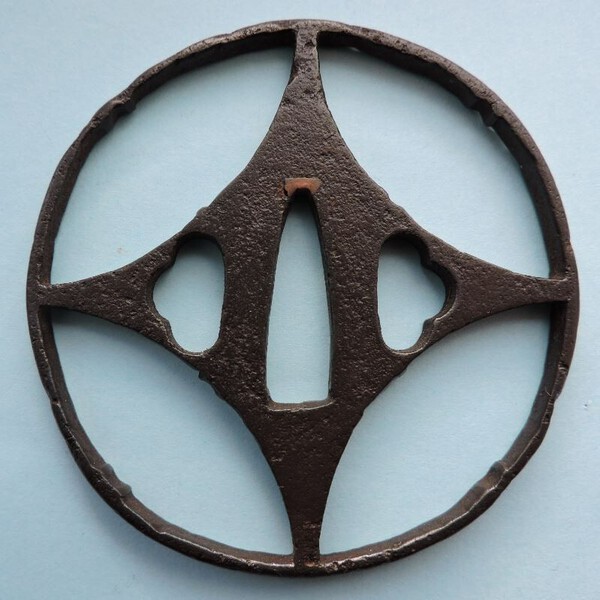
Hi guys, a couple of tsuba from my collection to add to the thread (sorry) The first is a shibuichi tsuba ‘inscribed’ Goto Mitsunobu (sometimes transliterated as Mitsutoshi), Tsujo, 11the generation master (1663-1721) living in Edo. The design is a shippo tsunagi (shippo chain) a symbol found in ancient Egypt as well as Asia and is 3,500 years old and embodies a wish for family happiness and financial success. No one has mentioned that the itomaki gata tsuba presented in this post can also be considered to be a single element of the shippo tsunagi design and I have never seen this mentioned anywhere. The second tsuba is a particular favourite of mine, maybe because it has seen better days and I can emphasize with it. A previous owner also loved it to judge by the old tsuba box in came in, maybe because it exudes wabi sabi. Although it is now an itomaki gata spindle, it was not always so. Inspection of the four large openings reveal that there were once inserts that have been removed. It took me several years before I stumbled across a picture of a tsuba with the missing elements, four jiguro bishi kamon of the Takeda clan (see pics). So why were these removed? Here is my rather fanciful explanation, for which I have no evidence. The jiguro bishi kamon version of the four diamond shapes of the Takeda kamon was used by Itagaki Nobutaku(1489-1548), one of Takeda Shingen’s 24-generals and although he won several battles became over confident, celebrating victories before the battle was finished. He did this at the battle of Uedahara in 1548, where he was killed. The Takeda were famously slaughtered at the battles of Nagashino in 1575 and Tenmokuzan in 1582 by Oda Nobunaga using volleys from matchlock muskets. I think that my tsuba may have been on a sword taken from a fallen Takeda samurai and as the new owner did not want to be falsely accused of being a Takeda clansman had it modified. My tsuba and the intact versions seem to shout ‘Kyo sukashi’ and the sale catalogue sources described them as such. However, Kyoto was in the hands of the Takeda’s enemies, so it would have been unlikely that they were made there. All the best, John

 1 point
 -
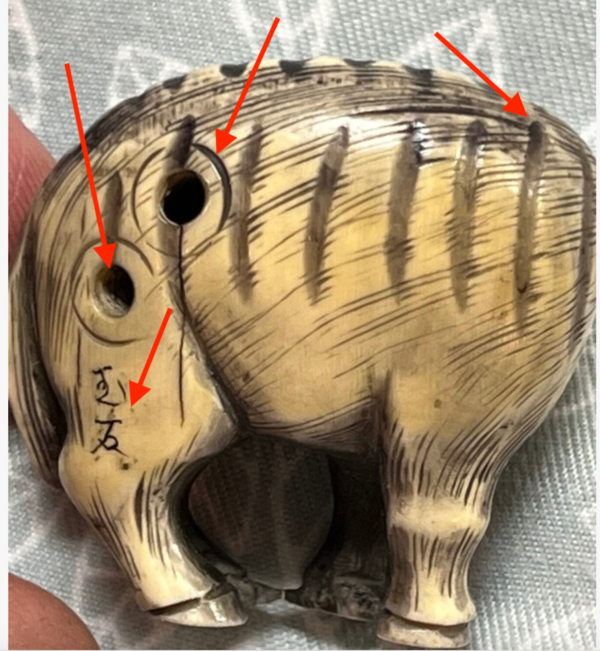
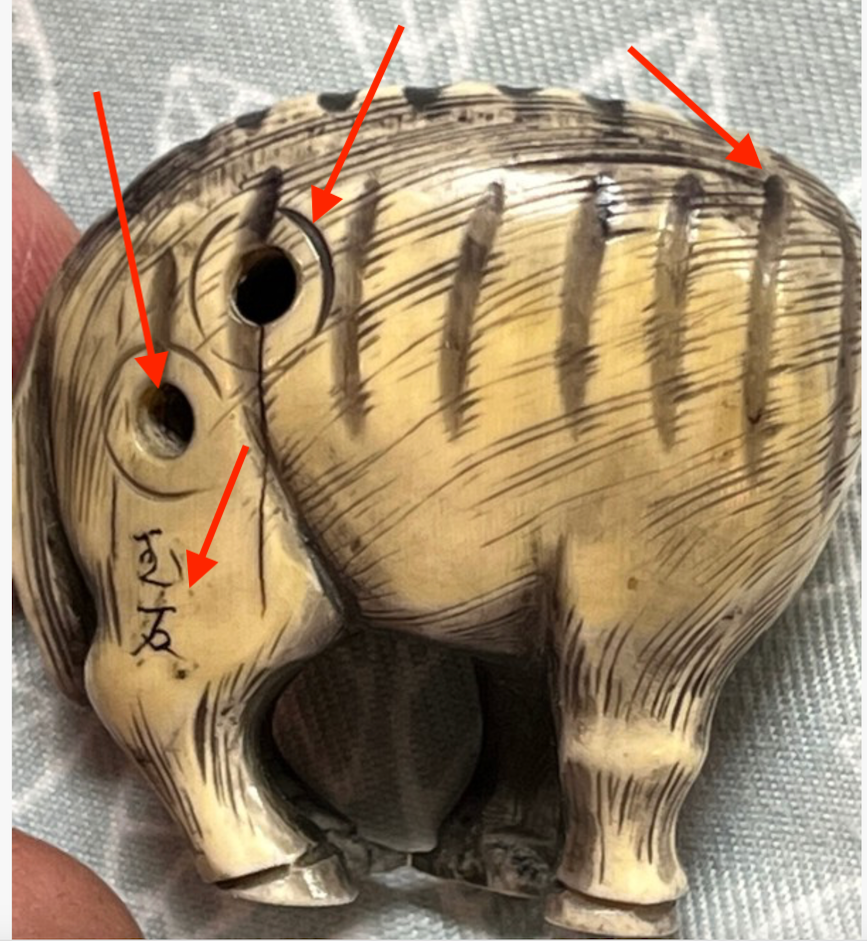
Tyler: My knowledge on netsuke is very limited, however here are a few things I know to watch out for: 1. Arrow at the top right shows where the rotary tool veered off course. 2. Arrow in the middle top points to the ring around the himotoshi, which is common on fakes. 3. Arrow at left top shows that the himotoshi are the same size, which is also common on fakes (one should be bigger to accomodate the knot in the cord) 4. Arrow at the bottom is to indicate that the "signature" is only roughly Japanese, which again, is common on fakes. Real netsuke are only occasionally signed and it is done very artistically. John C.
 1 point
 -
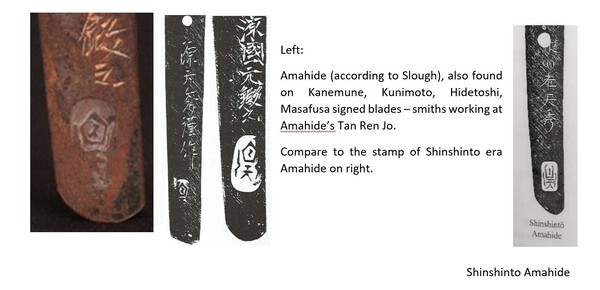
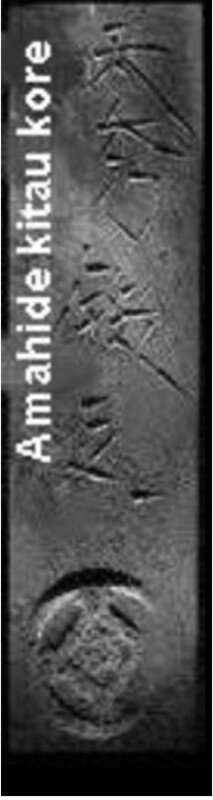
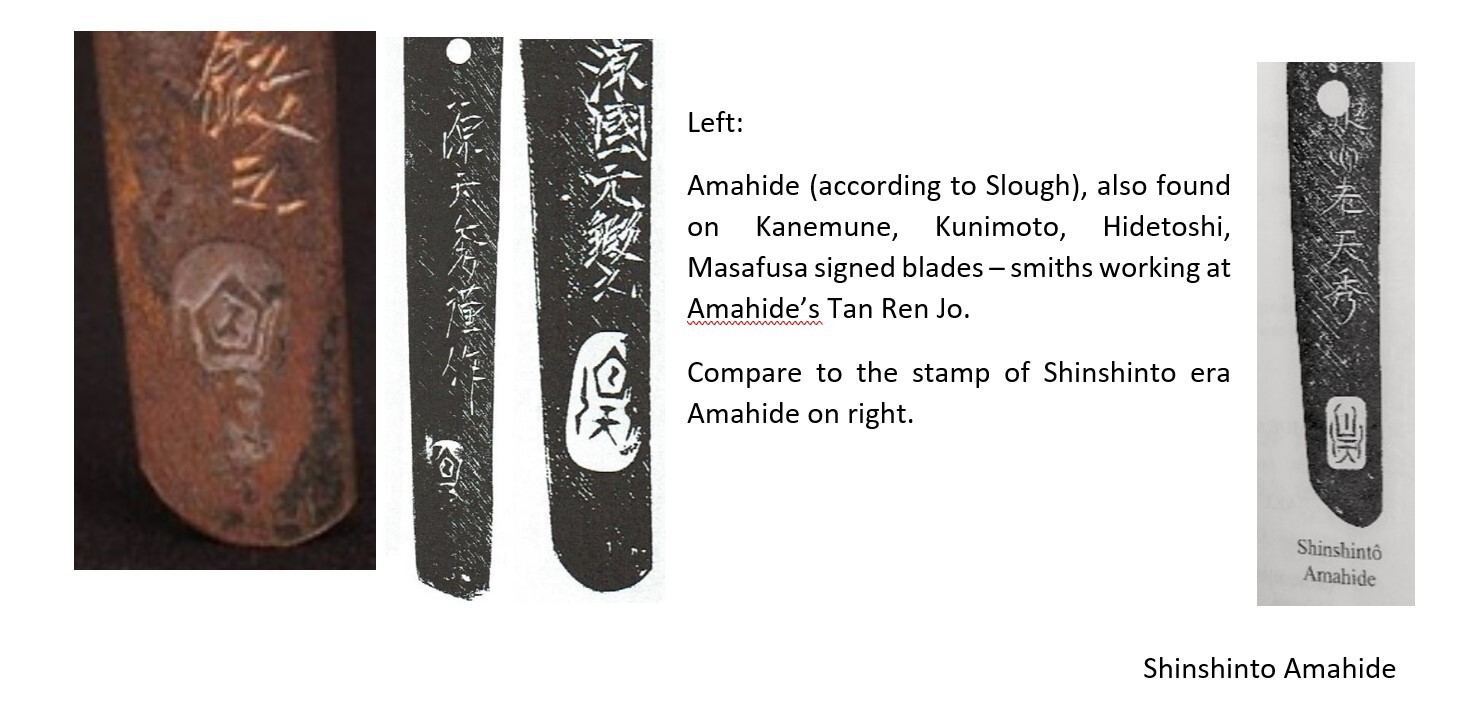
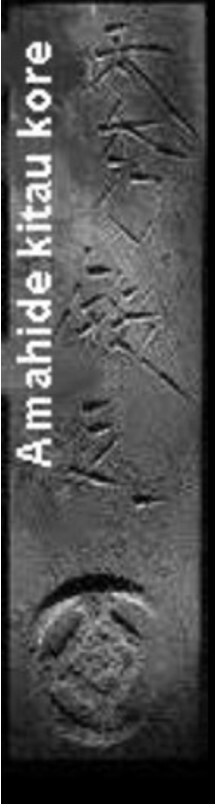
Yes. He, and/or his forge, had his own kokuin that is seen on his blades, but also on 4 other smiths that must have worked at the forge - Kanemune, Kunimoto, Hidetoshi, and Masafusa And yet, we also have one of his blades with an unknown stamp: And a couple blades with his Retired Servicemen's group, Koa Token Sha, kokuin: All this added to these stamped-mei blades!
 1 point
 -
FYI here’s the tanto with new tsuka wrap and menuki back in place.

 1 point






































This leaderboard is set to Johannesburg/GMT+02:00