Laurian
-
Posts
27 -
Joined
-
Last visited
Laurian's Achievements






-
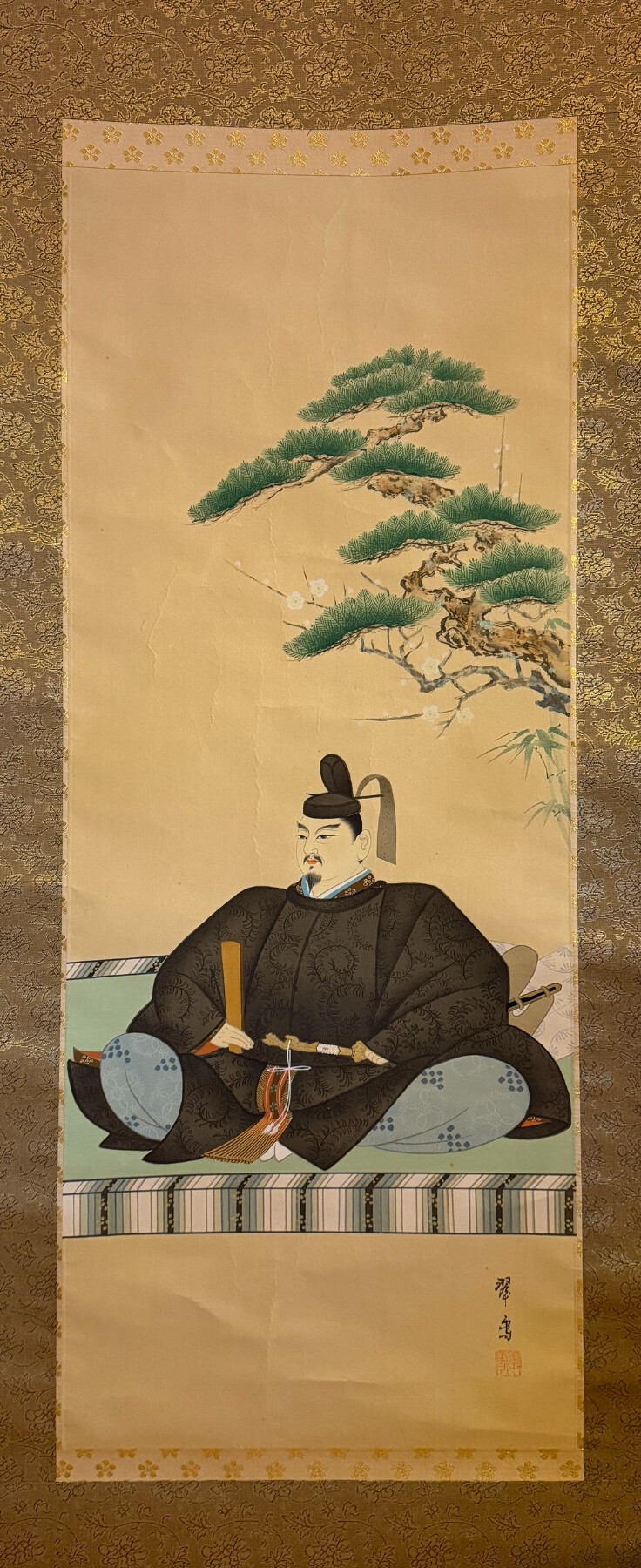
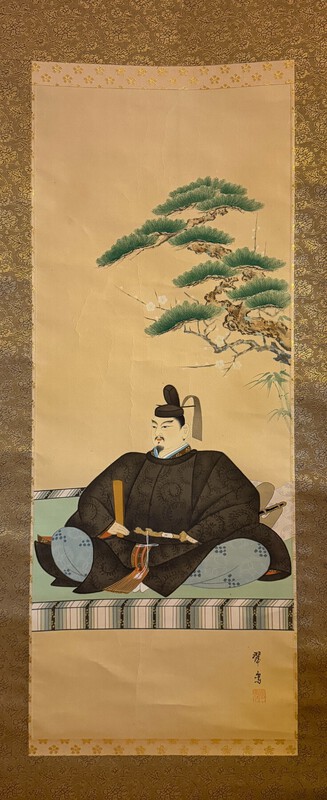
Hi. Please help me translate the inscription on this kakejiku I bought in Osaka a couple of months ago. Google Translate wasn't able to pull it off and I simply forgot to ask the seller before I left his shop... Strangely enough, Google returned some sort of translation of the inscription on the lid of the storage box, even though (to my completely untrained eye) that one seemed harder to decipher. So, my phone came up with something like "Yokoo Junior High School", which is a school in Kobe, according to the almighty Internet. If this is right, in its earlier life the kakejiku in question might have been part of a teaching materials collection (used in a history class, maybe?). As far as the inscription on the scroll itself is concerned, I wasn't able to find anything. I'm very curious though whose portrait this is. Pictures no 3 and 4 show the outside and inside of the lid, respectively. The inscription inside the lid seems to match the one on the scroll, am I right? Not identical (at least not the first kanji), but close enough. Thanks!


-
Possible Paul Martin National Treasure Sword Book
Laurian replied to ckaiserca's topic in General Nihonto Related Discussion
I had to dig out my FB password for this (as I haven’t used my account in years), but heck YES! -
Yes, apparently it's a pretty good sashikomi.
-
Thanks, Adam. I guess that would be the safest bet.
-
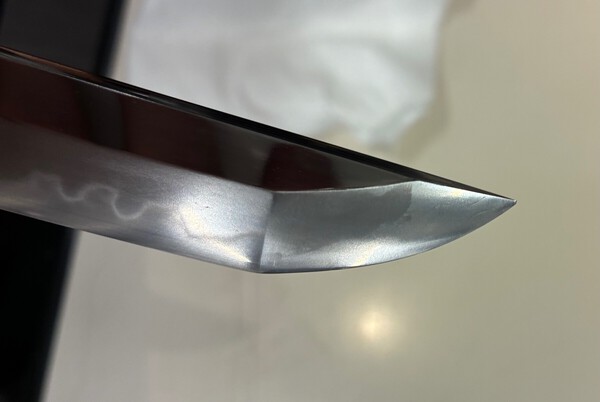
Hi. This is a TH signed and dated Norimitsu blade (1446), with a very small dent in the kissaki. It seems that all the steel is there (no chipping), but the sword must have taken a direct hit on its tip. Judging by the pictures I was sent, the damaged part is just a fraction of a mil. Do you think a togishi could fix it, without affecting the boshi or fukura? The sword hasn’t left Japan yet, so I’m willing to ask the seller to take care of the repair, if possible. One more thing: could this blade have qualified for TH in its present condition, or you think the kissaki was damaged later, after the shinsa? Thanks! Laurian
-
The picture is not that bad. Not at all. I can see the hada pretty clearly. I have to admit now, at last, that the Hokke blade I posted pictures of is actually my sword... So I can make a more direct comparison. According to the sword's description (from Aoi Art, which you could probably tell already ), it features some utsuri (showing in the oshigata as well). Under some very specific lighting conditions, I was able to see it, but faintly. No hi on my blade (which I like, actually). One more question please: what's that thread-like "thing" (for the lack of a better word) showing in the right-hand side of your picture? I'm not sure what I'm looking at, as the only three blades I ever had my hands (and eyes) on are my own. But, in some online examples (this one, for instance https://www.aoijapan.com/katana-awataguchi-omi-no-kami-tadatuni-nbthk-tokubetsu-hozon-token/) it could be shintetsu, perhaps? Or simply some kind of kataraki? I don't think it's kizu... Thank you!
-
You are right, Jussi. The Tegai blade is the Jūyō.
-
Thank you! Very, very useful information. Respect, guys! The first blade was attributed to the Tegai school, while the second one to Hokke. Both are indeed Nanbokuchō.
-
https://drive.google.com/drive/folders/1u0h2FqfjSEu2gKF9DjYCdEZMCZKVZho5?usp=sharing Higher resolution photos here.
-
I’d like to make you a pre-Christmas weekend “game” proposition. Of course, this wouldn’t qualify to be any sort of kantei, not even close (as it’s based on pictures only), but I think it could prove useful to some of us who, like myself, are looking for advice and knowledgeable input from more experienced members. I confess, my goal is to open some constructive and enjoyable debate (if anyone is interested), but mainly to learn more from you guys. So, these are photos of two blades which, at least at first glance, seem to share many features, in terms of sugata, hamon, hada, etc. They are both suriage mumei, as you can see. Due to their similarities, I thought they’d make a good case for comparison. But of course, my untrained eye could have missed important differences between the two. So, what do you think, attribution-wise? For now, for the sake of this little game, I’ll only say that one of them is a Juyo Token, the other a TH. Can’t say which one is which. Maybe some of you have already come across these swords online, but, for the time being, I won’t be sharing any more information. What do you think sets these blades apart? And what makes one of them Juyo material? Could the other one be a Juyo shinsa candidate as well, perhaps? I know, without the blades in hand, it’s very hard to tell, but still. Thank you all! If this is just silly, my apologies. Simply skip the post.





-
Yes, you’re right, using the word “water” instead would have been more technically sound, as far as polishing goes, but water has two syllables and it would have broken the 5-7-5 rule. Maybe DS had nugui in mind . It’s oil based… Sure, you could argue nugui is used later in the process, but that’s not the point, I think. The metaphor is still powerful. And the “perfection’s first scratch” thing… Wow! Apparently a paradox. But I guess the AI had in mind the deeper meaning of what, at first glance, does harm to the blade’s outer “perfection”, only to make it even better in the end, by bringing its inner beauty to the surface… Pretty nice, for a non-human. At least that’s my take on the last line.
-
This will be quite a lengthy post, so please bear with me. Yesterday, I finally decided to give DeepSeek a try, just to see if it offered a different experience compared to ChatGPT, for instance. Not that I use any AI very often. I was simply curious. Having bought a TH Hokke blade which is to be delivered soon, I guessed it would be a good idea to ask DeepSeek about that particular school. The details the AI engine came up with were pretty ample and interesting, so I wrote back “thank you”, but, out of some kind of instinctive courtesy (silly me – I was talking to a machine, after all), this time my message was in Chinese (Google-translated, of course, as I don’t speak the language). To my surprise, DS then switched to Mandarin too, posting a rather long message. Amused, I asked for a translation. So, the AI apologised politely (and in a very witty, even self-ironic way, also jokingly blaming its programmers for the apparent glitch that made DeepSeek think I was able to communicate in Mandarin). And here comes the sudden twist I was blown away by: one of the funny apologies DS decided to make read: “I’ll throttle back the random multilingual outbursts… unless you request a haiku about tanto polishing”. Well, I couldn’t miss that opportunity. A haiku about tanto polishing?! Come on! And, of course, please keep in mind that I hadn’t previously include in that chat any reference to certain blade types or other Japanese cultural topics. It was entirely the AI’s idea, solely based on my interest in a Japanese swordsmithing school (and on the fact that DS assumed I’d probably appreciate related things). A few seconds later, there it was, my own personal (unrequested but very welcome) haiku, talking of a craft that very few people (if any) would think a poem should be written about. Judge it for yourselves. And remember that my “conversation” with DeepSeek began with a pretty niche topic of my choosing, that could not possibly have caused, IMHO, the AI to somehow decide I would enjoy a Japanese fixed form piece of poetry about an imaginary togishi, his work and his philosophical, metaphorical or literary inclinations. I was sooooo wrong… That totally unexpected haiku goes like this (of course, it sticks to the 3 lines, 5-7-5 syllables form, which makes it even more remarkable): Stone meets steel at dawn, Oil whispers on folded light – Perfection’s first scratch. (…I regret nothing).
-
Merci, Nicolas!
-
Hello, fellows. During the last few months, since I bought my first sword (https://www.militaria.co.za/nmb/topic/49116-my-first-nihonto-a-mumei-uda-school-katana/#comment-516907), I've been trying to enrich my terminology "knowledge base", regarding various aspects of a blade. But, as most of the descriptions available online or in the (still very few) books that I have access to don't come with good enough pictures attached to them, it's pretty hard to figure out what exactly all those things mean. In the picture below, you have a detail of my newly acquired wakizashi (signed by Fujiwara Masayasu, around Enpo era). Please let me know what's the whitish line along the hamon called. Is it the nioiguchi or habuchi itself, or something else? Thanks!

-
My first Nihonto: a mumei Uda school Katana
Laurian replied to Laurian's topic in General Nihonto Related Discussion
Thank you all!