george trotter
-
Posts
3,004 -
Joined
-
Last visited
-
Days Won
14
Content Type
Profiles
Forums
Events
Store
Downloads
Gallery
Everything posted by george trotter
-
Now that's one I have not seen before. Looks to be better quality production standards than often seen. The K logo must be a manufacturer or sword shop. The kanji just say "sword steel". Any chance of an overall pic and of the nakago? Regards,
-
Nice to see another blade by the Okishiba line of Osaka. I have one by Okishiba Yoshisada (depending on which Masatsugu you have) either his son of his brother. For your info they were a good group, still going I think. They descend from the Heianjo line of Kyoto and are linked by blood to the Okimoto line of Osaka. You have either the father, Okishiba Masatsugu or 2nd Dai Okishiba Masatsugu. (2 dai worked with 7th Gassan student Enomoto Sadayoshi) and was followed by Okishiba Masakuni who is now dead I think? I have an old WWII newspaper clipping that shows Masatsugu and his son Masatsugu both worling in Tokyo for Prince Higashikuni (I attach), maybe Chris can check it and give you a bit clearer explanation than I can. Osaka Asahi Shimbun May 30 1939. Hope this helps,


-
Looking For Information About A World War 2 Sword
george trotter replied to Dennis Smith's topic in Military Swords of Japan
The side of the licence (with photo) says (reading right column first): No. 61 Vehicle licence Manchuria district 737 Saka? kura? (Sakagura?) Army superior private (Rikugun Jotohei) Hamada Seiichi Born Taisho 10 year 12 month 11 day (1921/Dec/11) The front of the licence is dated Showa 19 year 3 month 12 day (1944 /Mar/12). Because his rank is Superior Private the sword may not be his....BUT, it also may be a document he still had on him after he was promoted, but I don't think so as his rank in 1944 was still Superior Private.. I don't know promotion procedures for WWII Japanese Army, so you'd have to check to see if a Private could become an Officer. The sword will be handmade in my opinion. Those fittings usually contain a good sword...possibly with a star stamp on the tang. If you are careful and use a PROPER correct blade screwdriver (not with a 'V' shape tip but a parallel sided tip), and one that is just slightly less than the width of the screw slot...it should turn without damage to the lacquered binding (although as Chris said, you can try to carefully press the binding back into correct alignment). Please don't dismantle everything like that throat piece...not necessary and you lose or damage a part and you can't get replacements. Please put the tassel back on EXACTLY as it was ...make sure the original folds are re-used so it is original placement again (sorry...just my historical preference for originality coming out)....those tassels are rare on the Type 3 fittings. Look forward to seeing who the maker is...nice sword, you are fortunate indeed. Regards,. -
I think the '98' may be a RJT shinsa number. Maybe the code of the particular inspector who did the necessary shinsa on these blades to maintain quality. I say this as I have the same number in the same place on my RJT blade by Takashima Kunihide. He worked in Kyoto but the inspection and mounting may have been done at a central place like Osaka, which is where Hidemine worked. I have seen the number '90' in the same place on a second sword by Takashima Kunihide (NBTHK Hozon). I think Chris is right on the "four Strokes" near the jiri...probably a number for smith's workshop production record of some kind...these "tally" or contract numbers are often found on RJT tangs near the jiri, and sometimes include a katakana before the western style number. Hope this helps,
-
Ija Ijn Ww-Ii Rikugun Kaigun Gunto Book
george trotter replied to lonely panet's topic in Translation Assistance
Hi Kiyoshi san, Thank you, I understand now. Do the members know that you translated the index into English? It is a big help to members who do not speak Japanese. They can find it here http://www.jpsword.com/files/temp/shokomeikan.htm Regards, -
Ija Ijn Ww-Ii Rikugun Kaigun Gunto Book
george trotter replied to lonely panet's topic in Translation Assistance
I don't know of this book, or is this a general query about "books" about IJA IJN Kai-Gunto?...If there is "a" book, or one that discusses Kai-gunto, can you give its title, author, date etc?. A book on Kaigunto tosho would be of definite interest...Even if there is no translation version being available there are some of use who are able to use the Japanese version. Regards, -
Very nice find indeed...
-
Hi Dan, After gently cleaning off the flakey rust and giving the tang a gentle oiling ...maybe use your fingers to "massage' the oily tang,..a lot of muck then comes out of any grooves...might work for you. I can definitely see the presence of a mei on one side of the tang. After you clean off the gunk maybe we can help you read it. Good luck. Regards,
-
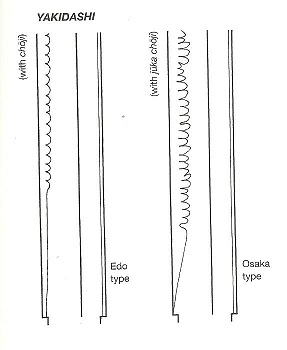
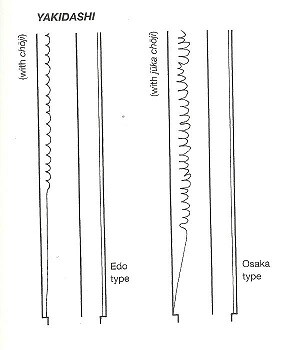
Hi Denis, The book "Cutting Edge" is a catalogue of newly polished swords in the British Museum, by Victor Harris, Tuttle, 2005 (about 160 pages). A good book with many blade pictures...I think you can get it on-line for about US$ 35...worth it IMHO. The explanation of yakidashi that was mentioned is on Pp.21 and 158 and if you look at the illustration (and also that kindly posted by Chris) the explanation fits well: "Yakidashi - Lower end of a complex hamon that straightens into suguha on shinto blades of some Edo schools and slopes down down to hamachi on shinto blades of some Osaka schools" (my underlining for emphasis). Hope this helps,
-
Hi Chris, I hope you have done the "Rikugun Jumei Tosho Meibo"? and I wonder, do they have the "Nihonto oyobi Nihon Shumi" set of magazines? I'd be interested in these.... Regards,
-
Hi Dick, just a gentle reminder about showato/gendaito identification. Your post title is "gendaito" in Type 3 mounts. Well I am pretty sure from the characteristics of the hamon etc that it is a oil tempered showato blade. Regards,
-
Hi Chris, Putting the journal (or interesting snippets from it) on-line would certainly get the "message" around. I have no idea of the financial and copyright aspects of doing so, but if "the public" consistently came across scholarly knowledge and illustrations when doing searches online for "sword questions" then it might stimulate a genuine interest that translates to membership in NTHK-NPO (to get the whole journal) and enhances our field of collecting. A good idea IMHO. Regards,
-
Hi Chris....wow, great find. Right up your Tsukamoto alley! Nice to have the reference to the Daitoa senso also....(this of course makes it a "war sword" Ford haha :D ). A really remarkable find. Many thanks to Morita san for checking with the shrine too...what a pity the records are not available...maybe something was reported in the local Fukushima newspapers around that date? Worth checking I think...maybe a pic of the presentation will turn up? Hope to hear more about your researches Chris. Congratulations.
-
can any one help translate this mei for me...thank you
george trotter replied to joe424's topic in Translation Assistance
Maybe Kanetomi . Two smiths of this name of Mino 1455 Seki (Hawley 1981 KAN 2543) of Mino 1532 2 character mei (Hawley KAN 2544) Hope this helps, -
I agree with BaZZa. Mino were known for this yahazu midare (uneven arrow notch, or fishtail), so might be a good place to start. Regards,
-
Hi Steve, you are very welcome...good luck in your research. On Brian's comment on Sesshu...I have to admit that I too would have had a small "?" without Kunitaro sensei's reading...I wish they would write things clearly for us foreigners of later centuries . Regards,
-
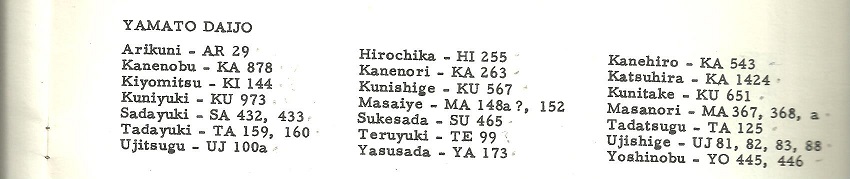
I looked up an old Hawley booklet called "Honorary Titles used by Swordsmiths" and there are 47 smiths who used "Yamato no Kami" and 3 smiths who used "Yamato no Suke" and 21 who used "Yamato Daijo". There are a further 24 who are probably following generations of some of these names. From your mei it is a smith who lived in Sesshu (Settsu) and used it in his mei followed by Yamato no...?. The list I quote from is referenced to the old "Blue Books" of Hawley so it is probably not possible to cross reference the code numbers to the later Hawley editions because the numbers changed. If you can get your hands on the "Blue Books" I have scanned the list of names of the 95 smiths for you so you can go through them and pick out those that have "Sesshu" in the mei. Then you can check oshigatas of these to see if any are close to your mei. Hope this helps,


-
Kurihara Akihide speech
george trotter replied to k morita's topic in General Nihonto Related Discussion
Wow, that is a great find Kiyoshi san. I hope you can tell us some of the gendaitosho information in his speech. Regards, -
Sword is by Shinoda Ujifusa, I think he worked with Watanabe Kanenaga, Kato Jumyo. I think I saw a sword of his 30 years ago that was "Fuji in the clouds" hamon. I suppose the koshirae was papered as being part of the "ensemble"? Regards,
-
I just noticed a post on this same smith back in June and Morita sensei posted him as Hayakawa Kanenori. This reading is in Hawley 1981 but for a different guy...so I'm sure Morita san is correct. Regards,
-
Hi Phil, I think the mei is Kane(shiki)? WWII Seki gunto smith. Family name Hayakawa...registered on 28 Sept 1939. As for the hamon, I know of a WWII smith who did this. His name is Iijima Masayuki (usually signed with a stamp). His blades most often have this type of hamon (see Slough p.111). Hope this helkps,
-
The Akinori who was a student of Kurihara Akihide (as mentioned in the sale link) was Sato Akinori of Saitama. I have only seen his mei in normal kanji, but this could be his work. A normal kanji mei of Akinori can be seen in Slough p.21 Pity you can't show us some pics of the blade and activity. Regards,
-
I was unaware of this etiquette, or rather I can't recall seeing swords resting with the hilt on the right. I looked up a book on the Gassan (Mus. of Fine Arts Boston 1989 pp.20-21) and it contains two pictures of what I suppose would be classed as "daimyo swords" but these are resting hilt left. One is a tachi with tachi mounts by Gassan Sadakazu made in 1916 for Emperor Taisho and the next is a straight blade sword in mounts dated 1921 presented to Crown Prince Hirohito by Sadakatsu. I suppose these would be classed as "daimyo" swords yet both of these are resting hilt left. Anyone have any info on this matter? Regards,
-
Early film of Miyari Akihira
george trotter replied to Ford Hallam's topic in General Nihonto Related Discussion
Very interesting Ford. Nice to see, thanks for posting. Regards, -
Without commenting on the quality, age, price etc, may I ask a kantei question? The blade is described as "suriage". To me it looks greatly suriage...this being the case (or not?), it can be seen that it has very noticeable fumbari just in front of the machi...how can this be? Just wondering,