george trotter
-
Posts
3,005 -
Joined
-
Last visited
-
Days Won
14
Content Type
Profiles
Forums
Events
Store
Downloads
Gallery
Everything posted by george trotter
-
I Could Use Some Assistance With This Text
george trotter replied to Jussi Ekholm's topic in Translation Assistance
Nice Heian Jidai Tachi with ubu nakago having Hikae/shinobi ana -
Hi Stephen, I too would go for A...IMO it seems the more correct for the period of the blade and for uchigatana koshirae of that period. Regards,
-
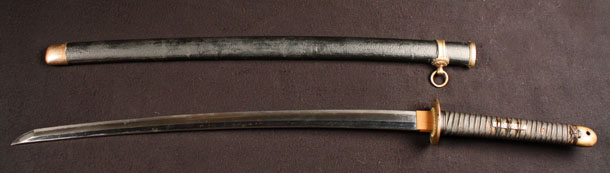
Here is a sword made in 1944 and mounted in Type 3 koshirae (custom made with lacquered gangi-maki binding). You can see the proportion of blade (62.1 cm) to nakago (19.5 cm) which makes the proportion of the blade to nakago as approx. 3 : 1. Nakago is with kinae/shinobi ana at extreme end of jiri. Main mekugi is a metal screw and second mekugi is bamboo. Each mekugi enters from opposite sides, Tsuka is 25.5 cm, so I would be interested in comment from our trained swordsmen about these blade/nakago/tsuka proportions in terms of being a good combat sword for infantry. Also their opinion of the effectiveness (compared with the Type 98 mounts) of having this length nakago, the kinae/shinobi ana and the lacquered gangi-maki as shown here. Regards,


-
While we wait for evidence that disproves that "the teachings of battle" (i.e. combat) was the reason the tsuka of Type 94/98 gunto was changed to Type 3, it might be interesting to examine the statement that "Our ancestors didn't know what they were doing anyhow for a thousand years, using only one [ana]". Well let's look at that thousand years: (1.) For the first 550 years there were pretty regular (though not constant) wars. These were regular trained armies. Swords were necessary tools of war. (2.) From 1460-1603 there was the Sengoku jidai.These were conscript ashigaru armies led by professional samurai. Ashigaru swords were mass produced, but still tools of war. (3.) After 1615 there was virtually no use of swords for battle combat. Swords became adornments and symbols of social rank. Swords only began to be used again as tools of war in the late 19th century through to 1945. So let's see what sources show: (1:1.) Before 1460: While the vast majority of swords are not ubu nakago, a quick look through Fujishiro Koto hen shows that of the ubu nakago examples surviving, there are a fair number with a hikae/shinobi ana, eg. ARITSUNA 1156 p. 412; TAMESHIGE 1219 p.199; MORIMITSU 1394 p.536...etc. These are quality swords made for trained swordsmen. (2.1) From 1460 through sengoku jidai: We still see these swords, eg. MITSUTADA 1467 p.482; KANEMOTO 1528 p.126; TSUGUHIRO 1532 p.209; ARI?MITSU 1532 p.415; TSUNEIYE 1592 p.209 etc.. These are quality swords made for trained swordsmen to use in combat, not ashigaru swords. (3.1.) After 1615 swords were not used for combat (other than a couple of rebellions) until Meiji, but hikae/shinobi ana are still seen (see Shinto hen pp. 23, 63, 68, 81, 95, 104, 291, 312, 356, 371, 396-7). These swords are virtually all privately purchased by samurai. Some of these samurai obviously ordered a hikae/shinobi ana. On evidence from Fujishiro, actual oshigata show that the extra ana has always been present throughout the last 1000 years. While we don't know the reason for these extra ana, evidence from Ohmura shows that "the lessons of battle" was the reason for its use in WWII. Hope this is helpful to the discussion,
-
Hi Guido, I am afraid you are mistaken...I actually did refer to a source (you must have missed it?). Here is the basic link: ohmura-study.net/952.html Please read his introductory paragraph on this link. Elsewhere he gives a presentation of the original documents and subsequent newspaper announcements describing the changes prescribed to transition from Type 98 to Type 3...all of these were my sources. This link describes the actual changes and Ohmura states that the reason for them was that "by the teachings of the battle, the brittleness of the hilt, the peg, and the tsuka-ito of the Type 94 and 98 was a problem". From this problem the need to strengthen the tsuka/nakago was seen. You are correct though...these do not refer to the quantity of fighting in which swords were used, just that the changes will make the swords more efficient in use. You say the changes were only intended to reassure those who thought that swords were "actually used" in battle...well... Ohmura's information does not say anything about these military delusions you refer to...that is why I also did not mention such a possibility . Ohmura's site also does not mention that (as you say) the Type 3 came about due to "crappy assembly and neglect [which] made the backup holes necessary" so once again I did not mention such a possibility. As you can see I only referred to sources that actually stated reasons and those reasons are what I posted here...rather than speculation and opinion as fact. I agree with you of course that the sword fighting of the sengoku jidai did not produce ashi-garu swords with longer nakago and two mekugi ana (as far as I know)...although I think it did produce the stronger katate-maki and the even stronger gangi-maki, Why a longer nakago and an extra ana may not have been necessary has been addressed in part by the learned sword users here...I cannot comment on their comments as I am not a sword user, but I can make a comment on a sengoku jidai sword I saw (Kane ...something, dated in the 1520s if I remember correctly) that was mounted as a Type 98 gunto for WWII...its tsuka was broken clean off at the end of the short nakago (one ana)...as this failure occurred in battle against the Australians in New Guinea I can only say that this problem did occur in battle as described by the documents in Ohmura's site...therefore it is reasonable to say that a proportion of the ashi-garu issue swords of the sengoku jidai would also have broken, and for the same reason...stress in battle. In addition I have seen a number of veteran bringback Type 98 mounted Showa period shingunto and pre-Meiji blades with broken tsukas...these had the longer nakago (1 ana)...so even though the nakago was longer, the tsuka still broke off. I must add that I have never seen a Type 3 with a broken off tsuka. Soooo, perhaps you can now accept that the Type 3 with longer nakago, 2 ana and lacquered katate-maki/gangi-maki actually did come about for the battle-use connected reasons as stated on Ohmura's site. If you still disagree, could you please say why...and quote your sources? Hope this helps...
-
Hi Guido, thanks for your comments. I am of course aware that shinobi ana are a rarity in the pre-Meiji era, but I was only pointing out the changes made to the gunto tsuka/nakago in WWII and the reasons given for this...all of which seem to align with wishing to strengthen the gunto tsuka against failing when in service use (combat). If this is not the case, please give your reasons for saying the changes were made for some other purpose...and please give your sources for saying so. Thanks,
-
There may be more to having a shinobi-ana than just "peace of mind". I say this as it is well known that in WWII, when the Type 98 fittings were meant to be superseded by the Type 3, there were a number of criteria given for the change. As well as "minor" changes in the decoration of the saya, a simplification of the fittings and a dust cover at the sayaguchi, The following points seem to point to battle experience providing evidence of a need to strengthen the nakago and tsuka. 1. the nakago was lengthened and two mekugi were used. 2. the binding was changed to katate maki type and was lacquered for added strength. I think this feature was more to do with "added security/strength" in the hilt area than any "cosmetic" or "psychological" consideration. My comments are based on the known record of these changes (see Ohmura's site) and also observation of Type 3 specimens compared to the usual Type 98 with one ana. I am referring of course to the gendaito versions of the Type 3 but it also applies to the mass-produced version, except that these rarely had lacquered maki. From this known information it seems reasonable to say that some swords have a shinobi-ana because of their intended "hard combat" use. Hope this helps, Regards,
-
I agree, this looks like a training bayonet, probably from a high school cadet unit. It is reasonably common to see "civilan' issue bayonets named or numbered on the grips. In this case it looks like (depending on which way you read it) either TANAKA or NAKATA...probably the school or group name. I think it is read point up as TANAKA. Hope this helps...
-
Just looking at the third pic, I must say that the mekugi ana is a bit unusual. Is it a larger hole "bushed" with a tube of metal to make a smaller diameter hole?. I haven't seen this before. just wondering, regards,
-
Usagiya Restoration
george trotter replied to Ray Singer's topic in Auctions and Online Sales or Sellers
Heh heh...good one. -
That is a very clear example of an "uchi-zori" nakago. I have seen this a few times, always with blades fitted to Kyu-gunto mounts. The nakago is bent towards the cutting edge to fit the curve of the kyu-gunto tsuka. It is ugly IMHO, but an interesting quirk of the Meiji-Taisho period. I don't know if it can be corrected (should a collector want to remount in koshirae. Maybe you should file that pic in the Military Sword page Brian as an educational guide to uchi-zori? Thanks Stephen,
-
Translation Help Please.
george trotter replied to tesscoothome123's topic in Translation Assistance
Hi John, The date is Meiji 2nd year (1869) chuto nichi...a day in mid winter. Yasukuni was from Shinano and sometimes used 'kimibanzai' in his mei which means (I think) long life to the Emperor. He is not well known...almost nothing on him. I found him in Hawley 1981 YAS 683 p.926. The nakago, yasuri and mei look good IMHO...I do like gendaito, and yours is almost year one of the gendaito era...any chance of a pic or two of the blade? Hope this helps, -
The mei is probably (first kanji hard to see) read as Kanesada. There was a Seki showato smith of this name registered in Sho 14 Oct. 8th. His family name is Okada Sadao. The blade is certainly a showato. Regards,
-
Tang Inscriptions On Both Sides
george trotter replied to Bruce W Sims's topic in Translation Assistance
As Jean says, the maker is one of more than 200 smiths working in Gifu (Gifu is the modern name for Mino Province) in the town of Seki in WWII. He was registered as a military swordmaker in Showa 17 (1942) on 21st October. Family name Komiyama Ryozo. As you said, your sword was carried by an officer from 1944 onwards. it is an example of a 'showato' or a military sword. Regards, -
Hi John, Maybe it is '....kuni ji? sa e mon jo...'. If so it may be by one of the many Sukesada smiths of Bizen. Maybe someone can confirm/correct my reading and then you can go through a list of the many Sukesada smiths (in Hawley or some other book) and hopefully see which one it is. If you happen to identify a possible smith, the shape of the 'kuni' should help when (if) you can check the mei against a book of oshigata. Hope this helps,
-
Hi Dave, very interesting. I have not seen/heard of a katana dance but it may well be danced. I say this as I remember from my university days (1970s-1980s) watching a small group of visiting Japanese women doing two traditional dances for us students of Japanese in our "mutsumi no ma", which has tatami floors, shoji screens and a Japanese garden beyond the wooden verandah. The first was a naginata dance, The spokeswoman told us that although it was a dance, it was actually structured as a kata and was specifically aimed to drill samurai women (left alone to guard the house when the men were at war) in reaching down the woman's size naginata resting horizontally above the shoji screen leading onto the veranda.In those times the naginata was always rested here as most attacks would come in the front yard gateway up to the front verandah. All the kata were for repelling either cavalry or infantry and were mostly directed at evading yari thrusts and in return cutting upwards so as to cut off horse and human legs and go into underbelly areas, as you can imagine with a woman on foot resisting a man on horseback. The second dance was unarmed. It was done with an iron edged fan and was a kata for deflecting/blocking sword cuts from an attacker also on foot. While to the average westerner the event was merely a strange dance, to those of us familiar with swords it was clearly a memory enhancing training kata exactly as the spokeswoman explained. So, to answer your question, no I haven't seen a katana dance, but it is stronly possible that samurai women received some training in home defence with that arm too. Hope this helps,
-
The signature of your first sword also has the following name... can't read the first few kanji, but it goes on to say TANGO No KAMI FUJIWARA SHIGETSUNE. Not sure if it is made by Shigetsune or Sadatsugu. Shigetsune is from the mid 1600s...there were several signing this way.
-
It is called uchi-zori nakago (reverse curve towards cutting edge). I have seen it before. I think the comment by Hamish is the correct explanation. The curved tsuka of the Meiji period gunto required this reverse curve. Usually the nakago was simplly shortened and reshaped with a file or chisel. It is uncommon to see this much trouble taken to re-shape the nakago.. Thanks for posting pics.
-
Showa 20 year 1st month (Jan 1945).
-
Sword Translation And Identification
george trotter replied to ZZr1100's topic in Translation Assistance
Hi Matt, the sword is dated KIGEN 2 thousand 6 hundred and 1 year (1941), so it is definitely a WWII showa gunto by Kaneuji. Regards, -
Hi Wouter, Yes, your smith is Miwa Kanetomo. He may have used Miwa in some signatures but mostly just plain "Seki Ju Kanetomo saku". Yours has no large Sho or Seki stamp, so it is a good chance of being gendaito. I looked up the the book Tosho Zenshu by Shimizu p.612 and he also has Miwa Kanetomo. He has the same info as Nihonto Meikan. He says Kanetomo was born in Taisho 4 and lived in Seki. By the way, the Na (Nagoya) and Ho (first or second inspection) stamps are seen on RJT blades on occasion. I have seen them on blades by the very good RJT smith Seki Kanehide (Nakata) and others. Happy researching...
-
Hi Wouter, it is good to see a new collector approach the study of swords in such a sensible way. I only know of one smith named Kanetomo who worked in Seki in WWII. His name is Miwa Kanetomo. His personal name was Shizuo. He was registered as a swordsmith in Seki in Sho 14, October 20. His name is listed in literary sources as being an RJT smith....He is given in NIHONTO MEIKAN p.160 as RJT of Seki and was 28 years old in Sho 18. If you google Miwa Kanetomo, something will probably come up. Hope this helps.
-
Hi Kurt, The mei says (hard to read) ??ta (or da) Ujifusa. There was a Shinoda Ujifusa working at Seki in WWII...this may be him, but the first (one or two?) kanji are hard for me to read so I can't be sure. hope this helps,
-
Just saw this last post and link. The quality of the fittings look good and the blade too (for a gunto). As for the bayonet question, that is one for the militaria guys. Thanks for sharing. Regards,
-
The name on the mune is Yokoda. Might be the name of the polisher? Hope this helps,