


george trotter
-
Posts
3,005 -
Joined
-
Last visited
-
Days Won
14
Content Type
Profiles
Forums
Events
Store
Downloads
Gallery
Everything posted by george trotter
-
That is great information Kiyoshi sama, An interesting discussion. Regards,
-
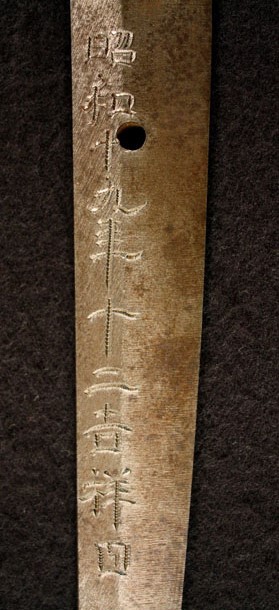
Interesting, I couldn't find that kanji in Nelson. So if it is not a kanji it is a "symbol" that means gift?...as in "gift number 33". I ask because I thought it might be reisho script for a normal kanji saying (maybe) "day 33" ? Here is something very similar...a reisho writing for jitsu (hi). .
-
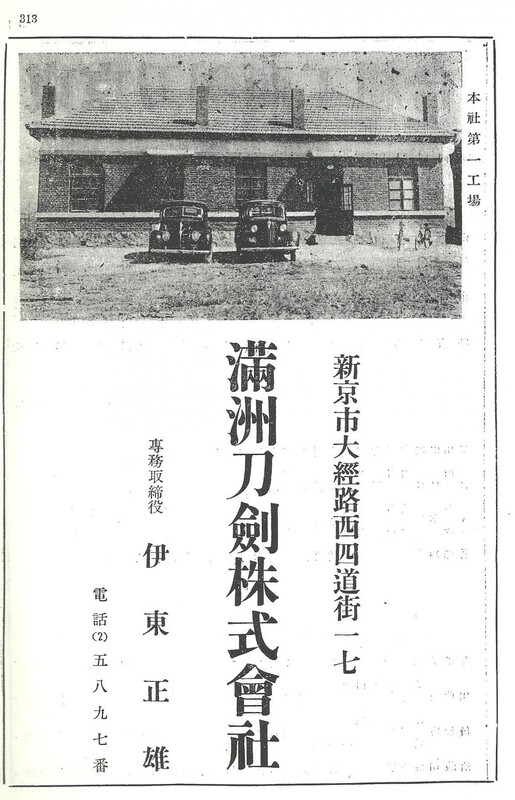
If any were made in overseas territories in the Pacific or south-west pacific or east indies etc they would be very minor productions, probably very unprofessional affairs. There were officially recognised "overseas" production facilities in Hokkaido, Taiwan, Korea, Manchukuo and China. These can be seen in the 'Dai Nihon Token Shoko Meikan' of 1942. These include Hagakure Tokenten (Hagakure sword shop) in Dalian, China. Manshu Token Kabushiki kaisha (Manchuria Swords Co Ltd) Shinkyo (Changchun), China...see pic. Fukuda Kendo (Fukudo Sword shop) Seoul, Korea. I don't know what they made. Hope this helps,
-
Jokeishi Masaaki Information, Help Needed
george trotter replied to AndyMcK's topic in General Nihonto Related Discussion
Hi Antii, I only have this oshigata from Shinshinto Nymon by Shibata 1975. Regards,
-
Hi Peter, Hawley put out a list of swordsmith titles in a booklet called "Honorary Titles used by Swordsmiths" in 1974, but this is number keyed to his old "Blue Books" of 1966. The "Nihonto Meikan" has a list of about 50 pages of them in the back (much more comprehensive than Hawley's) but of course it is in Japanese. I don't know of any others, sorry.
-
Barry san, I can't give you any feedback on likely value/reputation etc but I'm sure you have checked him out to the extent that he is a known gendaitosho RJT (Slough p.81). He is listed in Japanese sources as 1 mil yen...this is the standard rating for most gendaitosho. Of course we all know that the one maker can have good days and ordinary days. You would not know which yours is until it was restored. If the standard RJT blade was valued at $3000 US (not sure if I'm right), then yours could end up at this value or more if it was one of his good days. It will always be a "gut feeling" decision I think. The cost of restoration might see you at least break even (depending on what you already paid for it), or it might turn out to be a real "good day" gem... this is quite likely as it is already a bit superior as it is a private commission. Be very particular about de-plating...stand over them and make sure they do exactly as you say...don't leave it with them to dip in acid while they go and have a long lunch (I had a blade ruined by trusting them once). Hope this helps,
-
Show Us Your High Class Gunto
george trotter replied to lonely panet's topic in Military Swords of Japan
That is nice Ed, Who is the blade by? (some pics?) I agree about getting the ashi. This type are very plain (see Fuller pp.158-159 'Jap. Mil. & Civ. Swords and Dirks') so should be easy to have made, but also, there must be someone in Japan who has old parts in their shop, Be good to find some and have them re-fitted to the saya. Maybe ChrisB can help there? I'm sure you know, but that mon is of the Maeda family. Since it's on a court sword it probably really was worn by a Maeda at court. Thanks for showing. -
Hi Mark, not much to be told from the fittings except it is army (tsuba and tsuka?). Is it dated? I see from the pic it has a number in the place usually reserved for work connected to the Army RJT scheme...so maybe it is an official military scheme sword. Any star stamp?. Maybe post a couple of pics? Regards,
-
Hi Mark, The top two characters are Tsuku shi. Tsukushi is the old name for Chikuzen and Chikugo provinces, and also to the whole of Kyushu. It is classed as Fukuoka now I think. I can't read the two lower kanji, maybe "Yoshi ? " I have seen Tsukushi used like this before (separate above the hole) on swords by Suetsugu Shigetsugu and Matsunaga Mitsuyasu who made swords for naval officers mostly. This mei is one for Morita sensei I think...What are the blade and fittings like? Regards,.
-
Hi David, Yes, those kanji characters are correct for his name. Don't forget, I am only going on the pics you posted which look like a "fresh" mei to me. I could be wrong about him being modern. Probably best if you can show it to an experienced collector near you? The mei you posted looks very similar (but different) to another I have seen on a Edo period wakizashi on this site www.militaria.co.za/nmb/topic/2454-wakizashi/ I had another look at my books and on-line but can see no oshigatas or pics of a modern mei...sorry. Just keep looking on-line now and then by typing in his name/s...you never know what will turn up. I don't have Markus Sesko's book on smiths but maybe a member will look him up for you and post any info here. Hope I haven't led you astray.... regards,
-
Is This Made By Kanemich A 2 Million Yen Smith?
george trotter replied to bchboy1206's topic in Military Swords of Japan
Mei says Seki ju Kanematsu Kanetatsu Saku.. Ordinary WWII Showato blade...not Kanemichi. His real name is Kanemura Tatsuo and he started as a gunto swordsmith in Seki on 26th Oct 1939. Hope this helps. -
Is This An Goryu-Ken Akikuni Gendaito Blade
george trotter replied to chrisfe's topic in Military Swords of Japan
Hi Chrisfe I cant read the signature but it is I think it might be Aki as you say: "? ? ? Aki ? tsukuru kore" (? ? ? Aki ? made this)..This is one for Morita sensei. Can you tell us why you say it is Akikuni? The other side is the date "Koki ni sen ro'pyaku go nen yon gatsu kichi jitsu" (2605 year 4 month lucky day ...1945 April) Hope this helps a bit, Regards, -
The stamp is a "gi" stamp for Gifu. These appear only on "Type 3" general issue swords (or Type O or Contingency / Temporary Standard)...whatever we now classify them as. The stamp is often confused for a Sho stamp as it is also inside a sakura blossom. Gifu is up behind Nagoya. Kiyotsugu started as a gunto swordsmith on Showa 18.11.02 (2nd Nov 1943). Nothing more known. Your sword looks typical of the oil-tempered showato blades stamped with Seki or Gifu stamps. Gifu is about 20 km south-west of Seki. I'm not 100% clear on this stamp's true meaning though. As Seki is in Gifu Prefecture (as is Gifu town), the Gi stamp may mean made in Seki town Gifu Pref. or it could mean made in Gifu town in Gifu Pref....maybe someone will know whether the seki and gi stamped blades were made in two locations or were just stamped with different stamps because they were "separate" production facilites, but both made in Seki? Hope this helps, Regards,
-
Haha, if only... I wonder if the OP ever looked back here for an answer? He has 3 posts...maybe that is the last we'll see of him... Hope you and Sue are well and still having fun. I think I owe you both a nice Japanese dinner next time I'm in Sydney don't I? Regards,
-
Hi David, From the tang and "freshness" of the mei, I think your sword is more recent than 1800. I think it is WWII gendaito (traditionally made). The name Onizuka Yoshikuni appears in a couple of Japanese sources...not well known. "Tosho Zenshu" by Shimizu p.656 says he was chosen for exhibition in the Rikugun Gunto smith exhibition (I think)...he was of Fukuoka. Other Japanese sources say the following: His career his style, hamon, family, teacher are unknown. What is reported is that he was Noda Isaburo Yoshikuni of Fukuoka. He was making swords in 1942 in his own forge under the business name of "Noda Nihonto Tanrenjo" in Yame, Fukushimacho. Later in his career (after 1942 I think) he starts a "second phase" by the use of an additional name in his mei ---"Onizuka", so your sword seems to be signed in his second phase which went until the end of his career. As he does not appear in post-war Japanese books of swordsmiths I assume he stopped in 1945...BUT...he is listed in Hawley 1981 p.956 as "Yoshikuni...Fukuoka...1949...8(points)....YOS 282" I used Uchiyama "Nihon Gendaito Shoshi" Chap. VI p.8. (in Token Bijutsu Mag. #152 1969). and also the reprinted "Dai Nihon Token Shoko Meikan" 1942 p.304-28. Hope this helps, looks like a good sword, Regards,
-
Show Us Your High Class Gunto
george trotter replied to lonely panet's topic in Military Swords of Japan
Ian san, I recently saw a gendaito in gunto Type 98 mounts and it had the owners name written in ink on the brown side of the tassel...it was written in katakana...a Japanese name (forget what it was now) but strange to see it written in kana. And yes, I notice all those things you mention. I have a gendaito by an unknown maker "Shigekuni"...(maybe a modern member of the Nanki line?). It is a very nice sword (Type 98 with silver habaki) and it was surrendered to the Aussies on Halmahera in 1945. The chap who apparently received this sword must have asked the original owner his details, or perhaps a Japanese prisoner translated a surrender tag for him, but anyway, faintly visible on the side of the BLADE (darn) just in front of the habaki is the scratch marks of a fountain pen with small traces of ink still present...it says in English "Sword of 2nd Lt. Kume Kaede (Yellow Autumn Leaves) Division Made by Shigekuni" Research shows that this is the 32nd Div., 2nd Army of the 2nd Area Southern Army (Gen. Inami) that was at Halmahera (N.E.I. Moluccas) at the close of the War. It consisted of the 210, 211 and 212 Tokyo Regiments of infantry. Most sources state that the Division was defeated by the Americans on Morotai (which is true) but let's not forget that the Australian were part of what the American media call an "Allied Force" that fought the Japanese to a standstill. Thos parts of the Division still on Halmahera surrended in August 1945. It had a silver mon on the kabuto but it has been struck off. Gotta love the WWII gendaito. Regards, George. -
Hi Wayne, Probably leather...I have seen this type of "half-cover" a few times over the years...may have had a leather thong attached to hold the Icho (tassel). Regards,
-
Translation Of Tang Needed Please.
george trotter replied to mauser99's topic in Translation Assistance
These slogans are rare but do appear from time to time. I have one "Jinchu Hokoku" (Loyalty protects the country) on a gendaito by Yoshisada of Osaka. Regards, -
Your sword is signed by Shoda Masafusa. He was a properly trained swordsmith under Hayama Masatsuru and later under 23rd Gen Fujiwara Kanefusa in Seki. He made Gendaito during the war and became RJT (he also made showato in Seki). There is a bit on him in Slough pp.97-98. Regards,
-
Celluloid Same of WWII...and Type 3 mon.
george trotter replied to george trotter's topic in Military Swords of Japan
Hi all, Nice to see we are always updating info. I notice I call the tsuka of some swords the Type 3...well as you know this may well be incorrect now as some original research has appeared in recent months which shows that this "Type" may never have been actually designated. maybe it is a "Type 0" (1940) or "Contingency Type?". Also a mon has turned up on a "Type 3" kabuto. As for the celluloid same on the kaigunto...I think you will find that it is actually proper same with thick lacquer covering that fills the cracks. I would be VERY gentle in any cleaning...if at all. Keep up the good work, -
looks like a badly mis-hit sakura blossom, which usually contains the kanji for "sho". Indicates showato.
-
No offence intended to Steve, but I disagree...I think a sword that has been in the same hands since say 1944 and since the owner was 10 years old is unlikely to be a "fake" inscription. I think it likely that when the (possibly family) sword was taken in to a sword fittings shop to be fitted with the military leather covers etc, the owner or the owner's family who took it in asked the shop to cut the inscription. I think there is no reason to suppose the shop would have a professional nakiri shi on hand, but maybe a reasonably skilled mei cutter they could call on. I don't think the inscription is that badly cut at all...as for the cutting of a Buddhist inscription...well I have no opinion on how appropriate/inappropriate it is, but Fudo Myo-o is a fierce protector who sweeps away all impediments to the righteous I believe,,,perhaps cut on the tang as a personal good luck/protection wish from within his family...this is just my opinion. Hope this helps,
-
Hi Greg, You have done well. The inscription translates as "Made In answer to a request by Kariya Kazuo". So you not only know the name of your grandfather who brought it back, but also of the Japanese officer who had it made. It is hard to tell from the pics of course, but I think it would be appropriate to check out having it polished. It is a nice family keepsake. I have only ever seen the one Sato Shigenori blade, but it was good work. Yours looks like it has promise also. Good luck. Regards, PS...I notice that I said Shigenori won 3rd Seat in 1841...of course it was 1941...sorry...duhh!
-
oops, posted twice.
-
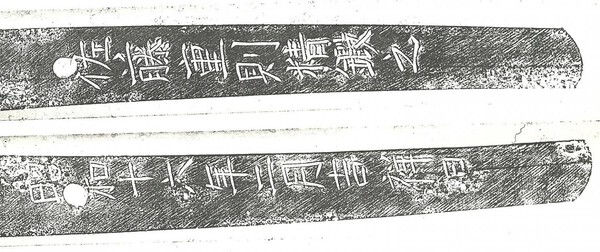
Here is an oshigata of a Sato shigenori that I owned...dated Showa 16. He was a good smith, won 3rd Seat in 1841 Ehib. of new-made swords. Hope this helps.





