


george trotter
-
Posts
3,004 -
Joined
-
Last visited
-
Days Won
14
Content Type
Profiles
Forums
Events
Store
Downloads
Gallery
Everything posted by george trotter
-
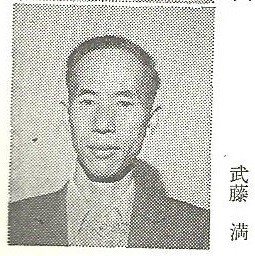
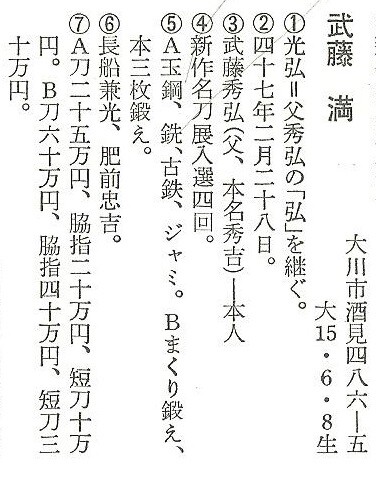
Hi Brandon, Thanks for showing your sword pics. Yes, Muto (Mitsuru) Mitsuhiro was born in Taisho 15 (1926), the son of (RJT smith) Muto Hidehiro, so only about 19 when the war ended. I presume he worked from a young age in his fathers forge and obviously learned the craft early, even being given his art name Mitsuhiro by his father. Had the war gone on a few years longer he may have been made RJT himself. Interesting that he did not date the sword. The personal stamp marks on the mune I can't read, but it is a custom occasionally seen in modern swords...probably an "in house" inspection mark? He re-entered sword making in Showa 46 (1972) so there must be some post-war swords of his around somewhere.In the post-war period he worked in the style of Osafune Kanemitsu and Hizen Tadayoshi. Nice sword...good find. Regards,
-
Hi Bruce, No, it is just one of three dating systems seen on WWII period tangs KIGEN, and KOKI both use the 2600 year = 1940 cycle and of course the most common is Showa (current Imperial reign) cycle. Koki is shown in Slough p.164 and others and Kigen is shown on p.79 and others. Regards,
-
The date is KIGEN 2 thousand 6 hundred and 1 year (1941) a system used to proclaim the number of years since the foundation of the Empire 660BC. The name? behind the munemachi is Wada something (can't tell if the next character is one character or two)...I think this is one for Morita sensei. Hope this helps,
-
Thanks guys...just a nerd taking notice of swords and taking notes...much of the info provided by members here and the web, so credit to all here. You might like to know (if you own a Munetoshi or an Akihisa) that Akihisa was the "best trained" as he was 8th student of Kasama Shigetsugu and 11th student of Kurihara Hikosaburo Akihide (from whom he took his "Aki" character. Munetoshi was the 12th student of Kasama Shigetsugu. So, either one a nice sword to find, although post-war collectors prefer Akihisa.. Regards,
-
Hi all, Just happened to see this discussion. Maybe I can help with answers to a couple of queries on the Yamagami brothers Munetoshi and Akihisa...both good smiths. The following info is taken from swords. The progression of the early tang numbers don't seem to make sense...that is the total swords made to Sho 16/9 is 308, but the total number made by Sho 17/11 (over a year later) has only risen to 422. I can only assume that we don't know exactly what these numberings mean? Anyway, here goes.... Munetoshi and his brother Akihisa ran a sword forge together in Niigata Ken and started using numbers early on in their career. The earliest/lowest numbers I have seen (no Matsu/circle or star stamp) run from 106 dated July 1941 to 308 dated Sept 1941. The first "Matsu in a circle" stamp I have seen starts in April 1942 (sho 17/4). The Star stamp appears about Nov 1942 at number 422 and continued until the end of the war.. They continued using the Matsu/circle stamp into their RJT period, but stopped using it in about late 1943-early 1944. When they became RJT in Nov 1942 Munetoshi started to use his "second" kanji . Akihisa never changed his mei as far as I know. The lowest "Matsu/circle" number I have seen is 11 dated sho 17/4 and the highest "Matsu/circle" number was 1377 dated sho 18/10. From about 1944 Munetoshi starts to use a kana/number code such as "TA 2353". As this is the same code used by other RJT smiths I think it was imposed on RJT smiths by Army HQ. While 2353 seems a fairly high number of swords to produce between about 1941-1945 remember that both brothers shared the numbers (so the total is about half each). Munetoshi returned to his "first" kanji after the war. Akihisa (younger bro.) became more prominent after the war. About whether Big Daddy's Munetoshi is Yamagami Munetoshi I can say that it definitely is his work. Apart from Japanese dealers confirming it, if you look up ONO Gendai Toko Meikan 1971 p.109 you will see his history and a pic of his mei . See also Slough p.121 and P.32 and you will see this mei and his details. The suggestion it might be Yamaue Munetoshi or Ikeda Munetoshi is a reasonable query, but I can say to you definitely that "Yamaue" is a mistaken reading of "Yamagami" (Kami/gami can also be read "UE". Hi also cannot be RJT smith Ikeda Munetoshi as Ikeda is from GIFU and used a different "TOSHI" and worked in a different style. I hope this helps,
-
Good Looking Lady!
george trotter replied to tokashikibob's topic in General Nihonto Related Discussion
Don't you mean Inoue Shinkai? I have seen a few of these Maiji/Taisho tachi outfits and they are usually signed by someone famous. I think they were presentation pieces intended to convey appreciation and respect...while they are not genuinely by the man named in the mei, they convey the "intention/respect" the giver holds for the recipient. Regards, -
Seki Inspection Tag On Combat Saya.
george trotter replied to mauser99's topic in Military Swords of Japan
Although you didn't ask about it I thought you might like to know that the owner's name is written in black ink on the label...looks like Miyagawa. Regards, -
I can't see the inscriptions properly (some better pics please?) but the date seems to be 194? and the left column of the mei reads "Chikuzen ju Muto Yukihiro". I can't see the right column clearly enough. The Muto line is a good line of quality gendaito smiths. I had a blade by RJT Muto Hidehiro. There are some oshigata of your YukiHiro (also RJT) in Slough page 203. From the description in Slough your mei might be Daisaku Daimei by his father Muto Hisahiro. Hope this helps,
-
Ah...Kanezane. I translated that letter from Kanezane to Mr Silver for Richard Fuller to publish in his 1986 book (with Mr Silver's permission of course). An interesting letter. I have seen half a dozen Asano Kanezane swords over the decades but none were gendaito. He must have had talent to win prizes, but I am pretty sure that after 1941 he would have been too busy running his factory turning out showato for the military to make many (if any) gendaito, It would be interesting if a gendaito by him turned up. Regards,
-
Hi Brian, Hard to read but I think it says "Mino no Kami Minamoto Sadatsugu Saku" Despite the noble title it certainly looks like a Seki WWII period mei (a bit hard to read), but I think it is by Takai Teijiro who was registered as a Seki guntosho on 11 April 1941. Regards,
-
Looking at the mei and the hamon characteristics I would agree with Chris B and those who named it to Nakata Eizo. This smith, using the name Kanetsura and worked as a gunto smith in Seki. He was made a Seki swordsmith on Showa 18 year /12 month / 30 day (Jinsoo Kim list). Hope this helps,
-
type 3 Gunto & kai-Gunto identification & commentaries
george trotter replied to rancho's topic in Military Swords of Japan
Hi Eric, That is good news. Nagamitsu is considered a good swordsmith.. It will be a nice Christmas present for you. Regards, -
Tenshin looks right. Date is Showa 2 10 nen 1 gatsu lucky day...so Jan. 1945. Mei looks well cut. Don't know who made it but "no-mekugi-ana" blades have been seen before. I would not dismiss it so quickly...may have some merit and be an interesting blade. Just my opinion, Regards,
-
Hi Andrew, Looking at my Nelson's Dictionary "Gi" can mean loyalty and "shudan" means group...so the maker seems to be the Loyalty Group (maybe a patriotic association? It seems they made them or paid for a swordsmith to make them and sign them with their association name as the "maker")...I'm just guessing. Very unusual anyway...I'm glad you have reported a second example...it all adds to the total of our knowledge (just goes to show the value of collecting and recording oshigata...you never know when another example will need the knowledge of past researchers like Fuller and Gregory.). Regards,
-
Hi, I have seen this type of mei before...about 30 years ago. I translated a copy of it for Richard Fuller and he printed it in his yellow book 'Swordsmiths of Japan 1926-1945" 1983 (thick volume) and it is oshigata 296 (I can't scan it as it will break the spine of the book...maybe someone else can scan/photograph the page?). Yours and the one in the book are signed the same. They both say "Gi Shu Dan Saku" which I would say as a guess is "Made by the art/culture group". The number on the one in Gregory's book is "dai shi ju ni go" (number 42) and yours is "ju go" number 10. I remember discussing it at the time and all I can say is that it appears that a certain cultural group must have volunteered to help make swords for Japanese troops, probably in Japan. Sorry I don't know any more.
-
Hi Oliver, I think we have discussed the Amachi line before. Type in Amachi and Amaike and I think the old posts will come up. Just quickly, there were two brothers and possibly three working as Seki smiths in WWII. Amachi Reiichiro Masatsune was the elder brother Amachi Reijiro Kanenaga was the second brother Amachi Yoshimasa was the third? brother (or a son?). I have seen a number of their swords and while some have seki stamps or showa? stamps, some are unstamped. Some seem to be self signed and some are Seki sword company na kiri shi signed. Hope this helps.
-
The kanji read right to left so the first (on right) is read 'Ho' praise, commend... So R to L reads Hosho or prize, award or probably merit award, merit prize. hope this helps.
-
Tsuba Mei Translation - 成。。。?
george trotter replied to ElleRoseEast's topic in Translation Assistance
To answer your mei query...it looks like Okinari (kao). I agree with the others, it looks like cast brass. Hope this helps,. -
First Time I Have Seen This Mark On Kabo
george trotter replied to The_ozzy_samurai's topic in Military Swords of Japan
Hi Bruce, I have only seen the star and other marks on a kabuto twice. The blade of one I can remember and it was by Endo Mitsuoki, a very good maker. I can't remember what the second stamp was though, sorry. Although my contact with these stamps is quite limited, I remember the ones I saw were only on army fittings of better quality blades. I hope that helps. PS, the four smaller kanji above the symbol say "kabu shiki kai sha" or Company Limited. -
First Time I Have Seen This Mark On Kabo
george trotter replied to The_ozzy_samurai's topic in Military Swords of Japan
Sorry, had some trouble (old and stupid)... The mark is that of Nakano Shoten, a sword shop of Tokyo. Here is a (cropped) advert from 1942, from p.204 of Dai Nihon Token Shoko Meikan 1942. The shop was in Kanda Ku, Higashi Fukuta cho and they had branches elsewhere. Hope this helps.
-
First Time I Have Seen This Mark On Kabo
george trotter replied to The_ozzy_samurai's topic in Military Swords of Japan
Hi Julian, The mark is that of Nakano Shoten, a sword shop in Tokyo. They probably supplied the fittings and mounted the blade. They advertised that they supplied army and navy swords and did fittings work. This advert (which I have cropped) is from P.204 of the 1942 edition of Dai Nihon Token Shoko Meikan. Hope this helps. -
I think this is the fourth such signed blade that has come up on this board...you'll have to search. Several have a star stamp also, but none had a signature. They are all "mei" cutting and yasuri mei by the same hand as yours. I don't know who he is. Some/all had a small stamp on back of nakago mune also 'ko' for Kokura. There is a book called 'Kokura Rikugun Zoheisho' by Nakahara Sumiko (Nakahara publishing- Kitakyushu) 2011 and 2012. I have not seen it but if any member has it maybe it has some info on sword making (bearing in mind they also made tanks, bayonets etc etc). the quality of the mei and finish looks too good to be just a showato...but who knows? Regards,
-
Lucky we have Markus. That is interesting info on a relatively unknown (to us) smith. I notice in the photo posted by Mark that his signnture is indeed visible at the bottom of the poem (upper oshigata).
-
The mark in the circle is discussed on several pages of our NMB 'Military Swords' page...I think all felt it was China production, but no-one sure who/where. Have a scroll through...
-
That is great information Kiyoshi sama, An interesting discussion. Regards,



