george trotter
-
Posts
3,005 -
Joined
-
Last visited
-
Days Won
14
Content Type
Profiles
Forums
Events
Store
Downloads
Gallery
Everything posted by george trotter
-
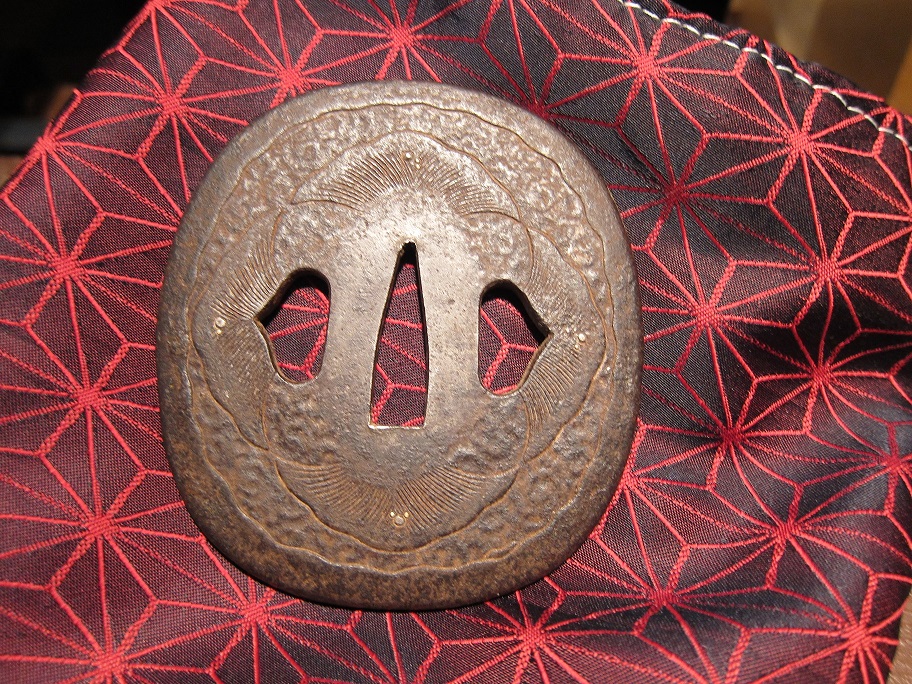
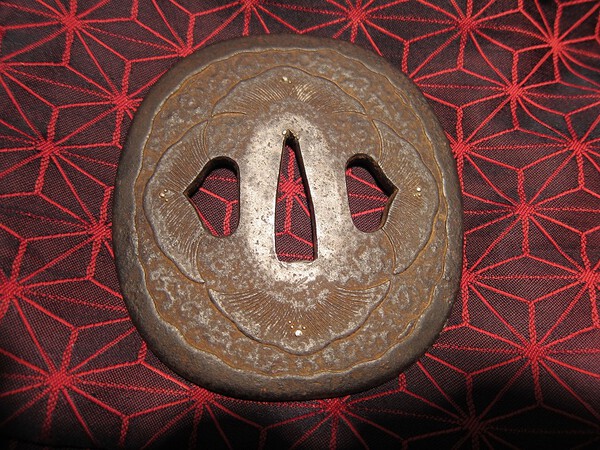
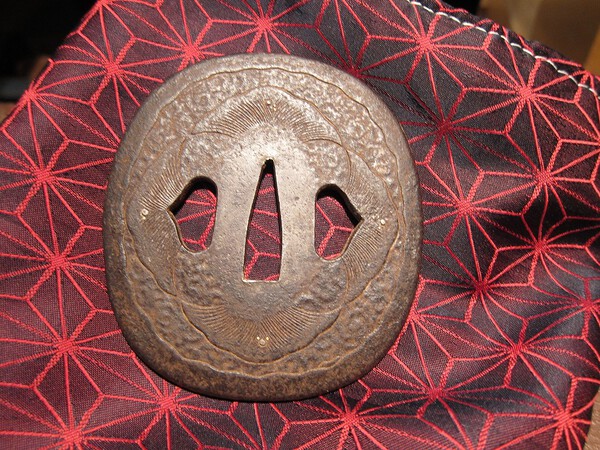
Thanks David and Ford, I won't do anything extreme, in fact, I have been carrying it in my pocket for the past two days and it is mellowing and cleaning nicely. I may finally end up with just some pinpoint spots here and there (especially on the side that was up and collecting dust when the sword was sitting propped against a wall in a shed for years), but generally, it is coming along well. I will definitely be very careful of the tiny inlaid dewdrops. I have owned many tsuba over the years (but only on swords) and appreciated the occasional example, usually on its artistic conceit more than its quality (like the sakura petals, hoof marks and horse on the Sumida River daisho tsubas in a thread about 18 months 2 years ago), so I am not a tsuba man, but I can see quality when it is placed in front of me, and this is just to my taste (understated but excellent work) and it says "quiet quality" to me...I do thank my friend for giving it to me...even my wife likes it This is the only tsube I have now and I think it is definitely a keeper. As for Higo or Umetada...I have been studying both and I must say, it is hard (for untrained me) to make a decision...still looking. Thanks for your comments and help. Regards,
-
English Index for Nihonto Jiten by Tokuno Kazuo
george trotter replied to Uechi's topic in General Nihonto Related Discussion
Not to be a douchbag, but really, the best way to navigate Japanese Nihonto texts is to make yourself familiar with the kanji...After all, you have the kanji in front of you on the mei itself...work out the pronunciation and look it up from there. After a while, the basic group of "more common" mei kanji will become familiar and you won't need translated indexes....I'm just trying to point out the obvious...it worked for many of us...as I said, you already need to know how to pronounce the kanji to know where on the index you will find the page...why not go straight to the Japanese index...it will improve your skills further. Always relying on English (or other) translations in the first instance means you are never becoming proficient in the basic building blocks od Japanese smith names. No offence intended, just trying to point out the practical... Regards, -
Thank you all for your comments. I will do some reading. The pics/flash are lousy for sure (I am unskilled with a camera)...the tsuba is much better in hand...a few spots but mostly fine dusty coating from storage. It was a nice present, pity I don't have a sword to put it on. I must say, the number of tsuba I have had in hand over the years is very large, but 99% of them are very "ordinary"...this one is quite fine work IMHO. It caught my attention as items do when the design is "quiet" but the quality of the work is fine. Thanks again, PS to add...I have had a good read on cleaning carefully (thanks for the link Guido) and am pleased to say the tsuba is relatively clean and still free from oil, so I won't add any more, but will get some bone and treat it gently and then do the dry cotton cloth treatment (and maybe the pocket treatment if it still needs it) and for now will now start on research. You might be right about ginko leaves Guido, they are a triangular shape...one of my favourite trees in Japan (but only to look at, not to walk on the oily leaves on the sidewalk). thanks again all.
-
Hi all, I was given this tsuba today and although I don't collect them as such, I thought this was of quite high quality and workmanship. Plain iron. Unsigned. Design seems to be four leaves or petals with dewdrops of gold and silver? Design is the same on both sides. The tsuba iis in good condition and I think normal handling with slightly oiled fingers will soon restore the dirty surface. Can anyone comment on date and school and quality? H: 8.2 cm W: 7.5 cm Thickness: (about) 3 mm seppadai is still unrusted and slightly bright so must have come off a sword in recent years...I got it from a friend who got it from the original owner, so I will try to track down more info on where/how he got it and if the sword is still around. regards, Edit to correct: thickness is 5mm tapering down to about 3mm at rim.
-
Star stamped Yoshihara Kuniie?
george trotter replied to george trotter's topic in General Nihonto Related Discussion
Thank you guys. Yes, I remember now that he signed his war blades with Nobutake (duuhh!), now I know why I haven't seen his Kuniie mei with a star. I have seen his teacher Shigetsugu's work in hand and yes, definitely flamboyant...from a western point of view I can see why this group's work is popular here. Great stuff. thanks again, -
I was talking to a friend recently about this smith. I have never been fortunate enough to have his work in hand, but I do know a little about him...he was trained under Kurihara Akihide and Kasama Shigetsugu and afterwards set up his own premises and worked often in Bizen ichimonji style...he was later selected to train the RJT smiths when they were established, so he must have been good. He is listed as RJT but I was wondering if he was making them himself or training others to make them...or both. My question is...has anyone seen a star stamped sword by him? Regards,
-
This punch mark on Masayasu swords has come up before I think ...check through Arsenal Stamps (I think) or search punch marks...I think it must be some kind of accounting system as, from memory it appears in single, double and triple style (I think they were all Masayasu). With all the variations I don't know how one tells which is the shoshin mei. Also, I have had a fair number of Masayasu in my hands over the years and would have to echo Chris' comment...good practical swords, but not in the realm of good gendaito (just my opinion based on what I have seen). Hope this helps.
-
I didn't know Jacques was "lying low"...I thought Brian had sent him to the "sin-bin"? I think Brian has called it right...here is "Stephen's" opportunity to show us what he's got and to name the dealers and Tokugawa family member who agree with him that this is the Honjo Masamune...what's so hard about that Stephen?
-
Old wakizashi...? My first mei translation
george trotter replied to Zoom Rabbit's topic in Translation Assistance
Hi Jim, Welcome to the board. Just to say...no-one is trying to bully or disrespect you, all are trying to guide you on the true path of nihonto collecting and preservation. What is not said plainly, but has been hinted at (maybe a bit bluntly), is that generally: We keep original fittings, or remount in original fittings or leave/store in original shirasaya (not Chinese stuff). It is part of the ethic of Nihonto no shushuka no shikata (the way of the Nihonto collector). As for your sword, it seems to have a nice wide hamon, and yes it is in pretty scratched polish, but looks good. I can usually read mei without any trouble (occasional mistakes aside) but in this case the pics are just too unclear (and should be tip upwards). Please take clearer pics and we'd be happy to help. Lastly, I have seen a lot of swords and honestly, (from the poor pics), I think the wounds on the back ridge are recent and are hit marks, not cut marks. I hope this helps and hope to hear more from you (with better pics). Regards, -
It does look like Kushida as John said. This is a family and personal name, which is a bit unusual when just written like that with no additional information (place, made for, made by...etc), so maybe the owner's name? Is there any inscription on the other side? Regards,
-
Just thinking...wouldn't it depend on whether you use the sword or not? If always a collector/art piece then a nice horn mekugi would look nice...if for iai, then a nice strong smoked/pickled/organically blessed mekugi would be desireable? I have had a number of gunto containing gendai, shinto and koto blades over the years that had their original (to WWII) horn mekugi, so I suppose at least some officers preferred horn and some preferred bamboo...ee ka, warui ka, dou ka, wakarimasen. Hope this helps,
-
Any ideas on age school tanto
george trotter replied to Cello's topic in General Nihonto Related Discussion
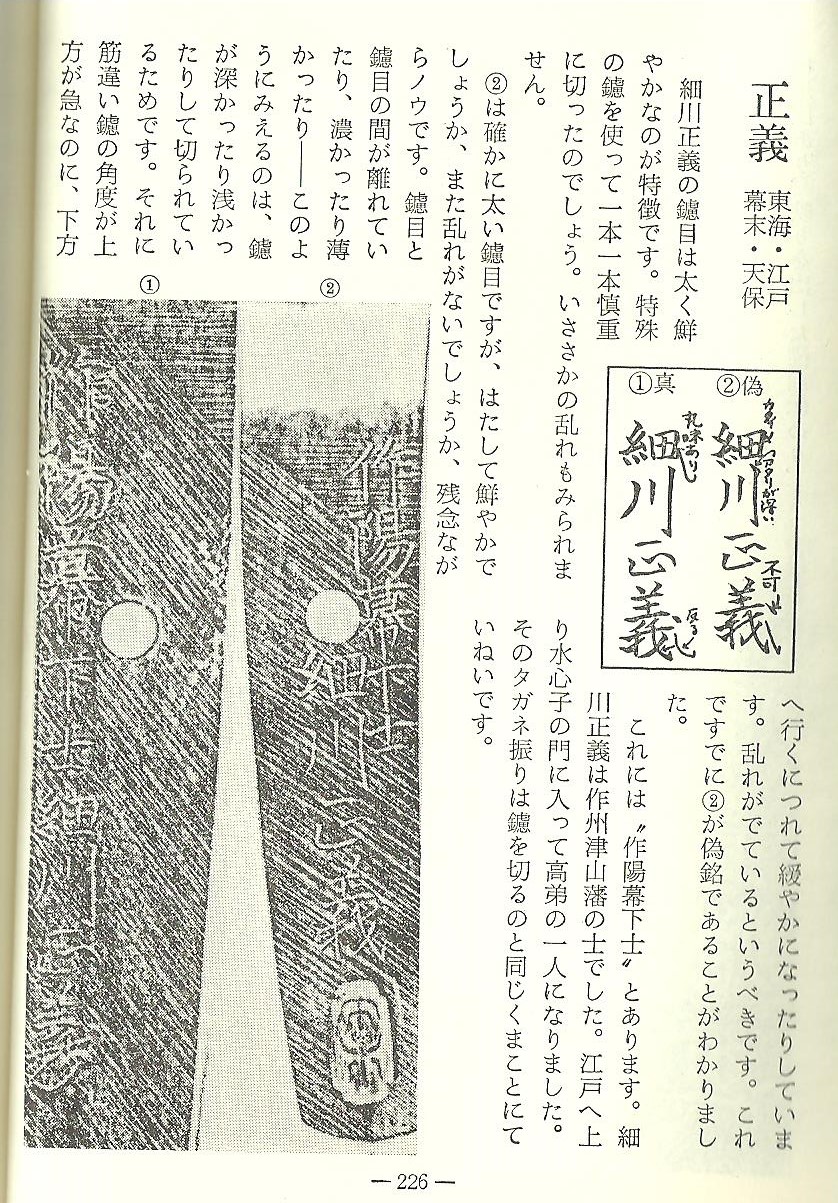
Here is a shoshi-gimei comparison that might help (Shin Nihonto no Kantei Nyumon by Hiroi & Iida, Sho58 p.226), The book is old now so may be superceeded. I think from these points shown your mei is not correct...but as Chris says there was more than one generation. If the oshigata are too hard to see maybe the kantei points will help...hope this helps. Regards,
-
Ford, just fabulous. As always. Thanks for sharing. Regards,
-
Source needed for Tsunagi
george trotter replied to Ed Hicks's topic in General Nihonto Related Discussion
Ed, Just thinking out loud...you don't say if you only have the mounts or you also have their blade? If the former, I'd think about making a tsunagi that is only say 12" of blade plus an adequate nakago...this way you don't have to interfere with the saya or tsuka. You can make the short blade/nakago tsunagi and it will hold everything together just fine for display (I used to make them out of good dry balsa wood...worked fine and being softer than the saya and tsuka wood they would compress a little and sit "firm" in the saya/tsuka). If the latter, and you have a blade then I don't have to tell you you can order the tsunagi blanks from one of those sites and trace out the blade on it and then shave the blank until the sori, niku and nakago etc are a snug fit. Good luck, -
Hope you find a piece of cloth to lay the blade on...much better than laying it on concrete :D Regards,
-
Hi Tony and Denis, Yes, it is a pretty standard Enfield type rifle. Tony, maybe your friend's rifle is from a shipment of European arms brought into Japan in the 1860-1870 period. If you check Watts & White bayonet book I think it mentions these arms as being purchased from UK and probably France and maybe Germany to arm the new national army. W&W has a pic of a Chassepot 1866 bayonet marked (in kanji) 2232 on blade and I had a 1860 Pat. Enfield yataghan bayonet marked 2279 on the scabbard leather. This rifle would probably take a socket bayonet, unless it had a bayonet lug on the front band (now removed). I'm sorry but I no longer have my detailed research notes as I traded off the bayonet/notes years ago. Without a doubt, this rifle (if it is one of this shipment) was used in the turbulent 1860s and possibly also in the Satsuma Rebellion to put down the rebels...or maybe was used by the rebels, who probably also brought in European arms. A nice find and I think probably historically important....your friend needs to do some research IMHO. Regards,
-
Yes, a straight European arm. I see no proofmarks, but it is a Tower type 3 band rifle-musket with cut down wood. Strange and I would say rare to see a Japanese inscription on it as "made by". I have owned yataghan type sword bayonets for these European arms used in Meiji and the bayonets and scabbards had similar Japanese numbers cut on them...so, maybe it started life as an early Meiji rifle and was later 'sportrtised". Interesting, Regards,
-
To me, it looks like a Pattern 1853 Enfield barrel, or something similar. Maybe a trade pattern that found its way to Japan in the early Meiji era (or perhaps a copy of one?). Any chance of an overall view of the barrel (and stock too) and any "european" marks that may be on the metalwork? Regards,
-
Hi Rich, I too add my thank you for your fine, informative site and your quiet integrity in the hosting and administration of it. It has been of great value to the education of the nihonto collector community. warmest regards,
-
shigemitsu for your enjoyment try the rest..
george trotter replied to 1tallsword's topic in Translation Assistance
I have seen two swords by Suetsugu Shigemitsu...both mounted in Kaigunto mounts. Both were very nice swords IMHO. Care to show us the blade etc? Regards, -
Wow, it used to be dogs and bunnies ... now it's satanic signs and dead animals. Oh well... Regards,
-
...or just look at the polish! :D
-
Hi Mariuszk, Thanks for that link explaining a later "attachment" blade...it makes the "crime" of hadori a bit less outrageous...although still unforgiveable :D Yes, I agree with Chris' question, I'd like to know when the blade was attached and who made it...also, how did they know the exact dimensions, sori etc to get the blade to fit the saya? Did they dismantle the saya maybe? Regards,
-
Speaking of noticeable and unacceptable...did anyone scroll down a bit further to the the polish on the Nara Kasuga-taishi shrine sword further down the sisters' info blog. Can you believe it...a 12th century blade in perfect healthy condition polished in modern hadori ...even the sisters were quietly offended. I would class this as a much higher offence against nihonto as in the case of the welded nakago it is plain fraud, while this polish is just...WRONG! Had my rant...
-
There are a few smiths that began prewar and worked through WWII into Heisei era. One I have always looked for but never found is Imaizumi Toshimitsu. Born Mei 31 in Saga he began in swords in Bizen Osafune in Sho 9...he was RJT and was still making swords into Heisei 5 at least (1991 or so). His work is usually about 75cm or so and spans 60 years. I was given an illustrated book of his life/work and must say I like much of his work which is Bizen Osafune style, but especially I like one dated 1943 that is included in the book for its shape, length, hamon etc because it is a practical working style about 66cm. He was RJT in WWII. He gained great recognition after the war and even made a sword for Walter Compton. I have never been lucky enough to come across his blades, but I think he is well worth collecting. You can see his details in Ono 1971 p.16 and Ono 1977 p.14. Regards,