george trotter
-
Posts
3,005 -
Joined
-
Last visited
-
Days Won
14
Content Type
Profiles
Forums
Events
Store
Downloads
Gallery
Everything posted by george trotter
-
Bonji Character on Blade Meanings
george trotter replied to Edward G's topic in Translation Assistance
Can't help with the bonji...they don't seem to match those in my (very limited) list. The regular kanji spell out "Hachiman Dai Bosatsu". Hope this helps a bit... -
Jean, never give up.... :lol: "Is it never mine to be a brilliant star? Shall I, for shame. refuse to shine, or send a single beam afar? The smallest star, its perfect work hath done, if it hath but twinkled -" I wonder what the members think of the general thrust of the above idea to "rehabilitate the miscreants"....? Regards,
-
Hi matt, !3th year 8th month 14th day...I didn't realise you were asking about the period name also...I think that a stylised Showa may be correct...maybe if you tell/show us a bit of the sword and mounts we could be more positive? Regards,
-
I agree Jean and Adam,...being wrong is not a shame, it is refusing to accept one is wrong in the face of evidence that is the embarrassing thing. Of course, books, experts, can be, and are, sometimes wrong, as are all of us, but we can only know this if the evidence is produced to prove it. I know poor old Brian has had his "bad hair days" with many of us, but I still think it is worth trying to educate the "differently logiced' to understand how mainstream logic works...it is always better to include and educate than exclude and ignore...after all, in most cases these "differently logiced" don't know that they don't know (as a wise man once said). I know that Jacques used the "L" word, and usually reverses the onus of proof, but I think overall he does not abuse members...unlike the "departed" who almost always attacked personally or ridiculed members who disagreed with them or merely presented some piece of evidence that contradicted their statement, rather than disprove their contra-evidence and this (unlike Jacques who seems to be logic disoriented) shows a real ego problem (not to mention a logic vacuum). But, even these "others" are not beyond learning if given a chance and guidance here. I don't mean we should all be luvvy, luvvy and super polite etc, I do think there is room for robust debate and points of view (even the occasional joke, and rant etc), but not trolling. just an idea...
-
Matt, It seems to be: 10 3 year (fancy way of writing nen) 8 month 10 4 day regards,
-
Seriously, this MUST be a language-cultural thing....this (to us) apparently "reversed" logic. Maybe Jacques could be "encouraged" to explain himself more clearly and give sources at the beginning, instead of expecting members to "prove him wrong" withoiut them being able to see why he takes his position. Rather than ban him, let's just keep trying to educate him in (our) logic?...maybe just ask him for sources before even answering his comment...? On this subject of cultural-language differences...I'd even like to see those other "different logic" thinkers return...you know who I mean. If we can get them to to produce more than just cryptic one word comments or one sentence comments (or pictures of dogs and rabbits) and actually give a position and a reason (sources) then discussion would expand and study would progress nicely. No one likes to be wrong, but it is easier to accept if it is explained clearly, step by step....and respectfully. Worth a try? regards,
-
Further to the comments here, there are many ukiyoe of the Russo-Japaneses War (1904-5) and even earlier, the Sino-Japanese War (1894), which show kyugunto being used in combat. I know these pics are stylised, but photos also show before and after pics of combat/battlefields and company officers and their men standing amid the debris of a hard won redoubt. These company officers would, one would presume, have been the man who led the attack at the head of their individual companies in infantry combat. I think there is no doubt that Kyugunto were used in combat and to extend to Geraint's comment, I think the difficulty is mostly in our modern "samurai oriented" minds and the difficulty of using them in combat must have been relatively minor as they were not re-designed until 1934, and this was primarily (IMHO) because of a desire to be more "Japanese" in the mounts...instead of "quasi-Western". IMHO these are true combat gunto mounts. Just my two cents...
-
Unknown tang signature?
george trotter replied to The_ozzy_samurai's topic in Translation Assistance
A neat and tidy gunto. On Jinsoo Kim's Seki Kaji list: he is family name Kataoka, personal name Chikashi? He was registered Sho 16-11-13. I have seen a few of his blades and all have been Seki made gunto. Hope this helps, -
On hawley and valuation..
george trotter replied to obiwanknabbe's topic in General Nihonto Related Discussion
Crikey!...even though I am a "geezer" and often corresponded with Willis Hawley, I did not know about the "first blue volume" or the "additional 400 names volume". So, all good info. I presume the "big brown volume" of 1981 had the additional names (and more). I don't know if the later "two grey soft cover volumes" (2001 I think) had additional info, but I'm sure they are handy as an initial, quick look-up source. Even though I have Japanese works, I still often jump straight to Hawley for a quick scan across the mei group. Interesting comments. Regards, -
Hi Eric, This is not the place to ask kantei questions...Brian might move your hamon pic and question to the appropriate thread? Just quickly, very coarse nie is usually called ara nie and "lines of nie" in the kissaki can be an indicator of masame hada. Regards,
-
Thanks Ian, The stamps on the mune of your RJT blade are "na" and "ho"...meaning Nagoya Arsenal and a second inspection mark. FYI Motomura Kanemoto of Saga originally trained in the Muto School. I had a RJT blade by Muto Hidehiro (see this thread, page 1) and his mune had "ko" and "ho" indicating Kokura arsenal inspection. Regards,
-
I was asked to do a drawing...here it is with dimensions in cm and mm...sorry I'm no tech drawing expert. Pic is reduced 50% Regards, Geo.

-
On hawley and valuation..
george trotter replied to obiwanknabbe's topic in General Nihonto Related Discussion
I agree with what you say Chris...I meant that the points system Hawley used (don't know where he got it from) was just a grading system that (as you say) alerted the reader to the relative value of a given blade compared to its fellow blades. 10 smiths rated at 15 points is just a comparison between them and 10 smiths rated at 25 points. How one accounts for one of the 10 @ 15 points being worth $1000 and another being worth $25,000 is a matter of deeper research. I too think it a nonsense to rate all gendaito smiths at 8 points as we know they vary in quality etc, but when Hawley compiled the work there was little known about gendai as we know them today and I think he put them at 8 points because they were then "barely" considered swords (and at the NBTHK they still won't even consider them!).. So, as a "quick reference" it is fine (IMHO) but of course, it is the beginning of the study only...the reader must then do the real research and appraisal from there on. Regards, -
On hawley and valuation..
george trotter replied to obiwanknabbe's topic in General Nihonto Related Discussion
Hi Kurt, Some errors there...Hawley wrote the first edition in 1967 (blue volumes), then the Revised edition (big brown volume) and after that in 2001 I think (two paperback volumes)...others? The point system is not a value in Yen, it is a point system of value against each other...eg all swords are 10 points as "base value" (except gendai which are 8 points as base value). From this basic rating a sword rated 40, 80, 150 or 200 is thus compared in excellence against the "base level" work. There is no need to upgrade the system, but I am sure later scholarship would modify some of these ratings up or down as more knowledge about them appears. Hope this helps, -
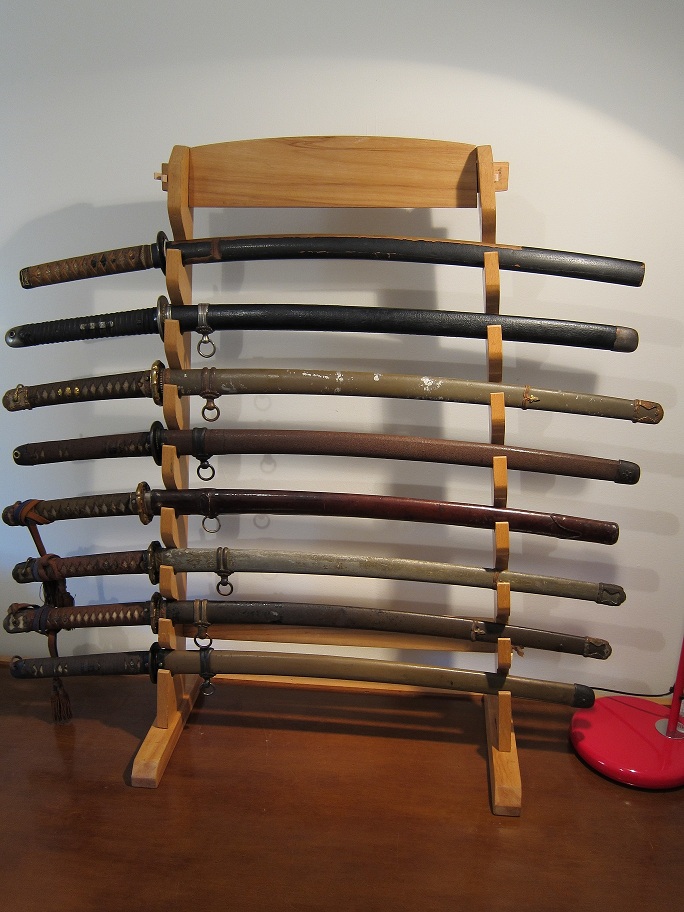
And then of course there is the plain storage kake... Normally my swords are in bags in a tansu and rarely, in a two sword black lacquered kake on top of the tansu, but once in a while I have need of greater display space and this suits my need well. This one is Japanese, held together by 4 pegs (literally). The original pegs were missing so this is held by 4 wooden clothes pegs...I haven't got around to shaping some proper tight fitting ones yet. This kake can be quickly dismantled and easily moved to another place...not very pretty, but well made and useful...must have come from a budokan or somewhere ($50 in a militaria shop). Regards,

-
Two Newly Sourced Gunto - Nagamitsu?
george trotter replied to dnmmilo's topic in Translation Assistance
Yes the mei is Nagamitsu. Look him up on the Jinsoo Kim's Seki Kaji list in the link above and you might like to look through "Arsenal Stamps" in the Military Sword link below for the meaning of the small stamp above the mei. Regards, -
Klaus, scroll back to page 12 of this thread...you will see the identical mark...I am sorry to say that the sword looks Chinese made to me. Regards,
-
Mr 1tallsword, if you just go online and type in "Japanese swordsmith Hideyo" or type in "samuraisword.com masatsugu" up will come a good Suishinshi line graphic by David Pepin 2005 which answers all your question....then you can ask us questions if you need to. Easy....
-
Thanks Dave, Hmmm...two unsigned RJT blades and both from Kokura...I think we'd better call this the "McDonald variation" haha. Maybe best to wait until someone can ID the work to a known Kokura smith before you spend money on a polish? Anyway, it has the star stamp so that is a promising sign...maybe, if someone knows the names of the smiths that worked at Kokura (do an on-line search)? we could compare known works to this for nakagojiri, yasurimei and mei kiri characteristics. A mystery worth solving IMHO. Regards,
-
I agree with Ian and Chris, I don't think this is a modern day attempt to deceive, I think it is just an example of a curious "anomaly"...as they say, never sat never with nihonto. Chris's comments re the date and the rush of late war production seems quite reasonable. BTW Itend to think the two kana stamps on the mune are indeed "ko" as this is the inspection stamp for Kokura. Looks like nice RJT blade...any blade pics? Regards,
-
Hi Klaus, Thanks for posting the stamp mark on "Arsenal Stamps"...it all helps future research for those interested. Hi Lakebum san, the meaning of the stamp is just "Haya" as in the first kanji of his family name Hayakawa. I can't be sure of course, but I suspect he put it on the jiri of each sword he made that week/month so the na-kiri-shi guy who cut the mei of all these guys in the factory would know which name to put on the nakago of that particular bundle of swords (just a theory)...other kaji may have had other methods of identifying their bundle when sent to the nakirishi. Just a possibility, Regards,
-
Yes, he is Kaneyuki. Jinsoo Kim's list says Hayakawa Masao...began as Seki Kaji in Sho 17-Sept 10 1942. Markus' book should have some details...but I don't have Markus' book so this is all I can find. I see your sword has a little kanji stamp at the kojiri...looks like "Haya". Maybe you could post that pic on the "Arsenal Stamps" thread? Regards.
-
Hmmm, As per the RJT rules (see "articles" link) a smith had to sign and date his work. Of the several RJT swords I have seen with "such and such" Rikugun Zoheisho, they all had a 2 kanji mei at least. See Slough p.135. This should not exist....I hope someone will comment. Regards,
-
How Important is Provenance?
george trotter replied to Loco Al's topic in General Nihonto Related Discussion
I think I am misunderstanding? In relation to the OP about provenance, (is it important?), I detailed how I thought my field of interest of gendaito 1868-1945 in gunto mounts already is (as a group) fulfilling the "ideal" of provenance...that unlike "old" swords, these gunto mounted swords' provenance is self-evident...and I thought that the discussion had drifted off provenance towards "value" and "better sword". So to be clear, I think provenance is important and I think quality is important, of course these enhance a sword for me...but it still has to be a sword that I like. I buy a sword because I like it... I am a collector. Saying one would prefer a sword by Bizen Nagamitsu over a gunto given to Goering is no real explanation for this preference...it has overtones of pre-judging (IMHO) in that it implies that the Nagamitsu is implicitly "better" If I purchased a Bizen Nagamitsu and left a Goering gunto, it would only be because I liked the Nagamitsu more, not because it was better. I hope this makes sense. It has also been said that some collect as art, with high investment value, with an eye to future financial gain...well yes, some do...but these people, while possibly well educated in swords, are not really collectors, they are investors. When you see the high prices of "top end" art and swords etc, it is an indication of this...they are not art, they are commodities. Put simply, what could possibly make a picture or a sword worth millions or maybe 2, or 3 or 50Xmillions. It is a nonsense. No human eye or knowledge could explain the features of quality which would (a) justify such prices, nor (b) explain what could make such a difference in price between two pictures or swords. In fact, it is such a nonsense that if I went to the Guggenheim Museum, I think I would learn more and enjoy the visit more by studying the curators rather than the art :lol: Let's just enjoy our preferences (and pity those who aren't "enlightened" enough to share them :D ). Regards, -
How Important is Provenance?
george trotter replied to Loco Al's topic in General Nihonto Related Discussion
Hi Paul, all of what you say is true of course. Art and artefacts are all a matter of opinion and preference. I too like to obtain the best quality in blade and fittings and I don't buy a sword because of an association...I have to like it for itself...the provenance is a bonus. The question that I posed was to do with this gunto period provenance... about what determines a provenance to be "good" or not. I'd be interested in some comments on this, and also on the question of "altering" an historically/artistically provenanced object. Regards,