Bruce Pennington
-
Posts
14,320 -
Joined
-
Last visited
-
Days Won
171
Content Type
Profiles
Forums
Events
Store
Downloads
Gallery
Everything posted by Bruce Pennington
-

Translation help on gendai sword
Bruce Pennington replied to matthewbrice's topic in Translation Assistance
October 1934 - is it in nice fittings? -
You would need to post some close, clear shots of the blade showing hamon (temper line) and body texture. Shots of the blade tip can help. Slough's reference page on Kunitoshi says he made medium - high grade gendaito, so there is a chance this is traditionally made.
-
Peter, The hash marks are modified Roman Numerals, and would be read the other way round. "/" is 5 and each horizontal is 1, so /II is "7" and IIII is "4", so "74". The paint is "3992" and ホ or "HO" of the 1st Factory of the Korkura Army Arsenal. The painted numbers often match the numbers on the fittings, and are believed to be put there by the shops doing the fittings. Fittings are custom fitted to each blade, so the numbers help keep all the matching set together as the blade goes through assembly. Don't know what it means when the numbers are different. Sometimes it seems this happens if the blade goes through another set of fittings. The HO on yours almost points to an arsenal numbering system. But there's no way to know.
-
Toy soldier IJA officers with Gunto - just for fun!
Bruce Pennington replied to Kolekt-To's topic in Military Swords of Japan
Good one Geoff! But you can see it has a bohi (fuller groove) so I'd say it's a family blade refitted for the war! Ha! -
Pretty cool, I've never seen one. Found that page in Dawson's book, John, you nailed it! Pretty rare item if you ask me.
-
We have been discussing this gunto lately, and after checking my chart, I have 28 "NAN" stamped Mantetsu and none of them are Koa Isshin. Of the couple hundred Koa on file, none have the NAN stamp. So, while we "never say never with gunto" I'd say that piece of evidence tilts the scales further toward this being gimei.
-
Is that a Feb '43 Kanetoshi? If not, could I get the mei and date?
-
Japanese type 32 (early production)
Bruce Pennington replied to KB1107's topic in Military Swords of Japan
The drag numbers were often changed when the gunto went to the factory for repairs. Many Type 32 saya drags are like this. Mine was filed off and a new number, with an added "1", was stamped on. I don't recall, now, where I read this, but it was a known practice back then. Here's mine

-
Paul, Got a couple of cool swords there! You might want to post the shorter, older one on the Nihonto forum. They can give you a good idea as to the age of the blade. Probably should post them both, though the larger one, to me, seems more like a WWII era blade, but I'm not a good source for that sort of judgement. It could be pre-WWII. Interesting to see the leather collar on the saya (scabbard), called the koiguchi. In my experience, these are usually metal end caps. Quite often, like the other one, they go missing. It will be difficult, but not impossible, to find a replacement that fits. Good challenge, though, if you have the time. I like the look of that leather one! Private blades were often taken to war and fitted with these leather covered saya. The fittings on the larger one are Type 98 officer fittings. If you haven't read Ohmura's site on these, it is worth checking out: http://ohmura-study.net/900.html
-
Japanese type 32 (early production)
Bruce Pennington replied to KB1107's topic in Military Swords of Japan
Ha! I get it with the serial number! I was getting clearance to fly out of a Florida airport and the Clearance Delivery guy gave us our "squawk" - 0666 (it's a radar identification system that shows the position on ATC radar screens). WEll, we asked for another, and he chuckled and and said "Yeah, I get that a lot. Here's a different one ...." Fuller says the Type 32 was introduced in August 1899. Going by memory, I want to say they were making about 9,000 per year? Could be wrong on that number, but I'd still say your blade was made in the last half of 1899. -
Arsenal Mark on RJT sword Fittings
Bruce Pennington replied to george trotter's topic in Military Swords of Japan
Trystan, It would be significant to see a more clear shot of that sakura stamp. As a 1945 blade, it should be a Gifu in sakura. I do have 1 1945 blade with the Showa stamp, but I have 33 '45 blades with the Gifu. Can you contact the owner, or give a link to the photos? -
Attention Mantetsu Owners: A Survey
Bruce Pennington replied to Bruce Pennington's topic in Military Swords of Japan
@Stephen - looks like "TSU 601" which would be a 1941, Koa Isshin. Any chance of photos of the rest? Not in the database! -
Arsenal Mark on RJT sword Fittings
Bruce Pennington replied to george trotter's topic in Military Swords of Japan
Thanks Trystan! I have 7 other star-stamped blades with the small seki, all in '44 & '45. Smiths Kanehide, Kunitoshi, and now Mitsunobu. -
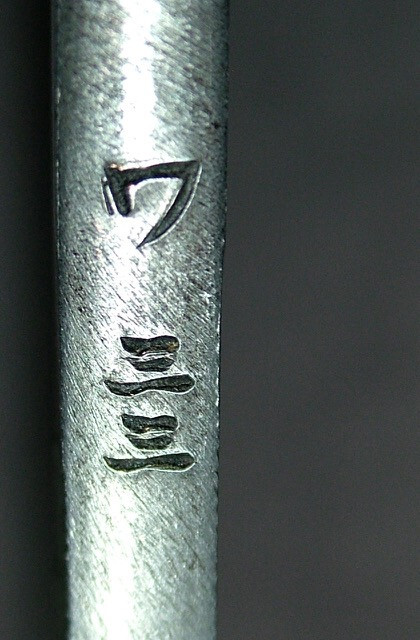
@Ed may correct me, if different, but, yes, this is the serial number. Nagasa is 21 in.:
-
early meji? police sword marking
Bruce Pennington replied to micah's topic in Military Swords of Japan
Ah, nice! Dawson says that is a "patrolman and sergeant sword" and Fuller thinks this one was for mounted civil police, though he said that wasn't confirmed. -
Kojima Katsumasa - Shin Gunto Katana - Juli 1943
Bruce Pennington replied to Erwin's topic in Military Swords of Japan
Wow, thanks Erwin! Excellent shot of the stamp details! @BANGBANGSAN @george trotter and @mecox have been digging into possible shops thanks to some leads provided by @IJASWORDS. It could be a shop called Chubu Token Kabushiki Kaisha, the "Chu" being the same kanji as on the tsuba. No actual proof yet, but it could be a shop like this. -
Attention Mantetsu Owners: A Survey
Bruce Pennington replied to Bruce Pennington's topic in Military Swords of Japan
Thanks Tony! I have some shots of that blade from 2019, but your pics are much better. Hey, is that a black saya? Not very often we see a Mantetsu in a black saya. -
early meji? police sword marking
Bruce Pennington replied to micah's topic in Military Swords of Japan
Micah, I was holding off, hoping someone with information would hop in, because I have never seen this one before. I'm no expert on the police swords, but my feel is that most of these were made before WWII or in the 1930's and there were many makers in those years with logo not in the books. There is another possibility that it was a Buddhist or religious marking for good luck, too. Very nice police sword, by the way! How about pics of the backstrap for curiosity sake? -
Almost had me with the hand-etched numbers on the nakago! Damascus pattern steel eith acid ectched hamon? Don't know how this was marketed to you, but it looks to me like a very modern Chinese blade, as said already.
-
WW2 Japanese Navy Takayama sword
Bruce Pennington replied to Swords's topic in General Nihonto Related Discussion
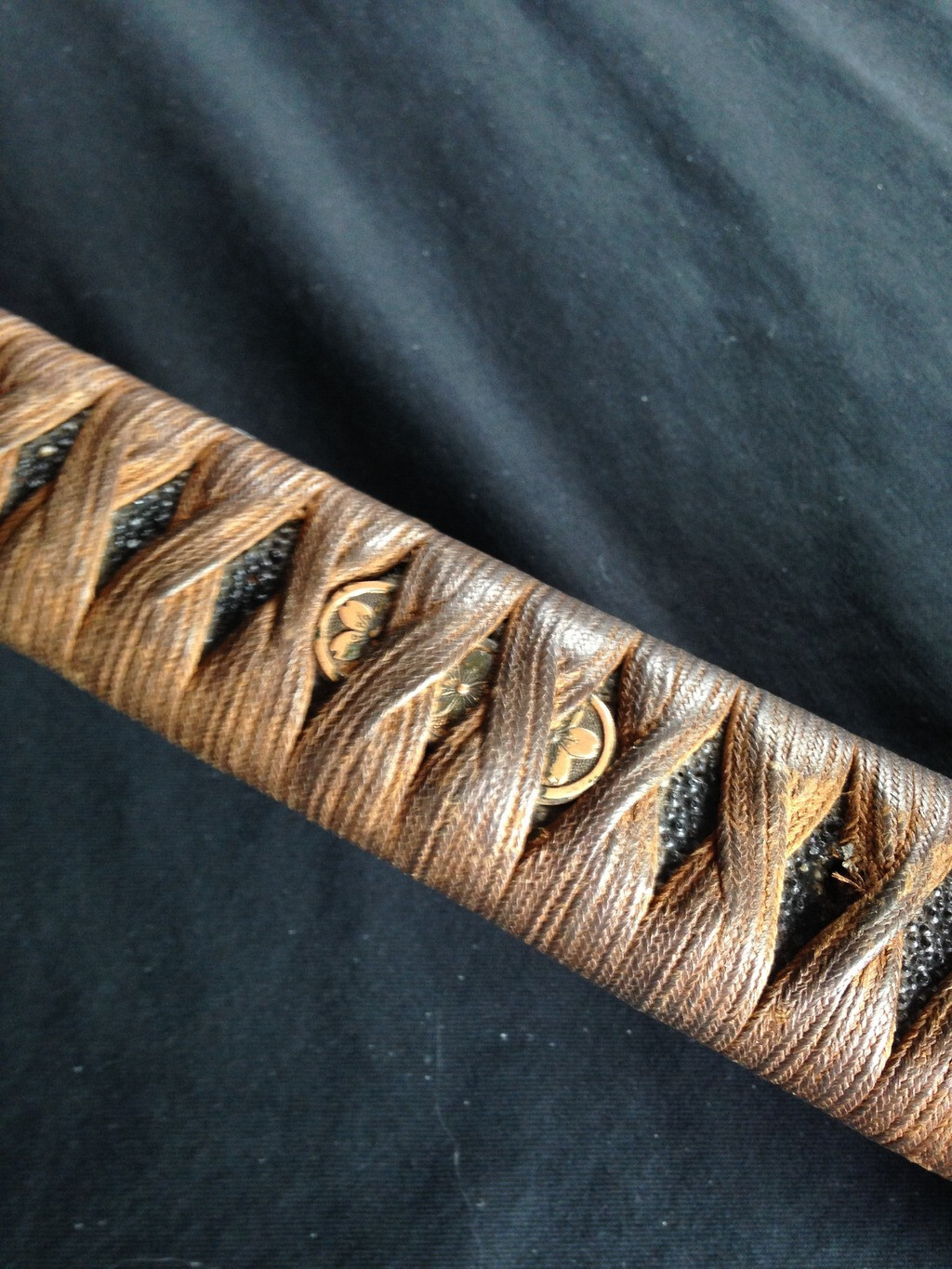
Steve, I think whomever told you the wrap was wrong, likely was thinking of the flat-wrap style normally seen on kaigunto. There are names for the various styles, which I don't know, but the majority of navy wrap is the flat style like this: Yours is folded, but I've seen plenty of kaigunto with the folded style as well. There was plenty of variation in every official gunto type. As to your saya, I would think a repair would be easier than finding another saya to fit your blade. Guys have done it, but it's a real hit-and-miss random experience, as each set of fittings were custom shaped to each blade. All blades varied in every dimension. Want to show us the split you are concerned about? @Dave R has quite a bit of experience with such things.
-
A real nice example on @Chrometank's thread HERE. Like all of these, it has evidence of original wear and tear, then a black repaint, which itself is aged and worn appropriate to a WWII gunto.
-
Thanks Paul! This seems to be the norm. All (dare I say "all"?!) of them look like they've seen wear and tear BEFORE they were painted black. And the black has age and wear of it's own. There's just too many of these, and they all look war-era aged, to be post-war Bubba jobs. Thanks for the photos. I'll link this on the Type 95 Black Saya thread.
-
Looks legit to me. If that saya is black, could we get some closer shots of some of the areas to see if it was original or not?
-
Scratched off mons
Bruce Pennington replied to Ontario_Archaeology's topic in Military Swords of Japan
There was a big discussion on Gunboards about the requirement to deface kiku on guns. The predominant claim is that the US Govt required G.I.s to do it before they would be allowed to bring the rifles home. Quite a few G.I. stories to back that up. If memory serves me, it was part of the Occupational governments' agreement with Japanese officials. Personal mon were not defaming the Emperor, so weren't as big a deal, although, like you say, some were defaced or removed, just as tassels were sometimes removed or cut off.