
Bruce Pennington
-
Posts
14,346 -
Joined
-
Last visited
-
Days Won
171
Content Type
Profiles
Forums
Events
Store
Downloads
Gallery
Everything posted by Bruce Pennington
-

HUGE mune inscription, and mei, Please!
Bruce Pennington replied to Bruce Pennington's topic in Translation Assistance
HUGE I'm tellin' ya!!! Ha! -
DOHHH! Trying to do too many things at once, and forgot that! Thanks Stephen!
-
@SteveM - do I have the "hisamichi" right?

-
Steve, Kaigunto prices are higher than Army because they are more rare, or less common. There's just not as many of them. Plus they are "prettier" than the plain Army gunto. Thanks for the stamp! The large seki stamp was used by the Seki Cutlery Manufacturers' Association to mark good quality blades. It is not know for a fact whether they are only on showato, but I believe that is the case, and higher quality showato at that. You can read more about this in the Stamps of the Japanese Sword document. A good close-up of a section of the blade, showing steel hada (grain) and hamon details might help guys give you a more educated opinion. I'm no nihonto guy, so my opinion on that is not worth anything.
-
HUGE mune inscription, and mei, Please!
Bruce Pennington replied to Bruce Pennington's topic in Translation Assistance
Thanks Uwe! Google searched: "Hachiman is commonly viewed as a Japanese god of war but he’s mostly worshipped as a patron kami of warriors and archery, and not of war itself. The archer kami was initially worshipped near-exclusively by warriors and samurai but his popularity eventually extended to all people in Japan and now he’s also viewed as the patron kami of agriculture and fishing as well." -
HUGE mune inscription, and mei, Please!
Bruce Pennington replied to Bruce Pennington's topic in Translation Assistance
@Okan - any chance of gettting a link to the original sale pages? -
Star stamped Ww2 traditionally forged
Bruce Pennington replied to Pippo's topic in Military Swords of Japan
Ok, that's just not nice! Now we're all going to have to wait to see what you've got! -
Also, would you mind posting a clear picture of the stamp you mentioned?
-
Yes, I love the hamon on it. Even if it's oil quenched, it's still a beauty. Ok.......thanks for bringing up the shark-skin saya. I hadn't noticed that, but was simply seeing the dull sheen of the photos from a distance. After zooming, you are right. So, forget all I've said up to this point about the possibility of it being a post-war souvenir. Nothing about it, with exception of the Army menugi is symptomatic of the Toyokawa souvenir. I've not followed current market prices on kaigunto. Pre-covid, they sold around $2,400 plus or minus. Re-wrapped tsuka are not uncommon, as many gunto came home with some really damaged ito. The only oddity, then is the menugi. I personally wouldn't downgrade a kaigunto much for that, as who knows if it was done post-war or simply late war. It's a pretty piece overall. If you're selling, I'd simply ask market price and see what counter offers come in. Sorry for getting this all confusing with my mistaken souvenir saya impression!
-
A Study: Minatogawa-to
Bruce Pennington replied to Bruce Pennington's topic in Military Swords of Japan
@Michael 67 posted this Masataka on the High Class Gunto thread:


-
Arsenal Mark on RJT sword Fittings
Bruce Pennington replied to george trotter's topic in Military Swords of Japan
Thanks George! The very Matsu 1080 that got me started tracking these and it's my Stamps Doc cover, but I realized I didn't have it on file! -
WHY is it never simple?
Bruce Pennington replied to Brian's topic in General Nihonto Related Discussion
Never seen a skin saya cover like that! Can even seen the hair dimples. Everything about this matches what we are seeing in the island-made swords. Same lower quality steel, with no polish, flat look; typical nakago. Tsuka wrap is unique, and like you said, Brian, could have been a returning G.I./sailor, but it looks like someone was imitating a ratan look fitting of the Philippines or somewhere in SE Asia. -
Pictures, just because ... no agenda.
Bruce Pennington replied to robinalexander's topic in Military Swords of Japan
Quite an interesting collection Rob. Each one different in it's own way. I've done that with mine. I wanted representatives of the main types and some of the major variations. So none of them are look-alikes. -
Bamboo Leaf pattern Tsuba on Gunto with old blade
Bruce Pennington replied to Baka Gaijin's topic in Military Swords of Japan
I have not been noting the blades in these, so I don't have a feel for it. Maybe one of the other guys might. I'll try to watch that from now on. -
That would explain it, though there is clear hand oil stains on the ito. I suppose it could have been done by a shop in the last stages of the war, with limited supplies.
-
Star stamped Ww2 traditionally forged
Bruce Pennington replied to Pippo's topic in Military Swords of Japan
Ahhh SO! You won this at the Lloyds aution! Congrats! I had pics from their sale page, but yours are better and they didn't show the double buttons. And yes, it would be gendaito, or traditionally made. -
Arsenal Mark on RJT sword Fittings
Bruce Pennington replied to george trotter's topic in Military Swords of Japan
George, Forgive me if we've discussed this before (a mind is a terrible thing to waste!), but I don't have photos of the mei and date on this one. Is it possible to get some? Thanks my friend! -
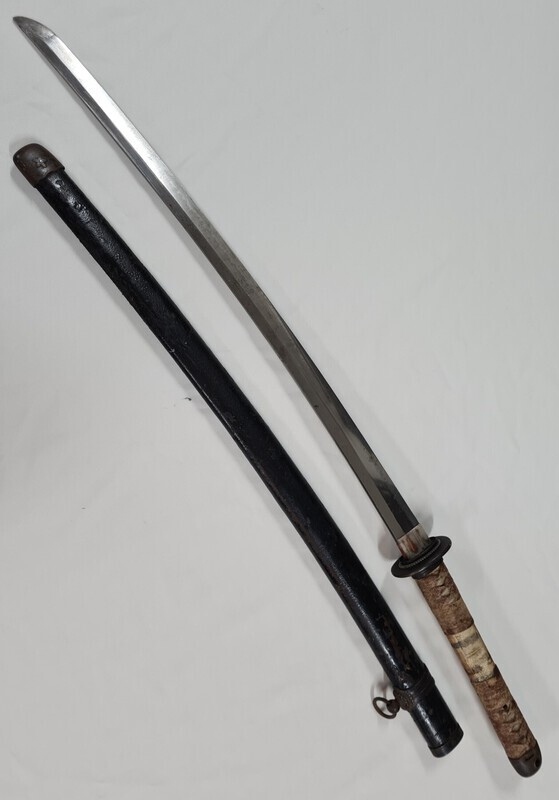
A black painted Rinji saya on a Munetoshi, star-stamped gunto. Posted by @Pippo HERE.
-
Star stamped Ww2 traditionally forged
Bruce Pennington replied to Pippo's topic in Military Swords of Japan
Pippo, Great gunto! Munetoshi was one of the primo sword makers in the RJT program (correct me if I'm exagerating @george trotter). Your fittings are unique with the black painted saya (scabbard). Star-stamped blades often have double latch release buttons, one on the fuchi (handle collar) and one on the saya throat collar. Does yours? Also, many of his blades have stamped numbers on the end of the nakago (tang) or on the back edge of it. Does yours? Also, any date inscription on the other side? Traditionally made blades tend to be more pricey on the market. Normal officer gunto run around $1,400 USD whereas a nihonto or gendaito can go into the $2,400 range or higher. -
Steve, I want to say "Hisamichi" but I'm usually wrong on smith mei! Quite an unusual gunto. 95% of it is kaigunto, but he menugi is Army. The finish on the saya, and dull gold gilding screams Post-war souvenir, but that blade!!! Wow. Cannot see the stamp at the top of the nakago, is it a Tenzoshan anchor or Toyokawa? Tenzoshan Toyokawa I'm wondering if it was very late war kaigunto.
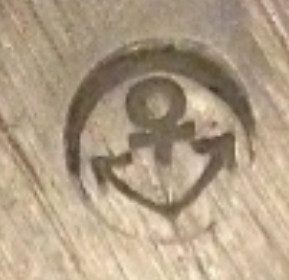
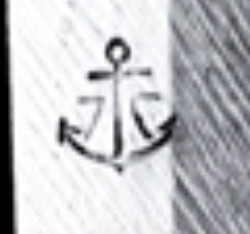
-
Bamboo Leaf pattern Tsuba on Gunto with old blade
Bruce Pennington replied to Baka Gaijin's topic in Military Swords of Japan
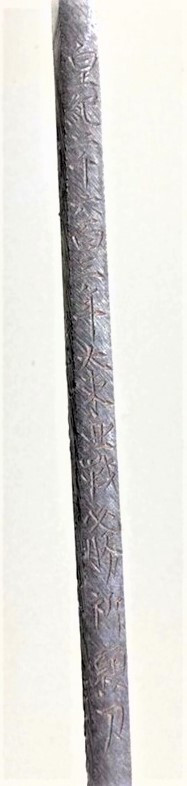
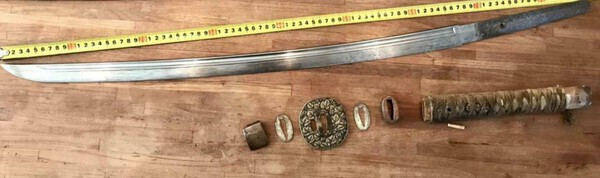
Ok, a new one - a 1943 Kanemitsu blade with a unique kiri engraving and LOOOONG inscription on the nakago mune that says "皇紀二千六百三年大東亜戦必勝祈願刀 – 2603 Imperial year (1943), a prayer sword for victory in the Greater East Asian War" thanks @Nobody! And thanks @Okan who found the gunto.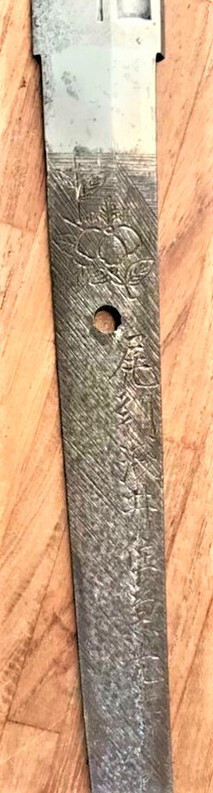
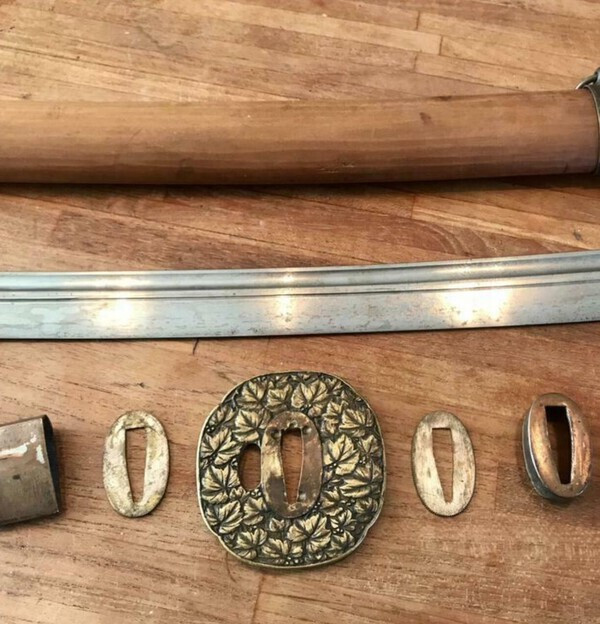

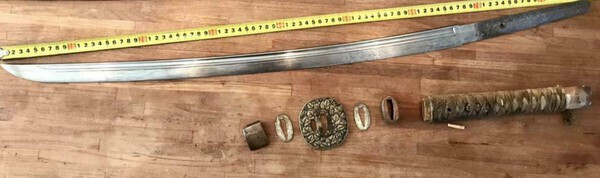
-
HUGE mune inscription, and mei, Please!
Bruce Pennington replied to Bruce Pennington's topic in Translation Assistance
Thanks go to Okan, he found it, but I know what you mean! Looking the kiri (Paulownia flower) in Fuller's book, he said: "Originally used by the Imperial Family but given to senior officers to denote their high rank. Found on naval kyu-gunto and parade sabres of Flag Officer (Admiral) rank, Diplomatic swords of Chokunin grade (appointment personally approved by the Emperor) plus the swords and dirks of Senior Railway Officials, the Imperial Household and Government-General of Korea" I don't know if that is the significance of this kiri, or if the flower held other significance for the Japanese aside from this. -
Thanks to @Okan for bringing this to my attention. Can't say I've ever seen this flower, which in other locations, often represents the holder is on Imperial household staff. But looking for translation of the mei and quite large mune inscription. Thanks guys!
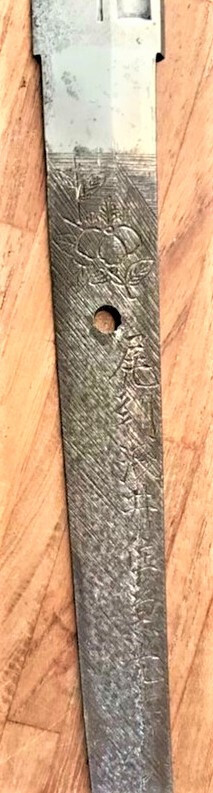
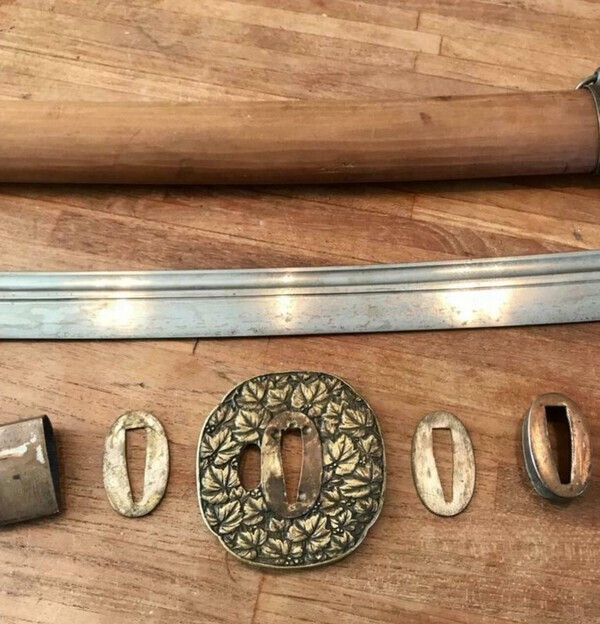
-
Hi Gabriella! I'm a little late to the discussion, and most of what can be said about your sword has been said already. But I'd like to elaborate on a couple of points. "Samurai Sword" is a term often used to label all Japanese swords. You can do some easy reading on the history of the Samurai HERE or other sites, but their official status ended in the late 1800's. I'm weak on the history of blade ownership during the centuries, but there were swords made in Japan as long as there were needs for them. For a period (memory fails me on the years) where only Samurai were allowed to carry swords, but that was not always the case. So there were several blades made over the centuries that were bought by non-Samurai as well. All swords built after 1876 were not made for Samurai, as that became illegal. Japan brought in Western experts and weapons after that, and for a time, Western-styled swords were used. But their weaknesses became evident in the Sino-Japanese and Ruso-Japanese wars. After many requests, the Japanese military opted to revive "Samurai-styled" swords. They had to revive the swordsmith industry to make blades again the old fashioned way. Manufacturing methods changed to meet the huge demand of numbers, but the style was preserved. All these blades were issued and sold to Army and Navy officers and sergeants, most of whom had no lineage whatsoever to the Samurai. It was simply their swords that were made in the fashion of the old Samurai sword. So, a more accurate name for them is simply "Japanese Sword." It looks like the fittings on yours are Navy, making this a "kaigunto" or Navy sword. Are they original to the sword or were they added when the handle was rebuilt? The handle end-cap (kabutogane) is a bit unique in that the hole for the sarute (tassle loop) was never drilled out! Also not common, is the leather covered saya (scabbard) for kaigunto. I own a couple myself, so they're not "rare" but not as commonly seen as the Army versions. You can see what kaigunto looks like and how they differ from Army gunto on Ohumara's site Here and Here.
-
Thanks @SteveM that makes sense, and explains the same kao on the seemingly different names.