Bruce Pennington
-
Posts
14,097 -
Joined
-
Last visited
-
Days Won
169
Content Type
Profiles
Forums
Events
Store
Downloads
Gallery
Everything posted by Bruce Pennington
-
-

-

-
-
-

-
-
"vonStubben" over at this Wehrmacht-awards Thread - Aerial bombing of the US West Coast started a conversation about this event. Quite interesting. There is a good 6 min video of the story by one of the news outlets here:
-
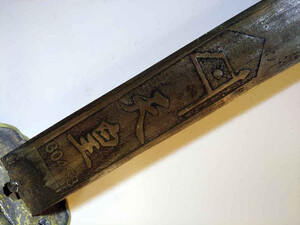
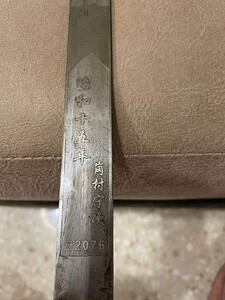
My google translate of that second page calls him "Shigeije" so bad translation, but they say he's the Mantetsu guy ...... which would be Shigetsugu?! "Shigeji Aizu Sumi Wakabayashi is an Army swordsmith. According to Akira Tsutsumi's "Guntō Union Disposition" (subtitle, Around the Army Ordered Swordsmith, published by the Aizu Cultural Research Study Group in 1994), Shigeji Wakabayashi (real name Inoyoshi Wakabayashi), who was a swordsmith in Aizu, Fukushima Prefecture, is a mantetsu. It seems that he was involved in the production of swords from the early days, and it is written that he returned to Aizu in the spring of 1941 and then produced swords as an army swordsmith. Although there are only two flaws in this work, it is an excellent work with a dignified appearance by Shigeji Aizu Sumi Wakabayashi, who was involved in the Mantetsu sword (Koa Isshin sword) and was a swordsmith of the Army. Passed the preservation in the examination in September 2021." Need some Sherlock Holmes work @mecox
-
Initial search on Wikipedia Page: "The Rising Sun Flag (旭日旗, Kyokujitsu-ki) is a Japanese flag that consists of a red disc and sixteen red rays emanating from the disc.[1] Like the Japanese national flag, the Rising Sun Flag symbolizes the sun. The flag was originally used by feudal warlords in Japan during the Edo period (1603–1868 CE).[2] On May 15, 1870, as a policy of the Meiji government, it was adopted as the war flag of the Imperial Japanese Army, and on October 7, 1889, it was adopted as the naval ensign of the Imperial Japanese Navy.[3]" "The flag of Japan and the symbolism of the rising Sun has held symbolic meaning in Japan since the Asuka period (538–710 CE). The Japanese archipelago is east of the Asian mainland, and is thus where the Sun "rises". In 607 CE, an official correspondence that began with "from the Emperor of the rising sun" was sent to Chinese Emperor Yang of Sui.[8] Japan is often referred to as "the land of the rising sun".[9] In the 12th century work The Tale of the Heike, it was written that different samurai carried drawings of the Sun on their fans.[10] The Japanese word for Japan is 日本, which is pronounced 'Nihon' or 'Nippon', and literally means "the origin of the sun". The character nichi (日) means "sun" or "day"; hon (本) means "base" or "origin".[11] The compound therefore means "origin of the sun" and is the source of the popular Western epithet "Land of the Rising Sun".[12] The red disc symbolizes the Sun and the red lines are light rays shining from the rising sun." "The Rising Sun Flag was historically used by the daimyō (大名) and Japan's military, particularly the Imperial Japanese Army and the Imperial Japanese Navy. The ensign, known in Japanese as the Jyūrokujō-Kyokujitsu-ki (十六条旭日旗), was first adopted as the war flag on May 15, 1870, and was used until the end of World War II in 1945. It was re-adopted on June 30, 1954, and is now used by the Japan Maritime Self-Defense Force (JMSDF). The Japan Self-Defense Forces (JSDF) and Japan Ground Self-Defense Force (JGSDF) use a variation of the Rising Sun Flag with red, white and gold colors.[20]" Haven't seen anything yet about sword use.
-
I wasn't going to chime in because I know almost nothing about sword before WWII. I have seen the war kabutogane styles on old samurai swords, so I expect the military fashioned much of their fittings after popular samurai styles. Can't say I've seen the navy tsuba/seppa style on anything before the war though.
-
Back in 2011, K. Morita-san said it was Shigetsugu:

-
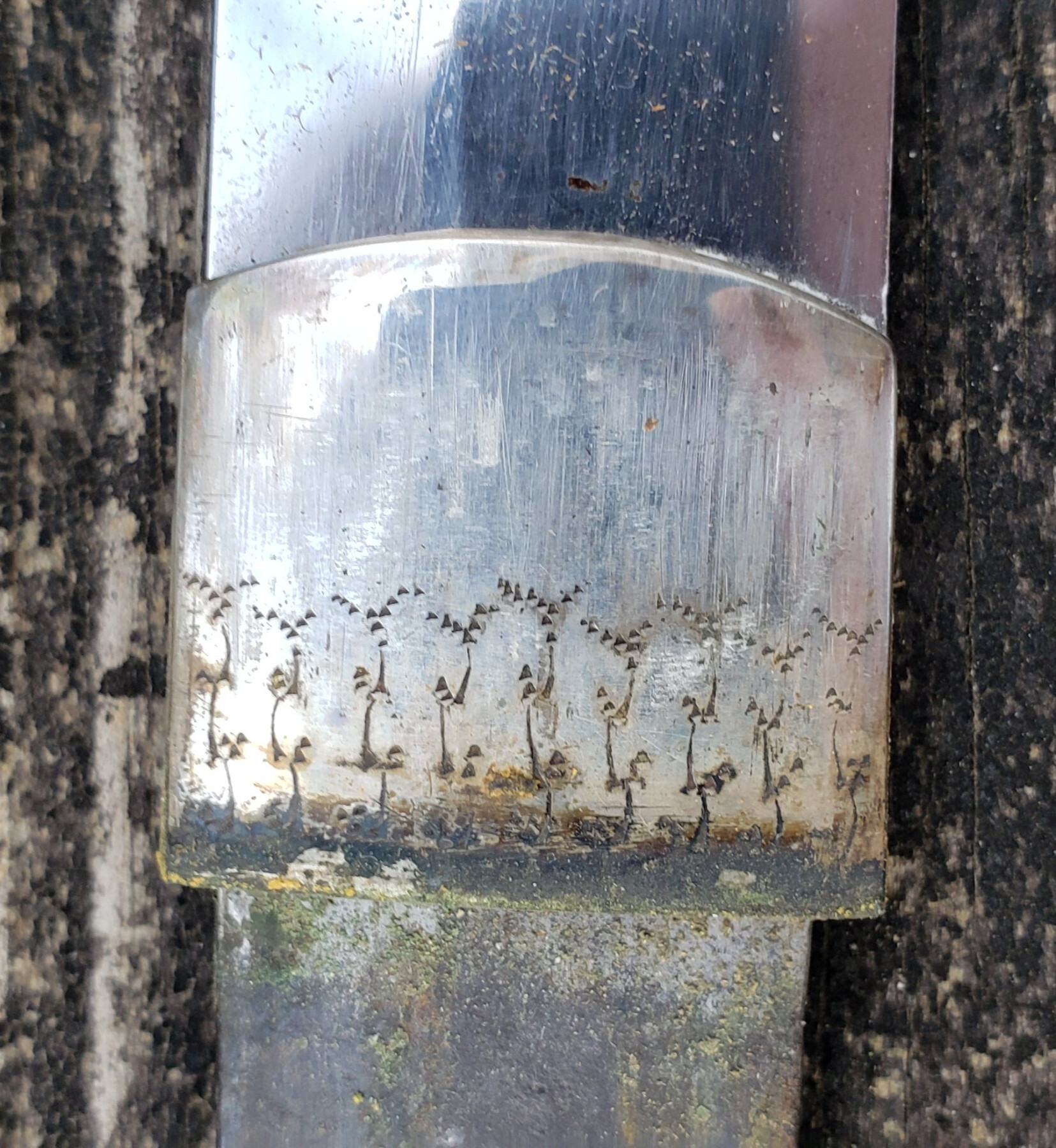
Here's one of simple skill/art, but effective. Tropical trees? Found HERE.

-
Interesting! Obviously intentional wrapping around of the waves to touch, making a boar's eye? Anyone know the significance of the boar's eye (looks like a heart shape) on swords?
-
Thanks Steve! Wish I had filed the previous photos of the exact same thing. I assumed Bubba did the first one, but after seeing yours, I'm thinking it was done by the original owners. While it is certainly possible the same Bubba got a-hold of both of them and did this, or 2 different Bubbas in different parts of the world having the same idea, is possible, the odds are greatly against it. The personalization of gunto was far more common than the Regulations perfectionists would like to believe!
-

Can I get some help to identify these stamps
Bruce Pennington replied to Oliver's topic in Translation Assistance
Wow, quite a flashy tsuba for a militarized sword! Thanks for sharing! They rewrapped the tsuka with army ito and menugi, kept the other civil parts, and fitted a leather covered wooden saya. -
Kai Gunto saya types compared
Bruce Pennington replied to Kolekt-To's topic in Military Swords of Japan
Geoff, I don't know the real answer to that. Maybe someone who studies koshirae, like @PNSSHOGUN, or someone who collects kaigunto has more of a feel for that. I know that late-war gunto, both army and navy, were being mounted in the black-lacquered wood with leather cover. Earlier mounts were more of a mixture of every combination. -
Kai Gunto saya types compared
Bruce Pennington replied to Kolekt-To's topic in Military Swords of Japan
Tony, Yours looks a lot like one of mine. Same worn look to the skin saya cover, same loss of gold-gilding. And my has a Muromachi era blade. Interesting!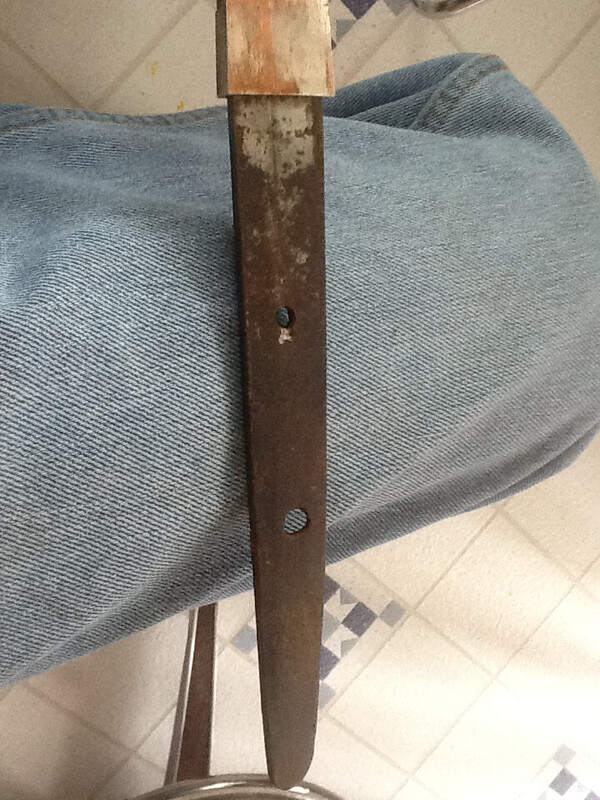


-
Kai Gunto saya types compared
Bruce Pennington replied to Kolekt-To's topic in Military Swords of Japan
I have not studied the kaigunto in depth, but in my casual exposure to the type, the single haikan (ashi) starts appearing toward the end of the war, so "older" simply means earlier in the war. The uniform regs were changed in the last year of the war to allow for single haikan and looser specifications to detail. Even non-guilded fittings were specified. I have seen pierced tsuba for a leather retention strap, but it is uncommon in my memory. -
Attention Mantetsu Owners: A Survey
Bruce Pennington replied to Bruce Pennington's topic in Military Swords of Japan
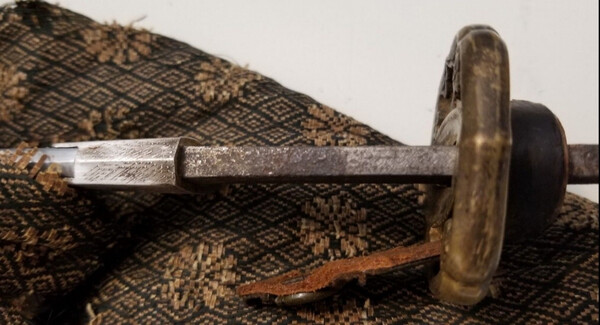
Yes, I saw that one on ebay a year ago. I have it on file as a "possible fake" because I'm not comfortable with some of the writing, and the lack of number. There are a few wavy blades on file, but they all have numbers. Could this one have been a custom order? If so, it might explain the more stylish writing. That's why I haven't totally ruled it out of the survey files. Here is the photo of the shirasaya: I also have a '39 Koa that was cut down to a waki with no number. So, this one could be legit, and a custom order, maybe. Here's the waki:

.thumb.jpg.d93980e56b51407b79700e68259730c9.jpg)
-
My First bargain of the year Star stamp Niwa Kanehisa
Bruce Pennington replied to vfc's topic in Nihonto
Chris, it's not common, but my '45 Kunitoshi is in the same fittings as this. That's why I was asking if it had the double release buttons. Here's mine:
-
I've always thought the slow photo loading was normal!!! Pictures are always delayed and slow, it seems.
-
My First bargain of the year Star stamp Niwa Kanehisa
Bruce Pennington replied to vfc's topic in Nihonto
And this is one of them. Vittorio, Many owners are quite proud to own a star-stamped blade in beat-up condition, scratched, used, and abused in the field. Yours is in far better condition that any of that. Don't be bothered by the opinions of the polish. It is still quite beautiful. A star-stamped RJT blades is Nihonto. And this is a nice one. -
Japanese swords in Indonesia.
Bruce Pennington replied to saemonjonosuke's topic in Military Swords of Japan
Well, after another look, Stephen, I think you're right. I can see a faint pattern on the tsuba, and what I thought was the fuchi sunken into a large hole (funnel), is really the center of the tsuba, with the fuchi above it. -
Kai Gunto saya types compared
Bruce Pennington replied to Kolekt-To's topic in Military Swords of Japan
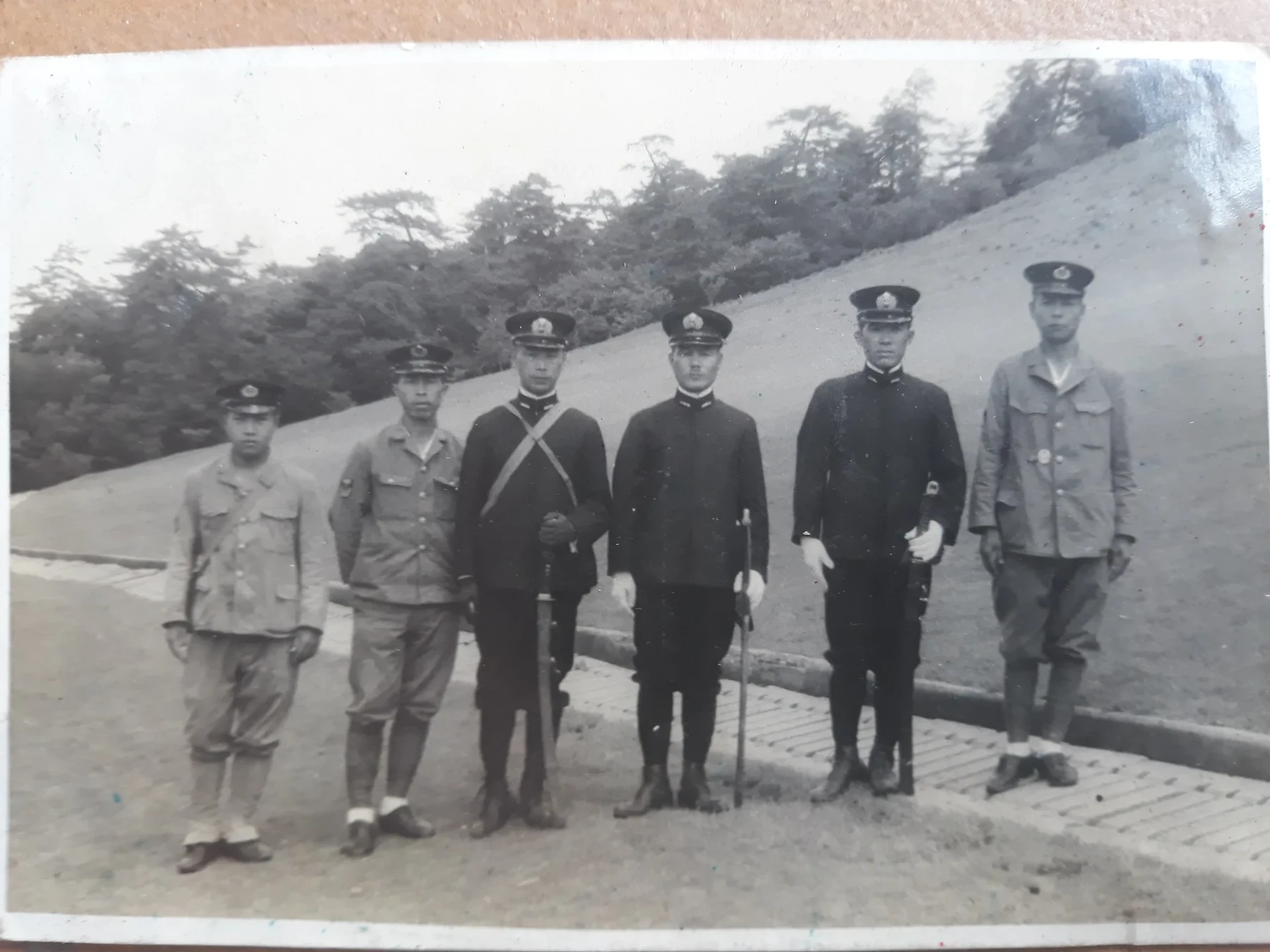
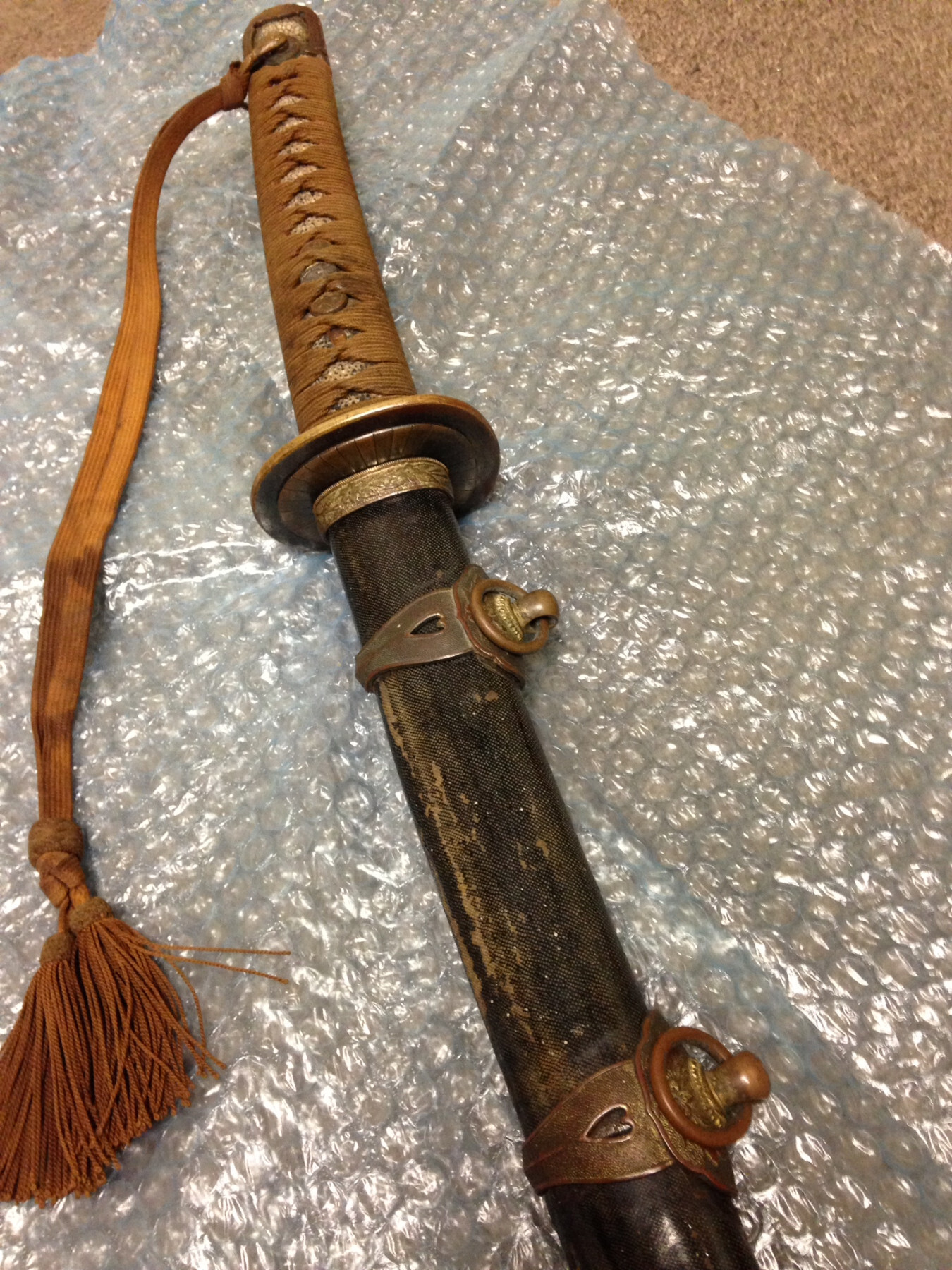
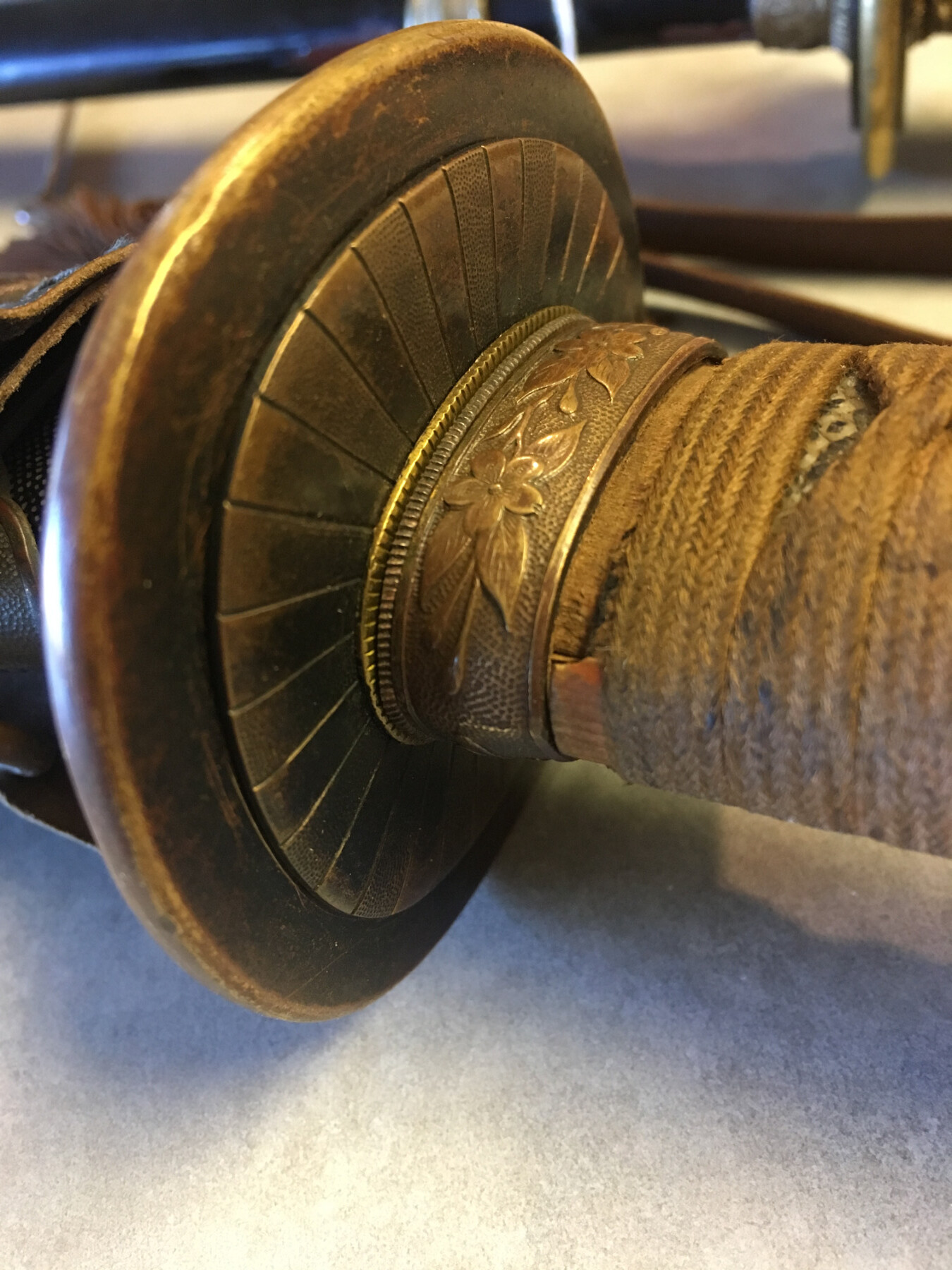
Can't find a thread dedicated to talking specifically about kaigunto fittings, so if @Kolekt-To doesn't mind, I'll start using this one a general reference thread for the topic. I know Nick Komiya made a post showing the leather saya covers for kaigunto were to be black or blackened, but I don't have that reference. If any Truly Gifted searchers, @Kiipu comes to mind, could dig that out and post here, I'd appreciate it. Otherwise, I can spend the next several years digging it out, and I'll update here! I mention this because I just came across this photo showing some kaigunto, a couple of them leather covered. One is dark, as expected, the other looks to be natural leather color. I appreciate this photo because I have a Navy takayama-to with a brown leather cover. It's always bothered me, as I've wondered if it were original or post-war made. This photo shows that the natural colored covers were in use by navy officers.






.jpg.e894b7f3c31d7ac3e00cb858da11d118.jpg)