Bruce Pennington
-
Posts
14,363 -
Joined
-
Last visited
-
Days Won
171
Content Type
Profiles
Forums
Events
Store
Downloads
Gallery
Everything posted by Bruce Pennington
-
A real nice example on @Chrometank's thread HERE. Like all of these, it has evidence of original wear and tear, then a black repaint, which itself is aged and worn appropriate to a WWII gunto.
-
Thanks Paul! This seems to be the norm. All (dare I say "all"?!) of them look like they've seen wear and tear BEFORE they were painted black. And the black has age and wear of it's own. There's just too many of these, and they all look war-era aged, to be post-war Bubba jobs. Thanks for the photos. I'll link this on the Type 95 Black Saya thread.
-
Looks legit to me. If that saya is black, could we get some closer shots of some of the areas to see if it was original or not?
-

Scratched off mons
Bruce Pennington replied to Ontario_Archaeology's topic in Military Swords of Japan
There was a big discussion on Gunboards about the requirement to deface kiku on guns. The predominant claim is that the US Govt required G.I.s to do it before they would be allowed to bring the rifles home. Quite a few G.I. stories to back that up. If memory serves me, it was part of the Occupational governments' agreement with Japanese officials. Personal mon were not defaming the Emperor, so weren't as big a deal, although, like you say, some were defaced or removed, just as tassels were sometimes removed or cut off. -
Arsenal Mark on RJT sword Fittings
Bruce Pennington replied to george trotter's topic in Military Swords of Japan
I used to have 1 blade dated 1942, but after doing some QualityControl, I have had to correct that one to "No Date". So I have 2 blades in May of '42 - the one Thomas listed and this one: 1943, May Niigata Munetoshi (RJT) 松 1080 RS star イ403 on fittings Trotter Collection, -
Arsenal Mark on RJT sword Fittings
Bruce Pennington replied to george trotter's topic in Military Swords of Japan
That's a beauty Trystan! I have only 1 other Kanetomo on file, a 1945, and it's a "Seki ..." also. So, looking in Sesko's list, he has 2 WWII Kanetomo listed. Oddly, the Gifu (Seki) one, Miwa Kanetomo, he doesn't have described as an RJT smith, while he does mention that for the Gunma smith. Both are on the RJT list at Japaneseswordindex.com however. -
Attention Mantetsu Owners: A Survey
Bruce Pennington replied to Bruce Pennington's topic in Military Swords of Japan
Incredible! @PNSSHOGUN - ever see a metal drag on a leather cover? -
Not sure where to post this @Stegel @Shamsy @BANGBANGSAN @Kiipu (and anyone else interested!). I've seen the extra numbers on copper 95s, but this one has a katakana in front:

-
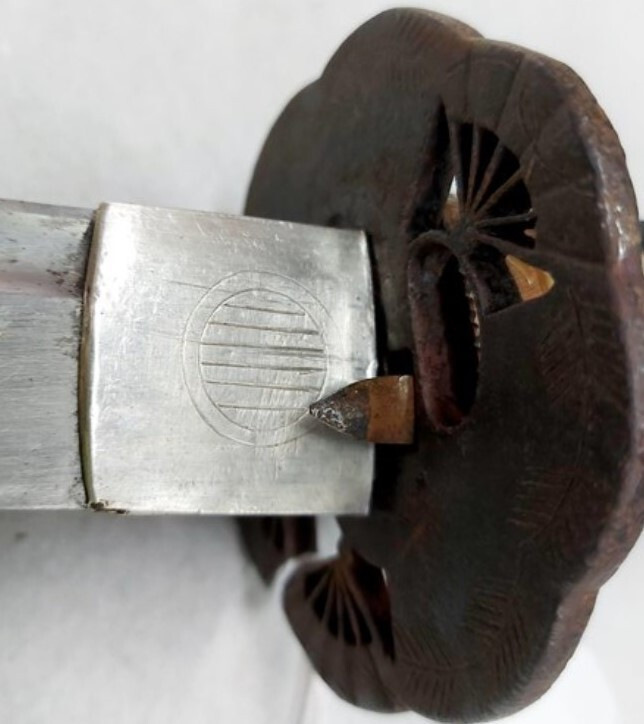
Wonder who, if it was a single craftsman or just a number of them, was etching mon into silver habaki (aluminum?). They seem to have all the right lines, but no inner detail to make the art stand out. This one, for example is the 3-bar in circle mon, but without some sort of texturing, either of the bars or of the spaces, it only looks like 6 lines.

-
A Type 95 at that big Lloyds action:

-
I haven't observed the holes to see if they vary in size. I've seen several. Here's mine:

-
Just to add drama to the "black-painted saya" story - a Type 19 on that big Lloyds auction, with an unknown shop stamp:


-
Mei and Date on this one Please!
Bruce Pennington replied to Bruce Pennington's topic in Translation Assistance
Thanks Steve! Pretty wild writing of that 6! -
Rob, The blade was made in WWII, 1943. The saya (scabbard) and fuchi (handle end by tsuba/handguard) are army. So It was made for the war. The tsuka (handle) could have been changed by any number of people. Your theory about the Philippines could explain it. The sword could have been taken by Filipino combatants and refitted. I have heard stories of these war blades being used by farmers after the war. The most common reason is a refitting by collectors well after the war. So, no way to know. As to the smith, Trystan my have the exact name, or the corrosion on the writing may be obscuring small details that would give a different name. Either way, with the condition of the blade, it will be pretty impossible to tell you whether this was a traditionally made blade or not. Odds are, it was not, as the massive majority of blades made for the war were oil-quenched which takes them out of the "traditional" classification regardless of how the blade was crafted. But that's just the odds, it could be either. My reaction to seeing a good nakago (tang) with Japanese writing was because there were a good many blades made in occupied lands, which were lower quality work, or worse, there are many fake/imitation blades on the market with pieced-together fittings. So, I was simply glad to see you had a legit Japanese blade in there.
-
Wow, nice turn of events.
-
Yeah, agree! Quite creative.
-
Normally I can get the date side, but this one's got me stumped! Thanks in advance!


-
Thanks guys! Tony, no, just hunting for stamped gunto for the files!
-
Agreed
-
Kenny, Could I get a full-length nakago shot of the date side too?
-
@Stegel @Shamsy First variation of the wooden handled Type 95. Likely made around 1944, but Stegel and Shamsy could narrow that down more accurately. Small Seki inspector stamp by the number of the Nagoya Army Arsenal. Nice one.
-
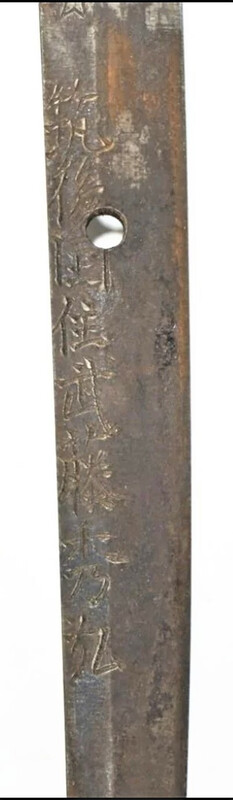
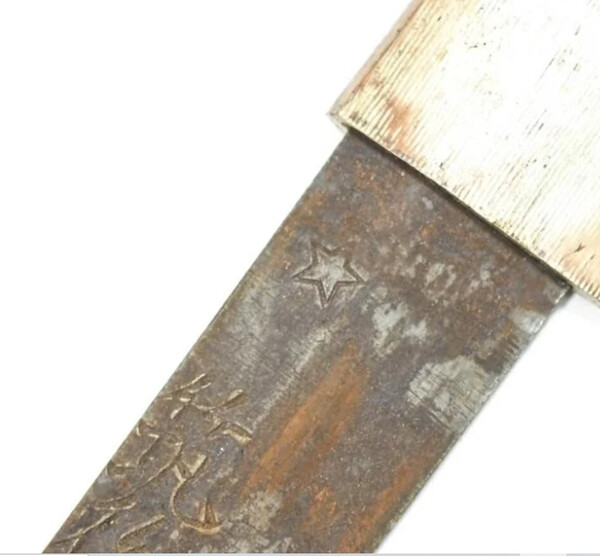
A 1942 star-stamped blade. Can I get a translation please?


-
type 19 kyu gunto dress swords, i love them.
Bruce Pennington replied to lonely panet's topic in Military Swords of Japan
Thanks for the stamp @Jason b, that's a new unknown shop logo. @lonely panet will be your best source as to authenticity. -
Dang, you're right! Thought it looked familiar! Just haven't seen one this clearly before. Fuller says the literal translation is "to forge" or "forged" and is a scarce stamp. I recall reading somewhere that it came out before the Showa/Seki stamps and is an indication of a quality, traditional blade. Thanks Steve!
-
Arsenal Mark on RJT sword Fittings
Bruce Pennington replied to george trotter's topic in Military Swords of Japan
@george trotter - found another Munetoshi with a "TA" number, but I can't make out that last number. TA 124? I have a 1943 Akimitsu with TA 1246. I WANT to say the last digit is a Japanese 7 "七". What do you think?