Bruce Pennington
-
Posts
14,222 -
Joined
-
Last visited
-
Days Won
169
Content Type
Profiles
Forums
Events
Store
Downloads
Gallery
Everything posted by Bruce Pennington
-

Can I get some help to identify these stamps
Bruce Pennington replied to Oliver's topic in Translation Assistance
Hi Oliver! One of the translation magicians will give you a full breakdown of the mei (signature). I'm jumping in to ask for a couple of shots of the full "naked" blade, and pics of the fittings. From the edges of a couple of these it looks like you've got one of the fairly rare canvas-covered scabbards. -
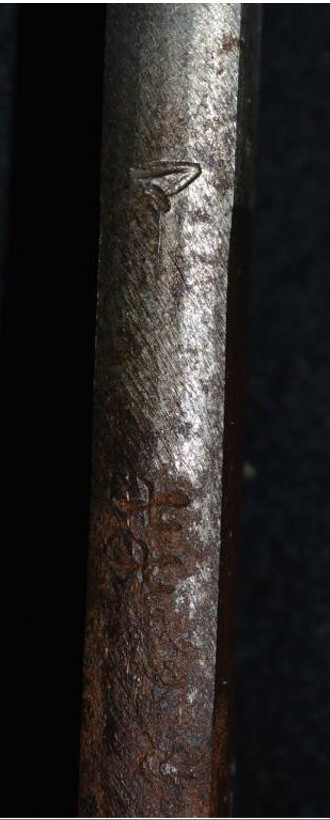
This mark is the strangest thing. It almost looks like the original nakago had been cut off, and another added. Yet if so, it was done before the kiku and mei. The kiku is right one line on the other side.

-
Mark, Can you tell if the saya was intentionally darkened? or is that just age/oxidation?
-
swords opinion request 4
Bruce Pennington replied to sencho's topic in General Nihonto Related Discussion
The offset machi is typical for Chinese work. It's normal on NCO 95s, but not officer swords. Even the island swords get that one right. So, COULD be an island made sword, but I'd lean toward Chinese. -
Just for clarification, I’m going to boil the linseed oil first and then mix it with the white spirits? Never mind! I found it, it’s called “boiled linseed oil”.
-
Not something you see every day.
Bruce Pennington replied to Stephen's topic in Military Swords of Japan
Here's one from an old post - Inherited Sword - owned by @wgt63 -
Ok, last one and I'll stop, but I found one with the same mei. I'm studying the chrysanthemums and it's amazing how many nobuyoshi blades are on NMB.

-
Repaired/wrapped Saya - wartime or post-war?
Bruce Pennington replied to Kolekt-To's topic in Military Swords of Japan
The collecting world has a name for the string-wrapping, braiding, thing G.I.s and sailors did onboard the ship, lots of time on their hands. A few examples on NMB of it. There were many white, cloth wrapped tsuka done by the Japanese. Can't say I've seen examples of them doing the saya. But remember - "Never say never, nor always, with gunto". -
Attention Mantetsu Owners: A Survey
Bruce Pennington replied to Bruce Pennington's topic in Military Swords of Japan
Mantetsu Sword Serial Numbers (4.2) A I U E O KA KI KU KE KO SA Shi SU SE SO TA CHI TSU TE TO NA NI NU NE NO HA HI FU HE HO MA MI MU ME MO YA YI YU YE YO RA RI RU RE RO WA WI WU WE WO Alpha Numeric Missing Kanji 1937 1938 C 17-S C 30-S H 14-A H 20-A M 61-A N 1-W N 71-W N 156-W N 182-W N 205-W N 206-W N 356-W N 377-W N 403-W N 408-W Unkn-S 1939 I 376-S I 466-S NI 57-A NI 190-A NI 679-W HA 24-A HO 123-W HO 125-W RO 75-S RO 270-S N 423-S N 574-S V 18-S V 33-S W 23- S W 38-S ? 122-W NoNmr-S NoNmr-W 1940 CHI 61-S CHI 66-S CHI 104-S CHI 128-S CHI 356-S CHI 801-? to 41-S to 374-S to 450-S to 562-S to 630-S to 729-S NU 182-S NU 2XX-S NU 389-S NU 407-S NU 503-A NU 608-A NU 65?-A HO 546-S RI108-S RI 110-S RI 328-S RI 404-S RI 415-S RI 488-S RI 560-S RU 16-A RU 163-A RU 199-A WA 20-S WA 33-A (waki) WA 73-A (waki) WA1840A Wo 433-S ? 57-A 1941 KA 89-S KA 228-S KA 232-S KA 236-S KA 238-S KA 275-S KA 353-S KA 405-S SO 66-S SO 185-S SO 482-S SO 564-S TA 181-S TA 287-S TA 298-S TA 277-S TA 305-S TA 313-S TA 336-S TSU 198-S TSU 254-S TSU 573-S TSU 575-S TSU 651-S NA 5-S NA 124-S NA 184-S NA 232-S NA 354-S NA 377-S NA 484-S NE 2-S NE 144-S NE 347-S NE 384-S NE 396-S NE 401-S NE 414-S YO 11 YO 57-S YO 122-S YO 150-S YO 234 YO 349-S YO 350-S YO 352-S RE 6-S RE 153-S RE 193-S RE 413-S RE 476-S WA 6 -S WA 134-S WA 158-S WA 238-S WA 638-S ? 218 1942 U 20-S U 70-S U 99-S U 255-S U 357-S U 414-S U 481-S U 593-S U 1593-S Ku 327-A Ku 471-A Ku 466-A Ku 878-A Ku 897-A Ku1020a Ku1087a Ku1226a NO 34-S NO 273-S NO 430-S NO 493-S NO 533-S Mu 87-S Mu 89-S Mu555-S Mu595-S Mu637-S Mu705-S Ma 77-A Ma 78-A YA 72-A YA 79-A YA 201-A YA 246-W YA 350-A YA 417-A YA 475-A YA 505-A YA 622-A YA 623-A YA 736-A YA 957-A YA1048-A RA 7(?)-S RA 341-S RA 820-S RA 823-S RA 934-S RA 984-S RA1030-S RA1071-S RA1196-S RA 1256-S RA 1333-S RA 1356-S ? 26-S ? 345-S ? 744-S 1943 A 17-S A 65-S A 105-S E 537-S KI 122-S KI 144-S KI 347-S KI 536-S KE 731-S KE 583-S KE 805-S KO 115-S SA 1-S SA 52-S SA 361-S SA 459-S SA 520-S Shi 304-S TE 71-S TE 224-S TE 284-S TE 305-S TE 337-S TE 486-S TE 567-S TE 595-S TE 699-S TE 801-S TE 835-S HI 22-S HI 41-S HI 153-S HI 226-S HI 591-S FU 48-S FU 106-S FU 624-S FU 757-S FU 758-S FU 795-S FU1008-S FU1272-S FU 960-S FU 1196 FU 1385-S Ma360-S Ma373-S Ma374-S Ma381-S Ma538-S MI 206-S MI 288-S MI 505-S ME 19-S ME 87-S YU 115-S YU 209-S YU 367-S YU 432-S YU 479-S YU 543-S WE 299-S WE 494-S ? 76 ?276 ? 330-S ?361 ?624-S KA 242-S A 601-S 1944 (I) 526-S (I)1644-S SU 10-S SU 18-S SU 219-S SU 273-S SE 1029-S SE 1066-S SE 1143-S SE 1225-S SE 1251-S SE 1293-S SE 1310-S SE 2409-S SE 2430-S SE 2575-S SE 2596-S SE 2767-S HI 1155-S Mo104-S Mo228-S Mo799-S ? 45 ?199 SU 615-S 1945 I 28 i 67-S i 90-S I 142 i 213-S i 289-S i 449-S i 622-S i 1170 Unkn year CHI 475 FU 594 MA 313 YA 72 RA 296 · Note: ALL CAPS – KATAKANA; lower case – hiragana. · The seasons are abbreviated as indicated below. -S Spring -R Summer -A Autumn -W Winter 春 haru Spring 夏 natsu Summer 秋 aki Autumn 冬 fuyu Winter -
Kai Gunto issued by IJN?
Bruce Pennington replied to BANGBANGSAN's topic in Military Swords of Japan
Still might get some clarification from Nick on the meaning of the charted rows. -
Kai Gunto issued by IJN?
Bruce Pennington replied to BANGBANGSAN's topic in Military Swords of Japan
Ok, I think I'm getting a more clear picture of your question. I thought you were saying that there was a kaigunto listed on the documents as both privately owned and government property. I cannot read the page, so I'm going by your description. Are you saying there is a row for privately owned, and a row for government property, and there are numbers of kaigunto in the "government property" row? If so, I'm betting they are classifying arsenal stamped blades, like the one you posted, as "government" blades and ancestral, civil, swords as "privately owned." Sounds like whomever made the chart didn't really know how it worked for officer gunto. -
Attention Mantetsu Owners: A Survey
Bruce Pennington replied to Bruce Pennington's topic in Military Swords of Japan
Thanks Trystan! I actually have it's "sister" Ma 77 on file:


-
Kai Gunto issued by IJN?
Bruce Pennington replied to BANGBANGSAN's topic in Military Swords of Japan
You might try running this by Nick Komiya. He's the one that uncovered the Army's reg that permitted private purchase of Type 95s. Maybe you'll tickle his curiosity and get him to do some more digging. On the face of it, I have never heard of "government property" officer swords of either Army or Navy. There were arsenal-made gunto in both services, so could this possibly be referring to a gunto bought directly from the arsenal, rather than from the officers club? -
You're killin' me @Kolekt-To Geoff!
-
Here's a comparison of a few other Nobuyoshi with kiku. You'll see the kiku varies with each one, so that isn't a good gauge to go by. Guys who study smith mei might have a better way to tell if it's legit.


-
That's really cool, Bruno, thanks for posting it! I've never seen a reg on what was allowed for the civil blades refitted for service. The vast variety of combinations lends me to believe there wasn't a set standard, though. Fuller's book shows some creative home-made fittings on various gunto, this would be a nice addition to his section! A great many we see on the market still have the leather cover, so it is possible there were some with the slots, but simply covered up.
-
Need translation help for this sword
Bruce Pennington replied to MarkCB's topic in Translation Assistance
You've got quite a fan club there in Fremantle if you see this often, and rightfully so! -
Unusual double lock Type 94/98
Bruce Pennington replied to PNSSHOGUN's topic in Military Swords of Japan
Added a shot of the koiguchi. That's a first for me, too. Clearly a custom gunto.
- 1 reply
-
- 1
-

-
@sechan Steve, Could I get a clear, closer shot of that red paint in the haikan (belt loop). I've seen 1 or 2 like this lately, and it's starting to look like a popular wartime modification.
-
An RS gunto, mumei … for George T
Bruce Pennington replied to paulatim's topic in Military Swords of Japan
Linking the newest one to the discussion. Not 100% conclusive that this one was in RS fittings. I has a shirasaya tsuka an RS fuchi. So, both pieces could have been added post-war. But it is possible the fuchi was original. -
Need translation help for this sword
Bruce Pennington replied to MarkCB's topic in Translation Assistance
Ok, now that I see the whole thing, I agree with the other guys. This is older, then re-mounted for the war, hence the second hole in the nakago. @george trotter -
Need translation help for this sword
Bruce Pennington replied to MarkCB's topic in Translation Assistance
I don’t think Steve is saying your blade is 500 years old. What he is saying is that it could be that old, or it could be from World War II. But without seeing the pictures that he described it is impossible to tell. There were many ancestral blades donated to the war effort, and they were fitted out in military fittings. I personally don’t think your blade is older than World War II, because until recently, when we have just found one, we have never seen ancestral blades in the RS fittings. Now, after having just seen one recently, it is certainly possible. So I wouldn’t rule either option out. The best thing is to get good clear photos like Steve described. -
WWII Gunto From Grandfather
Bruce Pennington replied to Seattle Guy's topic in Translation Assistance
I have 2 other Masayuki on file, identical mei. Chris, the small stamp above the mei is the "Showa" stamp. Some believe it to be an Army acceptance stamp, or it may the approval stamp of the Seki Cutlery Manunfacturers' Association. There were some poor quality blades being made in the late '30s to early '40s because of a huge sword shortage. The Seki sword dealers approached the association and asked them to inspect and approve blades to insure quality. I believe the Showa stamp was the first one used by them. If there is no date on the other side of the nakago (tang), then we can't know the year it was made. It's possible it was made between 1935 and 1942, as the dating of war blades increased greatly in '42 when the Army assumed control of blade production, but undated blades were still seen throughout the length of the war. -
Need translation help for this sword
Bruce Pennington replied to MarkCB's topic in Translation Assistance
Marcus Sesko lists 3 "Masanao" smiths working WWII. This one was from the Aichi prefecture where the city of Nagahama was, so it's likely the one: " MASANAO (正尚), Shōwa (昭和, 1926-1989), Aichi – “Murakami Masanao” (村上正尚), “Masanao” (正尚), adopted son of Hayama Enshin (羽山円真)
-
Correct. And the 江 is the Matsue Supervisory Unit inspector of Kokura Army Arsenal.