
Leaderboard



Popular Content
Showing content with the highest reputation on 01/09/2026 in all areas
-
Quite entertaining, especially for novices who don't know much about Nihonto.6 points
-
Pointless giving it to any museum. They are not scarce enough to be unavailable if they want one, and most museums let items rot in the store room. That's the best way to make sure an item isn't appreciated. You'd be better off keeping it, or selling to a collector where it would be appreciated and preserved.6 points
-
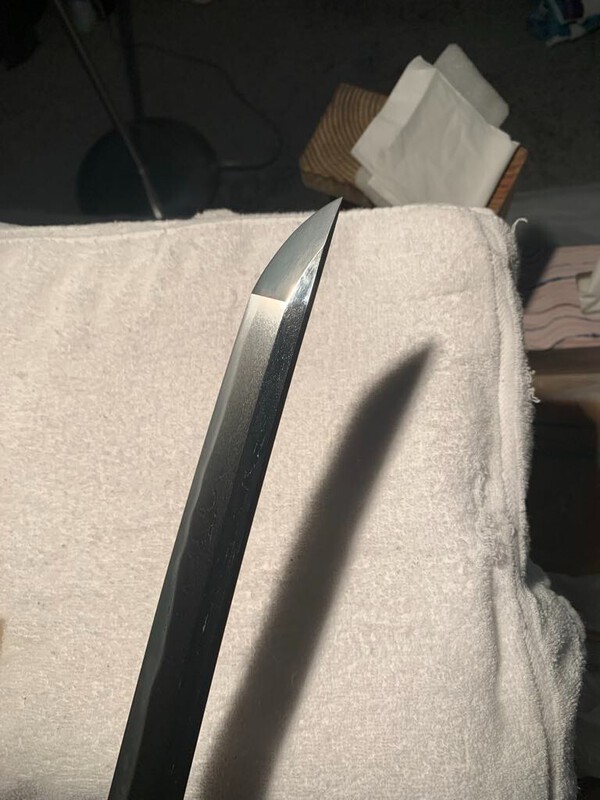
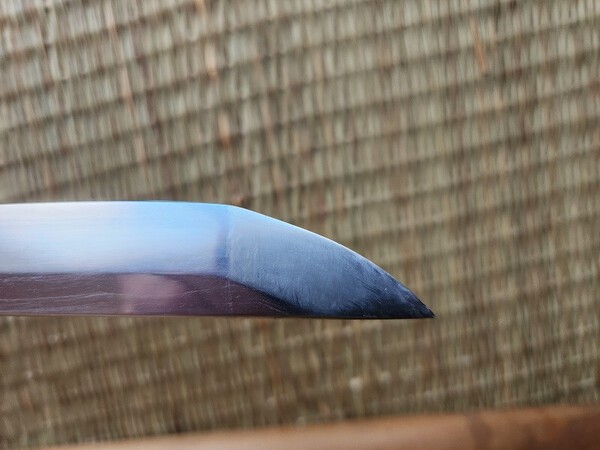
yes Woody Hall will do an amazing job with it. He has a very beautiful and unique style thats far better than anything that comes from the dealers in my opinion. It looks like you might only need a shiage togi . You might want to consider a slight kissaki shaping as it looks slightly mishapened but there s really nothing wrong leaving it the way it is. He s the only togishi I ll send my blades to and he has done a number of shiage togi for me. Each blade came back looking like a juyo sword lol


 5 points
 -
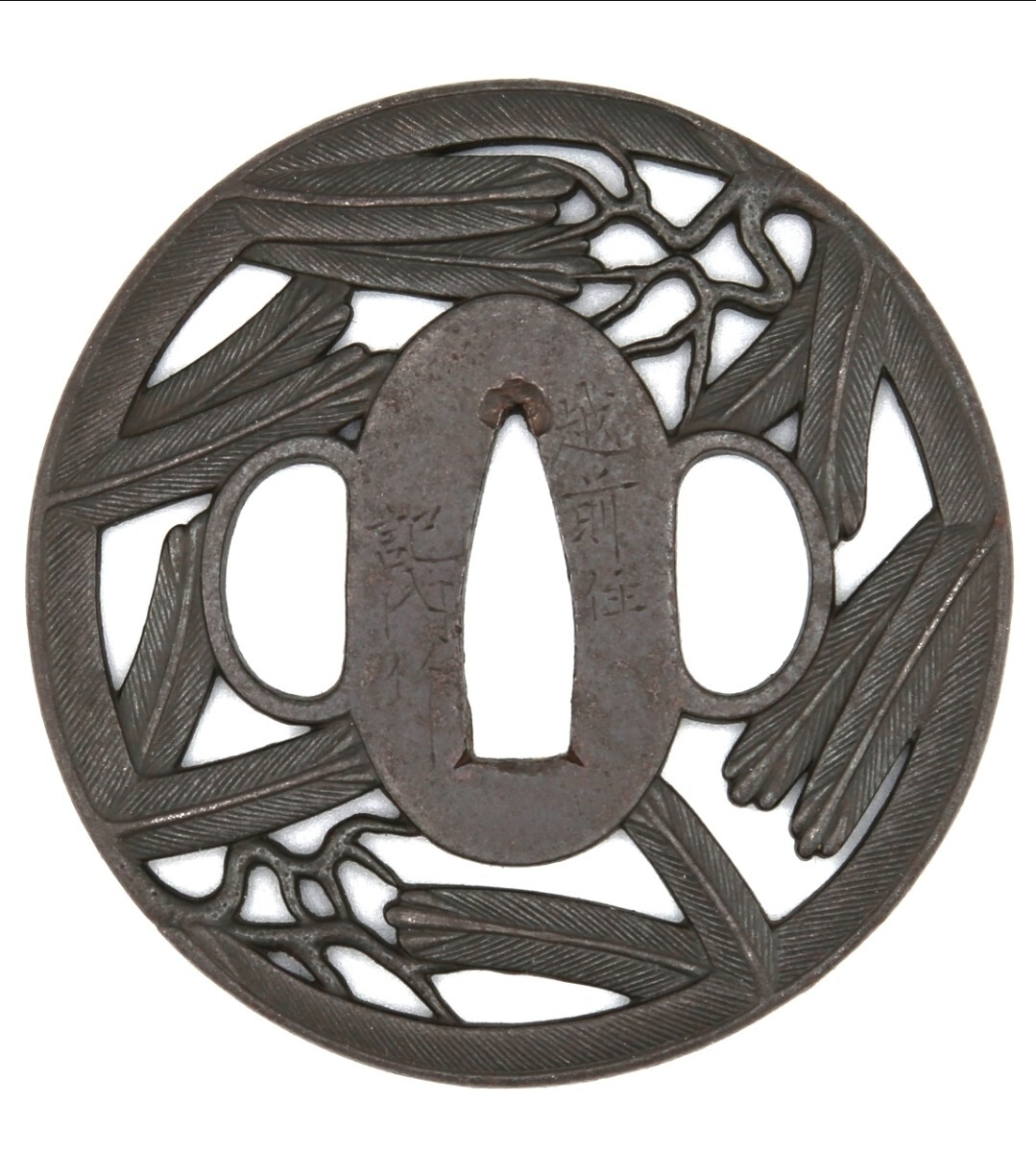
Happy New Year all. Reviving this topic from mid last year as I wanted to share another piece I acquired and how the information provided in this thread helped me make an informed decision. The Nebikimatsu theme was completely new to me and members of this wonderful forum helped crack it. So when I came across this piece described as "feathers," I immediately recognized what it actually was...and was quite thrilled as it appears to be very rare motif in Echizen tsuba. It's fitting that the theme is associated to the new year, and if you are ever in Japan over the new year period, you will definitely see the pine decorations on display around shop entrances all around...like this massive one I found outside a Seibu in Fukui City on my most recent trip. Wishing everyone a great 2026. All the best. Damon


 5 points
 -
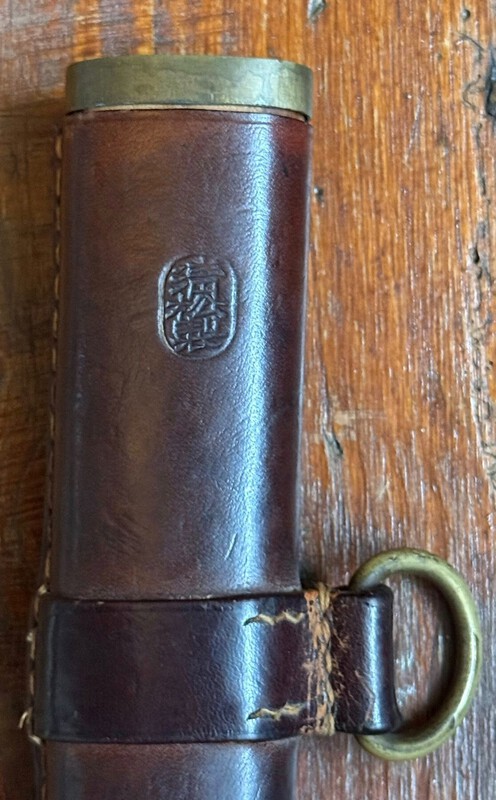
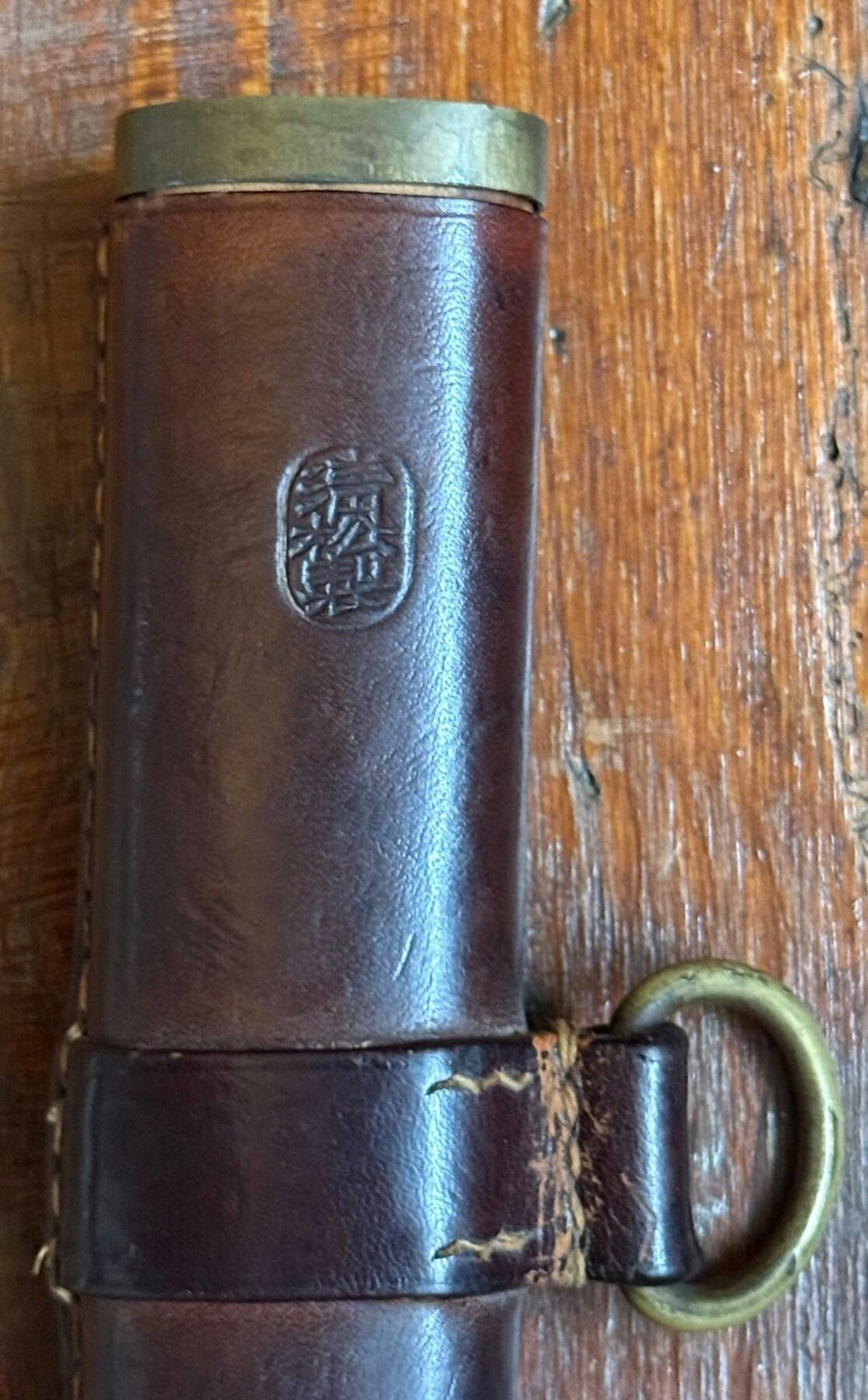
清松 製 Kiyomatsu Made5 points
-
Should be this item https://www.metmuseum.org/art/collection/search/246174 points
-
@Bruce Pennington Bruce, did you see this stamp on Facebook? On leather covered saya.
 4 points
 -
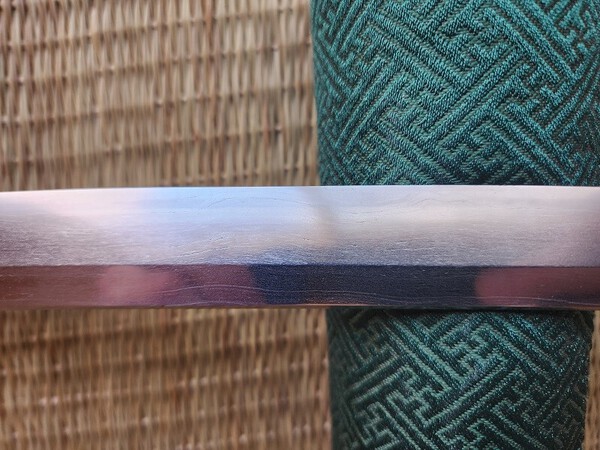
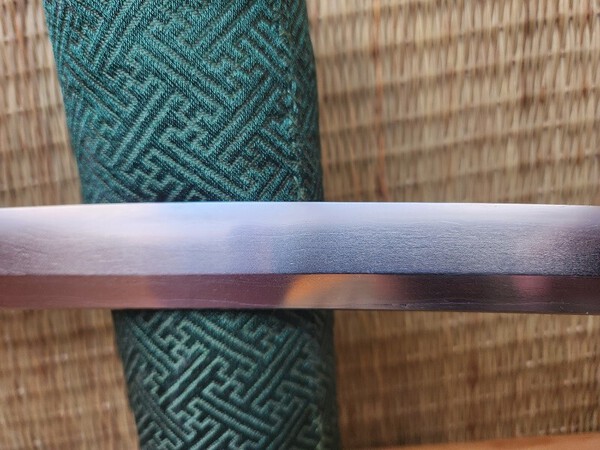
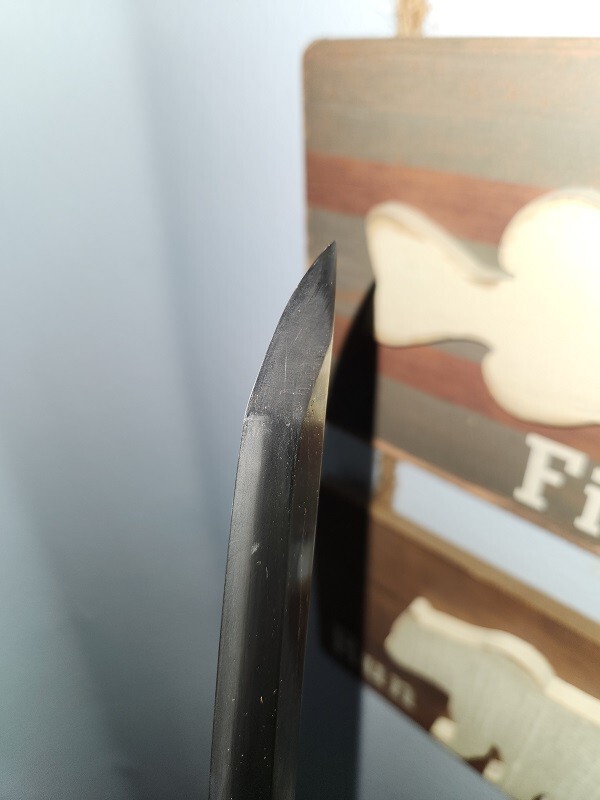
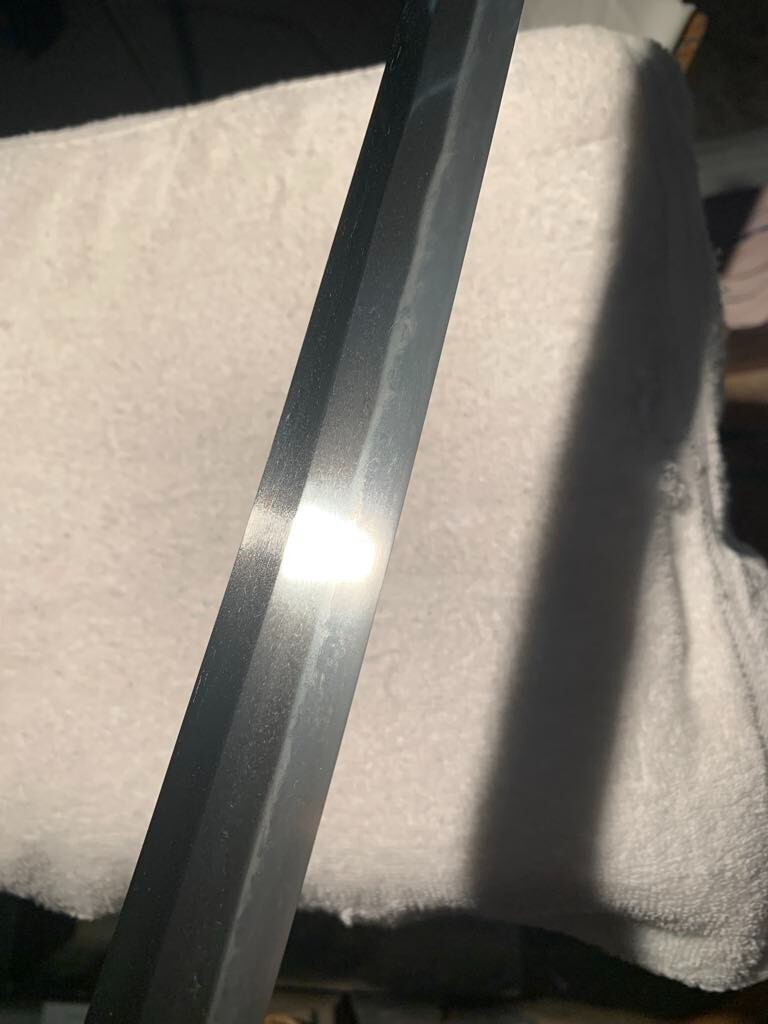
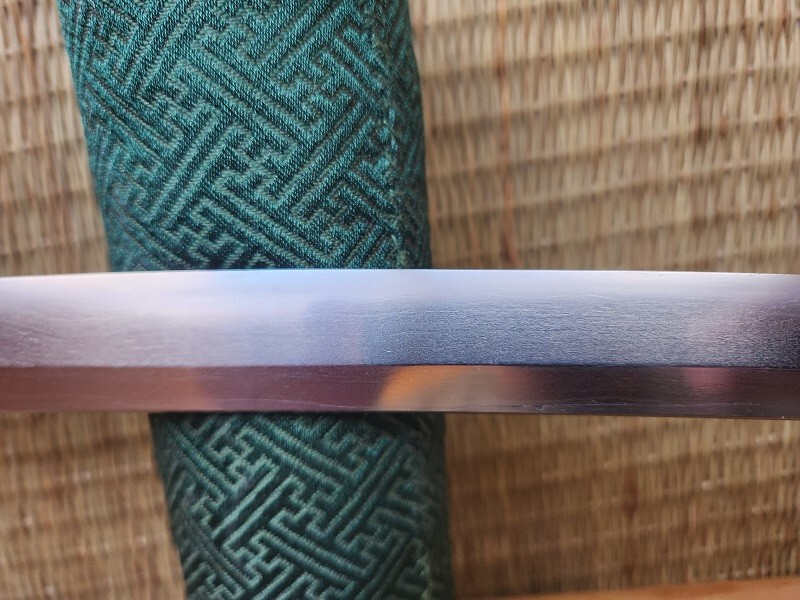
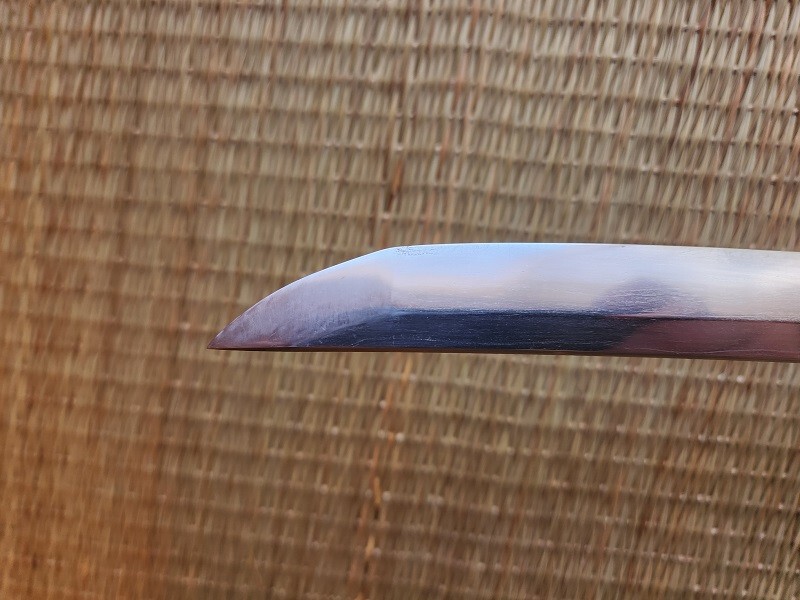
Hello All, Wanted to share my recent acquisition - an NBTHK-Hozon Katana attributed to the Sue-Hosho school. Overall dimensions are as follows: Nagasa : 68 cm Sori : 24 mm Total length : 97 cm Motohaba : 29.9 mm Sakihaba : 20 mm Motokasane : 6.4 mm Sakikasane : 4.3 mm Blade Weight : 544 grams I had the dealer I purchased the sword from coordinate to have it sent to a "polisher" they recommended while it was in Japan. Unfortunately this led to a less than sub-par and quite frustrating result that was not apparent until I received it in hand. I will be sending this off for a new shirasaya soon and then to Woody Hall for correction of the polish. Beyond the polish or lack thereof rather, I am absolutely in love with the sugata and dimensions of this sword and am looking forward to getting it back in good shape. I will likely submit for Tokubetsu Hozon in the future once the polish/shirasaya is complete.





 3 points
 -
It seems to be a nice sword with very strong masame. If trying for Tokubetsu Hozon, I would submit without the old paper from blank beginning. As the NBTHK has attributed it to Sue-Hoshō they see it as a Muromachi era sword. By default it would be that mumei Sue-Hoshō can only achieve Hozon level. There might always be an exception but so far all 17 NBTHK attributed mumei Sue-Hoshō that I have data on are all Hozon, even though some of would be good quality. Please send us pictures after Woody has worked on it.3 points
-
Unfortunately dodgy polishers aren't just something you find outside Japan; I've been watching some blades on auction sites in Japan in which a "polisher" has absolutely butchered the blade by 'painting' on a hamon/jigane matching the kantei points for famous smiths which the blade is then attributed to.3 points
-
2 points
-
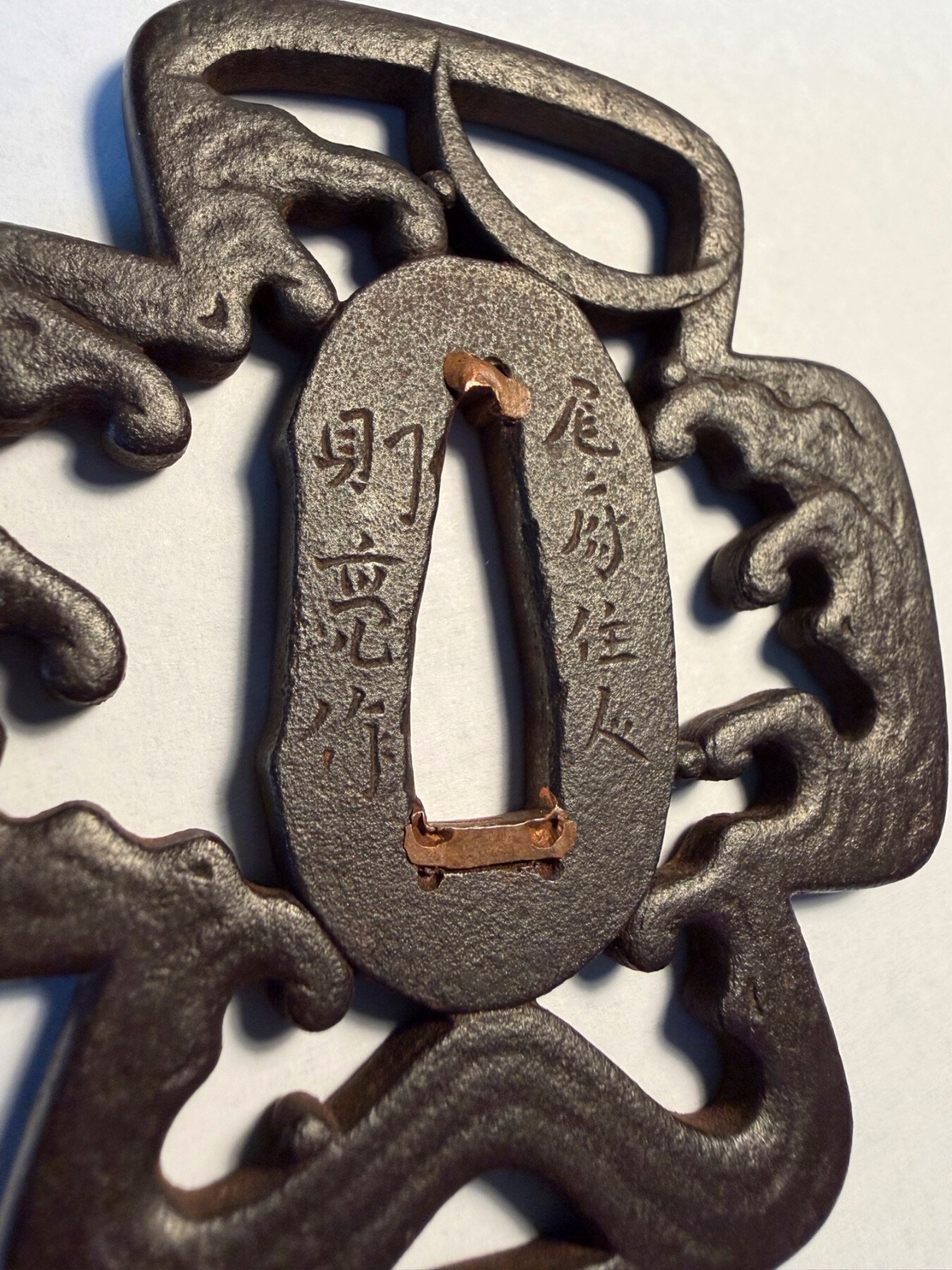
Bizen Osafune ju nin... Rest will be on the other side2 points
-
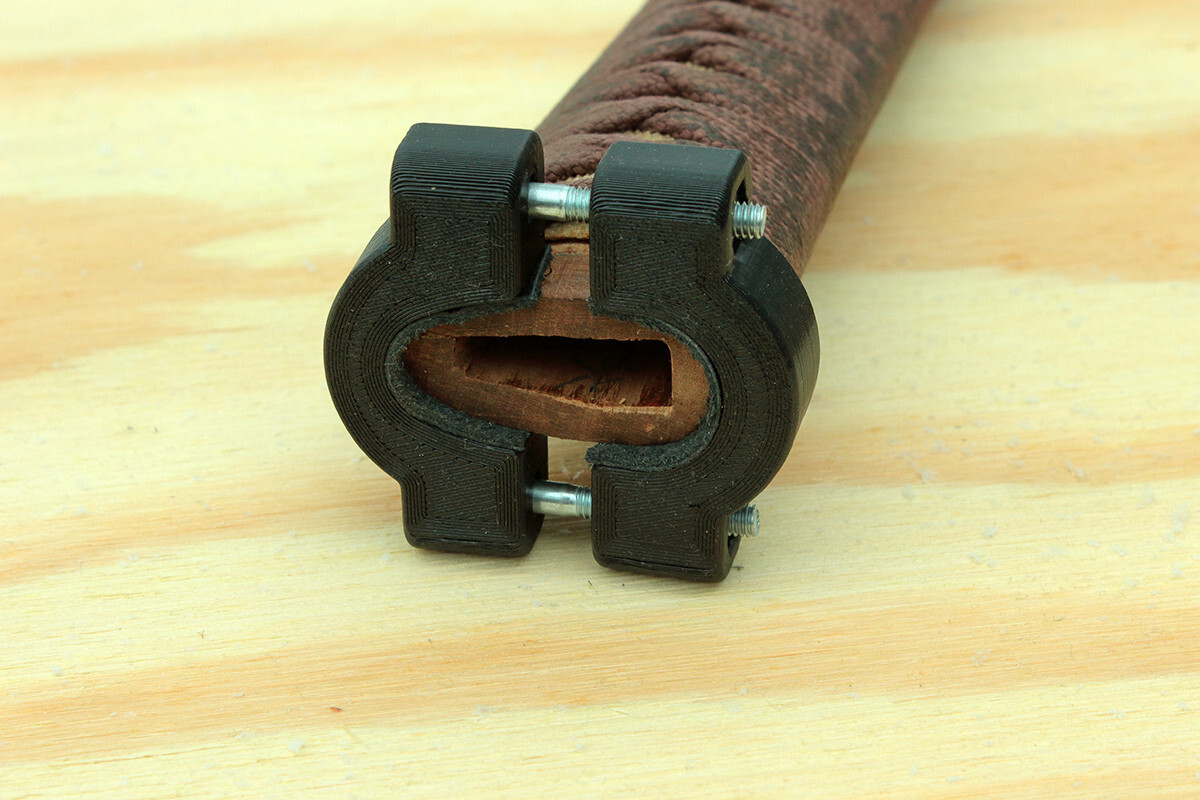
Upper and lower surfaces of tsuka in places where the fuchi sits are not parallel to each other. To solve this issue I simply made holes for bolts larger, so the halves of clamp adjust themselves on tsuka. And as I was bench testing the clamp I found out that I wouldn't be doctoring those cracks at all. Once I got tsuka clamped it became clear to me that if I got cracks fixed, I would instantly get another trouble: the ito would become loose. And as the pieces of samegawa aren't even glued to the wooden core, the ito and same could be shifted along the tsuka. I am glad I bench tested the idea before even making any irreversible decision. My current idea is to leave those cracks alone. However, I put a suitable liner (strip of thin plastic) between the fuchi and tsuka to ensure that the fuchi keeps cracks from further expanding.

 2 points
 -
Also, it's hard not to notice cracks in the tsuka wooden core. I went through some topics on tsuka repair and rice glue here. I also went through the corresponding section of "Craft of Japanese swords" on archive.org (the paper book hasn't arrived yet). My belief is these cracks couldn't be healed with rice glue. So I considered the option of using Titebond Ultimate wood glue. Yet, setting aside the question of glue, I needed something to keep cracks closed while glue is setting. Sure, there are traditional methods of wrapping, however my idea was to use something that would clamp tsuka frimley and for a long time, like for a week. My thought was that clamping tsuka for a prolonged time may remove some tension in the wood. So I designed a 3D printed clamp that consists of two halves that are to be joined by two M4 allen bolts and nuts. I made it to fit the shape of tsuka perfectly. I even added some space for leather liners so there wouldn't be direct contact of wood and plastic (so in case if plastic turned out to be harder than wood it would not leave any traces on wood).

 2 points
 -
Woody will be able to restore it to its true glory. Lovely sugata, and once polished properly; I imagine all that masame is going to be stunning. Sorry to see and hear what's already happened. Still, I would be excited for the future of this blade. Best of luck, -Sam2 points
-
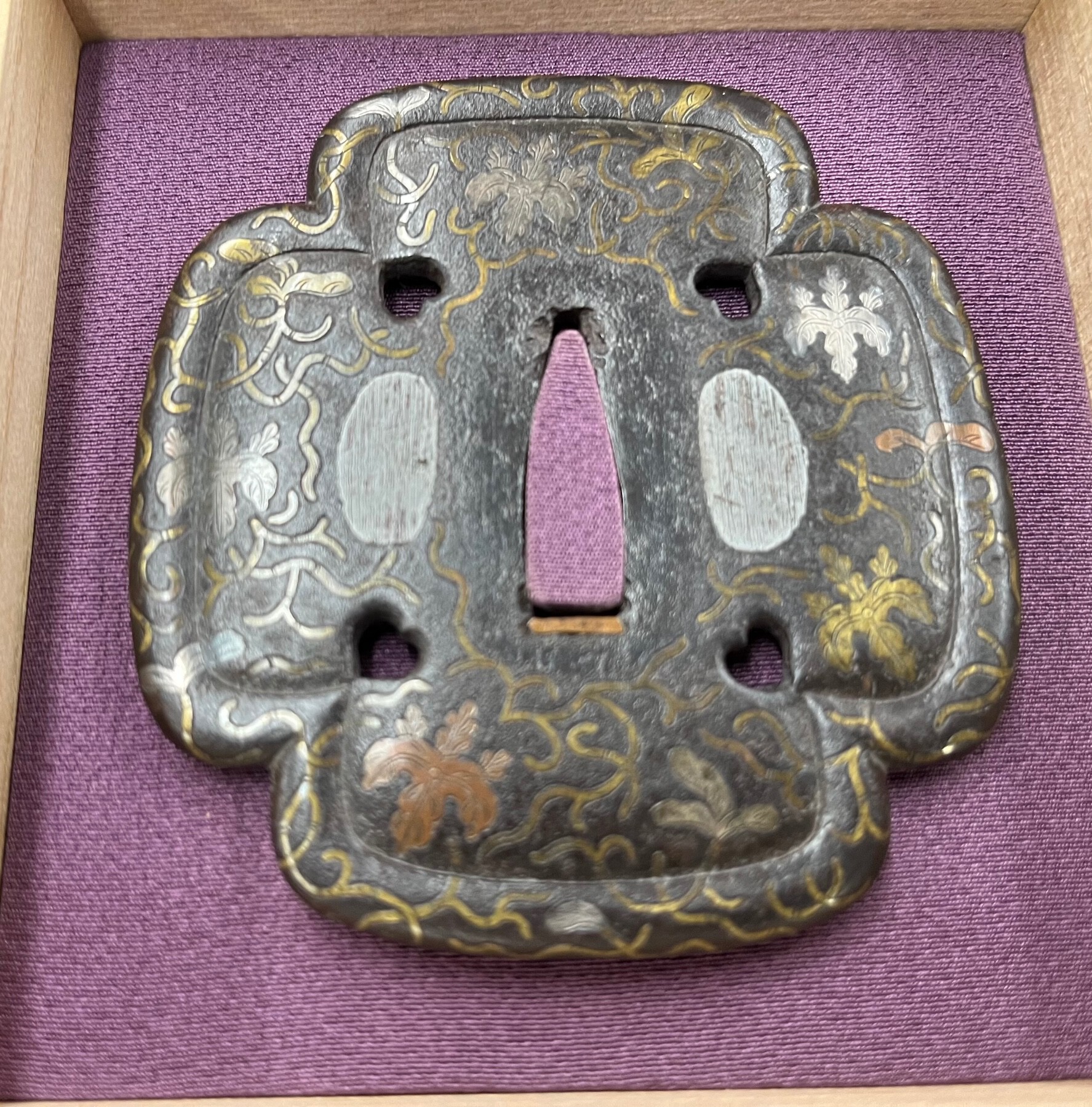
Dale, this TSUBA seems to have a "true" ORIKAESHI folding rim. The description of the SUKASHI as KATABAM/wood sorrel is correct. Apple blossoms have five petals like most ROSACEAE.2 points
-
We always remember our first. I was fortunate to be invited to visit the home of a German collector in May 2024, where I was given the opportunity to study 3 Juyo blades in hand. I held the nakago of the first blade so tightly and so intensely, the owner even commented on the heat transfer. He was probably hoping I wasn't related to Uri Geller.2 points
-
Was certainly using the term very loosely here but added some quotation marks for posterity. In any case, it's bridge under the water at this point and that particular matter has been resolved as much as can reasonably be expected. Indeed, I was too naïve in this regard, I should have been more thorough in vetting who it was that was recommended etc.2 points
-
George, based on what you have said and the result maybe you should discontinue referring to the person that did that to your blade as 'a polisher'. At least their not referred to as a Togishi.2 points
-
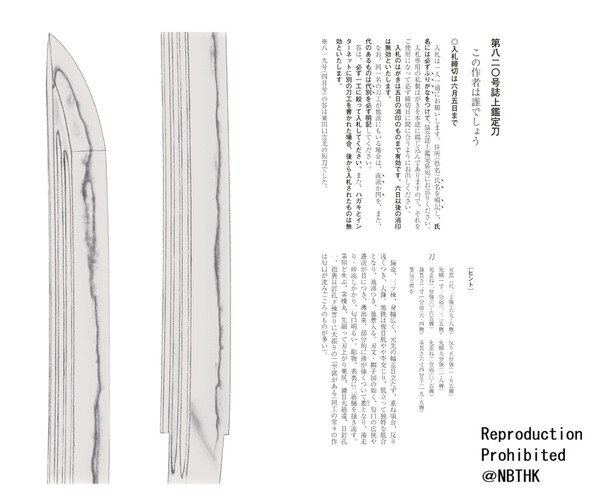
Very interesting, first as I've been pining after a Nobutaka wakizashi in Eirakudo (https://eirakudo.shop/601981), but also as it reminds me of one of the recent NBTHK kantei problems available on their website. I again thought Nanbokucho Mino and in my head guessed Naoe, whereas the correct answer was Horikawa Kunihiro. While I don't know that I can do a translation any justice, the initial discussion on the sugata points to viable options as Nanbokucho, Keicho Shinto (and very late Muromachi), and Shinshinto. It then goes on to discuss why the first and last options didn't fit the bill. Problem and solution images below:
 2 points
 -
Hi Will, I found this one in the Metropolitan Museum of Art. More elaborate but has some of the features to yours. https://www.metmuseum.org/art/collection/search/29973 The hitsu shapes on yours are interesting, I think they may represent gourds like on this one.2 points
-
My friend Will, You are not ignorant! We all learn. I hope you have fun with your hobby! Onward!2 points
-
Revisiting this thread as I just discovered Washida may be the source of my Tsuba.
 2 points
 -
Yes, typo on my part. Thanks Uwe for catching that. The mei reads "Bifu Ju Nin Norisuke Saku".2 points
-
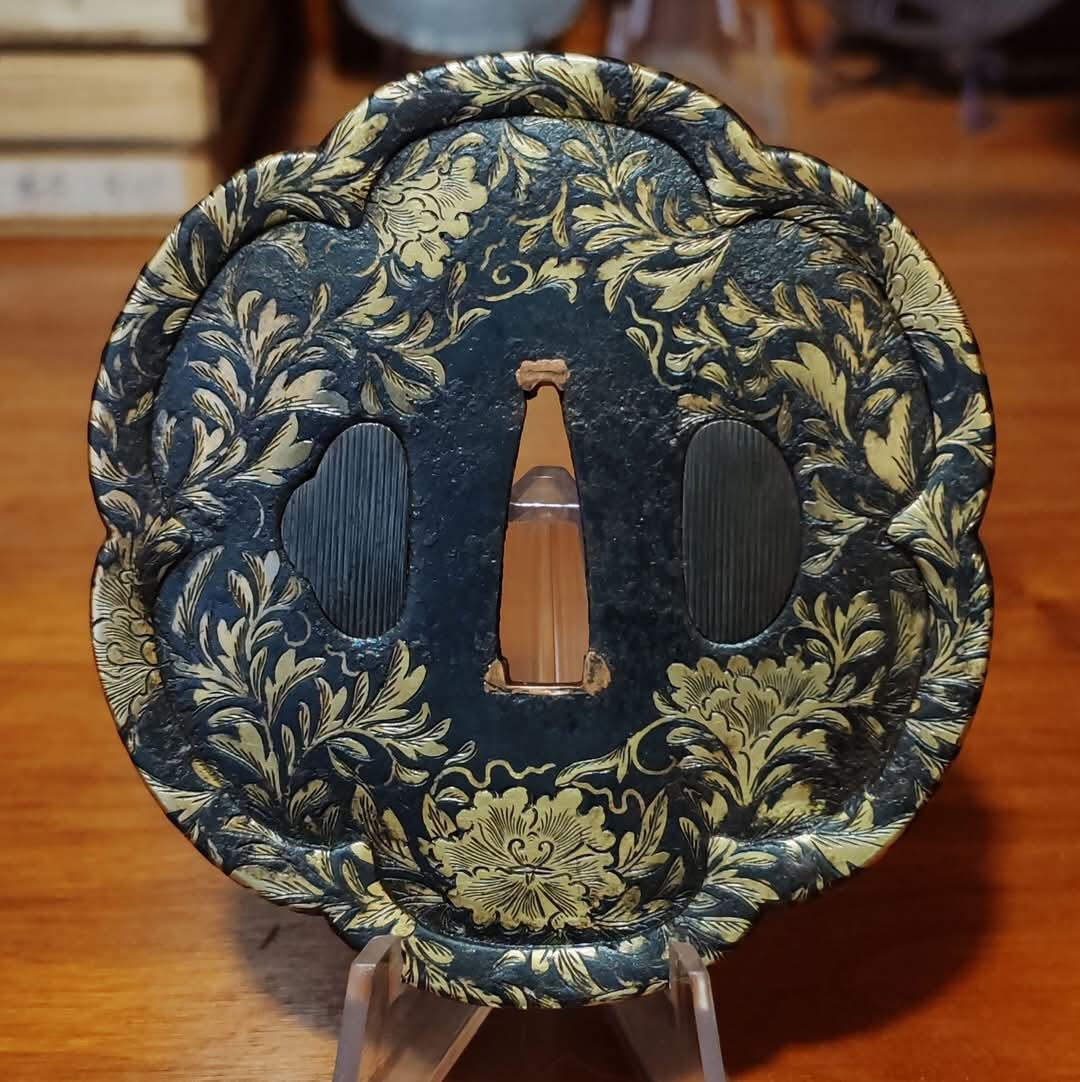
Superb job, Manuel. This piece has come back to life straight from the junk box. Washida Mitsunaka has produced several tsuba of this kind like https://www.metmuseu...lection/search/23060
 2 points
 -
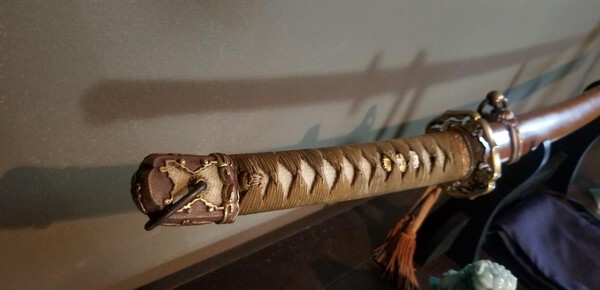
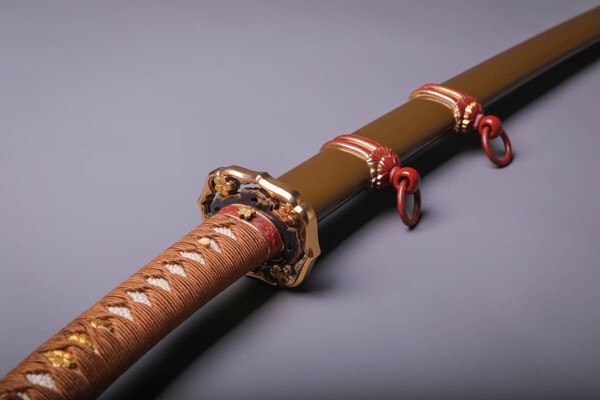
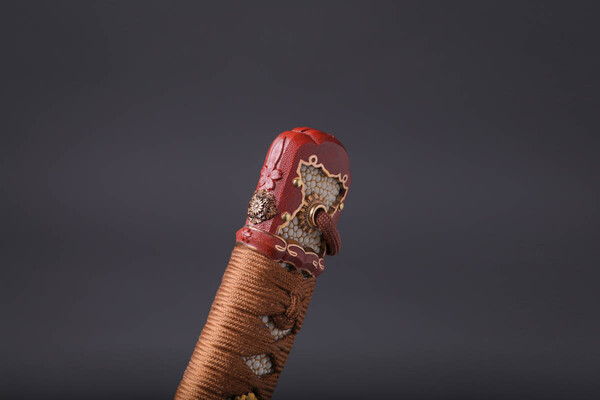
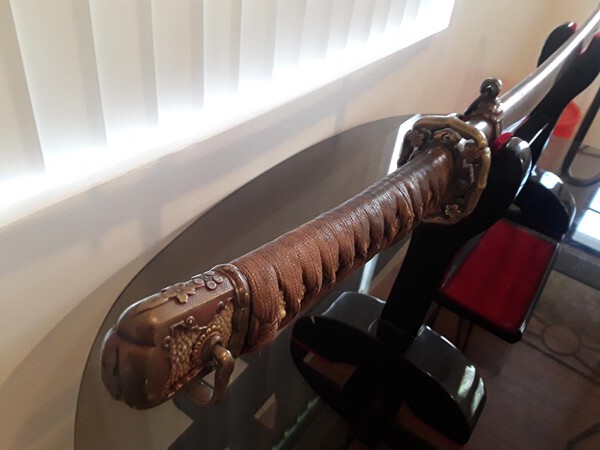
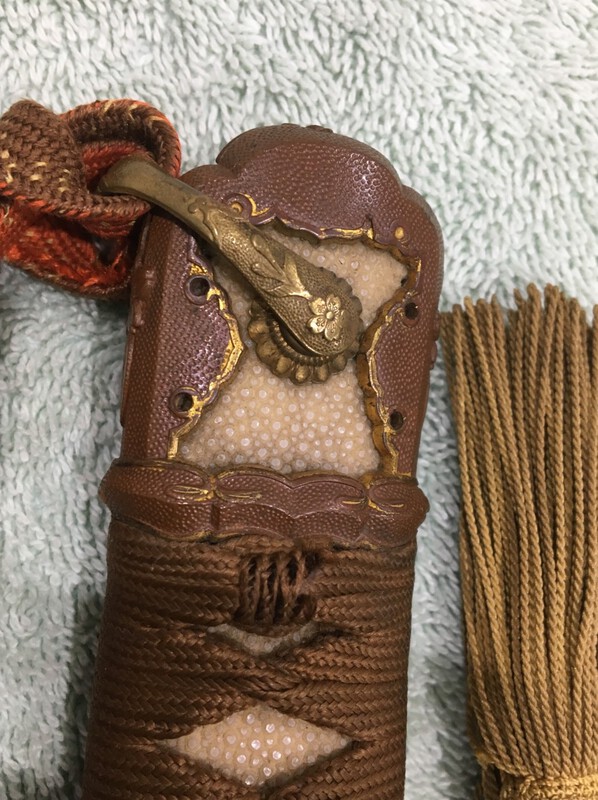
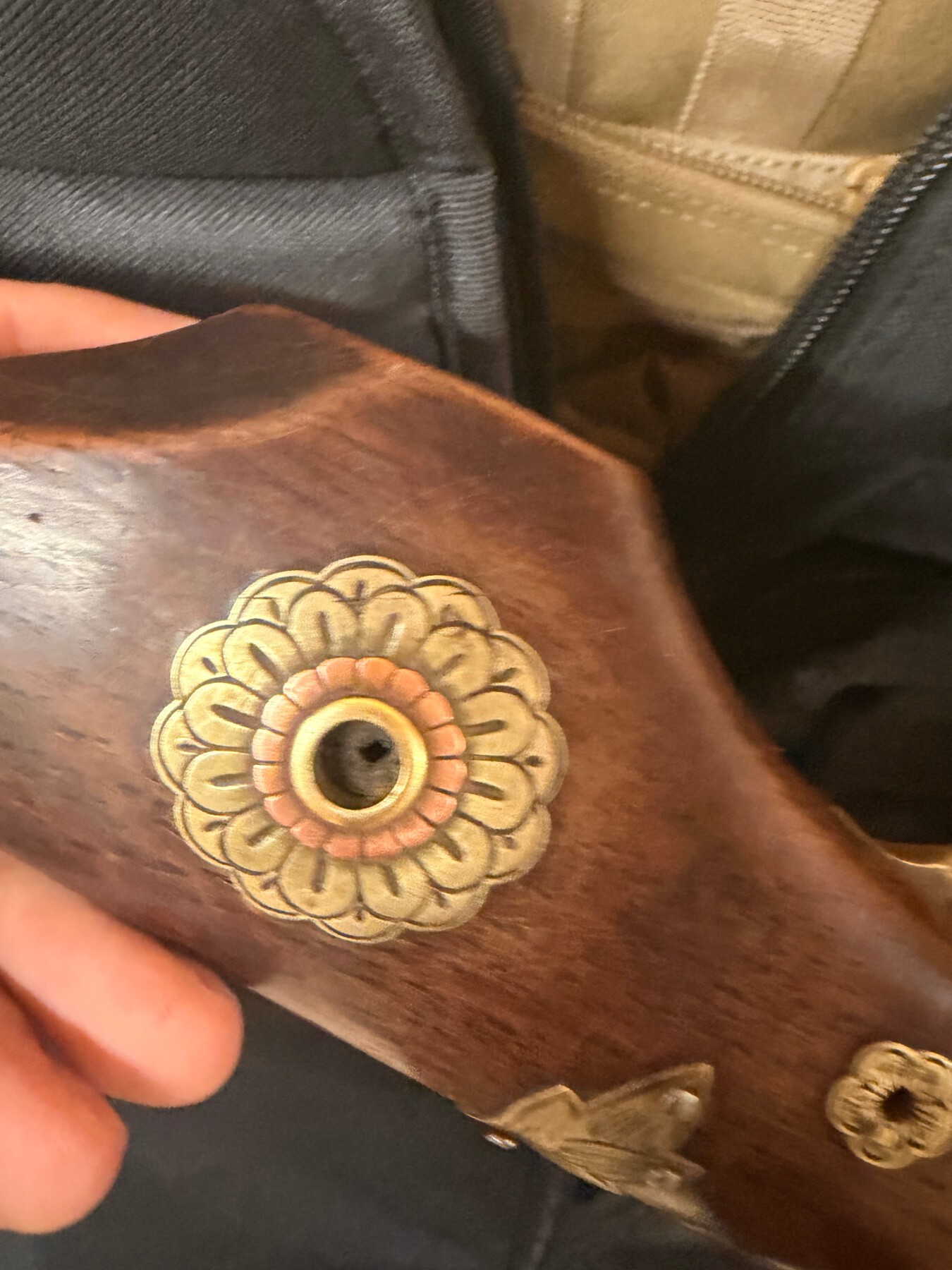
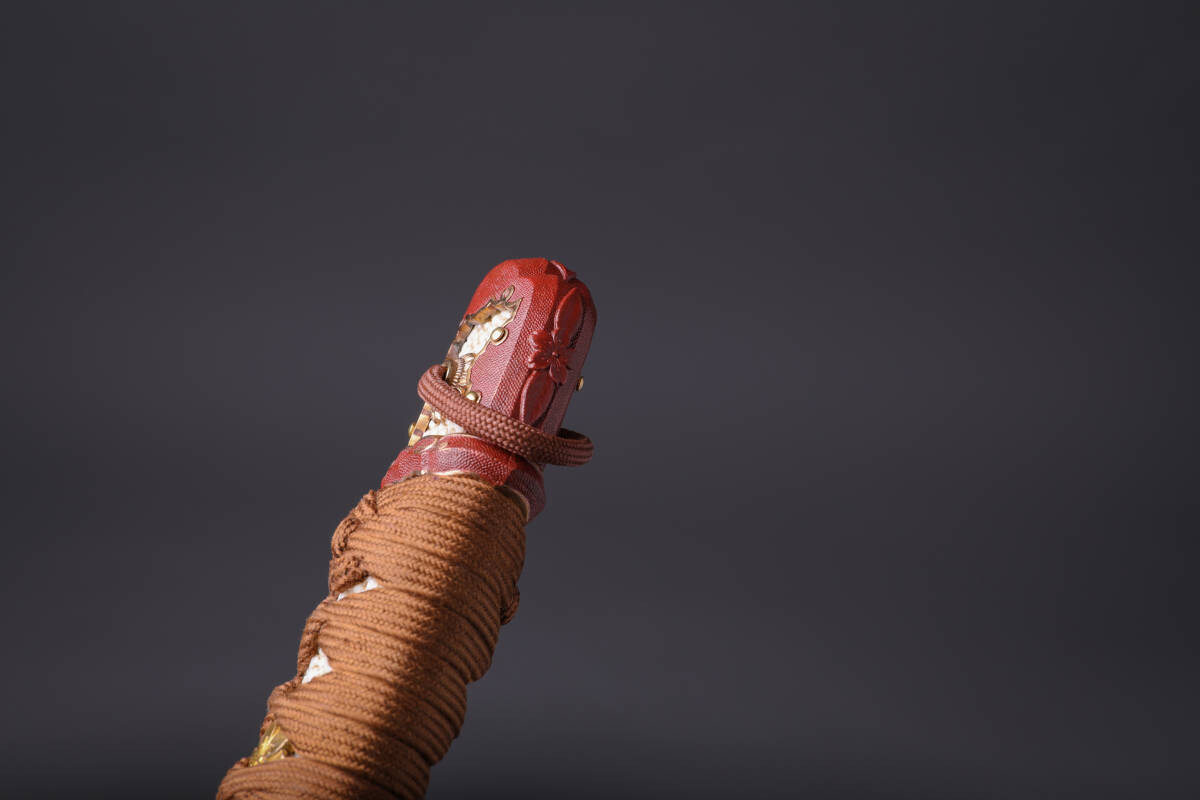
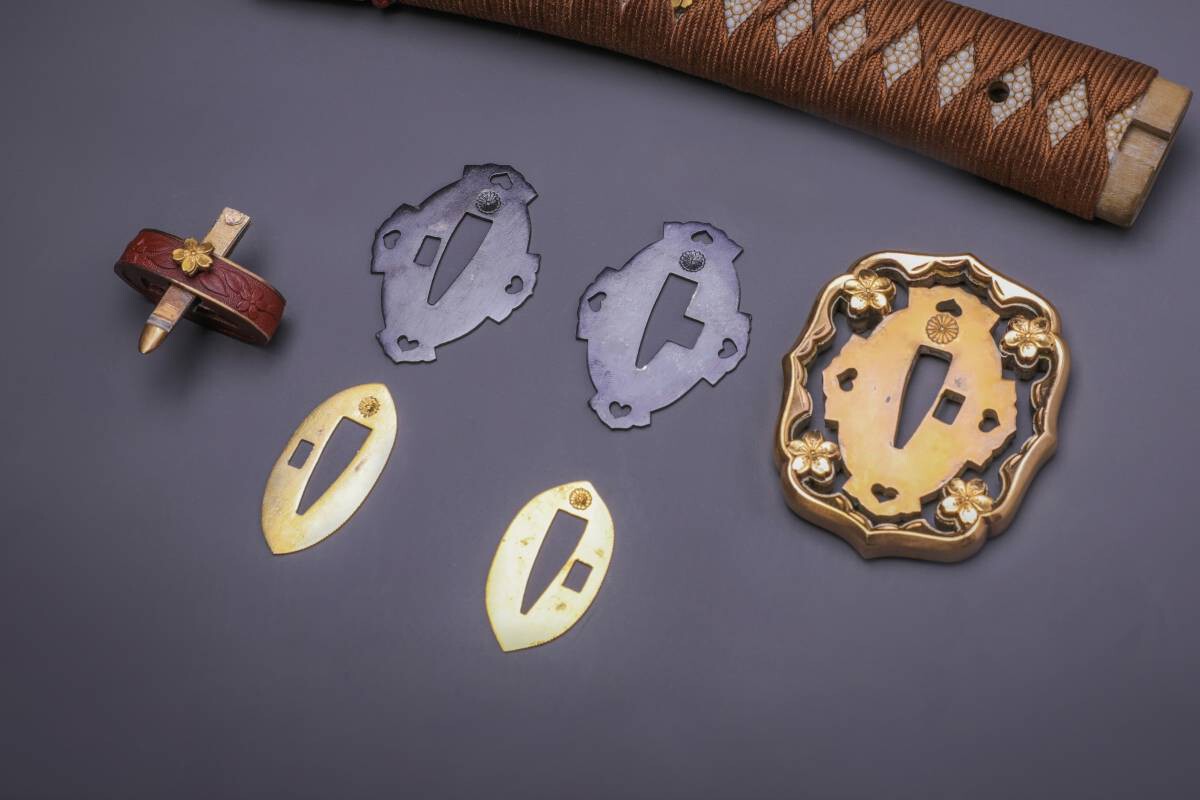
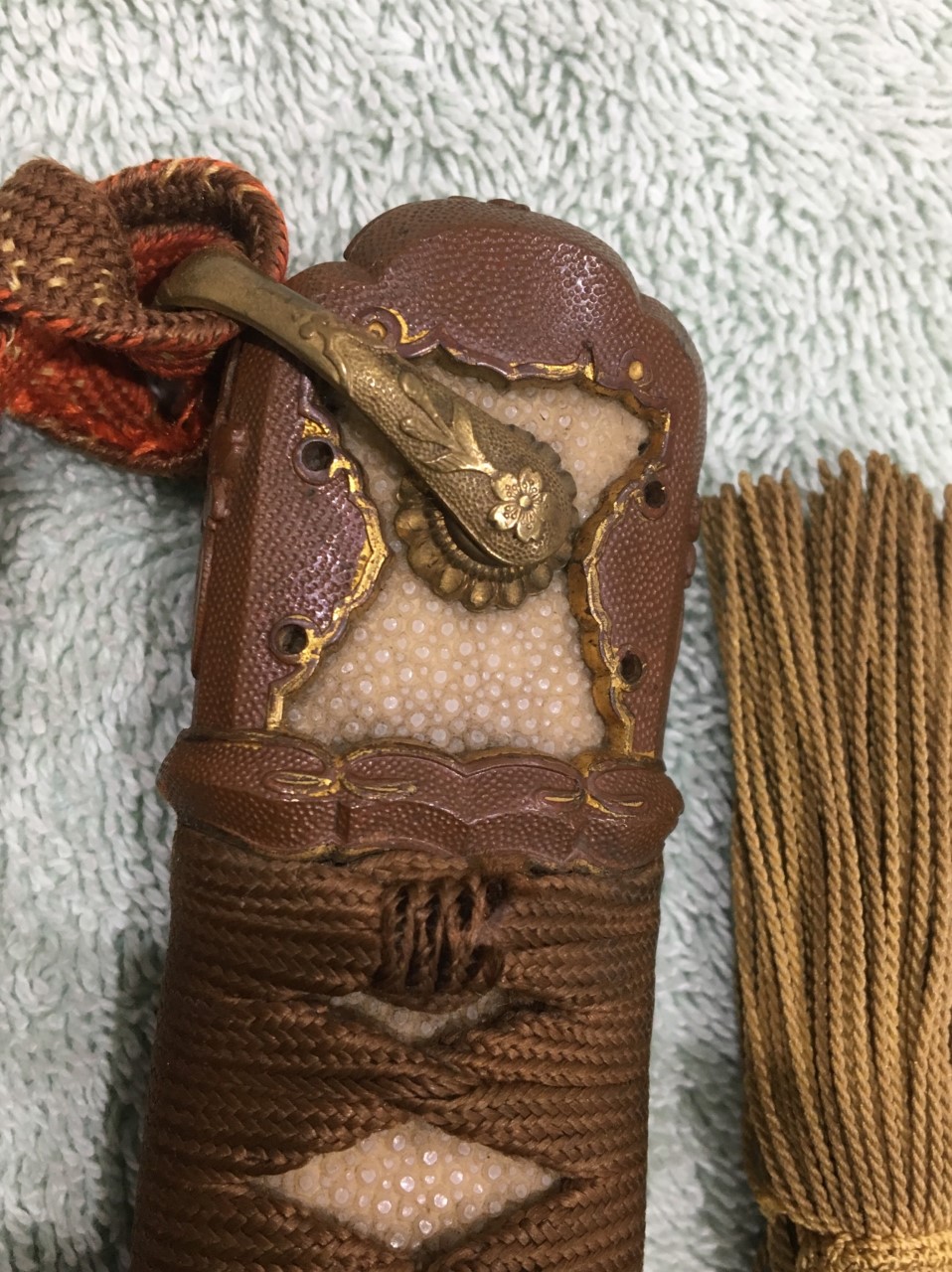
I'm searching for more examples of this fairly unusual type of Kabutogane seen on the Type 94, usually with a separate sarute barrel. Having only seen them on the Type 94 pattern fittings I'm wondering if this is a very early design and would like to see any more examples to compare and perhaps identify a specific Koshirae maker or date for these. Given the added complexity I can only imagine these were very early in the Type 94's introduction and were quickly phased out for the standard Kabutogane we all know.
 1 point
 -
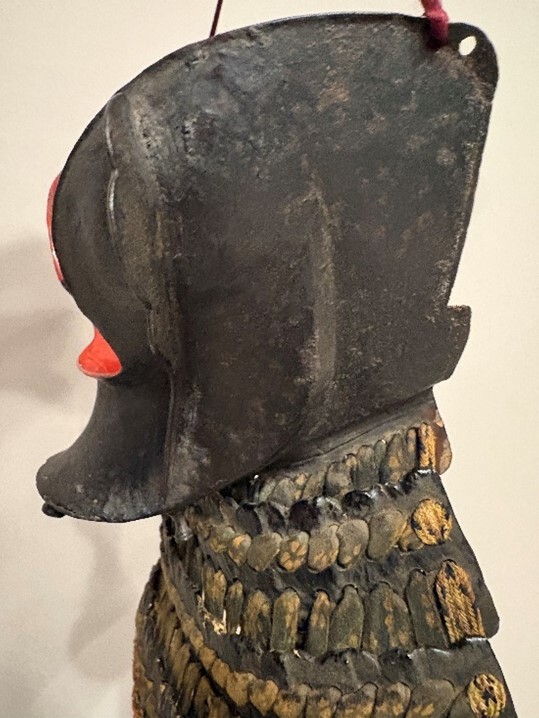
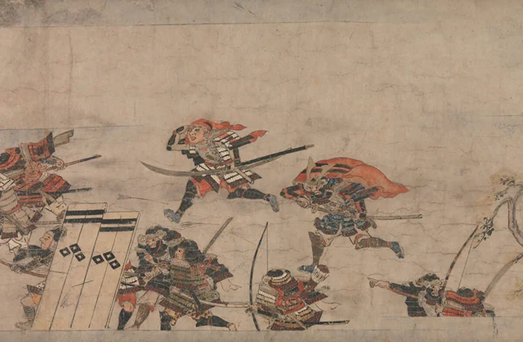
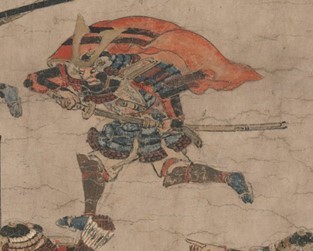
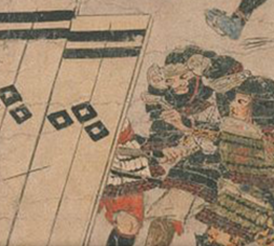
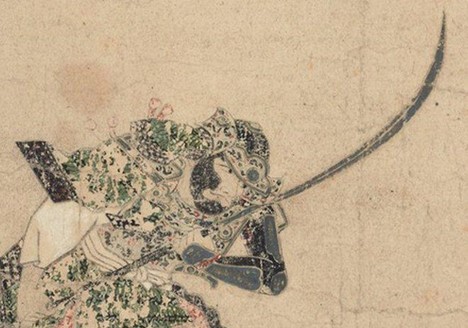
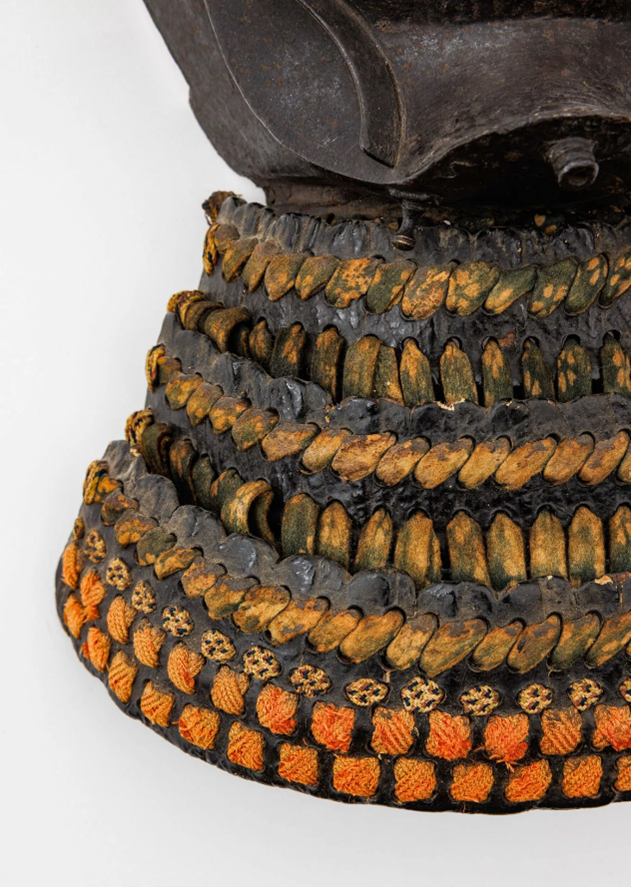
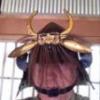
Hello, I share with you an interesting and rare old Hoate (or Hanbô) from the muromachi period (15-16 th). A half-mask made of natural iron, of the "Hanbō" type, covering half the face and excluding the nose. The inner surface is lacquered red. A sweat vent and a channel (ase nagashi) are present on the lower part. Two stamped iron "yadome" straps on each side of the mask guide and protect the helmet cord, while two iron studs (otayori) on the lower part secure the cord. The four-row gorget (yodarekake), very likely contemporary with the mask, is made of superficial iron strips covered with lacquered leather, joined together in a "hon kozane" style and then in a "kebiki odoshi" style with printed suede "egawa" cords and red silk. This half-mask is designed to cover part of the face while also protecting the cord and ensuring the helmet (still quite heavy during the Muromachi period) stays in place and distributing its weight more evenly. Half-masks from this period are extremely rare. The mask's shape, with its iron gorget covered in lacquered leather, immediately suggests a very early date, further confirmed by the black corrosion of the iron, which allows us to date the object to the middle of the Muromachi period (1336-1573). Some examples of hoate wearing during the Muromachi period : Handscroll : A Long Tale for an Autumn Night (Aki no yo nagamonogatari) ca. 1400. Metropolitan Museum of Art New-York, 2002.459.2 https://www.metmuseum.org/art/collection/search/65122 others exemple :





 1 point
 -
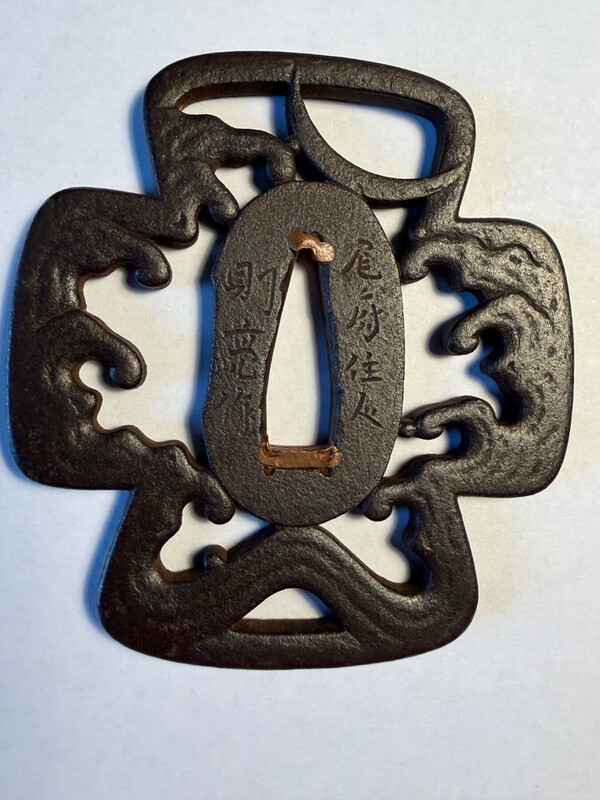
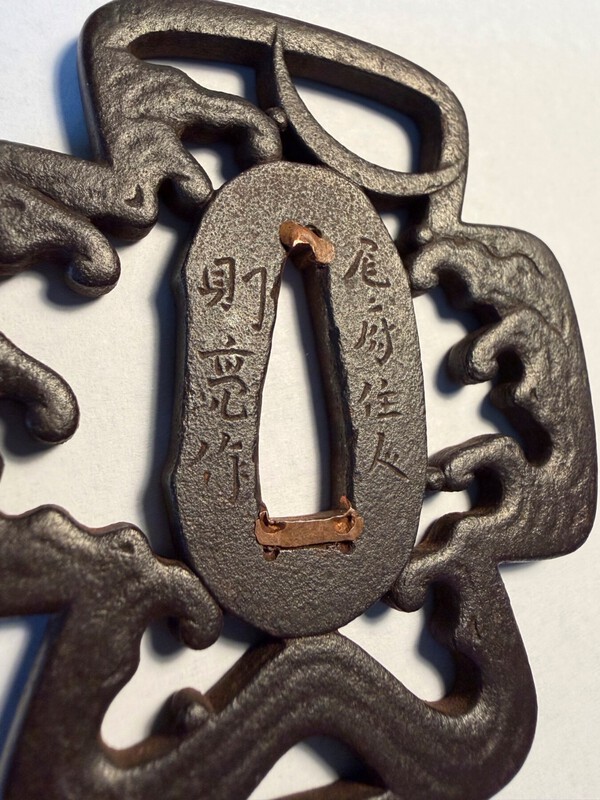
I'm hoping for some assistance with the Mei on this iron tsuba, as well as any insight into the maker/style. Thank you in advance...

 1 point
 -
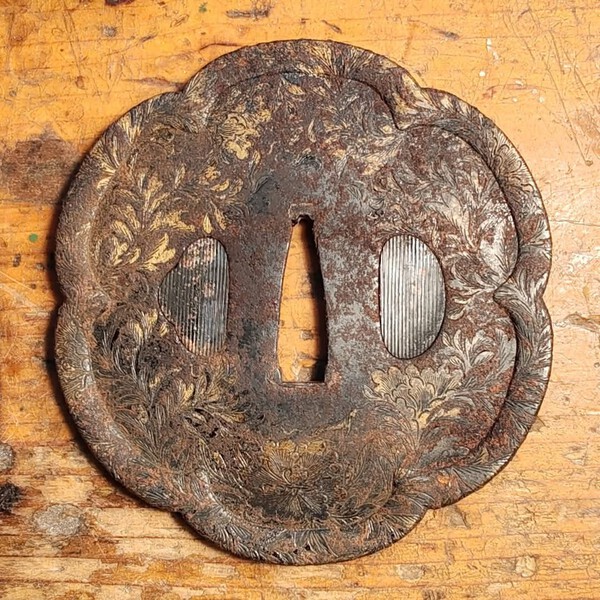
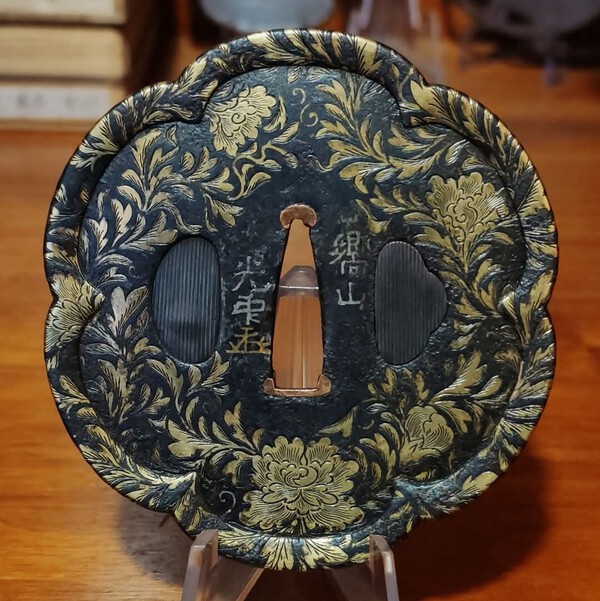
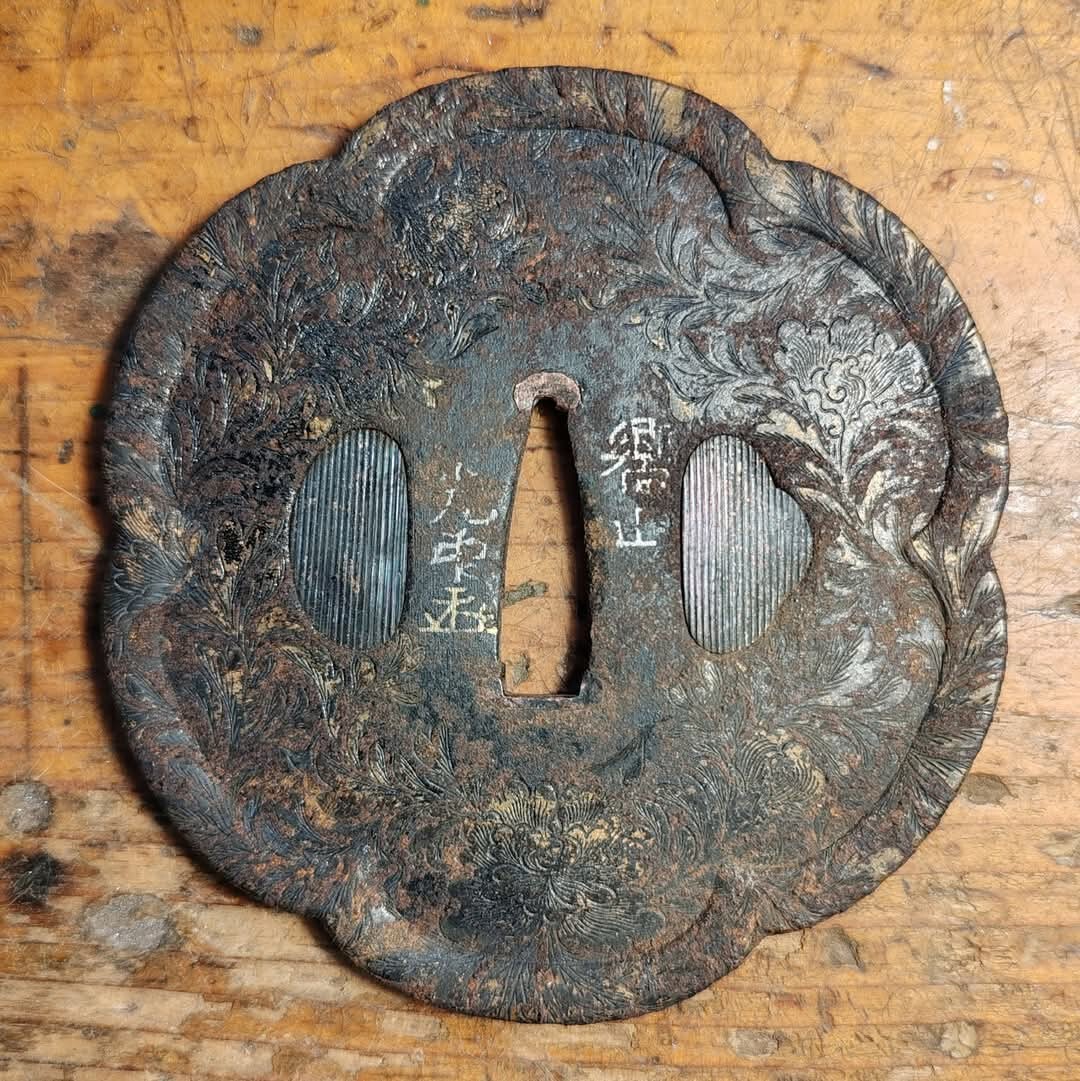
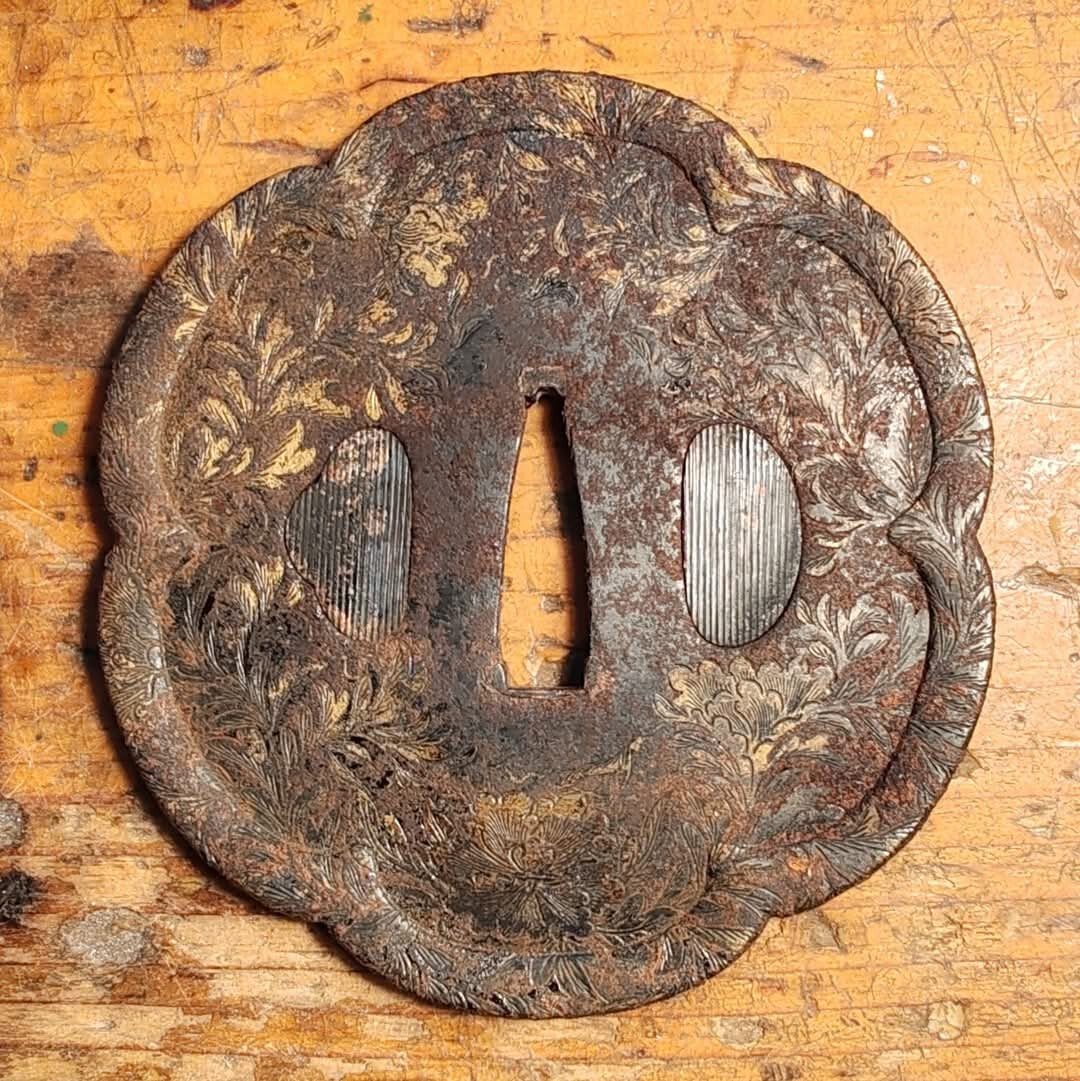
Greetings to All, Recently, I acquired a rather rusty tsuba as part of a deal for a Washida tsuba with another collector. This piece was thrown into the arrangement by the seller to meet the requested price range. Despite its condition, it showed some promise. The tsuba is signed Kyozan Mitsunaka + (Kao) ({嚮山 光中(花押)}) in kin-zogan. Based on the pictures, it appeared to feature brass hira-zogan of peonies and arabesques. Despite the rust, none of the inlays seemed to be missing - testament to the craftsmanship. The subject and execution also align well with works by Washida Mitsunaka or the Washida school. Seeing its potential, I decided to accept the deal, and both tsuba landed on my desk. Believing the piece was worth restoring, I sent it to Manuel @C0D for restoration, and I wasn't disappointed. Manuel did an outstanding job removing the rust and re-patinating the brass. If Manuel would like to elaborate on the restoration process, I would welcome it. The gamble paid off, as the final result is quite pleasing. As you can see, the tsuba has been brought back to life: I hope you enjoy it as much as I do. Regards, Luca P.S. I have to thank Manuel for allowing me to use the pictures he made.

 1 point
 -
Sorry, yip...Bishu. I think this is likely Sukesada?1 point
-
TokyoSword https://tokyosword.myshopify.com/collections/sword I don't think I would have issue purchasing from them again (assuming it's something too good to pass up) in the future as I've had many good transactions, but as far as coordinating services for things, that ship has sailed.1 point
-
That was my first thought too when I saw the pictures on Buyee. But looking at the signature I have seen it was signed Kyozan Mistunaka [Kao] in kinzogan. Mitsunaka is one of my favorite artist. Washida Mistunaka tsuba are rarely seen on the market signed and with peonies and karakusa decoration. Usually Mitsunaka (signed or from his workshop) are usually characterized by very high quality iron and the kin zogan is usually also of high quality rarely missing some pieces. From the pictures, except for the rust that looked superficial, the iron looked in good shape and the kin zogan didn't show any missing pieces. Thus I decided to take the risk. In the end I was just lucky. As I was lucky to find Manuel that made such a wonderful restoration work. Regards Luca1 point
-
Very good advice Brian. I agree 100%. If you like it, keep it, display it and appreciate it. Like Brian said if not sell it to someone who will give it a home it deserves MikeR1 point
-
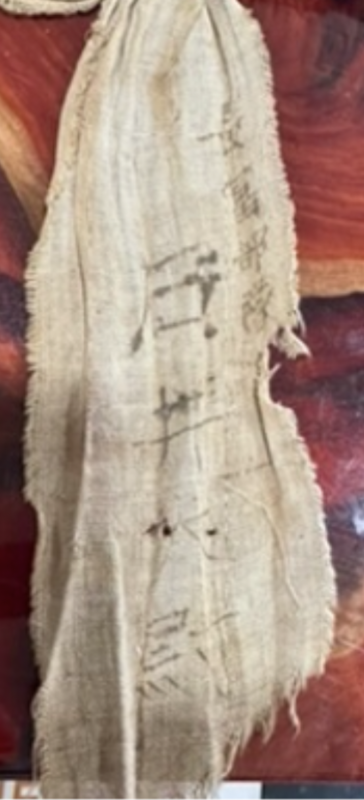
@blueblue Darcy, I looked at the surrender tag, and not sure if an interesting story here. Right column: NAGATOMI BUTAI 長富 部隊 looks to be military group (butai). Does this mean an infantry group commanded by an officer Nagatomi? Left column: ISHII TAII 石井 大尉 owners name Ishi = family name Taii = rank (captain) I think these are correct, but need confirmation.
 1 point
 -
Wow thank you Jesta for the knowledge much appreciated!1 point
-
They also got the "spring" wrong, though they had it right, "autumn" at the top.1 point
-
This is exactly the book you want: The Connoisseurs Book of Japanese Swords https://a.co/d/bYOs3m7 Best regards, Ray1 point
-
I appreciate the efforts of anyone who is willing to sacrifice their time and effort for this hobby Maybe this data on Nihonto Club will help https://nihontoclub.com/view/smiths/schools1 point
-
Raymond Yan sells a lot of affordable nihonto, and related items. He's a good seller, in my opinion. Beware though... He has very little patience for questions. He puts a great deal of effort into his descriptions, and he recommends you study his photos and writing. At these prices, he has no issue offloading items, and has little time to discuss each individual piece. I've followed him for some time, and I've gathered that he must like polearms. Lots of yari go through him. He also knows what he has; so you're not going to find a forgotten treasure or anything . You will find reasonable and fair deals. And as always, you get what you pay for. -Sam1 point
-
Hi @blueblue, Darcy, Thank you for the photos of the tang. You have an interesting WW2 non traditionally made blade. I would read into care and maintenance on this website to help preserve your item for future generations. https://www.militaria.co.za/nmb/faq/1-care-and-maintenance/ Now that we know it's all WW2 era, both fittings and blade, I'm going to relocate this thread to the "military swords of Japan" section, and delete that other one. Very nice sword, and thank you for sharing with us. All the best, -Sam1 point
-
Tsuka seem to come in endless variety, always something new comes along. Thanks for sharing. As to the tsuba, my impression is that it is made and patinated to look old, with a rather unsuccessful attempt to imitate a Mei.1 point
-
Hi Lex, If the sword will be available again, please, message me.1 point
-
Hi Jussi, you have a nice blade and thanks for the work for this kantei. Keicho Shinto is a nice period, i saw some very nice blade with impressive Sugata. Nobutaka is counted as one of the Owari Sansaku (尾張三作), the “Three Owari Masters.” (Keicho-Shinto from Markus Sesko) thanks Oli1 point
-
Well as I was travelling in Japan this summer I realized I should share the current data I have, because if something happens to me all my long time work is lost. There have been some unexpected passings in the last few years and I have been gathering the data for this file for around 10 years now and it would be shame to lose it all. This is still a work in progress and there is even tiny bit of Finnish language mixed in there. This will never be finished and I will continue to work this hopefully for a long long time. As I managed to pass 15,000 swords in the file I thought it would be time to share it. I am strong supporter of openly sharing the knowledge, so feel free to use this for research, just would be nice to be credited if this is used in research. My original idea was to stop around c.1450, and I mostly did. However I wanted to include some Muromachi stuff I like and old ōdachi in general, and few years ago I started adding late Muromachi and early Edo Naginata to the list. So I think the number of pre 1450 swords might be closer to 14,000. Of course would be amazing to have all swords included but as a solo project just stopping around Early-mid Muromachi has proven to take majority of my sword hobby time. There are most likely some errors somewhere in there and I correct then always when I notice them. It is just due to human error as this is my solo project and 15,000 sword entries there are bound to be errors, and there are still many items that might have XX etc. that I need to do more research. I have included reference for each and every sword, so I do have all 15,000+ swords in my personal references. I have been using this my personal reference system for a long time so for me it is easy. I am always updating this when I have time but I think I have 1000+ written references at home as I have c.800 issues of Tōken Bijutsu. For a long time I have tried to find motivation to finish seeking all the City Bunkazai from city websites but so far I have only gone through 187 cities and I think there are 700+ in Japan. The reference system might be bit confusing but at the bottom I should have quite up to date list of the reference codes I use. Few years ago I started adding additional information and attachments. I should have started it from the beginning as I need to go through references multiple times now. It is still a work in progress but for example additional info I should have around 300 Meitō, I think there should be provenance (denrai) for 1300+ swords currently. Maybe c. 150 shrine dedications etc. For attachment example I should have info on close to 1,500 sayagaki. Just looked and I think I should have c. 400 Tanobe sensei sayagaki. Listed as authentication I should have around 2,500 Hozon & Tokubetsu Hozon papers for these swords. I know there should be 3,000+ but many Japanese dealers never post the NBTHK papers. If I know the location of the sword (museum, shrine etc.) I have written it in authentication field along with the designation of the sword if it has such. I had a huge dream of a website and I had an amazing vision in mind but unfortunately reality hit that I could never achieve that, and on top of that copyright issues would hit hard. As I said I have every item somewhat accessible to myself however I cannot really share them to public. I try to be up to date with current information where smiths belong etc. and try to switch them around. However it is difficult as new theories emerge from Japan. I just read recently that in one view Ōmiya Morikage is now considered to be Osafune smith instead of Ōmiya, and just few years ago I switched Yoshikage from Sōden-Bizen to Ōmiya, maybe I need to do more switching... so some smiths might be in wrong school, or there can be alternating theories. In my defence I have all the references where I can check but there can be conflicting information among the references. Unless the item is dated I have tried to give a decent time range for the smith as I dislike very narrow ranges for mumei items. Some references can narrow the dating of mumei sword to very narrow time frame and therefore I have written what they see the item being. As for me size and shape is the most important thing for me it was logical to arrange the items by length first and foremost. So if present the swords should go ōdachi - tachi - katana - naginata - naoshi - kodachi - wakizashi - tantō - ken/yari. Then for same length I have usually gone higher ranked first (at least that was my plan). Well that is a brief summary of the database file. I hope everyone will have a great summer Koto tietokanta PDF15000.pdf1 point
-
Kuyo Mon - Nine Stars crest1 point
-
Thank you for posting this Luca, what a wonderful result. I think it shows your good eye in noticing this being worth of restoration and Manuel doing amazing work with this.1 point
-
While this isn't specifically a pinned Kabutogane, it is still within the early Kabutogane wheelhouse with two separate Sarute barrels! https://page.auctions.yahoo.co.jp/jp/auction/l1024499459

 1 point
 -
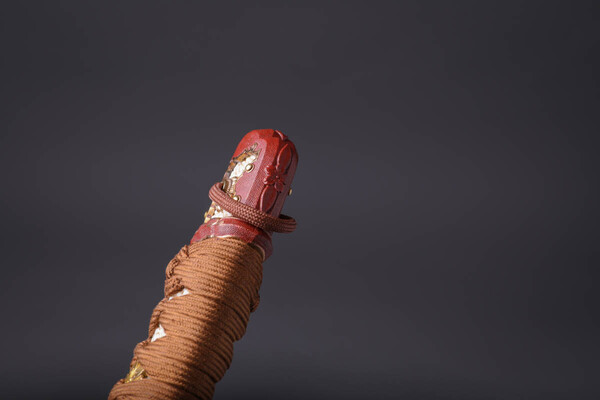
Can you imagine some of our swords looked like this at one point? A perfect example of a top quality Type 94 with pinned Kabutogane attributed to General Prince Yasuhiko Asaka. https://buyee.jp/item/yahoo/auction/j705406702


 1 point
 -
Was just pointed to this thread, as I have apparently come into possession of one! Didn't even know this was a thing.
 1 point
 -
John , interesting topic. These swords have a number of things in common . 1. High status 94 pattern koshirae for usually high ranking officers . 2. Usually house an old blade (making manufacturing date impossible ). 3. The sword with the general tassel has a drilled kabutogane, where the other is drilled and has pins inserted . 4. The ferrule for the sarute barrel if floating and not cast in the kabutogane like later 98 pattern . 5. I have a couple of bona fide 94's that are not drilled, pinned, or don't have floating sartute ferrules. (later production ?). 6. I think they are early 94's as the koshirae required a lot more fiddley pieces and workmanship , probably pre-Pacific war time . Interestingly, both the swords pictured have the family mon on the fuchi NOT on the kabutogane.
 1 point








































This leaderboard is set to Johannesburg/GMT+02:00