
Leaderboard


Popular Content
Showing content with the highest reputation on 12/17/2025 in all areas
-
6 points
-
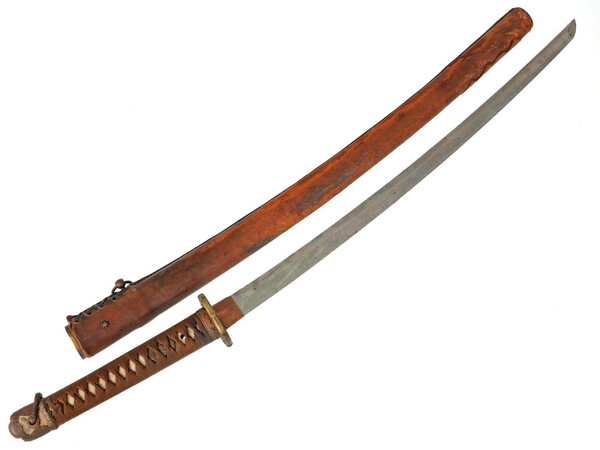
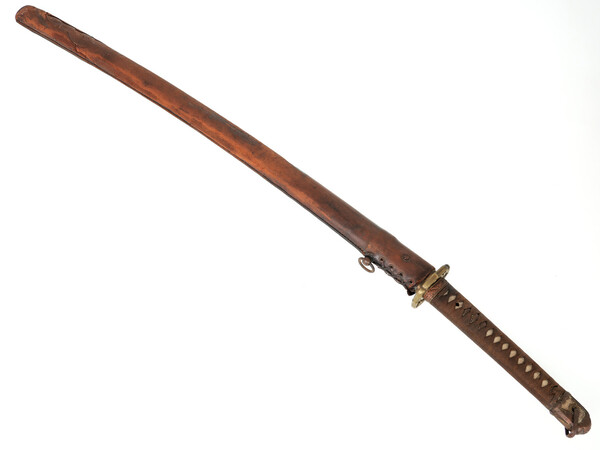
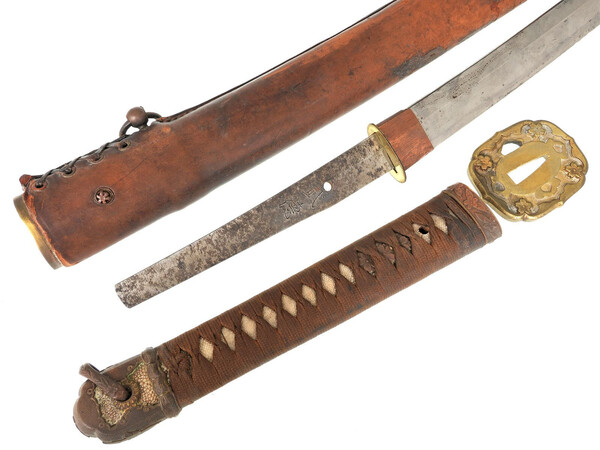
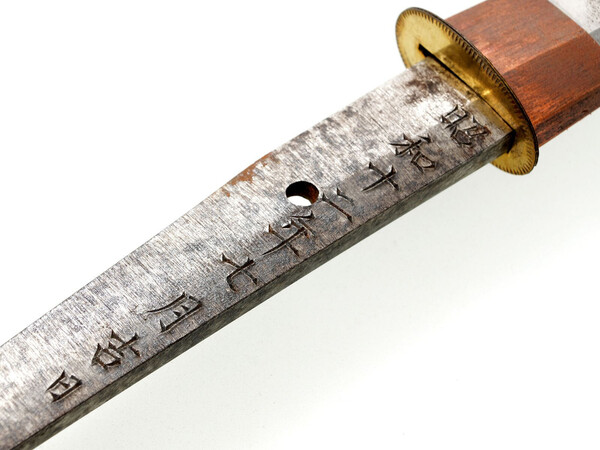
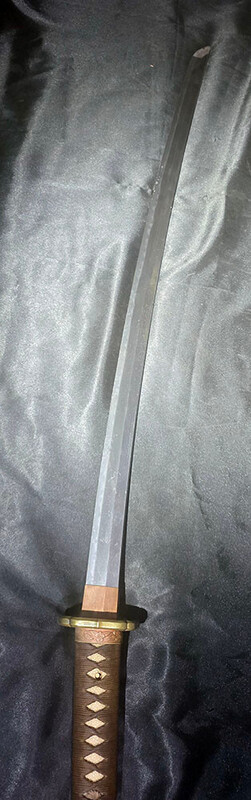
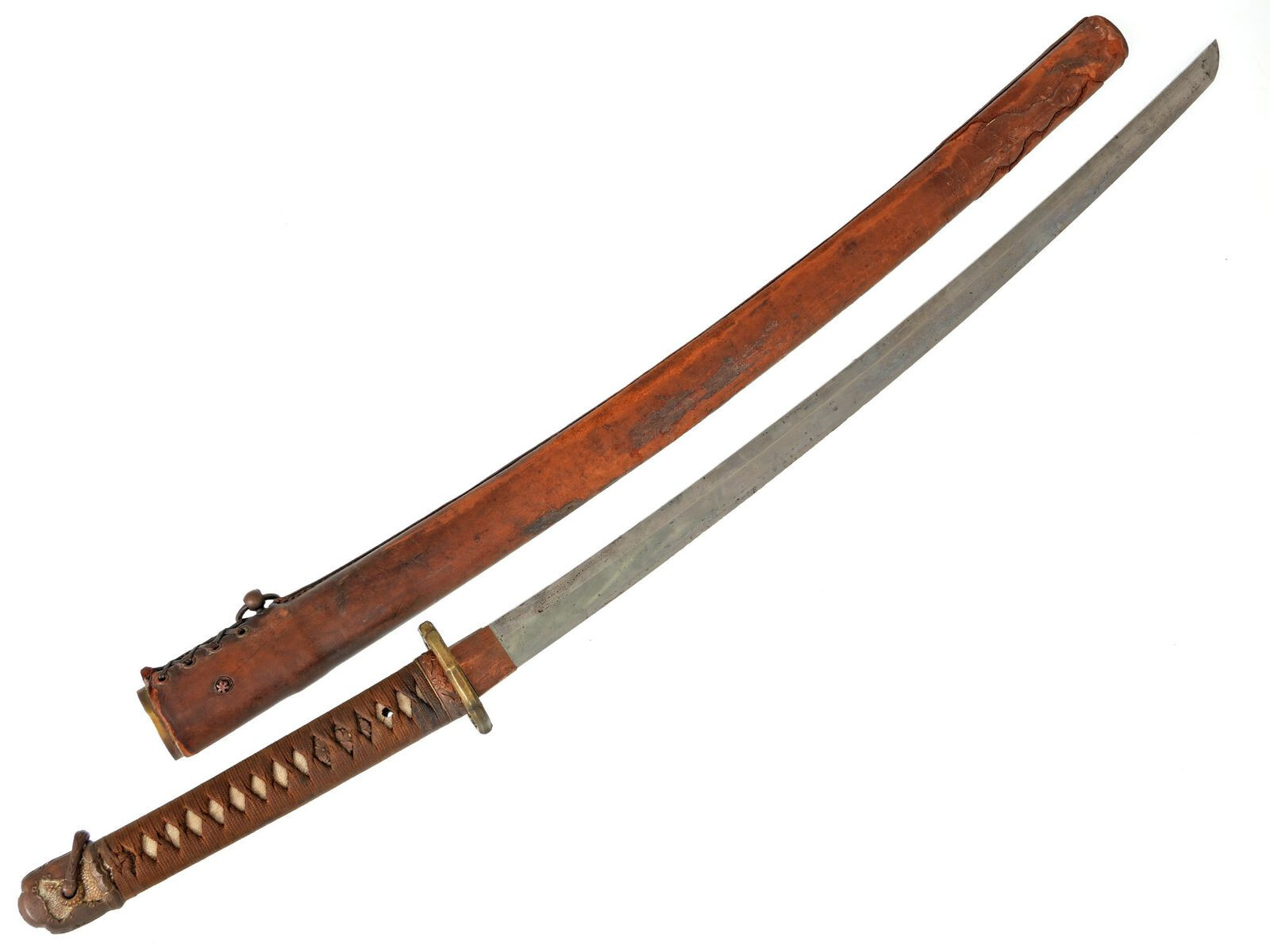
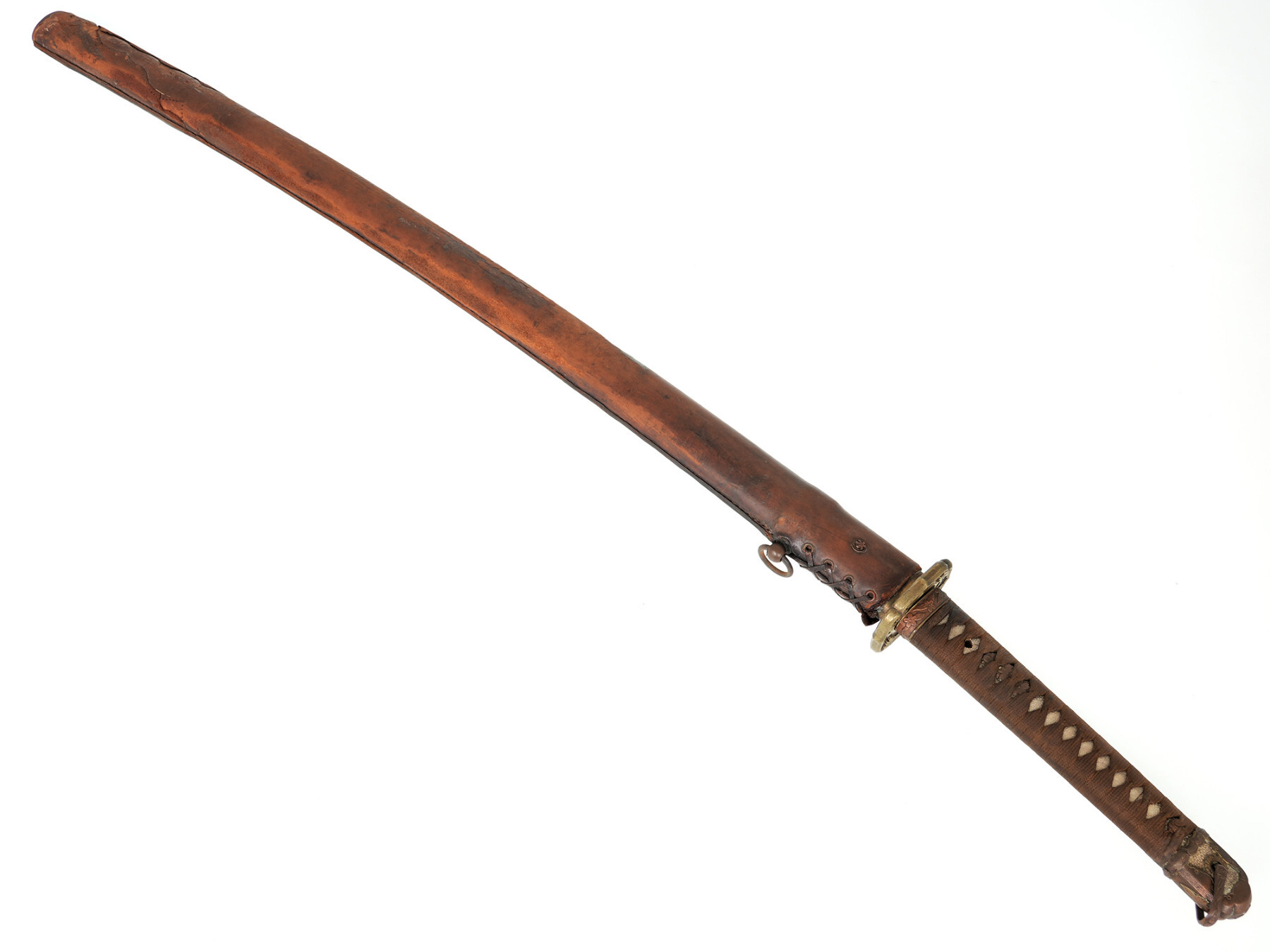
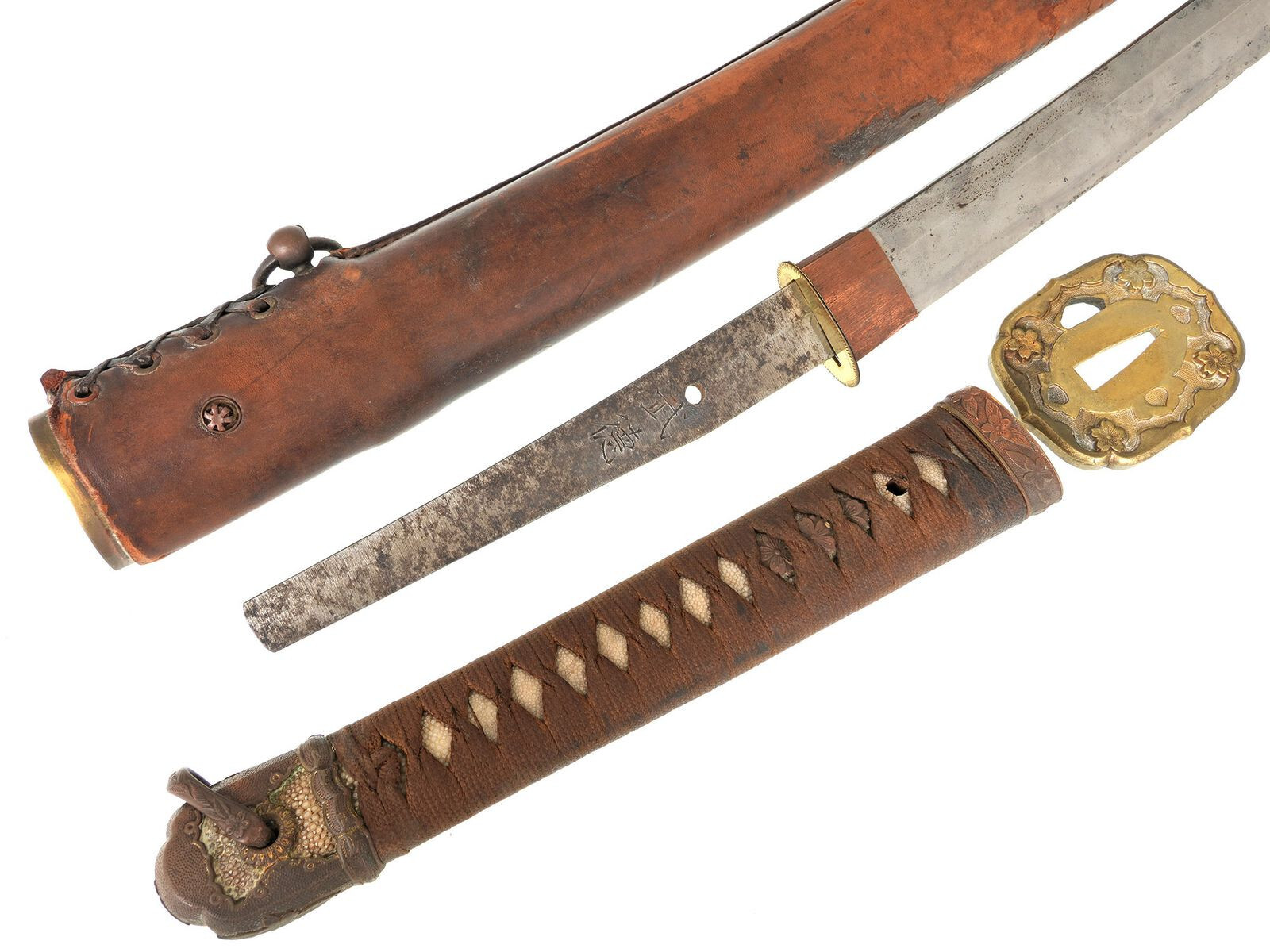
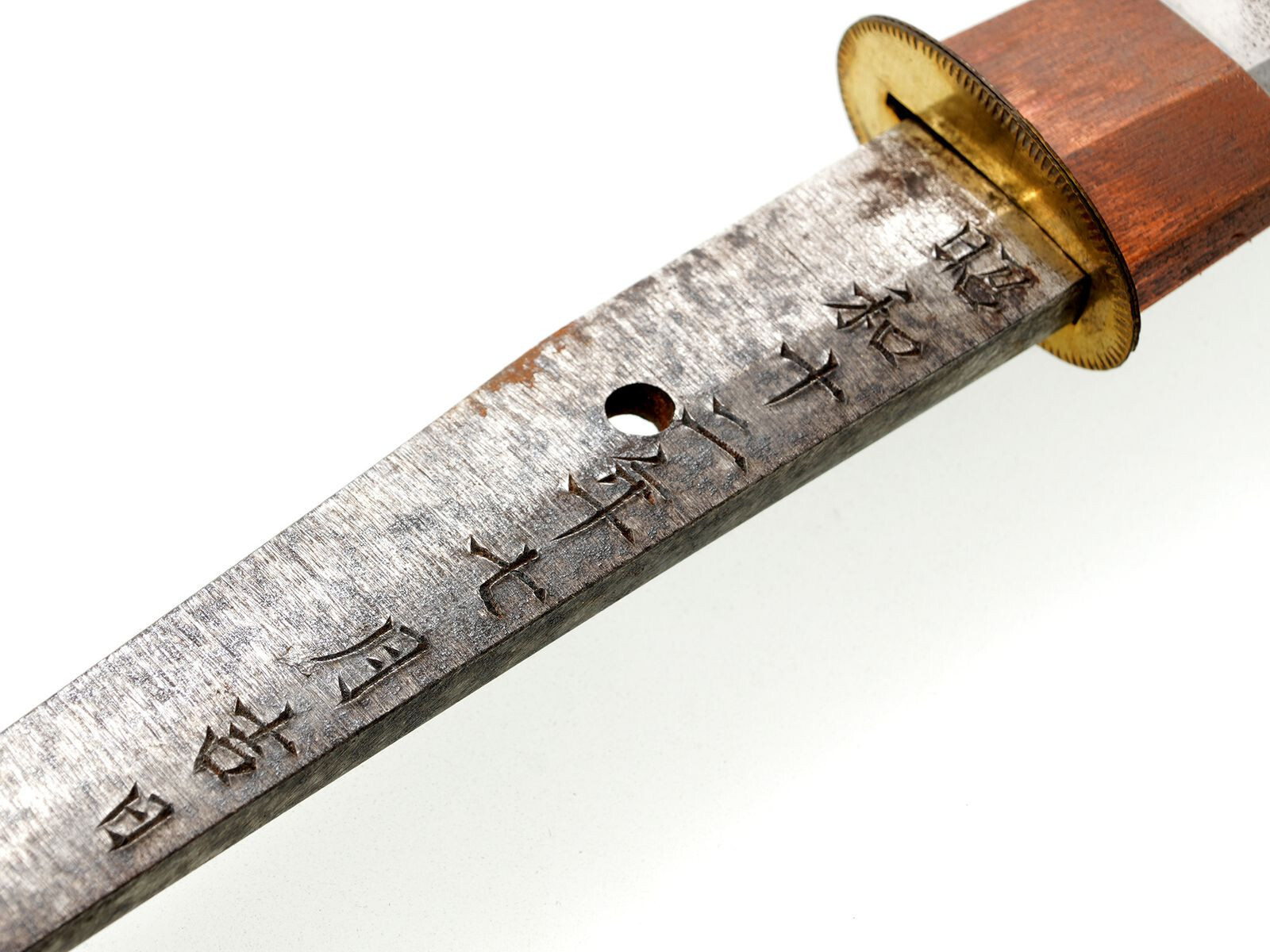
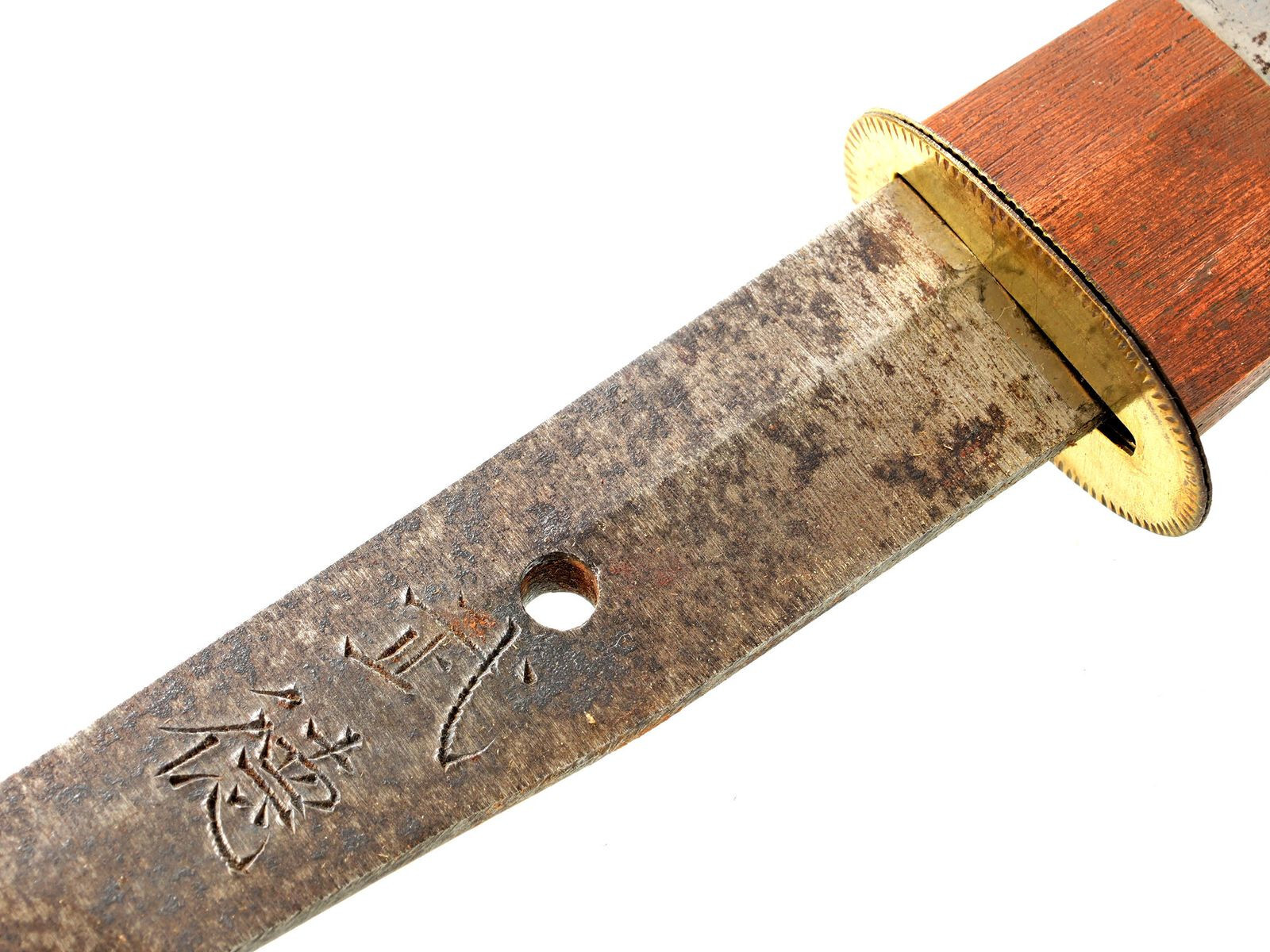
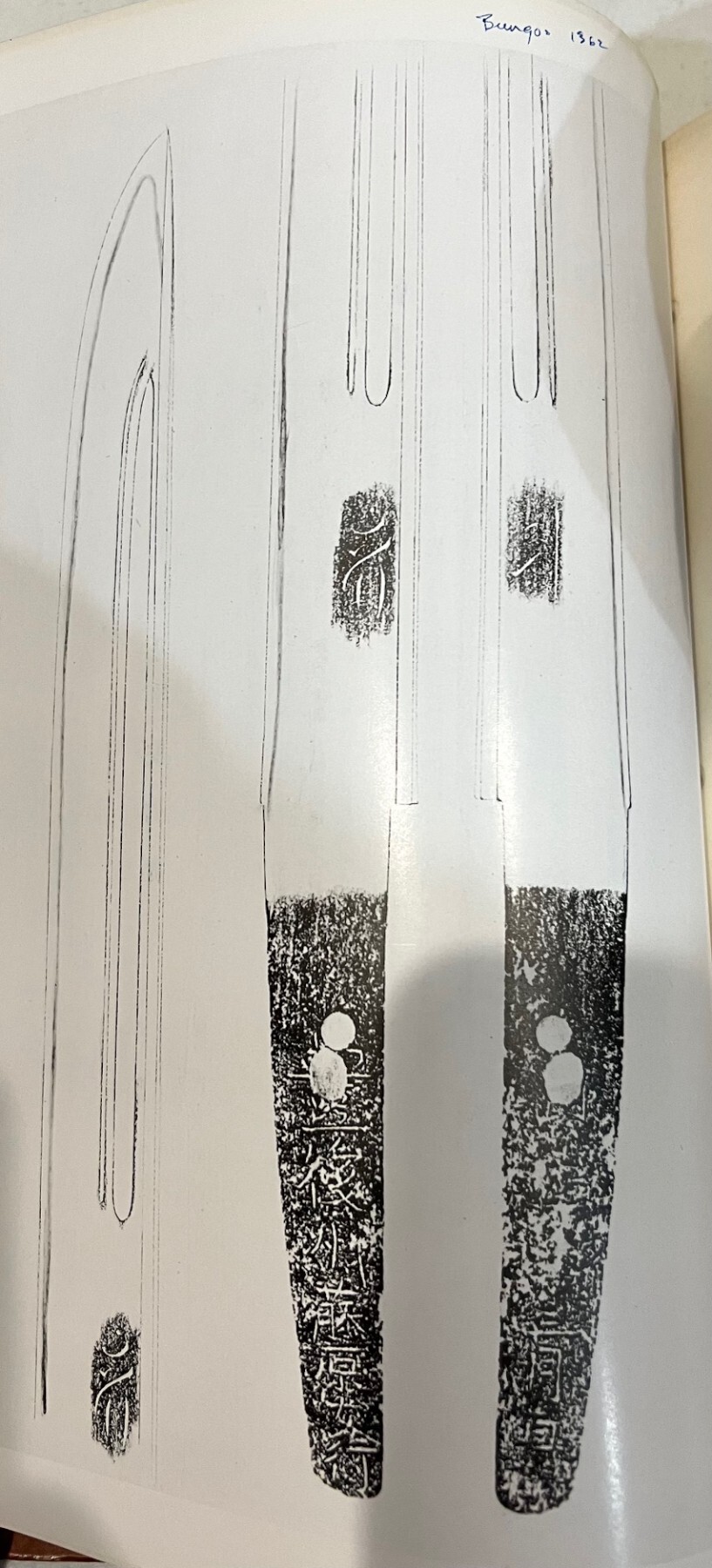
Even a blind squirrel finds a nut :-) I think I got my Xmas present. About a week ago, a respected and high end US collector of Gendaito posted on an SA site asking for advice on shipping a sword from SA to the US. All I could offer was the name of a lady that does knives for the collectors here, and the advice that shipping a sword from here is very complicated and difficult. None of the courier companies want to handle them. Anyways, I was interested how a decent sword would be found in SA of all places, since we hardly ever see Nihonto for sale here, but I forgot about it. About 3 days ago...I was browsing the website of a large local auction company that regularly has antiques and collectibles auctions. I have bought from them a few times, but almost never Japanese stuff. Usually knives and other small things. Imagine my shock when among the lots, I see a Shin Gunto for sale. I assumed it was a fake, but opened the pics anyways, and was surprised to see it was genuine, with a nijimei signature. Took me a few minutes, and I was gobsmacked to realize it was signed Takenori! (Later I realized it was Taketoku)| Realizing this was the Yasukuni smith, my heart went into overdrive. I realized this must be the sword that the collector had his eyes on, and i knew on an SA budget, there was zero chance I could compete. But I bookmarked the auction, and started planning what my budget was. A Yasukuni related sword has always been on my bucket list. Before the auction ended, I took the bid to a winning bid of about US$1150, and prepared for a fight at the end, and to see it end at far more than double that. Auction time, the lot eventually came up, and I prepared to lose, but at least to put up a fight. The lot starts...the price sits there. I'm waiting for other bids. Nothing? My heart is about to burst. Final call comes up...usually for about 5 seconds...this time it sits there for about 15 seconds. I am having a panic attack. Closed. I win it at $1150 plus about 20% premium. I don't know what I did to have some luck for a change, but I'm not complaining. Maybe shipping overseas was too complex. Don't know why locals didn't bid, that's cheap even by local standards for a regular Gunto. I was lucky..a friend was flying down to that city yesterday and driving back, and he agreed to fetch it. After some complications (Auction house decided to close yesterday and i had to reach out to the owner) my buddy brought it back late last night and I got it today. A lovely Kajiyama Taketoku Gendaito, made privately while he was working at Yasukuni but after he changed his nakago shape to kijimomo to prevent confusion between himself and his nephew Kotani Kenzo. Dated 1937 and in very good original polish, some stains but everything can be seen. Cleaned up nicely with isopropyl alcohol and some oil, and has a stunning sugata, tapering to a small ko-kissaki. Kijimomo nakago, nagasa is 655mm. Signed below the mekugi ana, which is something I need to research. It's only in hand you can appreciate how different these are to military swords. Light in the hand, with a Koto feel. Has a straight and active ko-choji hamon that I am still getting into examining. Lots to see and beautifully forged. Hard to take photos, so will add as i go along. But consider me one very happy guy. No idea how this got to South Africa, or the story behind it. But for now I am happy to be its owner, and thanks to that collector for giving me the shot at it. It has a good home and will be well cared for.



 6 points
 -
About 800 in these books!
 4 points
 -
HGK04 板鐔 – Itatsuba HGK05 鑢地 – Yasuri-ji HGK13 共覆輪 – Tomo-hukurin4 points
-
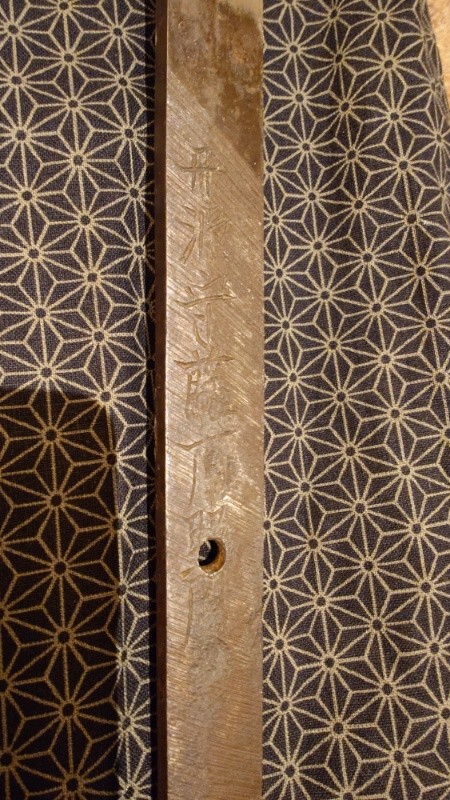
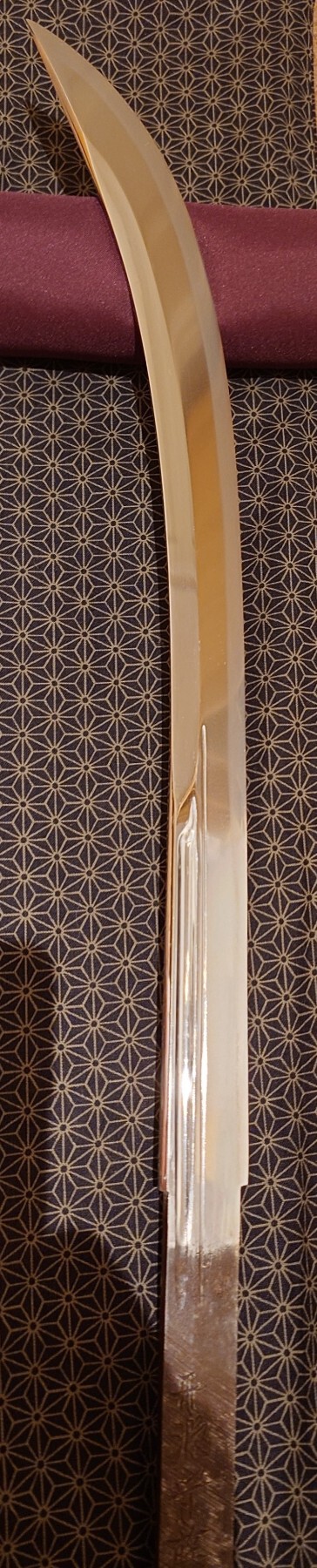
Just wanted to share my latest purchase. This is another Tanba no Kami Terukado blade. I bought this one at auction, and had it sent to shinsha - slightly worried as the mei had some corrosion, so I was only 80% confident. Anyways, it passed Tokubetsu Hozon, and I'd say the hamon is actually finer than some of the long sword examples I have. So very happy. Looking for a good ko-wakizashi or tanto next. 💪


 3 points
 -
Thank you, in session 35 I am not sure what item I was missing back then, as I got the book it has bit different numbering that I have adjusted for the current version. It is so much easier with the books as I can always look at the item. For session 61 I had actually skipped a den Unjū blade by accident later on, so big thanks for noticing this. Going just through hundreds of lines of text without any pictures is where I had made most of mistakes. I just have some Jūyō books that are very delayed because of Finnish post waiting inline for customs for 2 weeks now. I think I can do a full updated version of this early next year where I have corrected most of my mistakes.3 points
-
Thank you Brian can only confirm, that Kotani san was a kind and polite person and as we all know by now a great swordsmith! I was happy and proud to have been in good contact with him until his passing on March 1. 2003 a on nd special thanks to his granddaughter, who kindlydid all the translations between us. Once again, congratulations on your new Taketoku, we've already talked about it. An extremely rare signed example crafted by the great Kajiyama Yasutoku.3 points
-
Here's the best write-up I've seen on Taketoku https://yasutoku.blogspot.com/2014/07/tachi-by-kajiyama-yasutoku-may-1936.html3 points
-
A few more impressions. It starts at 9:00 minutes. With more usual suspects...3 points
-
I think this would be of interest to @Volker62 and @PNSSHOGUN3 points
-
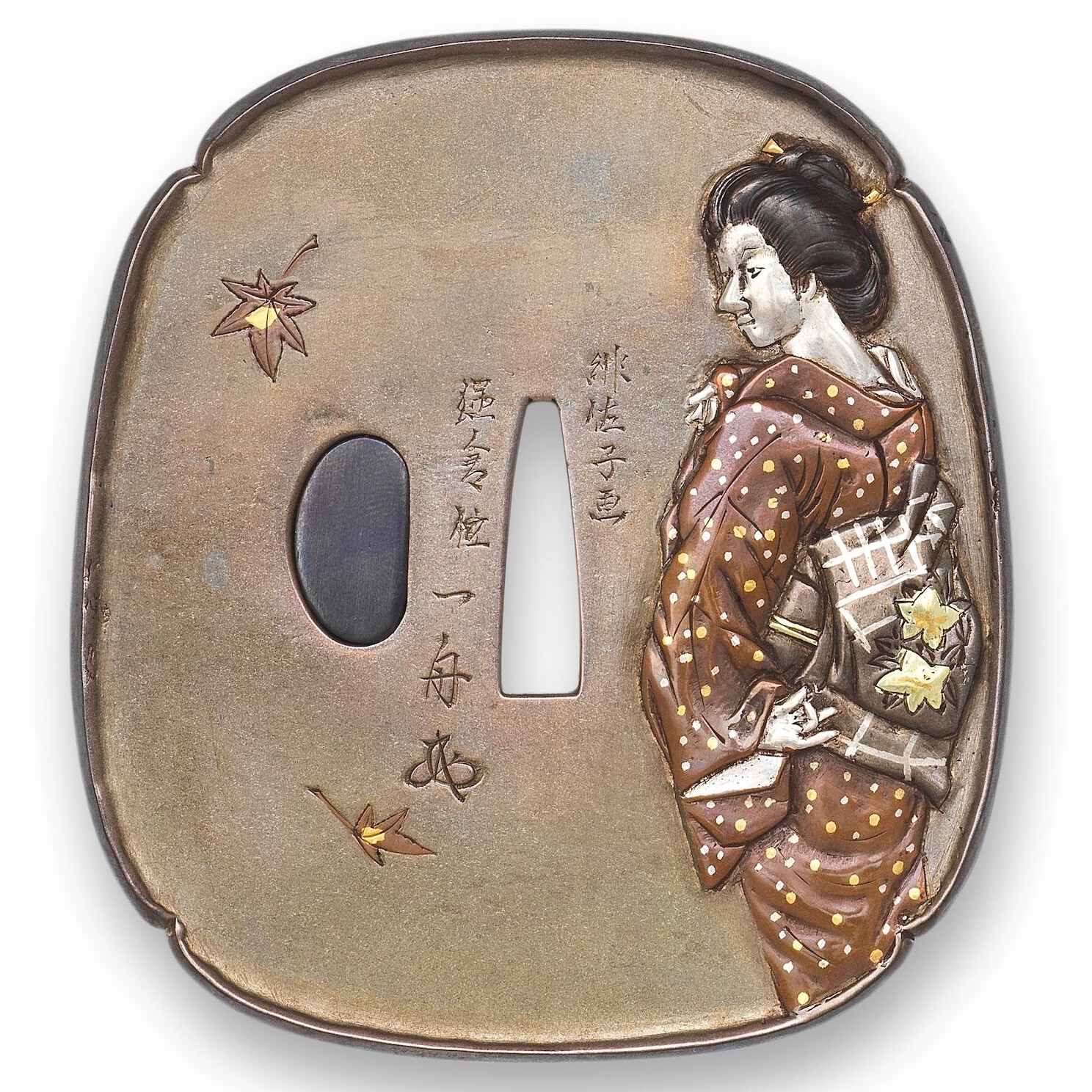
It really is. After reading this article, I became curious about the approximate cost of a piece of tosogu during the Edo period. https://nihonto.com/nakai-koshirae/ Must-see We can see that the prices of high-quality works were truly impressive. These prices were justified not only by demand and popularity at the time, but also by the amount of work involved. How much would you estimate a piece that took about three to six months to complete? Today, such a price would not be much lower. For example, prices for top-end tsuba by Ford Hallam start at around $5,000. Obviously, producing such work requires a great deal of time and skill, making it inaccessible to many people. Looking at examples related to this topic, it seems likely that someone simply wanted to quickly create something similar and sell it to an inexperienced collector, which, judging by the auction results, was successful. However, I still think it could have been made in Japan, but with a different goal - purely for profit. During the Edo period, there were also many rather “simple” or even crude works by novice and inexperienced artists. The difference is that in those days the primary purpose was practical use, whereas today the context is completely different.2 points
-
For the torokusho, I think we're only disagreeing on semantics - we've both set out our case, so all is well. 🙂 For the NBTHK certificates, these are rare - I can only recall ever seeing 2 or 3. As you say, the vast majority will be described as wakizashi on the kanteisho (even if the seller describes it as a tanto).2 points
-
Rob: The term stands for Post Exchange. Army posts all have a store, which varies in size depending on the size of the post (or fort if it's larger; depot if it's smaller), that sells everything from basic necessitites in smaller posts up to full-on big box stores in some of the larger forts. John C.2 points
-
This is the only Taketoku signed blade i could find. Apparently, they are much rarer than those with Yasutoku signatures. 👍 日本刀・表/武徳(靖国刀匠 靖徳同人)|日本刀・刀剣販売の十拳2 points
-
I have a wakizashi with a cut in the nakago as well. This one is in gunto fittings.

 2 points
 -
Congratulations, glad the blade cleaned up nicely. Onkashi had the important differentiation of having "Kinsaku" added to the Mei, they seem to have been only made at the Yasukuni Shrine forge.2 points
-
Still, I think it's just very poor quality and not following traditional techniques… It would be interesting to see them live. https://www.bonhams.com/auction/30444/lot/165/kawai-isshu-born-1920-an-inlaid-mixed-metal-large-tsuba-showa-era-1926-1989-mid-20th-century-2/

 2 points
 -
sorry forget to mention The appearance of such eleaborately crafted blades is often more attractive to our taste. like hamon ,shape , ect ect2 points
-
Brian after my reseach the reason for different place of the Mekugi ana could be a visual marker that the blade was made outside the shrine forge. the smith was free to choose the style of the balde and was not bound by the the strict rules of the shrine smith gulid2 points
-
Guys, it's almost Xmas, can we get less defensive and a little more chilled in our discussions? Let's have a peaceful December. Ed has been around the block more than most, and I can assure you he is just giving the facts as he knows them.2 points
-
@NotANinja Rob, PX is a store/retail outlet/supplier for US troops near their bases. They had them for occupation troops in Japan. Immediate post war, 1946, the PX stores were seliing "souvenir" swords that were made of arsenal parts left over. The blades were mostly naval arsenal with anchor stamps or anchor/circle, the tsuba mosly black plain iron ovals shape, and the tsuka bound but often with canvas underlay. The Fuchi/kashira were often mixed army/navy. Bruce has been compiling info on this....its confusing.2 points
-
I do speak English. Perhaps you struggle with comprehension. You are putting words in my mouth. I never used the word inaccurate. Superficial: appearing to be true or real only until examined more closely. concerned only with the obvious or apparent : not thorough or complete. The measurements must be more than a superficial, they must be accurate as I stated previously.2 points
-
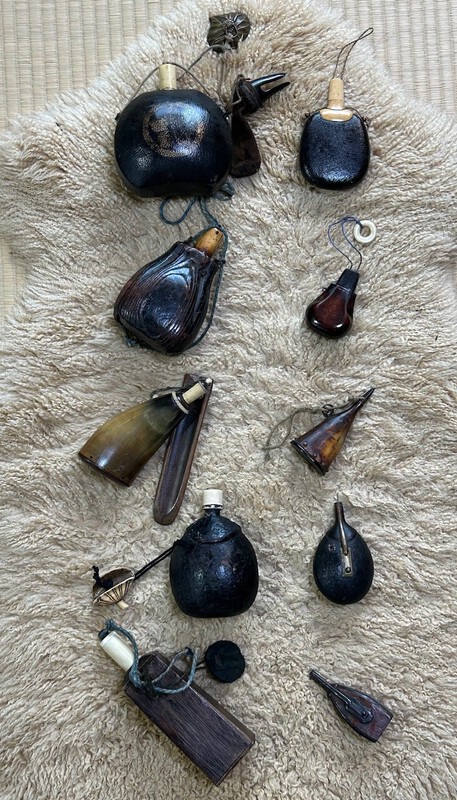
Recent posts regarding powder flasks have led me back to look again at A. and B. in the list at the top of this thread. 1. A gunner would have a large flask (A) for coarse gunpowder to replenish the quick-loading tubes, or to pour in measured amounts directly down the barrel for the main charge. 2. Hanging from the front of his armour would be a smaller flask (B) for the pan-priming powder, which is the same powder, but more finely ground. The pouring spout is narrower, to pour a pinch of fine powder into the pan. (B) flasks are smaller than their companion (A) flasks, though for a large gun you could have a relatively large flask (B) and a much larger flask (A). Photos below, showing example 'pairs' of (A) left, and (B) right, and their relative sizes.
 2 points
 -
Dan: I'm doing basically the same thing with mine. I too have several books published (I use Ingramspark). My method for the book covers, and for one of the interior files that is picture heavy, is done using Adobe Indesign. It has a HUGE learning curve but is by far the easiest way to layout the book. You can "rent" the software for 35 dollars / month and cancel after that. I watched hours of YT videos on it, got a free 7 day trial to practice, then rented it for a month and was able to create, layout, and publish all of my covers at one time. I also bought some "green screen" from Amazon to photograph the items, though you would have to use a photo editing program to get rid of the background before pasting it into the layout. Looks fairly professional. John C.2 points
-
Could be a postwar PX sword and I will kindly ask @Bruce Pennington to take a look at it.2 points
-
Thanks my friends for your kind words and support about cataloging my tsuba. So, here is something I was just thinking about (with my one brain cell!). I have self-published two small books using Amazon KDP. Not to sell them or make money, but just to have my research written down in a book type format. Yes, I am old school and prefer reading a book to reading a computer screen. Also, if my computer stops working or I lose my thumb drive, I still have something written down that anyone can access. Now what is cool about Amazon KDP is you can order proof copies to check out your work, and you can always edit or add to your work at any time. Also, Amazon KDP is a print-on-demand system. No minimum number of copies have to be ordered. Once someone orders a book, it is printed at the nearest Amazon KDP facility and sent out. So no major expense has to be invested by me in my catalog of tsuba idea. So, I think I will digitally photograph my collection and describe the tsuba or maybe just show pictures and the price that I think the tsuba are worth, so my heirs will have some clue as to what to sell them for. Then I will send a copy of the book to all my kids (not really kids any more at 43, 49, and 51 - but middle-aged adults!). Then when I pass, they will be coming over to the house with a copy of my book to pick out the tsuba that they want! Maybe they will keep some or sell some (or all!). Hey, but that won’t be up to me anymore!! I think this tsuba catalog book thing is a good idea!2 points
-
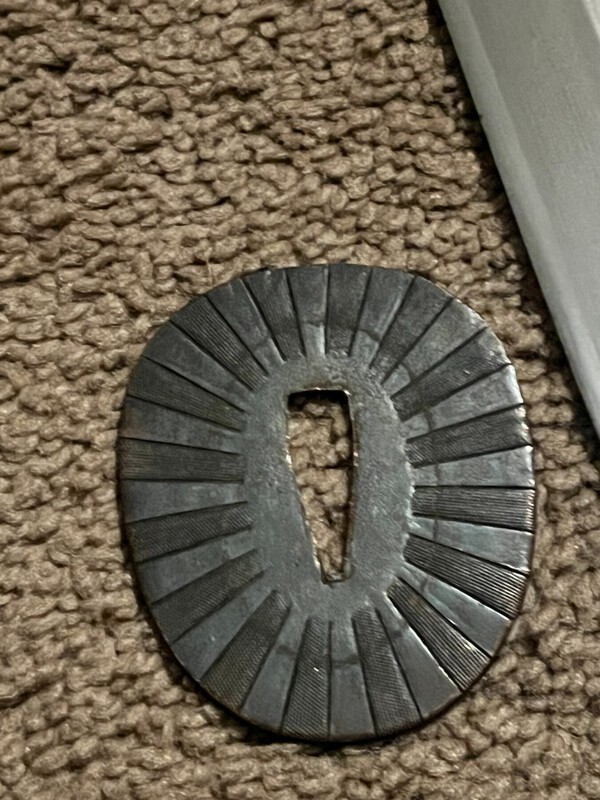
I was enjoying my kaigunto last night, and thought to count the rays of the daiseppa. There are 32, just like the 32 petals seen on the Imperial chrysanthemum. Maybe this is common knowledge, but I've never realized it before.
 2 points
 -
Yeah, I think at some point the fittings were changed, as the solid tsuba has 2 regular very thin seppa and the tsuba has has a slot for that leather retainer. I'll look at sorting the fittings out sometime. Interesting leather combat cover with lacing, and a brass? protector at the bottom.2 points
-
Yup, all good things come to those who wait. It was meant to be. Serendipity at work! Great find, and nice write-up.2 points
-
Hi Brian, If, as you say, you are new to the hobby, you don't want to be searching unknown websites for a bargain; it's a jungle out there. You need to learn a lot more that you currently do before buying and, even then, a trusted seller will be helpful. No need to hurry to a purchase; good Japanese swords will always be available. Grey2 points
-
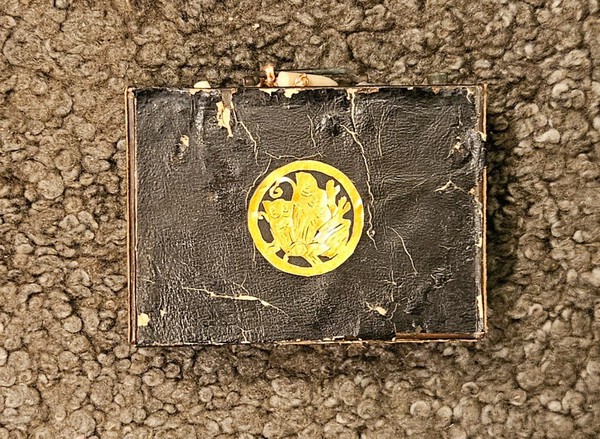
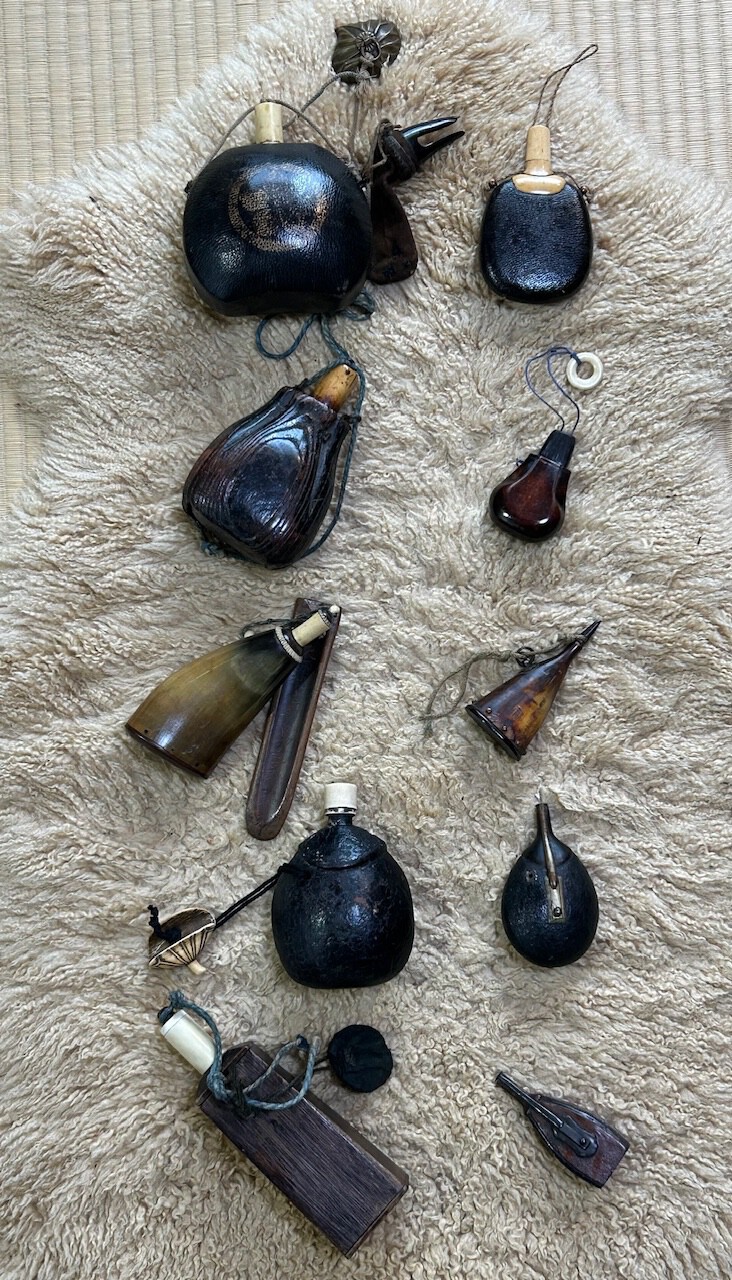
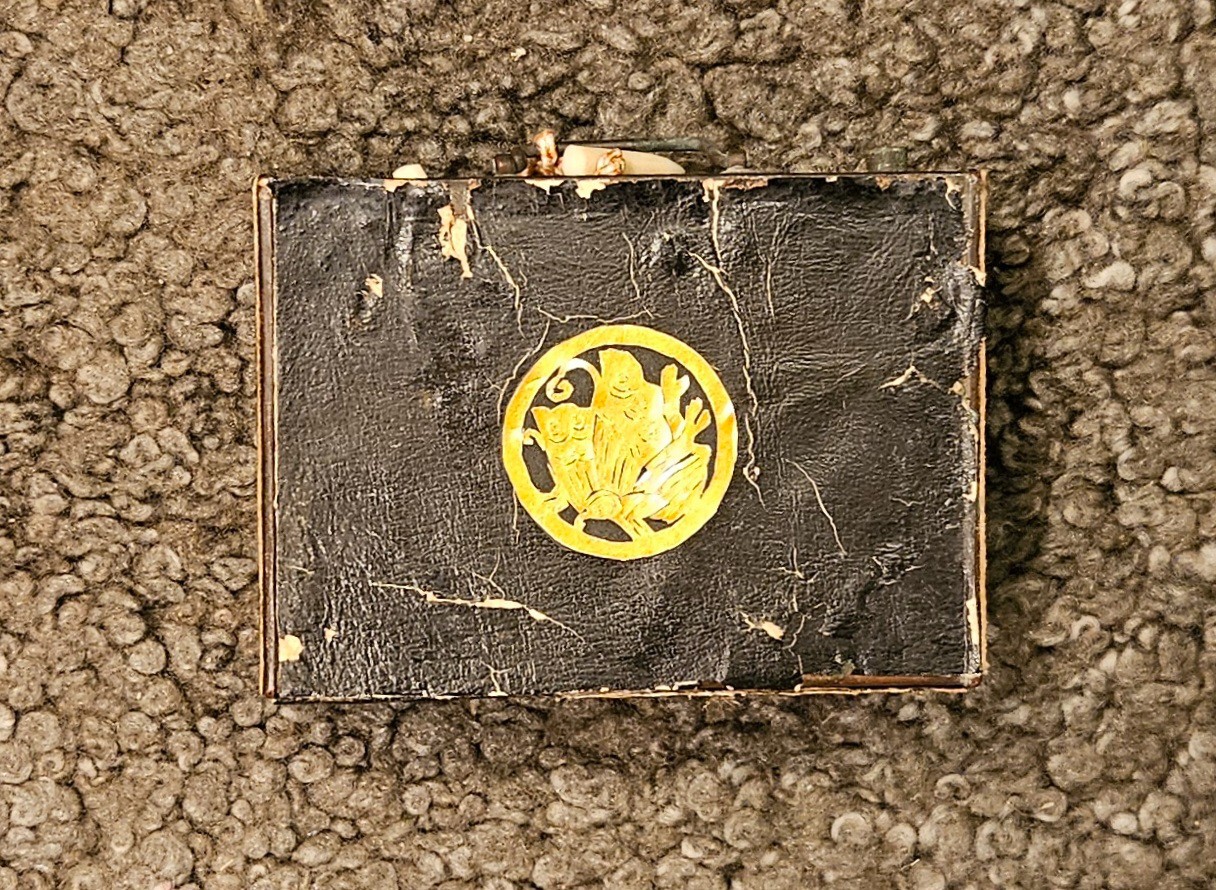
Won a handful of supposed gunpowder flasks at an auction as a part from a collection of different Japanese items. No muzzleloaded weapons at this auction. I am a beginner in this field so found this forum to lean on with hopefully answers on this flasks/boxes. Have been an active shooter with Japanese muzzleloaders since a while though. This kind of accessories almost never occure on auctions that I attend. On one picture western gunpowder and primer flasks for comparison. The box measures 11x8x4 cm.


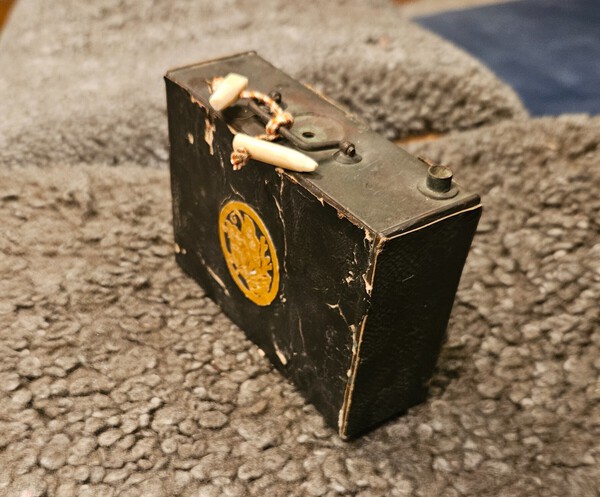
 1 point
 -
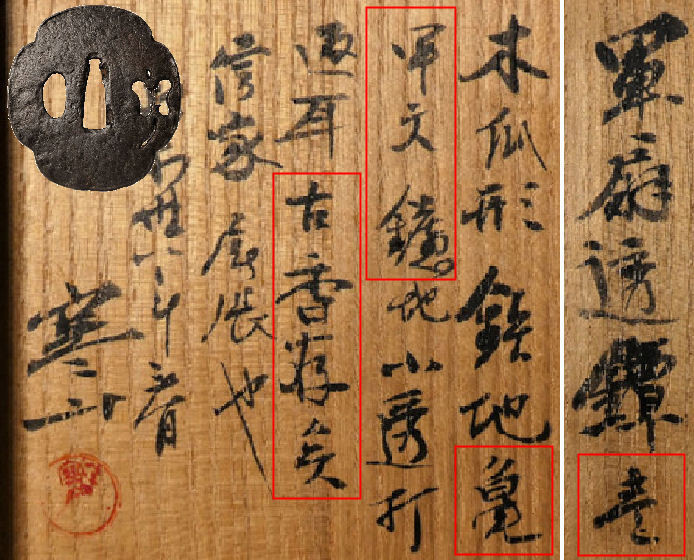
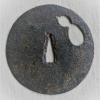
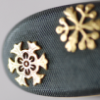
The project to compile a short collection of transcriptions of hakogaki by Satō Kanzan has grown larger than I originally intended. It now comprises 86 hakogaki (although at least three are likely forgeries, but I digress…). There are still missing kanji and transcriptions that need to be confirmed, so I kindly ask for your help. Thank you in advance. HGK04 Only one kanji is missing (but I am unable to identify it). 葵形 鉄地 * aoi-gata tetsu-ji ★鐔 透 * ??? sukashi 馬面序政(花押) * Bamen Tsunemasa (kaō) 珍也 * chin nari 昭和卅六年春 * Shōwa 36-nen haru [1961, spring 寒山 * Kanzan HGK05 There are quite a few gaps here: 軍扇透鐔★ * gunsen sukashi tsuba ??? 木瓜形 鉄地★ * mokkō-gata tetsu-ji ??? ★★ ★地 小透 打 * ??? ko-sukashi uchi 返耳 ★★★★ * kaeshi-mimi ??? 信家 尾張也 * Nobuie Owari nari 昭和卅六年春 * Shōwa 36-nen haru [1961, spring] 寒山 * Kanzan HGK13 One kanji is missing (could be 芝, but what does il mean?). 丸形 山金地 ★覆 * maru-gata yamagane-ji ??? fuku- 輪 小田原之 * rin Odawara no kore 無銘 彦三 * mumei Hikozō 昭和乙巳歳春 * Shōwa kinoto-mi no toshi haru [1965, spring] 寒山 * Kanzan

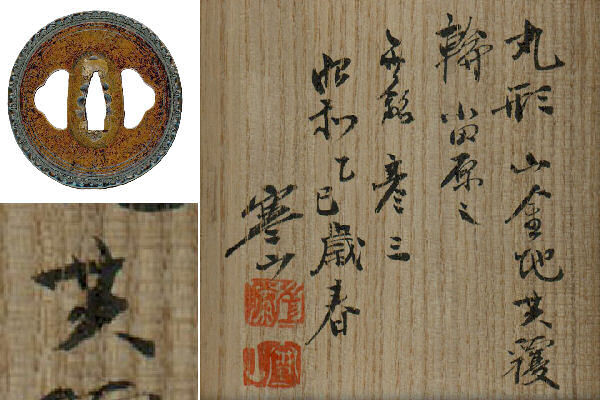
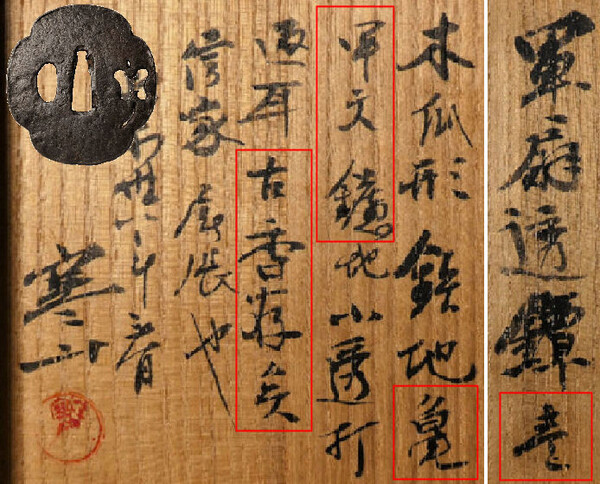 1 point
 -
Storing tsuba in Petri dishes, that'a a great idea!1 point
-
That may well be. My thoughts are that newbies might take these late reproductions for the real thing, and I would not like that.1 point
-
Haha! Two powder flasks out of three items. And one Japanese!! Not that bad for a Japanese rookie collector..... Soon gonna expose one more flask.....1 point
-
Thanks a lot for wonderful info! Well, I rarely wear my obi outside kyudo practice but I like the shape of the gunpowder flask regards. Unfortunately no ball in the bag....
 1 point
 -
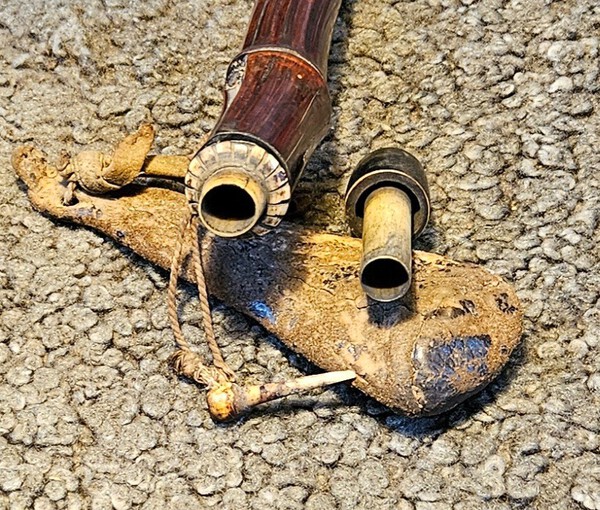
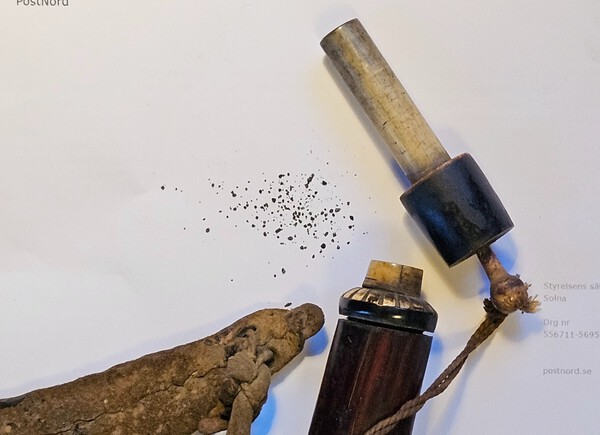
Next is this bamboo container wirh a leather pouch attached. Still some blackpowder left inside. The plug also works to measure right amount for loading. Bamboo powderflask 34 cm long. Any info on this item welcomed!
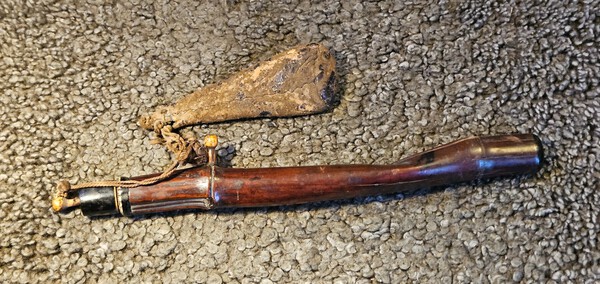
 1 point
 -
Addition, HGK05 亀甲文 - Kikko-mon 右香存矣 – This item has good taste. (Unsure)1 point
-
Hi All. I moved to another state and a smaller home last year and have decided to sell about half of my collection, which has been overflowing from my safe. I will be attending the shows in Las Vegas, Chicago and San Francisco this coming year, so please look me up if you attend any of those shows. If you plan to attend, or if you are not but are still interested in seeing the list of swords that I will be selling, please drop me a line and I will be happy to send you the list. In the meantime, I have listed a few nice swords on eBay. I am posting one of the links below. If you click on "sellers other items", you will find the rest. Sorry for my poor photography - I am working on improving it! Cheers, Bob PS, I'm a long time supporter of NMB and will make an extra donation if this posting yields sale results. PPS, I have been having trouble logging on to NMB (working on it with Brian), but the message function appears to work. https://www.ebay.com/itm/1679648008301 point
-
Do you have any reference to "Genuine" captured late war gunto with the one piece fuchi/seppa? Hard to tell in the photos, but these parts may have been gilded at one time and/or are just heavly tarnished. I so far have only seen this combo on the PX swords along with them having mixed parts i.e solid iron tsuba, navy menuki with army parts, navy kabutogane with army menuki etc.. I would be curious to learn that legit war time swords like this have actually been taken from combat. I have only seen documented PX receipts.1 point
-
My friend John C. Making a catalog of our tsuba collection for our heirs is a great thing to do and maybe it will let them realize that we had a great, interesting, and educational hobby. Or maybe they won’t care and just want to sell what we collected! Anyway, it won’t be my problem! But I will say that when I published my small books, Amazon KDP was great! I watched some YouTube videos about it. And even as computer illiterate as I am (with my one brain cell!) I figured it out! Amazon KDP doesn’t cost a thing! You only pay (and it is not very much) when you order your proof copy. I really enjoy that you can always edit and add new things to your book without much of a hassle. Onward my friend, to me taking pictures of my tsuba collection!1 point
-
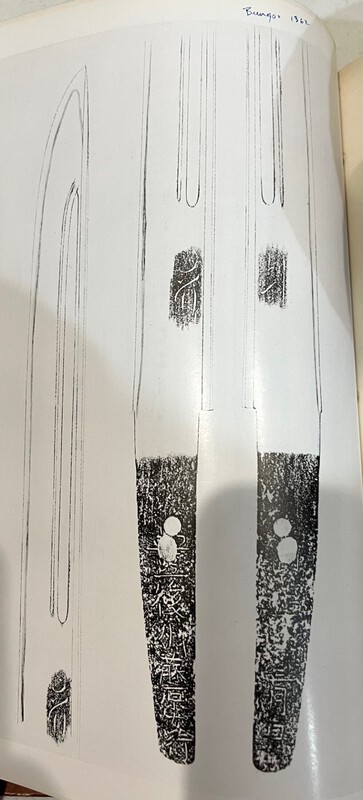
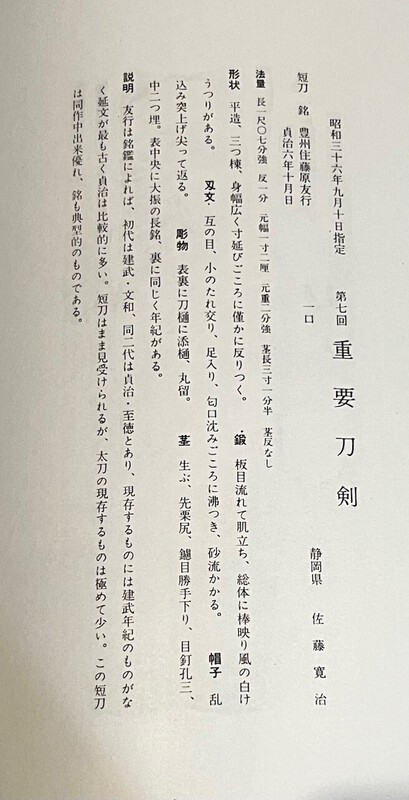
I think the confusion boils down to semantics and/or context. Were there Tanto over 1 shaku? Yes, Sunnobi Tanto were blades with a nagasa greater than 1 shaku and mounted as a tanto. In todays world of Japanese swords, the regulations which govern entities such as the NBTHK have set the criteria at three basic designations, tanto, wakizashi, and katana with some rare exceptions. If you submit a sword today mounted as a tanto, sunnobi or whatever, and the nagasa is over 1 shaku, it will be papered as a wakizashi. Yes and no. They actually call the entry process shinsa. While not in the context we commonly think of as shinsa which is much more detailed, they do have to address topics like measurements and mei for the torokusho. There is no research regarding the authenticity of the mei, but the measurements have to be correct, not superficial by law. It you are checked by the Japanese police and the measurements do not match the torokusho, the trouble you will incur will be far from superficial. As in the case of the torokusho in question, it clearly states "Wakizashi". Yes, there are Juyo Tanto with nagasa slightly over 1 shaku that were papered some years ago. Honestly, not sure if that is still the case today. If you have evidence of modern papers which state "Tanto" with nagasa over 1 shaku, I would like to see them. @Jussi Ekholm would probably know. Here is one example from the Juyo Zufu: Hoshu ju Fujiwara Tomoyuki, Bungo, Joji 1362-1368, Sa school. Tanto, Nagasa: 1.07 shaku 1 sun, 2 bu.
 1 point
 -
Great story, Brian, and what luck! Worth twice that in the US market. Also, lucky to still have the koiguchi on the saya opening. They are often missing on these type saya.1 point
-
I will create a new thread for the item and some more.....1 point
-
Hoshi this was probably the best thing I have ready all week - certainly made me smile - great write up. Thank you so much for taking the time out to share your hard earned knowledge. I woudl say you did Darcy proud!1 point
-
Curran, I have also had my eye on a fuchi/kashira set that I am going to pull the trigger on too. I will write down what tariff code I used and post it once I make this happen. Not sure it would apply to swords, but I am thrilled it worked for this tsuba. Jason1 point
-
Thanks a million times for that fast and informative answer! Thrilling!! Will create own posts on some other blackpowder containers in few days. And Alan, what a beautiful tanegashima. So nice with that bee wax pattern on the barrel. I am a bee keeper myself so my heart melted......1 point
-
Hi all, I think if you want to sell more than 1 item at any 1 time you should have to have gold membership Regards Ken1 point
-
Interestingly, when I have it right in my mind, it was long considered improper and dishonorable to work for personal profit in Japan, which is why merchants were regarded as possessing the least desirable traits as a class. The samurai had always possessed qualities that were considered desirable and attractive by other classes, both because of their social status and their rank. Through a process of samurai mimicry, merchants sought to elevate their own status by engaging in activities previously confined only to the samurai class. However, the limitations imposed by the hereditary system meant that merchants, no matter how prosperous or affluent, could not attain samurai status, and samurai were legally prohibited from engaging in commercial activities to improve their deteriorating living conditions. @HoshiUnfortunately, the trend continues that speculative value has become the highest value. The marketplaces are the temples, promoting an exchange dominated by profit motives, drawing more and more of their kind into the labyrinths of barren illusions. The ideological influence on the internal perspective only leads to more anxious vanity and habitual "Unter-sich-Seins“. However, this development also brings advantages, in my opinion. It grants us more sensitivity toward other forms of curiosity and intellectual hunger. This reminds me of the work by Ivan Morris, Nobility of Failure: Where I first read about the concept of "Seishinshugi" – a principle that shapes the philosophy of many Japanese heroic figures and offers far richer possibilities than the mere pursuit of desire. The inner work.1 point
-
Dear John, Yes, Kajihara did use the words Boo Utsuri, ... and I upon making inquiry of others in this regard was advised that a better term would have been Tobiyaki in long straight pattern almost giving the appearance of utsuri. I should have made an inquiry directly to Mr. Kajihara but alas I did not. ... Ron Watson Dear Jacques, I note you have edited your original comments to remove the word " Gimei ", .... a word I note you use somewhat flippantly ( my opinion not that you would care ). I also note you have removed your translation of the Kanji for Izu being in reality Iga in your opinion. I also noted your statement that Mishina School never used utsuri, .... and I have answered this with : a better term would have been Tobiyaki in my resonse to John. Now then as far as the signature and authenticity go, ... I should like to quote a letter from the late Cary Condell ..... " In response to your inquiry, the oshigata that you sent to me is indeed ( Kikumon ) Izu no Kami Fujiwara Kinmichi. That is a rare specimen. According to the Meikan IZU no Kami is the brother of the nidai ( 2nd gen. ) IGA no Kami. The page you zeroxed from Fujishiros' Nihon Toko Jiten page 392 shows an example of a joint work ( gassaku ) of the two brothers with the IGA no KAMI mei ( senior brother) on the omote and the IZU no KAMI ( junior ) on the ura. Your oshigata shows a mei with slight differences with the one displayed in Fujishiro ( look carefully at the KIN & MICHI ). It is unlikely to be fake however. It looks to be closer in feeling to the way the shodai signed. Perhaps the sword you have was made earlier in his career. " Now, ... in addition I should like to quote a letter dated August 10, 1992 from the NBTHK : " As you are already aware, there is very little information on Izu-no-kami Kinmichi besides what is already known to you. He seems to have produced very few swords under his name. It is likely that there are few false works attributed to this smith. " The sword was subsequently examined by Kotoken Kajihara who issued the Shinsa paper in 1994 stating GENUINE work by : Kikumon IZU no Kami Fujiwara Kinmichi. In personal communication he felt the work in this case surpassed that of the nidai. I do not mind constructive criticism, .... but I bloody do mind your elitist tone ( attitude ) , and rash statements which you then edit out after a goodly number of our readers have read your original without so much as : " I may have erred ! " I think given the evidence that I have presented, ... that the sword is not only genuine but a worthy study piece. ... Ron Watson1 point






















This leaderboard is set to Johannesburg/GMT+02:00