
Leaderboard


Popular Content
Showing content with the highest reputation on 08/18/2025 in all areas
-
For something like 60 years, I have told myself and others that I am a “Japanese sword collector”. Activities I see here on this on-line community, however, make me wonder if I can still say that. The craft, activities, and joy that USED to mark Japanese sword appreciation are gone together with the satisfaction and growth that used to mark the hobby. After 1945, a huge mass of Japanese swords flowed into victor nations, mainly the US – where they rather quickly lost much of the cache and value they had to souvenir hungry veterans. As families and suburban neighborhoods developed, swords moved from sea-bags to attics and garages and then on into garage sale and thrift stores. As that happened a small and fragmented community of “sword collectors” appeared. I wasn’t a real early adopter, but I was part of the post-war crowd. Given how Japanese blades had been acquired and returned, the challenge at that point was finding swords. Newspaper ads, business cards and colorful displays at gun shows were routine collector strategies at that point. I contrast such activities with sword shopping today where, with a bit of computer skill, you can discover an astounding array of swords. All of that was great fun, but the hard reality is that if the supply of Japanese swords is limited so we can’t “find” them like we used to. The place to “find” swords these days is on-line! The initial collectors’ cadre that did develop had access to a small but interesting body of publications. They may be mile signs long past, but books by Yumoto, Robinson, and Hakusui etc were very useful. They explained a bit about the 1000 year history of “samurai swords.” We came to realize that there were really wonderfully made swords and others that were not as good. We learned about “kizu”, “gimei” “retemper”. We discovered “kantei” well before we developed great skill in the topic. We certainly came to understand that quality was variable and had to be assessed. Making our own judgements was part of Japanese sword collecting, because credible authorities just weren’t there. I contrast that with the current situation were experts will provide you very complex judgements about swords. We simply have to trust them and learn the categories they provide. If a sword is not gushingly described, papered and certified, we better assume that it isn’t very good. We also learned enough Japanese to read signatures. Once we had read a signature, we got to look through a hugely thick reference with pages and pages of smiths That was great fun and made the complexity and richness of Japanese sword history and collecting substantive – and interesting. I developed real interest in the 12 generation of the Sendai Kunikane family and tried hard to understand the middle 5 generations. I am quite sure my efforts they will never warrant the attention of modern certification panels, but it was great fun… for a “collector.” Has the magic passed?5 points
-
I hear you Peter. All things change, and by and large change sucks. Change rarely has a big constituency of supporters. But not all change is bad. I certainly still feel the magic of collecting. I feel the magic of community, of learning and of discovery, whether finding something unexpected on a show table or an online website. I still feel the magic when I unbox a sword or fittings and seeing them in hand for the first time. I feel the excitement of an opinion by Tanobe-sensei or Itoh-san. Whether or not the market is growing or shrinking; whether it will come back resurgent or die, are not concerns that that weigh down my mind. (I personally think works by big name folks will always hold their value, but that's another conversation.) I still feel the magic in learning more everyday and in the community and the camaraderie of friends in the hobby, including new ones that pop into my life all the time because of Nihonto collecting. I still feel a great sense of belonging. Yes, Peter, it might not be what it used to be, I certainly missed out on the gun show chase and the madness of those early shows, and I see some friends aging out of the hobby, but it's still a pleasant pastime for me and my friends doing this. And I am grateful for that. Gratitude is the key to happiness along with enjoying what you have. That powers the magic for me!5 points
-
"Has the magic passed?" Not at all. Changed ? Definitely The seasoned collectors and key players who have passed were once begining collectors and novices as well. And while a great deal of knowledge passed on with them, there ll be a new generation of passionate collectors and future experts eventually. This is not just nihonto but almost every other form of art. Today, It is easier than ever to gain knowledge and learn about anything. Nihonto included. So those who fall in love with the hobby and are willing to learn will have no shortage of resources. It s similar to people who are passionate about sports or music. Those who played/watched in the 70s 80s 90s 2000s will all swear that their era was the finest but this is simply not true. We are unable to process change/ evolution because what we consider "best" is limited by our own experience which shapes our prespective.5 points
-
An observation — all journeys come in stages. At the beginning, the work is hard, but it is also exciting. Growth is fast, and it feels like we make progress with every passing day. But eventually, we enter into the long slog of the intermediate learner, where progression slows down and it feels like a drag... the moments of reward are increasingly few and far between. And eventually, as advanced learners, we might spend hours (or years...) in work, just to advance our knowledge by what feels like a few millimeters. I don't think this means that the journey itself is dying, it means that our attitude towards it is changing. That can be both good and bad. If it's that feeling of treasure-hunting that you're after, I'm sure there are still gems out there in the dusty pawn shops. Maybe they are fewer and farther between, but doesn't that make them all the more precious? If it's learning, I think there is nothing to do but embrace the suck. If it's community, well, I'm sure someone else will have more productive advice than I.4 points
-
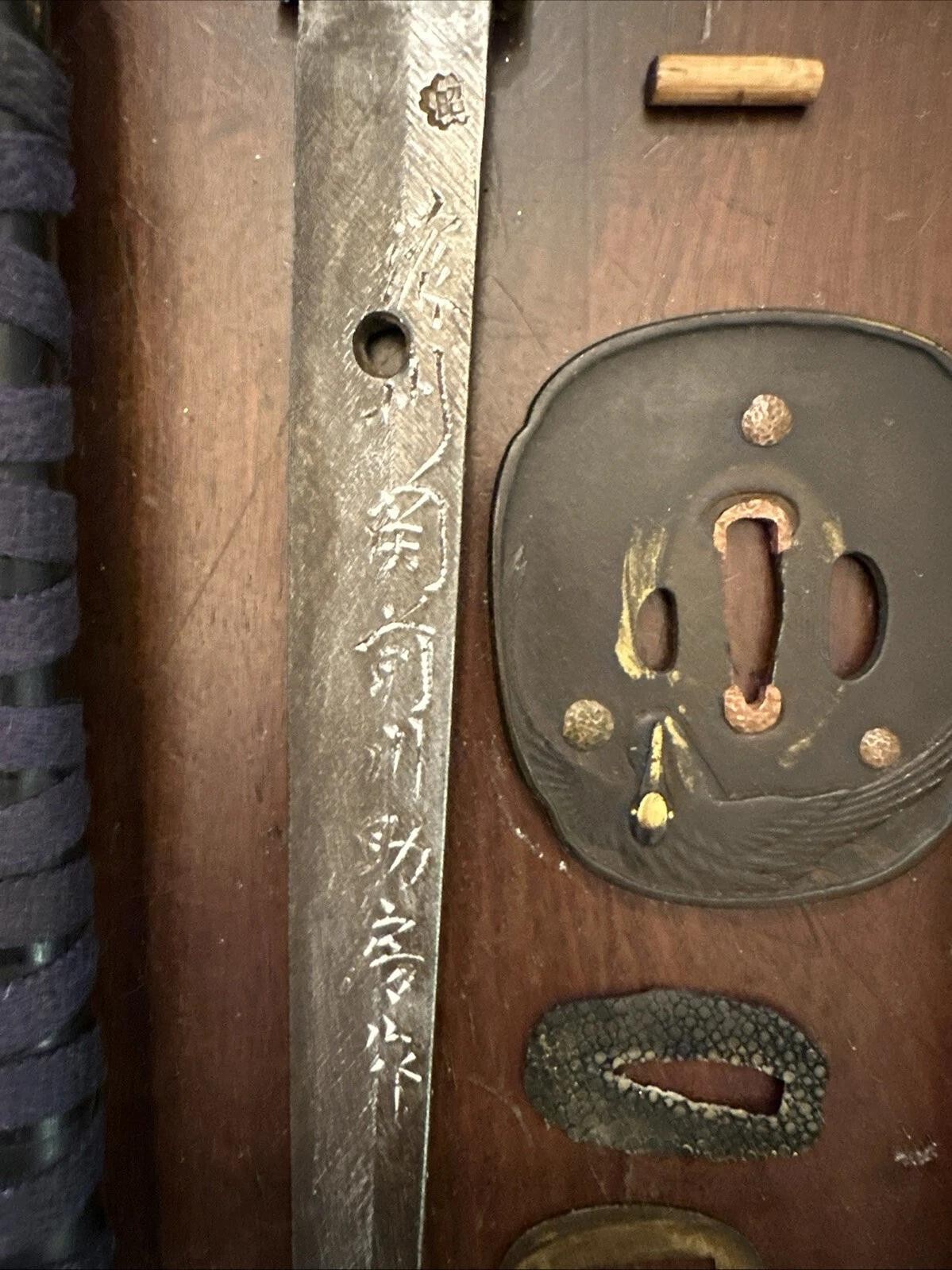
Well, I suppose it does try to say 本間 雅晴 將官 = General Masaharu Homma but this was evidently written by a 4-year old.4 points
-
Good evening. I would like to thank all those that responded to my inquiry, as well as all who read it. I have been given information that has helped my friend answer a question. ROKUJURO, STEVEM, Chris and Markus thank, you very much. This artifact that I have had the opportunity to research, has been eye opening. Myself, and the caretaker (owner) would not have the knowledge of its history without all involved in this forum. Thank you. Michael J. McKie.4 points
-
The artist is Sumiyoshi Naiki Hirosada (1793-1863) (aka Hirotsura). The theme looks like the God/Myth/Legendary figure Takeuchi-no-sukune holding the baby Emperor Ōjin.3 points
-
Once I receive and inspect it, I would definitely drop in some pictures here for you. Thanks everyone for the interest!3 points
-
Looks rather ambitious, usually the Saya liner markings are done in pencil and in a standard hand. The provided photos of Lt Gen Homma don't show a particularly larger sword, though he was supposedly quite tall. In my collection is an original photo of Lt General Homma showing him holding a sword of usual proportions:
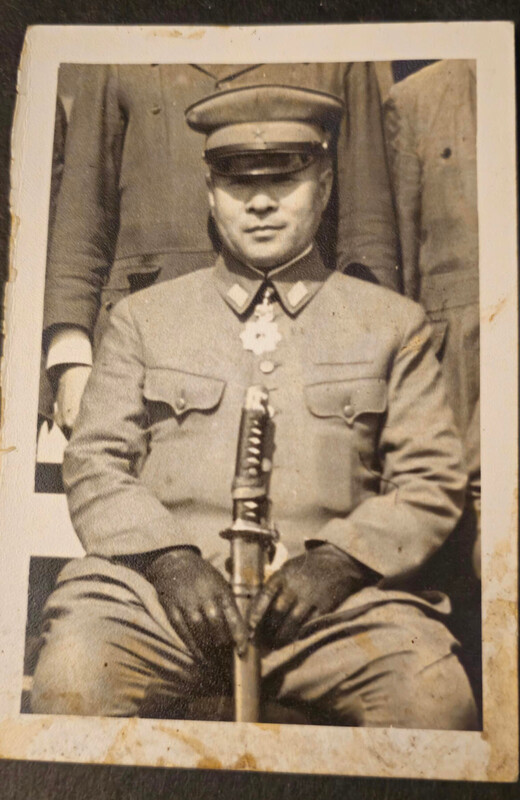 3 points
 -
Lots of general negativity, which I don't think is entirely justified. People tend to assume any period of contraction or decline means something is dying... Also remember we're in somewhat of a cost of living crisis, and when younger people are struggling to afford homes, cars and life's necessities, swords (as with other hobbies) lose out - as they should. One indicator, is prices of swords - if there were no collectors, they'd get cheaper - much cheaper. Like any field of collecting, if people aren't buying, objects lose their value very quickly. Is that happening?3 points
-
I have every confidence in Sam's decisions. He made the right choice. I opened it again for people to have their last say so that no-one blames Sam. Then I can lock it again like I am going to do to this one, and then people can blame me. Enough of this bullshit.3 points
-
PLEASE, everyone. Can we save the vitriol for facebook where it belongs? Let's talk swords instead. John C.3 points
-
These may be some life lessons. 水ハ苦クシテ求メヨ – Make the water bitter and drink it. 人ト人間ノ差 – The difference between a man and a human The first part of this sentence is unclear. 波…ハ世ノ 常デ……………… 任セテ雑魚ハ 歌ヒ雑魚ハ オドル サレド 誰ガ知ロウ 百尺下ノ 水ノ心ヲ 水ノ深サヲ However, I know that this sentence is the last part of a novel “Miyamoto Musashi” written by Yoshikawa Eiji. The whole sentence must be like this. 波騒は世の常である 波に任せて泳ぎ上手に 雑魚は歌い 雑魚は踊る けれど誰が知ろう 百尺下の水の心を水の深さを - Waves and noises are the norm in the world. Let the waves go, swim well, the small fish sing, and the small fish dance. But who knows the heart and the depth of the water a hundred feet below.3 points
-
Haiku translation (5-7-5 form): 名月や 留守の人にも 丸ながら meigetsu ya-- rusu no hito ni mo maru nagara Autumn's bright moon-- even for those who are not near to us is still full [Note: the seasonal reference (kigo) is the moon, "ya" is a break (kireji) denoted in English by a hyphen that is used to demarcate the eternal from a momentary perception (walking, in this case); there needs to be two electric poles between which a spark leaps for the haiku to be effective, otherwise it is just a brief statement] Fukuda Chiyo (1703-1775), also called Chiyo-jo ("jo" is a feminine suffix), Kaga No Chiyo (Chiyo of the Kaga Region), Matto No Chiyo (Chiyo of the Town of Matto), and Chiyo-ni (this suffix "ni" denotes nun), is Japan's most famous woman haiku poet. She lived the Way of Haikai, appreciating each moment and creating art as part of everyday life because she was open to her world. She became a lay Buddhist nun of the Pure Land sect after she retired, which allowed her to travel alone freely and access many groups such as poetry circles comprised of men and prostitutes of the pleasure quarters to devote herself intensely to her art in an age when women's freedom and creativity were restricted. Remarkably, she achieved fame and publication during her lifetime. In this haiku, Chiyo-ni reminds us of the enduring power of nature to connect us all, even across physical and emotional divides. It encourages us to find solace and a sense of shared humanity in the simple beauty of the world around us. Since the moon symbolizes enlightenment, it carries a hope that we can all realize the Buddha nature that lies concealed and unrevealed within each of us. I am reminded that Yamaoka Tesshu produced over a million calligraphy/painting works because the proceeds could be used to save all of the souls in Japan. Enlightenment that does not lead to boundless compassion is impotent. It is said that when thinking of famous haiku poets there are two names that have always been in the forefront: among the men there is Basho; among the women there is Chiyo-ni. She excelled at the "three perfections" of calligraphy, painting, and poetry--traditionally considered one art in East Asia. For the Japanese, the visual/spatial effect of calligraphy is almost as important as the meaning. Haiku is usually calligraphed in one vertical line, but sometimes, as in this case, in two or three lines. for visual effect. She was surrounded by famous artists living in her area and frequenting her family's shop that mounted other artists' works on kakejiku, or hanging scrolls. She was a largely self-taught painter, like most haijin (haiku poets) of the time. Her style has a freshness and spontaneity of composition and her masterly use of space is intuitive. Chiyo-ni's calligraphy line is feminine, refined, and freer than the more traditional masculine style of her teachers such as Genemon Yamamoto (1656-1725). Her cursive style, with its soft and energetic lines, is impossible to imitate. It is not the martial style of Otagaki Rengetsu with the precise spacing between the characters and between the rows with proportions retained and consistent (see comparison). Chiyo-ni's unique style can be divided into three periods: early period with a light, playful style; middle with a delicate, subtle style; and late with a simple, Zen-like style. A woodblock print by Tsukioka Yoshitoshi's of "Lady Chiyo and the Broken Water Bucket" is shown below. It illustrates an enlightenment poem by the unrelated Adachi Chiyono (1223-1298), who was the daughter of a samurai warrior in the 13th century and who became the first woman – and mother – to found and head a Zen monastery in Japan: "With this and that I tried to keep the bucket together, and then the bottom fell out. Where water does not collect, the moon does not dwell." The calligraphy version in the woodblock print appears to be a more contemporary rendering of Adachi's poem. Tsukioka may have been linking these two together since Chiyo-ni never wrote a haiku related to a bucket except for her famous "morning glory" series. She is said to have been a great beauty. Otagaki Rengetsu, eggplant


 2 points
 -
Long before ever buying anything, I joined the local NBTHK branch in Japan, and attended their meetings for several years. In those days it was mostly old men who spoke little, listening only to the Sensei explaining what he had brought. No one brought their own blades, even if they had any. Maybe some did, but that would have been a secret. When I put up my hand to ask a question, people turned around and stared, but I noticed the teacher seemed eager to answer. Some evenings when I kept my mouth shut, (as I had been advised by my elders and betters), he would ask me afterwards if I was all right. He encouraged me to ask freely, relieved at the give-and-take, and the sound of someone else's voice. Gradually over the years the older members faded away and dropped out and younger ones, male and female, came and joined. Even so, none seemed to want to possess their own blade. They were there to learn. When I questioned this, it was pointed out that the more they learned the higher they aspired, but at the same time the more financially distant those good blades became. A friend who had once been a member in the old system seemed to take almost twisted delight in the fact that members never actually bought anything. Eventually I was able to asure him that in reality people were now beginning to buy blades of their own. And they are. Thus it is that in Japan at least I would say that sword collecting is, to some extent, not over but changing in nature, and beginning anew.2 points
-
Nowadays we have more resources than ever and can instantly see in high resolution what once required a trip to Tokyo. Meanwhile, one can compare a sword against dozens of papered examples located all over the world in a single evening. The magic has become the thrill of knowledge, the ability to access what had been locked behind language and geography, and connecting with other collectors, experts and enthusiasts all over the world. These all involve a certain amount of skill, albeit not quite the same as poking through attics and thrift stores. Kurosawa films once drew collectors to the romance of the samurai, but the last decade has seen anime (Touken Ranbu), video games (Ghost of Tsushima, Nioh), and film franchises (The Last Samurai, 47 Ronin) breathe contemporary life into Japanese swords as a cultural icons. An impactful moment from any of these media has the potential to create the desire to hold the real thing. For some, owning one becomes inevitable. I believe the importance of educating audiences with engaging and entertaining elements promoting Japanese swords cannot be overstated. Stories must be told. Without a narrative, these objects lose their context and meaning. In the case of post-war America, the context is in the name, but going forward it will be the tales we tell our children and our children's children about the Japanese sword which keeps the spirit alive. Those stories are already being told all over the world as we speak, and interest in Japanese swords is growing globally. This will perhaps not translate as directly to the pursuit of aquisition as it may have among a different demographic, but the bottom line is that the market is growing.2 points
-
Access to information has certainly changed. The Internet is full of both information and misinformation about Nihonto (and many other topics). There are more books available, both in English and Japanese (bought on-line etc.). I see active collector communities in several countries - the US, UK, Germany, Japan are just a few of the more prominent I've seen. We now have mature organisations like the NBTHK, and friendly groups like the Token Society of GB. Sure, collecting Nihonto will never be mainstream - and believe me, you wouldn't want it to be (far too many swords would fall into the hands of people with little respect). Seasons change, but we're not in winter.2 points
-
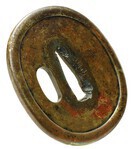
Had to post this seppa cut from black lacquered ray skin! I regularly hear about folks making seppa from leather, but this is a first.
 2 points
 -
I personally think its been cleaned, hence the colour of the iron and lack of rust2 points
-
Well, I'm not very capable. These haiku (and waka, etc) are relatively easy because most of them are on the internet somewhere, so I just have to identify a few words or phrases and the search engine will do the heavy lifting. Also, I lived in Japan for 30 years, so that gives me a pretty good base to jump from. If its just a page of medieval script with no context, it can be tough, and sometimes impossible, for me to decipher.2 points
-
吹け吹けと 花によくなし 鳳巾 Fukefuke to Hana ni yokunashi Ikanobori When the wind blows It is good for kite-flying But not so good for flowers2 points
-
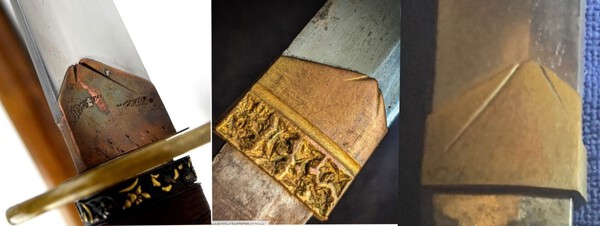
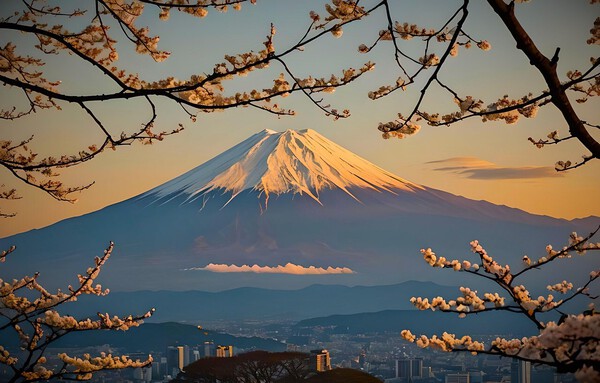
Another Mt Fuji habaki showed up and I thought it would be interesting to see the 3 I have on file together. Wondering why they all have the same two crevasses. Seemingly identical depiction of the mountain. Here is the only photo I could find showing more detail of the mountain, and I can see 3 points at the top. So, that must be what they are depicting.
 2 points
 -
Thanks Piers, the second one does look similar to yasu. I played with the filters to hopefully make it clearer.
 1 point
 -
Thank you so mutch Steve, that was a very sharp and fast answer. You have amazing knowledges... Best regards, Eric1 point
-
Another thing the internet has helped with, is knowledge around the care of swords. I know we've all seen abused examples, but for me, soon after my search began, proper care was something emphasized quickly. I only caught the end of the surplus/antiques-store-happening-to-have-a-nihonto period, and whilst there really is some thrill of the find, generally (and especially without knowledge) you're more likely to have encountered damaged, tired or mass produced gunto. These days, the internet allows you to fine-grain search for specific schools, periods, smiths etc. (across a wide variety of price points), which can be a lot of fun.1 point
-
Good purchase - where do you find them?1 point
-
1 point
-
No worries, additional examples below. https://www.google.com/search?client=ms-android-google&sca_esv=d181c16464dde945&sxsrf=AE3TifPraQHQurvj_6hW1F5EI9ThqK51kg:1755448366157&q="Maegawa"+Sukefusa+site:www.militaria.co.za&sa=X&ved=2ahUKEwiOgKXiopKPAxU8SDABHU0vOWQQ5t4CegQINxAB&biw=411&bih=865&dpr=2.631 point
-
Would love to hear (see) what you got.1 point
-
I sense that ‘not near to us’ does not really convey the Japanese word ‘rusu’. Someone is ‘rusu’, i.e. out of the house, not at home, (far) away, but their absence is felt. They are actually near to us (me) in spirit if not physically. And ‘hito’ often conveys someone close or dear to the one writing the poem. Even possibly one who has passed away. Spoken with poise and composure but hiding a deep connection and longing.1 point
-
The paper says late Muromachi.1 point
-
I’m not a dealer, so please understand the following is speculation from a buyer/collector perspective. With lower end items inherently comes more flaws and issues, and things in poorer state of polish. These things cause more questions, and therefore more time spent during the attempted sale. With that, comes less satisfaction as the buyer learns more, becomes more experienced, and/or develops an eye for higher quality. All these things contribute to a sellers long term reputation, of which, I can only imagine, they value and want to maintain. So maybe the simple answer is, that the juice is not worth the squeeze. That being said, there’s no shortage of lower end items out there in the market, and even a few dealers out there who sell things at lower price points. Sincerely, -Sam1 point
-
Howdy ya'll, If you ever need moderation assistance; such as with double posts, minor edits, or moving threads. Please feel free to tag me using @Scogg. When you start typing the @ symbol followed by my name, a dropdown should appear for you to select me. This sends me a direct notification and helps me respond more quickly. As long as it's aligned with the forum rules, I'm more than happy to assist. I check the forum regularly throughout the day, but tagging me ensures I can address your needs sooner. I'm here to help and want to do what I can to support the community and give Brian as much of a break as possible during his recovery. Feel free to reach out with any questions, All the best, -Sam1 point
-
67 , I started collecting 45 years ago. I have lived every minute of it !!!1 point
-
Also remember that not everyone is a blade collector. Many are sword collectors ie the whole package together with untouched koshirae. Not everyone is an elitist blade hunter. If that is your “thing” - fine but don’t assume others even want to follow the same path. The sword collector most likely has a whole different set of objectives and tolerances which could easily mean accepting an unimportant blade or one in poor condition in return for some nice fittings. It has already been said above I’m sure but judging what others enjoy collecting based on your own views is irrelevant1 point
-
If you save $2000, ‘someone’ will tell you, “you should have waited and saved $5000.” If you save $5000, ‘someone’ will tell you, “you should have waited and saved $10,000.” If you save $10,000, ‘someone’ will tell you, “you should have waited and saved $20,000.” If you save $20,000, ‘someone’ will tell you, “you should have waited and saved $100,000.” Collect the way you want to collect. You do you. While graciously accepting advice is noble, there will always be people who love to tell you what to do with your money, what you should or shouldn’t buy, and why you messed up buying what you bought. That is always the easy part. Studying and knowing what you like, being happy with your purchases, and collecting for yourself vs others is a little harder. Is it more important that you are happy, or impressing others? Who are we buying these blades for?1 point
-
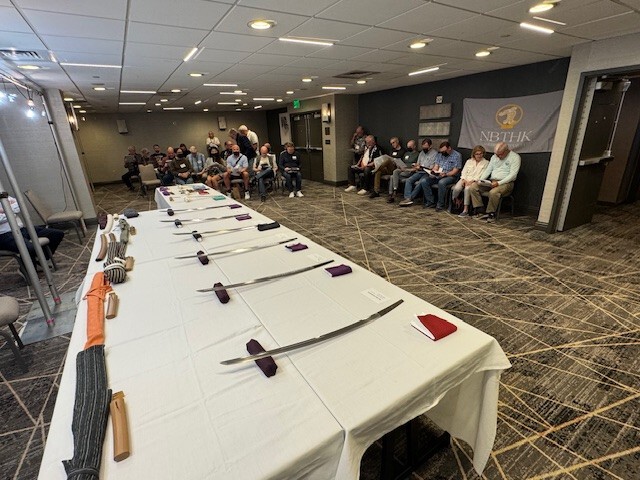
Here is the beginning layout out of the Aoe display at the SF show, prior to the actual hands-on viewing. There were 6 daito, 1 wakizashi, and 2 tanto. The sword committee seriously underestimated the attraction of the display. More than 100 people attended over 2 hours, 50 handouts disappeared early and so did other supplies. Kudos to the NBTHK-AB and the NCJSC.
 1 point
 -
And the Ko-Kinko Juyo tosogu
 1 point
 -
Idk if this Hirata was posted. It was on Fred’s table and absolutely wonderful alongside the other two
 1 point
 -
1 point
-
Something for Piers perhaps…

 1 point
 -
1 point
-
1 point
-
Thank you @Lewis B and @SteveM, my excited mistake. I’ve edited my previous post to reflect

 1 point
 -
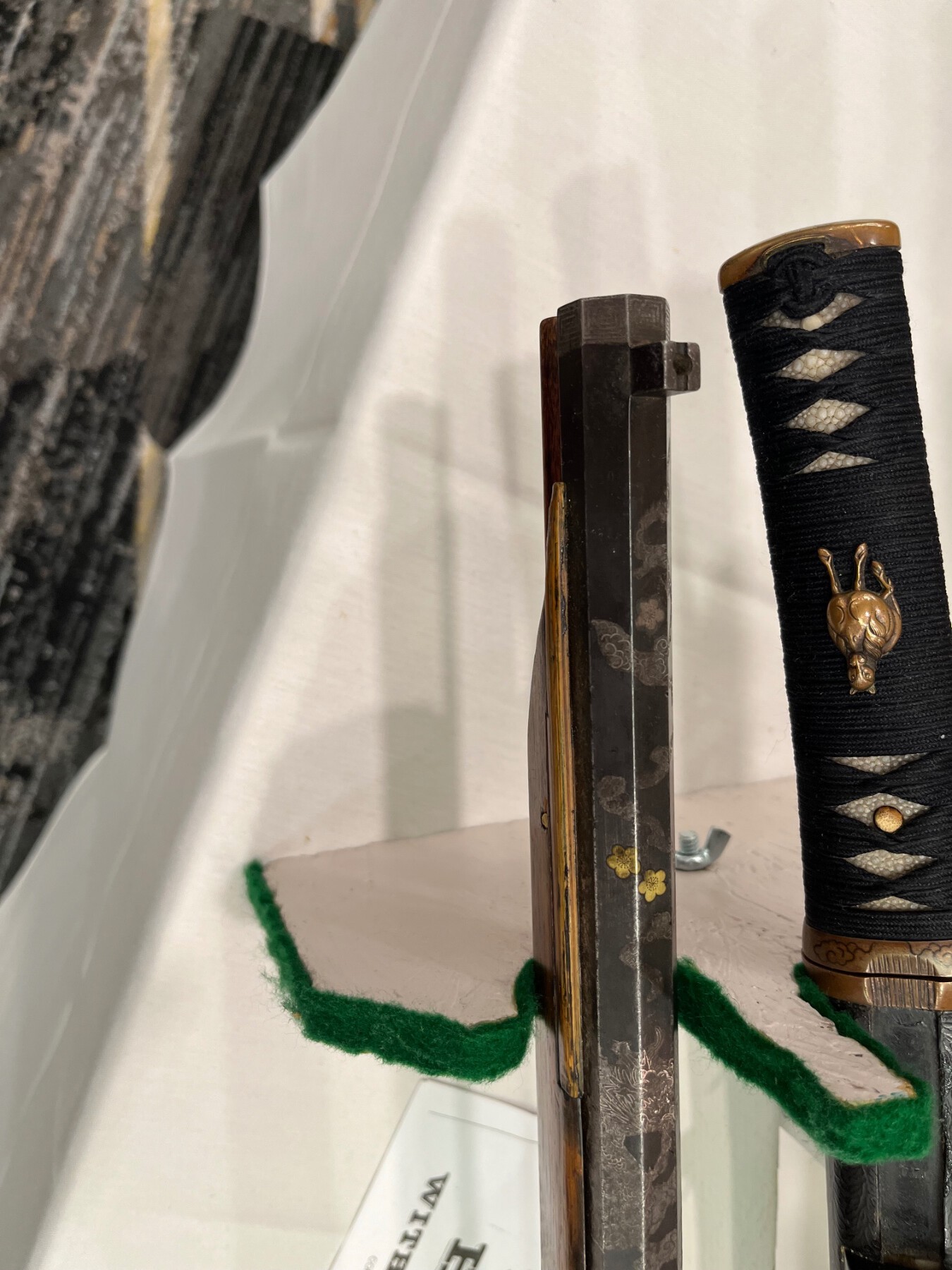
Incorrect: Pictures of the Shintogo Kunihiro Correction: Hatakeda Moriie Another scenario where it looks way better in person because of the barrier. It’s pretty challenging to get a good photo of these display blades, and there’s lots of people. Still, I hope my photos offer something to admire


 1 point
 -
Got a better photo of the Go Yoshihiro kissaki But this is the best my phone can do given the barrier, angles, and light
 1 point
 -
1 point
-
1 point
-
1 point
-
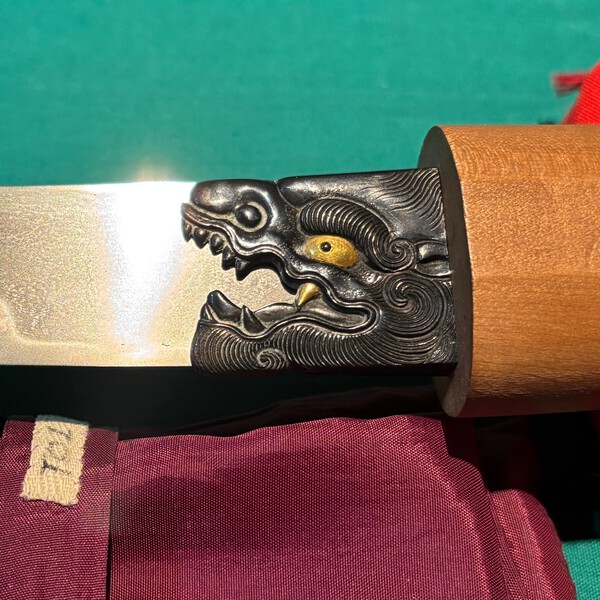
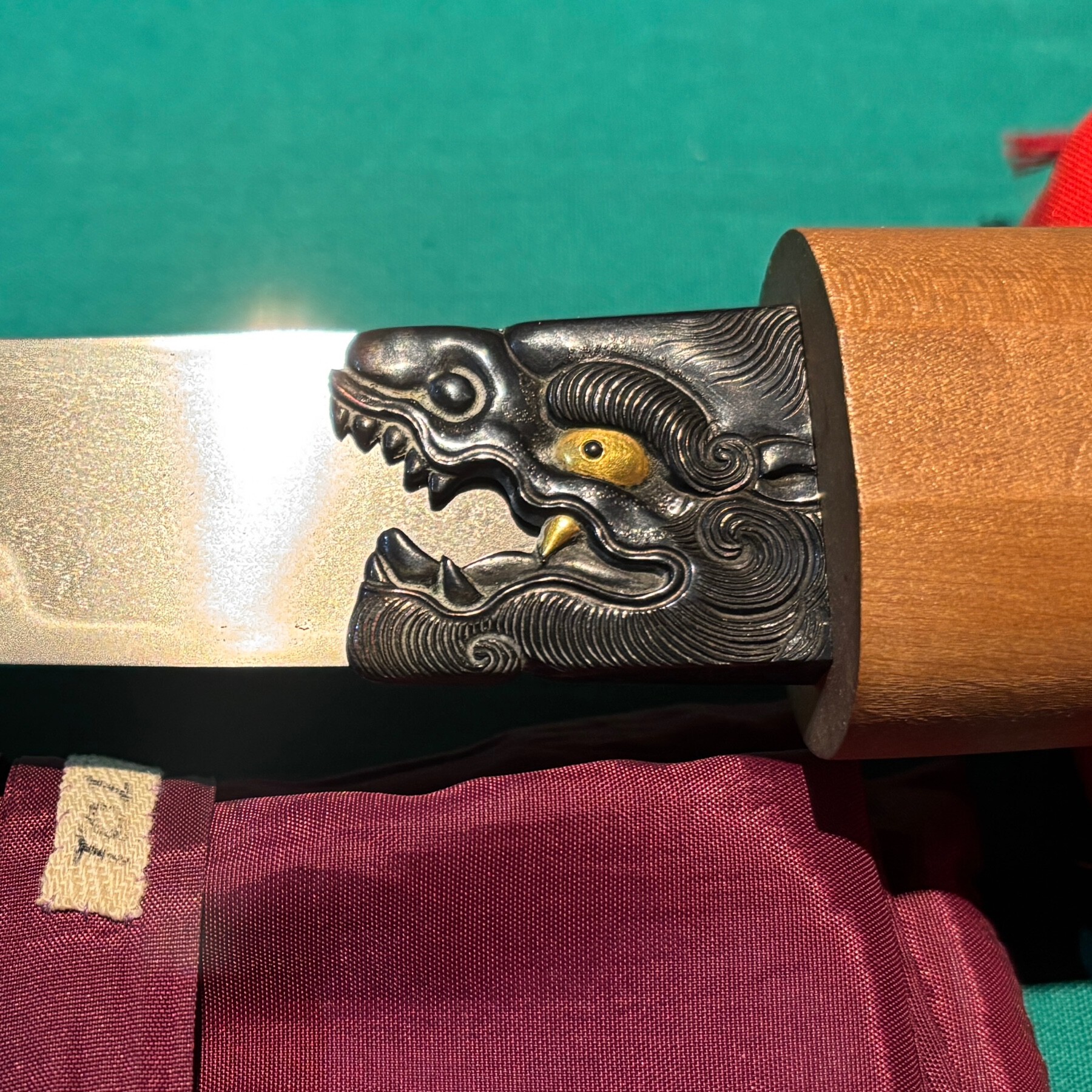
Another interesting dragon habaki. Looks Aztec.
 1 point





















This leaderboard is set to Johannesburg/GMT+02:00