
Leaderboard


Popular Content
Showing content with the highest reputation on 12/29/2024 in Posts
-
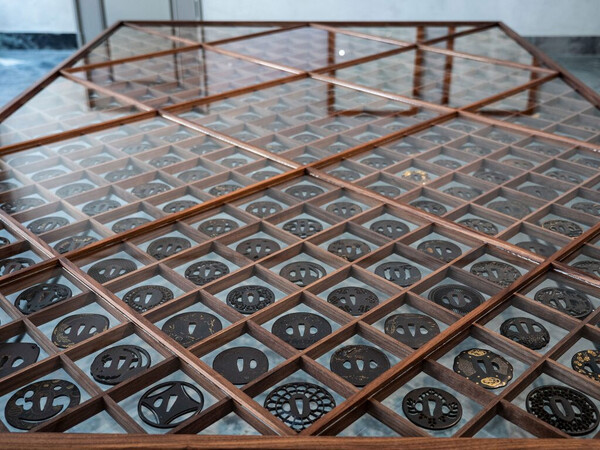
Sorry to reanimate an old thread, but this wonderful table caught my eye and matches in here: This display contains Tsuba of the Halberstadt collection in the Design Museum in Copenhagen, Denmark https://designmuseum...n/press-room-wonder/ Best, Florian
 7 points
 -
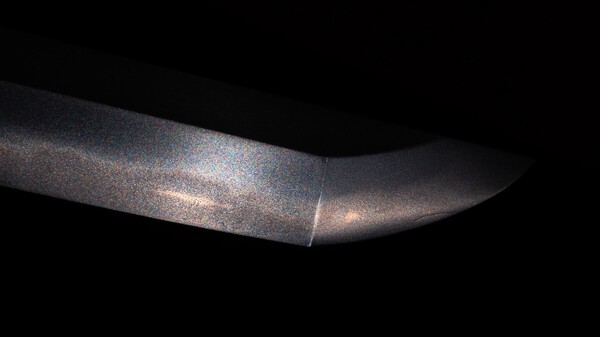
Something to share to end of this year Rai Kuniyuki is generally considered the founder of the Rai school. He worked at about the same time as Ayanokoji Sadatoshi and due to the similarity of some of their blades it is assumed that these swordsmiths collaborated No dated blade is known and the time of Rai Kuniyuki's work is estimated based on the signed and dated blades of Rai Kuniyoshi, who is believed to be his son The blade is a mumei, slender in shape with a nagasa of 68cm and represents the style of this smith's early work The Jigane is a tight and uniform ko-itame along the entire length of the blade with exquisitely bright ji-nie and delicate chikei throughout. The steel has a bluish color, typical of first-class Yamashiro blades The hardening is mostly deep nioi with fine ko-nie in kakubaru style with karimata pattern, which is well know for this swordsmith The blade has several kirikomi on the mune and muneyaki in the monouchi area The overall style of the blade is very similar to "Sakakibara Kuniyuki" which is a Juyo Bijutsuhin Enjoy


 6 points
 -
Just found this. Looks interesting6 points
-
Hi Dee, You may need to look into the history of the Goto a little more. They were indeed made for warriors, not the rank and file ashigaru and low-ranking bushi, admittedly, but for Daimyo (and higher), absolutely. Did you know that early generations of the Goto were of the Buke, and that Goto Joshin (3rd generation Goto) -- one of the most respected of the entire line of the Goto group -- actually died in battle in 1562? Killed by an arrow at the age of 50 or 51, I believe.6 points
-
What is silly to some is not silly to others. What is a redundant question is not redundant to the person asking it. Surely the point of a Forum is to help and educate everyone especially those trying to make a start in this hobby. What is a horrible blade is also quite probably someones first sword bought with great excitement. The reaction he gets here and how that reaction is delivered could either encourage him or break his spirit. Going forwards this hobby needs all the new blood it can get…..they are the ones who will buy our collections when we leave the planet. …and of course it’s not compulsory to read or reply to topics that are below your pay grade. We all started somewhere.5 points
-
There are a lot of silly, redundant questions and questions about horrible blades posted for discussion here on this forum every day. Jacques has been here to answer them in his unique and not very sociable style for a long time now. You can ignore him, if you want to, but his theoretical knowledge is worth listening to. I wish he could find a less confrontational language in his posts, but then, he is who he is. Better listen to an angry, honest voice than to the ignorants and the crooks everywhere. reinhard5 points
-
Get well soon Jacques! I would have gone for Tsuda Sukehiro guess initially. I admit I am not at level where I could tell Ōsaka-shintō smiths apart from worksmanship, and most likely will never be as they don't intrest me that much. However as Jacques gave the extra hint I had to refresh my memory from encyclopedia to figure out what yahazu is. Seems like this detail is often seen on the 2nd generation Kanesada work, as well as his tōran hamon is slanting. Also it seems like the three gunome elements right below yokote are often seen in his work. I am often very puzzled by Japanese descriptive terminology, as katayama-midare elements in hamon are described being featured in his work. As there are many different styled mountains in the world I am trying to understand just what this "half-mountain" element means. If it is the very steep drop compared to more gradual slope? Things like bright nioiguchi, wide nioiguchi etc. I cannot really say Ōsaka-shinto smith differences from those extremely fine details. I do confess I am better with the picture and text kantei than I would be in real life kantei. They are quite different even though of course some same basics apply. My eye is just not trained for extremely small details, and most likely never will be.4 points
-
Personally I think it is best to avoid Ebay, Catawiki, obscure auction houses and Gumtree/Craigslist, especially if you are new to collecting. I've seen FAR better blades recently, with papers, for a similar price on this forum. Ebay, Yahoo.jp/Jauce is a minefield and you'll only get burned... unless very lucky.4 points
-
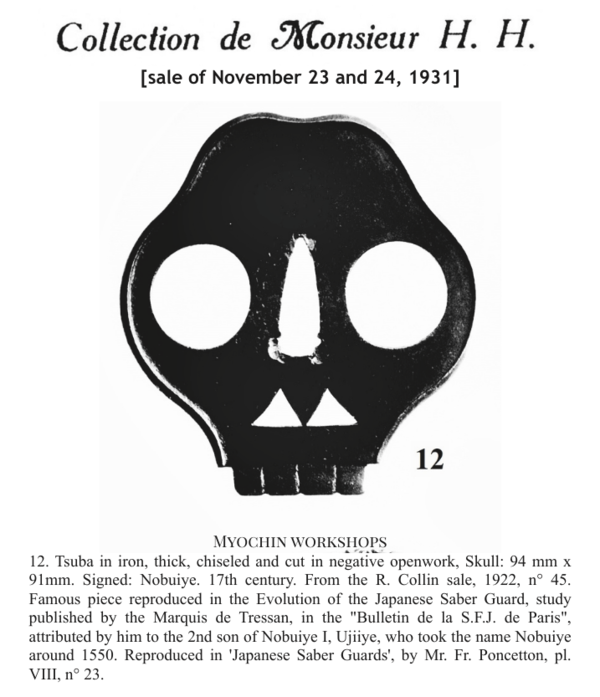
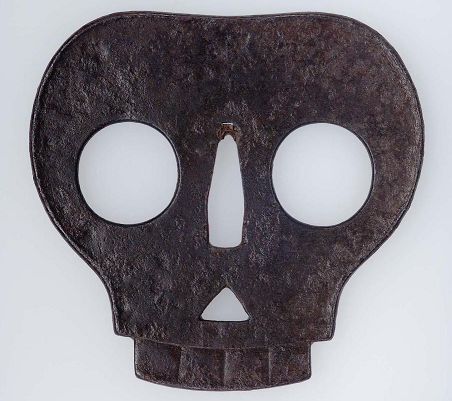
https://uk.pinterest.../800796377483681651/ https://collections.mfa.org/objects/13540 ebay and Yahoo auctions - modern


 4 points
 -
Technically you are right Jacques There is no known blade with the signature "Rai Kuniyuki", only "Kuniyuki" However, for mumei blades the designation "Rai Kuniyuki" is commonly used not only in NBTHK but also in other publications4 points
-
Tensho and Mike, thanks for sharing your swords. I also acquired two type 8 kyu a few years ago, one dress sword and one with a traditionally forged combat blade. Alex


 4 points
 -
4 points
-
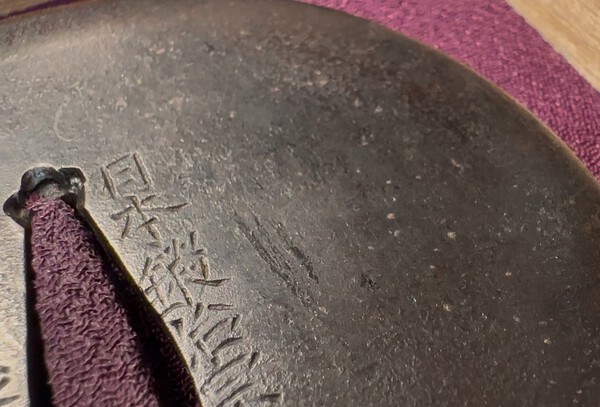
Wanted to share a swordsmith tsuba(Igo no kami Kinmichi) that was once covered with urushi. Luckily, we can still see some remnants of the old lacquer.




 3 points
 -
Dear Jacques, We are not talking about physics. We are talking about ART. And when it comes to a certain artist you use the name he is known for. And this is Rai Kuniyuki. Token Bijutsu and Meito Zukan use the name. Other publications too. In the end I just want to thank Brano for showing this magnificent sword. The rest is just white noise.3 points
-
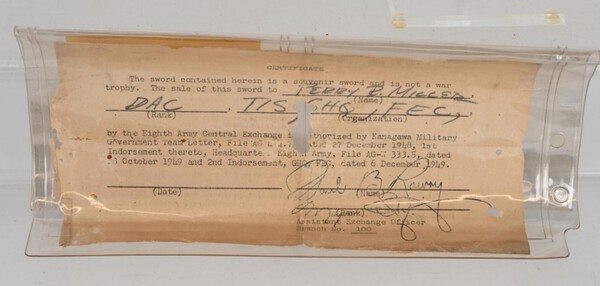
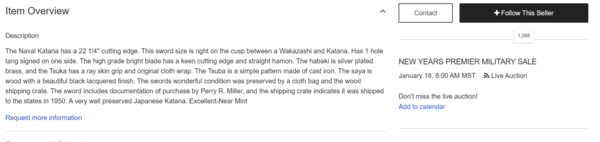
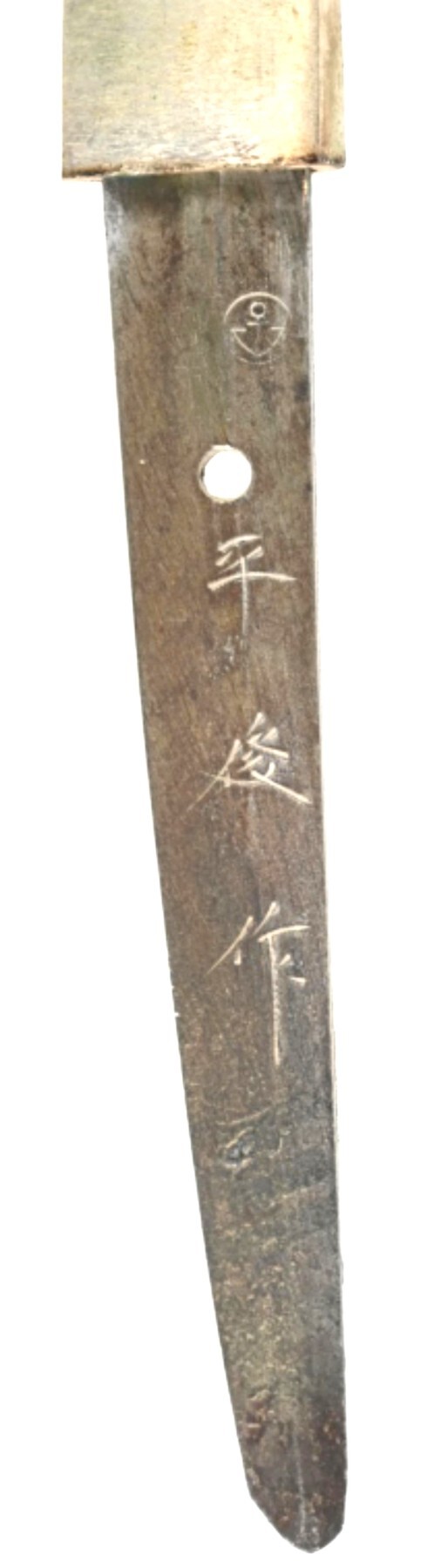
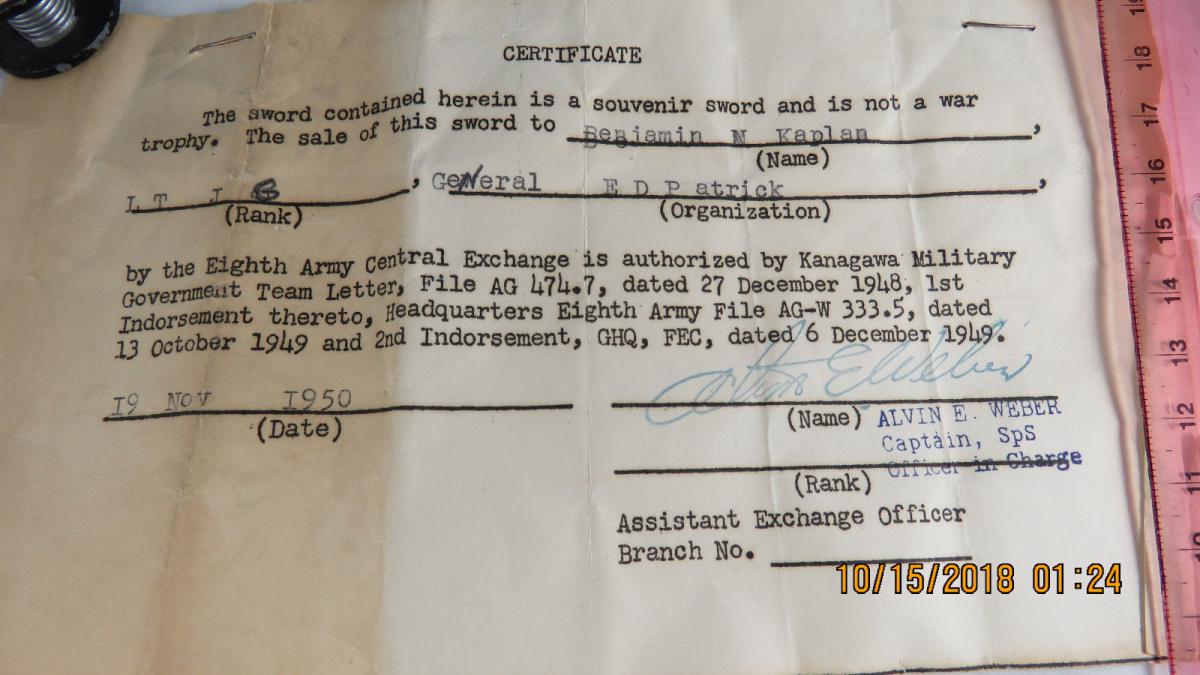
Exciting News! A second souvenir has showed up with PX cert.! A Hiratoshi blade with large circled-anchor, in standard souvenir fittings. Comes with 8th Army PX certificate and shipping box from 1950. At this Mileston Auction. Starting price is $1,000USD. I'd go for it, and would love to have it but I'm in some pretty deep debt already and would have to buy it on credit. I hope one of us could get it from the auction! Interesting note, that this is the first Hiratoshi we have in souvenir fittings. I have several of his blades on file, but none of them are souvenir. They are all kaigunto.


 3 points
 -
2nd gen. General shape of the hamon and Toran midare (I was going back and forth between Terukane and Sukehiro)3 points
-
This a good starter reference for nihonto flaws. https://www.Japanese...rdindex.com/kizu.htm3 points
-
Hi Ivo, Not a hagire. It is a slight ware', a very minor flaw. Grey3 points
-
Strangely enough I was talking to a friend about the same tsuba that he was interested in [he didn't get in quick enough!] I thought the guard might be Tempo/Tenpo/ Tembo [however you like to spell it ] Tempo tend to be more random with their hammer work though and the folding is anything but random on your piece. Another possibility is it could be Myochin like this pair. Myochin like thick bold designs https://www.ebay.com/itm/3758109066383 points
-
I recall reading that the original lineage of Ohno smiths gave up making tsuba and became ship builders sometime around the mid-Edo period. So if that mokko tsuba is from that area and late Edo, then it has no connection to the original group, other than that it was made in the same area. It really does look remarkably different from all the other type of tsuba that have been labeled as "Ohno" so far. It's an interesting thing to dig into though... wonder if that smith's name comes in in a meikan? ...hopefully with a date and lineage3 points
-
Hiromitsu dated 1943. A showato Seki arsenal blade, not traditionally made.3 points
-
Exactly. Some people moan there is not enough "high class" swords, and when they do they have put up with this **** Explains why we don't see more.2 points
-
Comparing the 2 certificates:
 2 points
 -
Typical nonsense. FFS It is what it is, stop making it about your opinion, as always. Attention seeking at its best. Grow up, Ps, if your a physicist I'm an Astro nought No one with such intelligence would argue over trivial BS the way you do2 points
-
Full transcription of the relevant part of the paper: 雲龍図鐔 - unryū (no) zu tsuba 鉄地 撫角形 - tetsu-ji nadekaku-gata 銘 早乙女[家]則 - mei Saotome Ienori2 points
-
Dog is fine kantei answer : ECHIGO NO KAMI KANESADA. For those who are right, can you say which generation and why ?2 points
-
Reading old posts and came across this thread. Here is a fairly typical 16-petal chrysanthemum style tsuba from my collection. Happy New Year!
 2 points
 -
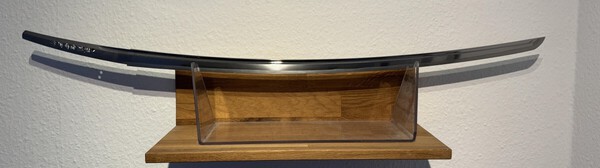
@Brano A beautiful, impressive work...even if it's just pictures. Thank you for showing it. It's been two years now since I had the opportunity to buy a Shinsakuto blade. It's a work by "Yasumune" in the Yamashiro style. I personally believe that he "tried" to make a blade in the style of Kuniyuki. With modern blades, you always have to have a certain tolerance when it comes to copies of old swords...but there is a certain similarity. Especially when you look at the Ochigata in CSM101's post.

 2 points
 -
Noshu ju Kanenobu Koki ni sen roku hiaku nen ki nen 濃州住兼延 皇紀二千六百年 紀念 2600 th year of empire (1940) "memorable year" or "commemorate" less common to see that examples in Slough p. 54 & 552 points
-
I thought this was already the site for "New Age Tsubaology"? Why do you think I wear the silly hat! Don't even ask about the tsuba - it is definitely cast!!!!
.thumb.jpg.8d3c6fa7d33d26e47bb3e3e089f4adc0.jpg)
 2 points
 -
Thanks for the close-ups, as I've commented above, it's quite the beautiful (if mismatched) arrangement. If my limited knowledge serves correctly, the Kabuto should be no older than late 16th or 17th century, like most pieces of surviving armor. Hope you enjoy this Christmas present to the fullest!2 points
-
Dear Jacques, the headline says Rai Kuniyuki. But maybe you should discuss this point with the author: Tanobe Michihiro.
 2 points
 -
2 points
-
We are going quite far back old boy so its doubtful. I forgot to mention the work is contemporary. I feel the need to chip in what I believe is a not commonly accepted piece of information / fact about China, a place I lived for approaching 15 years in total...that is...the country has a very large number of extremely skilled artists. Especially carvers and lacquer artists. It is the most common thing in our hobby circle to see a poorly made reproduction sword, and together with others remark in unison ''obvious China fake'', however, this approach leads many to believe that this level of 'work' is indicitave of the length and breadth of what China has to offer in terms of 'Japanese style swords' - which is a dangerously ignorant take. Sorry, Chris W above, I dont mean to pick on you, but when you comment 'Regardless of it being Chinese' you exemplify what I am referring to. Roughly 20 or so years ago when I was working for Sotheby's in London, there was a tachi in shirasaya which was left unsold after an auction and sat in a departmental store room for years. While doing a little tidying up I stumbled across the sword and had to take a look. Well, what I saw was what appeared to me to be a very nice shinshinto tachi with a wonderful tight hizen-like hada and suguha hamon. We had no experts left in London as the department had long since ceased samurai related sales, but I got in touch with the nearest guy who knew about the item and was located in our Paris office. He told me that the sword had been removed from an auction as it had been discovered to be a forgery made in China. He would not elaborate further on this... To caveat, I have owned both Chinese reproduction Japanese style swords and nihonto, and looked at quite a few recognised-as-high-quality nihonto on display. The sword I speak of was 'pristine' and there was absolutely nothing about it which would indicate that it was either a 'reproduction' or 'made in China'. Commissioned and bought, yes.2 points
-
Malcolm Cox has released another monograph for gendaitō collectors and it is worthy of taking a close look at. It can be downloaded for free via the link below. Cox, Malcolm E. Yoshioka Yoshichika 吉岡 吉近, Shimada Yoshisuke 島田 義助, and the WARRIOR Stamp. 2024. A4 size, 47 pages. Yoshika Yoshichika, Shimada Yoshisuke and the Warrior stamp2 points
-
Takasaki Saburo Kaneshige2 points
-
It occurred to me that AI might be able to synthesize the core features that are generally regarded as foundational to the group of tsuba that we commonly refer to as Ohno/Ono. I have used ChatGPT, which of course doesn't provide an annotated bibliography of sources, but can be a powerful tool for "casting the net." The user of course makes the final determination and judgement on the summary without interpretation. The strength in relation to the topic of this post is that it is not inherently biased towards the personal view of the user IF the query is not biased. My search query is: "What features define the ohno or ono (different spelling) or 大野 (Japanese kanji) tsuba (Japanese sword guards)?" Here is the result. I will just say that what I appreciate from this synthesis is the inductive nature of the definition, specifically the physical and aesthetic features, which often get short shrift in any definition that relies purely on historical documents including related period arts and crafts works for determination of what is "fact" versus "fiction." I have always held that in the absence of mei, theses modern categories are an attempt to describe a synthesized set of recognizable shared features of aesthetics and construction, which are highly likely to reflect a related group of artists following shared aesthetic principles and methods of production. The Ōno or Ōno-ha (大野 in kanji) tsuba are a distinct category of Japanese sword guards that reflect particular stylistic and construction techniques. These tsuba are often associated with the Edo period (1603–1868) and are admired for their elegant simplicity, restrained decoration, and excellent craftsmanship. Here are the defining features of Ōno tsuba: 1. Material and Finish Typically made of iron, often with a smooth and subtle patina that develops over time. The finish tends to emphasize the natural texture of the metal, showing the craftsman’s mastery of forging and surface treatment. 2. Shape and Size Most Ōno tsuba are circular (marugata) or slightly oval (nagamaru gata), though other shapes can occasionally be found. They are often medium-sized and exhibit well-balanced proportions. [Steve comment: there is no thickness range given] 3. Design Aesthetic The designs are generally understated and minimalist, often incorporating openwork (sukashi) motifs. Common themes include natural elements such as plants, waves, clouds, and animals, executed with delicate precision. Symmetry and balance are highly valued, giving the tsuba a harmonious appearance. 4. Technique The openwork (sukashi-bori) is a hallmark of Ōno tsuba and is usually intricate but not overly ornate. Chiseling and carving techniques are precise, emphasizing fine details within a minimalistic framework. 5. Influence Ōno tsuba often reflect influences from the sōken (austere or Zen-like) school of tsuba-making, which values simplicity and a focus on practical beauty. 6. Symbolism The motifs and themes often have deep cultural or philosophical meaning, reflecting Zen principles or Japanese aesthetics like wabi-sabi (beauty in imperfection and simplicity). 7. School and Makers The Ōno school or lineage of artisans produced these tsuba, but the term might also refer to a broader stylistic classification influenced by the school. These sword guards were not just functional components but also works of art, reflecting the tastes and values of their era. Collectors and scholars often prize Ōno tsuba for their balance of utility and artistic expression.1 point
-
The paper says the tsuba is signed 早乙女家則 - Saotome Ienori1 point
-
This is a lovely daisho. I remember seeing a tsuba with the identical composition on Jauce, but with a ruined patina from corrosion and blackening. It always pains me to see such damaged pieces that have great form. Reminds me of how many that have been lost.1 point
-
Thanks Dale1 point
-
It happened to me in Nara - I can never go back to that antique shop again! [You should never ask if the salesman has any "old spit" for sale ]1 point
-
on hold y1 point
-
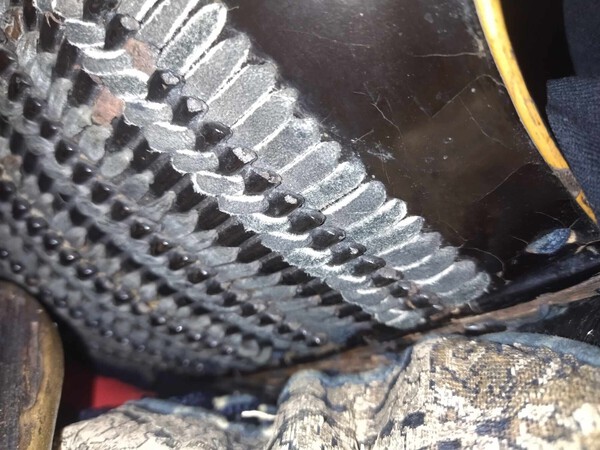
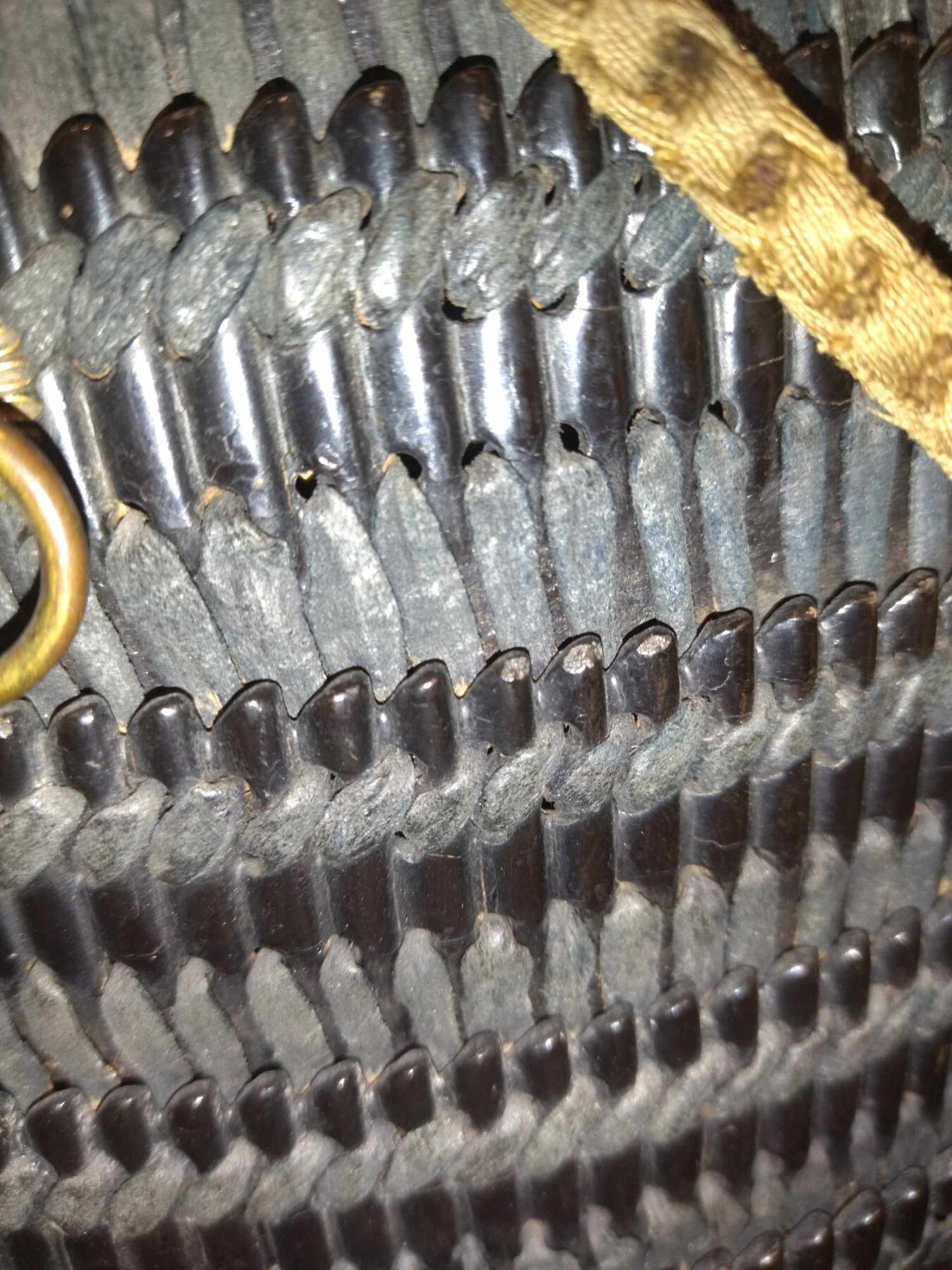
Alex, thank you very much for the comment, I somewhat agree, the maedate is a little big, see if later. dear Uwe, the Do and the shikoro are well laced in leather, I took photos. mempo also. only the soles are laced in fabric or silk. But same dye.


 1 point
 -
First one Yoshi.1 point
-
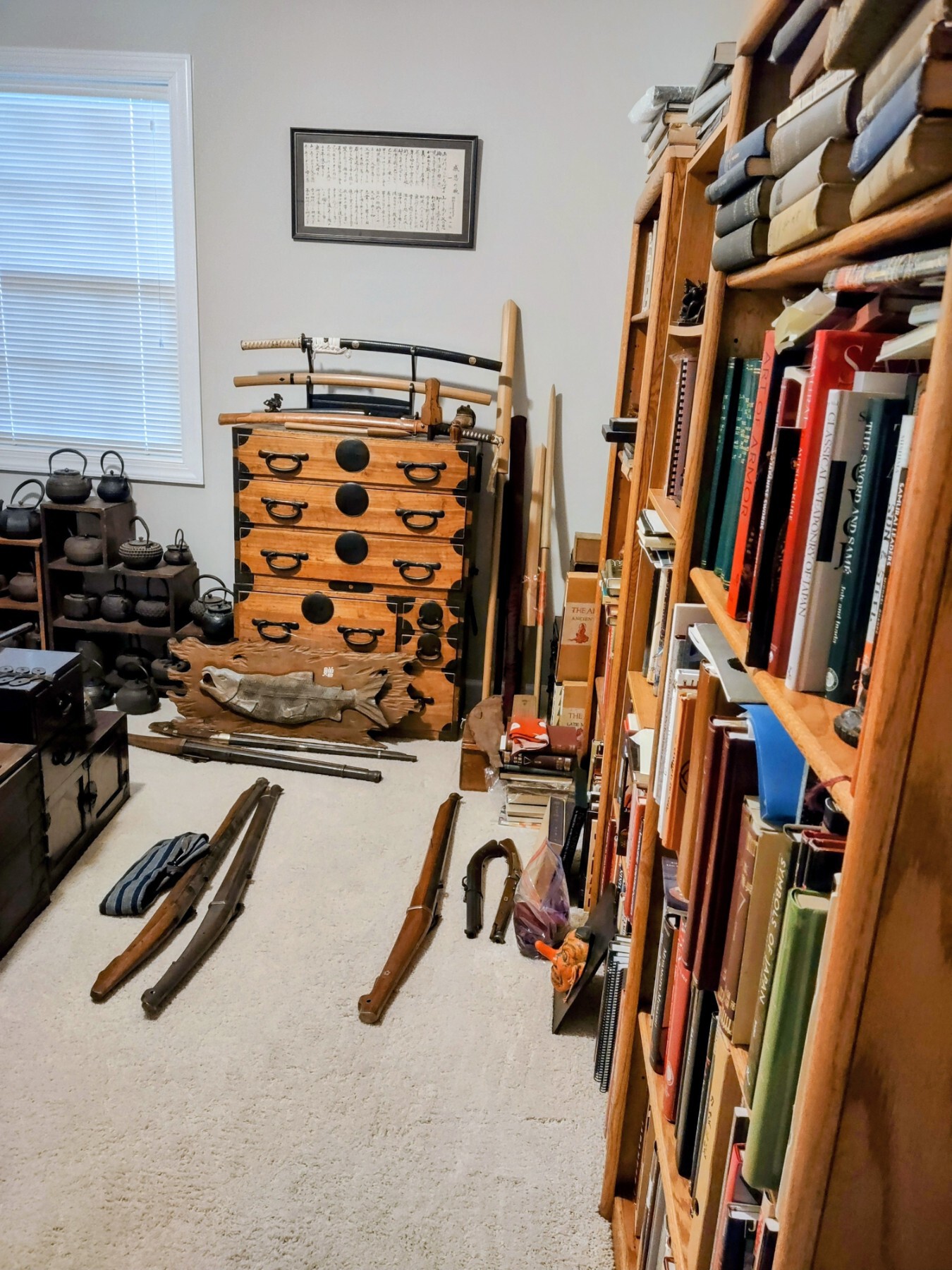
This is room 2 of 3. Mostly storage for swords but a Saotome armor and a lot of Tetsubin and books. I'm doing an exhibition now at the North Carolina Museum of art ( the making of a warrior ) from Oct 19 2025 to Feb 2 2025. You can see images on line. A lot is missing because it's there. The curator picked what she wanted so skipped over many of the Kamakura jidai swords.


 1 point
 -
There have been so many good posts it is great to read this thread. NBTHK mumei attributions are bit problematic as as Glen said above they use specific groups etc. It is the same for swords and in my personal opinion they should not be taken as 100% only truth especially for lower end items. There are just thousands and thousands of unremarkable mumei items swords/fittings etc. and they will need to give some attribution for the item. It is just common Japanese style that they will make quite specific mumei attributions be it for swords or fittings. Identifying a mumei sword as a work of specific smith is just how Japanese appreciation seems to be in some cases. And for more unremarkable items you will get broad group attributions. Best works go to top tier smiths and lower works to lower tier. I am focused on old swords so I am not that up to date on tsuba schools. However you fitting guys know much better. My question would be how many plausible categories (in current traditional tsuba appreciation) there even are for mumei Late Muromachi - Early Edo tsuba, 20-50-100+ possible categories? Then there are possibly hundreds of thousands of mumei tsuba that are fitting to that time frame, and need to be classified in some way. I think Glens example with 12 tsuba is a perfect example of that. For me personally having a mumei attribution to X doesn't really give too much exciting information of the tsuba in question. Having the tsuba theme explained is much more interesting to me than majority of the "bulk" attributions.1 point
-
Thanks for posting more photos. I think you are correct this is a very early variation. The Type 8s I have seen all have convex cherry blossoms on the backstop, whereas on this example they are inlaid.1 point
-
As I start to read - and absorb - this work, I am greatly impressed by the effort it has involved. This is serious work and a real contribution to sword history. Is anybody in Japan following, or absorbing, it? Peter1 point
-
false hope and helpfull words, when cpr isnt working is just wasted time. dont waste a new begginers time with false hope a felpfull kind words. "end of life" for this item. learn from this and move on. there are cheaper but just as furfilling areas in the Japanese arms area that are more affordable levels if that tikles your toes1 point
-
I looked. I saw the issues……but I thought we were trying to encourage constructive learning especially for those less experienced? Please point out the FATAL FLAW. …..and don’t bother trying to tell me what to do.1 point






















.jpg.8df2a922db0c0aaee8aaf6f2cac318ee.jpg)











This leaderboard is set to Johannesburg/GMT+02:00