
Leaderboard



Popular Content
Showing content with the highest reputation on 11/12/2025 in all areas
-
The term “Gannen” is commonly used when the new era begins in an existing calendar year. Thus, “Heisei Gannen Ni Gatsu Hi.”6 points
-
Hi Kenny, welcome to the forum. To begin this is a Type 98 made circa 1943, the small stamp indicates it's non-traditional.3 points
-
3 points
-
Showa22 has a Tadayoshi with the polisher mei, Yasukuni, if anyone needs this type of info. https://www.ebay.com/itm/365977509833? John C.
 2 points
 -
Mei is Kaneuji, smith is Yoshida Kaneuji. Not sure of date it is years of Japanese Empire, maybe 2601 which is 1941 ( but rusted). Yours has SHO stamp Slough has an example with SEKI stamp dated June 1942 and kokuin. Not sure if your mounts are Type 94 but Type 98


 2 points
 -
Hi John, It does look similar to this kanji: 重 It’s normally read “shige” in the context of Japanese art names but is normally used with at least one other character to make a name. Here’s a link to an on line dictionary for its meaning and other readings: https://jisho.org/search/重 %23kanji2 points
-
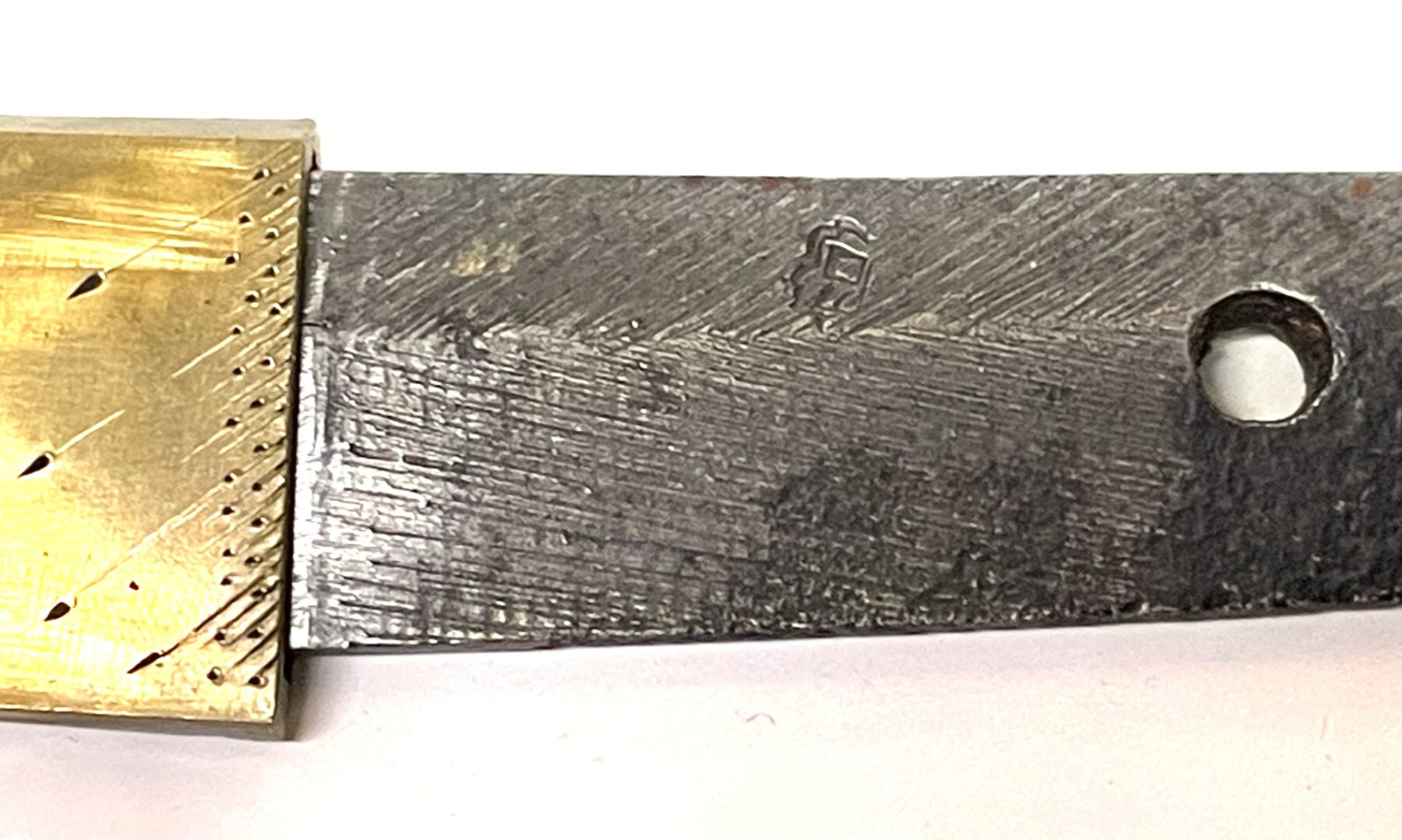
@Scogg Sam i made some pictures. This sword has been looking very good. But fake. This is one of those swords when you have it in hand you notice instead that it is fake. It feels wrong in hand. I think i shown it hear some time ago. It was good for learning holding in hands. I was sending the pictures Bruce i think. Notice the broken screw head because the material is very weak and thin. Look at the seppa and the habaki. Same weak sheet metal. Last part the fake stamps. The look sharp and not blury but fake.


 2 points
 -
Well that is not surprising re Berlin as Peter is first and foremost an armour collector, who later on diversified into swords and tosogu. He has a great collection and the digital displays for the Rai blades for instance (with the 5?6?m magnification of the blades) are exceptional. One can almost study the micro granules of the metal matrix even…2 points
-
I've recently been investigating these togi-mei. I am finding it difficult to track down any good info. I imagine these togi-mei are pretty rarely seen. I have only seen a handful myself. I recently discovered togi-mei on a katana that I own. It's not a wartime sword (o-suriage or suriage mumei, probably koto), but the polisher's mei has a date of Showa 31 (1956), so maybe this particular polisher was also working during the war? Just some speculation... -Sam One column: 君山研廣 = Kimiyama Kenhiro Two columns: 越後住 = Echigo ju = made in or resident of Echigo province 昭和三十一年 = Showa 31 = 1956 https://www.militaria.co.za/nmb/topic/54031-togi-mei-kanji-in-the-nagashi/#comment-566053

 2 points
 -
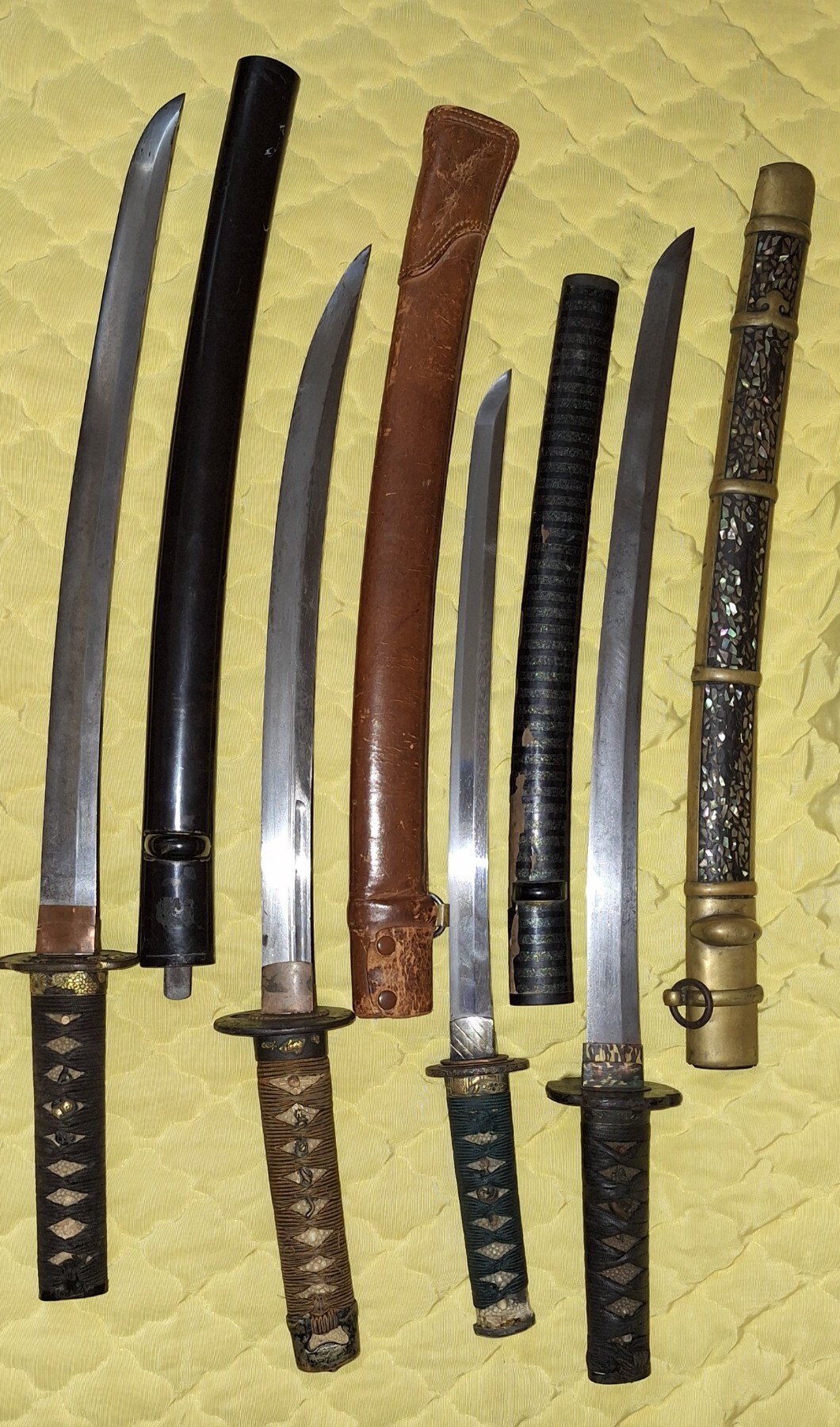
I was offered these today. Really interesting looking but I don't know enough about them to commit. Pictures might be a little jumbled, but would appreciate some comments !


 1 point
 -
PREFACE This new series „Tsuba are beautiful - Kantei Series“ is dedicated to collectors, friends, and enthusiasts who appreciate genuine Japanese art as much as I do. I share my knowledge from today’s perspective, offering insights that may help when, perhaps in a hidden corner of your favorite antique shop—or even online—you come across a precious Tsuba that captivates you, though you may not yet know much about it. By following this series, you’ll learn to work methodically toward identifying unsigned Tsuba on your own. I hope it will be helpful for your future collecting journey and maybe even ignite the spark for new collectors to begin theirs. Please enjoy—and feel free to ask questions or share your opinions. Let’s discuss kindly and respectfully, whether you agree or disagree. Remember, collecting is a shared journey; respect for others’ views keeps our community strong. You will find the link here: Tsuba are beautiful - Kantei Series #01: “The Black Shakudo Tsuba - Ko-Kinko, Kyo Shoami or Soten?“ Enjoy reading! Best wishes, Tobi www.nihonto.art www.tsuba-no-kake.com
 1 point
 -
Hi Robert, That's an interesting source. Funny that he collected so many Tsuba. I think that these were still "off the peg" swords in a sense, though. On the high-end, there are recorded transactions in the thousands of Kan (string of copper coins) and hundreds of Mai (Oban). There are also battles triggered over swords (one famous Kanemitsu comes to mind) and orders of gift giving by the Shogun rejected with stern words such as "I would rather surrender a province than part with this blade" (the blade was, as a result, named after the province). These are fascinating recorded events that demonstrate that at the Daimyo-level and above, there was a fierce competition for high-class masterpieces. Below, a Hon'ami Koyu origami for a blade attributed to Masamune with a value of 500 Mai, this is equivalent to 82.5 kg of pure gold (~165 gr per Oban), worth ~7-11M$ today depending on debasement. Best, Hoshi1 point
-
I recently found a sword that has been with the family since the end of the war . It was given to a young boy as a gift from a U.S. Marine General. The Generals name was W A Worton and he was given the sword at the Tientsin China Surrender by Major General K Omoto . The swords nagasa is a large 32 inches with a ubu Tang . It shows signs of being a Kanemoto sword. Jizo Boshi with a Hamon of an uneven rounded Sunbonsugi . It also has togariba . The ji is a itame mixed mokume . I am interested in some comment. Thank you Geoff


 1 point
 -
IMHO, start by putting them in chronological order.1 point
-
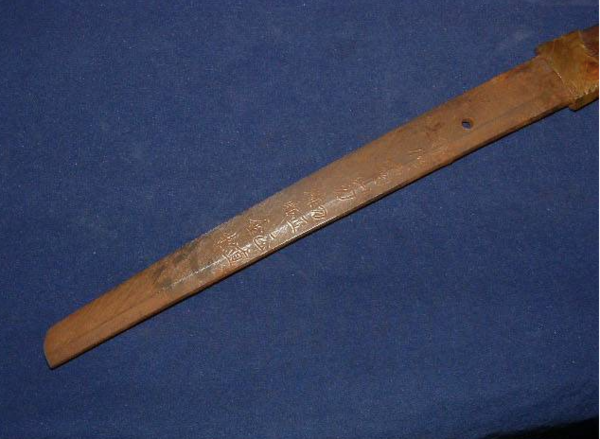
Different, but Takayama-to are known to have the togishi mei carved on the nakago next to the smith mei. I used to own the one on attached photos.
 1 point
 -
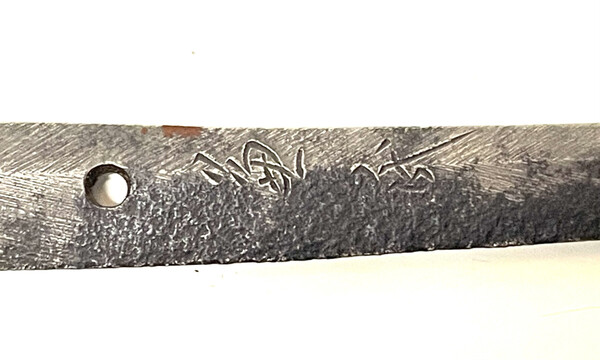
Hey guys, looking for a bit of help on this type94 I've seen and possibly buy. Because of my location it is unfortunately on the expensive side and i do not want to get burnt because I'd never be able to recoup the money lost. All I'm aware about is it's a type 94 sword made by showa - it does not come with any sort of paperwork. I'd appreciate if you guys could give me your expertise and tell me if it's authentic or not. Much appreciated for all the help.





 1 point
 -
Piers, it was just a well-intentioned criticism on my part. All detailed explanations about blades were exclusively in Japanese. Usually, the name of the blacksmith was written in Latin letters, often along with the era and school. But the next sign could be 100% in Japanese again. This inconsistency annoyed me. I wouldn't write it if it weren't the case. I was very sad that I could hardly study the museum's signed Kinju. The Japanese description rightly pointed out the extreme rarity of signed works by Kinju. But the Tanto/Ko Waki was so poorly positioned and so high up that even with my height of 1.85 m, I could see very little of the blade's characteristics. Of course, the large number of blades on display is impressive. But it is also too large to fight your way through the collection with full concentration and discipline. It is quite exhausting. Less would be more, and then it would be 100% well presented. In return, there could be more temporary exhibitions. But I am also aware that a lot of work, effort, time, and money goes into it. These are just my thoughts.1 point
-
The single hanger suggests type 98. In that condition (see the reproduction brass seppa?) I would not go anywhere near 3000 AUD for a non-traditional blade. You can get a star-stamped gendaito for that kind of money. John C.1 point
-
Typo is all. Date is March 1945.1 point
-
Ah. So it could be gannen, just stylized quite a bit. Thanks for the confirmation. John C.1 point
-
義忠 – Yoshitada 昭和二十年三月 – Showa 23rd year, 3rd month1 point
-
Hi Kenny, I agree with John. Type 98 mountings and not a traditional made blade.1 point
-
Well, as you have probably deduced, the shumei also looks somewhat like Kanemoto. This is valuable due to being ubu and the great, documented provenance. It looks healthy and in polish it might be a very good sword.1 point
-
Fairly common Hira-sankaku Yari indeed, but heavily damaged. I’ve never before seen a gimei Yari, but 大吉 作sounds more like a fortune telling than a real smith’s name. The slightly longer kerakubi could indicate a little more age, possibly early to mid Edo period(?), but I’m just guessing.1 point
-
@Scogg yes the nanako of the same is vice versa.1 point
-
HEISEI MOTO NEN?? BaZZa.1 point
-
重 ‘Shige’ can also be a nickname or short form of a person’s name.1 point
-
Consider that the mei is a brand, so the thinking is that signed on the front means a tsuba made as shop stock for sale to the public. Signed on the back is thought to mean this was a custom order, and would be presumptuous or tacky to obviously stick the brand on the front. There are also tsuba by known masters that are unsigned, which can mean the tsuba smith was a retainer to a Daimyo and produced tsuba or other fittings only for the Daimyo family, and were not ever for sale, so no need to brand them. This situation does not apply to the thousands of unsigned low end tsuba.1 point
-
1 point
-
Ok good, I just got home from work and was going to look it up and post it. I’m glad you found it. Tom1 point
-
@vajo I recognize that as one of those notorious Iijima stamped fakes. I have very many listed just like it in the 30k and 50k range. They do look pretty good, but the bohi is often the big fake identifier for these. The stamps too, like you note. Do you recall if the samegawa dimpling was indented or raised? I have never handled one myself, so it's very interesting to hear your description, and good to know that they at least feel wrong. Sometimes I wonder if they are intentionally aged replica's. Something like, but not necessarily identical, to one of these: https://www.kultofathena.com/product/Japanese-nco-shin-gunto-sword/?attribute_pa_item-grade=standard-grade Thanks for the photos! I've got this one logged now -Sam1 point
-
Sad that i didn't weight the sword for record. A genuine Typ95 feels massive in hand. It feels like a real weapon. This feels more like vegan meat or a non alcoholic beer.1 point
-
As Sam indicated, yes. Indeed, you almost have to if posting a picture from the auction to "cite your source" according to Fair Use Doctrine (you can use it for research or education, like in this case, just not commercially). John C.1 point
-
Yes, definitely. That said, if it’s an item you’re currently bidding on, posting the active auction could draw extra attention, and potentially more bidders, which might hurt your chances. That’s a risk you’ll need to weigh for yourself. I’d also suggest attaching a photo. That way, once the auction ends and the listing disappears, we’ll still have a visual reference here on the forum. (Looks like ya'll already covered that ). All the best, -Sam1 point
-
I think there were plenty of very good and great swords there. What however was the issue was the overpricing premium for the top swords. Gone are the days of plenty of great swords at great prices as the dealers have now overcompensated for the depreciation of the yen.1 point
-
I bought a zaimei Hasebe Kuninobu tanto, although not at DTI per se. Sokendo sold it to me after DTI as it wasn't there. To build on what @Hoshi said, there was a wide range of asking prices, with pricing on higher end swords seemingly higher than last year. There were a couple of nice Juyo swords of interest to me that had asking prices of 15M and 18M, which I thought were substantially overpriced. But by Sunday they seemingly had sold as they were no longer on display. Of course, we don't know what price was actually negotiated. I saw some solid TokuHo and "lower" Juyo swords at decent prices--mumei Aoe with nice koshirae and the like. And some dealers were volunteering discounts of 10% on any expression of interest.1 point
-
Hi, I can chime in. Prices for Tokuju swords climbed by ~25% compared to 2023, beating the depreciation of the yen against the USD/EUR. 30M, 35M, 38M, 60M, 60M, 35M, with one mumei Aoe outlier at 25M (up from 20M in 2023) The most expensive sword of the show was Jubi zaimei Kuniyuki tachi listed at 150M yen. Entry market and low Juyo felt stable in yen terms, so lower in USD/EUR terms. High potential Juyo were absent, due to the approaching Tokuju Shinsa and the dealers preferring to defer cashflow for a chance at increasing value. A mysterious influx of Nobuie tsuba, I counted seven - some have counted more. The Nobuie market enters oversupply and prices are expected to drop as a result. Overall, a combination of factor have deterred sellers from placing high-value pieces on the market, contributing to high prices. It's getting harder for collectors on the buy-side. Best, Hoshi1 point
-
5546 is on eBay. Tom
 1 point
 -
Bruce, here’s a picture of the stamp on the tang mune. I hade to run to work so I’ll try and get the other pictures you requested taken later today or tomorrow. Tom
 1 point
 -
Google Lens translation on a phone works reasonably well for Japanese labels. Some of the literal transitions can sound like gibberish but with commonsense mental replacements (e.g. "nie" for "boiling", "kinsuji" for "gold lines", "Nanbokucho" for "Northern and southern courts") the general gist can be gleaned.1 point
-
I was there on November 4. November 3 (Monday) was Bunka no Hi, a holiday honoring art and culture. Museums are usually open on this day, but I was in Seki. I'm not sure what to think of Token World. The concept behind the presentation of the blades raises questions. Ninety-five percent of the labels are in Japanese, sometimes even 100%. The lighting is like Russian roulette. Some blades can be studied well, others not at all. For some, you need to be 1.85 meters tall or taller, while for others, you shouldn't be taller than 1.30 meters. And what the curators are thinking when they exhibit a blade that can't be seen at all because of the cloth covering the sword stand, or when they put a large sign in front of it, is a complete mystery to me.
.thumb.jpg.4f0669935e53e7e67324acd32db8388f.jpg) 1 point
1 point -
NEVER touch a blade with your bare fingers! It looks like a variant of a (damaged?) SANKAKU YARI.1 point
-
Not sure if this has been posted before but I could not find it. So here is a link to the NDL scanned version of the Kyōhō Meibutsu Chō the Type 2 variant, compiled by the Hon'ami family in 1719. Enjoy.1 point
-
Some very nice, big name blades hitting the dealer sites now that the DTI is over for another year. Take this Rai Kunitoshi with a 83cm nagasa for example. https://eirakudo.shop/893683?fbclid=IwY2xjawN8o41leHRuA2FlbQIxMABzcnRjBmFwcF9pZBAyMjIwMzkxNzg4MjAwODkyAAEeLQq1a5LF0_auFK8Lfzf8ISvUcl-l-IbEOqlzlAbPNdLOLAkEdhB4DXdNaBw_aem_BP-p-U1Dmg9Vtxt31T2kTA1 point
-
@John C @Bruce Pennington John we often see over a 10 year period (1935-1945) that certain smiths mei form and style can change quite a bit, and this seems often the case in Seki/Gifu. These include things like wording of mei, is it katana-mei or tachi-mei, style of cutting some kanji, does yasurime change, and is there any relation (or not) to stamps. This also relates to evolution of their career (e.g. ranking, if RJT, retained as "exclusive" tosho). Certain factors look to be relevant: # who paid for the blade or where sold (e.g. shop, shop custom, individual, officers club). # where was smith working/employed when made (e.g. individual forge, group forge, production workshop, or arsenal). # was blade made for an exhibition or was a donation / dedication (mostly in shirasaya). # the above factors also influence whether blade is Showato, "semi-traditional" or traditionally made Nihonto and what iron/steel was used.1 point
-
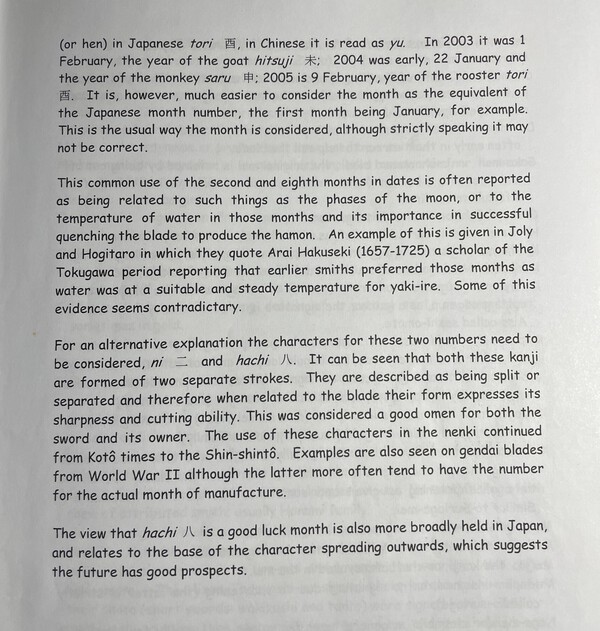
@John C John, here's some notes on "Empire" dates and months. Also in my paper in NMB Downloads of Taguchi Masatsugu (Hizen/Saga) at end are numerous examples he uses in this form.

 1 point
 -
Hi Brian, I think the show is only annually but there’s the North California sword society that has a (mostly) monthly meeting: https://www.ncjsc.org1 point
-
One thing that you learn after hanging around World War II swords is the phrase “never say never, never say always with World War II swords“.1 point
-
G'day Lance, It is a nice type 94 koshirae with the rare pinned kabutogane. If you search the site you will find a thread on "pinned kabutogane". Cheers, Bryce1 point
-
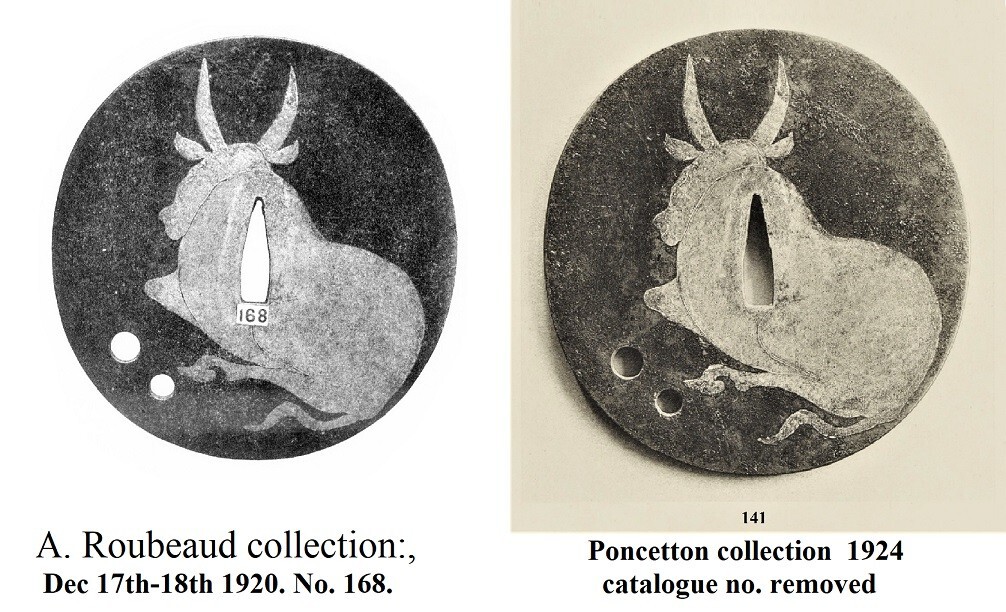
It does add to their history - I don't think most people would mark their collections anymore, but then we have the ability to photograph and take detailed digital records. I just traced some more information from some old references, which can show how some information can get lost and now brought back together. These two images are two years apart and neither source had both sides published - goes to show that sometimes displaying the incorrect side can come in handy otherwise you would need to guess what the other side looked like. The Poncetton image has a paper tag attached to the nakago-ana & hitsu so it didn't have to have a number painted on - these little paper tags are a less intrusive way to catalogue a collection, pity we can't read the information on it. It would appear Poncetton didn't like stickers on his tsuba in all cases? fickle

 1 point



















.jpg.772b368cefbbd08996b90fffe20333de.jpg)


This leaderboard is set to Johannesburg/GMT+02:00