sabiji
-
Posts
388 -
Joined
-
Last visited
-
Days Won
3




sabiji's Achievements






-
 Das ist eine interessante Theorie. Nun, wenn das der Fall ist... ...dann bin ich raus.
 -
By saying, “I wouldn’t attach so much importance to the spiritual aspects of various Buddhist traditions,” I meant that we shouldn’t read too much into them given our limited knowledge of the subject. I, too, am only scratching the surface, but I think Zen is significantly more popular in the West than in Japan itself, and that Zen, as it’s understood here, is one of the most misunderstood “religions” of all. Please don’t take this as a personal criticism, but I believe that D.T. Suzuki contributed greatly to this misunderstanding. You have to look at the historical context. Starting with the Meiji era, Japan copied the West in many ways in order to catch up with the West as quickly as possible. Having to copy something means that the original is desirable because it is superior. However, this technical inferiority can be offset by metaphysical superiority. Zen was ideally suited to explaining the Japanese spirit in this way. The hierarchical system—which, in Zen as well, emphasizes obedience and discipline—closely resembles samurai ideology. How can you top a moral and ethical mindset? By portraying your own—for whatever reason—as superior. BUT: If D.T. Suzuki had studied Shingon or Jodo-Shinshu, one could have used those traditions to explain this particular Japanese mindset as well. At least, that is my opinion, which I have formed through research. I could also be completely wrong. If you ask just about anyone today about Japanese Buddhism, as long as they know anything about it at all, you’ll hear the term “Zen.” That’s about all people in the West know, and Zen is virtually equated with Japanese Buddhism. And even in Japan, numerically speaking, Zen represents a minority. Even my daughter’s host parents couldn’t tell me off the top of their heads which school their family temple belonged to (it was part of Jodo Buddhism). The problem of Buddhism being reduced to a funeral religion is as old as Buddhism itself in Japan. It was only Tendai and Shingon that began to draw on the resources of Shinto and offer solutions for all situations in life. The only problem was that hardly any believers understood these secret and mystical rituals of esoteric Buddhism. True to the motto: “The priests will know what they’re doing.” It wasn’t until the “apocalyptic mood” at the end of the Heian period that believers needed a path they could practice themselves for their salvation. That marked the birth of Jodo, Zen, and Nichiren. For many people, Zen consists of various goals that must be achieved in order to become enlightened or to find success in one’s career and life. But it is precisely these goals—which we hold out before us like a promise (like the famous carrot dangling from a fishing line in front of a foolish donkey)—that have absolutely nothing to do with Zen. Nothing at all—in fact, quite the opposite. To finally bring the discussion back to the topic of swordsmiths and Buddhism somehow: Actually, I just wanted to suggest that we shouldn’t look for the importance of Buddhism to swordsmiths solely in its spiritual context, but rather study the economic significance of (certain) monasteries within the historical and social context. That was really all.
-
Naturally, many blacksmiths were associated with Todaiji. Todaiji is the main temple of the Kokubunji system, a network of state-sponsored temples in the Japanese provinces that dates back to the Nara period. And this is not limited to a single provincial Kokubunji. Each provincial Kokubunji, in turn, had subsidiary temples in the administrative districts. As a result, there were countless temples that served as “branch temples” of Todaiji through the Kokubunji system. This system functioned like Japan’s lymphatic system at that time, through which artisans—particularly swordsmiths (especially those of the Yamato tradition)—spread throughout Japan. Kaneuji’s first posting in Mino as a representative of the Tegai was, of course, a branch temple of Todaiji: the Mino Kokubunji in Fuwa. The Akasaka-Senjuin near Fuwa may have been the longest-established swordsmiths in Mino—although this cannot currently be proven with certainty. The construction of temples in Japan required tools, nails, blacksmiths, farmers, and potters. Archaeological finds of kilns used to fire bricks for temple construction are frequently discovered near such monasteries. As a result, temples were economically far more powerful than regional warrior clans could ever be until the early Nanbokucho period. When examining the movements and distribution of swordsmiths during the Kamakura and Nanbokucho periods, it is essential to keep a close eye on the temples! The most significant role that Buddhism played in the lives of many swordsmiths up until the Nanbokucho period was that of employer. However, I do not mean to imply that the swordsmiths worked exclusively FOR the temples. A certain degree of dependence was, however, necessary for the survival of various schools across generations.
-
I wouldn’t read too much into the spiritual aspects of various Buddhist traditions and sword smiths. What is unfortunately often overlooked, however, is the remarkable economic prowess of monasteries, particularly those of esoteric traditions such as Shingon and Tendai. As some of the largest landowners of the time, they were also exempt from taxes. Temples skillfully established all kinds of businesses and craftsmen near their temples in Teramaemachi. Since they, as landowners—or indirectly through their representatives, the Kuge—could also levy customs duties, monopolies often formed around services, products, and goods produced under their protection and on their lands. Thus, veritable “commercial enterprises” sprang up not only at monasteries but also at shrines, as was the case in Awataguchi. And the famous forges in Awataguchi produced not only fantastic swords but also countless nails for the construction and maintenance of various temples in the immediate and wider vicinity. No swordsmith could simply move from A to B just because he liked the area so much. The trades were clearly organized into guilds, which were generally administered by monasteries or shrines. There were a few exceptions, including Seki, which governed itself. This system was only dismantled by Oda Nobunaga, as the Za’s monopolies and countless tariff barriers hindered the country’s economic development. As for religious motifs on blades, people were relatively pragmatic. On the one hand, it depended on what the client wanted—and that was usually something believed to have the greatest impact. On the other hand, they also used symbolism that did not necessarily reflect the specific school of thought to which they themselves belonged. The “Kamakura Buddha” temple originally had an esoteric orientation. And Masamune was not a follower of Zen, but rather a Nichirin priest.
-
Inoue Shinkai Enpo, Jahr 7, Monat 8 (Enpo-Ära, Jahr 7, Monat 8 Nein, dies ist kein NBTHK - Zertifikat; Es ist ein Torokusho.
-
You're right, Florian. I was just hoping for it—I wasn't expecting it. Although I do have a TH from last year where the generation and the Nengo were also listed. That one, however, was a blade. Sometimes you get lucky, sometimes you don't...
-
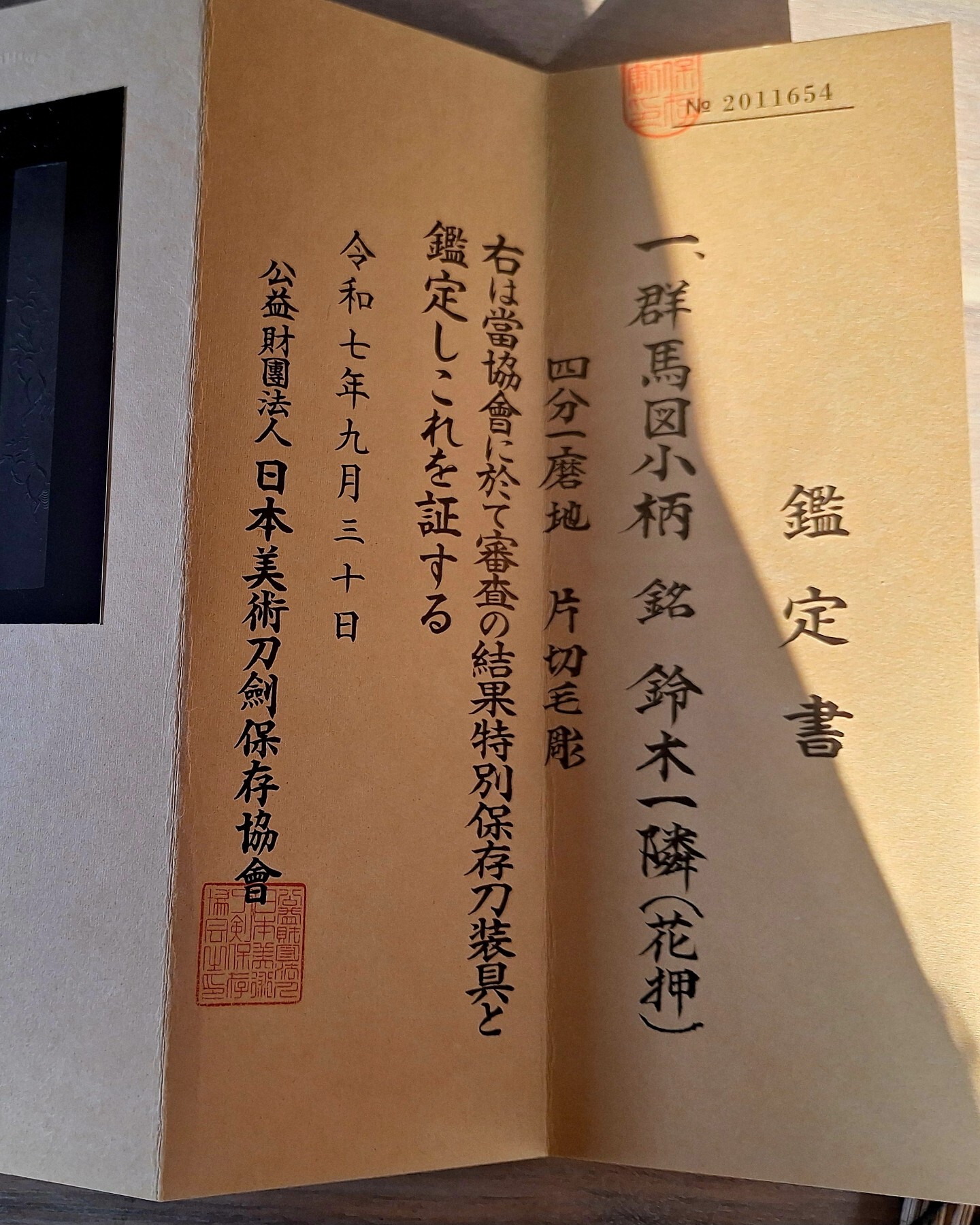
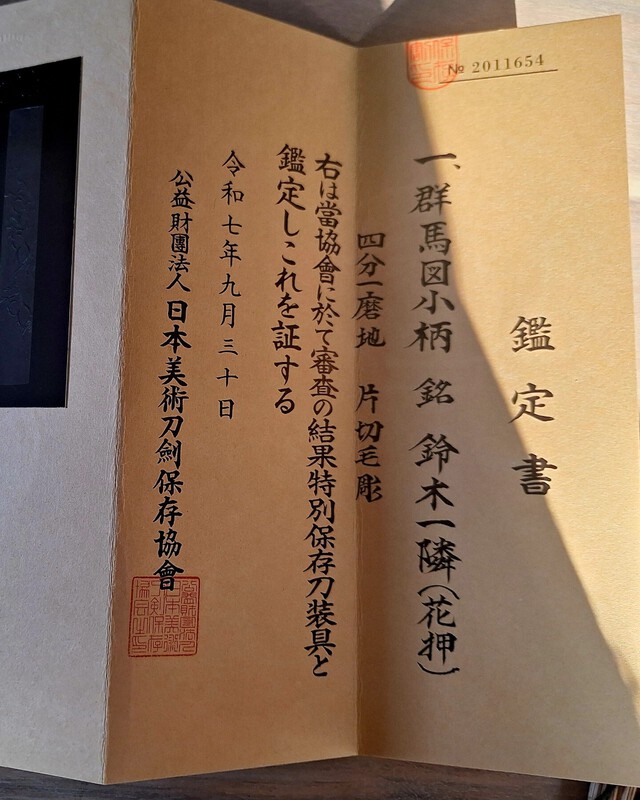
A quick update. It turned out that Paul Kremers took the kozuka to Japan last year to have it appraised by the NBTHK. I’d like to take this opportunity to thank Paul once again! Now I have the Kozuka back; it has achieved Tokubetsu Hozon status. I had hoped that the NBTHK might add a brief note regarding Ichirin (or Ikko), but in the end, only the signature was confirmed.
-
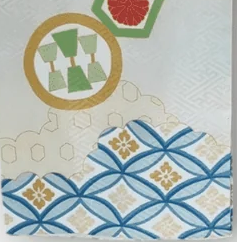
Can I bring up my “fabric pattern theory” (Monjo) again? The whole thing is purely decorative. There are countless variations and combinations. Designers and artists can really let their creativity run wild here. Something else that occurred to me: Tanzaku. Small, colorful pieces of paper on which you write haiku are sometimes designed in a similar way.


-
The meaning behind the name Hon'Ami
sabiji replied to MassiveMoonHeh's topic in General Nihonto Related Discussion
@Brett, The actual background is much more complex and would go beyond the scope of this discussion. Simply put, it is customary in the Jishu sect for its leading priests to use the suffix “Ami” or just “A” (for Amida). So, Hon’ami or Hon’a, Sho’ami or Sho’a, Ze’ami or Ze’a, San’ami or Sa’a. The Jishu are a sub-sect of Jodo Buddhism. Going into all the theological background here would take us too far afield. What is important to note is that the early Jishu broke away from monasteries and turned directly to the faithful in both urban and rural areas. They practiced “Nembutsu” (Namu Amida Buddsu) as itinerant priests. They also accompanied armies as chaplains, even into battle. This led to close ties with the samurai and local rulers. Another term in this context is “Doboshu,” meaning “companion.” After the death of the founder, Ippen, the sect appeared to disband, but it was reformed by his disciples and returned to monasteries. One aspect of their religious practice was a dedication to scholarship and the arts. In this sense, the Jishu were the catalysts for garden art, the tea ceremony, calligraphy, Noh, and much more, all of which were studied in the dojos of their monasteries. Combined with a certain freedom to travel and connections to the powerful figures of the time, membership in the Jishu was highly desirable. Masters of various artistic disciplines were granted priestly status and the title “Ami.” Some of the “Ami” artists effectively became curators and, as a result, artistic advisors—even to the shogun himself. In this context, the Hon'ami family became experts on swords, just as the Sho'ami family was responsible for “silversmithing” (in the broadest sense), and the Ze'ami family was responsible for the No theater for the aforementioned Ashikaga shoguns. Later, Zen Buddhism perfected what the Jishu had established as its foundation. And today, many art forms are known as typical Zen arts. Nevertheless, the Jodo-Shu remains the Buddhist school to which the majority of Japanese people still belong.- 4 replies
-
- 14
-

-

-
@Colin, The most important phrase my “teacher,” Michael Hagenbusch, ever said—one that has really stuck with me—was, “There is nothing that does not exist.” So I would be the last person to categorically reject anything, since everything is simply the current state of our knowledge. And I’m always open to other perspectives and interpretations. But, just as in the Kantei, I always follow the path of greatest likelihood. And in my subjective opinion, that would be the Shippo pattern. But if someone sees a constellation in it, that’s fine by me. Your examples almost certainly depict constellations. As for depictions of constellations in Japanese art, I have very little experience. I would point out, however, that there are some very interesting depictions, especially when the artist has no idea about the subject matter—whether they’re cat-tigers or a meaningless attempt to reproduce Latin letters without any significance. Some constellations will be more astronomically accurate, while others are highly stylized. I’m trying to depict what I mean by “very geometric” in this image.

-
Just as an example: the collegiate church in Quedlinburg here in Germany is an important Romanesque building that was constructed between 1070 and 1130 and, fortunately, escaped destruction during World War II. What’s particularly interesting are the pre-Romanesque decorative elements. They look very much like Celtic or North Germanic endless knots. When I asked a student who gives tours there and is studying art history why these decorative elements on such an important church didn’t look particularly Christian, she replied as follows: 1. That’s misleading! Because such knot patterns didn’t appear in Ireland or Northern Europe until the Christian era. 2. Their origin likely lies in Coptic art from Egypt and influenced both Europe and the Arab world, though it draws on ancient design motifs. 3. Variations can be found, among other places, in stonemasonry, woodcarving, calligraphy, as patterns on clothing, tapestries, weapon fittings, sword pommels, and much more. 4. The creators of the decorations in Quedlinburg were Lombard sculptors from northern Italy. The designs were taken from their pattern books and simply reflected the tastes of the time. And particularly in those German regions where the Romans had not ventured at the time, there was great interest in Lombard and Byzantine architectural styles. 5. Motifs that originated in earlier times can be reinterpreted and adapted regionally and culturally, and can thus take on a Christian meaning—just as churches were built on pagan sites of worship, or Christian holidays were modeled after pagan ones. But I don’t want to digress here. To bring the focus back to the tsuba, I simply want to point out that the origin sometimes lies in quite mundane, popular decorative motifs from woven and embroidered patterns that were in fashion at the time. I’m not concerned with claiming exclusive authority over the interpretation of what’s depicted, but simply with decorative elements—sometimes with folkloric or other religious backgrounds. These were taken up by artists, who in turn inspired other artists, who in turn inspired yet others, leading to different interpretations and executions—especially when they’re produced in larger series due to demand. But since you’re expecting a specific answer: if I personally had to describe this particular tsuba from this thread, I would refer to the Shippo pattern. Perhaps with the addition that the brass pins (added later, perhaps?) do indeed resemble a (fictional) constellation. But as a representation of a specific constellation, this decoration would be too geometric according to Japanese understanding.


-
My favorite Zen koan is, of course, “Honrai Mu ichi motsu.” “In the beginning, nothing exists.” We ourselves create things and worry ourselves sick… over nothing! Sometimes there doesn’t necessarily have to be a deep meaning behind motives. Especially during the Momoyama period, Kyoto flourished enormously due to economic reforms and became the center and trendsetter for many artisanal arts. I’m thinking in particular of Nishijin, the area where the Nishijin silk weavers were based. In and around Nishijin, the Umetada and Goto families, Shoami artists, representatives of the Kano school of painting, Raku artists, the three “Sen schools” of the tea ceremony, and…and…and… They benefited from the proximity of the Imperial Palace, as well as the seat of the Ashikaga Shogunate, and later Hideyoshi’s Jurakudai Castle and the associated estates of Hideyoshi’s vassals. In short: Nishijin became a trendy fashion hub, spanning the spectrum from the refined, exquisite understatement of the Kyoto nobility, through the austere restraint of wabi-sabi, to the bold colors and abundance of gold and glitter that Hideyoshi favored. Artists from various disciplines drew inspiration from one another. Tsuba shaped like silk spindles literally originated in Nishijin. Umetada-Kinko tsuba are reminiscent of E-Garatsu or Kyo-Yaki ceramic motifs, while Ko- and Kyo-Shoami and Kyosukashi feature many geometric shapes, similar to those then in vogue in kimono patterns or display a random selection of motifs found on clothing. In NBTHK documents, the term “fabric pattern” (Monjo) is frequently encountered. Karakusa is found in ceramics, lacquerware, and tsuba. The Shoami school developed a zogan technique that imitates silk embroidery with gold and silver threads, later known in its elaborate form as “Kenjo.” In my humble opinion, this “Shippo pattern” also falls under this basic concept, somewhat influenced by “Sabi,” because the pattern does not appear complete and only temporarily appears very subdued on the surface. I do not mean to rule out the possibility that the regular, strict grid of the Shippo, in its various executions, consciously or unconsciously evokes constellations. It would not be unusual in Japanese art to leave room for ambiguity. As I said, it could mean that, but it doesn’t have to. The owner probably simply saw it as a stylish, decorative element on his koshirae, an expression of his aesthetic taste. Honrai mu ichi motsu
- 189 replies
-
- 11
-
-
-

-
Are Japanese swordsmiths artists or craftsmen?
sabiji replied to MassiveMoonHeh's topic in General Nihonto Related Discussion
It is important to bear in mind that the Western conception of art differs significantly from the Japanese conception in terms of its cultural evolution. In the Western understanding, there is a clear distinction between the “fine arts” and craftsmanship. Consequently, artistic objects are detached from utility and functionality, and the focus is on the ingenuity and creativity of the “artist,” particularly in contrast to other creators. In the West, there is also a clear distinction between “high art” and folk art, which draws on centuries-old, regional, and typically rural traditions. Folk art is not the work of autonomous artists, and its creators are not specifically trained; at best, they follow family traditions. Of course, there are also cases here where craft production serves as a primary source of income. However, the objects are produced in large quantities for a broad customer base. In the Western understanding, a true work of art is unique, individual, and unmistakable. In contrast, the Japanese understanding of art permeates everyday life and is not separate from craftsmanship. Beauty, aesthetics, and functionality are interdependent and inseparable. It was precisely this aspect that so fundamentally captivated Westerners and had an enormous influence on Western artists and designers in the 19th century. Furthermore, art and crafts are not necessarily distinguished from one another, even though “folk art” exists in Japan just as it does in the West. In the Mingei movement—as someone here has already mentioned—there was a theoretical attempt to distance oneself from certain craft-oriented approaches in order to produce simple objects for everyday use as anonymous artisans. I’m no expert, but the Mingei movement is certainly also a result of the “elevation” of arts and crafts to art in the Western sense, which did not go without consequences in modern Japan either Ironically, in some cases the opposite was achieved, which actually proves that people fundamentally need “categories” for classification. I don’t know if the question posed in this thread would have been understood at all in Japan a few hundred years ago. Certainly, particularly outstanding swordsmiths were regarded as masters of their craft, were highly esteemed, and held in high regard. But were they viewed as artists, as we in the West understand the term? From a purely social standpoint, they were, first and foremost, simply craftsmen. -
Dealing with seller djcollection
sabiji replied to 2devnul's topic in Auctions and Online Sales or Sellers
Well, I would try to keep things in perspective. Statements like “...so far, I've always come across honest people,” or “...I definitely feel cheated” imply that the other person is dishonest and a cheater. A situation like this is always very emotional and, in a way, understandable, but I would still be cautious with such statements. If no consensus can be reached, the only thing left to do is to warn others: “...hey, this and that happened to me recently. Make sure to ask for better photos if necessary, or explicitly inquire about specific details that are important to you!” Because what is of great importance to one person may not be a priority for others. This is a very simple thing I can do as a buyer, and something I can fully understand as a seller as well. “Everything has always been fine so far, and I’ve trusted the seller” is therefore rather childish and naive. Anyone who’s been involved in this hobby long enough has surely had to gain enough experience of their own and could tell similarly unpleasant stories involving much larger sums. I found my visit to the last DTI—and, in that context, to several dealers—particularly noteworthy, as it was a mix of highs and lows. Some pieces turned out to be better than expected, while others I would describe as “skillfully photographed.” The blades’ weaknesses were also definitely not described on the dealers’ websites. And this was true even for dealers who are highly regarded here. That was quite sobering, but also a wake-up call, because by then I had come to believe I was quite good at interpreting photos. -
1798 Ozaki Gengomon Suketaka
sabiji replied to Frye1001's topic in General Nihonto Related Discussion
It’s not entirely accurate to say that such titles have no significance. I don’t want to dwell on the subject unnecessarily. Especially in highly organized Japan, which remains deeply traditional and conservative in many ways, the worst thing for a Japanese person is to be unaware of the rank and social status of the person they’re communicating with, making it impossible to choose the appropriate behavior and manner of expression. When I think about how incredibly complicated the rules were for drafting a document addressed to specific recipients in Edo-period Japan—and all the things one had to pay attention to—it clearly shows that holding a conferred title had a clear influence on the bearer’s social standing. Even if it only meant bowing 5 centimeters deeper. But I simply don’t know.