


uwe
-
Posts
2,169 -
Joined
-
Last visited
-
Days Won
2
Content Type
Profiles
Forums
Events
Store
Downloads
Gallery
Everything posted by uwe
-
Yep, the Kogatana is very hard to read. I imagine to see “守” and “藤原”, but it’s pure guesswork. Maybe you can try another angle for the light source Tyler?!
-
Probably “藤原守行” (Fujiwara Moriyuki)...
-
An image without the maedate and a view inside, without the liner (ukebari) would be helpful. Apart from that, I tend to agree with Piers. Looks authentic, from the pics provided....
-
Hi Alex, it is an “zunari no kabuto” (head shaped helmet) as you already might know. This type of helmet were made over an very long time frame in slightly different shapes and therefore usually hard to date. What exactly you want to know?
-
It is “Maru ni ken-katabami” (or “Naka-wa no uchi ni ken-katabami”), Dick! Often related with “Sakai” family..... I wonder about the armor, though?!
-
Adam, I’m afraid, that the nakago of an kogatana is telling not so much....
-
Sometimes...😳
-
What I can make out is: “長門国住藤原?太良” Reading of the first two is “Nagato”! Though, “郎“ would make sense, if there wasn’t a third (illegible) kanji....I think?!
-
Adam, your reflections carrying most of the desired answer..... So just two additional comments: 1. This helmet has nothing to do with an “akoda-nari” kabuto. 2. Ansei (1854-1859) is far too optimistic. But at the end of the day, it depends of what you want to have....
-
Type 98 Shin-Gunto Mei - 金 近 Kanechika? 金丸 Kanemaru?
uwe replied to tbonesullivan's topic in Translation Assistance
Perhaps “奥村金光” (Okumura Kanemitsu). -
I would say “肥前国正次” (Hizen no Kuni Masatsugu) Nengo seems right: “皇紀 2603” as far I can tell....
-
“粹光斉兼明造之”
-
Adam, the Jingasa above is a so called “Bajo-Jingasa” and the Kabuto is a “Zunari-Kabuto”. Google the terms and you will find a lot of info! More later, if you want. Off for work....
-
I assume “謙光斎一知” (Kenkōsai Kazutomo)
-
Don’t have much time, so in a hurry... Underneath seems to be the measurement “寸法”, (一) and the signature “記名”. Not sure (finished) about that...
-
Brian threw me a lifebuoy, so I also made it back to the vessel. My best wishes down to SA......get well soon!
-
Adam, the difference is, on futaye-gusari the connecting links are winded twice! Well spotted, John! I also think that the positioning of the holes might be crucial...
-
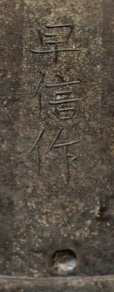
...Hayanobu saku "早信作"? Sounds a bit strange, but I wasn't able to find another plausible reading (let alone any reference of the smith). Can someone point me in the right direction please?!
-
Congrats Adam! Step by step you’re sliding to the “dark side”... On a more serious note, you indeed have two different types of gusari, “fusa + futaye”. I’m still not convinced that the tare is original to the men, but haven’t looked for other examples by now...... (The large number of holes can also point towards an former tare, laced in kebiki!)
-
Steve, “蝅” instead of “蚕”? Or is it the same?
-
Hi Uwe, mei looks a bit “有功” (Arikoto) to me and I agree with “光正” for the fittings. ...beaten by Jussi
-
You are right Adam, the parts matching condition wise... The mustache could well be an replacement, but it’s hard to spot, because on this kind of masks (probably Haruta school), the hair was attached with lacquer to the body of the mask rather then through drilled holes. On the other hand, that would cost something and makes no sense, considering the general condition of the menpo. In terms of the gusari-tare, I think the right way to fasten it to a mask, is shown in the picture from “aoi”. But I’ve to go back to my books for confirmation. The chain mail might be “fusa-gusari” or “futaye-gusari”, pics are too blurry.....
-
Well, this honest menpo has suffered somewhat in the past. Nothing that can’t be restored..... At this point the problem of displaying it properly, will be the the small plate on the bottom, where the tare would be fastened. It’s almost rotten away in the middle section. Always a problem to say something during pending sales!
-
I know at least one signed example (Myōchin Kanehide), however, from the very late Edo/Meiji period. So I think it won’t count....


