


uwe
-
Posts
2,165 -
Joined
-
Last visited
-
Days Won
2
Content Type
Profiles
Forums
Events
Store
Downloads
Gallery
Everything posted by uwe
-
I would say “肥前国正次” (Hizen no Kuni Masatsugu) Nengo seems right: “皇紀 2603” as far I can tell....
-
“粹光斉兼明造之”
-
Adam, the Jingasa above is a so called “Bajo-Jingasa” and the Kabuto is a “Zunari-Kabuto”. Google the terms and you will find a lot of info! More later, if you want. Off for work....
-
I assume “謙光斎一知” (Kenkōsai Kazutomo)
-
Don’t have much time, so in a hurry... Underneath seems to be the measurement “寸法”, (一) and the signature “記名”. Not sure (finished) about that...
-
Brian threw me a lifebuoy, so I also made it back to the vessel. My best wishes down to SA......get well soon!
-
Adam, the difference is, on futaye-gusari the connecting links are winded twice! Well spotted, John! I also think that the positioning of the holes might be crucial...
-
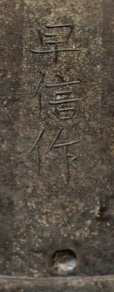
...Hayanobu saku "早信作"? Sounds a bit strange, but I wasn't able to find another plausible reading (let alone any reference of the smith). Can someone point me in the right direction please?!
-
Congrats Adam! Step by step you’re sliding to the “dark side”... On a more serious note, you indeed have two different types of gusari, “fusa + futaye”. I’m still not convinced that the tare is original to the men, but haven’t looked for other examples by now...... (The large number of holes can also point towards an former tare, laced in kebiki!)
-
Steve, “蝅” instead of “蚕”? Or is it the same?
-
Hi Uwe, mei looks a bit “有功” (Arikoto) to me and I agree with “光正” for the fittings. ...beaten by Jussi
-
You are right Adam, the parts matching condition wise... The mustache could well be an replacement, but it’s hard to spot, because on this kind of masks (probably Haruta school), the hair was attached with lacquer to the body of the mask rather then through drilled holes. On the other hand, that would cost something and makes no sense, considering the general condition of the menpo. In terms of the gusari-tare, I think the right way to fasten it to a mask, is shown in the picture from “aoi”. But I’ve to go back to my books for confirmation. The chain mail might be “fusa-gusari” or “futaye-gusari”, pics are too blurry.....
-
Well, this honest menpo has suffered somewhat in the past. Nothing that can’t be restored..... At this point the problem of displaying it properly, will be the the small plate on the bottom, where the tare would be fastened. It’s almost rotten away in the middle section. Always a problem to say something during pending sales!
-
I know at least one signed example (Myōchin Kanehide), however, from the very late Edo/Meiji period. So I think it won’t count....
-
Not that bad, first glance..... Can’t tell, if the shikoro is original to the piece!?
-
I never came across such a feature before. Learning never ends....????
-
Heads up......????
-
“恒康”, can be read as Tsuneyasu or Hisayasu....
-
What dō ever (I have my own opinion in this case), the additional plate connecting both parts is a bit strange in my eyes.... Furthermore, not a bad purchase for the first time, Adam! Some TLC and fixing the loosen parts of the lacquer (like Ian suggested) would be enough for the time being. If you like to clean it, use damp (not wet) wool cloth, but be careful that no moisture gets on the iron or under the urushi. First, try without a solvent. In addition, prevent the red rust doing its job.....that’s it!
-
Mauser C96 With SMR Railway Stamp?
uwe replied to Bruce Pennington's topic in Tanegashima / Teppo / Hinawajū
Seems that they also used the German M16/18 Stahlhelm back then.....?! -
Compare here: http://www.militaria.co.za/nmb/topic/19623-having-trouble-translating/
-
I thought “玄番” (Genba) at first....but no clue ????
-
As John said, but with lacking the character “州” (shū) for state or province in “濃州“ (Noshū).
-
In my eyes, this is a rare dou and of course worth restoring. It should be reunited with its kabuto and menpo to form a “matching set” at the end. The parts you have seems to be the kusazuri and the sode. Hard to tell whether complete or not.... Anyway, some meters of odoshi should solve most of the problems!
-
Could be “青柳軒” (Seiryūken).


