george trotter
-
Posts
3,005 -
Joined
-
Last visited
-
Days Won
14
Content Type
Profiles
Forums
Events
Store
Downloads
Gallery
Everything posted by george trotter
-
OK thanks. Yes a good point. Over the years I have done this test on a lot of tsuba that I KNOW are either forged and cast and the resulting 'ring' or 'thud' was consistent with this. Of course there may always be "variations"...which I can't explain....it is always up to the member to use or not use this test. Regards,
-
Duhh...Ok, thanks Bruce.
-
Tsuba looks OK to me Bruce but I'm not an expert. Can't say if the kanji are cut or cast. To test if tsuba is cast, hold tsuba lightly (horizontal) with your first finger and thumb on the nakago hole and 'flick' the edge of the tsuba with your other hand. If there is a fine ring it is forged, if a dull thud, it is cast...then nothing is legit. Let us know,
-
Survey on distribution of Mon
george trotter replied to PNSSHOGUN's topic in Military Swords of Japan
Oh, didn't think show you my mon...One I no longer have, 2 have been ripped off...this is the only one ...this is on a mumei shin-shinto/early gendaito in Type 98.
-
Survey on distribution of Mon
george trotter replied to PNSSHOGUN's topic in Military Swords of Japan
Hi John, As you say...so many variables, but maybe this will help. 2 old blades in Type 98 mounts (mon = 2) 9 gendai 1926-1945 blades as follows: 4 in Type 98 mounts (mon = 2,, both missing) 5 in Type Rinji mounts (mon = nil). 1 Type 98 'spare part' kabuto gane with mon. It is a strange thing but I have seen MANY Meiji-Taisho arsenal type brass hilted sabres with mon but very few 1940-1945 showato with mon...maybe the lack of mon shows that 1937-1945 officers were mostly 'called-up' for service and were not "traditional" army-alligned young men whereas back in Maiji-Taisho it was a "profession/brotherhood" one went in to and absorbed all the pride and thus needed to show one's family/clan etc to like-minded colleagues? Maybe in WWII those officers who had the money to have a blade hand-made and mounted would be more likely to add a mon. Regards, -
Well there you go...so I wasn't dreaming. Thanks Bruce...you are on the ball as usual.
-
Nice sword David, I have one by him in the same mounts (no leather cover) with star stamp. Mine is 7 months after yours being date 18/5 (May 1943) and matsu in a circle stamp is number 1080. BTW (for our US friends) Milne Bay in PNG was one hell of a battle (25 Aug-7 Sept 1942) and the Aussies stopped the Japanese there...didn't stop the war, but drastically weakened the Japanese army in PNG. Going by the date on your sword David (17/10 = Oct 1942) your friend's dad (while being a medic at Milne Bay himself) probably got the sword some time later, at one of the later battles/surrender. Great stuff, Regards,

-
Bruce san, I recall seeing a Type 98 gunto (signed Kaneuji?/Masauji?) a few decades ago...with a kikusui engraved on the BLADE, about 1 inch forward of the habaki. If my ancient memory is not confused, the hamon was Mt fuji appearing through the clouds, again, just in front of the habaki. So long ago, may have been 2 different swords...but just thought you should know the kikusui has been seen on a showato? blade. Regards,
-
Oh, I see the top writing has been torn off...too bad, I agree the name appears to be MATSUURA YASU ?. Regards,
-
Looks like a Kyu Gunto tassel. Also, show us the writing at the top portion of the tag...might help us figure it out. Regards,
-
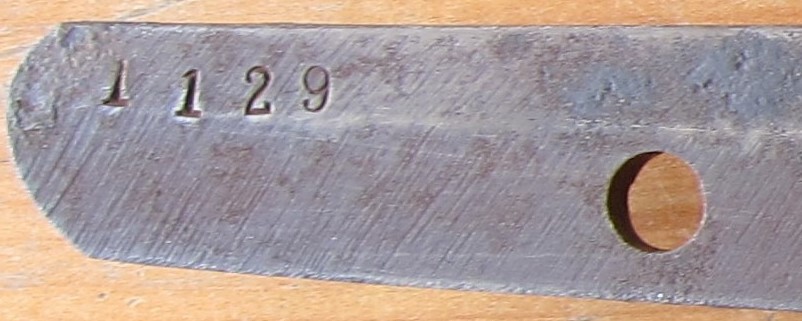
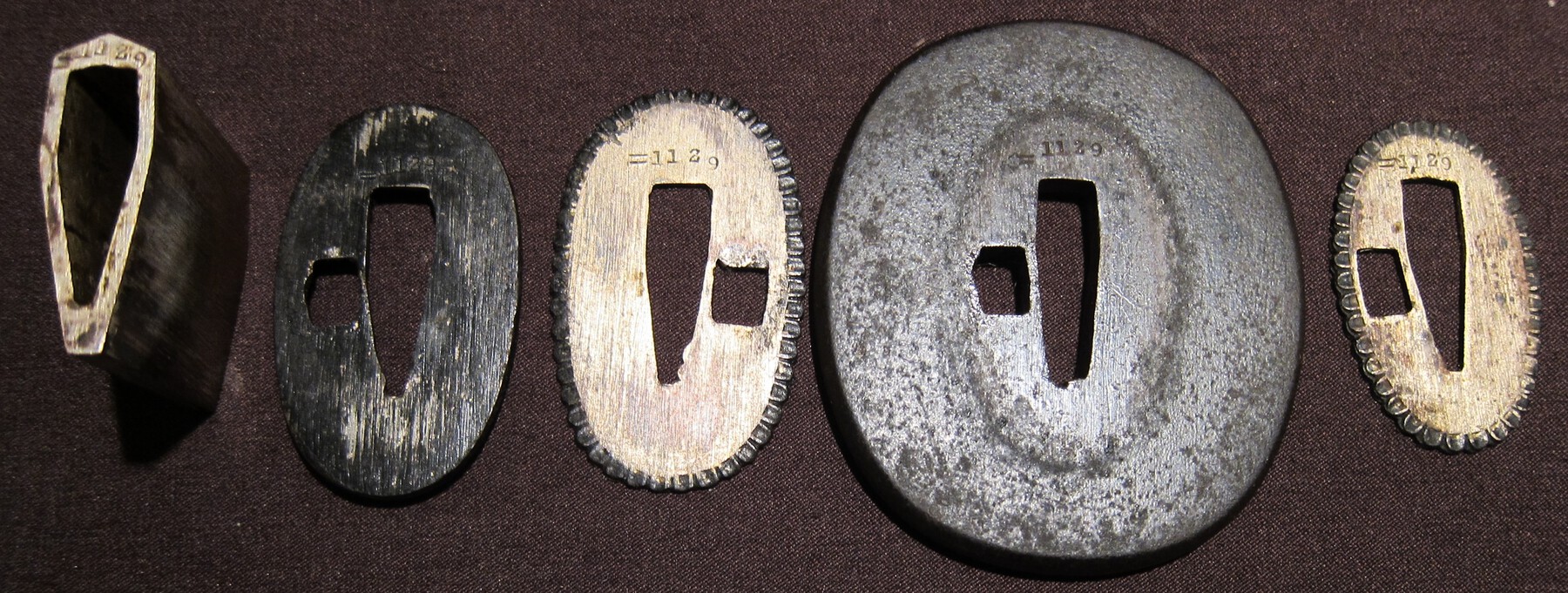
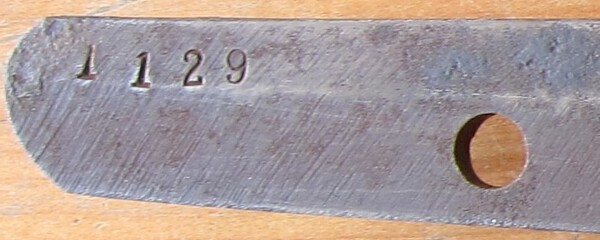
Yes, as you say Bruce, too early to tell. I have to say that since I put that Yamagami numbers list together, I have seen numbers on other tangs, and am now wondering if they really are smith numbers. I say this as my Tsukamoto Masakazu tang dated 17/4 (Apr. 1942) is numbered 1129 (and all parts)...so the question arises, how can Masakazu (later in 1942 a RJT smith) who only "graduated" from his brother Okimasa's sword training forge in Setagaya, Tokyo, in about mid-1941, have moved to Fukushima, set up his own forge, and produced his 1129th sword in April 1942? (that would be close to 100 swords/month). An excellent Japanese source on RJT smiths I got from Morita sama and Chris Bowen sensei says that in the 6 months 14 Aug. 1944 - 26 Feb 1945 Masakazu made 97 RJT swords (about 16/month), so the number 1129 (100/month when he was a private smith) must be "just a number"?. Maybe it is a contract number between smith and mounting shop (just a number in amongst all their other customer numbers?)...maybe it is just mounting shop number to keep all the parts from getting mixed up with other swords? I just am not sure. Again, with the Yamagami brothers, that MATSU in a circle stamp is local to Niigata (so far only them)...but is it (and the number) theirs or their local mounting shop? So, I hope I haven't confused everyone...I know you like mysteries Bruce...this is a beauty!...hope I don't read about a Japanese Sword Collector going crazy in the US in the near future!!!! Regards,

-
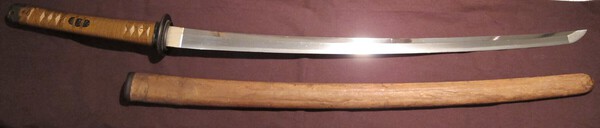
Not sure if I'm helping Bruce, but knowing you are a good detective, I have some info on the tang-mune numbers that appear on swords in those high class Rinji mounts (which I think, from those I have seen, come only from the Kyoto/Osaka/Hyogo area). I have seen (now with this Tomonari) as follows: Endo Tomonari Hyogo Star 19/7 mune = 24 Takashima Kunihide Kyoto Star 19/8 mune = 90 (papered NBTHK 1991 Hozon) Takashima Kunihide Kyoto Star 19/8 mune = 98 (mine - photo attached) Takashima Kunihide Kyoto Star 19/8 mune = 99 These are from research on Kunihide...there are others I didn't think to record...one named to Osaka. Exactly where the mounting shop/chain of shops who used these mounts and marked the mune was located...well...wish I knew. Regards


-
Well, looks like we can expect to find just about every variation possible in the RS group (probably lots more variations we haven't seen yet). Maybe best to just take them as they come and not try to "invent" an explanation for these variations. War-time, lots of pressure, supply problems etc, etc. Just make something that works...hyaku, hyaku... Thanks guys,
-
Thanks Dave. Yes we know they are a lot 'scarcer' than the Type 98, and for the reasons you give. Just wondering about how scarce are the gilt/brass menuki among these rinji. I know that the earliest Rinji mounted sword known (Yamagami Akihisa gendai dated 12/1941 numbered 566 in brown lacquered Rinji) has black iron menuki - so that seems to mean the black ones were there from day one, so these gilt ones must be "private customer's mounting choice"?. I am also supposing they'd only appear on the private order mounts for private order gendai and RJT blades...wouldn't expect to see them on the 'common' Seki made mounts for Rinji showato blades? and Bruce, yes, 1 inch longer heh-heh...do I hold the record? Wonder if there are longer blades in Rinji out there? Regards,
-
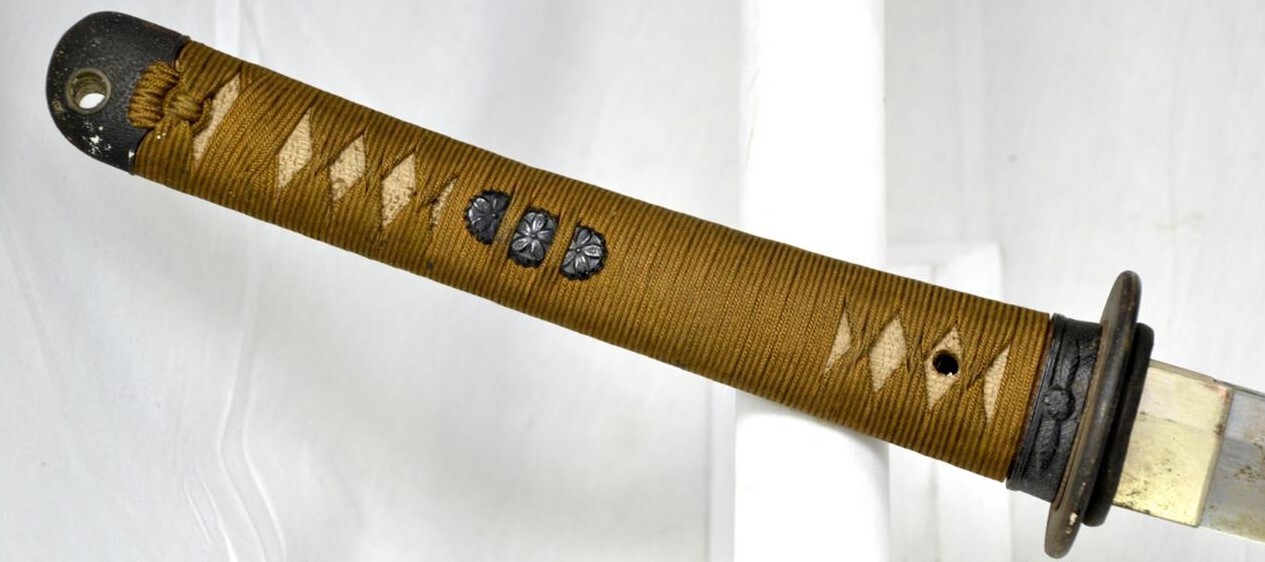
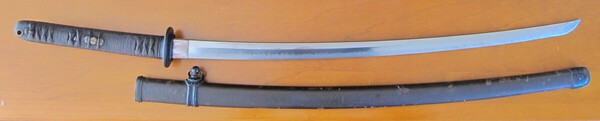
On the subject of this private order Tsukamoto Masakazu blade above. I have a couple of questions members might be able to help with...Just to add to the Rinji Seishiki knowledge base. Have a look at pics. 1. the blade is 69.5 cm.(27 3/8 in)...have other menbers seen this length blade in Rinji mounts ? 2. notice that the menuki are gilt/brass pattern instead of the usual 'Rinji pattern' black iron menuki...have members seen these as well?...maybe just a private order "customer choice" thing? Be interested to know just how "varied" the Rinji sytem was. Regards, (Edit) well there you go...I should have looked at post #55 on this thread and I would have seen the gilt/brass menuki on a Rinji...duuhh! Well, still interested in how common they are and answers on long blades.

-
Quoted this post by mistake...tried to cancel my reply...but can't see any way of doing that on this new format...can anyone tell me how to cancel for when I do this again? Thanks.
-
You'll have to find out what branch/family the 3 stripes on the centre leaf signifies. Have fun...
-
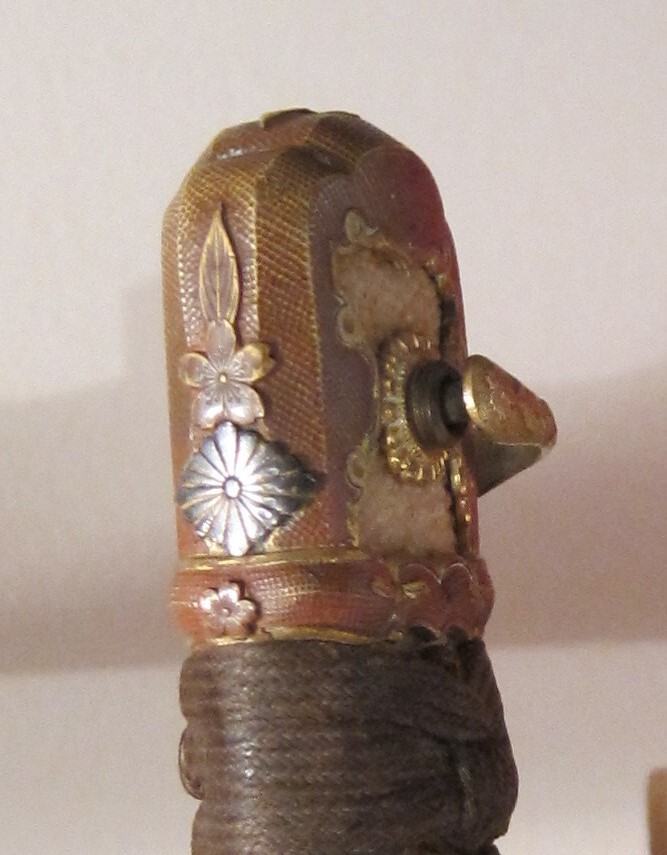
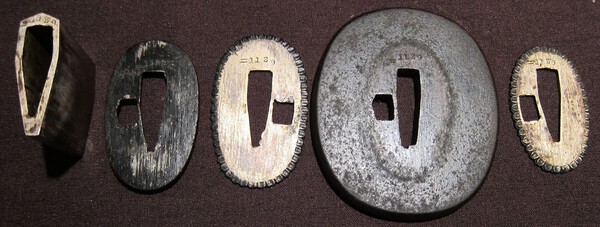
I'm back! Thanks to Bruce and Brian...finally got me trained in the new way of doing things...I wish! Anyway, about this Tsukamoto Masakazu blade made 4/17 (April 1942) in Rinji mounts. Pretty early for Rinji as Bruce says, but starting to appear in late 1941? Masakazu 1901-1969 of Fukushima studied under his younger brother Tsukamoto Ikkansai Okimasa in Tokyo and returned to Fukushima in late 1941 to set up his own forge. He became RJT smith from late 1942, but this one is one of his pre-RJT private order blades (no star) and is very long at 69.5 cm. As Bruce has been trying to unravel, this blade is marked 1129 on the tang and 'ni' 1129 on all metal parts, even the button catch and the back of the habaki...we are not certain yet, but as this is not a RJT blade this cannot be an RJT number...mounting shop number? Here are a couple more pics. Regards,

-
Translation assistance on good luck flag
george trotter replied to ww2colorado's topic in Translation Assistance
Its a bit small for me to read and it is (as usual) in semi-handwriting instead of neat printing...but IMHO it is genuine WWII and follows the usual form: Across the top reading R-L is the usual slogan about protecting the nation and good luck etc RH column down seems to be a neighbourhood association name (who gave him the flag). Next column (can't read first kanji) but seems to be his name Hayashi Masahiro? kun (Mr.) Next columns are the persons of the association/village name etc. All the names radiating out from the sun are well-wishers from his family and community etc. Wish I could help you more, but I have never spent much time on these flags...potentially historical interesting info there though... Regards, -
Whats the Value of this sword group?
george trotter replied to WW2UsCollector's topic in Military Swords of Japan
name on flag is KOGAWA (Mr. Old river). -
2 points... A. I can see no date on this article...does anyone know it? B. In the text within the box (I haven't translated it) it says roughly, that the value/cost of the sword will be to a maximum of 500 yen...so is this a 'donation" request or is it a call to sell the govt. your old sword? Just asking,
-
Star Stamped Tsutsui Kiyokane Blade
george trotter replied to cisco-san's topic in Military Swords of Japan
I have seen rinji with A...2 screws, each entering from the opposite side. B...1 screw / 1 peg types C.. 2 peg types. Screw types always have a 'threadless nut' as a rest for the screw head at the screw head end and a threaded nut at the threaded end (usually hidden by the same/binding)...this is so the screw (if over-tightened) will not crush the wooden hilt. Hope this helps, -
Yes the LHS star is the one I had...
-
'Special'
-
Toku means 'special' as in tokubetsu 'especially important'.