MauroP
-
Posts
853 -
Joined
-
Last visited
-
Days Won
5
Content Type
Profiles
Forums
Events
Store
Downloads
Gallery
Everything posted by MauroP
-
The paper says the tsuba is signed 早乙女家則 - Saotome Ienori
-
 Dear NMB fellows, I'm very pleased to read the "Established ideas that need to change" threads. It's a comprehensive effort to line up all the main issues that perplex every western scholar. Usually is said that it takes ten years time to master a specialized branch of knowledge. But that's not true for tōsōgu studies; why? Till now I was thinking it's just the lacking of relevant literature accessible in a language I can understand in a reasonably clear way. Now it seems to me that the "state of the art" in this field is much worse than I had perceived so far. Let me brefly focus on the main points emerging from this interesting thread and then discuss each separately: 1. school categorizations; 2. period of production; 3. consistency in assigning a categorization. Point 1: are tōsōgu studies a science? No (IMHO), it's a kind of religion! The "revelation" came out many years ago, but far later than the objects of its speculation, and resulted in a coherent "theology". Scientific approach is simply impossible: no contemporary documentation available (historic criteria), almost no circumstantial data available (archaeologic criteria). Stylistic analysis could be a (weak) basis, but we all know that in Japan the same models of tsuba have been produced for centuries, and many styles were present in the same period. Point 2: in principle it's possible date an iron specimen produced in a traditional way (using charcoal obtained from wood collected almost the same time the iron was produced). Actually the available technology is still immature: it's destructive, needs quite a lot of material from the specimen and is prone to pitfalls (if fossil fuel was used in the production, the result could predate the specimen by many centuries or even millennia). Point 3: this is a goal that can reasonably be pursued. But is it so important? Personally I'm interested in theology (nihil humani a me alienum puto) and I appreciate a coherent preach, but what if I'm an atheist or a believer in another religion... It's no clue to teach Catholicism to the Pope (and kantei to NBTHK).
 -
Hi Philip, the good news is that at least another very similar tsuba has been judged authentic by a shinsa in 2004 (and hiashi-yasuri is reported in the paper). See https://www.seiyudo.com/tu-08082.htm

-
Welcome Tom, I'd suggest a Hizen (肥前) attribution for your tsuba, early to mid Edo age.
-
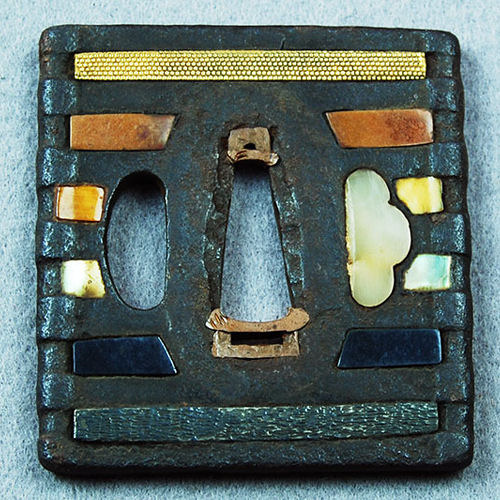
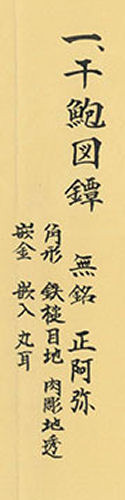
The plugs covering a sukashi are called gankin (嵌金), the homologue elements covering hitsu-ana are called ume (埋).
-
I think in omote is written 藻柄子 - Sōheishi (not Mogarashi),
-
久国 - Hisakuni? (but possibly some other sign over 久)
-
Possibly once was a plain tsuba lately converted for a bokken use (also an explanation for the presence of hitsu-ana).
-
Here what I think is a pre-Edo Kamakura tsuba:

-
As far as I know Heianjo-sukashi and Kyo-sukashi are just two names for the same school/tradition. Heianjo-sukashi is possibly an outdated name (I've never found it on a NBTHK paper).
-
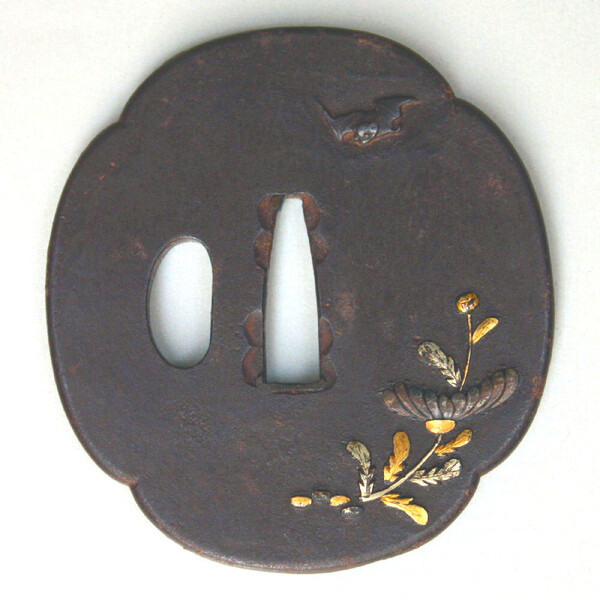
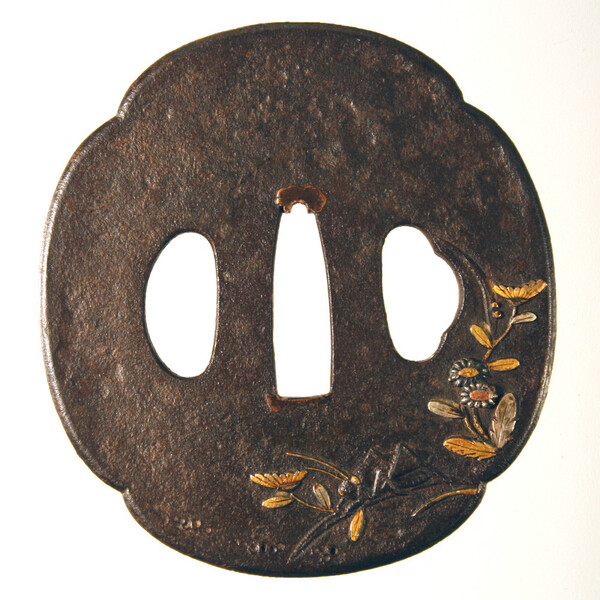
After a short time thinking which tsuba with plants theme I like the best, I resolved to propose some with akikusa - 秋草 - autumn flowers. All are simple, natural sketches from Aizu-Shōami school (just my opinion, none of them has a kanteisho). No masterworks here, but I appreciate the fine work of multicolor inlays. Please have a look at the updated version of Flora Hoplologica Japonica at: https://www.dropbox....0hr&st=n6fo0z5l&dl=0


-
Not exactly convincing (but I hate to give bad news)...
-
BTW, I'm selling my Ferrari car. Ask me via PM only if seriously interested...

-
Another ringing implement: unpan - 雲板. It's a kind of gong in shape of cloud used in Buddhist monasteries.

-
Asarum caulescens (hollyhock) and Paeonia suffruticosa (peony).
-
Camellia sinensis (tea plant)
-
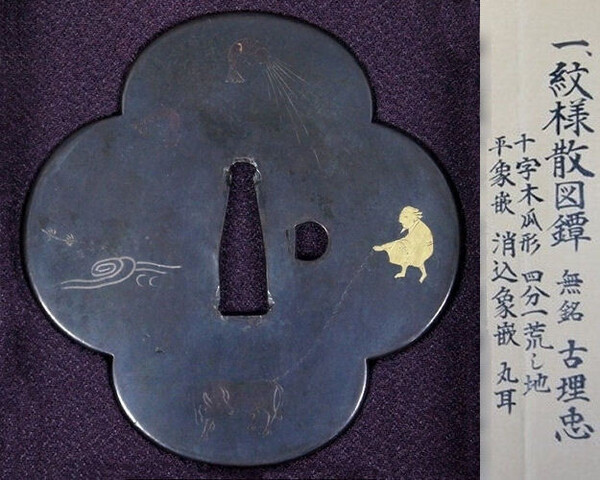
I think Umetada (or ko-Umetada) could be a good call. Here below a ko-Umetada tsuba (according to NBTHK) and the only ko-Shōami in soft metal I was able to find (which BTW is also not so far from the tsuba discussed here). .

-
関羽図鐔 - Kan'u no zu tsuba. Nikubori + suemon-zōgan + nunome-zōgan = Shōami (or better Aizu-Shōami), late Edo period. (for future reference)

-
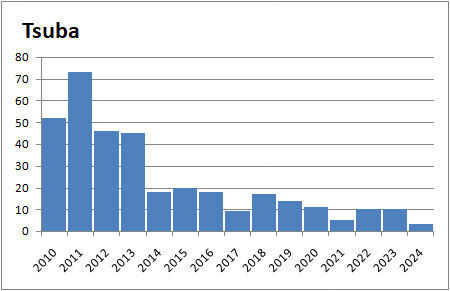
- Hi, my name is Mauro and I've been a tsuba addict for 14 years. - Thank you Mauro for telling us your problem! - Problem? Which problem...? All right folks, anyway now I've been astinent for 3 months. This thread prompted me to rewiew my buying habit about tsuba, and data clearly demonstrate: 1. it's a kind of addiction; 2. I'm improoving in the passing of years; 3. I'm not yet a wise man, but still enjoyng collecting .
- 57 replies
-
- 10
-

-

-

-

-
Possibly Akita-Shōami?
-
Kudos, finding an undervalued piece is the dream of every collector, much better IMHO than acquire a certified piece. Adding value through knowledge is the very essence of collectionism.
-
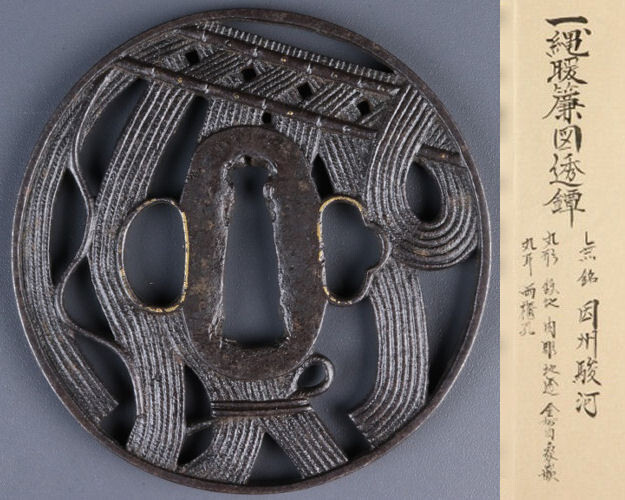
What about rope curtain (縄暖簾 - nawanoren)?

-
Complimenti, Manuel!