MauroP
-
Posts
883 -
Joined
-
Last visited
-
Days Won
5
Content Type
Profiles
Forums
Events
Store
Downloads
Gallery
Everything posted by MauroP
-
"Tsuba: The R. E. Haynes Study Collection" Auction
MauroP replied to Promo's topic in Auctions and Online Sales or Sellers
Hi, I phoned Czerny’s, and they explained that shipping antique items abroad from Italy requires permission from the Ministry of Culture, regardless of whether the destination is inside or outside the European Community. So don’t worry, it’s just the Italian bureaucracy... -
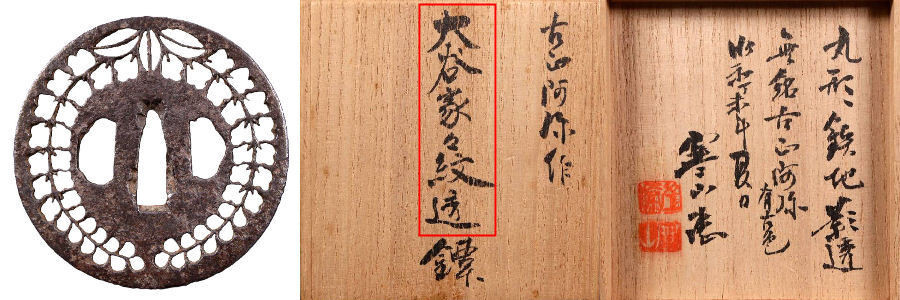
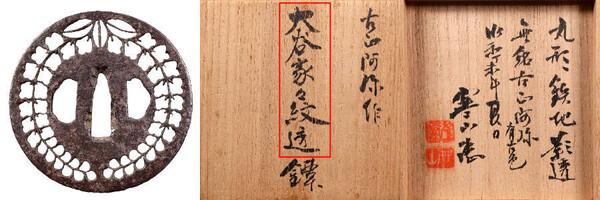
Thank you, Moriyama san. At least one branch of the Ōtani family used a kamon featuring a descending wisteria design, although it differs from the more common wisteria kamon. from: https://ja.wikipedia.org/wiki/大谷家

-
the vast majority of Japanese art and imagery... is closer to describe the reality.
-
HGK2 古正阿弥作 * ko-Shōami saku 大呑家々紋透鐔 * ??? mon sukashi 丸形 鉄地 影透 * maru-gata tetsu-ji kage 無銘 古正阿弥 * mumei ko-Shōami 有古色 * ari koshoku 昭和丁未年夏日 * Shōwa hinoto-hitsuji-nen kajitsu 寒山誌 * Kanzan shirusu Here I'm dubious about what is written in the description of the tsuba, so maybe the hakogaki could eventually refers to another tsuba. Thank you for any suggestion.

-
Thank you, Moriyama. I consider yours the final word on the matter. I'm planning to add an explanatory note at the end of the document.
-
Thank you again, Steve, for your efforts in interpreting this hakogaki. It is possible that we will never know for certain. Perhaps Satō-sensei was not aware at the time of the meaning of the kanji on the tsuba, and simply recorded them one by one, following a clockwise arrangement as in scheme A in the image below. The correct reading follows scheme B, which is by no means a common way to read an ancient Japanese text, as far as know. This interpretation was possibly suggested by Itō Mitsuru in his 2025 book "Nobuie". On the other hand, an NBTHK Tokubetsu Hozon paper for the same tsuba describes it as 龍に忠則命尽文字図鐔, thus suggesting scheme C (尽 is listed as a variant of 盡). Therefore, I suppose I must accept a certain degree of uncertainty in my transcription.

-
Thank you, Steve, your help is invaluable. I’m familiar with the meaning of 忠則盡命, and I suppose it can be rendered in rōmaji as chū-soku jinmei. However, when it is written as it appears in the hakogaki (盡忠則命), does it retain the same reading and meaning?
-
Dear NMB members, I’m back once again to ask for your kind help! I’m trying to fill in a few missing kanji and improve the romaji transcription of tsuba hakogaki by Satō Kanzan. The updated document (draft no. 3) is available here: https://www.dropbox.com/scl/fi/gkfcfqc6gs14invoeg6hn/KanzanHakogaki.pdf?rlkey=5i89f80fkbbf60x67f1lloa2k&st=j7yud1nq&dl=0 Here are the points that still need attention (I'm posting the relevant hakogaki one by one): HGK1 三信家 鐔 * San-Nobuie tsuba 盡忠則命 *??? 木瓜形 鉄地 毛彫 * mokkō-gata tetsu-ji kebori 銘 三信家 * mei San Nobuie 美同銘★ 無出共右者 * ??? ??? 珍重 伊達家伝来之一 * chinchō Date-ke denrai no itotsu 昭和甲辰夏日 * Shōwa kinoe-tatsu kajitsu [1964, a summer day] 寒山 * Kanzan Question 1: how should I transcribe the description of subject (盡忠則命)? Question 2: little idea about correct kanji and meaning of the 3rd column from the inside writing of the box. Thank you for any suggestion.


-
Dear Alexander, I finally had the opportunity to review your project: very interesting and exceptionally well done. It offers a historical perspective that is not often appreciated by modern collectors. I especially valued the inclusion of relevant bibliography for each chapter. Thank you for your effort.
-
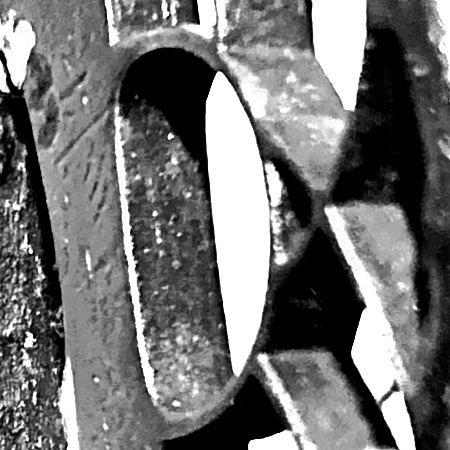
John, maybe I'm not grasping the question... if it has horns, moos and looks like a cow, well, most probably is a cow... Your tsuba has an Akasaka look and is signed Bushūj jū Akasaka, so what else? About layers I'm quite convinced I can even see them (but don't take it too seriously).
-
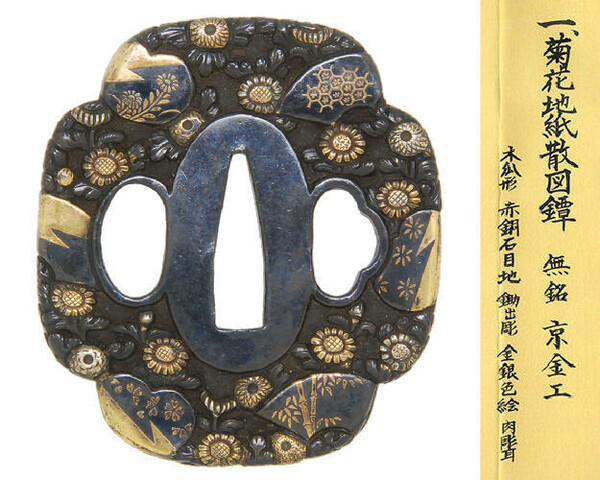
Kyō-kinkō?
-
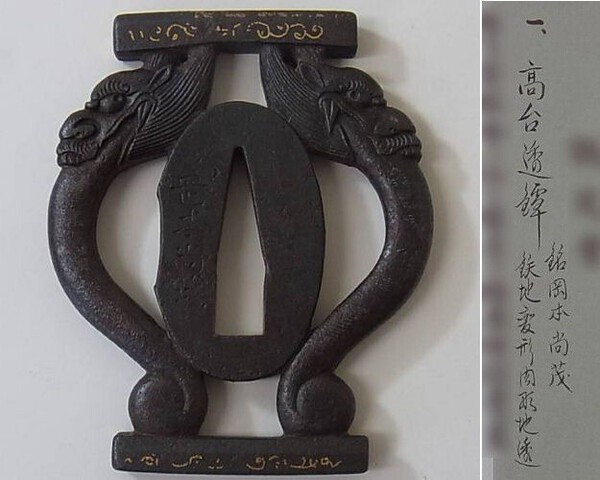
Hi Dale, nice tsuba, but I don't think it depictsa bell. Here another tsuba depicting 高台 - takadai, a kind of raised holder.
-
When "mystery" is mentioned about tsuba, it translates "Shōami" indeed...
-
The examples I provided are all from papered tsuba, and all NBTHK papers reported the subjects as karigane. The stylized birds with "twisted body' are reported as 結雁金 - musubikarigane.
-
Nice kozuka. I suppose you already know that the subject depicted is probably Kojima Takanori.
-
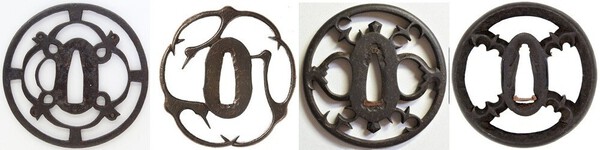
Love the discussion, although I’m not very confident that we can eventually arrive at a solid understanding of tsuba attribution to a specific school. So, let’s get back to the details, which may become clearer as our thinking progresses. Let’s try to move from naturalistic to more abstract representations of wild geese: Now it’s quite clear how the more abstract pattern is oriented.

-
Looking for auspices ("auspices" means "looking at birds") in tosogu is almost as varied as it is in nature. Birds may fly centripetally, centrifugally, or in circles (sometimes in the same direction, or occasionally in opposite directions). A brief treatise on “Tsuba Augury”:
-
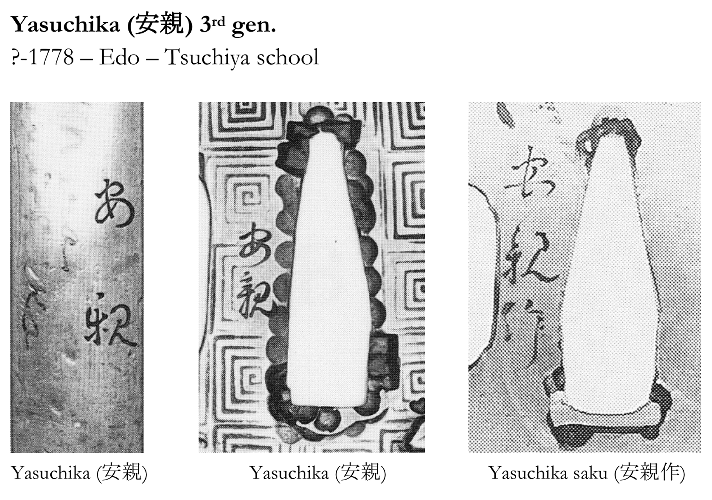
Sesko Markus, Signatures of Japanese Sword Fittings Artists, Lulu Inc., 2014, eBook. 680 pages. Possibly the best buy in my nihontō-related library — highly recommended.
-
There is great chaos under heaven; the situation is excellent. [Mao Zedong] Maybe the pieces in hand would narrow down a decision? Nope! It isn't science, it's a kind of kult. The experts don't consent even on the kind of birds... (clearly karigane, not chidori, IMHO).
-
"Tsuba: The R. E. Haynes Study Collection" Auction
MauroP replied to Promo's topic in Auctions and Online Sales or Sellers
Unfortunately, I don't have the book Gai Sō Shi – Study Collection of Japanese Sword Fittings by Haynes, but I would be curious to know how the supposed Gotō Teijō daishō is presented there. -
I'm not about to play since I know the book where the first tsuba was taken (but I'm not so sure the attribution proposed by the book is correct indeed). The sekigane which broaden the seppa-dai could suggest that the first tsuba is the oldest...
-
Hi Tim, the tsuba shown is neither mine nor from a book. It’s simply an entry in my database, sourced online from a link that is no longer active. The snippet comes from an NBTHK certificate attributing it to Shōami (so I’m not responsible for that attribution…) and reports it's made of iron.
-
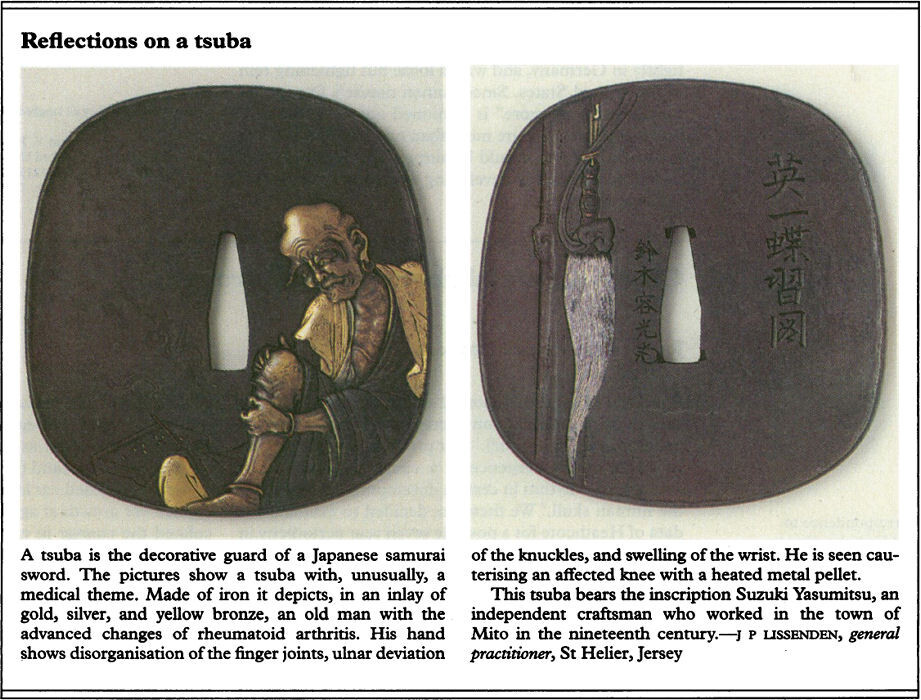
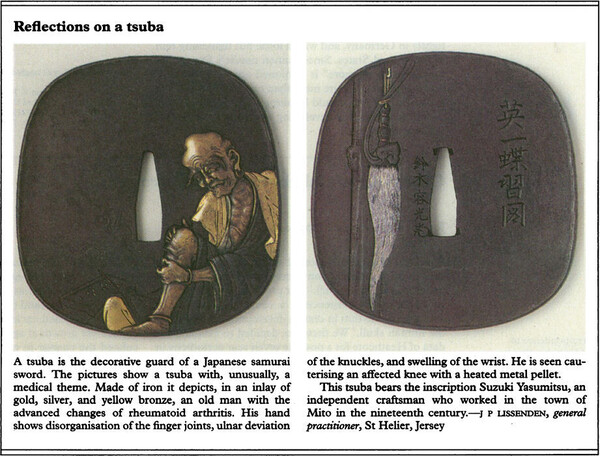
I came across a short article in the British Medical Journal by the late Dr. Lissenden. An opportunity to remember a respected member of the NMB ten years after his passing. from: https://pmc.ncbi.nlm.nih.gov/articles/PMC2359109/pdf/bmj00573-0034.pdf
-
- 12
-

-

-
"Tsuba: The R. E. Haynes Study Collection" Auction
MauroP replied to Promo's topic in Auctions and Online Sales or Sellers
Hi Julien, most of tsuba offered in auction were quite impressive regarding their dimension, being in the bigger segment of their own school/tradition. In particular the Tenpō tsuba bought by Dimitri (see above) outstanded for its unusual dimension. Anyway, too many eye-catcher to make wise choices... rationality woke up just when prices compelled me to chose.