

.png.109da69f50d2b8856e823a9916a8b657.png)
Jake6500
-
Posts
646 -
Joined
-
Last visited
-
Days Won
7
Recent Profile Visitors
4,232 profile views





Jake6500's Achievements






-
.thumb.png.4c5df79fec171b2dc4a23af38e280a4d.png) Agreed Victor, but the signature being gimei albeit original to the piece still seems like the most probable scenario to me... A legitimate workshop piece, perhaps even from the same inner circle but prepared and signed by another artisan within the school seems more realistic. Respectfully Steve I will have to disagree about the attribution to the Goto school. The style of the work and the design of the lion in particular is distinct from what you'd generally expect of the Goto school which had uniquely distinct characteristics in their shishi lion motifs. The circular/spiral pattern of the lions fur is a distinctive trait of the Yokoya school lineage and its branches which I think would disqualify the possibility of this being a Goto school piece...
Agreed Victor, but the signature being gimei albeit original to the piece still seems like the most probable scenario to me... A legitimate workshop piece, perhaps even from the same inner circle but prepared and signed by another artisan within the school seems more realistic. Respectfully Steve I will have to disagree about the attribution to the Goto school. The style of the work and the design of the lion in particular is distinct from what you'd generally expect of the Goto school which had uniquely distinct characteristics in their shishi lion motifs. The circular/spiral pattern of the lions fur is a distinctive trait of the Yokoya school lineage and its branches which I think would disqualify the possibility of this being a Goto school piece... -
Re-patination is possible but you can also just get black chemically treated tenjo-ita. The kao on your piece is less complicated, so based on that as well as Mauro's example I would assume the piece is a decent quality gimei piece from during or shortly after Eisen's time (maybe 1790-1800ish) with a false mei and kao to increase sale value. It could well have been made as mumei by a lesser known student of the Omori school or a similar adjacent machibori school from the same Yokoya school lineage then signed and re-patinated at a later date. At this point I would not suggest submission for shinsa. If you were to submit it, you'd likely need to have the mei professionally removed and apply for school attribution. If you did have the mei removed it likely would paper, however I personally don't like the practice of removing signatures even if they are false... Personally I'd just keep it in my collection as is for its artistic qualities. The cost would also outweigh the financial benefit.
-
Thanks for posting this example Mauro, Based on this example it seems that the mei and the kao in particular do not match. The signature is likely gimei, placed on a real late 18th century workshop piece.
-
Hi Thomas, The overall quality of the work certainly looks quite good... The early Omori masters often produced works of this kind with ground nanako-ji and high relief carving. Shishi lions were a known motif of theirs prior to the Omori-nami (wave) motif that eventually became the symbol of the schools peak works. If the piece is genuine it would be a signed work from a lesser-known second generation student of the founder of the Omori school, a contemporary of the infamous Teruhide. For comparison, the Yanagawa and Omori schools both branched off from the Yokoya school and the founders of both schools were students of Yokoya Somin. I happen to have a fuchigashira set from Yanagawa Naomitsu, the second generation head of the Yanagawa school with a similar motif and if you compare your own fuchigashira to it, you will see the structural similarities. Here's the thread I made at that time (feel free to post your own fuchigashira in this thread too!) What I'm getting at is that the design definitely fits the period of Eisen's activity. Naomitsu, who made my piece and became the head of the Yanagawa school, was active at the same time as Eisen and is part of the same generation of Machibori carvers... The quality, which I would call mid-level school workshop caliber also matches the artist who was skilled, but lacked the mastery of some of his contemporaries like Naomitsu or Teruhide. On the other end of the spectrum, because Eisen was a lesser known artist who did not take over the Omori school (you could say that he worked in Teruhide's shadow) it is hard to find any mei and kao examples or any comparison pieces. The NBTHK have reference examples if you choose to submit to shinsa but I could not find an example anywhere. Joly catalogued an "Eisen" and included an example of the kao in his names and kakihan, but it appears to be a different Eisen from the Bakumatsu Period. The signature on the piece is cut fairly fluidly. The first kanji seems great, the second features mild compression. This second character, as well as the overall simplicity of the kao (despite the fact that it seems well cut) is where my concern lies in submitting for shinsa. The other thing I'm not sure I can adequately judge from the pictures is if there is any divergence in colour where the signature is cut. Have a close look inside the crevices of the mei itself. Is the metal lighter in colour than the rest of the black fuchi base? If so, this is a sign that the signature may have been carved later (gimei). If not, this piece might warrant the shinsa submission to see what the NBTHK think. It is good enough in quality and aligns well enough with expectations that it COULD paper... Be advised that as Eisen is a minor student in the school, NBTHK authentication won't have a significant impact on the value of the piece. Further, you run the risk of the work being flagged as gimei and thereby losing financial value. My advice? If you submit it, do it purely out of curiosity or the desire to study the provenance of the piece, not for financial investment and be willing to lose the submission fee. If you're not willing to lose the financial investment, admire the piece as is.
-
Thanks Barry for rotating the image... Sorry to disappoint Danny but I think the mei does not stand up to minimal scrutiny... For comparison here is a verified example of Teruhide's mei and Kao: The angle of the strokes in your piece lack the sharpness you would expect in a confidently cut mei and in the latter half the forger seems to have given up altogether! The workmanship itself on the piece is a bit better (at least good enough to attempt to forge a mei on) but I couldn't confidently attribute it to the Omori school. Save your money on the shinsa fee, there is a 0% chance this would paper to Teruhide and probably not much greater chance of attributing Omori den either. It's a nice little piece provided you didn't pay too much for it.

-
I agree with Piers and Jean both, the style reminds me of Hikone Soten and the motif on the right could be Benkei and Yoshitsune which you might infer from the naginata held by the warrior on the fuchi (which Benkei is frequently depicted with). As for the motif of the piece on the left, I'm not sure, but maybe some sort of court scene is being depicted given the formal headwear and the seiza position on the fuchi? Alternatively, this could be a depiction of Noh theatre actors re-enacting a court scene as well?
-
As a general rule you don't usually want to risk cleaning or modifying anything in this hobby, however you could use hot water over a wooden (NOT METAL) toothpick to pick out dirt/grime or even better, a cotton Q-tip dipped in a hot water and dish soap solution (go light on the dish soap and let the water do most of the work). Make sure to dry thoroughly with a micro-fibre cloth afterward to avoid corrosion. Do NOT use any sort of abrasive or chemical polish or cleaning solution.
-
I think that either Brian is right and this tsuba has been modified for the war, OR the rectangular hole is a kozuka-ana. The tsuba itself seems legit to me. I'm not an expert in iron open works but maybe Owari?
-
These are all different "school" classifications managed by different families or lineages. Each "school" has certain stylistic differences, the nuances of which require considerable study in order to discern when you're starting out in this hobby. As Curran writes, the difference between Yanagawa and Kikuoka for example can be hard to discern even by the most expert professionals. In many cases, artists traditionally categorised into one type of school may actually have studied under several different schools at different times, making classifiction complicated. My recommendation is to come to this forum and participate in discussions frequently, it is a very efficient way to learn when you are starting out. Goto lions tend to have certain distinct design characteristics so I can help out a bit with that one. Here are some screenshots from a document I made for myself about this exact topic as part of my own little amateur investigation. It includes images of real pieces as well as screenshots from a Japanese reference book... When you click the images you may need to zoom in.


-
Fuchi-Kashira Shibuichi Nio Agyo
Jake6500 replied to flo06's topic in Fittings/Tosogu/Kodogu/Koshirae
Makes sense, I can see that. My mind goes toward Bakumatsu because of the more realistic presentation of the Nioh on the kashira, which is something you start to see more of post-1800 with late Edo artistic developments by artists such as Iwama Masayoshi or Yukimitsu Isobe who was a student of the Hamano school. These later artists would emulate earlier masters such as Shozui frequently, adding their own hyper-realistic spin to traditional designs. They also began to experiment with different techniques to enhance the realism of pieces such as using polished stone or horn for the eye, etc. My tengu profile picture is an example of one such work - unfortunately gimei with a fake Shozui mei. I've done some research and I believe it might have been a sister piece from Yukimitsu Isobe's workshop or from within his circle, however I couldn't say for sure... As the carving seems reminiscent of these later pieces but the techniques used are more traditional here, perhaps circa 1800-1820, a generation or two earlier, is right? -
Thank you Piers, that response helped me piece the story back together in my mind! If I remember correctly, there was also a punishment for opening the box right? I remember a temporal theme where time passes differently in the ocean v.s. on land and Taro ages dramatically as a consequence of disobeying the instruction. At least, this is the version I was taught in school about 20-25 years ago... Those netsuke examples are beautiful Piers! The small, painstaking wood carving in particular looks meticulous!
-
Urashima Taro came to mind but I wasn't actually sure... Doesn't he open a box in the story as opposed to a clam? I remember the story from primary school 20+ years ago now so it has been a while...
-
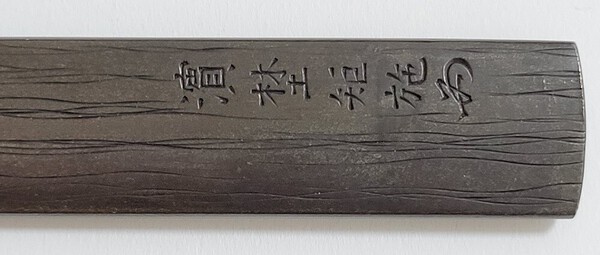
Hi NMB, I've been away from the board for a bit due to work but figured it was time to share my latest Hamano school acquisition. I picked this kozuka up direct from a Japanese dealer (shoutout Touken Matsumoto!) for what I think was a great price overall. This is a Tokubetsu Hozon papered kozuka by Hamano Noriyuki II, signed with his youthful gō prior to assuming his position as a master of the Hamano school (Norimasu). The piece features some beautiful takabori and the theme is Shinkiro (sea mirage) featuring shells which is a motif Noriyuki is famous for. The timing of this piece as it fits into Noriyuki's early career also makes for an interesting point of reference or study! I will keep looking to expand my collection of Hamano school fittings so that this piece has friends...

- 9 replies
-
- 12
-

-

-
Fuchi-Kashira Shibuichi Nio Agyo
Jake6500 replied to flo06's topic in Fittings/Tosogu/Kodogu/Koshirae
This strikes me as later work than that... I would have thought Bakumatsu Period (or in that ballpark, 1800-1850) Hamano work or possibly Iwama school... Agree with you that it is a nice piece and better mumei than gimei. -
I have looked it up and I in fact am NOT crazy lol It's called Inoshishi-no-ke (boar-hair lines) because the pattern mimics the coarse fur of a wild boar... Stop gaslighting me thread!! I'm not crazy I swear




