.png.109da69f50d2b8856e823a9916a8b657.png)
Jake6500
-
Posts
625 -
Joined
-
Last visited
-
Days Won
7



Jake6500's Achievements






-
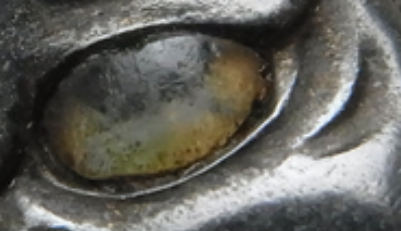
This is exactly what Gemini thinks this is... The exact construction method is where it gets complex as there were a few ways this was done. Sometimes a metal "lip" was carved over the dome material to hold it in place (higher quality, more advanced construction), sometimes it was basically glued down with an adhesive (lower complexity construction). Having had a chance to look at the piece in hand with magnification, I am now leaning toward the former, more complex construction. Jean, I was curious about this as well, however there seem to be a couple of possibilities for this including the use of a small birds feather quill or utilising a very fine, hollow bamboo needle as delivery devices and letting gravity do most of the work. A plunger could also be used in tandem with the bamboo needle to "inject" urushi, usually made of tightly rolled washi paper... These were apparently called "Kuda-fude" and were used in Maki-e to drop powders and liquids into precise spots, so it does appear to be a technical possibility. Remember, we are talking about a very late piece toward the very end of the Edo Period, circa 1850-1860... Apparently Henri Joly's 'The Sword and the Tsuba' has some further information about jewelled eyes and organic inlays in late Edo Hamano and Iwama school work, so my next goal will be to get my hands on a copy of this text. EDIT: Here's an interesting and seemingly similar stylistic example I found in Joly's Catalogue of the Naunton collection... This seems to feature a similar, hyper-realistic eye in the same style as my Tengu! The brow and carving aroud the eye also seems very similar and was signed Jogetsusai Hiroyoshi (Uchikoshi school) Another fuchi kashira which sounds borderline identical to mine in design is described in Joly as follows:


-
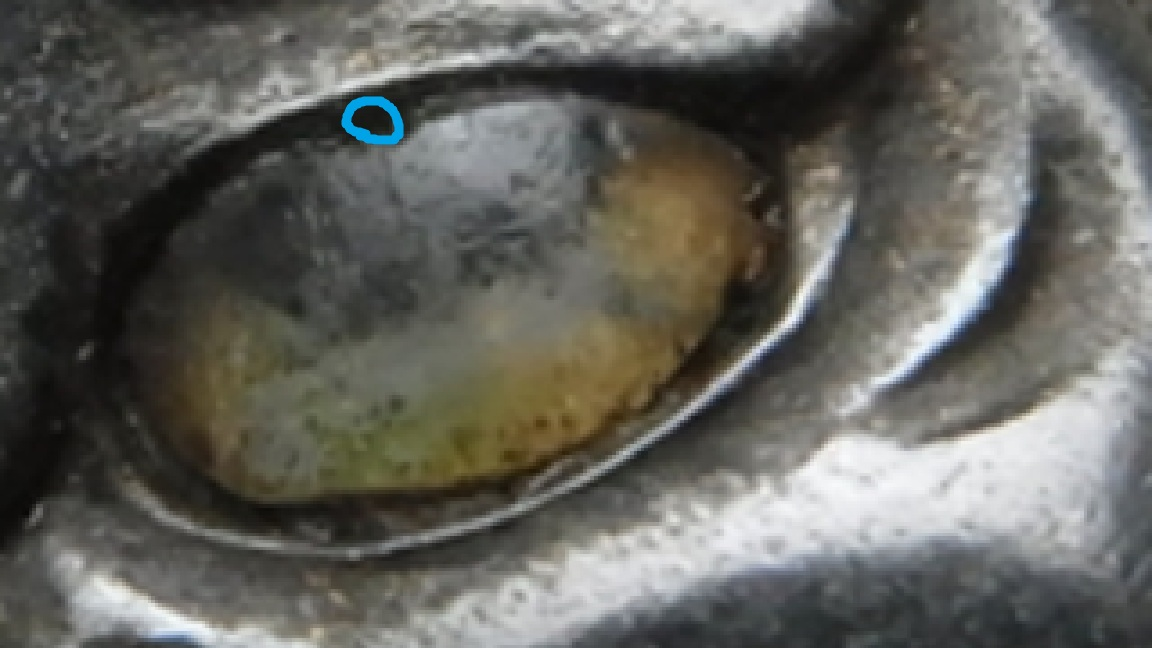
I see, thanks for that information. Seems like my understanding of what I read was simply incomplete. The Jewellers loupe I bought just arrived in the post today so I've had a quick look at the eye through it again, though I'm still getting used to using it... There does appear to be an extremely small hole at the top of the eye which may have been used to inject black urushi to form the pupil at the back... The hole is so small that it is just barely noticeable with x30 magnification. Here's a repost of the closeup photo of the eye with the area of the hole identified... Based on the observation of a thin gap at the bottom of the eye between the sclera and the metal and the absence of such a gap at the top, Gemini is still pointing me toward the use of stag horn for the eye dome on the basis that it believes this slight gap is a result of shrinkage due to dehydration of the material... The lack of a similar gap at the top is likely because metal overlapping the top of the eye is holding the dome in place. This explanation makes sense to me but being skeptical of AI (which I'm using as an investigative tool rather than any sort of authority) I still don't feel confident one way or the other about whether the piece uses horn or glass... None the less I feel like this investigative experiment has helped to develop my understanding of the piece and its construction, albeit to an incomplete extent.

-
I did read that Edo Period glass often had a yellowish tint due to the manufacturing process at the time. Another thing I read is that Bakumatsu artists included a thin gold foil underneath to give the eye a more realistic look and this can degrade under the glass leading to a more cloudy appearance over time. This is what I was referring to when I mentioned the aging process. I definitely should have specified that and realise I was being a bit vague. The pupil of the eye may or may not use urushi (I think it probably is but it is hard to tell for sure as it is underneath the eye dome). > Glass in such small dimensions is not at all "pliable", so there will be no press-fit or similar. Good point I hadn't properly thought through fully. > KASHIRA and related shaped metal objects are mostly formed in a hollow/bowl-shaped steel mold, not on a "dome" shaped tool. Sorry Jean, but I'm not actually sure I understand what you're trying to say with this last bit... When I'm referring to a "dome" I'm not talking about the kashira itself but about the eye which I presume was constructed by inserting a hollow dome made of a see-through material (such as glass) into a pre-determined hollowed space (the eye socket). The pupil of the eye is quite clearly placed behind said dome, likely made of urushi as you suggested. I was not suggesting the kashira itself was made on a "dome shaped tool" so I think this is a simple misunderstanding.
-
Thanks for sharing this example Ray, it is the closest I have seen to my own, though I think the material is probably still different. The middle picture makes the pupil underneath more visible which suggests it could have been produced using a similar method. Dale, I don't think the eye on mine is made using a stone or enamel. The material is cloudy but see-through and the yellowish tint is likely the result of 150+ years of aging so I suspect it was originally even more more transparent. The metal appears to have been hammered over/around the dome to lock it into place which leads me to doubt the use of a stone as it would be hard to do this without breaking something. A thin organic material made more sense to me, mainly because the material would have more flex or yield. Glass seems plausible to me as it would be more pliable whilst in a heated state. Quartz or a similar natural crystal seems possible as well but I think a lot less likely... I've finally got round to ordering a Jewellers loupe to take a closer look at the eye and see if I can narrow down the material. Figured given how deep I've thrown myself into this hobby it'd be a worthwhile investment to assess the quality of pieces, investigate construction processes before submitting to shinsa, etc.
-
It can be very hard to pin a specific generation to Hirata given most of the works are unsigned. NBTHK are more than likely to err on the side of caution and certify as Hirata den... Regardless, it's a pretty nice addition to any collection. Hirata school is interesting for a lot of reasons!
-
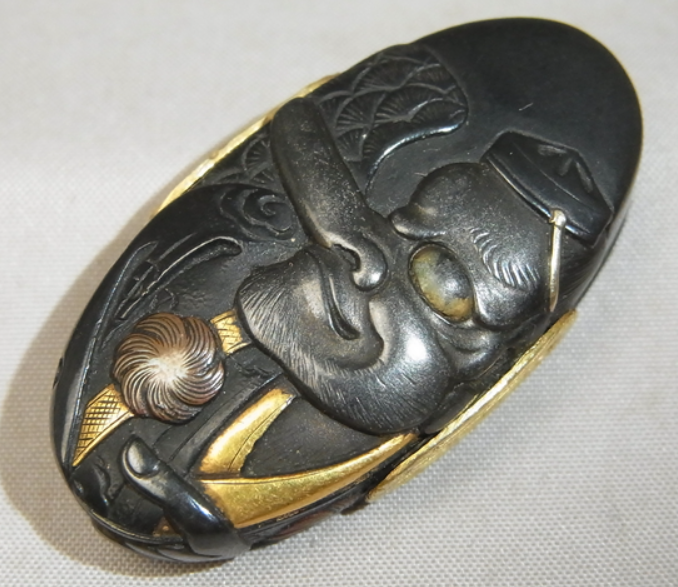
So back in November 2024 I made a thread about the first mid-high quality piece in my collection, a gimei "Shozui" piece. Whilst it is no longer the best piece in my entire collection I still use it as my profile picture on the forum to this day and the eye still fascinates me. Here's a link to the old thread for anyone curious: Recently as I was playing around with AI, I decided to use Gemini to see what it could tell me about the likely tradition of the piece or about the technique used for the eye and it pointed me in an interesting direction so I thought I'd make a thread about it. I uploaded some images and had an extensive back and forth with the AI: Eye Closeup: What the AI suggested is that the piece is likely either late Edo Hamano or Iwama school lineage with a gimei signature. Glass eye, mother of pearl, etc as many on this forum already know was a practice that mainly became popularised in the Bakumatsu Period. Based on the sort of "milky" opacity of the eye and the lack of colourful iridiscence reminiscent of crushed shell, the AI determined that the eye dome on this piece was most likely made from crushed stag horn using a technique known as Gyokugan. Gyokugan is a technique that originated from Buddhist statue carving however in the Bakumatsu Period, it (as well as other interesting techniques like Mother of Pearl or using bone, ivory inspired by netsuke craftsmen, etc.) was used experimentally by masters such as Hamano Noriyuki III, Unno Shomin or Iwama Nobuyuki who sought to make their work feel more "realistic" or "alive". The AI also provided some interesting information about the intricacies of using this technique (Gyokugan specifically...) on a small tosogu such as a kashira which appears to have been a very difficult process requiring precision. Here is a simplified outline, as I understood it: 1) The piece would need a carefully carved slot with a slightly raised rim in which the dome would be inserted. 2) Next, a properly fitted dome made of crushed stag horn would need to be shaped and slotted. 3) Taka-zogan would be shaped around the eye to give it its artistic appearance. 4) The artisan would also have to hit the metal around the dome tightly into place (seen in the brow here) to ensure that the piece retains its cohesiveness over time, as the stag horn material expands or contracts depending on hydration over the decades or centuries. * For this reason, Tosogu pieces that retain their domes (and are not later Meiji productions that use adhesives) are quite rare. 5) Finally, an incredibly small hole would be cut into the dome and a tiny shakudo peg inserted, or alternatively black lacquer would be used to form the pupil in the dome. ________________________________________________________________________________________________________________________________________________________________________________________ All of this interesting information about Bakumatsu Period experimental pieces aside, I figured this thread would be a space to share examples of tosogu pieces featuring mother of pearl, inlaid stones, bone, ivory etc. Most of all whilst I have found some limited information about this technique, most of what I can find relates to Buddhist statue carving. If anybody is able to locate information or examples of the Gyokugan technique used in other tosogu pieces, I would be very grateful! (Dale Sensei, I am hoping you can throw me another bone!) Post some crazy Bakamatsu experimental works! DISCLAIMER EDIT: Do also keep in mind that I am not 100% sure the eye is made using this technique. I am simply going off what the AI suggested... I just ran these images through ChatGPT which suggested Inlaid translucent stones like agate or chalcedony!! (This may however be ignoring the historical intricacies of Hamano style carving or Bakamatsu Period experimentation and going solely off the 100's of years dried out horn texture which looks rough like stone, so I think the Gemini assessment makes more sense. It's also a lot harder to hit soft-metal around precious stones without causing damage or breaking something!).

-
Can confirm this seller is pretty reliable. I have purchased some bits and pieces before, mainly when I was just starting my collection but all of them were authentic. The price and valuing things like tanegashima on the other hand, I have no idea... But if you are happy with the listed price and apparent condition you'll likely be happy with your purchase.
-
Both might be possible but I would think the kitsune wedding would make more sense given the apparent presence of references to the annual harvest. If you look at the bottom right of the tsuba you'll see what appear to be rice bales. Inari are associated with the harvest generally, however this seems to link more closely with the kitsune no yomeiri theme as there is seemingly no harvest connection in the story of Hakuzosu. The rice bales also double as a symbol of wealth and prosperity under the kokudaka system in which rice was traded as currency. Wealth and prosperity is typically something you would wish for a couple at their wedding, whilst it is something a buddhist monk might cast aside as a worldly attachment.
-
Not that my input matters so much given that it comes after Geraint and Brian here, but it is definitely a modern reproduction. the punch marks around the nakago (hole in the middle) are too perfectly circular and you can see how the carving and the seppa sort of blend into one another in the lower left which I think might be an error in casting... The general lack of detail in the carving of the people also suggests a quick reproduction as opposed to a hand carved/forged piece. I strongly encourage you to use this forum as a place of learning. The more examples you look at on here, the better your eye for quality and authenticity will develop.
-
Honestly, I think most on the board would agree we'd have to see clear photos of the blade and such to determine whether we think the expense of having new fittings made would be financially worth the money and time invested into such a project. If you want decent quality fittings made, this is not a cheap project as some have already pointed out. I have a Dewa Gassan school katana that I am considering getting fittings made for, however the fittings would cost more than half the value of the sword itself. Personally, it would have to be one very nice, high quality tanto for me to want to proceed... Sentimentality plays a role in such decisions of course, but spending (potentially) twice as much on the fittings as the blade itself might not be worth the investment.
-
I have seen two similar examples owned by collectors here in Melbourne Australia. One is actually on sale currently... signed "Masakuni" with Tokubetsu Hozon papers...
-
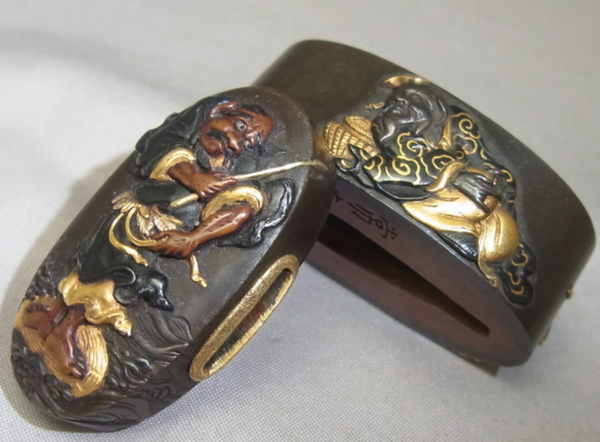
Correct Liang, The kashira depicts Taigong Wang / Taigong Jiang. Those who like video games will appreciate his appearance as a character in TECMO KOEI's Warriors Orochi series... I have not heard this saying before but it is quite fitting! The picture I uploaded last time does not reflect the true quality of this piece... Here's a better one:
-
Those are some very nice pieces I would love to have in my collection, gimei or not! Everyone wants the authentic signature but as long as the piece is high quality, I don't think it matters too much.
-
Definitely gimei but I like this motif nonetheless... The mei is Otsuryuken Shozui which was one of the common ways Shozui signed earlier in his career, however his signatures are some of the most commonly forged out there. The tengu fuchigashira from my profile picture is also signed "Shozui" but chances are it is also gimei, though the quality is pretty good... I would like to submit it to the NBTHK one day. This is only a guess but the triangular shape on the ura could perhaps be a hunting trap of some kind? I agree with Colin
-
Wonderful to hear that it worked out Max! Not surprised that you were happy with the quality and price point! It can be hard to capture the level of quality with pictures when it comes to tosogu, and even so the tsuba seemed decent for the price you said you paid. Interesting that you've found a similar example, however it isn't that unusual to find certain iconic motifs repeated by artisans of different schools with their own distinct style or spin!
.thumb.png.4c5df79fec171b2dc4a23af38e280a4d.png)