MauroP
-
Posts
888 -
Joined
-
Last visited
-
Days Won
5
Content Type
Profiles
Forums
Events
Store
Downloads
Gallery
Everything posted by MauroP
-
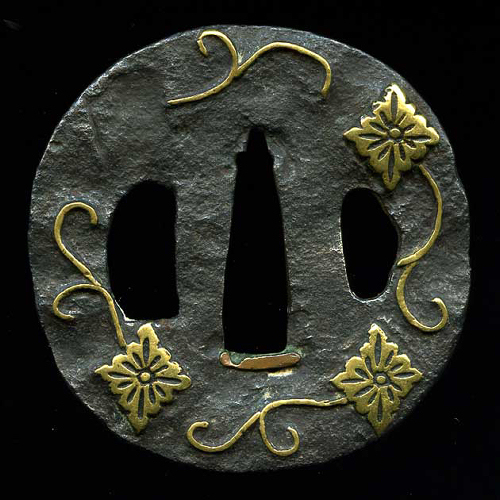
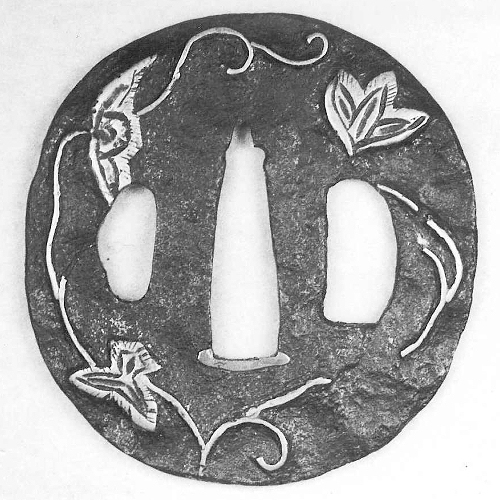
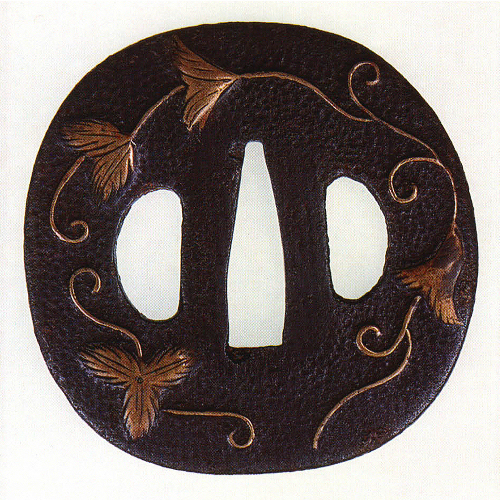
Here are some high resolution pictures of my tsuba, as required by Junichi: https://www.dropbox.com/sh/7hh9tfc706g0 ... hi%20tsuba
-
Thanks Geraint and Mariusz, you have effectively expressed what I awkwardly tried to say with my poor English. Bye, Mauro
-
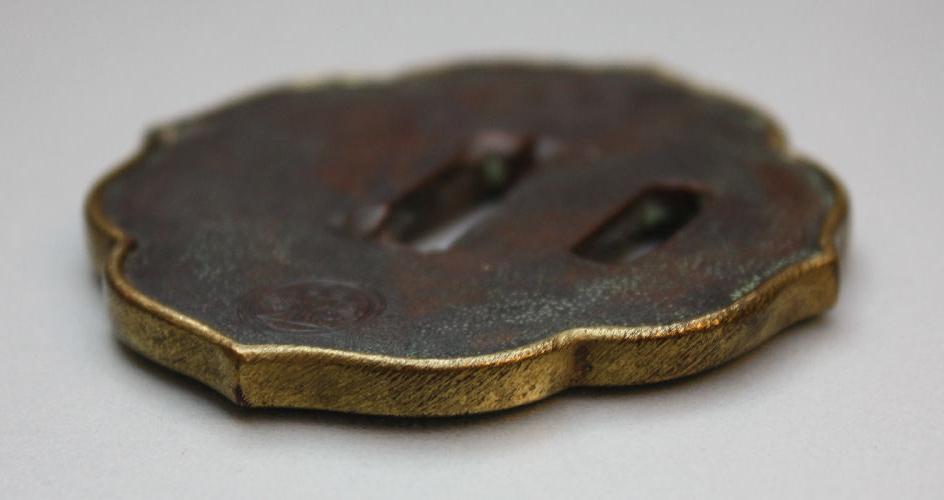
Hi Junichi, I’m planning to take better pics of my tsuba, but I’m afraid it will take me some days. The nanako finishing on my tsuba is possibly worse than the other tsuba posted, but I think it’s just the wearing of usage. Telling the truth, the finishing of the borders in any of the tsuba posted here can hardly be defined nanako, since the round chisel marks fail to form the characteristic dome-shaped lumps. Prove (or disprove) the construction technique could be very hard. Casting soft metal tsuba was a common practice since Muromachi period (e.g. Kagamishi tsuba), so why not using similar approach for mass production in late Edo? Moreover in none of such tsuba we can find true inlays, since the golden coloring was probably obtained by amalgam/mercury gilding (as in most of sanmai tsuba - 三枚鐔). Bye, Mauro PS - about "paperable" and “non-paperable" tsuba: I deserve high regards to shinsa origami, but after all it’s just a (very) educated opinion written in good Japanese…
-
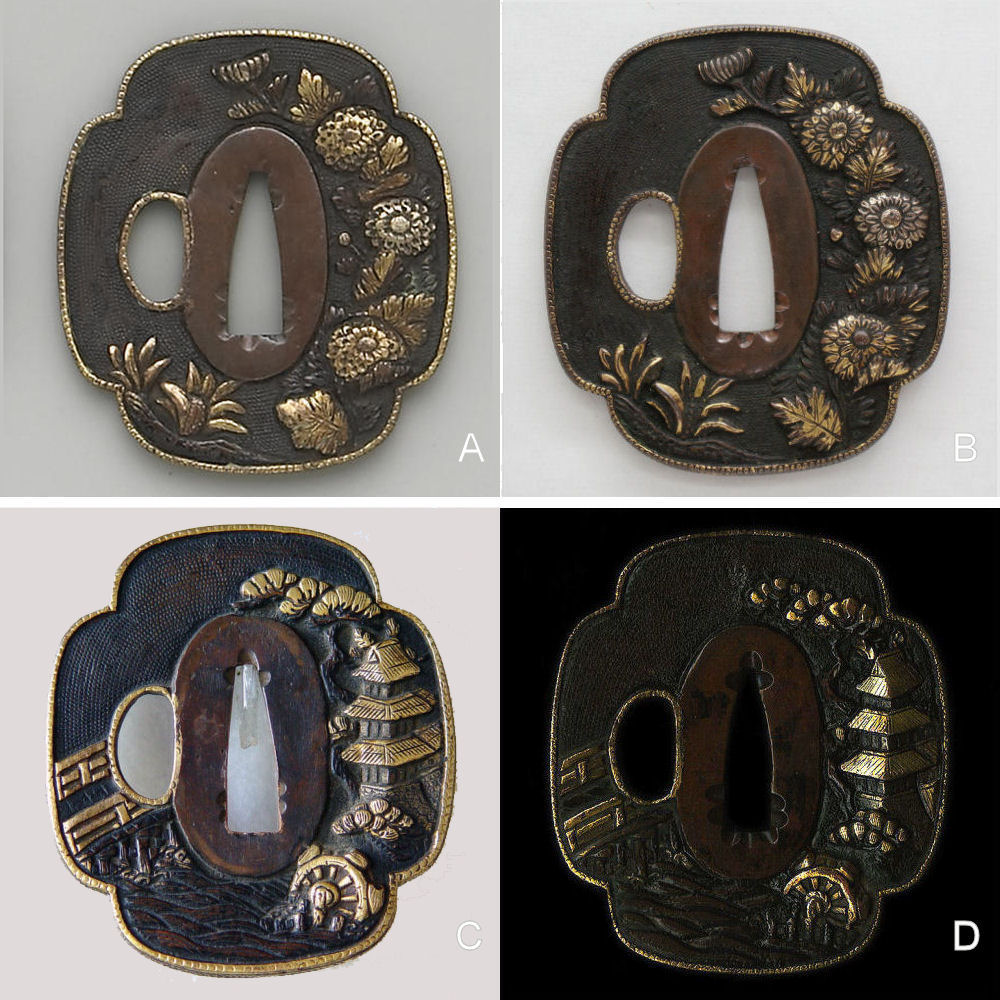
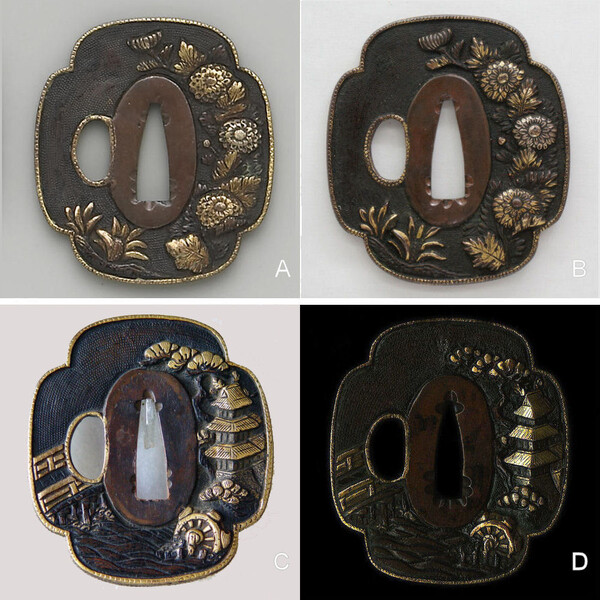
I'm not so confident about the sex of the dragon (considering the moustaches he/she is wearing...) I don’t think it’s just a matter of very popular motif; the serialism of production was the rule for this kind of low level tōsōgu. See a couple of more examples here below: A from: http://www.bonhams.com/auctions/14043/lot/6092/ B from: http://www.aoijapan.com/tsuba-mumei-chrysanthemum C from: http://www.silk-road.us/shakudo3.html D from: http://www.ricecracker.com/inventory/94 ... agoda.html Note the characteristic disposition of chisel marks around nakago-ana, which probably configure as a tagane-mei (鏨銘). The different pieces are variably refined and patinated (for instance I think my tsuba received a shakudō-like patination from its origin and never got golden gilding), but all share the same overall dimensions. Bye, Mauro
-
Quality matters, but seldom I can afford it... Hi, Mauro
-
Hi Junichi, well, shiiremono means mass production, and mass production usually imply lower quality in comparison to unique or small-series pieces. Anyway shiiremono do not means fake tsuba. After all Kyō-Kanagushi is not really a school (with a shodai, pupils, definite generations and so on) but rather a classification of a style, so ours tsuba may be legitimate pieces of Kyō-Kanagushi tradition and shiiremono as well (i.e. lower level Kyō-Kanagushi pieces). That's the way I see it. Bye, Mauro
-
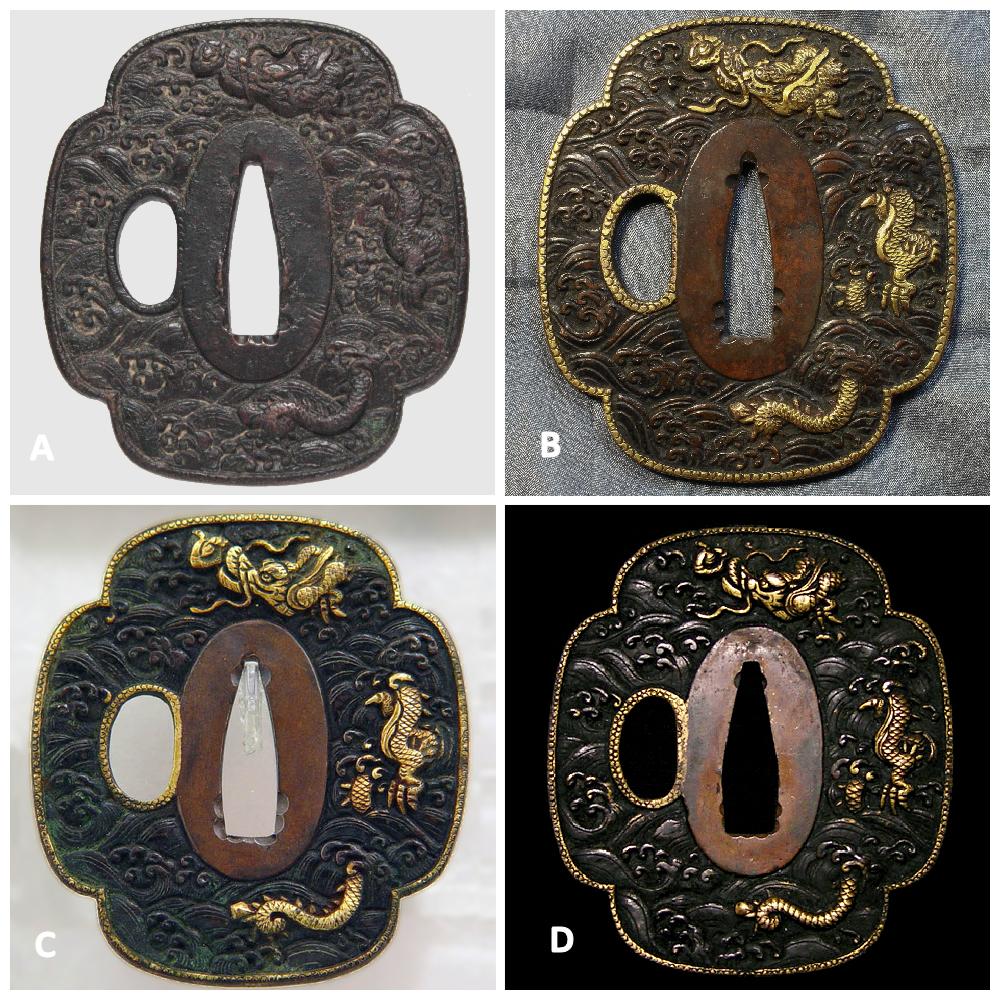
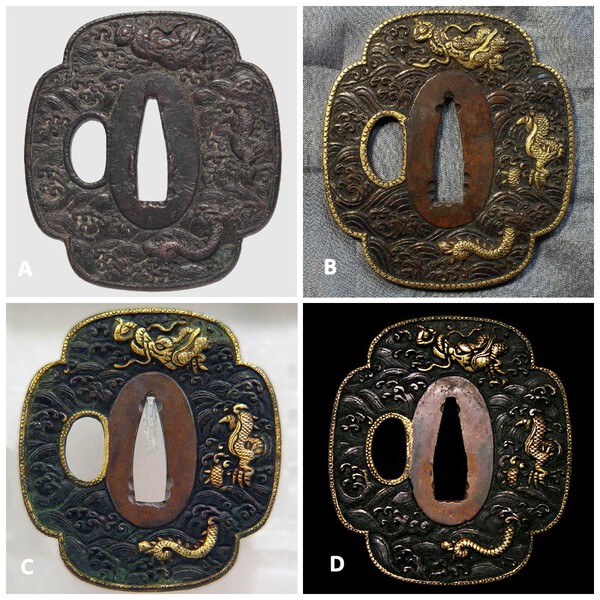
Please see the following image I have already submitted to INTK forum (http://www.intk-token.it/forum/index.ph ... topic=8273): Tsuba A is mine, previously in W.M. Hawley’s collection. Tsuba B belongs to a fellow Italian collector. Tsuba C (surprisingly described as "Jakushi style") is from http://www.silk-road.us/kinko1.html. Tsuba D is the same one posted here from http://tsuba.jyuluck-do.com/TU10481.html. This kind of tsuba is obviously a shiiremono (仕入物), probably obtained from molded pieces and subsequently refined by handmade chiseling, since kebori carving is differently represented. Bye, Mauro
-
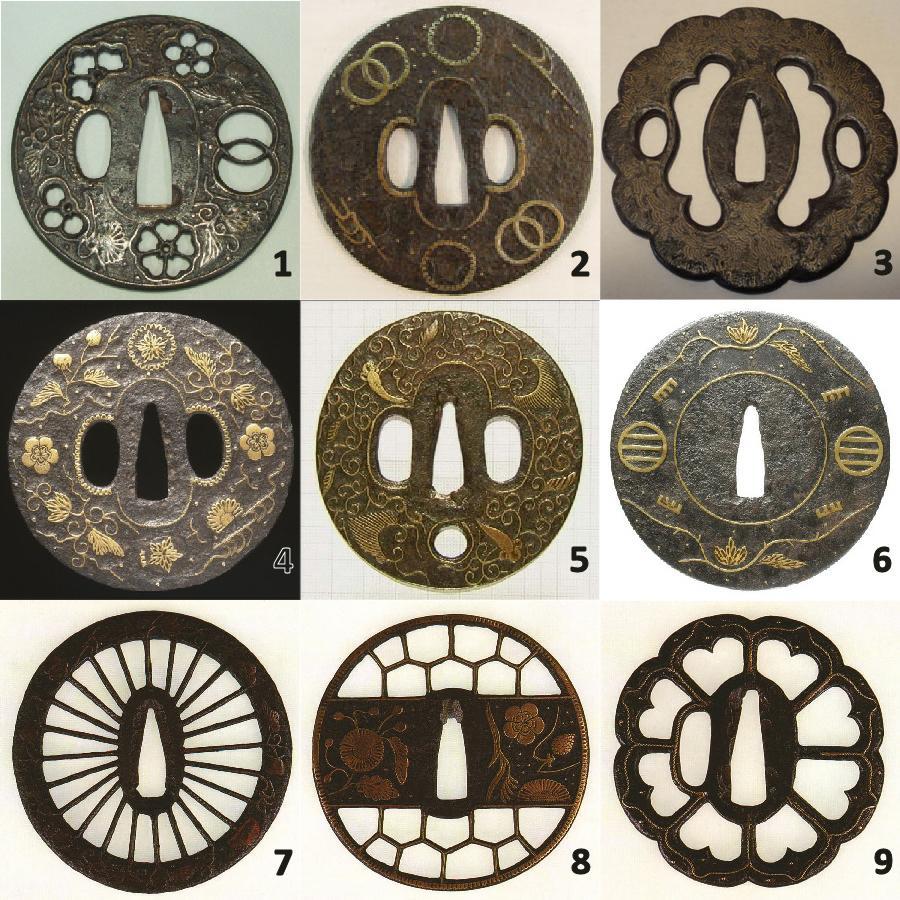
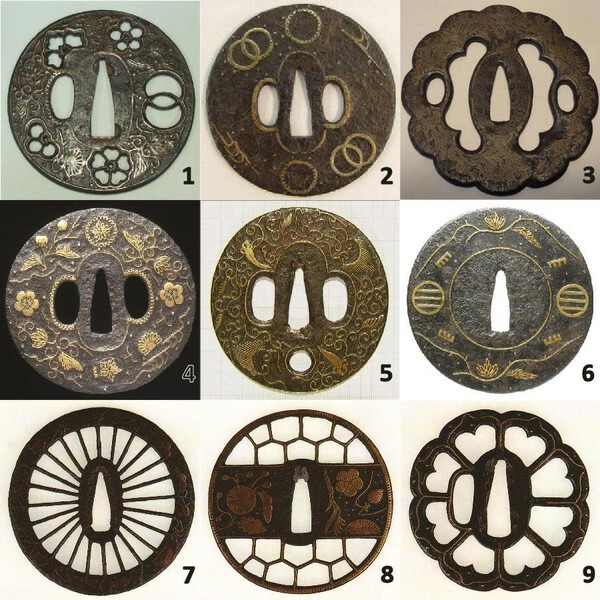
Hi everybody, sadly I have to admit that the more I study tsuba, the less I understand. The following tsuba are all claimed to be Ōnin examples: Please see the original links for reference: 1 - http://www.shoubudou.co.jp/tuba-304.html (NBTHK Hozon Paper) 2 - http://www.e-sword.jp/baiyaku_to_3.htm 3 - http://www9.plala.or.jp/tuyukusamisuzu/index2.html 4 - http://blog.goo.ne.jp/tsuba_001/e/d8e69 ... 1e0e5352c0 5 - http://touken-tousougu.sakura.ne.jp/kan ... ugu10.html 6 - http://blog.goo.ne.jp/tsuba_001/e/0028a ... d7b54dbd9a 7 - http://is2.sss.fukushima-u.ac.jp/fks-db ... 016_02.jpg 8 - http://is2.sss.fukushima-u.ac.jp/fks-db ... 016_03.jpg 9 - http://is2.sss.fukushima-u.ac.jp/fks-db ... 016_04.jpg Notably #1 got a NBTHK Hozon Paper, and #7, 8 and 9 are from Aotsu Yasuhisa's Tōsōgu korekushon. By the way, #3 has the same pattern decoration as the original tsuba posted here by Grey. Can anybody explain me how to distinguish an Ōnin from an Heianjō-zōgan tsuba? The fact (or hypothesis?) that the brass pieces in Ōnin tsuba were precast (as stated in "Tsuba - An Aestetic Study" ) seems to me of very little help. Bye, Mauro
-
Hi David, I think the style of carving could be called kōsuki-bori (甲鋤彫). See Markus Sesko Handbook of Sword Fittings Related Terms, p. 21. Bye, Mauro
-

Edo Period Tsubashi - some insight into the approach to work
MauroP replied to Ford Hallam's topic in Tosogu
Hi Ford, thank you for your effort to make the text more understandable. Curiously as an Italian I’m more comfortable with the old words rather the new ones. It’s a pity (from my point of view, of course) that Latin heritage is fading out in modern English. Regards, Mauro -
Vita brevis, ars longa, occasio praeceps, experimentum periculosum, iudicium difficile... Bye, Mauro
-
Heianjō-zōgan (平安城象嵌), Momoyama to early Edo. Bye, Mauro
-
Hi David, probably you made it too easy this time. Bye, Mauro
-
Hi Grev, in “collaborative tsuba” during late Edo period the maker of the tsuba plate used to sign on ura side, while the signature on omote side was reserved to artisan responsible for decoration (carved or inlayed with soft metals). So the plain tsuba could be an unfinished piece. Just my 2 pence guess. Bye, Mauro
-
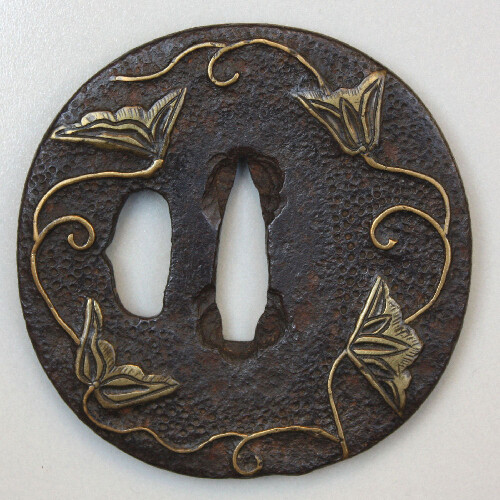
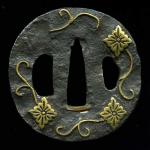
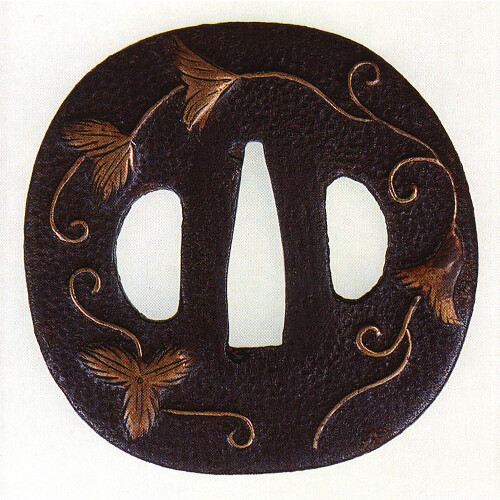
Hi Chris, I'm trying to act as a supporter of a "self-help group for parent with an ugly baby". And that's mine: I know it's not an item that is worth the exposition in Tokyo National Museum, but till now I believed that the punch marks (hari-ishime - 針石目) could be compatible with early Heianjō-zōgan style rather than "garage- zōgan". Anyway, that guy in his garage should have been very active since he must have also produced: (from ricecracker.com, a reputed dealer) (from Col. Hartley's Collection - http://home.comcast.net/~ColHartley/Vir ... eArmor.htm) (from Aotsu Yasuhisa - Tōsōgu korekushon, p. 24 - http://is2.sss.fukushima-u.ac.jp/fks-db ... index.html). So, if you decide to follow the advice of throwing your tsuba away, please let me know where you put your litter bin. Bye, Mauro

-
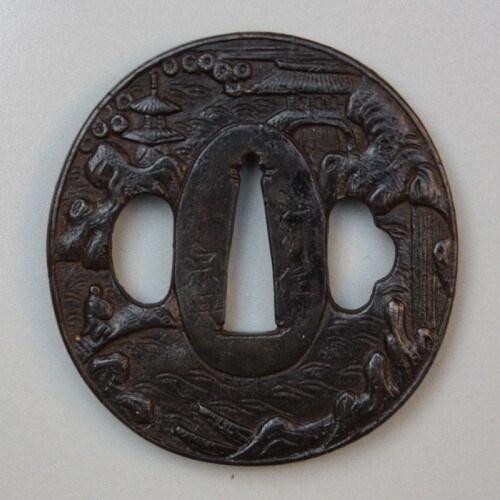
Hi Jeremy, I think the mei is Gōshū jū Sōten - 江州住 宗典. It's a very "popular" tsuba, surely a mass production casted item. Anyway I think it was a genuine utilitarian product of late Edo period (such tsuba is surely of very little appeal for rich western tourists). That's my copy: Bye, Mauro
-
Hi Josh, it seems to me that the tsuba was originally silver-plated (oborogin-ji - 朧銀地), but it was badly damaged by fire. Hard to say now what was its quality in origin. Regards, Mauro
-
Brian and Kunitaro, thanks for your help. Regards, Mauro
-
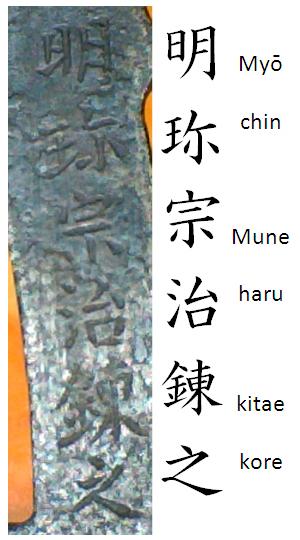
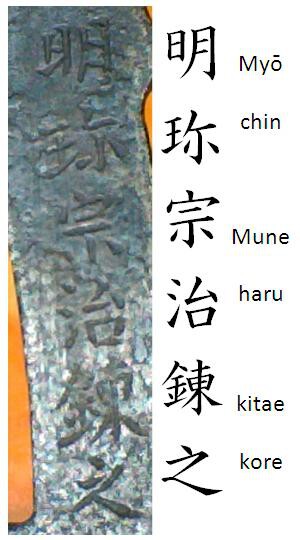
Hi everybody, I'm unable to fully understand a mei in ura side of a badly damaged tsuba: The transcription should be: 明珎宗治錬之 but the last sign could be the hiragana え (as verbal inflection for "forged"). I grasp the meaning (Myōchin Munearu forged this) but I'd like to know the exact transcription in romanji. A similar signature on a tsuba from Boston Museum of Fine Arts was reported as "Myochin Muneharu kore o kitaeru" (?). Thanks for reading. Mauro
-
(addendum) The complete mei of the first tsuba could be Kōfu jū Namitoshi (江府住 並壽). See for reference: http://www.finesword.co.jp/sale/kodougu/htm/1051_2000/1801_1850/1811/k1811.htm The mei of the second tsuba could be Kōfu jū Mitsuyoshi (江府住 満喜). See: http://www.e-sword.jp/sale/0810_6099syousai.htm
-
Hi Grev, I'm really a newcomer, but I guess the mei of the two tsuba should be Kōfu jū (江府住) rather than Bushū (武州). As far as I know there were at least 3 places named Kōfu, but I think that in a tsuba mei Kōfu was simply a part of Edo. Bye, Mauro
-
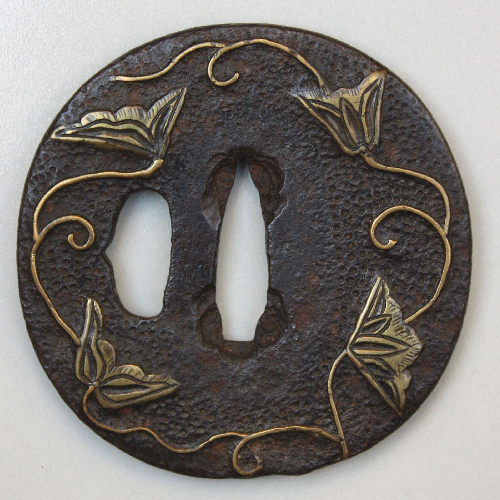
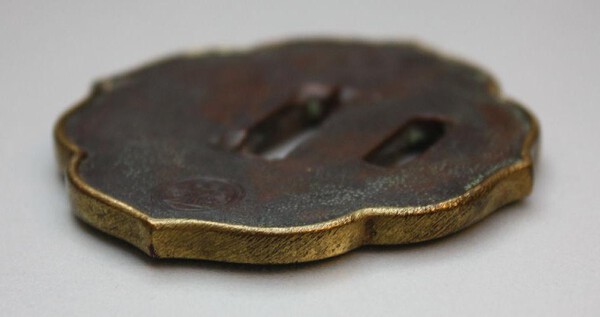
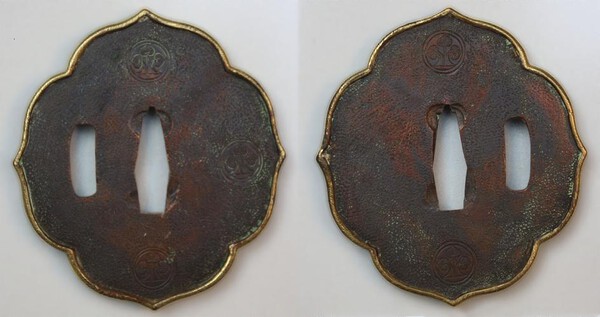
Hi everybody, I wish opinions (particularly from the kinkō guys) about a small aoi-gata (葵形) tantō tsuba (dimensions 66 x 59,8 x 3,8 mm at seppa-dai, 80 g). The simple hari-ishime (針石目) finish and the unusual shape of the kozuca-ana point me to ko-kinkō. On the other hand the fukurin and the fine kebori carving of the Hondake Tachi Aoi (本多家立葵 - the mon of Honda Clan) suggest a later attribution in Edo time. Thanks for any input about this tsuba. Bye, Mauro
-
Thank you, Thierry, now I know what a tsuba collection should be. Bye, Mauro
-
Hi Matt, IMHO a nice mid to late Edo tsuba, the first I see with a kingfisher (kawasemi - 川蝉). I'm unable to suggest a school, but I'd guess either Shōami (正阿弥), Nara (奈良) or Mito (水戸). Bye, Mauro
-
Ko-Shoami, Muromachi jidai?