MauroP
-
Posts
829 -
Joined
-
Last visited
-
Days Won
4
Content Type
Profiles
Forums
Events
Store
Downloads
Gallery
Everything posted by MauroP
-
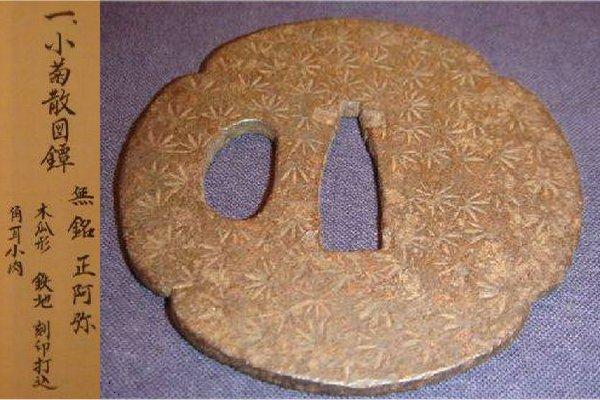
Thank you Chris. Of course 小 - ko = small. The meaning of 小菊散 should be "scattered small chrysanthemi". The transcription you propose has the same meaning? Bye, Mauro
-
Translating NBTHK kanteisho found on the Internet can be an effective and inexpensive way to study tsuba. I'm particularly interested in papers dealing with tsuba similar to mine. Please see the following: I think I succeeded in finding the right kanji, but I'm still unsure about the correct rōmaji transcription: 小菊散圖鐔 - ki kiku chishi zu tsuba 無銘 正阿弥 - mumei Shōami 木瓜形 鉄地 刻印打込 - mokkō-gata tetsu-ji kokuin uchikomu 角耳小肉 - kaku-mimi koniku Any corrections? Thanks for reading. Mauro

-
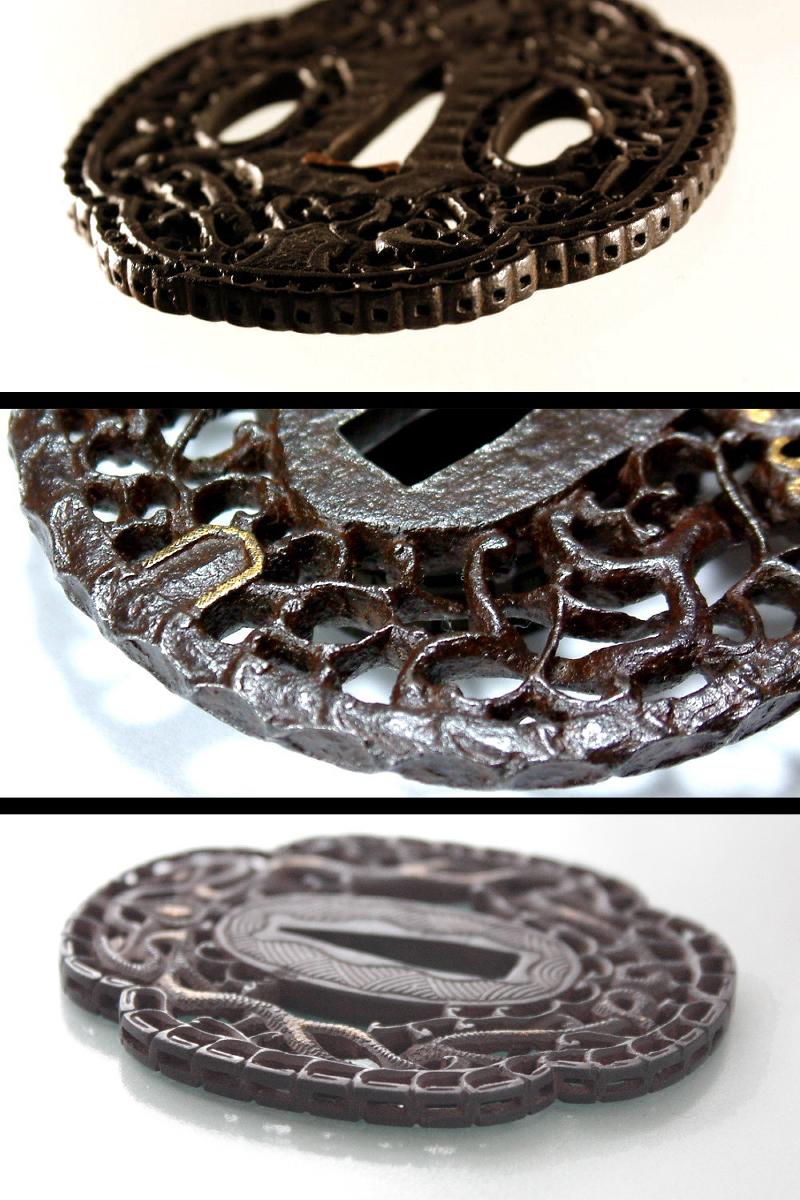
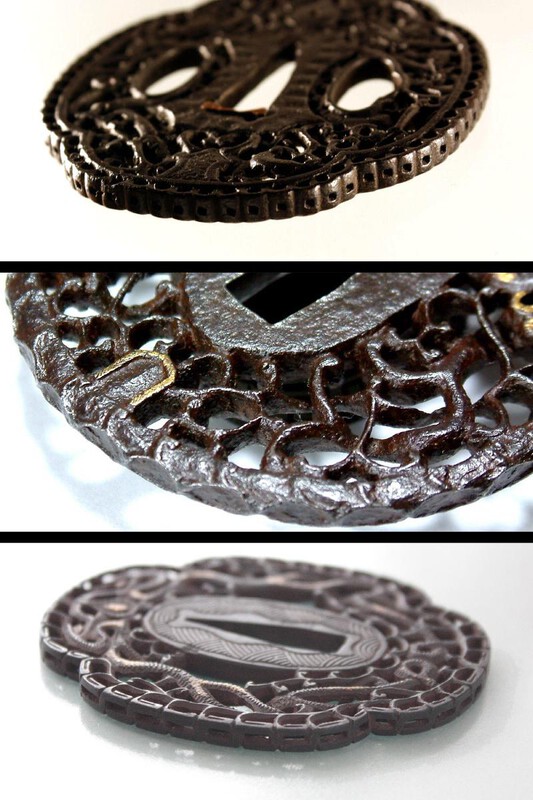
Hi everybody, I'd really be surprised if these Namban tsuba (see below) would eventually prove to be casted. Anyway chapeau if any artisan is able to cast this quality of items just with a charcoal furnace! Bye, Mauro
-
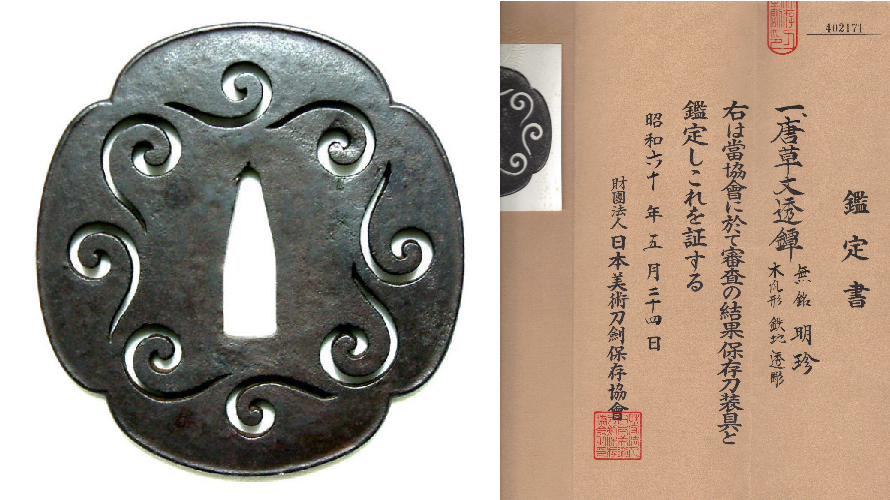
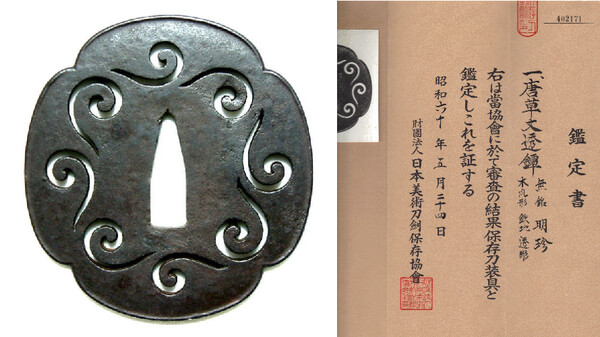
Hi Hamish, I have a similar tsuba papered by NBTHK as Myōchin (明珍). My tsuba has a more pronounced uchigaeshi-mimi (打返耳) but the same ko-sukashi pattern, described as karakusa mon sukashi (唐草文透). Dimensions are 79,3 x 74,8 x 4,7 mm. In my opinion it should be a middle-late Edo piece. Bye, Mauro
-
A very similar tsuba is here: http://www.silk-road.us/jingo7.html. Bye, Mauro
-
The kanji should be 乘意 but I'm uncertain how to read them. For the same mei see http://www.bonhams.com/auctions/19295/lot/35/ Bye, Mauro
-
Banshū (播州) is the other name of Harima Province, and Harima was a sub-school of Umetada, so Umetada attribution could be consistent with the provenience. Index of Japanese Swordsmiths by markus Sesko reports at p. 382 a Yoshishige (義重), Kanbun (寛文, 1661-1673), Harima. Bye, Mauro
-
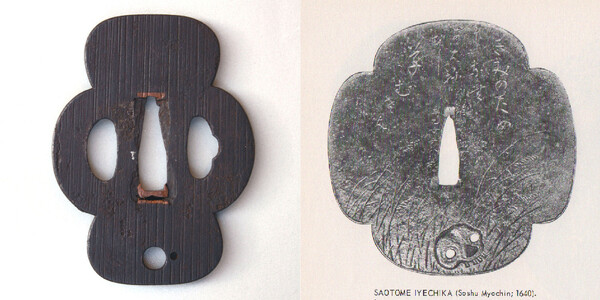
The kawari mokkō-gata (変り木瓜形) tsuba is mine; the tsuba with udenuki-ana shaped as orbits of a skull is from "The Japanese sword and its fittings, from the collections of the members of the Japanese Sword Society of New York and the Cooper Union Museum", 1966, p. 22. Bye, Mauro
-
Hi David, in my opinion the paper say just "mei Nobuie". Bye, Mauro
-

One of my latest aquisition - your thoughts are welcome!
MauroP replied to Thierry BERNARD's topic in Tosogu
Kyō-sukashi, late Momoyama? But the shape of hitsu-ana may suggest also Hayashi. Bye, Mauro -
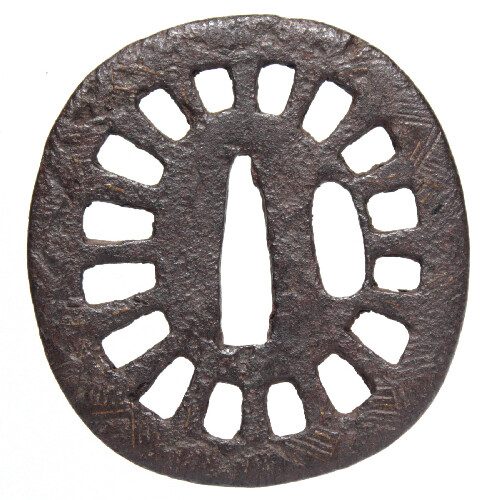
Hi David, yours it's really a puzzling tsuba. Some features suggest an early Kamakura - 鎌倉 influence (i.e. kōsuki-bori - 甲鋤彫 style of carving and the same design on both sides). On the other hand other features do not fit the Kamakura hypothesis: ten-zōgan -点象嵌 and that kind of dote-mimi - 土手耳 (or it's a tomotetsu-fukurin - 共鉄覆輪?). The fine carvings on the border in omote resemble the early representation of waves in some Heianjō tsuba. Anyway most of features in my opinion point to a pre-Edo piece. Even the hitsu-ana may well be a later modification (why else disrupt so badly the design in ura side?). On the main issue (why the tsuba has been papered as Higo) I simply cannot understand. Bye, Mauro
-
Hi Richard, I bought several tsuba from Takahashi-san and I consider him a gentleman. Unfortunately it's hard to judge the quality of items he is selling on eBay from his pics. This seems a very interesting ko-kinko tsuba, and you got it at a bargain price. Bye, Mauro
-
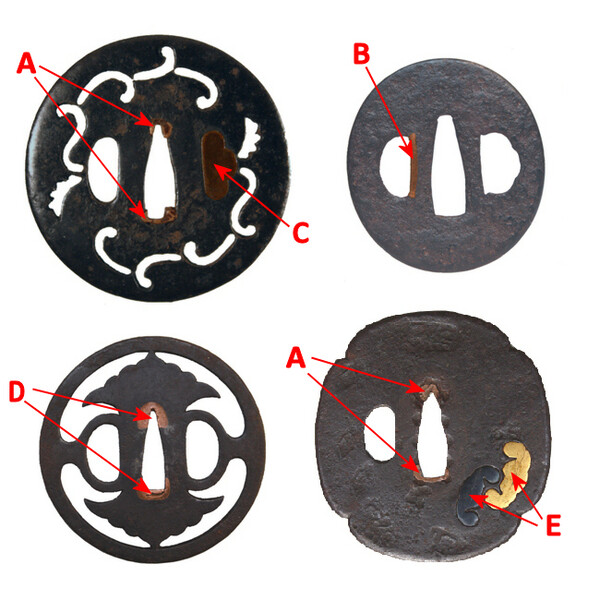
Hi everybody, I apologize in advance for reopening a long time closed thread, but since NMB is (or should be) an authoritative resource for western tsuba connoisseurs, I think it would be useful to fix definitely some old but still unresolved issues. So, back to basics: A: sekigane (責金). The small bits of soft metal added to the nakago-ana to fit the tsuba to a sword are unanimously defined sekigane by all the books I have consulted (ref.s 1,2,3,4). B: sekigane (責金). Soft metal inserts lining the medial side of kōgai-ana and/or kozuka-ana (whatever they were intended to serve for) are called sekigane in Sasano (ref. 2). The exact meaning of sekigane is unclear in Haynes (ref. 5, p. 256). C: ategane (当金). I think that the plugs that obliterate an hitsu-ana can safely called this way, but I was unable to find any support from my very limited library. D: kuchibeni (口紅). Haynes (ref. 5, p. 251) states that the so called "lipstick" are the copper plugs which may be seen at the top and bottom of the central opening of a tsuba. I suppose it would be safe to call this way the sort of sekigane which were build with the tsuba itself (like most tsuba from Tanaka school, for instance). E: ??? no idea at all. Decorative plugs of ko-sukashi can as well be called ategane/umegane? I have deliberately ignored on-line glossaries (which I suspect are all cross-referenced). Thanks in advance to whom will help me to definitely understand that issues, but please referenced statements, not just personal opinions. Bye, Mauro References: 1. Earle J., Lethal Elegance, MFA Publications, Boston, 2004, p. 36 & 235 2. Sasano M, Early Japanese Sword Guards. Sukashi Tsuba, Robert G. Sawers, London, 1972, p. 278 3. Shibata M., Tsuba Nyūmon, Kōgei Shuppan, Tōkyō, 1967, p. 19 4. Kashima S. et al., Tsuba-no-Bi, Ribun Shuppan, 1969, p. 237 5. Torigoye K. & Haynes R.E., Tsuba. An Aestetic Study, Northern California Japanese Sword Club, 1994
-
Really a challenging task. My best guess is 秀忠刻 - Hidetada koku. Bye, Mauro
-
Hi everybody, I don't know why but tadpoles (katō - 蝌蚪) are not so uncommon in tōsōgu representation: Tsuba A is mine; tsuba B from Ashmolean Museum, University of Oxford; menuki C from http://www.toukenkomachi.com/image/B040514-2.jpg ; tsuba D from http://www.bonhams.com/auctions/20189/l ... ference=14. Bye, Mauro

-
The tsuba probably depicts the "Green Dragon" polearm of Guan Yu, a legendary chinese hero and a guardian deity in Taoism. Bye, Mauro
-
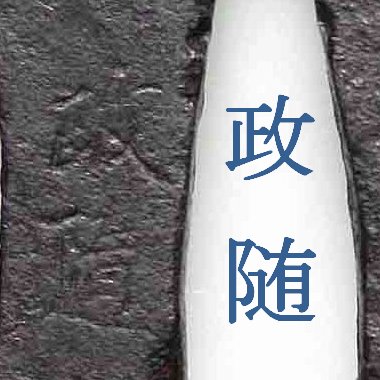
Could be 政随 – Shōzui? Bye, Mauro

-
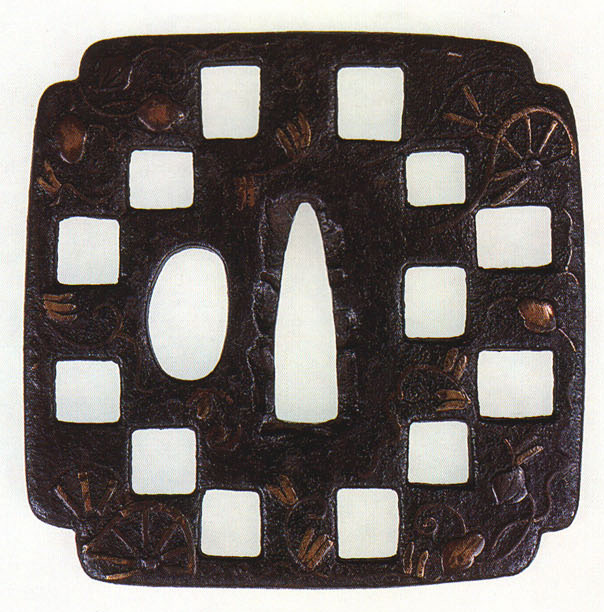
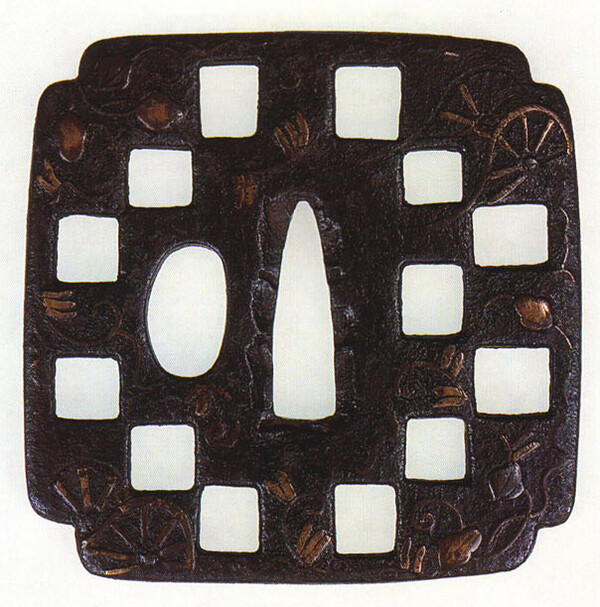
Hi Curran, the chessboard-like sukashi (which surely is not the most important feature of your tsuba) reminded me a tsuba from Aotsu Yasuhisa - Tōsōgu korekushon, p. 24 (http://is2.sss.fukushima-u.ac.jp/fks-db ... 00024.html). It's a mid-Muromachi piece, and the quality of brass could be comparable (difficult to judge from the picture). Bye, Mauro
-
Here are some high resolution pictures of my tsuba, as required by Junichi: https://www.dropbox.com/sh/7hh9tfc706g0 ... hi%20tsuba
-
Thanks Geraint and Mariusz, you have effectively expressed what I awkwardly tried to say with my poor English. Bye, Mauro
-
Hi Junichi, I’m planning to take better pics of my tsuba, but I’m afraid it will take me some days. The nanako finishing on my tsuba is possibly worse than the other tsuba posted, but I think it’s just the wearing of usage. Telling the truth, the finishing of the borders in any of the tsuba posted here can hardly be defined nanako, since the round chisel marks fail to form the characteristic dome-shaped lumps. Prove (or disprove) the construction technique could be very hard. Casting soft metal tsuba was a common practice since Muromachi period (e.g. Kagamishi tsuba), so why not using similar approach for mass production in late Edo? Moreover in none of such tsuba we can find true inlays, since the golden coloring was probably obtained by amalgam/mercury gilding (as in most of sanmai tsuba - 三枚鐔). Bye, Mauro PS - about "paperable" and “non-paperable" tsuba: I deserve high regards to shinsa origami, but after all it’s just a (very) educated opinion written in good Japanese…
-
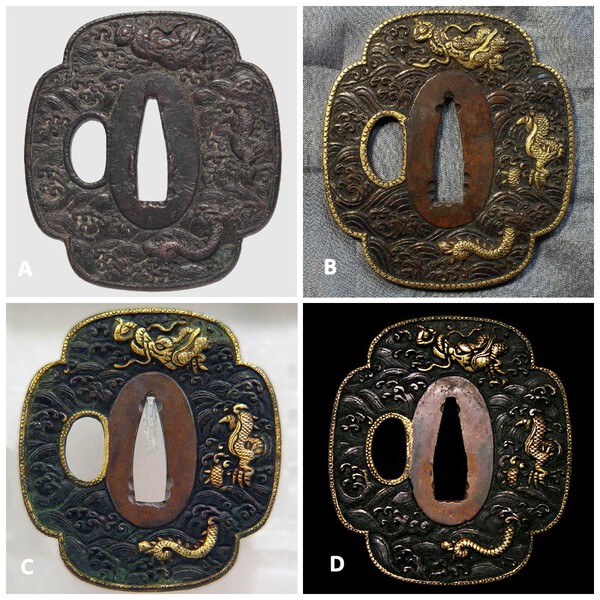
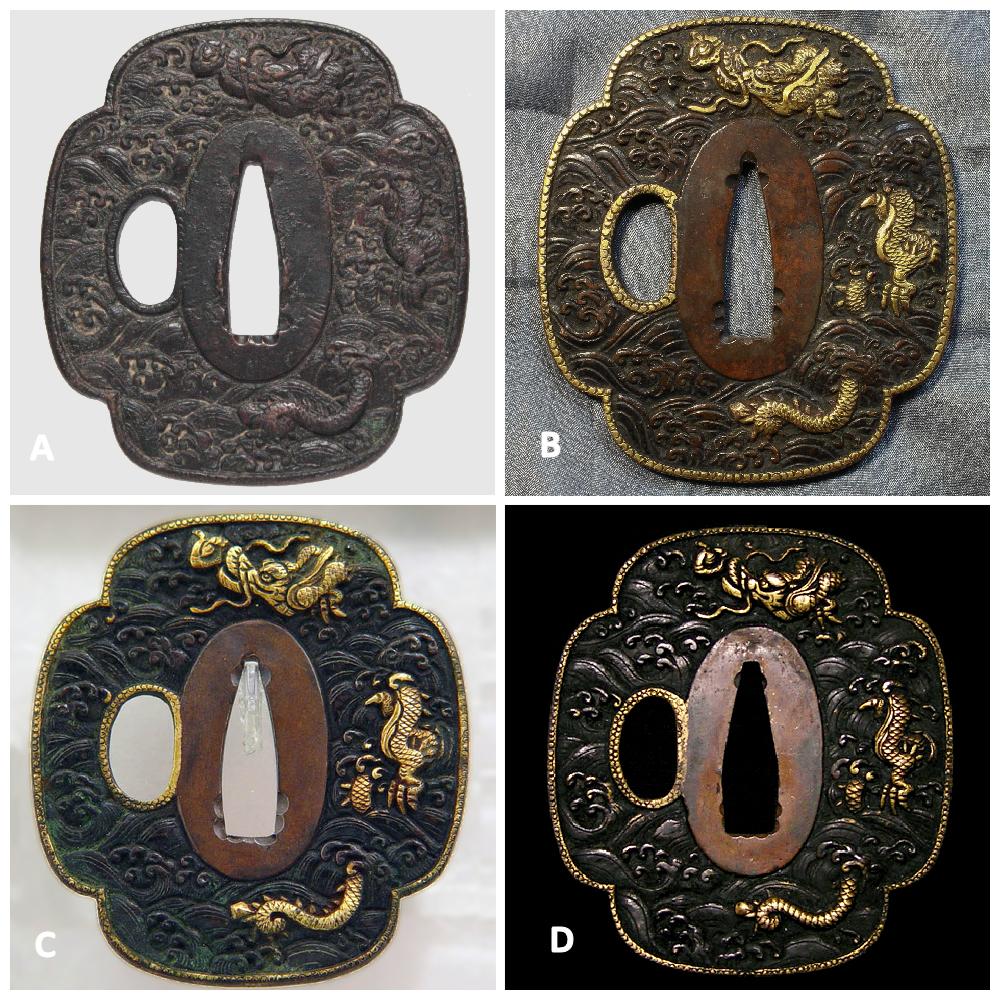
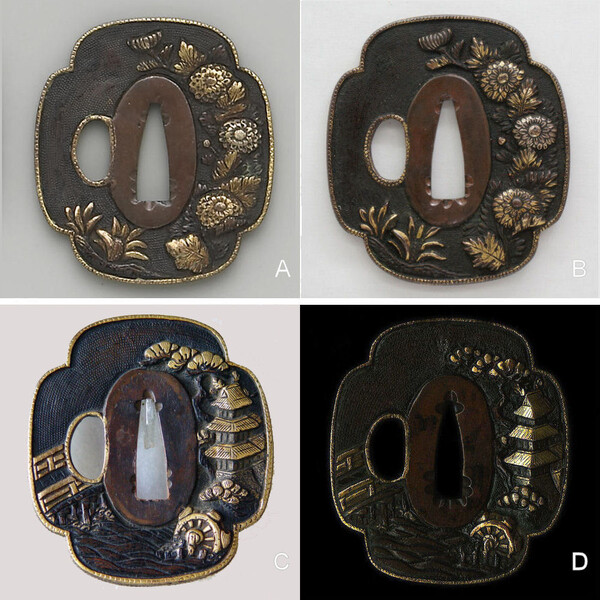
I'm not so confident about the sex of the dragon (considering the moustaches he/she is wearing...) I don’t think it’s just a matter of very popular motif; the serialism of production was the rule for this kind of low level tōsōgu. See a couple of more examples here below: A from: http://www.bonhams.com/auctions/14043/lot/6092/ B from: http://www.aoijapan.com/tsuba-mumei-chrysanthemum C from: http://www.silk-road.us/shakudo3.html D from: http://www.ricecracker.com/inventory/94 ... agoda.html Note the characteristic disposition of chisel marks around nakago-ana, which probably configure as a tagane-mei (鏨銘). The different pieces are variably refined and patinated (for instance I think my tsuba received a shakudō-like patination from its origin and never got golden gilding), but all share the same overall dimensions. Bye, Mauro
-
Quality matters, but seldom I can afford it... Hi, Mauro
-
Hi Junichi, well, shiiremono means mass production, and mass production usually imply lower quality in comparison to unique or small-series pieces. Anyway shiiremono do not means fake tsuba. After all Kyō-Kanagushi is not really a school (with a shodai, pupils, definite generations and so on) but rather a classification of a style, so ours tsuba may be legitimate pieces of Kyō-Kanagushi tradition and shiiremono as well (i.e. lower level Kyō-Kanagushi pieces). That's the way I see it. Bye, Mauro
-
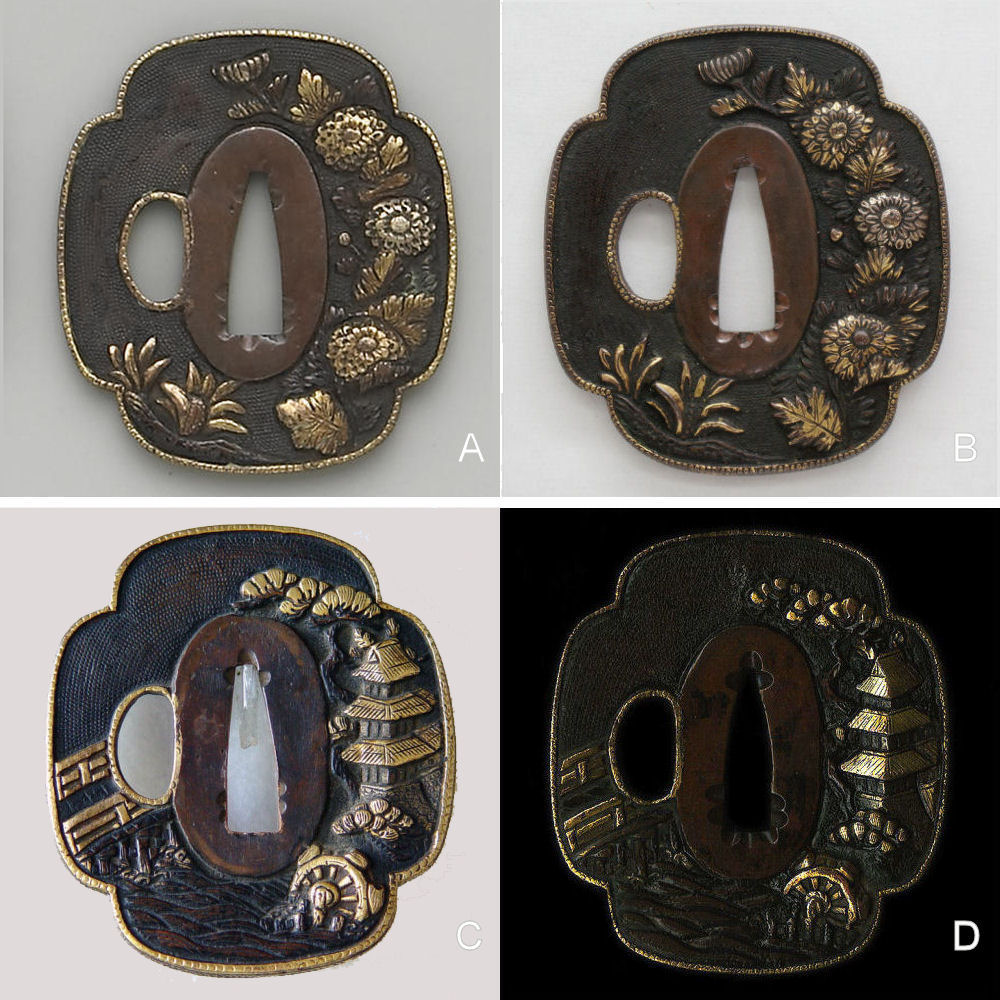
Please see the following image I have already submitted to INTK forum (http://www.intk-token.it/forum/index.ph ... topic=8273): Tsuba A is mine, previously in W.M. Hawley’s collection. Tsuba B belongs to a fellow Italian collector. Tsuba C (surprisingly described as "Jakushi style") is from http://www.silk-road.us/kinko1.html. Tsuba D is the same one posted here from http://tsuba.jyuluck-do.com/TU10481.html. This kind of tsuba is obviously a shiiremono (仕入物), probably obtained from molded pieces and subsequently refined by handmade chiseling, since kebori carving is differently represented. Bye, Mauro