MauroP
-
Posts
828 -
Joined
-
Last visited
-
Days Won
4
Content Type
Profiles
Forums
Events
Store
Downloads
Gallery
Everything posted by MauroP
-
Hi David, I think the style of carving could be called kōsuki-bori (甲鋤彫). See Markus Sesko Handbook of Sword Fittings Related Terms, p. 21. Bye, Mauro
-
Edo Period Tsubashi - some insight into the approach to work
MauroP replied to Ford Hallam's topic in Tosogu
Hi Ford, thank you for your effort to make the text more understandable. Curiously as an Italian I’m more comfortable with the old words rather the new ones. It’s a pity (from my point of view, of course) that Latin heritage is fading out in modern English. Regards, Mauro -
Vita brevis, ars longa, occasio praeceps, experimentum periculosum, iudicium difficile... Bye, Mauro
-
Heianjō-zōgan (平安城象嵌), Momoyama to early Edo. Bye, Mauro
-
Hi David, probably you made it too easy this time. Bye, Mauro
-
Hi Grev, in “collaborative tsuba” during late Edo period the maker of the tsuba plate used to sign on ura side, while the signature on omote side was reserved to artisan responsible for decoration (carved or inlayed with soft metals). So the plain tsuba could be an unfinished piece. Just my 2 pence guess. Bye, Mauro
-
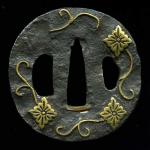
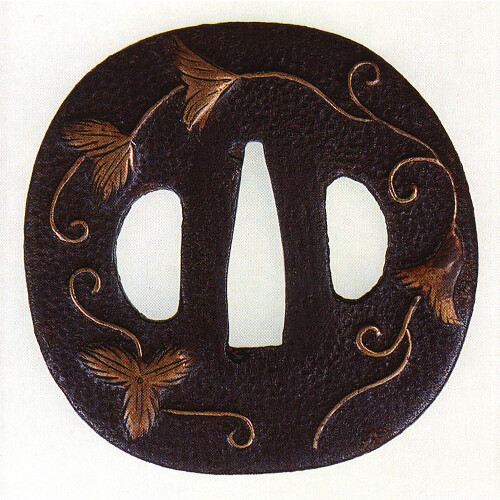
Hi Chris, I'm trying to act as a supporter of a "self-help group for parent with an ugly baby". And that's mine: I know it's not an item that is worth the exposition in Tokyo National Museum, but till now I believed that the punch marks (hari-ishime - 針石目) could be compatible with early Heianjō-zōgan style rather than "garage- zōgan". Anyway, that guy in his garage should have been very active since he must have also produced: (from ricecracker.com, a reputed dealer) (from Col. Hartley's Collection - http://home.comcast.net/~ColHartley/Vir ... eArmor.htm) (from Aotsu Yasuhisa - Tōsōgu korekushon, p. 24 - http://is2.sss.fukushima-u.ac.jp/fks-db ... index.html). So, if you decide to follow the advice of throwing your tsuba away, please let me know where you put your litter bin. Bye, Mauro

-
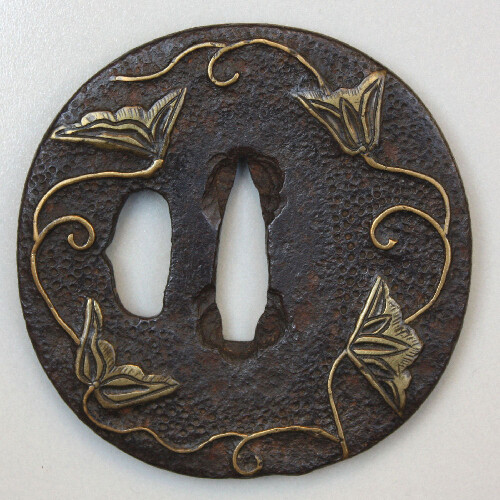
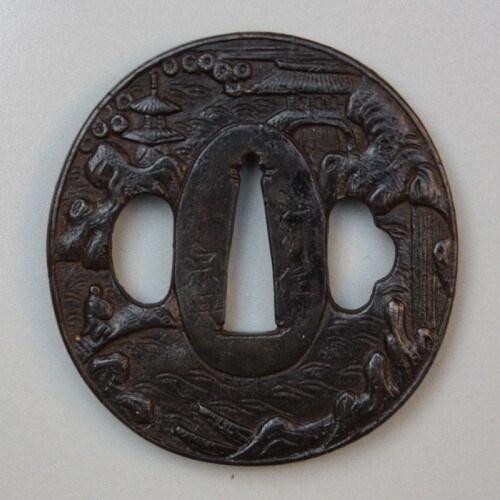
Hi Jeremy, I think the mei is Gōshū jū Sōten - 江州住 宗典. It's a very "popular" tsuba, surely a mass production casted item. Anyway I think it was a genuine utilitarian product of late Edo period (such tsuba is surely of very little appeal for rich western tourists). That's my copy: Bye, Mauro
-
Hi Josh, it seems to me that the tsuba was originally silver-plated (oborogin-ji - 朧銀地), but it was badly damaged by fire. Hard to say now what was its quality in origin. Regards, Mauro
-
Brian and Kunitaro, thanks for your help. Regards, Mauro
-
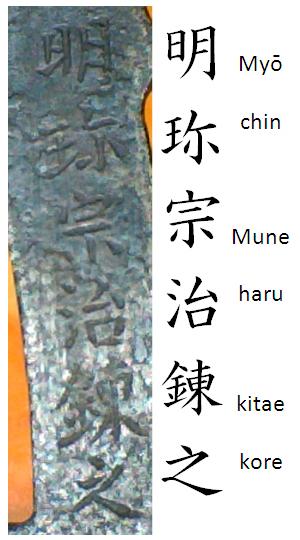
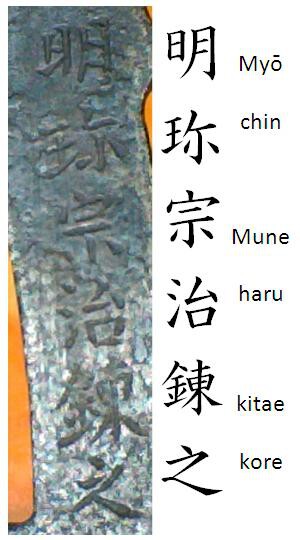
Hi everybody, I'm unable to fully understand a mei in ura side of a badly damaged tsuba: The transcription should be: 明珎宗治錬之 but the last sign could be the hiragana え (as verbal inflection for "forged"). I grasp the meaning (Myōchin Munearu forged this) but I'd like to know the exact transcription in romanji. A similar signature on a tsuba from Boston Museum of Fine Arts was reported as "Myochin Muneharu kore o kitaeru" (?). Thanks for reading. Mauro
-
(addendum) The complete mei of the first tsuba could be Kōfu jū Namitoshi (江府住 並壽). See for reference: http://www.finesword.co.jp/sale/kodougu/htm/1051_2000/1801_1850/1811/k1811.htm The mei of the second tsuba could be Kōfu jū Mitsuyoshi (江府住 満喜). See: http://www.e-sword.jp/sale/0810_6099syousai.htm
-
Hi Grev, I'm really a newcomer, but I guess the mei of the two tsuba should be Kōfu jū (江府住) rather than Bushū (武州). As far as I know there were at least 3 places named Kōfu, but I think that in a tsuba mei Kōfu was simply a part of Edo. Bye, Mauro
-
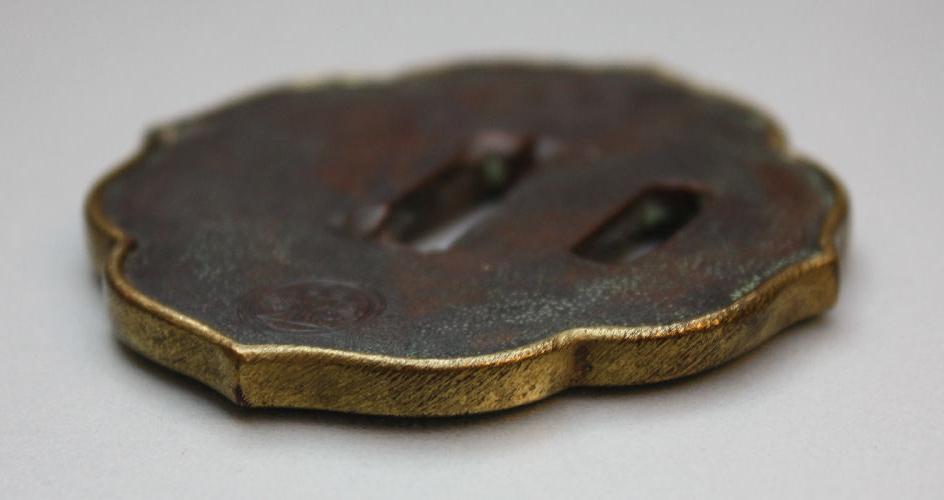
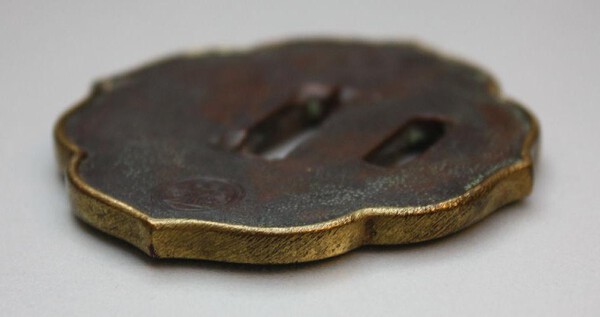
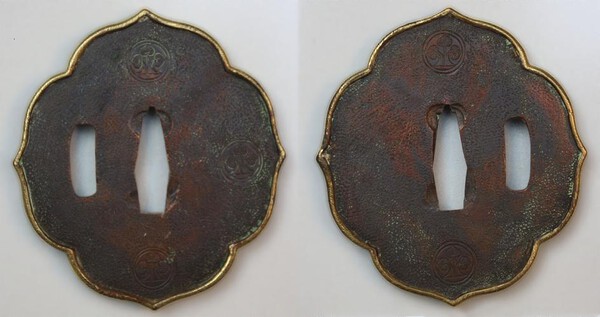
Hi everybody, I wish opinions (particularly from the kinkō guys) about a small aoi-gata (葵形) tantō tsuba (dimensions 66 x 59,8 x 3,8 mm at seppa-dai, 80 g). The simple hari-ishime (針石目) finish and the unusual shape of the kozuca-ana point me to ko-kinkō. On the other hand the fukurin and the fine kebori carving of the Hondake Tachi Aoi (本多家立葵 - the mon of Honda Clan) suggest a later attribution in Edo time. Thanks for any input about this tsuba. Bye, Mauro
-
Thank you, Thierry, now I know what a tsuba collection should be. Bye, Mauro
-
Hi Matt, IMHO a nice mid to late Edo tsuba, the first I see with a kingfisher (kawasemi - 川蝉). I'm unable to suggest a school, but I'd guess either Shōami (正阿弥), Nara (奈良) or Mito (水戸). Bye, Mauro
-
Ko-Shoami, Muromachi jidai?
-
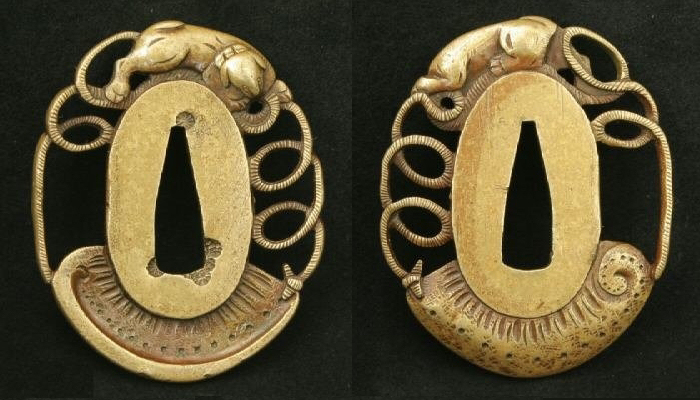
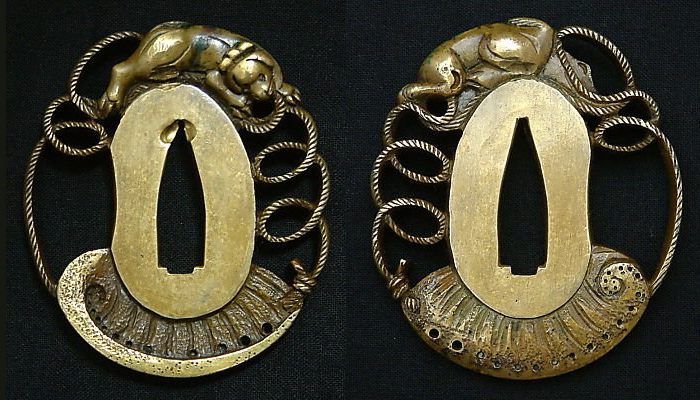
Hi Barry, two tantō tsuba similar to yours have been sold on eBay in 2007 and 2009, one being attributed by the seller to late Edo period (1800-1849): abalone&puppy3.jpg.jpg[/attachment] Bye, Mauro


-
Hi Alan, thank you for the feedback. I would be pleased if you could provide me an image of a similar tsuba and any other relevant clues on it. Bye, Mauro
-
Hi Antti. nice tsuba. Here the transcription/translation of the relevant part of your NBTHK paper (first 3 columns from the right): 鑑定書 - kanteisho - certificate 一。霞雁金透鐔 銘寿竹 - Ichi. Kasumi karigane sukashi tsuba Mei Toshichiku - Subject: open work tsuba with wild geese in the mist, signed Toshichiku 竪丸形 鉄磨地 地透 - Tatemaru-gata tetsu migaki-ji ji-sukashi - Oval shape, iron material, polished surface, positive design openwork Bye, Mauro
-
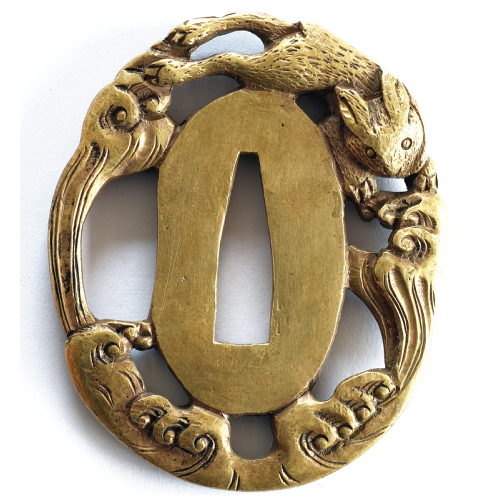
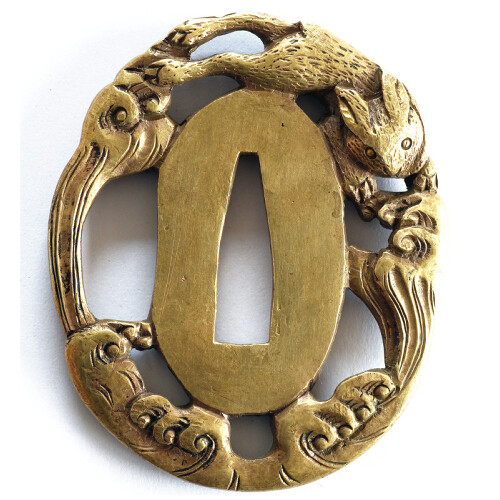
Hi everybody, this tantō tsuba arrived just yesterday. Made of brass (shinchū - 真鍮), 55 x 46 mm, decorated with hare and waves (nami ni usagi zu - 波に兎図). Probably late Edo and possibly Nara style (criticism on attribution are welcomed). Bye, Mauro
-
Hi James, my non-so-educated opinionion is that your tsuba is a legitimate Edo period Kyō-Sukashi tsuba (symmetry suggest me this attribution rather than Akasaka), probably damaged by fire and badly restored. Try with a magnet to exclude a non-ferrous alloy. Bye, Mauro
-
I like competition, and since my bravery is comparable only to my ignorance, I'm giving my answers: Bye, Mauro
-
Hi, nice tsuba. I'm far from being an expert, but I think that a strong tsuchime-ji (槌目地) ground is not enough to assign your tsuba to Tenpō (天法) school. Naturalistic carvings, presence of soft metal inlays and absence of "hot stamps" (kokuin - 刻印) are all characteristics not typical of Tenpō. Bye, Mauro
-
I have a candidate for the shape at 5 o'clock: could be a paddle for hanetsuki (羽根突き), a sort of badminton. See http://en.wikipedia.org/wiki/Hanetsuki The following tsuba is described as 羽根突き透鍔. http://www.e-sword.jp/sale/2010/1010_6035syousai.htm