MauroP
-
Posts
854 -
Joined
-
Last visited
-
Days Won
5
Content Type
Profiles
Forums
Events
Store
Downloads
Gallery
Everything posted by MauroP
-
Pretty sure the correct rōmaji term is juzu-mimi (数珠耳), juzu being a Buddhist string of prayer beads. Bye, Mauro
-
Hi Grev, I think this post could have been educative, but the bitter reactions it received do not allow to take home any useful teaching. The main point is that you solicited an analytical discussion, but the way educated collectors deal with artistic input is more on Gestalt, not on analysis. The points we all can all share are: the tsuba is a real Edo manufact, but it's gimei. The interesting question now is: why not-so-bad tsuba have a gimei? (to deceive collectors? - I don't think so, since gimei was quite a common practice in Edo time). Bye, Mauro
-
Possibly a sort of "doctor's sword"? http://www.sciencemuseum.org.uk/broughttolife/objects/display.aspx?id=92557
-
Hi Grev, here it is the complete transcription of the certificate: 認定書 - ninteisho 活花図鐔 - ikebana (no) zu tsuba 鉄地 肉彫象嵌 - tetsu-ji nikubori zōgan 銘 奈良 - mei Nara 右は當協會に於て審査の結果特別貴重 - migi wa tō kyōkai ni oite shinsa no kekka tokubetsu kichō 小道具として認定する - kodōgu toshite ninteisuru 昭和四十五年十月二十五日 - October 25, 1970 戝団法人日本美術刀劍保存協會 - Zaidan hōjin Nihon Bijutsu Tōken Hozon Kyōkai 會長 細川護立 - Kai chō Hosokawa Moritatsu (I'm unsure about the kanji 肉 in the third column) Bye, Mauro
-
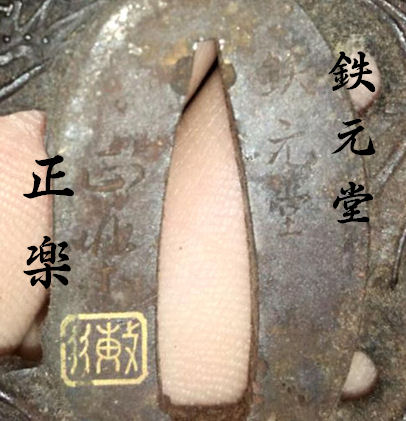
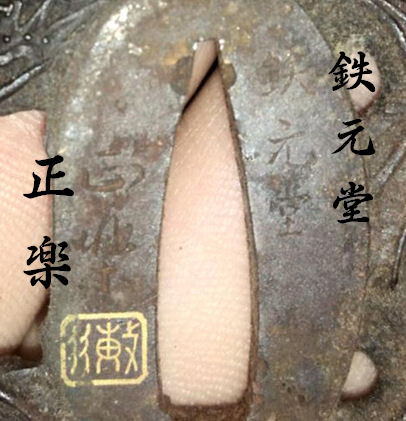
Hi, I think the signature on the tsuba could be: 鉄元堂 - Tetsugendo 正楽 - Shōraku For a similar signature of this artist AKA Okamoto Naoshige see: https://commons.wikimedia.org/wiki/File:Okamoto_Naoshige_-_Tsuba_with_a_Tiger_and_a_Dragon_-_Walters_51199_-_Mark.jpg Bye, Mauro
-
Hi Jason, good take for the price! Just some hints on your tsuba you can research by your own. The sukashi of the first one represent an umpan ( 雲板), i.e. a sort of gong used in Zen monasteries. The tiny cross-hatched pattern is just the base for a nunome-zōgan (布目象嵌), now almost completely worn-out. The style and the subject suggest most likely a Shōami work. The second tsuba represent a mushroom (Lentinula edodes - shiitake - 椎茸). I'm unable to read the signature (but doesn't seem Kinai). The tsuba is probably from mid to late Edo, and it's unlikely to have tekkotsu for this kind of late tsuba. Bye, Mauro
-
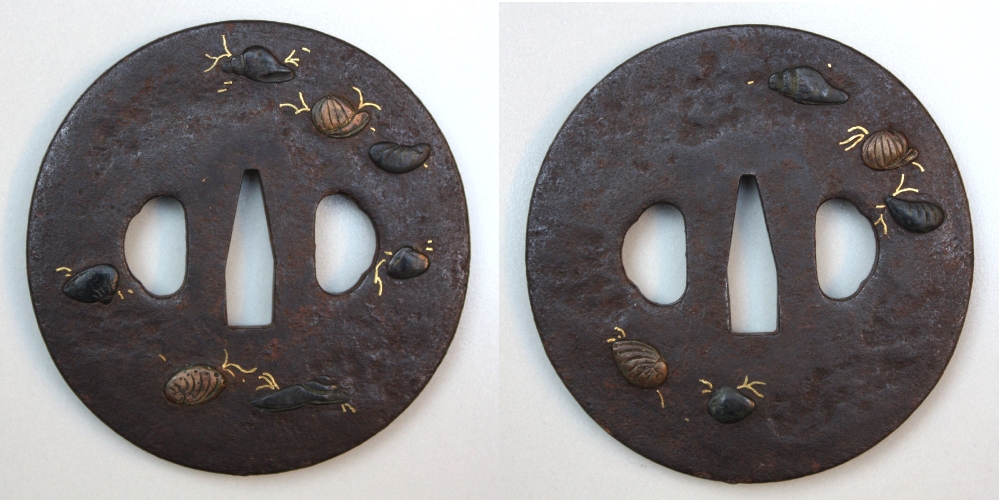
Hi Joe, my guess about your tsuba is Owari sukashi or possibly Akao for the first one. Plain itame-mon tsuba (板目文鐔) are quite common in Myōchin tsubako (Tetsugendo scool also produced that kind of tsuba but used to sign them in some way, as far as I know). The image of "shrimp motif" tsuba (海老 - ebi) is not so good to allow an hypothesis: if the colored parts are true soft metal inlays, it could be a Shōami tsuba of the late Edo, otherwise it seems a much later casted tsuba. No idea at all about your daisho set. Just my 5 cents, and pretty sure other much more educated guys in this forum can correct my not-so-educated opinions. Bye, Mauro
-
Junichi, spokes brazed/soldered in Saotome is a well known fact or just an hypothesis? Bye, Mauro
-
Thank you Marius for commenting on my tsuba. I consider you the go-to guy for ko-kinkō tsuba, and I take your opinion in the utmost consideration. Bye, Mauro
-
Hi everybody, I'm still unsure what this topic is about, anyway I wish to present a tsuba I think is ko-kinkō. The patina is greenish-brownish, really difficult to take in picture. Dimensions 68.2 x 63 x 3 mm, weight 76 g. I have also some sanmai awase tsuba (三枚合鐔), which usually, if papered, obtain a ko-kinkō attribution (but none of mine has a certificate). Bye, Mauro
-
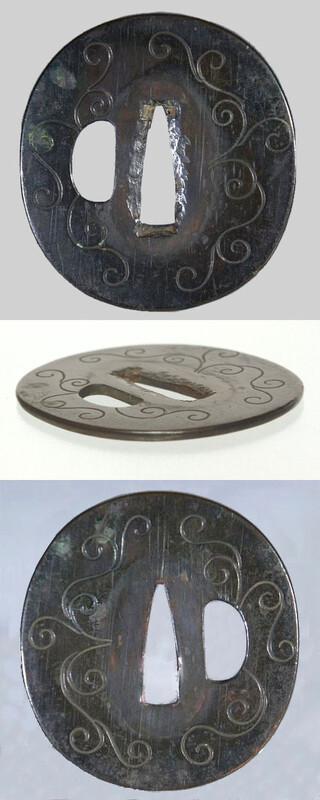
Hi Fleck, it's really difficult to define the age of your tsuba, and my hypothesis is only speculative. I presume an utilitarian fitting for ashigaru soldiers from Bakumatsu (i.e. the very late Edo) or Meji era. In earlier times would have been impractical to make casted tsuba (you get poor quality pieces but need a lot of charcoal), and later the military fittings should be shaped in a more western fashion. See some pictures here: https://docs.google.com/file/d/0B5wQUaNuuFQxV2U2V29LRkZTUGlwWk5pNFV2ZU8yUQ/edit?pli=1 Bye, Mauro
-
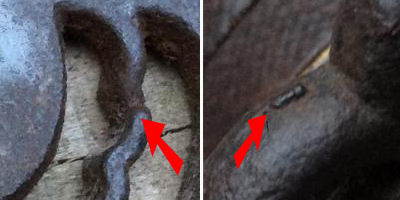
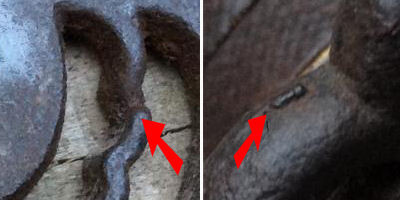
Hi Fleck, an opinion is just an opinion, and has very little value if unexplained. That's why I think your tsuba is a casted one: - that kind of item is very common in shape (and I'm guessing in dimensions). I have an (almost?) identical tsuba. Mine is 58.3 x 52.9 x 5 mm, weight 45 g. In the picture below I've put 4 other identical tsuba randomly taken from eBay: - here below, from pictures you have posted, two defects that are typical of imperfect casting: Of course casted tsuba does not mean fake modern tsuba, but just a low level mass production (i.e. a sciiremono - 仕入物). Bye, Mauro

-
Hi Fleck, I'm able to comment only on tsuba, and unfortunately I strongly suspect it's a poor cast item of post-Edo. You can find dozen of them on eBay. The sukashi pattern probably represent a family crest (変り四菱紋 - kawari yottsu hishi-mon). Bye, Mauro
-
My best guess is 鈴 - Suzusaki. Bye, Mauro
-
Hi Denis, The tsuba is an honest Echizen Kinai of the mid to late Edo period. The carving is accurate and the subject is not so common for that school. Of course the rim has been over polished a bit an that could be considered a flaw. If you like it, take it (if the price is not an issue). Bye, Mauro
-
Probably takanoha-mon (鷹の羽紋) or hawk-feather mon. Bye, Mauro
-
The description of the Kyō-sukashi tsuba on the NBTHK certificate is: 松葉繋透鐔 - matsuba tsunagi sukashi tsuba - connected pine needles openwork tsuba.
-
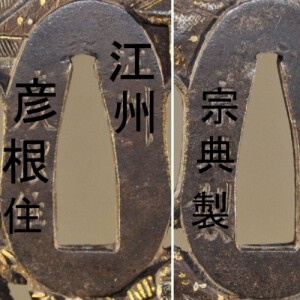
Hi Grev, I think the complete signature should be: 江州 彦根住 宗典製 - Gōshū Hikone jū Soten sei The variant of 彦 kanji is common in Soten tsuba (see a papered example http://www.seiyudo.com/tu-010513.htm). Bye, Mauro
-
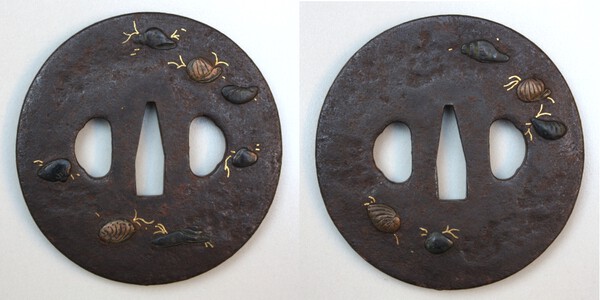
Hi Ron, The inlay style is consistent with Aizu-Shōami (as the tsuba below), but the kind of sukashi of your tsuba is unusual for that school. Anyway a nice piece. Bye, Mauro
-
Kyō-kanagushi, late Edo, in my opinion. The tsuba is nice, but the workmanship is not as good as one would expect from Mino/Gotō. Bye, Mauro
-
Hi Axel, here are two links from Boston Museum of Fine Arts that may interest you: http://www.mfa.org/collections/object/tsuba-with-design-of-bridge-waves-and-scroll-14765 http://www.mfa.org/collections/object/tsuba-with-design-of-bridge-waves-and-scroll-14850 Bye, Mauro
-
Morita-san, thanks for the explanation of the inner meaning. Its understanding is the most interesting part of kodōgu collecting. Bye, Mauro
-
Hi Axel, that's the transcription/translation of the relevant part of your origami: 浪巻物図鐔 - nami (ni) makimono zu tsuba (waves and scroll subject tsuba) 無銘 (埋忠) - mumei (Umetada) 赤銅地丸形地透平象嵌 - shakudō-ji maru-gata ji-sukashi hira-zōgan Bye, Mauro PS: by the way, wonderful tsuba!

-
Hi everybody, I have no particular or personal interest in pre-dating or post-dating that kind of tsuba we usually refer as Kanayama. But some reputed members in this forum have clearly stated that dating a Kanayama tsuba to mid-Muromachi "makes little sense in terms of cultural context" and advise "not take Sasano as any form of orthodoxy". Well, I don't indulge in any form of fascination for authoritative ipse dixit, but I'm not able to see new facts here. The Azuchi-Momoyama period is undoubtedly a very important political turning point in Japanese history, but lasted just 30 years, and in such short time is quite unlikely that the cultural context changed so abruptly. What I'm trying to say is that the burden of evidence should be sustained by the supporters of the Momoyama hypothesis. Bye, Mauro