ROKUJURO
-
Posts
7,228 -
Joined
-
Last visited
-
Days Won
40
Content Type
Profiles
Forums
Events
Store
Downloads
Gallery
Everything posted by ROKUJURO
-
Rodriguez, please try again with better (nicely focused) photos!
-
John, an interesting but unfortunately quite corroded TSUBA. I cannot see the bright speckles properly, so no attempt for an analysis here. Concerning your text: ... I am quoting Yoshindo when I say that iron with 1-2% carbon will tend to form large crystals of austenite when subjected to long periods of heating (the longer, the bigger). It is only upon yakiire that these crystals become martensite, forming the iron lumps that we, tsuba collectors, call tekkotsu and sword collectors call nie.... , l will only add that in this statement. YOSHINDO is correct (it applies as well to low-carbon iron), but your assumption is not. I will shoot some sample photos as soon as I am able to, and you will see what he meant. As I wrote in my long comment above, we cannot be sure that martensite particles we find in swords as NIOI or NIE are the same as TEKKOTSU in TSUBA. You are of course right to say that YAKIIRE could possibly be executed on TSUBA as well, but there is no evidence and no good reason for that. A major thought is that to produce martensite effects in a workpiece, you have to make sure that there is sufficient carbon content in the metal. This starts theoretically at 0,22% of carbon content, but you would need about 0,5% C minimum to really see some effect. An item made from raw iron will never produce any martensite irrespective of how often you quench it.
-
Roger, the metric system is something that has to be learned like left/right hand driving, and when you have grown up differently, it may really seem complicated. In all her loooooong life, my mother never learned that the 'old' German pound was omitted and replaced by kilogram. "74 x 71 x 4 cm ( after all these years I still find metrics a bit confusing after being raised on feet and inches )" Your TSUBA probably measures 74 x 71 x 4 mm.
-
James, Kapp/YOSHINDO are correct: 'It's ......produced by selectively filing away sections at the edge of a MASAME pattern steel block when the blank for the sword is being formed'. It cannot be produced by making indentations which you hammer flat again, that will not produce a pattern. This method works only if you file the billet after making the indentations. The whole process is more understandable if you imagine the steel billet as a piece of puff pastry. If you cut this at an angle, you will see the layers. It is no witchwork but mainly experience.
-
Depends on what MURAMASA and the condition.
-
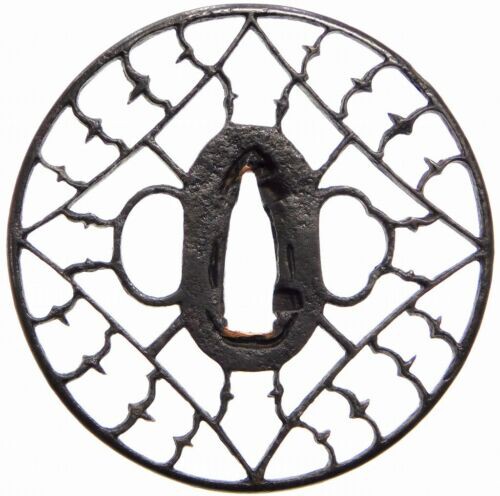
For John: Different form but similar design
-
Didier, in KANTEI you will avoid to look at the MEI immediately; that is the last thing to look at. In an ideal case, the signature confirms the features of a blade. The KANTEI of a MUMEI blade will always reflect the expertise of a SHINSA panel, but it has to be considered an educated opinion with no 100% guarantee.
-
John, a nice TSUBA with a lot of KARIGANE (not karagane)! Does not look at all cast to me. TEKKOTSU is a very interesting topic! The problem is that all literature I have seen about TEKKOTSU is based on assumptions (made by non-metallurgists), and no scientific evidence has ever come up. I am working on this subject but I cannot present my thesis as it is not finished yet, but from my observations, I will give you some food for thoughts: Carbon migration in iron/steel is a very slow process. You need a minimum temperature of 900°C to start it, and it takes hours to transfer very small amounts of carbon into an iron or steel surface. Time, temperature, the metal mass and surface, and the exclusion of oxygen are crucial factors for this. On the other hand, the carbon content of a steel layer imbedded in low-carbon iron will follow these physical laws and release its carbon content into the iron environment. We call that homogenization, and it works faster when the layers are thinner. The viscosity of steel is considerably higher at forging temperature than that of iron. So there is no way of "pressing" out steel lumps to the surface of the iron, in the contrary, I have shown in my test samples that it is exactly the other way round. In a composite test piece consisting of iron and steel sheets, the softer iron protrudes at the edges. There is no evidence for quenching (= hardening) of TSUBA, in the contrary, TSUBA have to have some considerable resilience and plasticity to be able to parry a stroke without breaking. Instead there is the story of one YAGYU Samurai (don't have the name at hand) who tested TSUBA for their quality in trying to break them (story goes about a mortar being used for that). This brings us to the use of a TSUBA. Some authors insist that a TSUBA is mounted on a blade predominantly to prevent the hands of the SAMURAI to slip onto the blade in a thrusting motion. While this will certainly work, I do not believe this to be the main reason for the mounting of a TSUBA on a sword. I think that catching an opponent's blade with the MUNE and having it slide down is a risk for the hand which will be reduced by a TSUBA. For this purpose, the outer dimensions of a TSUBA are not that important. I have seen a good number of TSUBA with KIRI-KOMI, so that the protective aspect of TSUBA may not be considered too small. Going a bit into metallurgy, you are correct in that the density of hard martensite is lower than that of pearlite, which causes some stress in the blade in the YAKIIRE process. On the other side this does not cause the martensite to come to the surface like air bubbles in water! Martensite is a structure that goes relatively deep into the steel - we are talking about a max. of 4 mm from each side. Repeated polishiing can reduce the width and the appearance of HAMON. In the TOGI process, very special natural stones are used which are chosen by the TOGISHI following his experience and knowledge about the given blade. In the later steps of a good polish, ideally soft stones (and a lot of time) will be used to remove steel from the blade surface without grinding the martensite lumps (NIE and NIOI) completely flat. In magnification, you can see NIE and NIOI protruding out of the surface like very small spheres. In cheap polishes, everything is flat and level and only visible by heavy HADORI. There is a big difference in the final treatment of blades and TSUBA: While the former should never be treated with acids, TSUBA ofter undergo an etching process necessary to create the desired 'old' or 'used' appearance which is not always the same as patina. In my experience, carbon steel is more easily attacked by acids than low-carbon iron, so if the superficial phenomena we call TEKKOTSU were carbon steel, they would be attacked by the acids in the first place. Some authors have speculated about TEKKOTSU being lumps of hard steel which remained when the surrounding iron of a TSUBA was worn away in the use by rubbing on clothes. This is very far away from any probability. I will not go further down in the abysses of steel and forging, Kind regards, Jean C.
-
The TSUBA has obviously been (mis-)used as a keyhole cover. Not very uncommon, unfortunately. Design is KURA to (TETSU) UMA MUCHI (horse whip, which could indeed be made of iron)
-
Thank you Grev!
-
Félicitations, Didier! Looks like an honest blade! The pronounced SORI does not say KANBUN to me, but the NAKAGO could probably indeed be early EDO and not SHIN-SHINTO. The MENUKI seem to be very nice, but although the TSUKA has seen much handling and age, the TSUKA-ITO seems to have been made in a wrong way. Surprising! The whole sword might have an interesting history, but it may be too young to be classified as UCHIGATANA or KATATE UCHI. I would like to see the blade polished for many more revelations.
-
MORIYAMA-SAN ARIGATO GOZAI MASU
-
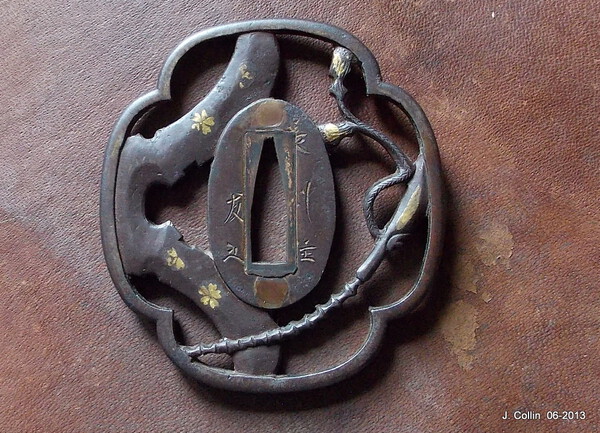
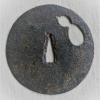
Gentlemen, I have what I think is a CHOSHU TSUBA , but I cannot read the second KANJI of the MEI. First is TOMO. I would appreciate your help in deciphering it. Thanks in advance!
-
Can anyone please translate this mei.. thanks in advance
ROKUJURO replied to Yuradneprov's topic in Translation Assistance
Jacques, Tokuho is a shortened term for “tokutei hoken-yo shokuhin.” The practice of attaching this label on different food and drinks in Japan began in 1991 with the aim of easing the rising health care cost in the country. -
Ludo, whatever we venture to do, we have to be conscious about the limits of our knowledge and capacities, and our aims should not be 'better than the worst' but always acceptable on a general basis of that specific field. Just my opinion.
-
Any thoughts on this tanto I'm planning to buy?
ROKUJURO replied to a topic in Auctions and Online Sales or Sellers
Amy, I can understand that you would like to own an authentic blade right now, and this HIROMITSU TANTO looks like one. Unfortunately, we cannot be sure about the quality and the authenticity from looking at photos alone. In my opinion there is an issue near the MUNEMACHI, but that may just be the condition of the polish. Under these conditions, the price seems a bit high with only a SHIRA-SAYA (not shiro-saya). Like mentioned before, I am sure you could do better for that amount of money with some basic information - and patience! -
Ludo, I would not call it 'destroyed', but not in good condition. There may be a good thing about these ugly restoration attemps as they possibly prevented more corrosion. A BIZEN SUKESADA blade without written confirmation of authenticity may not warrant an investment of a lot of effort and money, but as it seems to be a family heirloom, it will have some emotional value for you. Concerning a match for your FUCHI, you may find a nice KASHIRA in the 'orphan KODOGU' section here on NMB (http://www.militaria.co.za/nmb/topic/13286-the-fuchikashira-orphanage/). I cannot identify the theme of your FUCHI. I sincerely hope that restoring TSUKA and SAYA yourself will produce better results than the previous attempts! In my eyes, having an expert look at the blade and then deciding about restoration would be a good first step.
-
Can anyone please translate this mei.. thanks in advance
ROKUJURO replied to Yuradneprov's topic in Translation Assistance
Yura, these photos are not well focused and not really helpful, but I will give it a try: BITCHU KUNI MIZUTA no JU KUNISHIGE SAKU (with some doubts). -
Ciro, welcome to the NMB! Besides or own reliable members in the sales section you may find many dealers if you click the links (uppermost task line).
-
The signature was probably made with a screwdriver. Not Japanese! The KOJIRI might be the only item of interest. FUCHI and SEPPA look like over-cleaned with sandpaper or a steel-wire brush.
-
Ken, it looks as if your KOZUKA has been badly mistreated, and the dents were probably not caused by the TSUBA, I believe. It should be cleaned but it might not be worth a professional restoration. It is of course you to decide that!
-
Perhaps try in the translation section? KIYOSABURO?
-
HÔSHÔ (?) KUNIMITSU
-
Top right seems to have more contrast.
-
GURI-BORI - very nice!