

ROKUJURO
-
Posts
6,850 -
Joined
-
Last visited
-
Days Won
33
Content Type
Profiles
Forums
Events
Store
Downloads
Gallery
Everything posted by ROKUJURO
-
You have probably to remove the mastic/glue to be sure about the way of production.
-
Ken, there are AKASAKA SUKASHI TSUBA with that thickness at the MIMI. It looks indeed quite fat, but this is not completely unusual; NUNOME is probably not the 'soul' purpose....
-
Gethin, you have a better chance of help in the translation section!
-
Geoff, maybe you can see these features holding your blade in hand, but for my old eyes nothing of that can be seen in the photos. The condition of the blade is too bad; NIE needs a good (traditional) polish to come out properly. In addition to that you need very good photos to show it.
-
David, items like this get their life from use. It seems to be a very nice CHAWAN, and it would certainly be a sensory pleasure to drink from it. There is no rule to use it only for MACHA. While newer CHAWAN are indeed made for CHADO, we must not forget that the early tea-masters bought simple traditional rice-bowls from Korea for their tea ceremony.
-
Terminus, please sign all of your posts with your first name plus an initial as is the rule here.
-
Hi Mark, welcome to the forum! Your sword seems indeed to have a blade from the SAMURAI era, probably later SHINTO period. The smith signed with his name KANE.... but the second KANJI was cut off when the NAKAGO was slightly shortened to adapt to another TSUKA (handle). There were many generations of smiths with that name. The HAMON is SANBONSUGI which means 'three cedars'. All these features point to a manufacture in SEKI province. Of course this is only my opinion based on photos. To make a safer assessment one has to have the blade in hand.
-
TSUKA (handle), HABAKI and SAYA (sheath) seem to be new and are probably from a cheap decoration sword or IAITO. Parts of the blade look like an oil-hardened one from WW II to me. NAKAGO looks old, though. One would have to see the blade in hand to decide. As you are not an expert, better be careful.
-
Dwain, the problem with defects of this kind is that the wood underneath the URUSHI will dry out and the shrinkage will cause larger areas of lacquer to become loose. In the end the SAYA will probably crack open. There is no fast and easy way for an aesthetically satisfying restoration, but I suggest that you have it done soon by a lacquer expert. By the way, most SAYA will dry out if left without a blade or a TSUNAGI, especially in our Western homes with a heating system. Almost inevitably, the lacquer of old KOSHIRAE will suffer so that the SAYA needs repair or even replacement. The texture of your SAYA was done with salt mixed into the URUSHI. After hardening (URUSHI does not 'dry' but hardens by polymerisation), the surface is ground even and the salt is washed out of the surface with water. You will immediately understand that a small scale repair will be very difficult if not impossible.
-
Hoping for assistance with a translation
ROKUJURO replied to John in FL's topic in Translation Assistance
Probably Chinese script, but not Japanese blade. -
Ray, why don't you try it with a good close-up photo in the translation section?
-
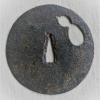
Although this TSUBA looks as if it has been mounted on a blade, I have the impression that it might be a cast reproduction, possibly from a IAITO. It could also be a genuine one, but was very corroded in the past as the surface seems unusually coarse. Difficult to judge from the photos.
-
Grev, you point out a real problem. Sometimes I even feel it is impolite to throw out some blurred photos and nonetheless ask for identification help. The other side is that newcomers might believe that our experts can read everything, and in fact I am sometimes really surprised about what Raymond, Steve and others can still read out of these pictures. Another thing is of course that beginning collectors often do not know what might be important to show and in which way. Perhaps it would be helpful to give some recommendations concerning the presentation of photos in the FAQ or another general place.
-
All in all, this is a good story to accompany an interesting sword. I like the idea that a number of kind and knowledgeable people from NMB supported its journey!
-
Very helpful for beginners! Thank you for the work and time!
-
I can only see dates.
-
Last KANJI of MEI could be TSUNE 常
-
Luis, I think it is a quite good one, but a late one. Unfortunately I can't read the MEI. MUNE....something?
-
....but a good one!
-
Help With Translation My Great Uncle's Sword.
ROKUJURO replied to tominfukuoka's topic in Translation Assistance
Tom, for comparison: http://www.sanmei.com/contents/media/A64210_W2751_PUP_E.html -
I don't think it is a well made blade (and it is not a KIMONO.....). I see WARE and cracks in the YAKIBA. It is never actual production from a Japanese swordsmith. The signature TADAHIRO and the description show that this blade was made to deceive. Everybody stay away!
-
Honjo Masamune On Flebay
ROKUJURO replied to dominnimod's topic in Auctions and Online Sales or Sellers
The packing tape on the SHIRA-SAYA is a giveaway. I have never heard about MASAMUNE-SENSEI using self-adhesive parcel tape. Other than that, the slender SUGATA and the numerous WARE are certainly typical for the smith. Unfortunately, the KISSAKI is not shown, so I will refrain from bidding. -
Mrs. Rankin, welcome to the NMB! We have a wealth of information to read about swords here on the forums, so you will find many similar posts with similar answers. Your sword is probably not a mystery. The mounts are WWII military, but the blade is perhaps older. Detailed photos might reveal that. Try to show the blade to one of our experts in Australia, who will give you good advice about how to care for the blade and preserve the value. The signature is probably not by the 'original' MUNECHIKA (https://japaneseswordlegends.wordpress.com/2015/10/01/the-kogitsune-maru/). Looking for information in the internet, you may even find the name being used by a modern kitchen knife maker. Please sign all posts with your first name plus an initial as is requested here.
-
Samurai Art Expo Utrecht
ROKUJURO replied to paulb's topic in Sword Shows, Events, Community News and Legislation Issues
Pete, I asked the KTK secretary, Mr. Ploplys, about that, but he has no infos about such plans. -
One of the warriors on the FUCHI carries a KEN as often seen with SHOKI, but he is mostly depicted in combination with ONI which I miss here.
