

ROKUJURO
-
Posts
6,966 -
Joined
-
Last visited
-
Days Won
37
Content Type
Profiles
Forums
Events
Store
Downloads
Gallery
Everything posted by ROKUJURO
-
Faint mei can anyone make this out?
ROKUJURO replied to Yuradneprov's topic in Translation Assistance
Yura, ONE photo please of the NAKAGO, vertical, with light from the side! -
What did you find out? I think I can read KUNIHARU 圀 春
-
This thread should be transferred to TRANSLATION.
-
A papered AIZU SHOAMI TSUBA with a similar theme: https://www.aoijapan.com/tsuba-mumeiaizu-shoami-2/
-
.....The plate does exhibit this very nice gradual and uniform thinning from the rim in towards the center, which I imagine was not easy to do.) Michael, while good iron TSUBA are indeed not so easy to make, as design and craftsmanship have to be on a high level, giving the plate an even or tapering thickness is not so difficult!
-
Perhaps http://www.thejapanesesword.com/services/swordsmiths/Ehime/ehime.html
-
Usually HEIANJO inlays are brass/SHINCHU, but I have seen some TSUBA with a few copper inlays as well. This is the first for me that seems to have copper only.
-
Barry, in principle, yes, but it seems that we have here a well homogenized iron, so the patination process does not reveal a crystalline or other structure as we might see in MOKUME TSUBA. The nature of TEKKOTSU is perhaps not what we are thinking it might be - I am working on that. TSUBA are not hardened like sword blades and thus we should not expect Martensite particles to protrude from the surface.
-
What are my thoughts? Well, it is quite nice, very well preserved, indeed in KANEIE style, and competently crafted. AIZU SHOAMI?
-
This kind of matte surface is probably caused by pickling/etching, a normal finishing process. All features speak for a nicely and competently handcrafted item, but indeed it lacks the vivid expression of some older TSUBA in NOBUIE style. I like it and I think it is a good find!
-
Chris, for me a GIMEI price reflects the facts. Seller and buyer know what they are talking about. In this case the photos do not allow for an estimation, but generally I think you are not too far, considering the whole package with a cut-off shaft.
-
Chuck, there are so many fake signatures, and the few authentic ones are so expensive, that I remind you to buy the blade, not the signature! If the blade has no major faults and is nice to look at, why not keep it as a study piece? Always depending on the price-tag, of course! A GI-MEI item should have a GI-MEI price!
-
Chuck, that weapon is called NAGINATA and it has an unusually short shaft as we see them on NAGAMAKI.
-
Thank you, Pete! I always get that mixed up! Is there something typical on this KOZUKA that would allow an assignment to the style of a certain school? Iron KOZUKA are probably not that common.
-
Is that KOZUKA extremely ugly, not well made or only difficult to assign to a school or maker? I would really appreciate your help!
-
Tony, as Ford explained, the TSUBA body is cast, but many of these TSUBA were finished by hand. In a high quality SHINCHU TSUBA, there is no other way. Of course, some of the items shown above may have been made completely by casting, and received very little work afterwards.
-
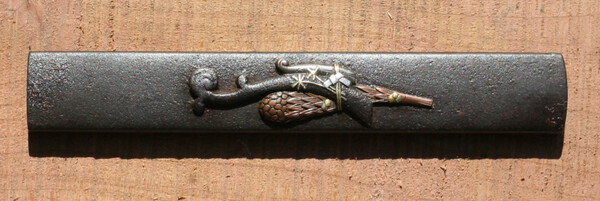
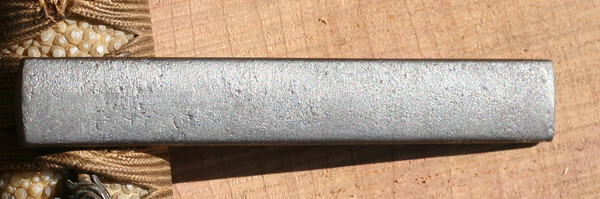
Gentlemen, recently I bought a KOZUKA decorated with - what I think is - fern sprouts and horsetail. I would like to read your opinions as to the meaning of this and if possible a school or maker. The KOZUKA is signed on the OMOTE but there is almost nothing left of the MEI Thank you in advance!
-
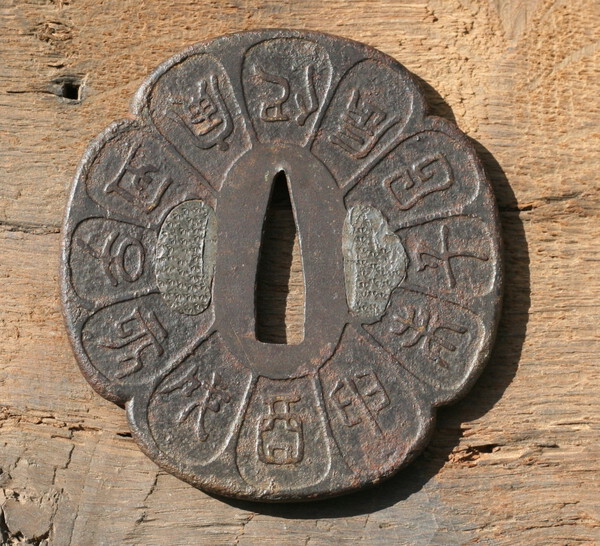
Gentlemen, a new TSUBA in my collection. Condition is not so good, but I am curious to know the school and period it was made. Motive seems to be Zodiac and stars constellation. Dimensions: 80 x 76 mm, thickness 4,3 mm (MIMI). Thank you in advance for your opinion!

-
I can understand that, but those are factory made items which probably could be replaced in case they are destroyed (if not too old). Handmade Japanese swords are always one of a kind! It is the same with old ceramics.
-
Gentlemen, I use a non-expensive (Chinese) IAI-TO with a blunt steel blade. It is lightweight like an original and has a BOHI which allows for a nice TACHIKAZE. It is still dangerous enough to cause damage if you are careless, but this applies also to a heavy red oak BOKKEN. As we all know, this latter can be considered a deadly weapon. I don't feel so much the need to cut through something, but in that case I would simply use one of the better Chinese models. It is so easy to bend a blade in TAMESHIGIRI if you don't get the correct angle!
-
BITCHU....KUNISHIGE
-
Perhaps two TSUBAKI petals would have done the job..... BTW, it is WAKIZASHI.
-
jblev2, I don't think so. Please sign all posts at least with your first name plus an initial as is requested here.
-
Ray, these very small photos are difficult to read!



