ROKUJURO
-
Posts
6,888 -
Joined
-
Last visited
-
Days Won
34
Content Type
Profiles
Forums
Events
Store
Downloads
Gallery
Everything posted by ROKUJURO
-
As Ford mentions, URUSHI may be a problem. In many TSUBA, the metal plugs in the HITSU (ATEGANE or UME) are glued in with URUSHI. All depends from the temperature, so it's difficult to talk about the hazards when you don't know exactly how hot the TSUBA were.
-
Logan, I cannot believe that members here might be afraid to post a critical comment. But you are certainly correct with that insightful look at the tradition and long learning processes in the crafts of the Japanese sword.
-
Logan, reading your comment, I can only say that you obviously lack the knowledge and experience in this field. Yes, a good woodworker may be able to make a raw TSUKA or a SAYA, but making it the original Japanese way is a completely different thing! While a SAYA may 'only' fall apart or scratch the blade, an incompetently made TSUKA is a potentially dangerous thing and may lead to the 'House of the Flying Swords'! There are seven different expert craftsmen involved in making a Japanese sword, and I think it is over-self-confident to believe that any craftsman in the West could do the same. Experience in this field is a main factor.
-
Jean, you have received an e-mail for No. 36
-
Gang Wang, please try again in the 'Translation' section. More expert members might see and identify this. Looks like a GENDAITO, but of course we need to see the full blade without HABAKI.
-
The "MEI" could be a 27 standing on its head.
-
Yura, may read KANEMITSU. The photos do not allow an assessment if GIMEI or SHOSHIN, at least not for me.
-
Faint mei can anyone make this out?
ROKUJURO replied to Yuradneprov's topic in Translation Assistance
Yura, ONE photo please of the NAKAGO, vertical, with light from the side! -
What did you find out? I think I can read KUNIHARU 圀 春
-
This thread should be transferred to TRANSLATION.
-
A papered AIZU SHOAMI TSUBA with a similar theme: https://www.aoijapan.com/tsuba-mumeiaizu-shoami-2/
-
.....The plate does exhibit this very nice gradual and uniform thinning from the rim in towards the center, which I imagine was not easy to do.) Michael, while good iron TSUBA are indeed not so easy to make, as design and craftsmanship have to be on a high level, giving the plate an even or tapering thickness is not so difficult!
-
Perhaps http://www.thejapanesesword.com/services/swordsmiths/Ehime/ehime.html
-
Usually HEIANJO inlays are brass/SHINCHU, but I have seen some TSUBA with a few copper inlays as well. This is the first for me that seems to have copper only.
-
Barry, in principle, yes, but it seems that we have here a well homogenized iron, so the patination process does not reveal a crystalline or other structure as we might see in MOKUME TSUBA. The nature of TEKKOTSU is perhaps not what we are thinking it might be - I am working on that. TSUBA are not hardened like sword blades and thus we should not expect Martensite particles to protrude from the surface.
-
What are my thoughts? Well, it is quite nice, very well preserved, indeed in KANEIE style, and competently crafted. AIZU SHOAMI?
-
This kind of matte surface is probably caused by pickling/etching, a normal finishing process. All features speak for a nicely and competently handcrafted item, but indeed it lacks the vivid expression of some older TSUBA in NOBUIE style. I like it and I think it is a good find!
-
Chris, for me a GIMEI price reflects the facts. Seller and buyer know what they are talking about. In this case the photos do not allow for an estimation, but generally I think you are not too far, considering the whole package with a cut-off shaft.
-
Chuck, there are so many fake signatures, and the few authentic ones are so expensive, that I remind you to buy the blade, not the signature! If the blade has no major faults and is nice to look at, why not keep it as a study piece? Always depending on the price-tag, of course! A GI-MEI item should have a GI-MEI price!
-
Chuck, that weapon is called NAGINATA and it has an unusually short shaft as we see them on NAGAMAKI.
-
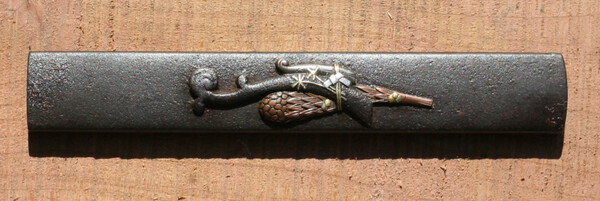
Thank you, Pete! I always get that mixed up! Is there something typical on this KOZUKA that would allow an assignment to the style of a certain school? Iron KOZUKA are probably not that common.
-
Is that KOZUKA extremely ugly, not well made or only difficult to assign to a school or maker? I would really appreciate your help!
-
Tony, as Ford explained, the TSUBA body is cast, but many of these TSUBA were finished by hand. In a high quality SHINCHU TSUBA, there is no other way. Of course, some of the items shown above may have been made completely by casting, and received very little work afterwards.
-
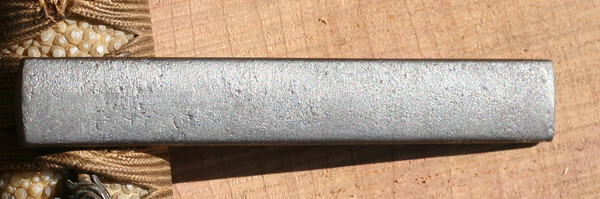
Gentlemen, recently I bought a KOZUKA decorated with - what I think is - fern sprouts and horsetail. I would like to read your opinions as to the meaning of this and if possible a school or maker. The KOZUKA is signed on the OMOTE but there is almost nothing left of the MEI Thank you in advance!