PietroParis
-
Posts
796 -
Joined
-
Last visited
-
Days Won
4



PietroParis's Achievements






-
I was referring to the antler piece. Antler darkens with age and this looks too white to be 150 years old, just compare it with the silk seal. Moreover, the style smells vaguely Chinese to me. OTOH, I like the tooth a lot and would have no problem dating it to Meiji or even earlier.
-
The style of the tonkotsu (inlays on raw-looking wood) vaguely reminds me of Hasegawa Ikko. https://www.invaluable.com/auction-lot/signed-ikko-hasegawa-antique-Japanese-tonkotsu-to-256-c-120447a96d
-
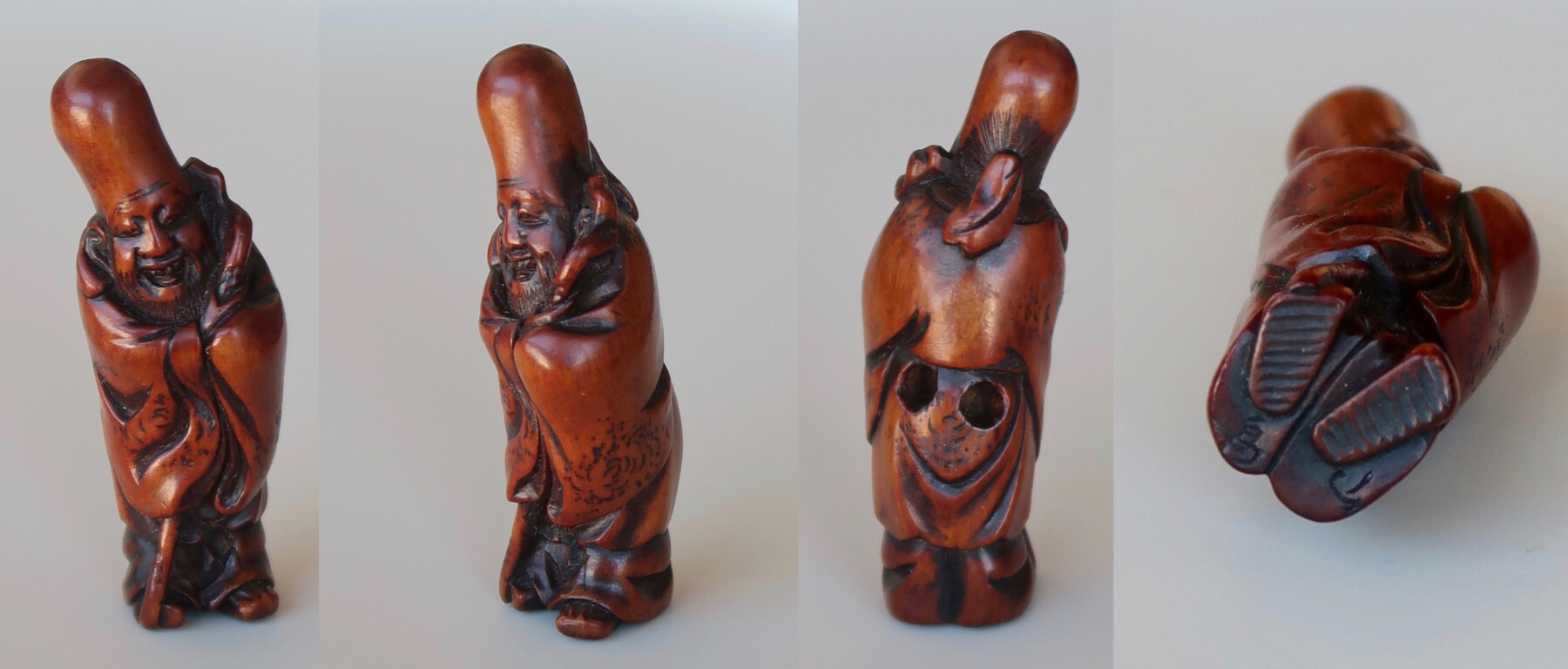
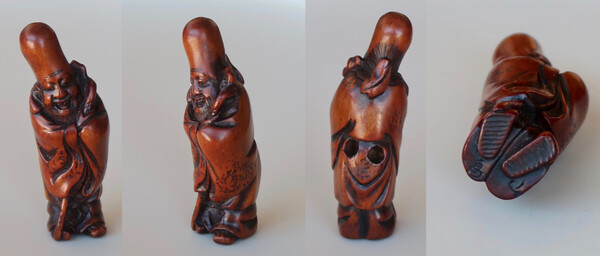
BTW this is my only Fukurokuju. Nothing special, but sometimes it triggers the weird urge (luckily always resisted ) to pick my nose with it.
-
I suppose a peach of immortality, but definitely suggestive. OTOH, I don't think it is a very old carving. In particular, the surface of the antler is a bit too white (just compare it with the seal on the left, which is definitely antique), and the style looks slightly "off" to me. P.S. my favorite in this picture is the tooth, can we have more views?
-
In these cases it may be useful to compare with genuine antique examples of the same model (these are from the Linden Museum in Stuttgart)

-
That someone in his late forties (then) or mid fifties (now) should be considered a "youngster" is just a sad reflection of the state of these communities. And while undoubtedly "young" in collecting years, I am already "old" enough to appreciate that the levels of passion, scholarship and specialization in netsuke collecting are not inferior to what members of this forum are used to in the context of Nihonto. Being a grizzled expert in a field does not automatically imply knowing anything about the other, and when someone spews misinformation he needs to be called out.
-
Ronald Watson you clearly don't know what you are talking about. Where do I start unraveling your ball of nonsense? Bernard Hurtig's "International Netsuke Collectors Society" started in 1972 and closed shop around 1985. An unrelated collectors group, "Netsuke Kenkyukai", started in 1980 and became the "International Netsuke Society" in 1996. The yearly $125 fee of the INS covers four issues of the journal, which may or may not be considered a good deal, but most importantly it gives access to 46 years of back issues in electronic form. Genuine netsuke can be bought from dealers, from major auction houses (but not Sotheby's, which closed its Japanese art department in 2007, and even Christie's rarely sells netsuke nowadays), from cheaper local auctions, from flea markets, from other collectors, from Catawiki, and even from eBay. Collectors do not "shy away from buying netsuke" for fear of Chinese fakes: a minimal education in the subject is sufficient to spot those fakes, which are comparable to the cast tsuba or fake gunto that are commonly seen in this forum. If you fear that you cannot distinguish them, just buy a few books first, as is advisable in all branches of collecting. Sophisticated forgeries of course also exist, but those do not necessarily come from China (e.g., German fakers were prolific in the 1990s) and generally target the higher end of the market. The prices of collectible netsuke range from a few hundreds to, indeed, a few hundred thousands. Some collectors will be confined to low and mid-range pieces, others will be able to afford the best stuff. But all of the collectors I know are passionate about the subject, and many are also knowledgeable. Is this any different from what happens with Japanese swords?
-
Russ: the link works for me; there are at least four version of the go players in a fruit in the BM collection, which one is your favorite? https://www.britishmuseum.org/collection/search?keyword=netsuke&keyword=go&view=grid&sort=object_name__asc&page=1 John C.: decent figural netsuke can be bought already for a few-hundred $/£/€ when one knows what he/she is doing, the problem is distinguishing them from the 99% of modern fakes.
-
There are three netsuke by Natasha Popova on page 70.
-
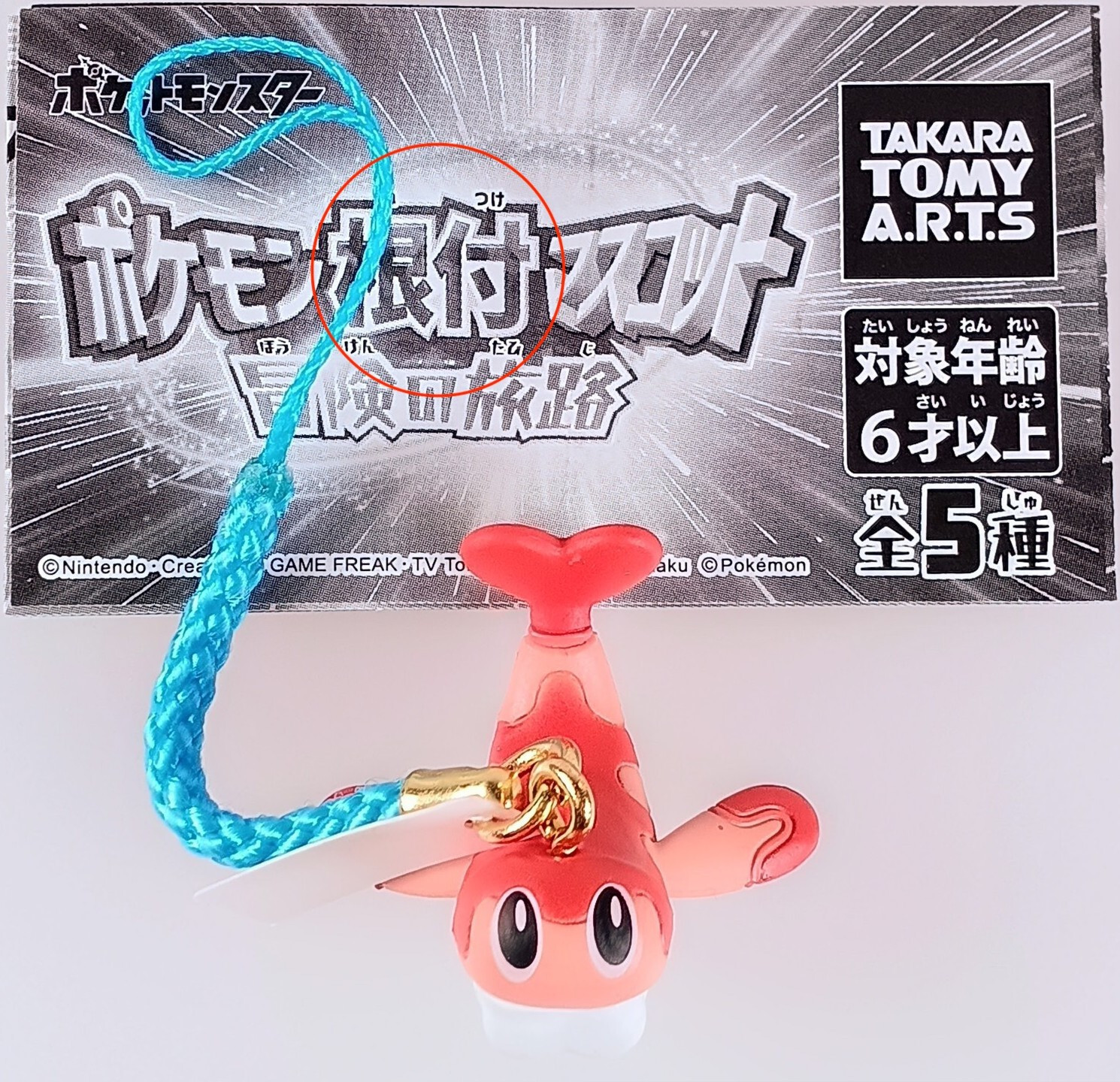
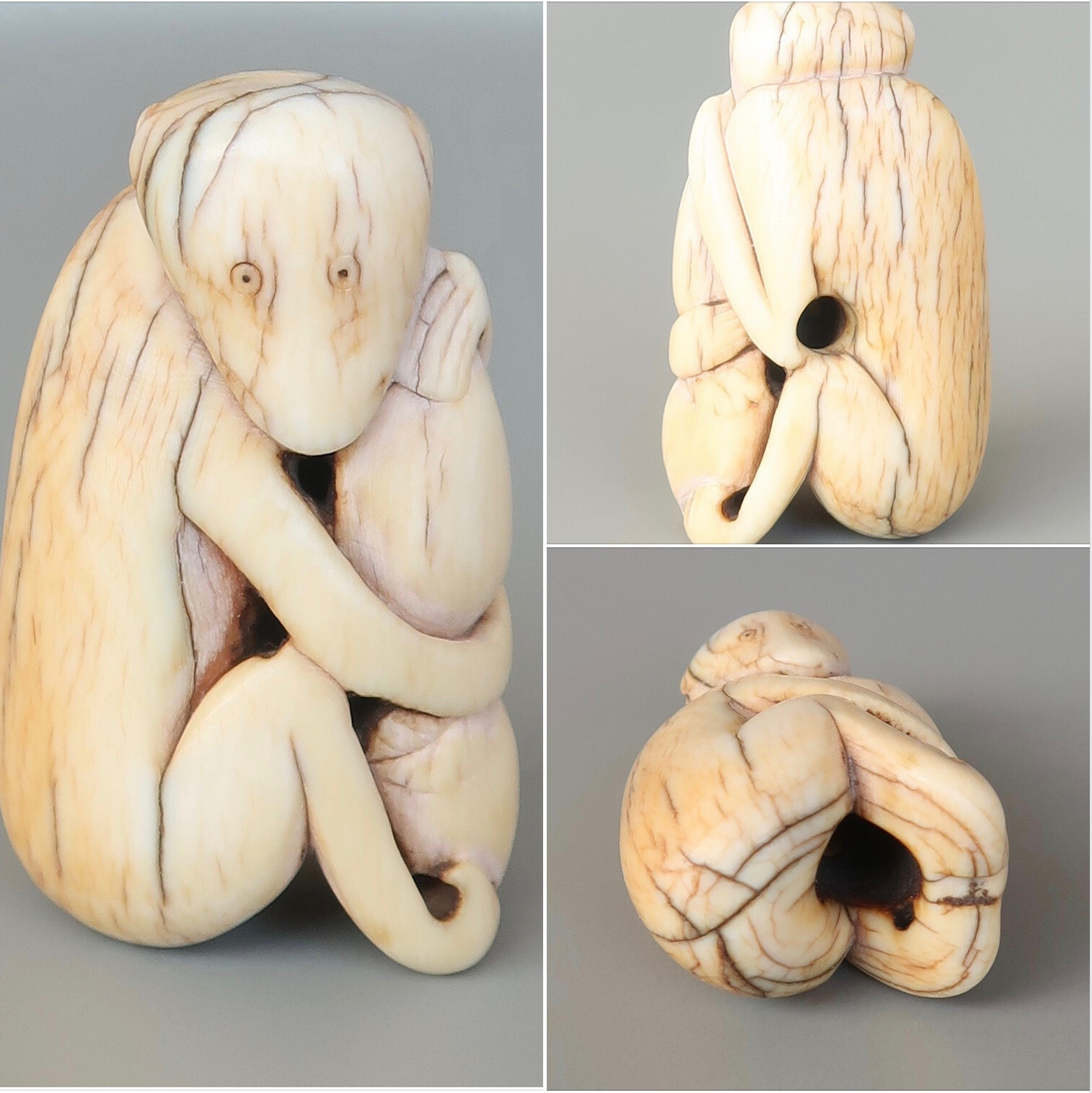
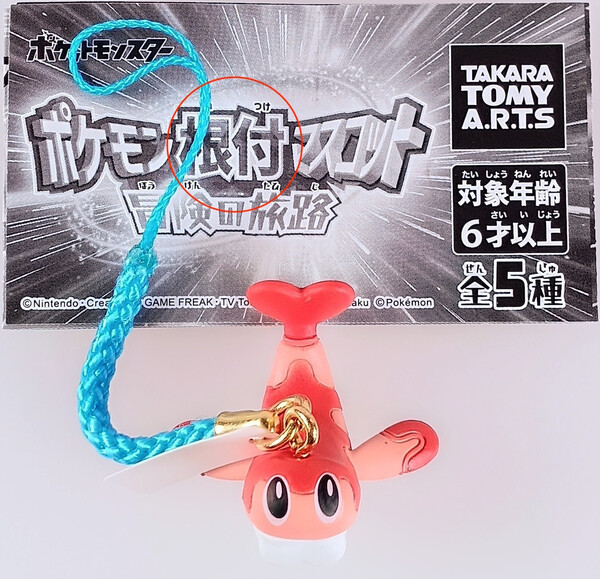
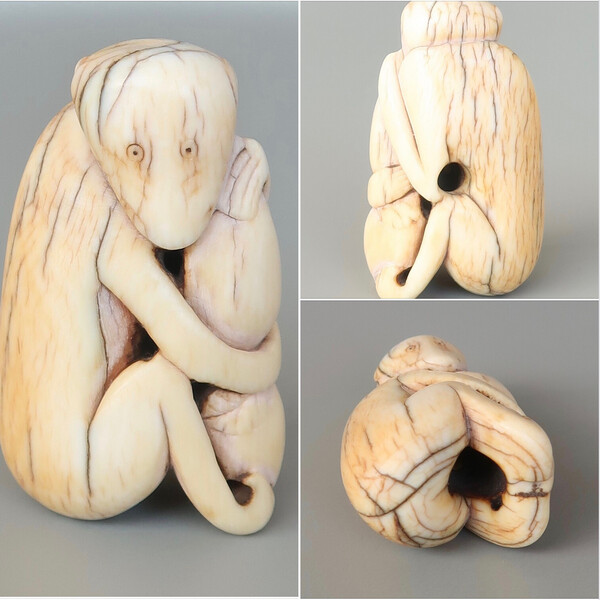
Since the question "what exactly is a netsuke?" is a recurrent one in collectors' forums, here are my two cents. First of all, I agree that we should not get fixated on the name. The Japanese use 根付 even for mass-produced keyrings, and who am I to tell them they are wrong? The question might thus become "what is a collectible netsuke?", but yet again people should be free to collect whatever they like (within some bounds, e.g. for what concerns poached ivory). However, they should be aware of what they are collecting, so that they don't end up overpaying for modern trinkets, and they don't inflict them on those who prefer antique and/or artistic items. To "mainstream" experienced collectors, antique pieces are always of some interest - regardless of the artistic quality, which might vary a lot - as a manifestation of a bygone age and culture. From that point of view it is understandable that collectors of Japanese stuff might be less interested in antique Chinese artifacts, as they are less able to place them in the proper context. It is true that Chinese toggles were often repurposed as netsuke in Japan, especially in earlier times, but I am under the impression that Japanese netsuke art evolved to a much higher level of sophistication. However, that might be just due to my ignorance of the Chinese side. For the record, I have this toggle which may or may not have been converted into a netsuke. I read in an article by a Western collector that the subject is a kind of pun, since in Chinese "crazy monkey holding a peach" (feng hou pao shou) is homophone to something like "may you advance in rank and live long". Maybe Zhangshilong can confirm this theory? Finally to the question of antique vs modern: netsuke by contemporary artists are certainly considered collectible. The good ones can fetch prices that are generally higher than entry-level antiques, and the geographical origin of the carver is not a factor. However, absent the connection with a bygone age and culture, what matters for contemporary netsuke is the artistic quality, which is not just technical skill but also originality in the conception. Whenever I am accused of prejudice against contemporary carvings by someone who didn't like being told that granpa's treasure is in fact a mass-produced souvenir, I point them to this catalogue: https://library.orientmuseum.ru/images/pdf/Sovr_Netsuke_2017.pdf
-
石川 Ishikawa is a very common signature on this kind of mass-produced souvenirs.
-
 An obvious explanation would be that this is an imitation made in China or Hong Kong (and I would guess quite later than Taisho).
 -
Netsuke Identification-help needed
PietroParis replied to C G Forrester's topic in Other Japanese Arts
Indeed, it's a mass-produced souvenir: https://ebay.us/m/1HJRYB https://spicersauctioneers.com/catalogue/lot/3854b156aa2e7af44cf82585fc6f87b3/2a6fa85538c56e3991b429b74f737ad8/antique-and-fine-art-lot-294/ In these cases I usually suggest a comparison with a genuine example, but I don't recall ever seeing an antique version of this model. Anyway, this is what genuine birds in wood might look like: https://www.metmuseum.org/art/collection/search/59041 -
This is an old acquaintance, it was already there in 2021 (see page 2).
-
Namitoshi on eBay: