ROKUJURO
-
Posts
6,866 -
Joined
-
Last visited
-
Days Won
33
Content Type
Profiles
Forums
Events
Store
Downloads
Gallery
Everything posted by ROKUJURO
-
BADACTOR0323, welcome to the wonderful world of NMB! Please sign all posts at least with your first name plus an initial, so we may address you politely. It is a rule here.
-
KYUDO?
-
Christophe, to my eyes the plate looks like patinated SHINCHU (brass), leaves are probably SHAKUDO and copper. 19th century item?
-
 Christopher, welcome to the NMB! There are many options on the net to compare the signature (https://www.aoijapan.net/katana-tamba-no-kami-yoshimichi-osaka-third-generation/) but even if GIMEI the blade might be a decent one, so look at the quality and the features first and then the MEI should confirm the smith (in the best of all cases). Please show more of the blade so the experts could comment.
 -
Zombie tsuba... raaaauuuughhhh!
ROKUJURO replied to PietroParis's topic in Auctions and Online Sales or Sellers
Steven, you are right. It does not deserve that much attention. -
Zombie tsuba... raaaauuuughhhh!
ROKUJURO replied to PietroParis's topic in Auctions and Online Sales or Sellers
Yes, that happens from time to time. I remember a German dealer who bought a number of TSUBA from Japan which were exposed to saltwater for a while. I believe he had hoped the potential customers wouldn't care about the corrosion issues.... -
Zombie tsuba... raaaauuuughhhh!
ROKUJURO replied to PietroParis's topic in Auctions and Online Sales or Sellers
Chris, as I wrote, it could be lacquer, but also a different metal coating that was less attacked by corrosion. It is certainly not caused by 'vertical forging'. I am always interested to learn from well made items, but I am afraid this one will remain an enigma in this late state of disintegration, as long as it is not in my hands for close inspection. -
Obscured / Rusted Mei - How to Read?
ROKUJURO replied to tbonesullivan's topic in Translation Assistance
Brian, as far as I have seen, read, or practised, MEI in sword NAKAGO are punched in a downward motion. No metal is removed as in soft metal carving on TSUBA. It is true that I don't know much about the mentioned x-ray method, but it was described as non-destructive. One important point may be the force applied to the steel of the workpiece in inscribing a registration number resp. a MEI. This might be different in the two methods. Generally, I admit that this method will probably be the last in the research of a MEI, as others might be less expensive and more promising. -
Zombie tsuba... raaaauuuughhhh!
ROKUJURO replied to PietroParis's topic in Auctions and Online Sales or Sellers
The superficial layers that withstood the corrosion look like lacquer to me. -
Obscured / Rusted Mei - How to Read?
ROKUJURO replied to tbonesullivan's topic in Translation Assistance
David, there is a special x-ray method which makes even filed-out numbers in handguns readable. Please ask your personal FBI agent. -
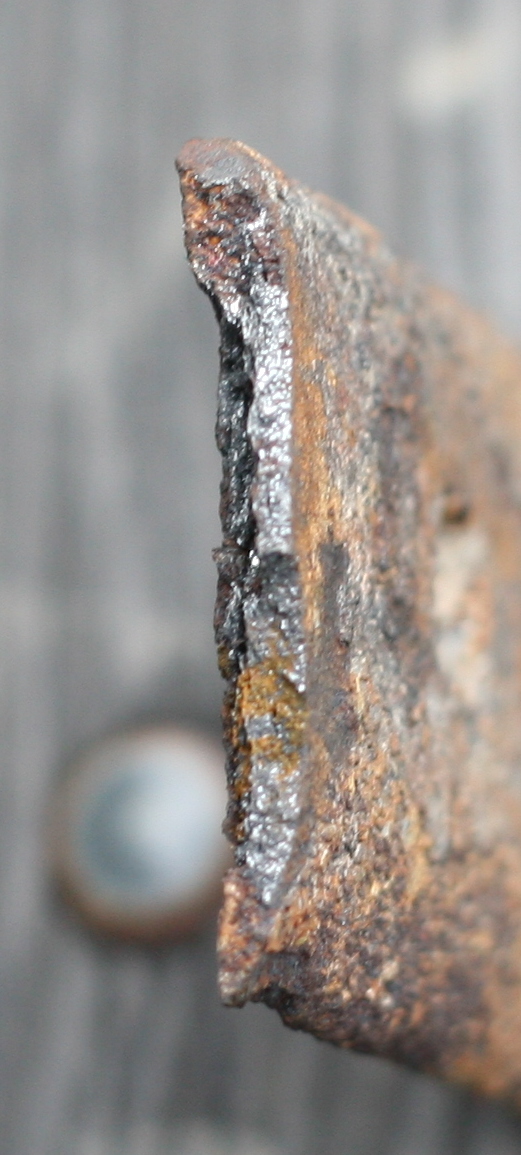
I have finally shot some (unfortunately not so good) photos of the surface of broken wrought iron pieces wich were submitted to long-term heating. Both are old; the thicker piece with the crystals may date to late medieval times or early 17th century. It was part of a punching tool to make holes in a workpiece. The other flat piece is a part of an old wagon wheel, dating at least into the pre-industrial times or before. Both items show pronounced crystal forming caused by repeated heating and slow cooling. This has nothing to do with martensite as both materials do not contain any carbon at all.


-
Sword Photography is hard... (but fun)
ROKUJURO replied to ChrisM's topic in General Nihonto Related Discussion
Then it must be my old eyes! -
Sword Photography is hard... (but fun)
ROKUJURO replied to ChrisM's topic in General Nihonto Related Discussion
It must be difficult to avoid reflections on the blade, but for a good presentation, I think it is crucial. -
George, the KOSHIRAE is the complete mounting of a sword. The KISSAKI is the tip of a blade, and HA or HASAKI is the cutting edge. You will have to learn some vocabulary, it seems that WIKIPEDIA has something for you (https://en.wikipedia.org/wiki/Glossary_of_Japanese_swords), but not all is correct. The hardened part of the edge is YAKIBA, not Yaiba. So you better drink from several different fountains...
-
George, welcome to the NMB! In your first post you wrote .... 'I always wanted a "samurai sword"... I am sure you know that this is probably a good quality sword from WWII (not looking at the damages), but not from the SAMURAI era. Restoring this might cost a little fortune but may result in a very nice blade. Congratulations!
-
Not a single picture of the NAKAGO?
-
This is a very late souvenir item for tourists. Gruesome!
-
Philip, it would have been a good idea to read some books before the purchase to avoid mistakes like this one. The date punched on to the blade (SHOWA 17 = 1942) is a giveaway for very bad fakes.
-
This could well be an authentic blade, "signed" in an attempt to raise interest and value. To say more, we should see more pictures of the blade, but then tip-up!
-
Yes, that seems to be beyond restoration indeed. Don't buy it!
-
Rodriguez, please try again with better (nicely focused) photos!
-
John, an interesting but unfortunately quite corroded TSUBA. I cannot see the bright speckles properly, so no attempt for an analysis here. Concerning your text: ... I am quoting Yoshindo when I say that iron with 1-2% carbon will tend to form large crystals of austenite when subjected to long periods of heating (the longer, the bigger). It is only upon yakiire that these crystals become martensite, forming the iron lumps that we, tsuba collectors, call tekkotsu and sword collectors call nie.... , l will only add that in this statement. YOSHINDO is correct (it applies as well to low-carbon iron), but your assumption is not. I will shoot some sample photos as soon as I am able to, and you will see what he meant. As I wrote in my long comment above, we cannot be sure that martensite particles we find in swords as NIOI or NIE are the same as TEKKOTSU in TSUBA. You are of course right to say that YAKIIRE could possibly be executed on TSUBA as well, but there is no evidence and no good reason for that. A major thought is that to produce martensite effects in a workpiece, you have to make sure that there is sufficient carbon content in the metal. This starts theoretically at 0,22% of carbon content, but you would need about 0,5% C minimum to really see some effect. An item made from raw iron will never produce any martensite irrespective of how often you quench it.
-
Roger, the metric system is something that has to be learned like left/right hand driving, and when you have grown up differently, it may really seem complicated. In all her loooooong life, my mother never learned that the 'old' German pound was omitted and replaced by kilogram. "74 x 71 x 4 cm ( after all these years I still find metrics a bit confusing after being raised on feet and inches )" Your TSUBA probably measures 74 x 71 x 4 mm.
-
James, Kapp/YOSHINDO are correct: 'It's ......produced by selectively filing away sections at the edge of a MASAME pattern steel block when the blank for the sword is being formed'. It cannot be produced by making indentations which you hammer flat again, that will not produce a pattern. This method works only if you file the billet after making the indentations. The whole process is more understandable if you imagine the steel billet as a piece of puff pastry. If you cut this at an angle, you will see the layers. It is no witchwork but mainly experience.
-
Depends on what MURAMASA and the condition.