ROKUJURO
-
Posts
6,875 -
Joined
-
Last visited
-
Days Won
33
Content Type
Profiles
Forums
Events
Store
Downloads
Gallery
Everything posted by ROKUJURO
-
John, iron is not spongy....
-
Dwain, the TSUBA (no plural form in Japanese nouns) looks o.k. but the (modern mass produced) crane is indeed quite ugly. Heating up the TSUBA to ca. 150°C (certainly not above 180°C) in a kitchen stove might be enough to loosen the glue without affecting the TSUBA.
-
....which is why I set "HAMON" in quotation marks.
-
Peter, I have read that swords having been produced for battle - especially in KOTO times - were sharp, but not 'art polished' as we know it today. It seems that the very fine polishes that show all details we can enjoy today came only up in the late EDO JIDAI.
-
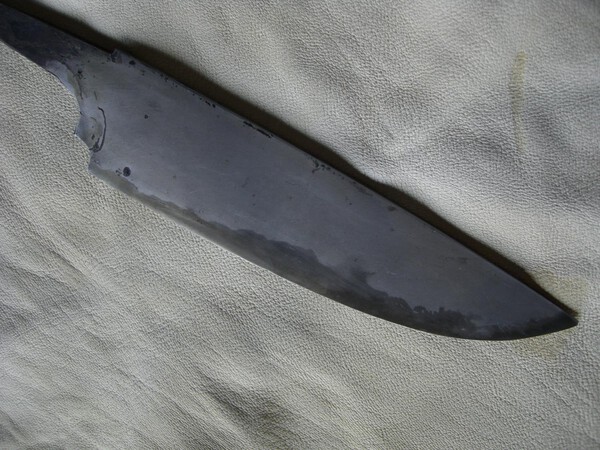
James, you are starting with wrong premises: Not all Japanese sword blades have high carbon KAWAGANE, it depends on the forging technique used. Sharpness is not limited to hard steel, but holding an edge in heavy use is of course better with hardened steel than with low carbon (< 0,22 % C) iron. If you forge a blade with a soft core and insert a high carbon cutting edge steel (like in HONSANMAI, SHIHOZUME, WARIHA TETSU, or SOSHU KITAE), you do not need to make a differential hardening procedure with clay (TSUCHI OKI). The blade will automatically have a hard edge and a softer body and show a similar feature like a HAMON. . A flexible body of a blade is in many cases not the result of the inherent flexibility of the SHINGANE, but of its position between layers of hardened steel. Today, we call this a 'sandwich' type of construction. In the forging of blades, the smith is always aware of the stress his blade will be submitted to. This is why TANTO mostly have a different inner structure than long blades. Thrusting is a different stress to a piece of metal than slashing with a long blade. I attach an image of a SAN MAI blade with a "HAMON" that was not produced by differential hardening.
-
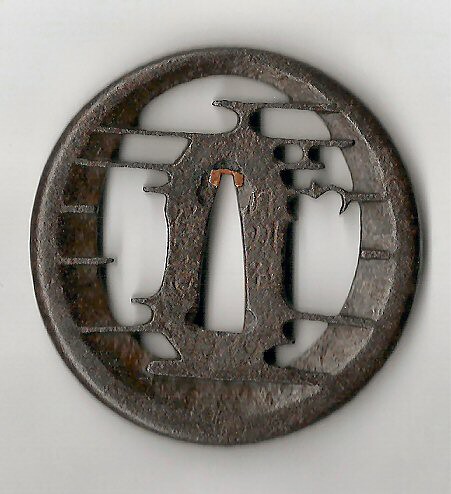
I like this one, probably MYOCHIN,
-
I cannot see a signature or remains of it under the dirt.
-
Phil, the straight blade reminds me of early EDO (KANBUN) JIDAI. I do not think the damaged KISSAKI is beyond repair, but the BOSHI has to be made visible to decide that. And then you have to see if the repair costs surpass the actual market value. Value discussions are always a bit difficult as you have to remember that a smith made that blade a few hundred years ago under very simple conditions. These blades are historical artefacts, but we sell and buy them rather cheaply. Let's assume you have this one completly restored and have paid $ 3.500.- all in all with a fine SHIRA-SAYA, HABAKI and SHINSA. Way too expensive, I hear them shouting! Yes, correct, but have the same blade made by a good GENDAI smith in Japan, not even GASSAN SADATOSHI or YOSHIHARA YOSHINDO! How much will it cost, and then it is not an antique blade, but contemporary. The same with TSUBA: Old TSUBA are in comparison quite cheap although the labour implied is a lot! Many hours of fine work and craftsmanship - no steel cutting saws, no electric drills! - have been invested, and this applies to modern TSUBA as well. How can they be both so cheap? . In the olden times a talented TSUBASHI might have been able to make a good living with his work, but how is it today? I really would like to know how many hours Ford Hallam or one of his pupils work on their TSUBA, and then calculate the hourly wage. I believe most tax consultants would advise them to change profession.... Apologies for my excursion from the subject!
-
Mark, no SEPPA! Both parts fit into one another and 'seal' the KOSHIRAE as you see it in SHIRA-SAYA. AIKUCHI 01.doc AIKUCHI 07.doc
-
Mark, these FUCHI should exactly fit into their respective counterpart on the SAYA, the KOIGUCHI. Typical for AIKUCHI.
-
deeceeg, please sign all posts at least with your first name plus an initial as is requested here. Your TANTO seems to be a very late item (MEIJI or later) made for tourists. They have been made in numbers, so you find them being offered quite often. Photos of the NAKAGO (tang) might reveal if it is possubly an older blade. Signatures on the wood of the TSUKA (handle) are often just the names of the craftsmen who worked on this item.
-
Chris, is it brass, directly from the mine?
-
Sword question, what is it?
ROKUJURO replied to Smee78's topic in General Nihonto Related Discussion
If you look closely at the TSUKA (handle), you will see that the binding technique is wrong (and rather new). This will not hold in actual use in combat, so my guess is that this is a more recent attempt to make money by selling fakes to less knowledgeable collectors and militaria fans. -
Opinions on a sword blade and nakago
ROKUJURO replied to Dean1981's topic in Military Swords of Japan
Chris, I wrote "if it has no HADA" which means 'in case it has no HADA'. Better photos might help to make it visible, but I am not so sure that the 'polish' is a traditional one. To me, it is looking more as if someone tried to enhance the HAMON without using appropriate stones. But that may well be the effect of the images. -
Opinions on a sword blade and nakago
ROKUJURO replied to Dean1981's topic in Military Swords of Japan
We have a saying in Germany that would fit here: PAPER IS PATIENT. As long as this is not a SHINSA ORIGAMI it it just an opinion of a seller. What is indeed interesting in this blade is the rather nicely chiselled TACHI MEI which is consistent with HIZEN. On the other hand if it has no HADA it is way too expensive in my opinion. But I am not a military guy so I may be wrong. -
Ken, to my knowledge, SHINAE are not forging flaws but stress cracks from bending.
-
The MARU MIMI may also be considered as typical for AKASAKA.
-
Interesting Mikasa Dirk w/Hotstamp
ROKUJURO replied to Bruce Pennington's topic in General Nihonto Related Discussion
A quite nostalgic fashion which is still used today just for the sake of sales ( https://www.boker.de/leopard-damast-i-110084dam?c=5323; https://www.boker.de/tirpitz-damast-110190dam?c=5326). The special steel for guns has only low carbon content and has to be combined with other carbon-loaded steel for blade-making. -
From a technical point of view, only a thick cover of a soft wax will offer some protection against oxygen attack. A thin layer (depending on the kind of wax) will not seal the surface of an iron TSUBA tightly enough for a longer period of time because of the molecular structure of most waxes. Wax will not clean the surface from rust! If warmed or heated, it penetrates into the rust layer, giving it a darker appearance. This may help indeed, as mentioned above, to give the TSUBA a superficial "for sale" appearance, but it will not improve the chemical situation (oxidation). In addition, it may give the TSUBA surface an unnatural shine. Under the best of conditions, an ideal wax (they do not have a common formula) may slow down rust formation. Another reason to avoid wax as conservant is the fact that it may enter into the smaller structures of the TSUBA's surface and decoration, thus disguising the fine details. In my experience, careful rust removal and a good natural patina are the best protection, followed by very little oil from time to time in cases when iron TSUBA are exposed to moisture.
-
Making a sword stand...thoughts?
ROKUJURO replied to OnTime2Day's topic in General Nihonto Related Discussion
Ryan, the wood is the easy part. Finding a small pair of fitting antlers with just the right number and width of the prongs might be another task. Maybe look for SIKA deer. -
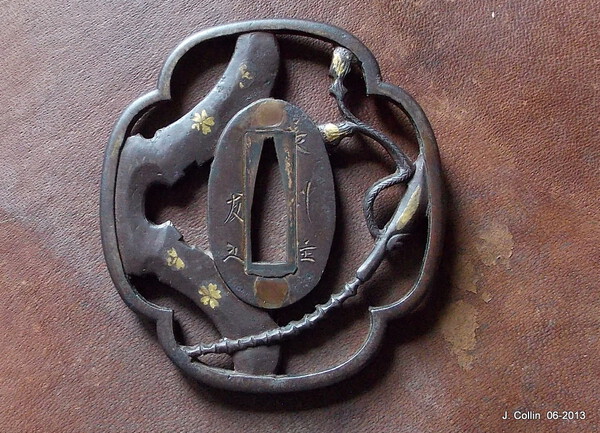
I had shown this before. It was probably used as keyhole cover at one time of its life.
-
Looks more like a TAGANE mark to my eyes.
-
There was a tendency in SHIN SHINTO times to copy old blades. While mostly KOTO blades were used as template, perhaps yours was made looking at a classic KANBUN sample? Or the new owner wanted it exactly like that? Swords were probably not made for stockage but on request only.
-
Perhaps OTSUKI MITSU X?