ROKUJURO
-
Posts
7,007 -
Joined
-
Last visited
-
Days Won
38
Content Type
Profiles
Forums
Events
Store
Downloads
Gallery
Everything posted by ROKUJURO
-
Ken, to my knowledge, SHINAE are not forging flaws but stress cracks from bending.
-
The MARU MIMI may also be considered as typical for AKASAKA.
-
Interesting Mikasa Dirk w/Hotstamp
ROKUJURO replied to Bruce Pennington's topic in General Nihonto Related Discussion
A quite nostalgic fashion which is still used today just for the sake of sales ( https://www.boker.de/leopard-damast-i-110084dam?c=5323; https://www.boker.de/tirpitz-damast-110190dam?c=5326). The special steel for guns has only low carbon content and has to be combined with other carbon-loaded steel for blade-making. -
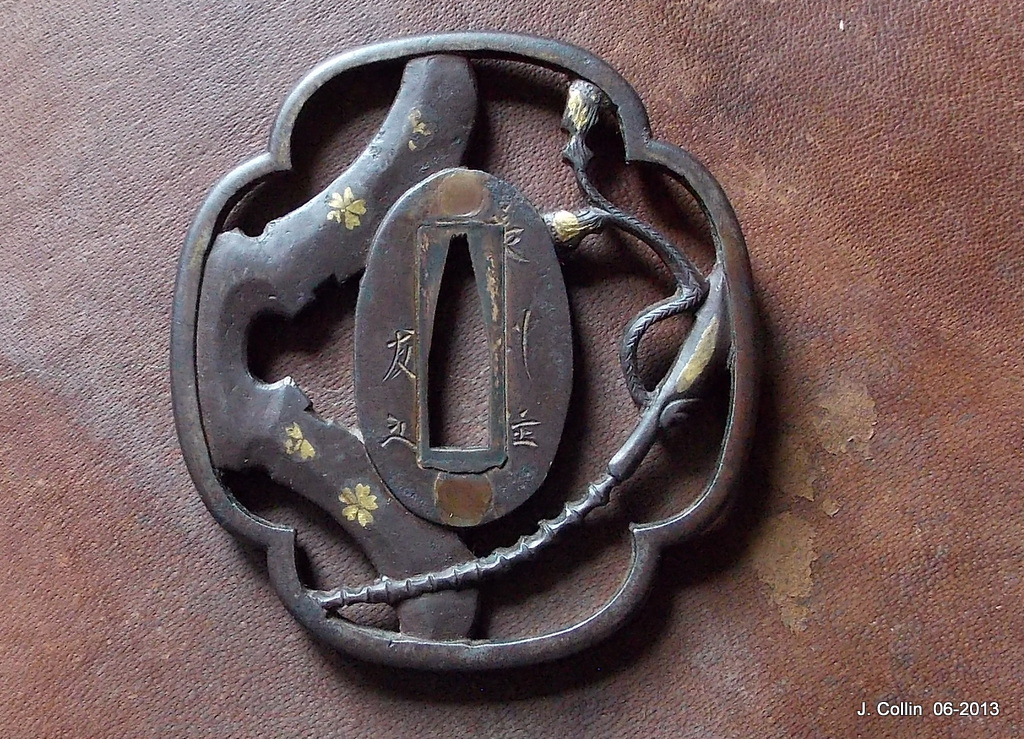
From a technical point of view, only a thick cover of a soft wax will offer some protection against oxygen attack. A thin layer (depending on the kind of wax) will not seal the surface of an iron TSUBA tightly enough for a longer period of time because of the molecular structure of most waxes. Wax will not clean the surface from rust! If warmed or heated, it penetrates into the rust layer, giving it a darker appearance. This may help indeed, as mentioned above, to give the TSUBA a superficial "for sale" appearance, but it will not improve the chemical situation (oxidation). In addition, it may give the TSUBA surface an unnatural shine. Under the best of conditions, an ideal wax (they do not have a common formula) may slow down rust formation. Another reason to avoid wax as conservant is the fact that it may enter into the smaller structures of the TSUBA's surface and decoration, thus disguising the fine details. In my experience, careful rust removal and a good natural patina are the best protection, followed by very little oil from time to time in cases when iron TSUBA are exposed to moisture.
-
Making a sword stand...thoughts?
ROKUJURO replied to OnTime2Day's topic in General Nihonto Related Discussion
Ryan, the wood is the easy part. Finding a small pair of fitting antlers with just the right number and width of the prongs might be another task. Maybe look for SIKA deer. -
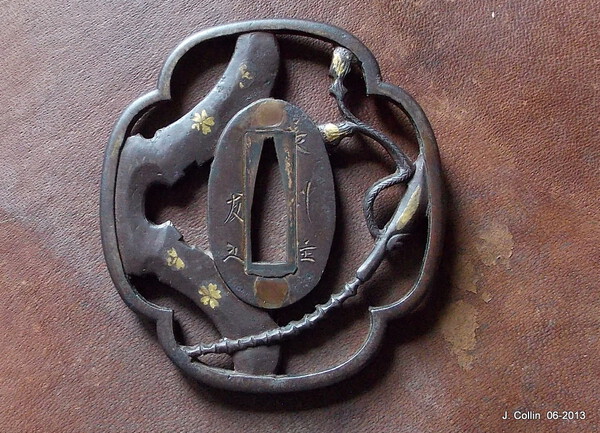
I had shown this before. It was probably used as keyhole cover at one time of its life.
-
Looks more like a TAGANE mark to my eyes.
-
There was a tendency in SHIN SHINTO times to copy old blades. While mostly KOTO blades were used as template, perhaps yours was made looking at a classic KANBUN sample? Or the new owner wanted it exactly like that? Swords were probably not made for stockage but on request only.
-
Perhaps OTSUKI MITSU X?
-
Yoshimichi Wakizashi
ROKUJURO replied to Vermithrax16's topic in Auctions and Online Sales or Sellers
It is advertised as KATANA but indeed it is a WAKIZASHI. -
Information in the research of two swords that I have recently purchased.
ROKUJURO replied to CaptainMac's topic in Nihonto
Really? I thought they would take longer to make one. -
Need help translating mei and date
ROKUJURO replied to Utopianarian's topic in Translation Assistance
No, but NAO is possible. -
Making a sword stand...thoughts?
ROKUJURO replied to OnTime2Day's topic in General Nihonto Related Discussion
Dave, in Japan, swords are generally not displayed. For special occasions or in museums, KOSHIRAE (with TSUNAGI) are temporarily displayed while the blade often rests in its SHIRA-SAYA. Naked blades as shown above can only be admired in shops or museums. -
Making a sword stand...thoughts?
ROKUJURO replied to OnTime2Day's topic in General Nihonto Related Discussion
Ryan, I am not sure if antler is the better material, but if you choose to use this, make sure that the swords are supported by the SAYA and not by the TSUKA! -
mh2324, please sign all posts with your first name plus an initial as is requested here. The mounting you describe is a SHIRA SAYA. It is used when the blade is not in action, and it protects it from moisture/air. Swords are traditionally stored horizontally in a drawer of a TANSU (chest).
-
Thank you, MORIYAMA-SAN I would never have guessed that! Non-Japanese are helpless in most cases!
-
Luis, I have also some problems with the second KANJI. The first is MASA, second could probably be -NARI or SHIGE (like in HATTORI HANZO).
-
https://www.youtube.com/watch?v=gur6F2tszvE Lecture by Markus Sesko
-
- 6
-

-
Help with Translation of Good Luck Flag Mei
ROKUJURO replied to ChuckJ's topic in General Nihonto Related Discussion
Chuck, perhaps try in the translation section. -
Dan, this is indeed a TSUBA in NANBAN style (thousand monkeys theme), but as you can see by yourself, its execution is quite crude and lacks any details which were probably visible in the original. It is a cast copy with no value for collectors.
-
How available was tamahagane?
ROKUJURO replied to Ken-Hawaii's topic in General Nihonto Related Discussion
Simple answer: It was enough to make all the swords and armour of that period plus all the iron items needed in those times! As the Japanese have always been amazing craftsmen, especially in wood, they could build houses, temples, bridges a.s.o. almost without nails or other iron parts. It is possible that they developed these techniques because iron was rare, but the maritime climate may also have played a role. -
How available was tamahagane?
ROKUJURO replied to Ken-Hawaii's topic in General Nihonto Related Discussion
This is an interesting subject. First, I will answer Austus who wrote: ....'does all Japanese iron sand qualify as tamahagane?'... No, iron sand is SATETSU (magnetite), a kind of iron ore. TAMAHAGANE (raw iron of varying purity) can be produced by direct reduction in a bloomery kiln using this ore. Different composition of the ore does not necessarily mean a different composition of the iron/steel, which will be explained later. Ken, I did not read the complete KOSHIBA paper, but they are talking about HSS (high speed steel), an alloy. ...The standard composite elements accepted in the test were: C: 0.8; Cr: 4; V: 20; Mo: 1; V: 2 %. An effort was made to seek the effect of each of these elements by changing its content. At the same time, an experiment was conducted as to similar steel containing 5-25 per cent Cobalt..... If I understood correctly, the factory researched and used SATETSU as the main Japanese source of iron ore (but for their ongoing production they probably use other sources). However, there is a lot of difference between the iron (TAMAHAGANE) coming out of the TATARA and the iron produced in an electric kiln by complete melting. This latter method results in a higher content of accompanying elements in the iron. The TATARA process on the other side will work below the melting temperature of iron (1.538°C), so that no alloying elements present in the ore will be reduced and later found in the TAMAHAGANE. As with all modern steel production, a high efficiency factor is important for the industry. While a bloomery kiln yields roughly about 30% of iron (in relation to the percentage of iron in the ore which is calculated as 100%), a modern blast furnace turns out up to 95% because of the complete melting. The fact that the slag coming out of a bloomery kiln still contains up to 50% of iron, was used by late medieval iron makers, when they re-used the large amounts of slag left over from Celtic iron production. One has to differentiate between the composition of the ore and that of the TAMAHAGANE, which is relatively pure: Average content in Tamahagane: Carbon: 1.33; Silica: 0.03; Manganese: 0.04; Phosphorus: 0014; Sulphur: 0.006; Chromium: 0.05, and only traces of Nickel and Copper. It has to be said that the composition of TAMAHAGANE varies considerably even within one single TATARA process. There will be some iron with very low carbon content as well as (non-forgeable) cast iron (found near the blast holes) with a very high percentage of carbon, and a lot of steel with varying amounts of C. All these different qualities of TAMAHAGANE can be used by the swordsmith, even the cast iron. This latter will be made useable by the OROSHIGANE process. The reason why modern TOSHO are in constant search for antique iron (old nails, anchor chains, water kettles, old agricultural tools a.s.o.) has nothing to do with nostalgic notions, but with the purity of the old iron which was produced by pre-industrial processes (TATARA). Modern steels are made with the addition of scrap iron into the furnace, and this always contains a wide range of (unwanted) alloying elements. These make the steel properties unpredictable for the TOSHO (not for the industry as they can make analyses for every batch of iron). I will go back to your question about how large amounts of steel could have been produced in Japan's past. I do not know exactly about the situation there, but I presume that it did not differ much from Europe, although it occurred much later. In Celtic times (800 to 45 B.C.) the iron production was so high that it changed the landscape! Wide areas were completely cleared of trees because so much wood was needed to make charcoal. There was much less forest than today! In the beginning of the iron age, ore was not mined but gathered from the surface. Where there was a lot of ore in one place, big holes were dug which we can still see today! The bloomery kilns produced so much slag that hills of it were formed. As mentioned above, these slag deposits were exploited in later times when blast furnaces came up. It is probably safe to say that in Japan a comparable, non-centralized iron production similar to Europe took place besides that of the swordsmiths. In areas with iron ore, numerous small ironworks were installed especially along rivers. Transports (wood, charcoal and ore) were easier on the waterways, and they also served as energy sources to propel bellows and power hammers. From Celtic to medieval times, iron was available mainly as ingots, so every smith had to form his stock material by himself. Although I have no safe knowledge of the situation in Japan, I hope that my speculation can shed some light into the past! -
The photo is bad, and my eyesight is not good, but it looks like KUNISADA to me. Trying to look like INOUE SHINKAI?
-
How available was tamahagane?
ROKUJURO replied to Ken-Hawaii's topic in General Nihonto Related Discussion
Chris, the use of Indian or Persian crucible steel in Ulfberth swordblades is just an assumption without proof. Prof. J. D. Verhoeven found that these steels have a typical content of Vanadium and Molybdenum carbides up to 0,3 %, which are not found in European blades. So it is more likely that the Frankish smiths found their own way of forging highly raffinated carbon steel without a pattern. This has of course not much to do with Ken's initial question so I apologize. On the other hand this could demonstrate that the development of better techniques lead to better (= more homogenous) steel in both cultures, and the much bigger TATARA in early EDO, managed by teams of specialized workers, could produce larger amounts of iron with constant composition. But we should not forget that TAMAHAGANE, although low in phosphorous and sulphur, had a considerable content of slag which the smith could not eliminate except with hard work. The minimal impurities in the raw steel are not a big problem and do not influence the properties very much. Carbon distribution and slag elimination are the main tasks in traditional Japanese blade forging when using TAMAHAGANE. Just a side information: Collegues of mine have gathered black iron sand on the shores of the Baltic sea and have successfully produced a lump of usable iron from it in a bloomery kiln.