ROKUJURO
-
Posts
6,870 -
Joined
-
Last visited
-
Days Won
33
Content Type
Profiles
Forums
Events
Store
Downloads
Gallery
Everything posted by ROKUJURO
-
I have problems to believe that. A good polish will immediately reveal if there is HADA, a HAMON and HATARAKI typically seen in water-quenched blades made with TAMAHAGANE. And if you have all that, it is a traditionally made GENDAITO in my understanding.
-
Well, I cannot see a good reason to chisel the name of a famous smith into the NAKAGO of an obviously machine-made blade in war times. I also cannot think of a criminal intent to deceive potential buyers some 70 years later, but perhaps the first wearer of such a blade wanted a famous name as symbol for a sword he had at home (but did not want to take to war).
-
I am not in this subject and would like to know what is meant by GIMEI SHOWA blades. Have false signatures been applied to blades at the time of their production in the factory? Did MUMEI SHOWA-TO (?) receive a wrong signature later in their lives to deceive? Or are you speaking of recent non-Japanese production to satisfy the buying power of a militaria market?
-
Ancient Japanese Writing - Old Scroll #4
ROKUJURO replied to Marino F's topic in Translation Assistance
Probably not an "old" scroll. Looks like a very late (painting or) print in my eyes. -
tsuba Any information about this piece is welcome.Thank you.
ROKUJURO replied to roger dundas's topic in Tosogu
Roger, concerning your TSUBA, I am not sure about the way it was made. In some places it looks as if it was cast and decorated later. I hope you did not pay much. -
Tell us about your name: Please sign all posts at least with your first name plus an initial as is requested here.
-
Neil, what we see as HADA are the weldings seams of the steel, not remains of slag. But you are correct if you meant KIZU like FUKURE. These are pockets in the steel billet which can contain slag (mostly iron oxide) or carbon.
-
Interesting indeed, but I am a little in doubt if this is really Japanese.
-
Austus, The TATARA process yields a relatively pure steel with differing contents of carbon in different parts of the big KERA (Steel block) It is not homogeneous, but contains only very small amounts of impurities and no alloying elements. The patterns of the JIGANE are achieved by the forging process alone and have nothing to do with 'impurities'. What you call 'inefficient method' has to be seen in the light of the respective era. There was no 'better' method available in pre-industrial times, and this is the same wordwide. Steel production today is of course much more efficient (TATARA about 35%, modern blast furnaces up to 95%), but the resulting steel is not nearly as pure as TAMAHAGANE in respect to alloying metal content. This modern steel would not be usable for the traditional YAKIIRE quenching in water.and thus not look like a NIHONTO as we know it.
-
Not smashed up tea pots, but old cast iron water kettles (TETSUBIN) and similar. These were originally made using traditionally produced TAMAHAGANE, and they are a good means to introduce carbon into the OROSHIGANE.
-
Stylized gourds?
-
Bruce, I have always wondered where the HONJO MASAMUNE might be. Now I see that you store it with the other swords back lefthand!
-
Of course it is ridiculous, but good marketing. What could you do better when trying to sell a bad KATANA copy with unpleasing SUGATA and wrongly applied TSUKA-ITO?
-
After what we see here, it seems that WASHIDA are a lot finer and more detailed than the average HEIANJO TSUBA. The workmanship shows a much higher level. Very nice! The one offered by SEIYUDO reminds me a bit of UMETADA MYOJU.
-
You have to go back in history to explain this. Early European knives (starting with Celtic times 800 B.C. up to the pre-industrial period mid to end 1800) for the broader public have often been made by blacksmiths with no special experience and knowledge about steel metallurgy. They used the material that was available to them, and often their steel was of inferior quality compared to the material that was used by specialized blade and sword smiths. Heat treatment was basically known but was partly obscured by mythology and was not a well researched science as it is today. These 'normal' household and workshop knives (and this includes all cutting tools for crafts) had to been sharpened on a daily basis, depending of course on the use. This led to knife constructions with very thick blades to ensure a long life. The HOLTMANN dissertation (a technical survey on about 1.300 early medieval knives) showed that the back (MUNE) of most average household knives had about 8 mm thickness! In the same period, sword and specialized knife smiths had better refined material and more sophisticated methods of forging and heat treatment, leading to better quality and performance. Their forges were often related to wealthy noblemen who supported them financially. Stefan Mäder has done his famous research on early medieval Alamannic sword blades ( http://www.schwertbruecken.de/english/starte.htm). He was able to show how close European smiths were some five centuries earlier to the basic Japanese forging techniques. The heat treatment of steel was known in principle, but it was kept secret by smiths. In pre-industrial times in Europe, this was mostly a thing of trial and error, and as a poor foot soldier (or ASHIGARU) you could find yourself on a battlefield with a simple (and cheaper) sword that was likely to bend or to break. I think this situation was not much different in Japan and Europe. When we are talking here about Japanese sword making methods, we often leave out background knowledge that is essential to understanding what is going on in the steel. Let me cite a phrase from Mark H. (post #33): ...Lamination creates a composite material. Composites allow you to combine materials, to make the most of each respective material, rather than accepting a compromise between the two.... What does that mean? What is lamination? Just to explain this a bit to those interested, lamination does not mean the production of one of the steel components of a blade by repeated folding and fire-welding. In this process, we have as a result very thin layers of steel with homogenous carbon distribution, bonded very firmly. The thinner the steel layers and the higher the temperature, the faster the carbon migration will be. This material is very close to modern mono-steel. The carbon level in this material can be controlled by the number of folds (and welds) and by the time and temperature to which the steel is exposed to heat. Lamination (in the context with traditional cutting tool forging) means the combination of steels with different carbon content to a physical unit. Carbon distribution between these steel alloy layers is not intended, and only then the desired performance is achieved. Less experienced smiths who work too slowly (who have no helpers), too hot, or who do not work according to the requirements of the material, will not achieve the optimuml performance of the sword. This is just a small part of the craft background (not even metallurgy), and in olden times, the 'battle test' was the proof for good (or bad) quality of a blade. In times of no life insurance, you would have to trust the abilities of your swordsmith!
-
Jesse, you can sign all posts in your profile (Jesse R. would be your signature). Your photos are horrible. Try to understand how they should be to make an assessment posssible for us. Take photos always tip up; if they are blurred or not well focused, they don't help. The last photos seem to show a MINO blade with SANBONSUGI HAMON. Age is not so important. A blade from 1850 might be much better (and have a higher value) than an inferior one from 1550. Condition is important, so never touch a blade with your bare hands or fingers!
-
Mark, until quite recently, YAKIMODOSHI was rarely mentioned in the literature. As far as I know, most swordsmiths will perform the annealing right after the quenching which is technically very reasonable. While we in Western countries use annealing furnaces with computer controlled temperature or a separate gas flame (that is how I do it), the Japanese swordsmith does this in his forge. Temperature control - I have difficulties calling that so - is done by watching water drops falling on the blade. A 'seasoned' smith knows from experience how fast these have to evaporate to guess the actual temperature. This is much more difficult than the YAKIIRE where the radiant heat colour gives you a good indication to the temperature.
-
Yes, Michael, I understand, but this may be difficult indeed as it was probably factory made in numbers. I think it is more a memory medal gifted by TOBARI SHIRO to emplöyees and not meant to be mounted on a sword. Age is not of great importance in Japanese arts, but artistic quality, uniqueness, good workmanship and condition are. You can add your name to your profile, so you need not add it to every post.
-
Mark, 45 HRC on the edge of a finished sword blade would not be enough. A very cheap modern kitchen knife is expected to have around 50 HRC. As far as I know, carbon contents of the different steel components vary quite a bit, but are usually within reasonable and useful dimensions. That is about 0.7 to 0.8 in the YAKIBA, ca. 0.3-0.4 in the SHINGANE. Quenching and tempering of Japanese sword blades (YAKIIRE and YAKIMODOSHI) follow the requirements of low alloy carbon steel as in the rest of the world, e.g. quenching at about 800°C, annealing at about 200°C. These temperatures are not technically controlled but estimated by the experienced smith, following the colours. From time to time I find research results about this subject. See attachments mechanical-properties-of-samurai-swords-carbon-steel-made-using-atraditional-steelmaking-technology-tatara-2169-0022-1000162.pdf Material and manufacturing of blade steel (1).doc
-
Mikeyman, please sign all posts at least with your first name plus an initial, so we may address you politely. You know probably that this item is not a collectible TSUBA from the SAMURAI era?
-
John, iron is not spongy....
-
Dwain, the TSUBA (no plural form in Japanese nouns) looks o.k. but the (modern mass produced) crane is indeed quite ugly. Heating up the TSUBA to ca. 150°C (certainly not above 180°C) in a kitchen stove might be enough to loosen the glue without affecting the TSUBA.
-
....which is why I set "HAMON" in quotation marks.
-
Peter, I have read that swords having been produced for battle - especially in KOTO times - were sharp, but not 'art polished' as we know it today. It seems that the very fine polishes that show all details we can enjoy today came only up in the late EDO JIDAI.
-
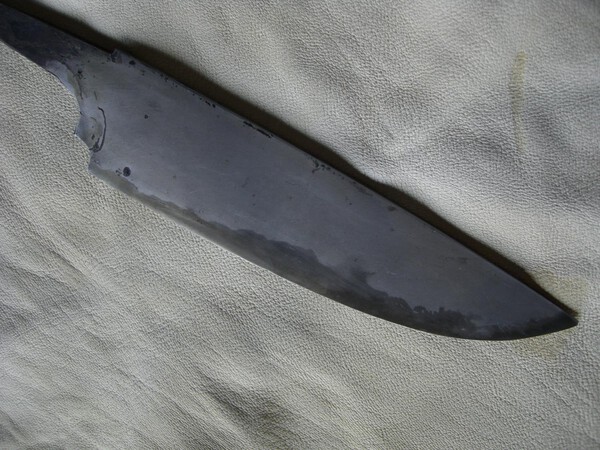
James, you are starting with wrong premises: Not all Japanese sword blades have high carbon KAWAGANE, it depends on the forging technique used. Sharpness is not limited to hard steel, but holding an edge in heavy use is of course better with hardened steel than with low carbon (< 0,22 % C) iron. If you forge a blade with a soft core and insert a high carbon cutting edge steel (like in HONSANMAI, SHIHOZUME, WARIHA TETSU, or SOSHU KITAE), you do not need to make a differential hardening procedure with clay (TSUCHI OKI). The blade will automatically have a hard edge and a softer body and show a similar feature like a HAMON. . A flexible body of a blade is in many cases not the result of the inherent flexibility of the SHINGANE, but of its position between layers of hardened steel. Today, we call this a 'sandwich' type of construction. In the forging of blades, the smith is always aware of the stress his blade will be submitted to. This is why TANTO mostly have a different inner structure than long blades. Thrusting is a different stress to a piece of metal than slashing with a long blade. I attach an image of a SAN MAI blade with a "HAMON" that was not produced by differential hardening.