ROKUJURO
-
Posts
6,854 -
Joined
-
Last visited
-
Days Won
33
Content Type
Profiles
Forums
Events
Store
Downloads
Gallery
Everything posted by ROKUJURO
-
Peter, I overlooked something: I is not a pine tree that is depicted but a stylized cherry tree (SAKURA).
-
An early Tadamitsu can't make out the rest?
ROKUJURO replied to Tom Darling's topic in Translation Assistance
Well, in fact I was quite off the mark..... -
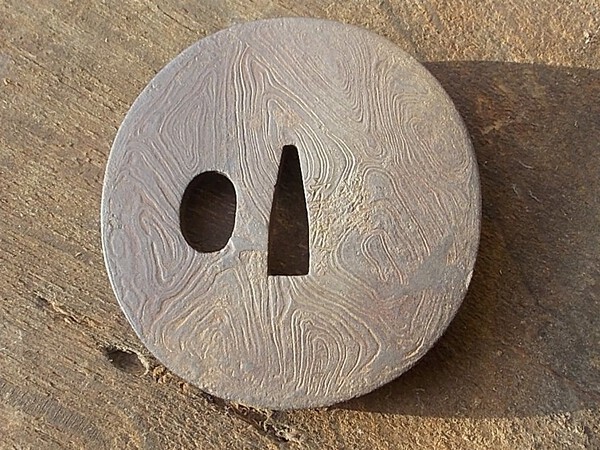
I like them also. Unfortunately, the MEI of mine is not legible.
-
Nice tsuba on Yahoo auction
ROKUJURO replied to Surfson's topic in Auctions and Online Sales or Sellers
It is a really nice one. I had seen it standing at 2.5 K, Probably not a MATASHICHI as I suspect those to go considerably higher. -
Robin, a steel wire brush doesn't cause wear on a TSUBA. It causes damage. Would you clean your REMBRANDT paintings at home with a chemical thinner?
-
Peter, the age is difficult to determine, motive is certainly HIGO-ish as José says. From the pictures it looks as if the TSUBA was quite corroded at one time in its life, and then treated with a steel wire brush. That treatment erased most of the original work traces.
-
An early Tadamitsu can't make out the rest?
ROKUJURO replied to Tom Darling's topic in Translation Assistance
Thankfully, MORIYAMA-SAN has provided the second date, which could mean that the blade is an UTSUSHI-MONO of a middle MUROMACHI TADAMITSU blade. Might be interesting to see the whole blade in case you have pictures. -
An early Tadamitsu can't make out the rest?
ROKUJURO replied to Tom Darling's topic in Translation Assistance
Tom, BIZEN OSAFUNE TADAMITSU: it looks like ANSEI period (1854), so SHIN-SHINTO. Four MEKUGI-ANA (no plural in Japanese nouns!) is quite special for such a "young" blade. -
KH195, what is your name please? Signing TANTO is sometimes different because of the limited space on the NAKAGO. Generally said: The shape of your TANTO is consistent with some late KOTO blades, while the MEI with the special YASU character is not the same as the OEI BIZEN SHODAI used. Have a look: http://www.militaria.co.za/nmb/topic/4042-help-with-mei-bishu-ju-yasumitsu/ and https://www.aoijapan.net/dai-sho-bishu-osafune-yasumitsunoushu-seki-kaneie-not-gurantee
-
There is still another method in faking which is used where the technical methods like X-rays are not available. Grave robbers often find large amounts of antique ceramic shards they cannot use for sale. These shards are ground down to produce grog. This is mixed with clay to manufacture copies of antique items which are difficult to be identified as such. It is said that even many museum pieces of seemingly Aztec and Inca provenience have been faked this way. When scientifically tested, these ceramic items do not provide clear results as fakes, so they are often thought to be authentic.
-
On older ceramic items, you will generally find traces of use which are visible under magnification. Especially the inner bottom and the footring can show these fine scratches and abrasion. However, I own a small Chinese bowl from the SONG period that is like new. Together with hundreds of other ceramic items, it was found in a ship wreck and survived on the bottom of the Southern Chinese Sea for about 600 years. So, depending on the circumstances, some older ceramic pieces can be found in very good condition or even unused. In these cases, TL might be a way to verify the age. On the other hand, if you like the bowl, age is not that important.
-
Interesting TSUBA! I don't know about the design, but I don't think it is a TOSHO.
-
You can find European characters on NANBAN TSUBA as decoration as the artists usually did not speak any of the European languages.
-
Were these books a good deal?
ROKUJURO replied to Jason N's topic in General Nihonto Related Discussion
https://en.wikipedia.org/wiki/Hagakure -
Chris, a hint to the possible age of your sword can be found in the thickness difference between the blade and the NAKAGO, well identifiable in one of your photos. Older blades often have lost more material from polishing. This is a general thing and as so often, may see exceptions. But this may narrow down the age discussion a bit. My guess is that the blade is not older than early EDO, so together with the SUGATA, KANBUN seems to be reasonable.
-
It is obviously not the coarse clay used by IGA, SHIGARAKI, or MASHIKO, but a fine throwing clay. The ash glaze (not copper) was fired in reduction and came out as a SEIJI (or Celadon) tone. May I add that a crack is always an issue as long as it has not been closed. Cracks are either an "intrinsic" problem of the bowl caused by different shrinkage between glaze and body. That can lead to a crackled glaze, but can also be the cause of a bigger accidental crack when the bowl was knocked against something hard. But of course hitting a stoneware bowl hard enough can lead to a bigger crack as well. You never know the story of a bowl! In any case it can be repaired, but it is not the KINTSUGI decoration alone that is important. Low viscosity URUSHI has to go into the tiny gaps and fix the parts of the ceramic object, preventing them from moving.
-
Asking for help with Wakizashi papers & Shirasaya
ROKUJURO replied to sz_waldmann's topic in Translation Assistance
KOGATANA seems to be signed MITSURO (?) KANEUJI -
The steel does not look like HIGO, and the execution is less carefully made in comparison to HIGO I think. Maybe someone from SHOAMI used this common HIGO motive.
-
Made January 1942 (SHOWA JU SHICHI NEN SHOGATSU) Thank you Steve!
-
Joe, it is difficult to tell the age without seeing your blade in hand. The non-traditional polish did not bring out the HADA - at least I can't see it in the photos. The SORI is significant and could point to an earlier blade, but the MEKUGI-ANA seems to be drilled, not punched. The NAKAGO shows some age and related corrosion, but the YASURI-ME is still visible. If we had the signature of a noted smith, it would obviously be easy, but with these few facts, I would guess that you have an early EDO blade. But please consider that age has nothing to do with quality or market value. As the smith seems to be less known, there is a good chance that the signature is authentic. On the other hand, I don't know if your "renovator" might have changed some features while repairing the KISSAKI, so this might make identification and evaluation more difficult. As I wrote, take some good photos of the NAKAGO (showing the tip always up!) and go to the TRANSLATION section. Maybe our Japanese members could tell more.
-
Joe, someone who 'refurbishes' KATANA should be able to read signatures and define style, school and maker even without MEI. From the photos I do not have the impression of a traditional Japanese polish. I am sure one of our experts here can read the province (which might be HIZEN or BIZEN). Please try again in the TRANSLATION section. Is there a date on the other side of the NAKAGO?
-
Chris, you had probably the peasant population of OKINAWA in mind and thought of KAMA, TONFA, NUNCHAKU and other arms which were derived from farm tools. NINJA (no plural form in Japanese nouns) were a secret society, and very little is known about their inner organisation and their arms, and that is not un-typical for secret societies. It is only recently (< 50 years or so in my observation) that people seem to become interested in NINJA, probably triggered by (non-Japanese) movies. Suddenly there are schools that train wannabe-NINJA, and they have even teacher who consider themselves to be in the genetic line of these former assassins/agents. Quite amazing!
-
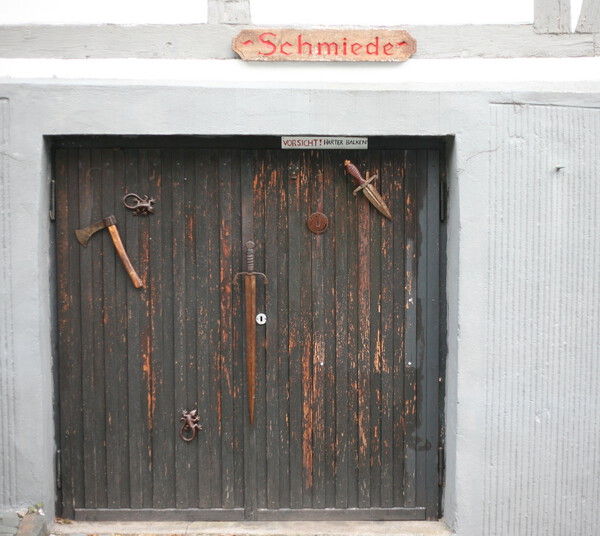
Well, as a blade-smith I am allowed to possess 'dangerous' things that are forbidden for normal citizen. I have a few of these items in my personal collection/museum and on display, but of course mostly legal ones!
-
Chris, I can make them, own and display them, but we are not allowed to carry or use them outside the house, as far as I understand § 42 WaffGes.
-
I would be interested too, to see an authentic and old SHURIKEN. Even the Japanese NINJA museums seem to have only modern copies/items, and these are quite small.