
Leaderboard


Popular Content
Showing content with the highest reputation on 06/12/2026 in all areas
-
Hi nihonto community. Even though the USPS office of the inspector general is still looking for the Sanjo Chikamura blade, it still hasn’t been found. I have my fingers crossed that eventually it will be found and will find its way back to me! I do want to mention that Nicholas Benson has been a real gentleman throughout this whole process and we have come to a mutually acceptable agreement. As such, I am happy to continue to be one of his customers and have recently bought some juyo blades from him!5 points
-
Am I posting too many tsubas to talk about? Should I have put this in the auction section? I'm not planning to bid, I just want to talk about the Tsuba. I haven't seen a Tsuba colored like this one before, I imagine it's uncommon but not unheard of? Very striking design. Almost feels like a halloween theme with the bat and the halloween orange/black jelly bean coloration. It's being auctioned (in about ten minutes) in Vienna at Galarie Zacke. I'll reply later with what it sells for. Auction text below. https://www.liveauctioneers.com/item/232258999_tenkodo-hidekuni-a-fine-and-rare-suaka-and-shibuichi-bats-at-dusk-and-dawn-tsuba-vienna-vienna3 points
-
That is pretty much what I was saying. It is a nice tsuba. Very nice. If it were not so spuriously signed, I would place a bid. I'm after something much bigger and should behave, but kawaii little shakudo works like this are tempting.3 points
-
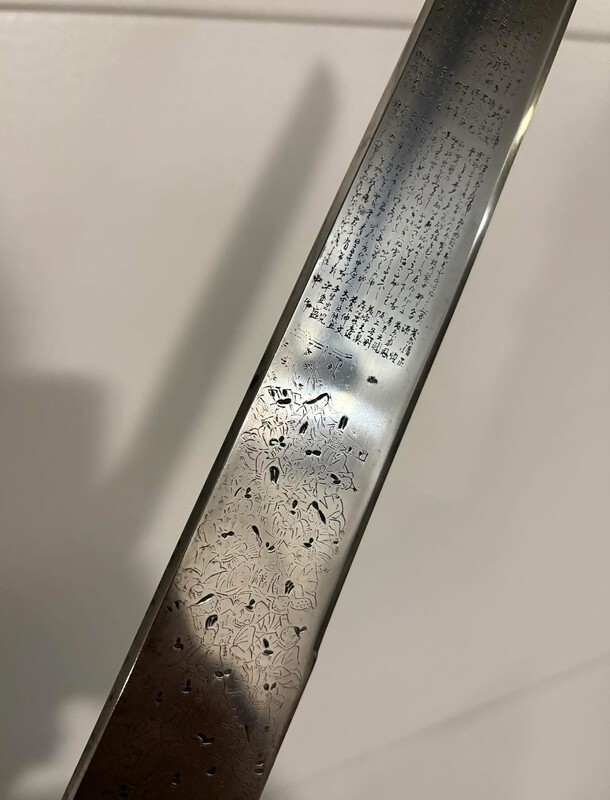
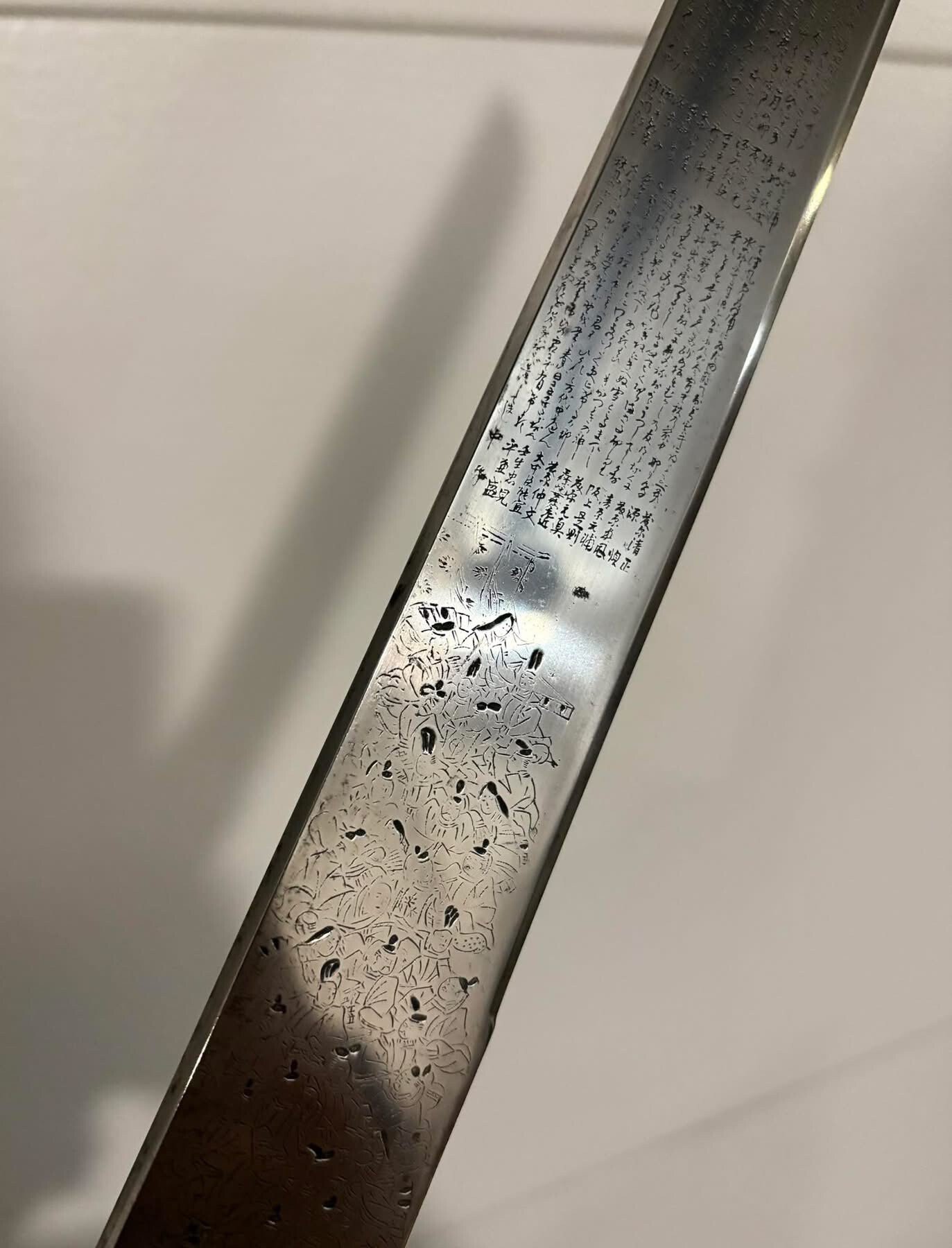
The Showa smith Kanenaga was known for making Tanto with similar extensive script Horimono.3 points
-
Largely what Tim said. This is a very core list of the good books for the hard core collector. I was looking at a fitting recently trying to kantei it to a specific maker, though it is mumei. There is one 99.95% authoritative book in this area, and it took me about 15 years to buy a copy. I may only use the book 1 or 2 times per year, but it is the binary [yes/no] book to have for kantei in that particular area. That is all I will say for now. After about 30 years, I've been able to narrow it down to about 20 books. 10 of those books are"must have or stay ignorant" tomes of knowledge.3 points
-
Curran's approach is the same as what I was taught about sword kantei - look at the sugata, jigane and yakite - What does that tell you about time period, smith tradition and maybe swordsmith?. THEN look at the mei and see if it fits. Many of the Japanese books about swords and kodogu are limited publication or privately published, so very little of that knowledge has been scanned into online digital records. So yes, reference books are still required. For signatures, here are a few standards. Probably the most recent and exhaustive in English, but no images of actual mei. I believe it came with searchable files in .pdf format. https://japaneseswordbooksandtsuba.com/store/book/fittings-books/b760-the-index-of-Japanese-sword-fittings-and-associated-artists-by-robert-haynes/ Anything by Wakayama is highly regarded. https://japaneseswordbooksandtsuba.com/?s=wakayama My go-to books with images of validated mei. https://japaneseswordbooksandtsuba.com/store/book/fittings-books/b672-toso-kodogu-meiji-taikei-by-wakayama-with-english-index/ Another by different authors. https://japaneseswordbooksandtsuba.com/store/book/fittings-books/b755-kinko-meikan-by-senichiro-masumoto-kenichi-kokubo-with-translation/3 points
-
It’s been a while since we’ve had a good Kantei quiz here in NMB. Some of you have seen this sword or know it but keep your answers in spoiler tags and I’ll post the answer later.


 2 points
 -
Can anyone tell more about this Tsuba? It was put between a lot random items at auction below. Looks like crafted with skill but I ask for Your opinion. 300 pounds or 400$ respectively. https://www.invaluable.com/auction-lot/a-Japanese-iron-tsuba-sword-guard-edo-period-1568-254-c-c9d7c06688?objectID=204470392&algIndex=upcoming_lots_lotNumber_asc_prod&queryID=347c44727dc08ff8cc5e4197e114e255
.png.2b435f69b6dc54d2ea9217b0e9857c06.png)
.png.9dfb875566d6fe965f233305183343ad.png) 2 points
2 points -
In fact I also had a kogatana in my collection of a similar fashion. Quite nice, very finely made. Best,.Alex
 2 points
 -
Thank you Julien. Here is the example that Raymond Yan shared on his Facebook page. Likely not the same exact sword? Looks like he just shared this one image. But nice to see the engravings a bit more focused / up-close
 2 points
 -
ACK! I've been caught in a typo! (Yes photons.) But Jean is correct, you don't need complicated equipment. You can use a household lamp and get good results if you take the time to look at the light you are using. A household lamp, a white piece of paper or poster board, and a bit of black cloth can be used to create almost any lighting setup you might need.2 points
-
In theory, practice and theory should be the same, but in practice, they are not. Generally, making good photos of swords isn't too difficult, but some practice can be helpful. Also, helping in identifying a sword from images is easier if the photographer knows what may be important. Not so easy for beginners in this field! Try to post images that are: - well focused, not foggy or blurry - made with a plain dark/black, non-reflective background for good contrast (not white, not patterned!) - made in a dark room, using spotlights - made with light from the side (may not apply to HAMON photos) - made directly from above (not at an angle) - made with correct orientation of the blade (straight vertically tip-upwards, especially NAKAGO photos) - without HABAKI, showing the MACHI and NAKAGO JIRI - made in high resolution to see details like BOSHI, HAMACHI, HAMON, HADA, NAKAGO JIRI etc. - presented as cut-outs so very little background is showing! Quite often, even when following all advice, the condition of a blade may not allow to see the necessary details on an image! Good photos do not depend so much on an expensive camera, a professional set-up, or on special skills, but mainly on observing the results. Only really good photos will be useful!2 points
-
There are a lot of tricks to taking better photos. Photos are all about understanding the movement of light. Light tends to bounce around with trillions of photos treating the environment like a pinball machine. To take a good photo you ideally want the strongest light on one side, another from just to the other side of the camera that is dimmer, and a third coming from behind the object. This is three point lighting. You can make do with two points. Try to ensure all the lights in the room 'look the same color.' Some lights are kind of orange, some are kind of blue. You can judge this well enough with the eye for most tasks. When you take a photo, understand where the closest lights are. You can point one at a wall and get a reflected 'soft' light. Soft light makes most things look good but a harder light will show the lines better by casting hard shadows. Don't stand in one of the lights or you shadow will fall on the object. Anything white can be used as a reflector to 'bounce' light. Also, an overcast sky is some of the worst light you can use. It coats everything with a sick grey light. Don't be afraid to put the object down on something safe, and near a piece of black cloth, as this will suck up extra light and allow you to hold the camera firmly and stand further back to get a good focus. Later you can crop the image to the important part. Don't feel like you need to use every pixel on your camera by 'zooming in.' you have plenty to spare. Get a solid focus and move the lights around as needed. That will allow you to produce images these good experts can use to tell you more about your acquisition. Personally I'm extremely curious about that 'droplet' looking hole on the tang.2 points
-
Thanks Bruce! I had no idea it was an officers sword it was handed down to me with no real history other than it was brought back from the war by a my uncles girlfriends grandfather. Thanks for the links on how to take care of the sword and the information2 points
-
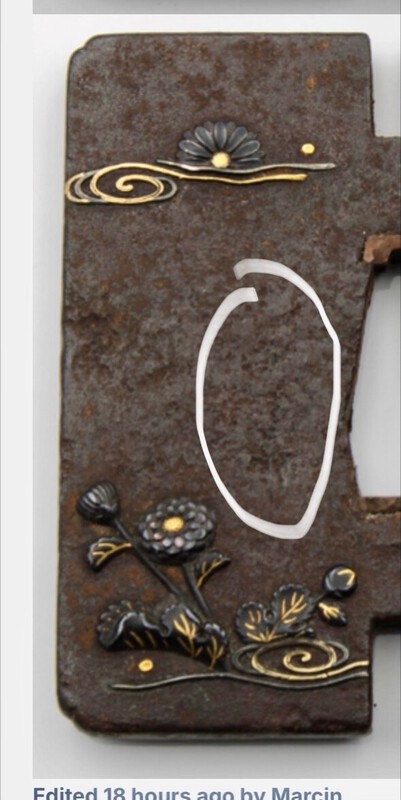
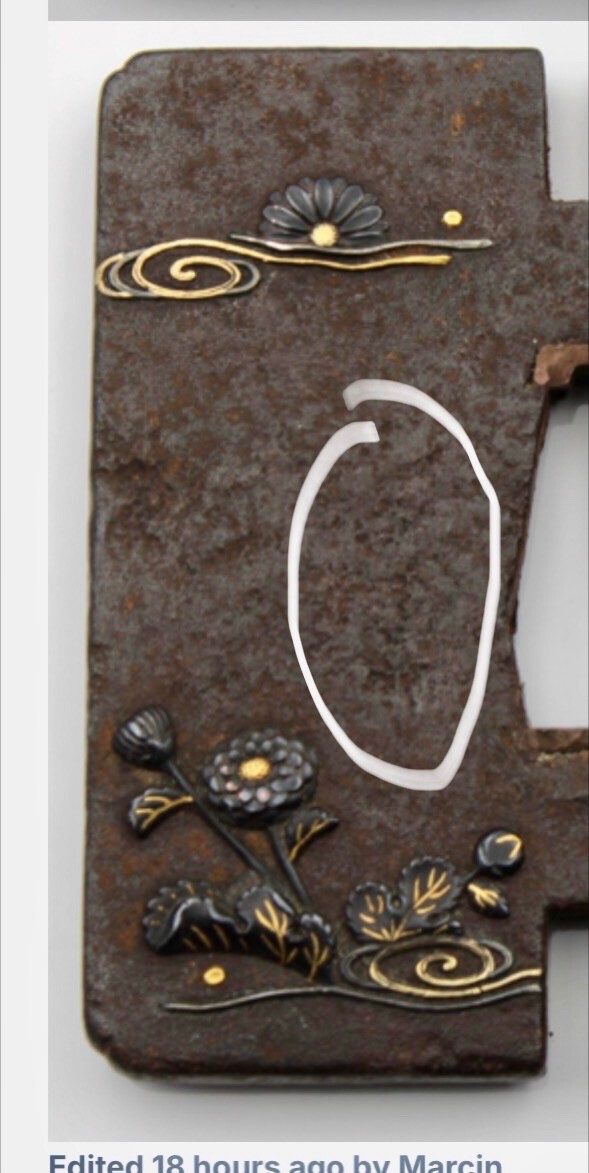
Thank You! Yes it have Minatogawa vibes. If You have any thread about securing base material link me. These petals are made with precision. I don’t want to rub them off, maybe isoprophyl alcohol and cotton ear buds? Spot at ura side looks like leftovers of mei? If so then tsuba was eaten a lot. Marcin
 2 points
 -
HI Carolyn,where in Australia to you live? you can get someone to have a look and give you a better opinion its hard from photos.2 points
-
As far as I remember the wording of the original rescript was commenting explicitly that many attend to Tenno (this is late Muromachi, so both Ashikaga and Tenno courts are very modest) with horn kashira which is not even lacquered and therefore demanding that all kashira at court are to bear black lacquer. After sometime having a black lacquered kashira became a symbol of someone who attends at court and the default attire at court, and persisted in such a role long after the original reasoning was forgotten.2 points
-
Just a small caveat to Jean's 'no collecting value'. It may have little or no monetary value, but as a reference for examples of cast tsuba, if that is what it is, I would count it as a personally valuable object for the goodies drawer. Something to learn from everything that bubbles up!2 points
-
Travis, it will be sad for you to hear, but this looks like a cast TSUBA with no collecting value. Do not be disappointed, there are many much better ones waiting for you out there! Looking at good TSUBA here on NMB, in books, and exhibitions will train your eyes soon so you can tell bad from good. Cleaning off rust with antler: Using powdered antler is obviously a misunderstanding. What you need are pointed pieces like those on the photo I am attaching. You can also use bone, ivory, or even bamboo. Removing red rust is good, but it will not restore a blade. You will need the help of a traditionally trained sword polisher for that. Do not attempt anything yourself! If you find a way to show your sword to a NMB member near you or to some dealers on a sword show, you will probably get more information on it.
 2 points
 -
Hi. I recently secured this little treasure, a Toran Kei Tsuba from the Kofun period. I absolutely love it, the antiquity, rarity, beauty and charm. It measures about 7cm x 5.2. The wording placed over the tsuba is my instagram account. Mark

 1 point
 -
Dear fellow sword enthusiasts, We would like to let you know that the Dutch Token Society will be present at the Japan Art Fair in Utrecht this weekend. If you are visiting the fair, please feel free to stop by our stand, have a chat, and share our passion for Japanese swords. We look forward to meeting you there! Kind regards, On behalf of the Dutch Token Society, Leen van Ochten Chairman1 point
-
My error. Yaki-ba or yaki-ire would have been a better choice.1 point
-
Wow. Tough one... Masayoshi? But it's relatively hard to see. Maybe anyone with better eyes.1 point
-
Looking forward to it Alex!1 point
-
They're uncommon, but as you assumed not unheard of. They're referred to as chûya-tsuba (昼夜鐔, lit. “day and night tsuba”).1 point
-
Very nice piece, I used to have a papered set of F/K (now moved on to a new owner) in the same theme and materials. Bats in Japanese culture are symbols of happiness, luck, and prosperity. In Japanese, bat is 蝙蝠 (kōmori) and the second character 蝠 can also be pronounced ‘fu’ or ‘fuku’ which means happiness. It is the same character found in the name of the lucky god Fukurokuju (福禄寿). https://curiousordinary.substack.com/p/bats-in-Japanese-folklore1 point
-
When considering softmetal tsuba, then there is no direct corollary to yakite. It would apply to certain makers of iron tsuba, Yamakichibei for example. I was really thinking more about a disciplined kantei approach by looking at general factors first before judging the mei. Beginning collectors often look at the mei first and then try to rationalize what is seen in the object to fit the famous name, hoping for a horidashi. I know I did that more than once.1 point
-
I saw a nearly identical Tanto horimono on facebook recently. Described as depicting: 三十六歌仙 "Thirty-Six Immortals of Poetry" https://en.wikipedia.org/wiki/Thirty-Six_Immortals_of_Poetry1 point
-
Thanks Piers: Those diagonal lines are really deep so difficult to align, I imagine. But I wouldn't expect a smith to carve his mei in them without leaving a blank spot. You can barely see it without the right angle. John C.1 point
-
Possibly 正一 Masakazu w/kao(?) (But they are very small and do not seem well aligned)1 point
-
I would be inclined to consider the dates around Tensho. Nakago is in good condition, but we don't see too many higaki yasurime in shinto even for mino, the signature is a bit koto with nijimei closer to the mune and a bit more cursive-shallow and its nijimei... Tensho matches sugata - very beefy powerful, no taper, uniform curvature.1 point
-
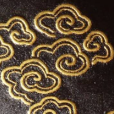
Nunome Zogan: From this reference Nunome-zogan is NOT originally a Japanese technique - however they certainly mastered it Nunome Zogan means cloth weave overlay and uses very thin foils - 0.02mm thick and the gold is attached to the base metal by creating a cross-hatched ground made with chisels. Around 7 - 9 chisel marks per mm created in three different directions at 45 degrees to each other. The technique is a type of Damascening that was introduced to Japan by the Portuguese in the 16th Century. The technique was originally used on Iron and Steel to decorate weapons although more recent practitioners have expanded this to include copper, brass and sterling silver. https://www.sandrawilson.co.uk/blog/nunome-zogan https://www.scribd.com/document/439904095/Numone-Zogan
 1 point
 -
Will Sitting on a wall can be painful……jumping off it can be worse! Lots of folk on here would be happy to advise if you need advice. Mounting a sword brings many tricky issues to consider and many potential pitfalls. Hope it goes well for you.1 point
-
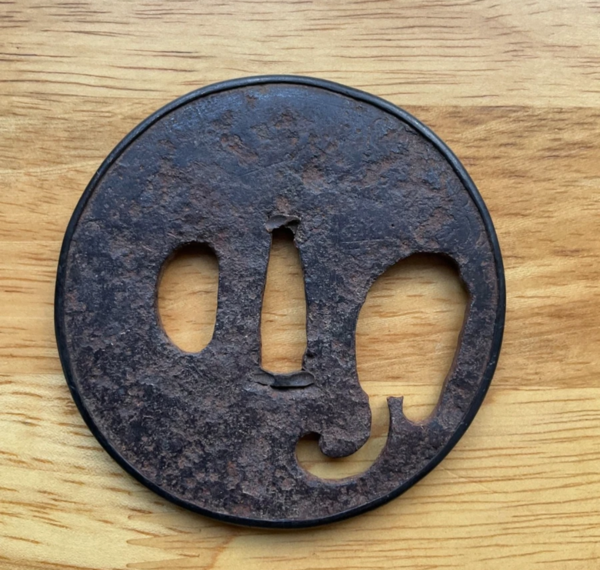
Hi matsunoki. Mounting on a late muromachi wakizashi. I have 2 which need fittings, no.1 seems more utilitarian, has several kirikomi so going a bit simpler, no.2 a short wakizashi, lovely Sue bizen hamon, but fitted in a bone shira saya.... Have attached a pic of the tsuba I have bought for the no.1 I think the second simpler fuchi and kashira would suit better....but sitting on the wall about it
 1 point
 -
You need to provide the model with enough context to know what it is translating. Your free online AI translations go in with minimal, if not zero context when given a task to do. If you give an AI tool proper context about nihonto terminology, the results can be quite excellent if not near perfect.1 point
-
Line two says that it depicts/suggests an absent Ebisu (rusu-moyo) by means of a fishing line and a sea bream, and on the reverse waves crashing on the rocks.1 point
-
Have an almost identical Lantaka sitting in my living room :-)1 point
-
Puzzled by the word 'Ebitsu' above. Daikoku and Ebisu are two gods, their presence indicated by the articles normally associated with them. Ebisu is often shown with a sea bream, for example, so a depiction of a freshly caught sea bream will suggest him. A sack likewise as in your link, will be ‘rusu moyo’ for Daikoku (actually for Hotei).1 point
-
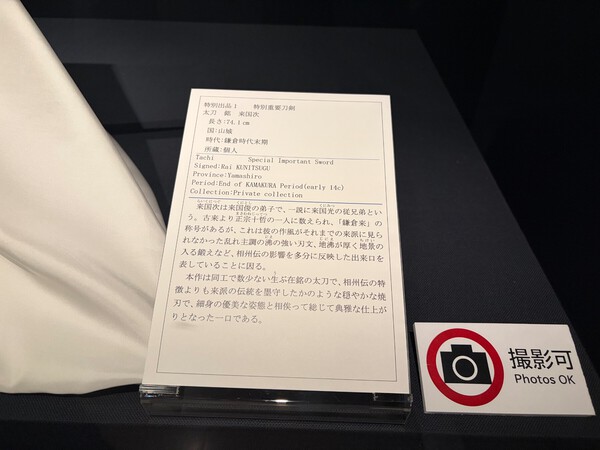
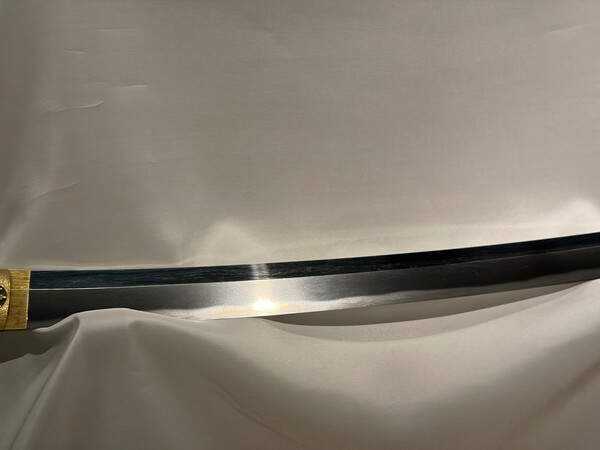
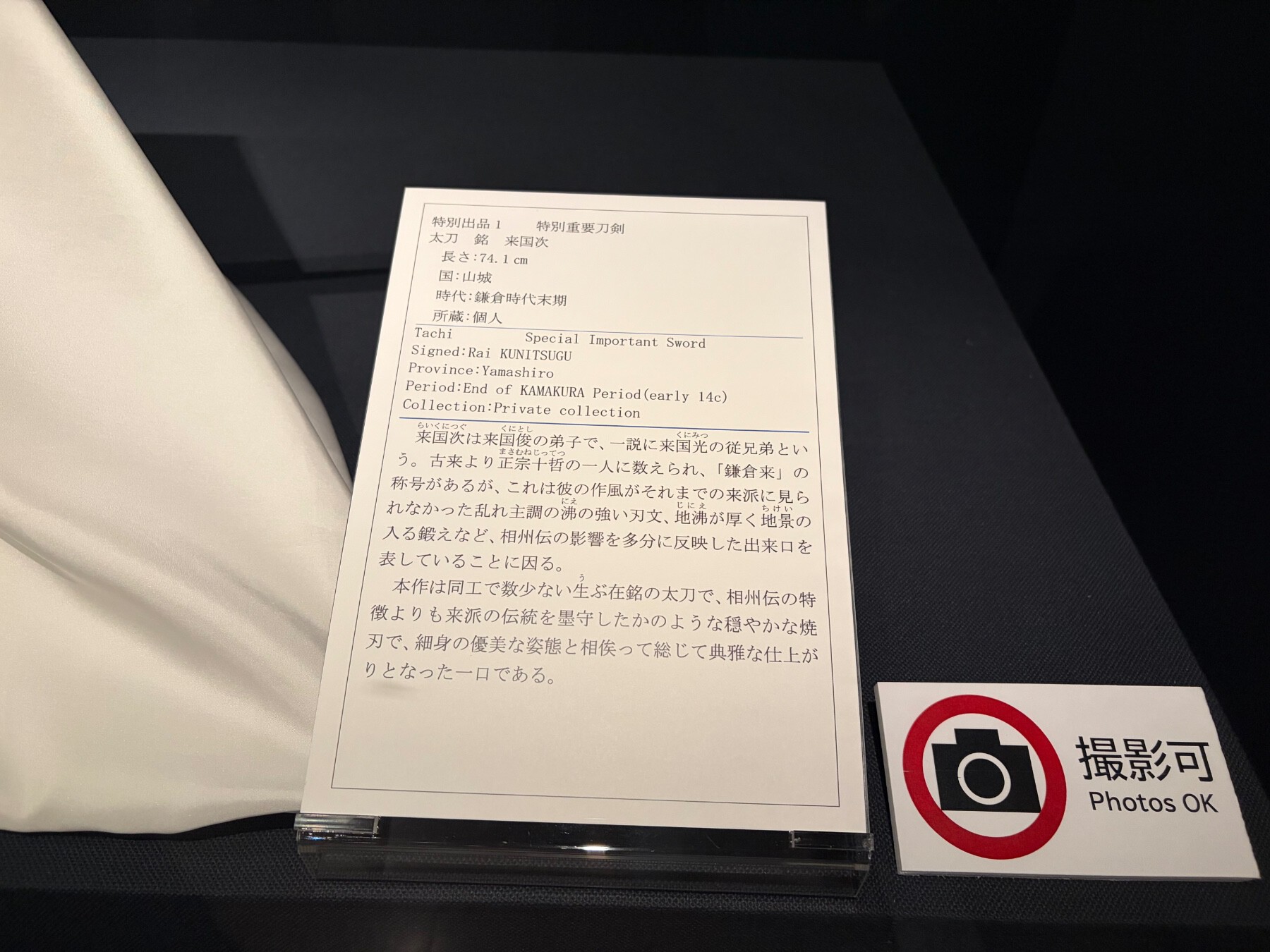
Had to pleasure to attend the opening of the new Tokubetsu Juyo exhibition at the Japanese sword museum this morning. Wonderful turnout with many young faces with great interest in our hobby. The NBTHK student workshop also came into the museum room. It was a group of about 10 young girls, I think around 16-18 years old. They were lectured shortly on some swords, whereafter they were tasked to appreciate the swords and identify key characteristics of traditions. I am to be honest a little relieved to see so much interest from the younger generation. This ensures our wonderful hobby can continue into the future. Only a few swords were allowed to be photographed unfortunately. Which I did of course! But of the exhibits the Norishige Tanto really stood out to me, although this could just be personal preference. I was not allowed to photograph it unfortunately.

 1 point
 -
Hi everyone, I am in the process of launching a mobile app version of my kanji flashcards. The digital app includes expanded content. In additional to being digital versions of my existing flashcards with names, places and time periods, the mobile app also includes flashcard sets for terminology, schools and examples of famous swordsmith mei. Please see below for a link to the Android version of the app. For those who are on iPhones and need an iOS version, that is still in development and a link will be shared here in the future. https://play.google.com/store/apps/details?id=com.swordsofjapan.flashcards If anyone needs assistance with access to the Android link, please let me know. As I am in the process of transitioning from the test to production release, it may be necessary to add your Gmail address to my access list. Please email me at raymondsinger@gmail.com with any questions. Best regards, Ray1 point
-
There are three netsuke by Natasha Popova on page 70.1 point
-
Excellent example of an NCO tassel that has had the end 'cap' undone, or never crimped at all. Found by Marcin, @Rawa:1 point
-
長船 Osafuné 郷 normally read as Gō Heavy? One kilogram or more? Be careful though as there are many Sukenaga fakes, making for a wide disparity in values. The real Sukenaga worked around 1830-1850 ish1 point
-
Strange, I'm only seeing this post now...... Anyway, Hi! This says 備陽長船郷 友成五十九代孫横山藤原祐永 Biyou Osafune Kyou(or Sato) Tomonari Gojyu-Kyu Dai Mago Yokohama Fujiwara Sukenaga, meaning explained by Mr. Singer!
 1 point
 -
By Yokoyama Fujiwara Sukenaga, 59th generation descendant of Tomonari, living in Osafune Village, Bizen province (Biyo Osafune)1 point
-
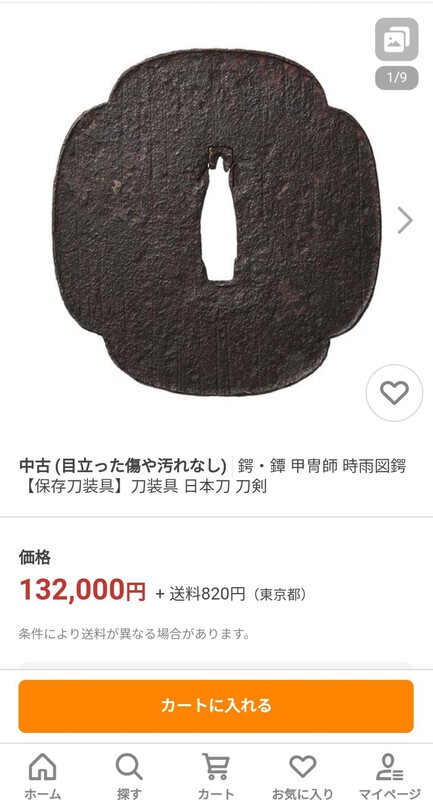
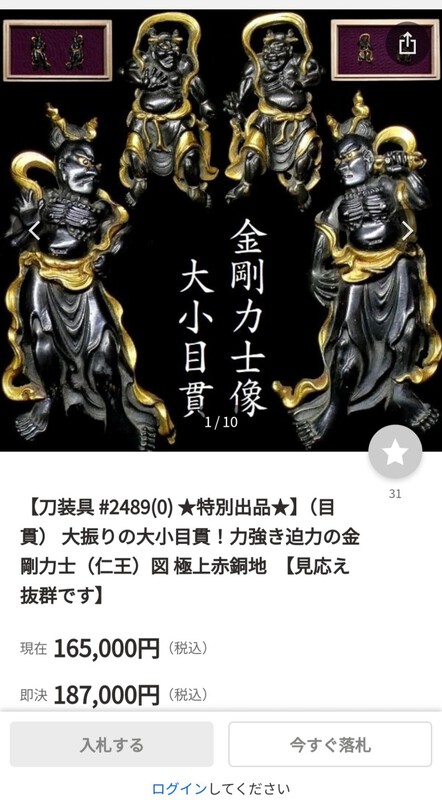
None of these ebay sellers "own/possess" these items. They are for sale on yahoo Japan(for much cheaper)After a westerner pays double the price for them on ebay they purchase the item and have it sent to the buyer.
 1 point
 -
Hi all, In line with improving features and services on the NMB, I am starting to make more use of modules and features we aren't using much yet. And at the same time, I want to have a place to share the works of Ford Hallam and showcase his talents as a tribute. I have set up a photo gallery in the GALLERY section for people to view and share his work. If you head here: https://www.militaria.co.za/nmb/gallery/ and scroll down, you will see an album dedicated to this subject. With the help of @Bob M. we would invite you to view some of his work. Gold members are also able to upload pictures to this section, and add a bit about them. Please take the time to explore a bit, and share with us some of the items you have. Bob has shared some of his treasures. You should be able to share comments on them too. Please also check out some of the other galleries, where we will eventually have a nice library of other topics, for people to browse and share items.1 point
-
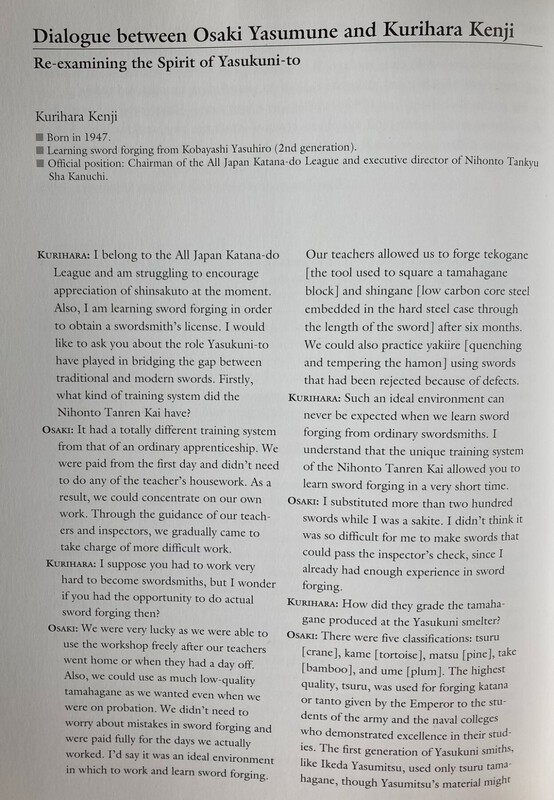
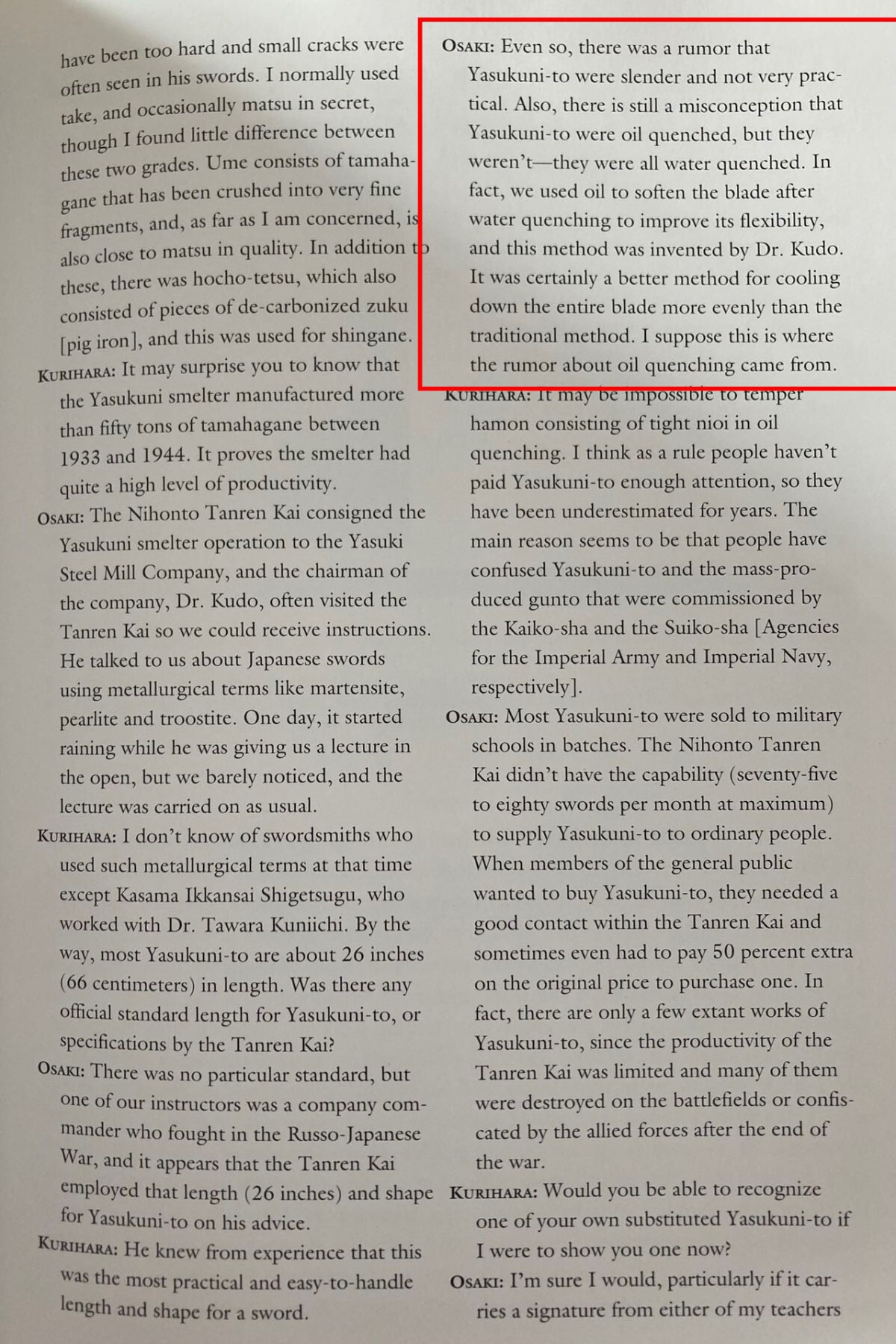
I read this interview with 大崎靖宗 Osaki Yasumune, and the interviewer is 栗原謙二 Kurihara Kenji, a apprentice of the second-generation 小林康広 Kobayashi Yasuhiro. In the article, some interesting story is mentioned, where 靖宗 Yasumune talks about"In fact,we use oil to soften the blade after water quenching to improve it's flexibility.And this method was invented by Dr.Kuto Haruto 工藤治人(The chariman of Yasuki Steel Mill Company 安來鋼製作所 ).It was certainly a better method for cooling down the entire blade more evenly than the traditional method."
 1 point
 -
Yes, in the process. Have a letter from my grandpa to my nana, in which he mentions a bit of his time in Rabaul in September, 45. “70,000 Japs (pows) just down the road”.1 point



















.thumb.png.54593db2789c8a1dcb235543b184ce39.png)





This leaderboard is set to Johannesburg/GMT+02:00