Tim Evans
-
Posts
187 -
Joined
-
Last visited
-
Days Won
1
Content Type
Profiles
Forums
Events
Store
Downloads
Gallery
Everything posted by Tim Evans
-
M.A. Quigley Collection Information
Tim Evans replied to Soshin's topic in General Nihonto Related Discussion
The name of his online business was Shogun Oriental Arts. The URL is no longer working. -
Given the timeframe and the high status of the koshirae, it could also have been worn with western dress in the style of toppei koshirae.
-
Best way to clean and/or degrease habaki and koshirae
Tim Evans replied to Cookie_Monstah's topic in Tosogu
I have not read Jim's essay on tsuba cleaning for a while, and noticed a detail worth mentioning. IF you do decide to boil a tsuba, it is important to cool the water down to at or below room temperature before exposing the tsuba to air. A hot wet iron tsuba will red rust immediately on air contact. -
I don’t have the direct experience you specified, but I will put a few thoughts forward. You are asking about kantei procedure for mumei tsuba. There are some differences if the tsuba is kinko or tsubako. Kinko is primarily soft metal and the focus of the art is on the carving. Most of the mumei kinko tsuba that would merit shinsa are from the Edo period where there is more documented about the artists and the schools, because a lot of them are signed, so unsigned work by the same artist or school can be compared. The carving technique details of the famous masters is known by certain experts, so it is possible to confidently attribute a name or workshop to a high quality but unsigned kinko fitting by looking at the unique style, the tool marks, how the tool was moved, etc. This is known as the teguse, or the “hand” of the artist. An example are the specialists who study Goto fittings. You sometimes see kanteisho stating, unsigned, but by Goto so-and-so. A shinsa team may or may not have such a specialist, but I assume in a Japan based shinsa, such a specialist could be called in to evaluate a high quality mumei candidate. This approach can also be applied to a some tsuba artists that worked in iron, such as the well known Higo groups that have distinctive sukashi and softmetal decoration. However, the majority of unsigned, average and low quality tsuba do not have characteristics that can be identified to a specific person, and so in shinsa they are assigned to broadly defined schools or categories. Particularly in the case of unsigned iron tsubako, most of these categories are of relatively recent invention, made up by tsuba scholars in the 19th-early 20th centuries in order to classify similar tsuba into groups. Because of the broadness, there can be multiple opinions about where a tsuba fits. For example, is it Koshoami or Kanayama? Is it Onin or Heianjo Zogan? This can lead to a tsuba having multiple papers with different opinions. This existing unsigned tsuba classification methodology is mostly based on comparative analysis, logical inference, and oral tradition since there are few documented facts supporting the majority of these broad tsuba classifications. We know that the NBTHK utilizes a “kantei points” checklist approach when evaluating sword blades, so there may be a similar approach with tsuba. From a science perspective, there has been a few attempts to analyze the material of sword fittings, but this is expensive and non-destructive methods are limited. A question here, is an NBTHK Hozon paper really worth much on an average quality mumei tsuba? I think in most cases no, because most collectors can classify their mumei tsubako and kinko into these broad categories themselves with some reference books and study. It may be worth submitting if you think the tsuba may make Tokubetsu Hozon, which is useful as an assessment of quality.
- 21 replies
-
- 14
-

-
Hi Tom, There are a few mentions. Okamoto in Owari to Mikawa no Tanko calls signed Yagyu tsuba, Yagyu utsushi, I think meaning that that some Owari smiths made Yagyu-like tsuba for themselves and not as commissioned pieces for the Yagyu family. Sakura Yamakichibe is mentioned in the Yagyu Utsushi section on page 51 of the Sesko translation of Owari to Mikawa no Tanko. This Yamakichibe (as well as a group of other Owari smiths) is mentioned as signing Yagyu-like tsuba in the following references: Tsuba, an Aesthetic Study by Dr. Torigoye and Robert Haynes, page 95 -softcover issue Sukashi Tsuba, (gold book) by Sasano, page 18 Japanese Sword Guard Masterpieces (silver book) by Sasano, the Yagyu introduction after #172 Also, Bob Haynes made a copy of a Yagyu design or inventory book while studying with Dr. Torigoye. Entry #153 states "Yamakichibe saku, no signature", implying, I think, commissioned by the Yagyu, so not a Yagyu utsushi. I have not seen the Yamakichibe enso tsuba in person, or know its dimensions or metal, so I am speculating that it may be Yagyu utsushi. It does have a pattern resemblance to a few in the Yagyu design book, and does not look like a typical Yamakichibe. I am not sure how the NBTHK would handle a Yagyu utsushi. Would they say iron tsuba, signed (so-and-so), design of (whatever) and ignore the Yagyu connection?
-
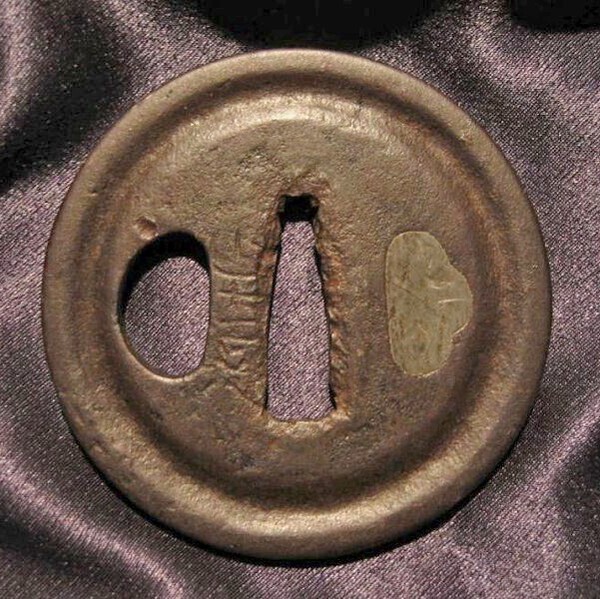
Here is another signed Yamakichibe, who according to the books made tsuba for the Yagyu. I don't own this one.
-
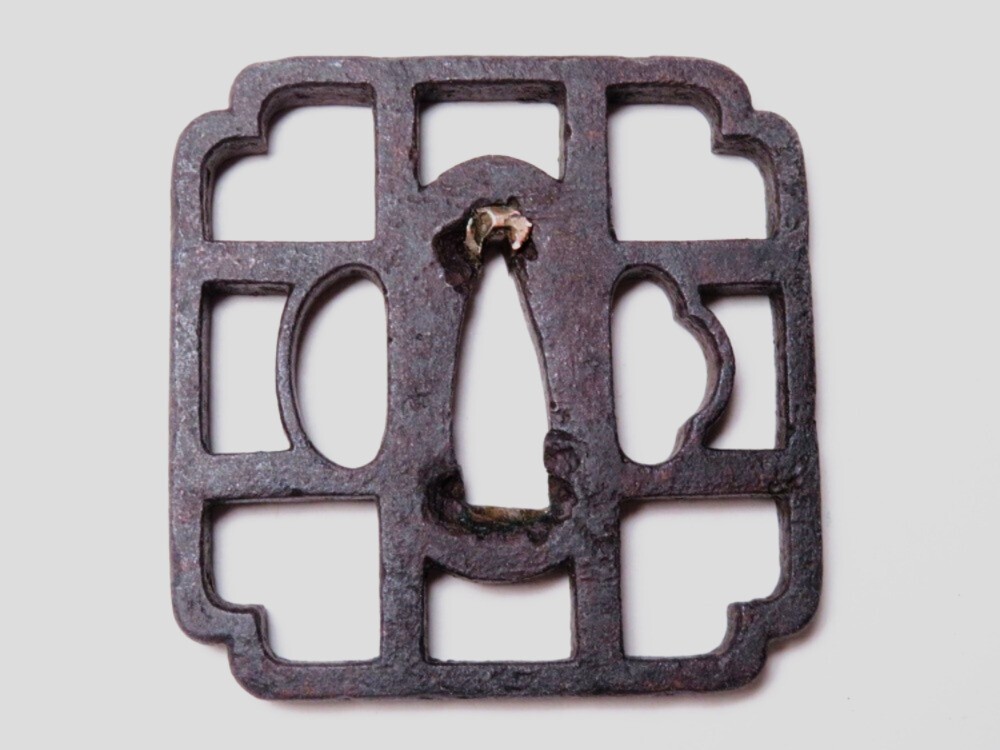
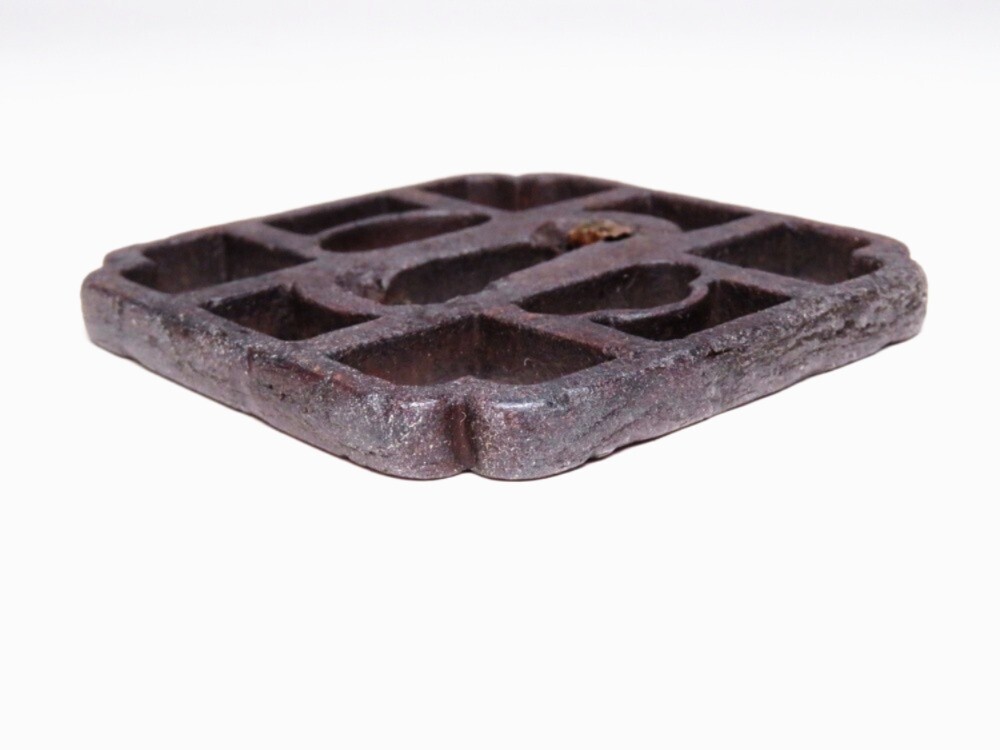
One I have that seems to have Yagyuish charictaristics. 64 X 64 X 6mm. Masame to be seen in the mimi, coarse iron, blackish gray. Not in the design books, but has what is defined in the Yagyu section of Owari Mikawa no Tanko as sumiiri-kaku-gata, or, a square shape with notches at the corners. I bought this for a Yagyu wakizashi koshirae I have, but it is a little too thick. Something about 5.5mm would be about right.
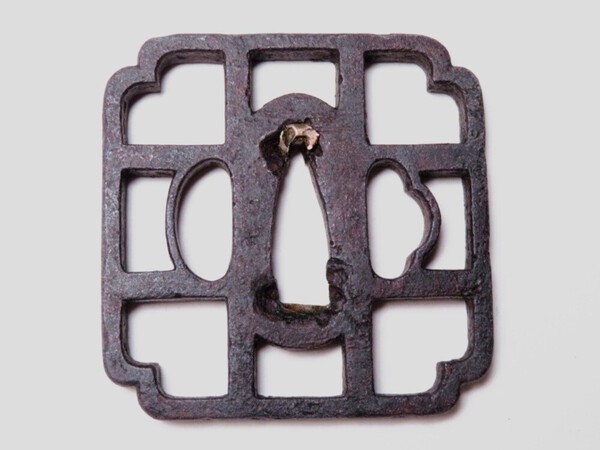
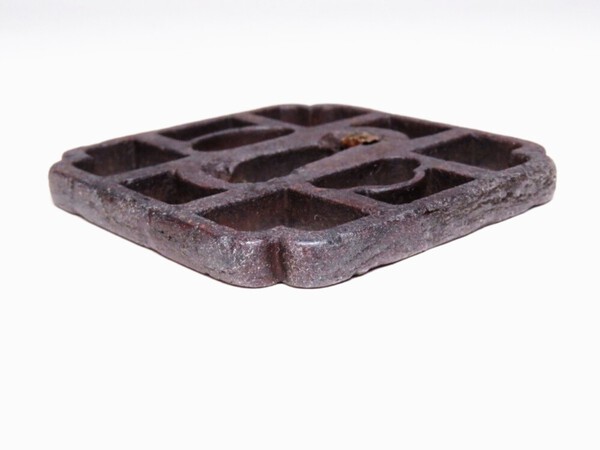
-
Perhaps it is designated as ko so it does not to contradict the hakogaki ?
-
Here is an image from Nihonto Koza Volume VII showing how the cord was rigged. Western sport fencers were allowed by the rules to use a similar loop, called a martingale, mostly on french grip foil and epee to improve the hold and to maintain control of the weapon in the event of a disarm. The advent of the so called pistol grip made the martingale obsolete. Per traditional knowledge, the two holes to the right side on a Jigen Ryu Satsuma tsuba were used to tie down the tsuba to the kurkata. This has been mentioned before in this thread. That was a completely different purpose for the holes that is unique to Satsuma samurai culture.

-
I don't think that Miyamoto was attempting to depict a namako. This is probably a fanciful description by some collector at a later time. As is shown in some of the images above, this bilobe design was popular from before Miyamoto or the Higo tsubako. More general discussion of bilobe tsuba here. Also, i seem to recall a discussion about the similarity of the katzbalger european sword guard to the namakogata tsuba somewhere on NMB, implying a European influence. I own that one. There are very similar Hirata tsuba in softmetal. I think the design is matsu, or pine boughs, and the Hirata possibly made these for the Matsui clan.
-
How a samurai used the sageo was learned in the swordsmanship system he was taught. I would suggest looking into how various legitimate iaido and iajutsu ryu use the sageo. Many of these martial arts schools claim lineage back to the Edo period or before, so their handling of the sageo may have historic basis. Most likely there are youtube videos of iaido and iajutsu demonstrations to look at. Also there are instruction books for these martial arts which provide details. One reference to gert you started. https://www.amazon.com/Japanese-Swordsmanship-Technique-Donn-Draeger/dp/0834802368
-
My error. Yaki-ba or yaki-ire would have been a better choice.
-
When considering softmetal tsuba, then there is no direct corollary to yakite. It would apply to certain makers of iron tsuba, Yamakichibei for example. I was really thinking more about a disciplined kantei approach by looking at general factors first before judging the mei. Beginning collectors often look at the mei first and then try to rationalize what is seen in the object to fit the famous name, hoping for a horidashi. I know I did that more than once.
-
Curran's approach is the same as what I was taught about sword kantei - look at the sugata, jigane and yakite - What does that tell you about time period, smith tradition and maybe swordsmith?. THEN look at the mei and see if it fits. Many of the Japanese books about swords and kodogu are limited publication or privately published, so very little of that knowledge has been scanned into online digital records. So yes, reference books are still required. For signatures, here are a few standards. Probably the most recent and exhaustive in English, but no images of actual mei. I believe it came with searchable files in .pdf format. https://japaneseswordbooksandtsuba.com/store/book/fittings-books/b760-the-index-of-Japanese-sword-fittings-and-associated-artists-by-robert-haynes/ Anything by Wakayama is highly regarded. https://japaneseswordbooksandtsuba.com/?s=wakayama My go-to books with images of validated mei. https://japaneseswordbooksandtsuba.com/store/book/fittings-books/b672-toso-kodogu-meiji-taikei-by-wakayama-with-english-index/ Another by different authors. https://japaneseswordbooksandtsuba.com/store/book/fittings-books/b755-kinko-meikan-by-senichiro-masumoto-kenichi-kokubo-with-translation/
-
Returning to the subject.... Does anyone have any insights (and please be clear if you have a source or just a really good idea!) on why the horn was required over metal fittings by that law? There is purpose, fashion, taste, regulation, location and time period to consider. Purpose - koshirae were configured for different situations. Broadly speaking, the Japanese categorize these as Formal (court wear), Semi-formal (some appearance requirements based on status and class) and Informal (personal weapon and no status factor) Fashion and taste - This varied quite a bit over time, location (Kyoto vs. some place else), class (samurai - warrior taste vs. chonin - commoner taste, etc.), education and purchasing power. Regulation - Some Daimyo domains (Han) had uniform requirements for their Samurai. Very specific koshirae and sword size requirements were instituted during the Tokugawa regime. The key phrase to look these up is "Tokugawa Jikki". I believe the Yamanaka Newsletters has some information about that. The newsletters are located in the link below if you want to dig. As to the horn kashira being required for Tokugawa period formal wear, it may just be that the Shoguns expected understated decorum from their vassals. Time period - The sword evolved from being primarily a weapon or tool, to being primarily a status and authority symbol.
-
Koshirae advice for my Wakizashi in shirasaya.
Tim Evans replied to GreyVR's topic in General Nihonto Related Discussion
There are some US based craftsmen that could be approached for a complete, traditional koshirae project. Brian Tschernega comes to mind. Perhaps some of the other members have recommendations? -
You might like to invest in a book titled Uchigatana Koshirae which is a Tokyo National Museum exhibition catalog. illustrated are relatively undisturbed, documented koshirae that are preserved in shrines, temples, museums, and private collections, many were the property of famous Buke. Timeframe is Muromachi to early Edo. Here is an ad on Grey Doffin's site, he may be able to find you one. https://japaneseswordbooksandtsuba.com/store/book/fittings-books/b734-uchigatana-koshirae-with-translation-by-tokyo-national-museum-2/ Or, maybe post a want ad on NMB. Roundabout to the point. The majority of these uchigata tsuka had horn kashira and a metal fuchi. As you observed, early metal pommels were frequently of the kabuto-gane form that comes from tachi koshirae. The flat, artisticaly carved kashira are more prevelent from the early-mid Edo period onward. There are some exceptions to matchy-matchy fuchi-gashira, deliberately mis-matched sets are sometimes seen in Edo period Higo koshirae and Owari koshirae as a design choice. That said, your suspicion about kashira falling off because the wrap broke, or discarded because of damage is probably correct.
-
Urushi is best left as it is because it is very hard and inert. It is normally dark brown or black, not clear. Also, on old iron fighting tsuba, urushi may have been the original finish and should not be disturbed. Bob Haynes once told me "they were too busy killng each other to bother with an artistic patina" I suspect many of the the kotosho and kokatchushi tsuba were oil blackened, meaning they were heated up and then brushed with oil and the process repeated until a dark, polymerized oil surface was created, Quick and easy. Sometimes this polymerised layer is mistaken for urushi, but it will come off with solvents. Akiyama goes into the various vegatable oils that were used on iron tsuba as preservative and appearance changers in one of his Token Kai Shi articles, so I think the application of oil was commonly done. What we call patina is a mixture of iron oxides, dirt, oil, and hand grease. Sasano advocated that this top layer be removed by scraping with deer antler and then the remaining fine particle magnetite be polished by rubbing with a cloth, resulting in a glossy surface. After he died, the fashion flipped and high level iron tsuba collectors valued "undisturbed looking" patina rather than cleaned up and polished. One of the downsides of cleaned up and polished is that these tsuba can easily attract rust, so they need to be periodically monitored and maintained, and ideally not handled with bare fingers. Rust never sleeps.
-
it could have a wax coating. This is very commonly done to iron tsuba as a rust preventative, especially in high humidity environments. Does water bead up on the surface? Wax is easily removed by soaking in a pan of alcohol for 15 minutes or so then wiping off, repeat as neccessary. Also easily reapplied if it looks better with the wax on.
-
I have seen retrofit old tsuka where the mekugiana was moved. you can tell if you see a same' patch where the original hole was. If the Cheness tsuka is too tight, then various files could be used to remove material. This is a 3D problem that takes some thought about which way you want the tsuka to move. Do you take wood off the ha side or the mune side? It is also important to make sure that fuchi tenjogane is parallel to the tsuba seppadai, so may need to remove or add wood in stategic spots to "rotate" the tsuka into proper alignment. Also need to check the interior length against the nakago length with the habaki, tsuba and seppa in place. If used for martial arts, then the tsuka needs to seat tightly. If too much wood is removed then this can be replaced with thin shims, basswood sheet from the hobby shop works. I have an old wakizashi koshirae where the tsuka is a period refit. I can tell because the inside was crudely recut. Also, the style of the tsuka does not ideally match the Owari/Yagyu saya. The original mekugiana was used, but this resulted in a big gap where the tsuba goes. Their solution was to make an extra long habaki to fit the tsuba and seppa correctly. Apparently that was preferable to making a new tsuka for it.
-
Do people have a way to fit these to swords? It would seem like you would need an Xray machine. You could break it down for the metal fittings, (which I imagine happens, but is that all?) If so, why sell it as a tsuka and not pull out the fittings? Yes, the interior of tsuka can be enlarged with basic woodworking tools, and also shimmed using thin strips of wood and glue. I have examples of both being done back in the day on old koshirae I have. Can you break them open and use the wood and same? Is this desirable? High grade same' is very expensive and is salvaged and reused Do people (More then a tiny number I mean) collect Tsukas? Very old/rare and very high grade tsuka are collected and preserved. But yes, there are very few specialist tsuka collectors. I think mostly these are people with an interest in koshirae and will buy parts of the types of koshirae that interest them. Finding a complete tsuka in good condition is way cheaper and more authentic that have a new one made with old parts.
-
Shopping for wakizashi size fittings?
Tim Evans replied to GreyVR's topic in General Nihonto Related Discussion
As mentioned there are no hard rules for what size tsuba goes on what size sword. There can be small size tsuba on katana, such as usually found on Satsuma koshirae, or quite large tsuba on some showy Edo period wakizashi. Most wakizashi tsuba have kozuka hitsuana only, however, it was common during the Edo period for tsuba to have both hitsuana and plug the kogai hitsu if no kogai pocket on the saya. Does your saya have a pocket for a kozuka? If so, then need to find a tsuba where the hitsuana lines up with the pocket. If no pocket, then find a tsuba with no hitsu, or have the hitsu plugged. If the tsuba has a defined seppadai, then the seppadai size and shape should be close to the saya and the tsuka/fuchi size and shape where it meets the tsuba. Also the seppa need to follow these sizes and shapes. This is a goldilocks problem, too big, too small, just right. Visually, the shape of the saya flows into the shape of the tsuka in a continuous line, much like the way shirasaya are made, but with a tsuba in between. The tsuba nakagoana will likely need to be shimmed if too big or enlarged if too small. a competent craftsman can do that. If you are having an agent in Japan doing this assembly, then it might be useful to provide some pictures of koshirae that you would like yours to look like. That would help them find the right parts. -
I have also seen gamahada described as blobs of silver on a base metal. Jacoby has some examples of imohada in his book which look like textured iron. I agree it is odd that the nunome cross hatching was not removed on your tsuba. for something completely different, there is a modern tsuba smith that is able to create a mottled or textured surface on his tsuba. I don't know the process but suspect heat might be involved. http://tsubaryuken.com/
-
This surface is associated with Kamiyoshi Rakuju per the Higo Kinko Roku translation by Jacoby. There are various names such as gamahada (toad skin) or Imohada (skin of the imo tuber). The shape and design is theirs. I don't see Kamiyoshi tagane, but that is not necessarily disqualifying.
-
A big topic. There is not much in the way of definitive documentation on koshirae. There are a few books in Japanese on regional styles such as Satsuma. In contrast, there are many books about regional sword fittings makers that show metal parts and occasionally koshirae. Part of the problem is that relatively few koshirae were preserved or documented as koshirae fashions changed. Since there are a lot of gaps in the material record, it is difficult to describe trends or specific styles from the remaining intact examples. Over the history of the blade, the saya and tsuka were periodically discarded due to damage and wear, and the blade refitted with a new koshirae according to the taste of the then present owner. There is an article I wrote titled A BRIEF OVERVIEW OF Japanese SWORD MOUNTS OF THE LATE MUROMACHI THROUGH EDO PERIODS in the Downloads section under Member Articles. This gets into questions about koshirae differences by time period, class status, and level of formality. There is a bibliography with references for further reading. In other types of sword collecting, European and American swords for example, preservation of the mounts is considered as important as preservation of the blade, so more historical context is known, and can be correlated to time and place and class of user. A nihonto in new shirasaya on the other hand, tells us nothing about who used it or how it was mounted, unless that was separately documented. Part of the problem is the formation of specialist collectors for nihonto, tsuba and other fittings which has led to koshirae being taken apart to get at the metal bits. The downside is a loss of context and in some cases the destruction of a historic object. As a group dedicated to the preservation of the Japanese sword I think we nihonto collectors should consider choosing the western conservation approach in some cases, by keeping and stabilizing that old koshirae and sword blade together as a complete object.